Chapter Six The Golden Lion: Ten Gates in One Lesson
The Golden Lion compresses the entire school's apparatus onto a single page. Teaching Empress Wu, Fazang pointed to a golden lion before the palace as an analogy. The resulting text has fewer than two thousand Chinese characters yet contains all ten gates: explaining dependent origination, distinguishing form and emptiness, applying the three natures, disclosing the absence of characteristics, explaining nonarising, discussing the five teachings, outlining the ten mysteries, summarizing the six aspects, accomplishing bodhi, and entering nirvāṇa. The standard edition is Jingyuan's Classified Explanation from Yunjian, with a preface dated to the third year of the Northern Song Yuanfeng era. Jingyuan says four commentators preceded him. “I delete what is cumbersome in the wording and supply what is missing in the meaning,” combining the two Jin and Tang sūtras, the two works on the mysteries, and the two commentaries into his classified explanation.1 Root text and explanation alternate. Whenever this chapter quotes the Classified Explanation, it explicitly identifies it.
The first gate sets the terms. The root text gives three phrases: “Gold has no own-nature”; “following the condition of the skilled craftsman”; “the lion's characteristic thus arises.” Under “gold,” the Classified Explanation comments: “Gold illustrates thusness not holding to own-nature.”1 This statement deserves to stand alone. The four characters 不守自性, “not holding to own-nature,” are a clause against own-nature written by Jingyuan in explaining Fazang's "gold has no own-nature." They belong to a Song commentary's interpretation of the legislative text. In function, the clause belongs to the same family as momentary cessation and dependence on many conditions among the six seed characteristics, the warning label in the ādāna verse, and Tiantai's twofold exclusion of vertical and horizontal arrangements. If thusness held to own-nature, that would be a D2 pledge, with the entire set of theorems waiting for it. The Classified Explanation declares in advance that it does not, disarming the substrate reading at the entrance. The root text then concludes the meaning of dependent origination: “Arising is only conditions; hence it is called dependent origination.”1 Arising is only conditions, with no further ariser left outside them. These eight characters, 起但是緣故名緣起, can serve as the school's seal on dependent origination. Under the arising of the lion's characteristic, the Classified Explanation adds another note: “It illustrates the conjunction of true and deluded, constituting ālaya consciousness. This consciousness has two meanings: first, awakening … second, nonawakening.”1 The conjunction sentence from the Awakening of Faith is annotated into the lion's body. Chapter Five's foundation becomes visible here.
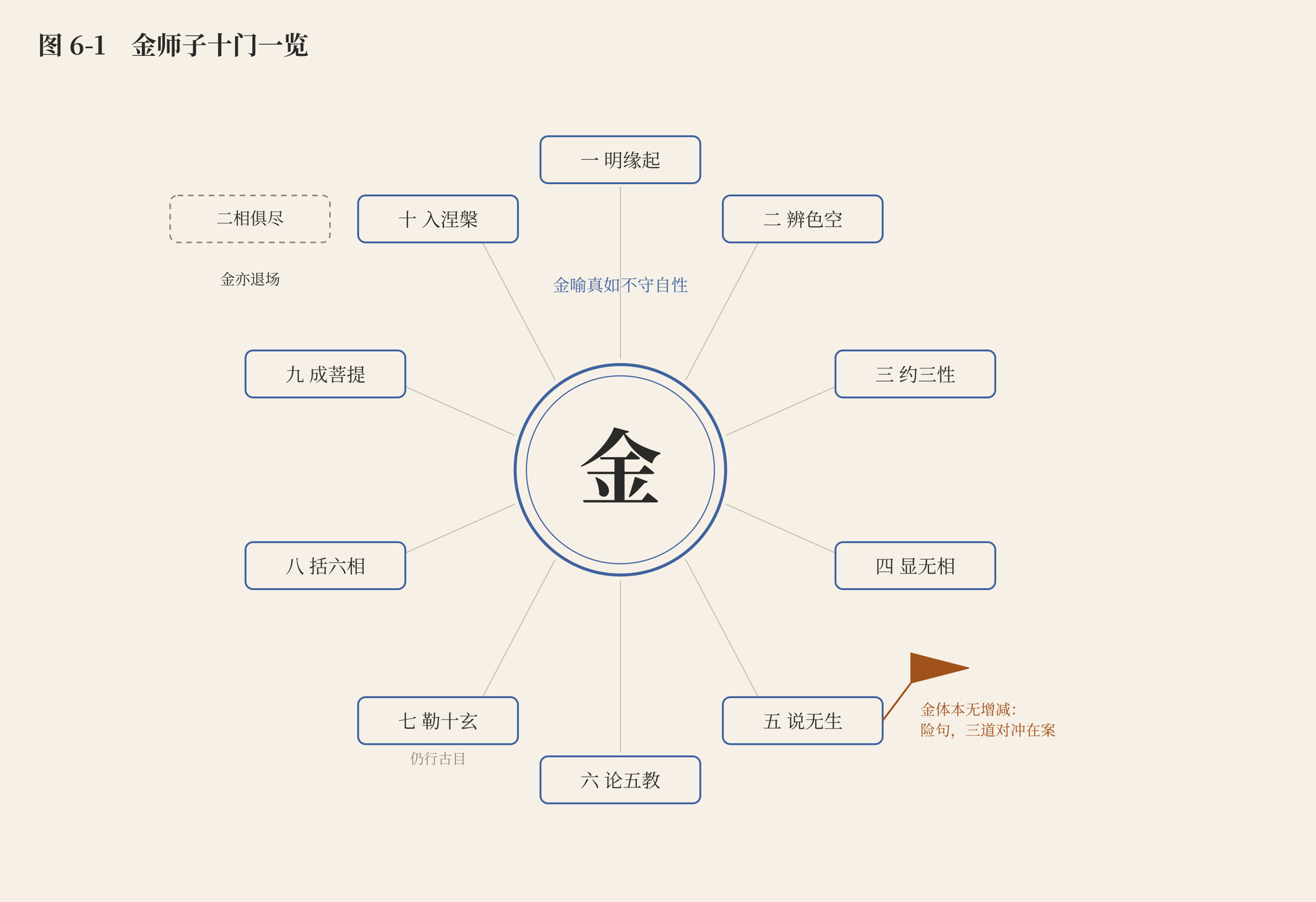
The first five gates: from dependent origination to nonarising. Distinguishing form and emptiness, the root text makes two exclusions: “The lion does not exist; the gold substance is not nonexistent.” The Classified Explanation comments: “Form-characteristics follow conditions and are not existent: this excludes the ordinary person's real form. Empty nature does not change and is not nonexistent: this excludes the non-Buddhist's annihilative emptiness.”1 One statement excludes real form, the other annihilative emptiness: exactly the paired emergence of Essay Eighteen's rejection and preservation sides. The nonobstruction of the two truths is gathered into the two words form and emptiness.
Applying the three natures: “The lion exists in mistaken conception, hence is called imagined”; “the lion seems to exist, hence is called dependent”; “gold's nature does not change, hence is called perfected.”1 The three slots from Essay Twenty appear in new analogical dress. The Classified Explanation offers a self-aware comment worth quoting in full: “According to the teaching and meaning, the Treatise explains that each of the three natures has two meanings … The present text discloses only the first of each and leaves the second implicit in all cases.”1 Each nature has two meanings in the Five Teachings: the imagined exists in mistaken conception and is nonexistent in principle; the dependent seems to exist and lacks nature; the perfected does not change and follows conditions. Chapter Five quotes the full passage. The Golden Lion gives only half of each: existence in mistaken conception, seeming existence, and unchanging. Nonexistence in principle, naturelessness, and following conditions are all held back. The commentator himself marks the compression ratio. This short page reveals the whole apparatus, yet reveals only half of it; the other half waits in the Five Teachings. 單複抗行, “the single and the double run side by side”: these are Jingyuan's four characters.
Disclosing the absence of characteristics: “Gold contains the lion completely; outside gold, no further lion-characteristic can be obtained.”1 The Classified Explanation cites evidence: “This is also as Zhongnan says: apart from true principle, not a single phenomenon can be obtained.”1 Zhongnan is Dushun. The quotation is precisely the wording of the gate in which principle displaces phenomena in Chapter Two's contemplation of nonobstruction between principle and phenomena. The compressed text and the contemplation now connect: disclosing the absence of characteristics is the lion version of principle displacing phenomena.
Explaining nonarising is the weightiest of the first five gates. The root text says: “Just when one sees the lion arise, it is only gold arising. Outside gold there is no further thing. Although the lion arises and ceases, the gold substance originally neither increases nor decreases; hence nonarising.”1 The Classified Explanation cites the great sūtra: “The nature of the aggregates cannot cease; therefore nonarising is taught”; “because it is empty, it cannot cease: this is the meaning of nonarising.”1 The latter appeared in Chapter Two, in the same Yāma verse cited by the Mystic Mirror to explain the gate of phenomena constituted in dependence on principle. The aggregates' empty nature is the meaning of nonarising. The compressed text and the contemplation connect a second time.
The six characters 金體本無增減, “the gold substance originally neither increases nor decreases,” need separate examination. This is the statement closest to substrate language in the whole text. Something is always there; arising and ceasing pass over it while it neither increases nor decreases. Conservation language gives the material-cause reading its best foothold in the text. Examine three counterweights. The first lies within this gate: the Classified Explanation reformulates both increase and decrease as dharmas arising and ceasing. “The constitution of phenomena seems to be arising, yet gold's nature does not increase; thus arising is solely dharmas arising. Emptiness of substance seems to be cessation, yet gold's nature does not decrease; thus cessation is solely dharmas ceasing.”1 Arising is solely dharmas arising, with no separate ariser at the point of arising: a restatement of the first gate's seal. The second counterweight lies in the first gate. “Gold has no own-nature” and “does not hold to own-nature” are entered in advance. From the outset, the gold that originally neither increases nor decreases has no own-nature to hold to. The third lies in the final gate, as we shall see below: entering nirvāṇa exhausts both characteristics, gold and lion, and what was conserved itself leaves the scene. With all three counterweights in place, the statement is judged hazardous, not a pledge. Its wording steps half a pace over the boundary, and the clauses pull it back. “Each remains in its own-nature” in Essay Fifteen is a pledge; “each nature remains” in the Zhao Treatises is hazardous. “Originally neither increases nor decreases” joins the hazardous category on the evidence of three counterweights on the same page.
Discussing the five teachings: five readings of one lion. The sixth gate reenacts doctrinal classification within the analogy, making the five teachings distinct in the same lion:
| Teaching | Reading of the lion | Root text |
|---|---|---|
| Śrāvaka teaching ignorant of dharmas | Dependently arisen dharmas arise and cease thought by thought; no lion-characteristic can be obtained | “Although the lion is a dharma of causes and conditions, it arises and ceases thought by thought; no lion-characteristic can really be obtained” |
| Initial Mahāyāna teaching | Conditionally arisen dharmas are thoroughly empty | “These very conditionally arisen dharmas each have no own-nature and are thoroughly empty” |
| Final Mahāyāna teaching | Emptiness does not obstruct illusory existence; both characteristics remain | “Although thoroughly empty, they do not obstruct manifest illusory existence. There is provisional existence born of conditions; both characteristics remain” |
| Sudden Mahāyāna teaching | The two characteristics displace each other and both disappear; the path of words ends | “These two characteristics displace each other and both disappear. False conceptions do not remain … The path of words ends; mind settles with nowhere to rest” |
| Perfect One Vehicle teaching | Conceptions end and substance is disclosed; great functions flourish, freely contracting and expanding | “This dharma in which conceptions end and substance is disclosed merges into one whole. Great functions flourish; whatever arises is wholly true … Powers and functions include each other, freely contracting and expanding” |
The five teachings in Chapter One grade scriptures; here they distinguish levels of reading. The same lion receives five registrations at different depths. Within the analogy, classification of teachings becomes classification of readings. This change lays bare doctrinal classification's logical content. The difference among the five teachings is the difference in how far one may speak about the same dependently arisen phenomenon, exactly matching the judgment of grading doctrinal strength in Essay Nineteen, Chapter Six. The perfect-teaching entry has another important phrase: “Powers and functions include each other, freely contracting and expanding.” The Classified Explanation reads it as “one, possessing power, contains many as function … many, possessing power, contain one as body.”1 Power, having power, and lacking power are precisely the mechanism terms of interpenetration in Chapter Three's counting of ten coins, present unchanged in the pocket version.
Outlining the ten mysteries and summarizing the six aspects: two chapters in miniature. The ten mysterious gates are traversed one by one in the lion. Gold and lion established simultaneously form the gate of simultaneous completeness and correspondence. The eye containing the entire lion makes everything purely eye: the gate of virtues in purity and mixture. Under mutual containment of one and many without sameness, the Classified Explanation quotes the same sūtra verse as Chapter Three: “One Buddha land fills the ten directions; the ten directions enter one with nothing left over; yet the world's original characteristics are not destroyed.” Eye being ear and ear being nose form the gate of free interidentity among dharmas. Looking at the lion makes the lion manifest and gold concealed; looking at gold makes gold manifest and the lion concealed: the gate of the simultaneous accomplishment of concealed and manifest. Each hair contains a golden lion, and these enter one hair again: the gate of the realm of Indra's net, “layer upon inexhaustible layer, like the jewels in the heavenly emperor's net.”1
One textual fact about the list must be recorded. The Golden Lion uses the old ten mysteries, retaining both purity and mixture and transformation through mind alone. Under purity and mixture, the Classified Explanation notes: “This name is established following Zhixiang, since Xianshou newly established the gate of free nonobstruction between breadth and narrowness.” Under transformation through mind alone it says: “Xianshou also changed this gate to the gate of host and companions perfectly illuminated and endowed with virtues.”1 The two replacements recorded in Chapter Three's comparison table are marked gate by gate in this compressed text by the Northern Song commentator. The Golden Lion itself still uses the old headings, showing that both lists circulate under Fazang's name. The root text of transformation through mind alone here reads “each has no own-nature and turns through mind,” and quotes “contemplate the nature of the dharmadhātu: all is made by mind alone.”1 Mind still occupies one gate in the compressed text.
The gate of six aspects gives eight statements: “The lion is wholeness. The distinctions among the five faculties are particularity. Their arising together from one condition is commonality. Eyes, ears, and so forth are not confused with one another: this is differentiation. The faculties come together; there is a lion: this is integration. Each faculty remains in its own position: this is nonintegration.”1 The house analogy in miniature, with faculties replacing rafters. Chapter Four's verdict applies in full. One correspondence is added here: each remaining in its own position is explicitly paired with their coming together to constitute the lion. It occupies the same matrix of mutual dependence as each remaining in its own dharma, and is judged a grammatical component, not a pledge.
The last two gates: the apparatus returns to practice and fruition, and gold too leaves the scene. Accomplishing bodhi: “When one sees the lion, one sees all conditioned dharmas. Without awaiting their destruction, they are originally quiescent.”1 The Classified Explanation quotes the Vimalakīrti: “Sentient beings are the characteristic of quiescent cessation; they need not cease again.”1 The three characters 不待壞, “without awaiting destruction,” are the syntax of the preservation theorem. Liberation is not obtained by demolishing conditioned dharmas. This is the same Vimalakīrti cited in Chapter Two's gate of phenomenal dharmas being principle: the third connection.
The gate of entering nirvāṇa closes the text and this chapter's analysis: “Seeing both characteristics, lion and gold, exhausted, afflictions do not arise. The beautiful and ugly appear before one, and mind rests like the sea.”1 Both characteristics are exhausted: gold as well as lion. Throughout, gold illustrates thusness, and the argument repeatedly rests on gold's substance. The final gate withdraws the analogy's underlying term too. The text's own closing move dismantles the last possible foothold of the material-cause reading. This is the third counterweight in the gate of nonarising. The beautiful and ugly appear, and mind rests like the sea. The Classified Explanation ends by quoting the gold-vessel analogy from the New Commentary: “Gold is made into vessels of vastly different skill and clumsiness … What runs through them as one is ultimately only gold.”1 Vessels differ in workmanship, but gold makes no selection. The same analogy bears the impartial equanimity of practice.
The historical layer of the Classified Explanation. Alternation between root text and explanatory wording also overlays two periods. Under the three natures, the root text's entire account of the perfected nature is the four characters 金性不變, “gold's nature does not change.” The Classified Explanation directly renders this as “the true mind of original awakening is disclosed by initial awakening, perfectly accomplished, real and permanently abiding.”1 Other gates successively cite the General Preface to the Collected Explanations of Chan, Tongxuan's Commentary, and Guifeng's Commentary on the Sūtra of Perfect Awakening as evidence. The four characters 本覺真心, “the true mind of original awakening,” belong to the vocabulary of the Chengguan and Zongmi rows in Chapter Five's table of shifts. The Northern Song Jingyuan annotates them back into Fazang's root text. A fourth row can therefore be added to that chapter's three-generation table. By the time of the Classified Explanation, the standard reading of nature-arising texts is a philosophy-of-mind reading; the explanatory layer of this compressed text is the evidence. Read the Golden Lion without distinguishing root text from explanation, and one reads Song Huayan. This is why every quotation here identifies its layer.
This chapter serves both as a review of the essay and as the page assembling evidence for Chapter Seven. The exhibits are complete: the commentary's clause against own-nature, not holding to own-nature; the root text's seal of dependent origination, arising is only conditions; one hazardous statement, the gold substance originally neither increases nor decreases, with three counterweights on record; the ten mysteries and six aspects in miniature; the textual record of the old list's continued circulation; and the closing exhaustion of gold itself. Here too is the brief-exposition format's own justification. The whole apparatus can be compressed to a little over a thousand Chinese characters without losing its framework; a Huayan patriarch demonstrated this first. Jingyuan also marks the cost of compression: each of the three natures is only half disclosed; the single and the double run side by side.
References
References
-
Classified Explanation from Yunjian of the Golden Lion (T45, no. 1880, pp. 663a21–667a5; root text by Fazang, explanation by Jingyuan). Jingyuan's preface: “I delete what is cumbersome in the wording and supply what is missing in the meaning.” Root text: “Gold has no own-nature”; “following the condition of the skilled craftsman”; “the lion's characteristic thus arises”; “arising is only conditions; hence it is called dependent origination”; “the lion does not exist; the gold substance is not nonexistent”; “the lion exists in mistaken conception, hence is called imagined; the lion seems to exist, hence is called dependent; gold's nature does not change, hence is called perfected”; “gold contains the lion completely; outside gold, no further lion-characteristic can be obtained”; “just when one sees the lion arise, it is only gold arising. Outside gold there is no further thing. Although the lion arises and ceases, the gold substance originally neither increases nor decreases; hence nonarising”; the five sections on the five teachings—the śrāvaka teaching ignorant of dharmas, initial, final, sudden, and perfect—quoted in the table; the ten sections outlining the ten mysteries; “the lion is wholeness. The distinctions among the five faculties are particularity. Their arising together from one condition is commonality. Eyes, ears, and so forth are not confused with one another: this is differentiation. The faculties come together; there is a lion: this is integration. Each faculty remains in its own position: this is nonintegration”; “when one sees the lion, one sees all conditioned dharmas. Without awaiting their destruction, they are originally quiescent”; “seeing both characteristics, lion and gold, exhausted, afflictions do not arise. The beautiful and ugly appear before one, and mind rests like the sea.” Wording of the Classified Explanation: “Gold illustrates thusness not holding to own-nature”; “it illustrates the conjunction of true and deluded, constituting ālaya consciousness. This consciousness has two meanings: first, awakening … second, nonawakening”; “form-characteristics follow conditions and are not existent: this excludes the ordinary person's real form. Empty nature does not change and is not nonexistent: this excludes the non-Buddhist's annihilative emptiness”; “according to the teaching and meaning, the Treatise explains that each of the three natures has two meanings … The present text discloses only the first of each and leaves the second implicit in all cases”; “the single and the double run side by side”; “this is also as Zhongnan says: apart from true principle, not a single phenomenon can be obtained”; “the nature of the aggregates cannot cease; therefore nonarising is taught”; “because it is empty, it cannot cease: this is the meaning of nonarising” (quoting the great sūtra); “the constitution of phenomena seems to be arising, yet gold's nature does not increase; thus arising is solely dharmas arising. Emptiness of substance seems to be cessation, yet gold's nature does not decrease; thus cessation is solely dharmas ceasing”; “one, possessing power, contains many as function … many, possessing power, contain one as body”; “one Buddha land fills the ten directions; the ten directions enter one with nothing left over; yet the world's original characteristics are not destroyed” (quoting a sūtra verse); “layer upon inexhaustible layer, like the jewels in the heavenly emperor's net”; “this name is established following Zhixiang, since Xianshou newly established the gate of free nonobstruction between breadth and narrowness”; “Xianshou also changed this gate to the gate of host and companions perfectly illuminated and endowed with virtues”; “each has no own-nature and turns through mind”; “contemplate the nature of the dharmadhātu: all is made by mind alone”; “sentient beings are the characteristic of quiescent cessation; they need not cease again” (quoting the Vimalakīrti); “gold is made into vessels of vastly different skill and clumsiness … What runs through them as one is ultimately only gold” (quoting the New Commentary); “the true mind of original awakening is disclosed by initial awakening, perfectly accomplished, real and permanently abiding.” ↩↩↩↩↩↩↩↩↩↩↩↩↩↩↩↩↩↩↩↩↩↩