Chapter 1 The Maitreya Treatises and the Formation of Yogācāra
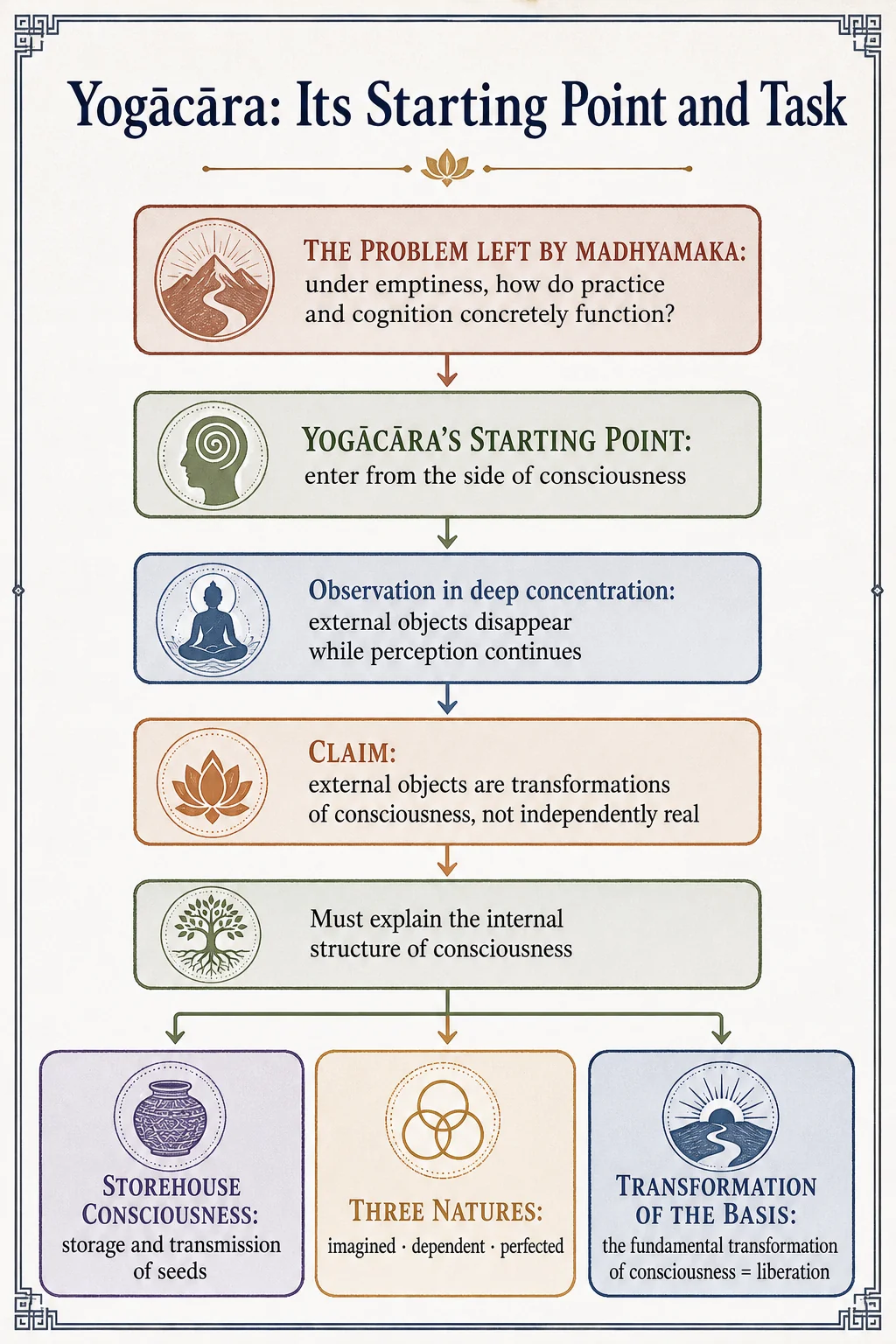
At the end of Part V, Madhyamaka reached its logical boundary. It called everything empty, treated worldly agreement as the only ground of knowledge, and then could not further question that ground. This was less a mistake than the necessary position reached by carrying "refuting without establishing" through to its conclusion. It left a group of philosophical questions. If external objects and consciousness both lack intrinsic nature, while dependent arising and designation are conventions, what is the subject of practice? Where are defilements stored and transmitted? What exactly does liberation operate on? Madhyamaka's "emptiness" is enough to dismantle erroneous attachment but largely remains silent about the structure of cognition.
Yogācāra formed around these questions. It does not comprehensively reject Madhyamaka but enters positively into the problems Madhyamaka left behind. Once the work of dismantling attachment has been done, someone must explain how cognition and practice actually operate from the perspective of emptiness. This chapter examines the school's origin: who founded it, which texts it rests on, and what philosophical problem supplied its point of departure.
1. Historical Background: Philosophical Problems after Madhyamaka
The philosophies of the early schools, especially Abhidharma, supplied a detailed map of cognition and practice. Dharmas possessed own characteristics; mental factors were enumerated; the five aggregates, twelve sense fields, and eighteen elements provided workable coordinates. Madhyamaka removed the metaphysical foundation of this framework (the real existence of intrinsic nature), but did not replace it with a new epistemological system. It said only that the old architecture failed, everything was designated, and convention continued to function.
For a teacher lecturing at Nālandā or a meditator asking "what type of mind is arising at this moment?" the answer was insufficient. They needed to know: when a defilement arises in an instant, on what does it rest? How are seeds (bīja) perfumed into a stream and later brought to fruition? How should Madhyamaka explain phenomena observed in meditation—the mind's subtle flow, or the disappearance of external objects in deep concentration while perception continues?
Abhidharma explanations remained available. Its detailed classifications and rigorous phenomenology of mind had not disappeared. But Abhidharma alone had also become inadequate in two directions.
First, Abhidharma is restrained at heart. Its ontology stops with dharmas as minimal units (momentarily arising and ceasing mental and material phenomena), and does not further ask why they operate in these ways. It says only that "this is how they are." The restraint is philosophically honest. Yet human thought, within and outside Buddhism, is naturally dissatisfied with such an answer. It asks for a deeper mechanism. Where exactly are seeds stored, how are they preserved, and what maintains continuity in a stream of momentarily ceasing dharmas? Abhidharma supplies functional descriptions without a convincing underlying structure.
Second, once Madhyamaka denied Abhidharma's ontological foundation, the mind inevitably grasped for a replacement. If dharmas cannot serve as ultimately real explanatory endpoints, explanation must move in another direction and seek a deeper structure outside that framework but capable of carrying the work of practice.
This is the most distinctive feature of consciousness-only theory: it always continues to ask for a deeper structure. It does not simply exchange one ontology for another. Under the premise of emptiness, it constructs a more detailed mechanism of fabrication. Beneath every visible layer lies something deeper driving it. Storehouse consciousness expresses the feature most clearly: when six consciousnesses are insufficient, a seventh is added; when the first seven still cannot explain continuity, an eighth is established.
This was the philosophical soil of Yogācāra. It sought to rebuild a theory of cognition and practice under emptiness. In its own terms, it sought to clarify dependent nature (paratantra-svabhāva): exactly how the cognitive process arising through conditions works.
2. Who Was "Maitreya"? A Historical Problem
Yogācāra's ancestry is generally traced to Maitreya, but an enduring historical problem follows: was this "Maitreya" a human being or the bodhisattva?
Tradition says that after prolonged practice Asaṅga, around the fourth century, traveled spiritually to Tuṣita Heaven and directly received teachings from Maitreya Bodhisattva, the Buddha's successor now residing in Tuṣita's inner court until his future descent. Asaṅga brought back five treatises, the "Five Treatises of Maitreya." Indian Buddhist tradition consistently records this account, and Tibetan Buddhism maintains it today.
Modern scholarship differs. Some scholars regard "Maitreya" as a historical teacher named Maitreya, or Maitreyanātha, whose disciple was Asaṅga. The five treatises were composed by Maitreyanātha and organized and developed by Asaṅga. Evidence includes major differences in style among the treatises, which are difficult to assign to one person at one time; Tibetan historiographical materials that sometimes distinguish Maitreya from Asaṅga; and biographies recorded by Xuanzang and other travelers.1
Others argue that the textual evidence for establishing Maitreya as a historical individual is very thin. References to Maitreyanātha are largely indirect quotations with untraceable original sources, while strong philosophical continuities connect the five treatises with Asaṅga's other works. It remains plausible that Asaṅga principally authored and organized them.2
This book's position is that no certain answer currently exists. The possible historical existence of a Maitreyanātha cannot be excluded, but the evidence is insufficient to catalogue him securely as an independent philosopher. The book uses the conventional phrase "Five Treatises of Maitreya," treating them as the foundational corpus of Yogācāra without deciding the identity of their human author. Where a doctrine can be confidently attributed to Asaṅga, it is explicitly assigned to him.
3. The Five Treatises of Maitreya
Whatever their authorship, the five treatises form the foundational literature of Yogācāra and should be introduced individually:
| Treatise | Sanskrit | Chinese translation | Subject |
|---|---|---|---|
| Yogācārabhūmi Śāstra | Yogācārabhūmi-śāstra | Xuanzang, 100 fascicles | The largest encyclopedia of practice: stages from ordinary being to buddha, psychological analysis, interpretations of Āgama teachings, Vinaya, and more; the school's knowledge base |
| Mahāyānasūtrālaṃkāra | Mahāyānasūtrālaṃkāra | Prabhākaramitra; Tibetan translation also survives | Verses and prose elaborating Mahāyāna view and practice, including a detailed bodhisattva path |
| Madhyāntavibhāga | Madhyāntavibhāga | Xuanzang, three fascicles, with Vasubandhu's commentary | Distinguishes the "middle," emptiness beyond existence and nonexistence, from the "extremes" of eternalism and annihilationism; centers on "false imagination" (abhūtaparikalpa) as the cognitive construction at the root of saṃsāra |
| Dharmadharmatāvibhāga | Dharmadharmatāvibhāga | Survives in Tibetan; modern English translations exist | Distinguishes dharmas, contaminated worldly phenomena, from dharmatā, uncontaminated suchness; an important source for transformation of the basis |
| Abhisamayālaṃkāra | Abhisamayālaṃkāra | Survives in Tibetan; no complete Chinese translation | Expounds the implicit stages of practice in the Larger Prajñāpāramitā; closely connected with Madhyamaka and used as a Prajñāpāramitā manual in Tibet |
The five differ greatly in style and emphasis. The Yogācārabhūmi is an encyclopedic manual of practice longer than all the others combined. The Madhyāntavibhāga and Dharmadharmatāvibhāga are the most philosophical. The Abhisamayālaṃkāra is more deeply connected with Madhyamaka and used independently in Tibetan Prajñāpāramitā education. If Maitreyanātha was a historical figure, the Madhyāntavibhāga and Dharmadharmatāvibhāga are the most likely candidates for his work, while the extensive contents of the Yogācārabhūmi more clearly manifest Asaṅga's scale of learning and organizational ability.
4. Asaṅga: From Vision to System
Asaṅga, ca. 310–390, though the dates are disputed, is the actual founder of Yogācāra. Whatever conclusion is reached about authorship of the Five Treatises, Asaṅga's own writings and organization were decisive in turning the movement into a system.
Tradition says that he initially studied the teachings of an early school, possibly Vibhajyavāda, and after a long failure to make progress in meditative practice ascended to Tuṣita and saw Maitreya. He then acquired insight and began teaching consciousness-only. Whatever the story's literal truth, it reveals that from the beginning Yogācāra understood itself as deeply bound to meditation rather than merely philosophical controversy. It did not see itself as armchair speculation but as observation of the structure of mind in meditative concentration.
Asaṅga's most important works include:
- The Mahāyānasaṃgraha is short but provides the clearest outline of the entire consciousness-only system. It treats storehouse consciousness, the three natures, the bodhisattva's six perfections, and transformation of the basis. It is a principal source for the next chapter.6
- The Abhidharmasamuccaya reorganizes the Abhidharma taxonomy of mental factors from a Yogācāra perspective and can be understood as the Yogācāra version of Abhidharma.
Asaṅga's younger brother Vasubandhu, around the fourth to fifth century, moved from Abhidharma to consciousness-only. His Viṃśatikā and Triṃśikā offer the most rigorous expression of Yogācāra philosophical argument.
A scholarly controversy must be noted. In 1951 Erich Frauwallner advanced an influential hypothesis that two historical persons named Vasubandhu existed. An older Vasubandhu, ca. 320–380, was Asaṅga's brother and composed the Yogācāra treatises. A younger Vasubandhu, ca. 400–480, was an Abhidharma master who composed the Abhidharmakośa and related works. Both bore the name Vasubandhu and were later conflated.3 The "two Vasubandhus" theory gained wide acceptance for a period and reshaped the chronology of Indian Buddhism.
Later research increasingly questions it. The Abhidharmakośa and Yogācāra works show a coherent development that can belong to one author at different stages: first a master of Sarvāstivāda and Sautrāntika Abhidharma, later a convert under Asaṅga's influence to Mahāyāna consciousness-only. Traditional literature narrates the change coherently and does not require division into two individuals.4 This book takes Vasubandhu to have been one person and his philosophical transformation as real. The Abhidharmakośa and Triṃśikā represent work by the same thinker at different stages. Chapter 6.3 treats him in detail.
5. Two Names: Yogācāra and Consciousness-Only
The school bears two parallel names, each emphasizing a different aspect.
Yogācāra literally means "the practice of yoga" or "practitioners of yoga." Here yoga chiefly means meditation (dhyāna) and cultivation, while ācāra means a mode of practice. The name emphasizes the school's practical origin. Its theories developed through observation of mind in deep concentration, and its liberation theory culminates in progressively purifying the structure of consciousness through meditation.
Consciousness-only (vijñaptimātra or vijñānamātra) literally means "representation only" or "only consciousness." It is the school's central philosophical claim. The world ordinarily believed to exist outside is a transformation (pariṇāma) of consciousness. So-called external objects are constructed by consciousness in a particular way rather than material entities existing independently of it.
The names are not separate subjects. Precisely because deep meditation reveals that external objects can disappear while perception continues, the philosophical conclusion arises that external objects are constructions of consciousness. Precisely because the problem lies in the structure of consciousness, practice must transform consciousness at its basis—"transformation of the basis" (āśraya-parāvṛtti). This book uses the two names according to context.
A Chinese controversy: consciousness-only or mind-only?
The distinction between the names produced an interesting controversy in China.
The central Sanskrit terms are vijñaptimātra, translated by Xuanzang as "consciousness-only," and vijñānamātra, which can be rendered "consciousness-only" or "mind-only." Vijñapti emphasizes discrimination or representation (the expressive, presenting side of consciousness), while vijñāna is broader consciousness or mind. Indian texts sometimes use them together and sometimes with different emphases. In China, translational choices created a philosophical fork.
Before Xuanzang (602–664), Paramārtha (499–569) had translated Yogācāra works extensively, including the Mahāyānasaṃgraha and Vasubandhu's Viṃśatikā. His terminology was broader, and consciousness-only and mind-only could sometimes be interchangeable. His interpretation also showed clear tathāgatagarbha coloring. He tended to identify the "pure side" of storehouse consciousness (immaculate consciousness) with tathāgatagarbha, connecting it to the possibility of liberation.
Xuanzang brought back from India the stricter consciousness-only position of Dharmapāla's line, ca. 530–561. He deliberately distinguished vijñapti, discrimination or manifestation transformed by consciousness, from vijñāna. He insisted on "consciousness-only" rather than "mind-only" because the latter was too broad and easily led toward Chinese theories of mind-nature, conflating consciousness with a substantial "mind" or buddha-nature. Xuanzang maintained that the claim concerns transformation by consciousness, not the presence of a universal mind.
After returning to China he organized an enormous translation project. His disciple Kuiji (632–682) systematized the school, conventionally known as Faxiang, the "Characteristics of Dharmas," or the Consciousness-Only school. "Characteristics of dharmas" points to the precise analysis of the properties and categories of every dharma, the school's core methodological posture.
Its Chinese history took a winding course. The school maintained a strict position: the theory of five lineages (pañcagotrā) holds that beings have different capacities and that icchantikas cannot become buddhas. This directly conflicted with the increasingly entrenched Chinese belief that "every being possesses buddha-nature," shared by buddha-nature traditions, Tiantai, and Huayan. Few successors remained after Xuanzang and Kuiji, and after the Huichang persecution of 845, Faxiang largely declined and failed to preserve a continuing network of doctrinal teaching in China.5
The history is revealing. Yogācāra's most rigorous philosophical form proved poorly adapted to China. The form that continued to influence Chinese Buddhism was diluted by tathāgatagarbha thought and fused with the intuition that "mind is intrinsically pure." It was farther from the original texts but better suited Chinese religious needs. The tension between these routes will be examined in Part X.
6. Philosophical Point of Departure: Where Consciousness Is, There Lies the Problem
To understand Yogācāra's claims, we must begin with its motivating question.
Madhyamaka analysis starts with external objects: they lack intrinsic nature and are designated. Yogācāra approaches from the side of the cognizing subject. Practitioners in deep concentration observe that at a certain depth the so-called external object disappears while cognition itself continues. If external objects genuinely exist independently of consciousness, why do they disappear in deep meditation while perception remains? If perception continues, what does it perceive?
The observation produces a thesis: the "external object" is only content presented by consciousness to itself in a particular way—an objective aspect (nimitta-bhāga)—not an independently existing thing. This is the beginning of consciousness-only argument, not its end. Vasubandhu would refine it into more rigorous forms in 6.3.
From this point, Yogācāra's principal philosophical task is to explain how consciousness manifests the illusion of an external object, how consciousness is internally structured, and how defilements accumulate, seeds perfume the stream, and transformation of the basis occurs. Storehouse consciousness (ālaya-vijñāna) was introduced to perform the function of storing and transmitting seeds. The next chapter turns to it.
7. Its Relationship with Madhyamaka
Yogācāra is not a rejection of Madhyamaka, a point that must be clear at the outset.
The two schools more accurately respond to different aspects of the same problems. Yogācāra does not cancel Madhyamaka emptiness—the lack of intrinsic nature and designation of all things. Asaṅga and Vasubandhu explicitly maintain emptiness. The difference is that Madhyamaka largely stops after saying "empty." Yogācāra says that under the premise of emptiness, the operating structure of consciousness still must be explained, or practice has nothing on which to act.
This relationship enabled the later Indian synthesis of "Yogācāra–Madhyamaka," represented by Śāntarakṣita and Kamalaśīla around the eighth century. They attempted to combine the epistemological foundation of consciousness-only with Madhyamaka emptiness in a single system. It became an important direction in late Indian Buddhist philosophy; see 8.3.
Candrakīrti's criticism of Yogācāra in 5.5, section 4, and the Yogācāra objection that Madhyamaka "refutes without establishing" mark genuine philosophical disagreements. Chapter 6.5 will treat the controversy directly. Before that, the Yogācāra system itself must be understood, beginning with Asaṅga's storehouse consciousness.
References
References
-
Erich Frauwallner. Die Philosophie des Buddhismus. Berlin: Akademie-Verlag, 1956. (A representative discussion arguing that Maitreya, or Maitreyanātha, was a historical person and the author of some of the "Five Treatises of Maitreya.") ↩
-
Lambert Schmithausen. Ālayavijñāna: On the Origin and the Early Development of a Central Concept of Yogācāra Philosophy. Tokyo: International Institute for Buddhist Studies, 1987. (The origins of storehouse consciousness and related questions of attribution among the five treatises.) ↩
-
Erich Frauwallner. On the Date of the Buddhist Master of the Law Vasubandhu. Serie Orientale Roma 3. Rome: IsMEO, 1951. (The systematic proposal of the two-Vasubandhus theory.) ↩
-
Jonathan C. Gold. Paving the Great Way: Vasubandhu's Unifying Buddhist Philosophy. New York: Columbia University Press, 2015. (On the philosophical continuity of a single Vasubandhu and the path from seeds to Yogācāra.) ↩
-
Kenneth K. S. Ch'en. Buddhism in China: A Historical Survey. Princeton: Princeton University Press, 1964. (The rise and decline of the Faxiang school in China, including Xuanzang, Kuiji, and the controversy over five lineages.) ↩
-
Étienne Lamotte (trans.). La Somme du Grand Véhicule d'Asaṅga (Mahāyānasaṃgraha). 2 vols. Louvain: Institut Orientaliste, 1938–1939. (French translation and study with Sanskrit, Tibetan, and Chinese comparisons.) ↩