Chapter One: Transmission to Sri Lanka and the Conflict between Mahāvihāra and Abhayagiri
From Part II through Part VIII, the narrative followed developments within India. This part turns to Southern Buddhism: the lineage that treats the Pāli scriptures as canonical and the Theravāda vinaya as its institutional foundation. Its geographic center is Sri Lanka, from which it later spread to Myanmar, Thailand, Cambodia, and Laos.
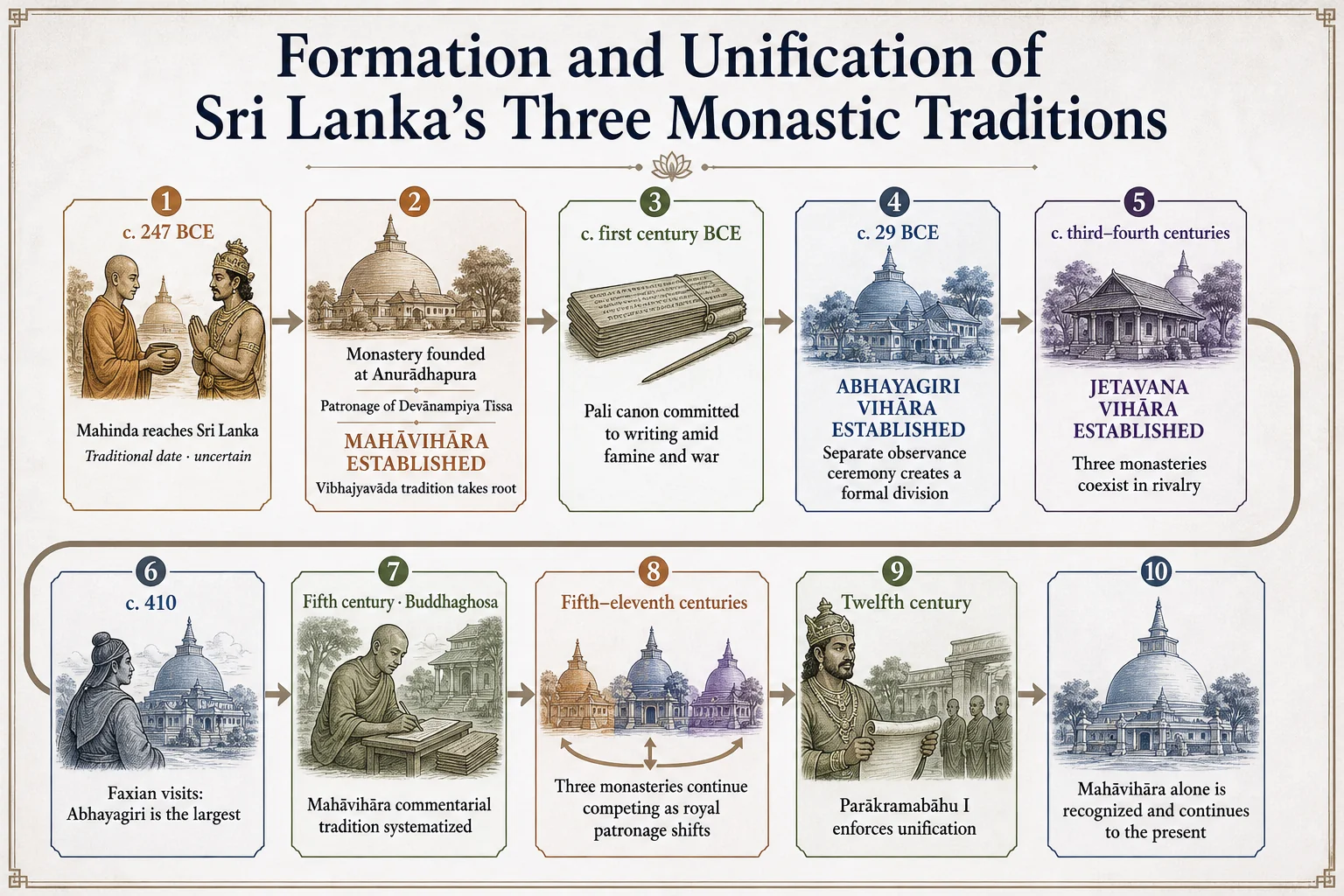
This chapter examines how Buddhism entered Sri Lanka and the nearly thousand-year internal conflict that followed. Sri Lanka was both the principal repository of the Pāli Tipiṭaka and the setting of the largest monastic division within the Theravāda tradition. Mahāvihāra and Abhayagiri, two monasteries facing one another across the capital, remained in opposition for almost a millennium.
I. Sources: Useful, but Their Provenance Matters
Any account of early Sri Lankan Buddhism must use two Pāli chronicles: the Dīpavaṃsa, composed around the fourth century CE, and the Mahāvaṃsa, compiled by Mahānāma around the fifth or sixth.1 They provide the most detailed surviving narrative of the period and almost the only usable written framework.
Both, however, were composed within the Mahāvihāra lineage. They were written during the most intense phase of conflict and sought, among other things, to establish Mahāvihāra’s orthodoxy. Whenever Abhayagiri appears, it is cast as heterodox, lax, and contaminated by non-Buddhist teaching. Accounts involving it tend toward interpretations favorable to Mahāvihāra. This is not speculation: the Dīpavaṃsa’s narrative organization itself serves the lineage of Mahāvihāra.
This book therefore treats the chronicles as important partisan sources, not neutral records. Material corroborated by archaeology, inscriptions, or outside literature (especially the Chinese travel accounts of Faxian and Yijing) is more reliable. Where a story appears only in the chronicles and plainly favors Mahāvihāra, its provenance will be identified rather than accepted casually as fact.
II. Transmission: Mahinda and the Vibhajjavādins
Traditional narrative attributes the transmission of Buddhism to Sri Lanka to Mahinda, said to be Aśoka’s son. The Mahāvaṃsa fully mythologizes the episode: light appears in the sky, the king encounters Mahinda upon a mountain, and Mahinda tests him through the famous “mango-tree dialogue.” This book sets aside the miraculous elements.
The historical outline that can be stated with reasonable confidence is:
- Around the middle of the third century BCE, during Aśoka’s reign, monks belonging to the Vibhajjavāda reached Sri Lanka. They defined themselves through analytical discrimination in accordance with dharmas, in contrast to the broad Sarvāstivāda assertion that “all dharmas in the three times are real,” discussed in 2.4. In Sri Lanka this lineage later became known as Theravāda, the Pāli “Teaching of the Elders.”
- Under royal protection, traditionally that of Devānampiyatissa, they established the institutional basis of the saṅgha and its monasteries at the capital Anurādhapura.
- Mahāvihāra was founded in a royal park south of the city and became Sri Lanka’s earliest and later most authoritative major monastery.
This book doubts that Mahinda was Aśoka’s biological son. Narratives of “royal children transmitting the teaching” are common in Indian and Southeast Asian mission stories and confer the highest royal authority upon transmission. Aśoka’s inscriptions repeatedly mention sending emissaries to neighboring lands to spread the Dharma but name neither Mahinda nor Sri Lanka. The most reasonable inference is that Mahinda was a missionary monk active during Aśoka’s reign; his exact identity and royal connection cannot be externally verified. A third-century mission to Sri Lanka is geographically plausible, and Mahinda probably existed; the mythologization of his identity is a separate matter.
Tradition says that Saṅghamittā accompanied the mission and brought a cutting said to descend from the bodhi tree beneath which the Buddha awakened. It was planted near Mahāvihāra and still lives at Anurādhapura. With a traceable written record, it is among the world’s oldest individually named living trees and remains one of Sri Lankan Buddhism’s most important sacred objects.2
III. Writing Down the Pāli Tipiṭaka
For roughly two centuries after the transmission, the Sri Lankan saṅgha remained broadly united. Mahāvihāra, supported by the royal court, accumulated a substantial oral and scholarly tradition.
In the first century BCE, Sri Lanka suffered severe foreign invasion and famine. King Vaṭṭagāmaṇī Abhaya was defeated, spent fourteen years in exile, and later recovered the throne. The Mahāvaṃsa says that during the disorder monks feared the deaths of reciters through war and famine and the consequent loss of the teaching. They therefore decided to commit the orally transmitted Tipiṭaka to writing.3
This agrees completely with the analysis in 1.4. The resilience of oral transmission depends on reciters remaining alive; only a threat of death on a mass scale forced the turn to writing. This book’s position is that the Pāli Tipiṭaka reached its definitive written form in Sri Lanka around the first century BCE, a decisive moment in Southern Buddhist transmission.
Writing preserved the scriptures while freezing one particular version as the “authorized text.” Interpretation and addition thereafter had to occur upon that fixed foundation. This established the basis of Mahāvihāra’s commentarial tradition and planted the seed of a later dispute: who possessed authority to interpret the canon?
IV. Abhayagiri: Where Did the Fracture Begin?
After defeating the invaders and regaining the throne, Vaṭṭagāmaṇī Abhaya made a gift with unexpectedly far-reaching consequences. Around 29 BCE, he gave a monastery, Abhayagiri, to a monk named Mahātissa, a different person from the missionary Mahinda.
Mahāvihāra’s saṅgha had previously expelled Mahātissa for a vinaya violation. In Mahāvihāra’s record, the king’s act placed royal protection around someone already judged by the saṅgha. This was the beginning of a fracture in the relation between Mahāvihāra and the court.4
Mahāvihāra immediately severed relations with Abhayagiri and refused to hold the uposatha ceremony jointly with its monks. The uposatha is a central rite affirming the harmony of the saṅgha; its joint performance is a key sign that two groups belong to the same legitimate community. Severing that relation institutionally declared that the monasteries represented separate lineages.
But was this disciplinary case only a disciplinary case?
Two questions are easily run together and should be kept apart: whether the charge was accurate, and why proceedings were brought against this man in particular.
On the first, the grant of the monastery tells against the accused. It came after the sentence, which is usually read as royal retaliation; in fact its evidential force is the greater. Building a monastery for an uncontroversial elder costs a king nothing; building one for a man the island’s most authoritative monastery has just condemned costs him an open breach with that monastery. A willingness to pay that price is itself a measure of how close the relationship was. And the disciplinary category of undue association with householders judges the state of a relationship, not the monk’s culpable intent: the rule carries no exemption for having been the passive party. Between charge and fact there is probably no great gap. One further point: whether the association was opportunism or loyalty, the chronicles will bear either reading and cannot decide between them, and on the account just given it makes no difference to the conclusion.
The second question is the substantial one. In a saṅgha that runs on royal and noble patronage, that line is within everyone’s reach. Mahāvihāra was itself a royal foundation and had lived on royal endowment for two centuries; if closeness to a king were in itself an offence, every senior elder of Mahāvihāra was equally guilty. When a line that everyone crosses is invoked against one man, what is doing the work is not the line but the mechanism that invokes it. So the familiar formula, that a disciplinary quarrel later became political, does not hold: in a saṅgha of this kind, discipline and the politics of patronage are two faces of one thing. What could not be absorbed was not a private friendship either. It was a rival centre, endowed by the crown and built around one man; the boundary of the saṅgha was being redrawn from the palace.
What the confrontation later developed into was far larger than a single sentence. Several pieces of outside evidence bear on it.
Faxian’s external testimony, around 410. When Faxian reached Anurādhapura, he left the most important outside record. Three great monasteries in the city housed more than ten thousand monks in total, and Abhayagiri had “more than five thousand.” During his two years on the island, Faxian obtained the Mahīśāsaka Vinaya, the Dīrgha Āgama, the Saṃyukta Āgama, and other texts then unavailable in China.5 This shows that texts of schools outside Mahāvihāra circulated within the Abhayagiri system, rather than only the Tāmraparṇīya or Theravāda lineage preserved at Mahāvihāra. The monastery described by the chronicles as “heterodox and lax” was clearly larger than Mahāvihāra.
Yijing’s indirect record, around 671–695. Yijing did not visit Sri Lanka, but reports two groups of Sri Lankan monks, attached respectively to Mahāvihāra and Abhayagiri, who “did not reside, eat, or hold the uposatha together.” They were fully independent lineages.
Taken together, the evidence suggests that the Abhayagiri conflict began as a dispute over patronage and over where the boundary of the saṅgha lay, and then acquired a further layer, becoming a conflict over “what counts as orthodox Buddhism.” Mahāvihāra guarded a closed Vibhajjavāda canon and vinaya, while Abhayagiri remained open to a wider range of Indian Buddhist traditions.
V. The Substance of the Conflict
The two monasteries cannot be described simply as “orthodox versus heretical.” That is Mahāvihāra’s self-narrative, not historical description. This book regards them as two different strategies within Southern Buddhism.
Mahāvihāra chose closed guardianship of orthodoxy. The Pāli Tipiṭaka alone was authoritative, its commentarial lineage the sole legitimate interpretation, and imported Mahāyāna or other doctrines were contaminations. The position rested upon the authenticity of the written Pāli scriptures and the continuity of vinaya marked by common uposatha.
Abhayagiri chose open absorption. It did not embrace Mahāyāna from the beginning, but tended to receive varied Indian currents: first Sarvāstivāda and Mahāsāṃghika texts, later Mahāyāna scriptures, and perhaps eventually Vajrayāna influences. From its own perspective, this was attention to the larger living tradition of Indian Buddhism, not betrayal of its inheritance. One particular form this openness took deserves separate notice: Abhayagiri had a cult of Avalokiteśvara, known locally as Nātha, for which the Mahāvihāra tradition has no counterpart. Xuanzang’s seventh-century account likewise separates the two, reporting that the Abhayagiri community studied both vehicles while the Mahāvihāra community held to the lesser vehicle and rejected Mahāyāna. He never reached Sri Lanka himself and was recording report rather than observation, which puts his testimony on a different footing from Faxian’s firsthand account; but the two point to the same configuration.
Each strategy had a price. Closed guardianship preserved the purity of transmission but ultimately depended on political power to defeat competitors. Open absorption remained responsive to living intellectual currents but risked losing the core of institutional identity.
| Mahāvihāra | Abhayagiri | |
|---|---|---|
| Founded | c. third century BCE | c. 29 BCE |
| Scriptural position | Closed: the Pāli Tipiṭaka as sole authority | Open: compatible with multiple Indian Buddhist traditions |
| Vinaya | Tāmraparṇīya or Theravāda Vinaya | Also received Mahāsāṃghika Vinaya, according to Faxian |
| Attitude toward Mahāyāna | Explicit rejection as non-Buddhist contamination | Increasing openness; Mahāyāna texts circulated in the later period |
| Commentarial tradition | Highly systematic and centered on Buddhaghosa, discussed next | Dispersed and reliant on texts circulating from India |
| Relation with the court | Sometimes strained, but long established as an institutional authority | Repeatedly received royal patronage |
VI. Three Monasteries and a Long Confrontation
In the third or fourth century CE, a third major monastery appeared in Anurādhapura: Jetavana. It originally separated from Abhayagiri over doctrinal differences and later formed an independent lineage. The capital consequently developed a three-way monastic structure.
This was the situation Faxian saw around 410. All three institutions were substantial: Abhayagiri was largest, Mahāvihāra second, and Jetavana third. Their shares of royal support rose and fell with the religious inclinations of successive kings. Some strongly supported Abhayagiri; others favored Mahāvihāra.
In the fifth century, Buddhaghosa from South India resided at Mahāvihāra, compiled the Visuddhimagga, and systematically commented upon the sections of the Pāli Tipiṭaka, as the next chapter explains. This was decisive for Mahāvihāra scholarship. It elevated interpretive authority from “guardianship of the authorized text” to “production of authoritative commentary.” Even when Abhayagiri possessed political advantage, it could no longer compete with this accumulation of commentary.
VII. Mahāvihāra’s Final Victory
Nearly a thousand years of three-way conflict ended in the twelfth century through a politically enforced merger.
King Parakkamabāhu I, who reigned approximately 1153–1186, sought to unify the saṅgha and reform the teaching. Under his authority, monks of Abhayagiri and Jetavana were required to receive ordination again under Mahāvihāra authority or else disrobe or leave. This was compulsory religious unification, not voluntary doctrinal synthesis. Thereafter Mahāvihāra Theravāda became Sri Lanka’s only institutional orthodoxy and continues to the present.1
This book’s position is that Mahāvihāra’s “final victory” was political, not the natural outcome of doctrine. The open path represented by Abhayagiri was not philosophically refuted. Its failure arose chiefly from its relationship with successive kings and its disadvantage relative to Mahāvihāra in building a commentarial system. Sri Lankan histories often describe the twelfth-century merger as “purification” and “return to the right path.” That narrative still comes from the Mahāvihāra writing tradition; this book merely makes the provenance clear.
VIII. Its Place in Intellectual History
This thousand-year Sri Lankan conflict had a foundational significance for Southern Buddhism.
It determined what “Southern Buddhism” means. Mahāvihāra’s victory means that the institutional foundation, scriptural system, and commentarial tradition of what is now called “Southern Theravāda Buddhism” are essentially its inheritance. The more open Abhayagiri path (receiving diverse Indian traditions and remaining flexible toward Mahāyāna texts) failed in Sri Lanka, but some of its influence reached mainland Southeast Asia through other channels, as 9.3 explains.
It established the centrality of Pāli literature. The Pāli Tipiṭaka was written in Sri Lanka and guarded by Mahāvihāra, making the island the principal source of the entire Southeast Asian Theravāda tradition for more than a millennium. The Theravāda traditions of Myanmar, Thailand, Cambodia, and Laos all trace themselves to this Sri Lankan lineage.
It is a historical example of a “closed-canon” strategy. Mahāvihāra’s closed guardianship preserved the purity of transmission in the short term, but over the long term required political power to defeat competitors. Abhayagiri’s openness better reflected a living intellectual environment but placed it at a structural disadvantage by weakening its institutional identity. This is a historical observation; the book does not render a value judgment between “closed” and “open.”
A larger pattern. Extend the trajectory outward and a repeatedly recurring structure appears: in Buddhist history, the “victory” of a school has usually resulted from political choice, while doctrinal superiority was a retrospective ornament. Aśoka’s purification of the saṅgha was royal intervention selecting which school was more “orthodox.” The Tibetan court’s choice of Indian Madhyamaka and exclusion of Chinese Chan after the Samye debate reflected court politics and alliances choosing between two paths rather than the natural victory of one in textual discussion, as Part XI develops. Mahāvihāra’s triumph over Abhayagiri, examined here, depended upon a king’s command rather than a doctrinal refutation.
This book’s position is that, at a still greater distance, the object of discussion is not only which school prevailed but Buddhism’s own growth and decline, whose broad direction was likewise a function of political change. The early expansion of the Buddha’s saṅgha depended on continued support from rulers including Bimbisāra and Prasenajit. Nālandā’s near-overnight disappearance in the late twelfth century resulted more directly from the fall of the Pāla dynasty and Bakhtiyar Khilji’s military destruction than from intellectual exhaustion. The “Three Wu and One Zong” persecutions of Buddhism in China were driven by secular rulers’ economic calculations and ideological consolidation, not the refutation of a Buddhist philosophical proposition. The Meiji government’s separation of kami and buddhas and compulsion of monks to disrobe and marry arose from the replacement of Buddhism by Shintō in the public order of a newly constructing nation-state. It transformed the institutional form of modern Japanese Buddhism without disproving a doctrine.
There are, of course, changes genuinely driven by internal doctrine, and this book identifies them where appropriate. In its broad direction, however, Buddhism’s historical expansion, contraction, division, and integration look more like adaptations to political climate than a purely internal history of ideas. A history of Buddhist philosophy must always keep this background in view.
The next chapter turns to the center of Mahāvihāra’s commentarial tradition: the fifth-century Buddhaghosa and his Visuddhimagga, the most important systematization of Theravāda philosophy and practice.
Further Reading
- Peter Skilling. “Theravāda in History.” Pacific World: Journal of the Institute of Buddhist Studies, 3rd series, no. 11 (2009): 61–93.
- Stephen C. Berkwitz. South Asian Buddhism: A Survey. London: Routledge, 2010.
References
References
-
Wilhelm Geiger (trans.). Mahāvaṃsa: The Great Chronicle of Ceylon. London: Pali Text Society, 1912; Hermann Oldenberg (trans.). The Dīpavaṃsa: An Ancient Buddhist Historical Record. London: Williams and Norgate, 1879. ↩↩
-
G. P. Malalasekera. The Pāli Literature of Ceylon. London: Royal Asiatic Society, 1928; repr. Colombo: M. D. Gunasena, 1958. ↩
-
K. R. Norman. Pāli Literature: Including the Canonical Literature in Prakrit and Sanskrit of All the Hīnayāna Schools of Buddhism. Wiesbaden: Harrassowitz, 1983 (on the date of writing down the Pāli Tipiṭaka and its connection with Sri Lanka, see chapter 1). ↩
-
R. A. L. H. Gunawardana. Robe and Plough: Monasticism and Economic Interest in Early Medieval Sri Lanka. Tucson: University of Arizona Press, 1979 (the founding context of Abhayagiri and a political-economic analysis of the conflict). ↩
-
Faxian, A Record of Buddhist Kingdoms, c. 415; Chinese Taishō Tripiṭaka 51, no. 2085; English trans. James Legge, A Record of Buddhistic Kingdoms. Oxford: Clarendon Press, 1886. Faxian’s Sri Lankan account is the earliest external testimony to the conflict between the monasteries. ↩