Chapter 1 The Problem of Mahāyāna Origins: Evidence and Hypotheses
Part IV turns to Mahāyāna. Before addressing its doctrines, however, we must confront an awkward historical problem. The Mahāyāna scriptures (the Prajñāpāramitā, Lotus, Avataṃsaka, Vimalakīrti, Pure Land, and related sūtras) are largely absent from the early Āgamas of the various schools and appeared gradually around the turn of the Common Era. Yet every one begins "Thus have I heard" and claims to record the Buddha's own words. Where did they come from? Why do they call themselves the word of the Buddha? This chapter first defines the problem and then considers several explanations.
A note on terminology is necessary because it reflects a principled position of this book. "Hīnayāna," literally "inferior vehicle," is a pejorative invented by Mahāyāna authors for their opponents. The schools to which it was applied, such as the Sarvāstivādins and Vibhajyavādins, never called themselves by that name, and this book does not use it. Nor does this book use "Śrāvaka Vehicle" or "disciples of the Śrāvaka Vehicle." To speak of a "Śrāvaka Vehicle" already presupposes the Mahāyāna classificatory framework that opposes a bodhisattva vehicle to a śrāvaka vehicle; it accepts the category of "vehicle" in advance. Yet practitioners who kept the Buddha's Dharma and sought liberation for themselves had never boarded any "vehicle." They were travelers on the path, making themselves their island and the Dharma their island; the vehicle was a later Mahāyāna frame. This book therefore uses precise school names and personal names wherever possible. When a collective term is necessary, it speaks of "liberation-path practitioners," and where a distinction from solitary buddhas is needed, of "hearer liberation-path practitioners" and "solitary-awakening liberation-path practitioners."
1. The Problem: Why Do Later Scriptures Claim to Be the Buddha's Word?
We should begin with what can be established.
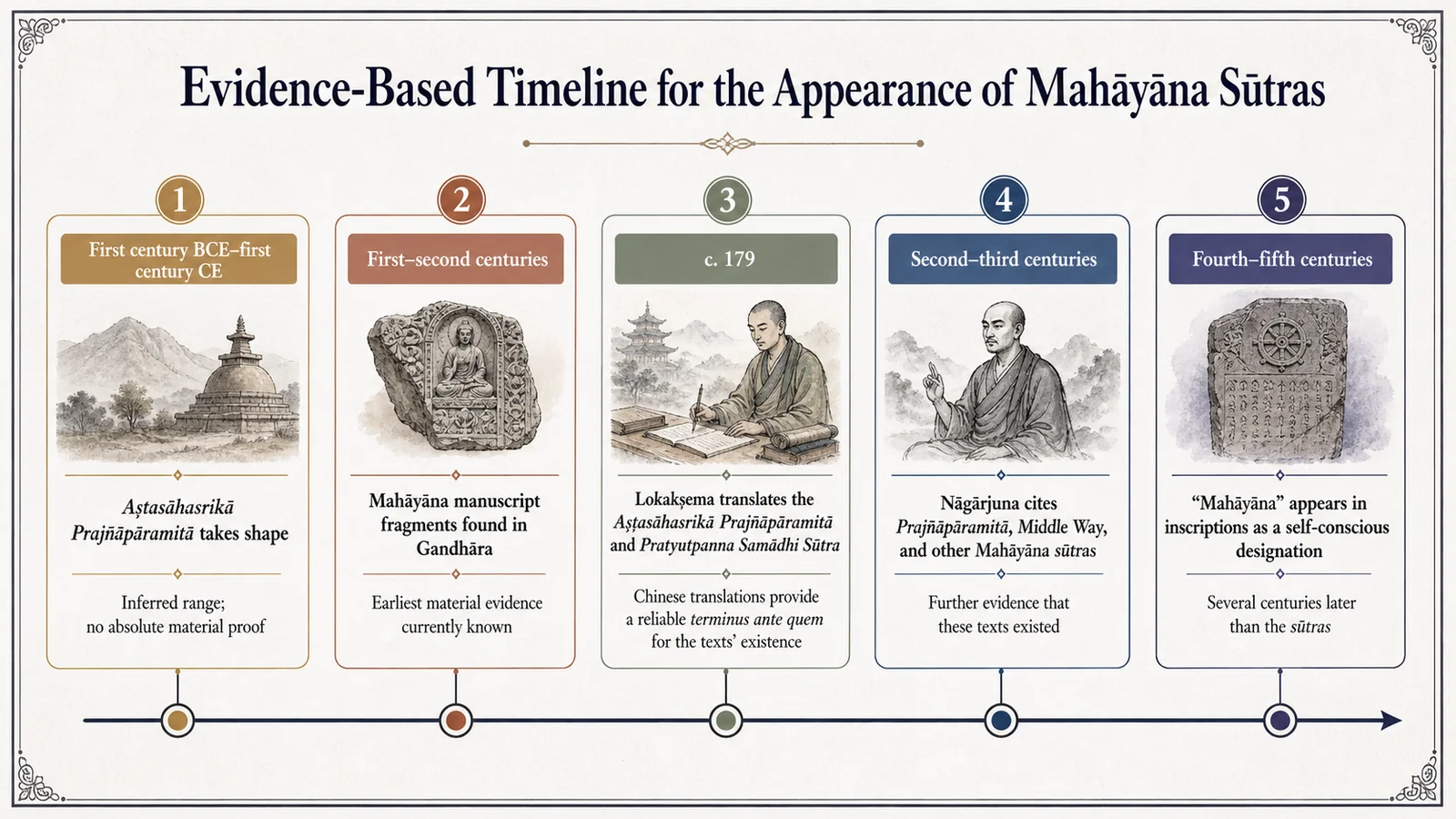
The Gandhāran fragments from around the first and second centuries CE are the earliest known physical Mahāyāna manuscripts. Written on birch bark, they were discovered in the region of present-day Afghanistan and Pakistan. Around 179 CE, Lokakṣema had already translated the Aṣṭasāhasrikā Prajñāpāramitā into Chinese as the Daoxing banruo jing, together with the Pratyutpanna Samādhi Sūtra. These dates provide a secure written terminus by which Mahāyāna scriptures existed.1 Before that point we have only inferences. Linguistic features and analyses of doctrinal layers can establish the relative order of passages within a text, but they cannot anchor them to an absolute chronology.
The difficulty is that these scriptures are absent from the early Āgamas and Nikāyas independently recited through generations by the various schools, collections that can be cross-compared using the method discussed in 2.2. The independent Āgama and Nikāya recensions agree to a high degree because they share an earlier oral foundation. The absence of Mahāyāna scriptures from this network indicates that they did not originate in that common early layer of recitation. Judged by the evidence alone, they are later compositions that appeared only subsequently, not teachings circulating during the historical Buddha's lifetime. Yet they all call themselves the Buddha's word. The tension between "later origin" and "claiming to be the Buddha's word" forms the core of the problem of Mahāyāna origins.
One numerical fact should also be remembered. Drewes's survey shows that before the Gupta dynasty, roughly before the fifth century, archaeological inscriptions and donation records contain very little trace of Mahāyāna; the overwhelming majority of donors still belonged to mainstream Buddhist schools.2 Several centuries separate the appearance of Mahāyāna scriptures from the widespread adoption of Mahāyāna beliefs. The interval is itself a clue: early Mahāyāna involved very small minorities, not a mass movement that swept through the Saṅgha.
2. Legend and Method: The Nāga Palace and the Three Turnings of the Dharma Wheel
Mahāyāna naturally developed its own accounts of the scriptures' origin. The best known is the story of Nāgārjuna retrieving them from the nāga palace. The Buddha had taught the Prajñāpāramitā but instructed the nāga king to conceal it in his underwater palace until the proper time, when Nāgārjuna would restore it to the human world; chapter 2.5 has already used this story as a comparison. A more general account says that the Buddha taught Mahāyāna to bodhisattvas and gods or in other realms, but liberation-path practitioners at the time lacked the capacity to hear it. Later doxographies speak of "three turnings of the Dharma wheel," classifying the liberation-path teachings as the first turning and Mahāyāna as a higher, later turning.
This book treats these accounts consistently with 2.5: they are legends authorizing scriptures and are not accepted as history. We do not believe that Nāgārjuna literally descended to a nāga palace, just as we do not believe that the Buddha literally ascended to the Heaven of the Thirty-Three. Yet the qualification made there must be repeated. Legend is one thing; the evidentiary status of what the legend supports is another. Mahāyāna scriptures lack early, cross-school corroboration, and their textual history points to a later origin. Acknowledging this does not diminish their intellectual value (see section 5).
3. It Was Not Actually a "School": Growth within the Existing Schools
A common misunderstanding imagines Mahāyāna as another "school" parallel to established schools such as the Sarvāstivāda and Vibhajyavāda—as if it had broken away in a discrete schism and established a separate institution. This is not what the evidence shows.
For a long period Mahāyāna possessed no independent ordination lineage and did not separate from the Saṅgha. It was more like an intellectual and devotional current growing within the existing schools. A monk could be ordained according to the Sarvāstivāda Vinaya and live under its discipline while reciting Prajñāpāramitā scriptures and taking a bodhisattva vow. Xuanzang's seventh-century observations and Yijing's slightly later records describe the same arrangement. Mahāyāna and non-Mahāyāna monks lived in the same monasteries and kept the same disciplinary code; what distinguished them was which scriptures they read, whom they venerated, and which vows they made, not the lineage through which they were ordained.1 Schopen's systematic work on inscriptions further strengthens this conclusion. In records of donations to stūpas and offerings to relics, donors commonly identify their school ("the Sarvāstivāda monk so-and-so"), yet only rarely call themselves "Mahāyānists." "Mahāyāna" became a common self-conscious designation in inscriptions only after the Gupta period, several centuries after the scriptures themselves appeared.3
An important institutional distinction must be made. Part III explained that the core distinction among Buddhist schools lay in their respective Vinayas and associated ordination lineages. A "split in the Saṅgha" (saṅghabheda) has a specific technical definition in the Vinaya: establishing a separate uposatha within the same ordination boundary. It does not refer broadly to doctrinal dissent. Mahāyāna never created a separate boundary or ordination lineage and therefore never constituted a schism in the disciplinary sense or an independent school. The term "Mahāyāna school" can consequently mislead. Mahāyāna was an intellectual movement across the schools, not a Vinaya-based branch.
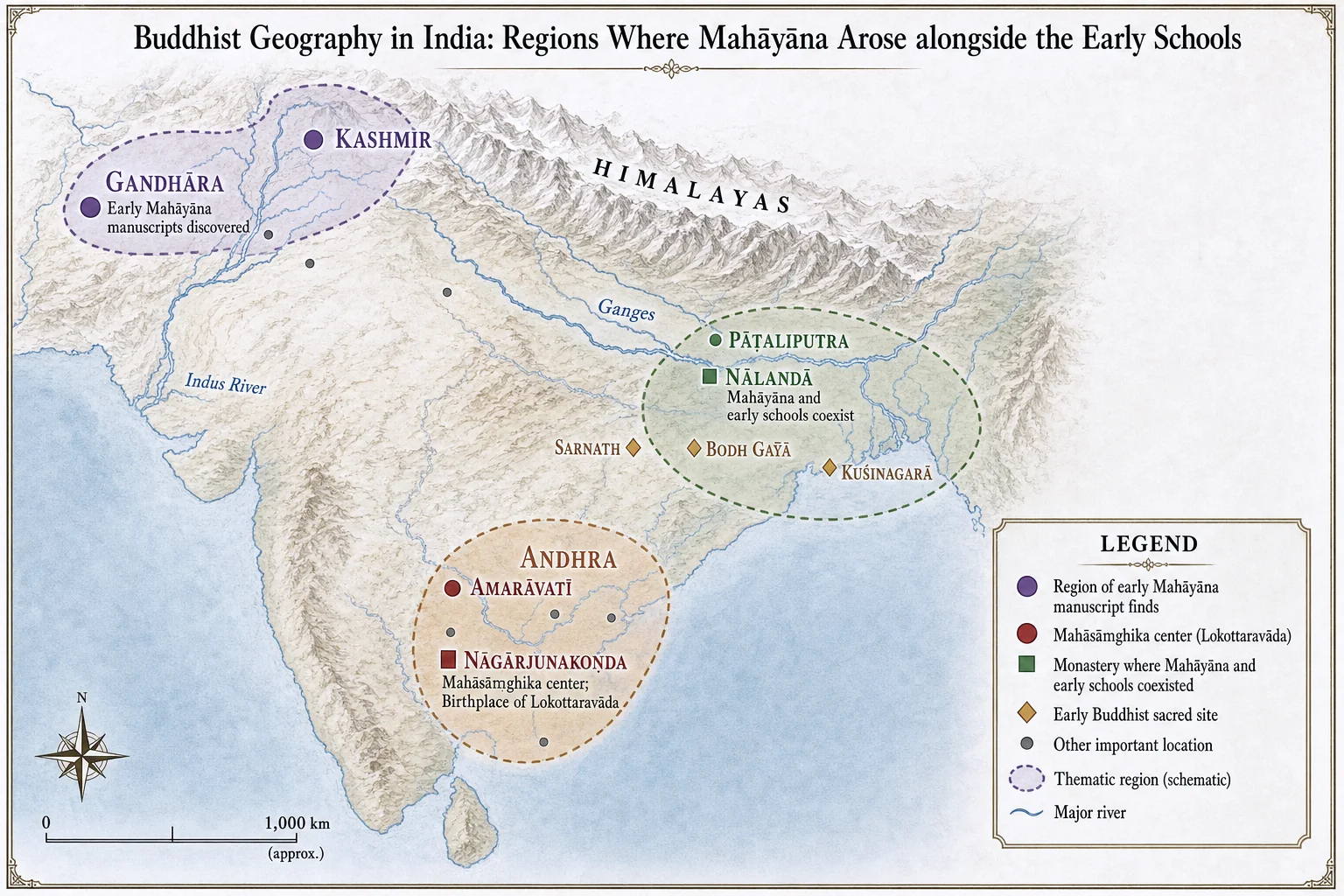
The movement's geography can be partially traced, although the evidence remains fragmentary. Early Mahāyāna manuscripts and inscriptions cluster especially in northwestern India (Gandhāra and Kashmir) and the southern Deccan, particularly Andhra. Sites at Nāgārjunakoṇḍa and Amarāvatī have yielded images possibly connected with Mahāyāna, and tradition associates Nāgārjuna himself with Andhra. Caution is necessary: geographical association is not the same as a place of origin, and the relevant inscriptions cannot always be assigned to Mahāyāna with certainty. The puzzle remains incomplete.
The map below marks three geographical centers indicated by existing evidence: Gandhāra, where the earliest manuscripts were found; Andhra, a stronghold of the Mahāsāṃghikas and an important region for supramundane views of the Buddha; and the area around Nālandā, which Yijing and other travelers record as a center where Mahāyāna and the early schools coexisted.
4. Several Modern Hypotheses
Among whom and by what process did Mahāyāna arise? Modern scholars have proposed several hypotheses, with no final agreement. The table provides an overview before each is considered in turn.
| Hypothesis | Representative | Claim | Present status |
|---|---|---|---|
| Lay or stūpa-cult origins | Akira Hirakawa | Mahāyāna arose among lay devotees around stūpas; the bodhisattva path was a lay ideal | Long influential, now widely questioned |
| Monastic or forest-meditator origins | Harrison and Nattier | Mahāyāna arose among rigorous monastic practitioners, especially forest meditators; it was elite asceticism rather than a popular lay movement | Closer to the recent mainstream tendency |
| Cult of the book, a "religion of the book" | Schopen | Centered on veneration of the manuscript itself: "wherever this sūtra is taught is itself a shrine"; scripture replaces relics as a sacred object | Important supplement |
| Revelatory meditation | Harrison and others | New scriptures emerged from visions of seeing and hearing a Buddha in meditation, as in the Pratyutpanna Samādhi Sūtra | A key to explaining the production of "new words of the Buddha" |
The rise and decline of the lay-origin hypothesis. In the 1960s, Akira Hirakawa proposed that Mahāyāna began as a grassroots lay movement organized around offerings at stūpas and existed in tension with the monastic Saṅgha. The proposal has intuitive appeal. The bodhisattva path emphasizes that laypeople too can attain buddhahood, as in the Vimalakīrti Sūtra, and the stūpa was undeniably a major focus of lay devotion. But Schopen's inscriptional research dealt the theory a severe blow. Among the donors recorded around stūpas, monastics greatly outnumber laypeople and explicitly identify their school. If Mahāyāna had been a lay movement, the records should preserve a stronger lay imprint; they do not. Nattier's study of the Ugraparipṛcchā makes the point more directly. The bodhisattva path described in the text is exceptionally demanding: ordination, meditation, ascetic practice, and residence in the forest. It is the lifestyle of an elite monastic, entirely unlike a popular form of lay devotion.4
The forest-meditator hypothesis. Work by Harrison, Nattier, Drewes, and others shifted attention toward small, distinctive groups of monastics within the established schools, especially those who chose solitary life in forests. Institutionally they were ordained under existing Vinayas, but their lives were more rigorous than those of ordinary monastery residents. They concentrated on the practice of meditative absorption (samādhi) and sometimes identified themselves as "sons of good family" or "bodhisattvas." They produced new scriptural texts, some of which appear to record meditative experiences directly. The Pratyutpanna Samādhi Sūtra, for example, describes single-minded recollection of Amitābha Buddha and a vision of his body in meditation. On this basis, the earliest forms of some Mahāyāna scriptures may have been reports of meditation or religious literature created by communities organized around particular contemplative practices.
The cult of the book. Schopen identified a repeated theme in many Mahāyāna scriptures: any place where a given scripture exists, is preached, or is copied is itself equal to a shrine (caitya) containing the Buddha's relics. This makes scripture a sacred object and gives preachers and scribes authority comparable to that of a stūpa. These people, the dharmabhāṇakas or Dharma preachers, portray themselves in Mahāyāna sūtras as hearing the teaching directly from the Buddha and then transmitting it to the human world. This continues the logic of revelatory meditation. The material form of scripture (writing, copying, and worship) and the source of its authority (receiving it from a Buddha in meditation) support one another.
The hypotheses are not mutually exclusive. The most likely picture is that Mahāyāna developed independently in different regions within several schools, among small groups that did not entirely agree with one another and that gathered around distinct contemplative practices or scriptures. Early Mahāyāna was itself not a unified movement but a collection of small, self-contained traditions later joined under a common name and shared themes such as the aspiration to awakening, wisdom, and emptiness. This book's position is that the combined forest-meditator and cult-of-the-book hypotheses currently offer the best-evidenced explanatory framework; the lay-origin hypothesis is difficult to sustain on present evidence. The overall question remains open: Mahāyāna had multiple sources rather than a single origin.
5. How Was "the Buddha's Word" Redefined?
We return to the central question: why did later scriptures call themselves the Buddha's word? The real answer lies not in legends of the nāga palace but in Mahāyāna's redefinition of the criterion for "the Buddha's word" (buddhavacana).
It proceeded along two paths. One shifted the criterion from "source" to "content": any good teaching that accords with reason and leads toward liberation is the Buddha's word—"what is well spoken is the Buddha's word." A teaching's status as buddhavacana does not depend on whether the historical Buddha uttered it personally at a particular place, but on whether it transmits the Buddha's Dharma. The other path made the Buddha someone who "continues to teach." The Buddha is no longer only the historical individual who entered parinirvāṇa but an enduring Dharma body. Seeing a Buddha and hearing the teaching directly in meditation, as in the revelatory experiences discussed above, therefore produces the Buddha's word. Together, these two paths opened the door for "new scriptures to be the Buddha's word."
Both redefinitions appear explicitly within Mahāyāna scriptures. In the Aṣṭasāhasrikā Prajñāpāramitā, Subhūti asks the Buddha where he should learn this perfection of wisdom. The Buddha answers: from the buddhas. "Buddha" no longer refers only to the one who entered parinirvāṇa at Kuśinagara but to plural beings transcending space and time. In the Lotus Sūtra, the Buddha declares that he did not in fact enter parinirvāṇa; his apparent passing was only an "expedient display" (upāyakauśalya). He remains eternally on Vulture Peak and continually teaches the Dharma. This dissolves the historical parinirvāṇa itself and makes the Buddha's teaching endless in time. Within this framework, new scriptures are no longer understood as later forgeries but as Dharma continuously taught to bodhisattvas by the "ever-present" Buddha.
Connecting this with earlier discussions reveals the recurrence of a single structure. Each method seeks authority for material "absent from the early canon."
| Method | Claim | Tradition |
|---|---|---|
| Direct transmission in heaven | The Buddha taught Abhidharma to the gods in the Heaven of the Thirty-Three and transmitted it through Śāriputra | Theravāda commentaries (2.5) |
| Concealment in the nāga palace | The Buddha instructed the nāga king to conceal the Prajñāpāramitā, later retrieved by Nāgārjuna | Mahāyāna legend |
| Revelatory meditation | A practitioner sees the Buddha in meditation and personally hears a new teaching | The Pratyutpanna Samādhi line |
| What is well spoken is the Buddha's word | Whatever accords with reason and leads to liberation is buddhavacana | Mahāyāna redefinition of the criterion |
| The Buddha permanently abides without passing away | Parinirvāṇa is an expedient display; the Buddha remains and new scriptures transmit his teaching | The Lotus Sūtra line |
| A separate transmission outside the scriptures | Beyond written words: the flower sermon, a smile, and mind-to-mind transmission | Chinese Chan (later; see the relevant chapter) |
The question left by Part II can now be answered in outline. Faced with the inability of a closed early canon to contain later developments, different traditions devised different solutions. Some created a superhuman scene of transmission, some redefined what counts as "the Buddha's word," and some moved transmission outside writing altogether. This book's position is that, as a matter of history, Mahāyāna scriptures are later compositions rather than the words of the historical Buddha. But three questions must not be conflated: whether a scripture was personally spoken by the Buddha, whether it has intellectual value, and whether it remains consistent with the early account of liberation. A scripture can be late and not spoken by the Buddha yet still possess intellectual value. It can possess intellectual value while departing from the early account of liberation. The three must be judged separately.
Mahāyāna's redefinition of "the Buddha's word" from "source" to "accordance with reason" is itself a consequential intellectual act. It announces that the criterion has shifted from "who said this?" to "is this correct?" But by whose measure is "correctness" judged? Mahāyāna's own. Some Mahāyāna traditions even changed the standard of "liberation" itself, replacing the arhat's realization with buddhahood and establishing a new category of non-abiding nirvāṇa. "Accordance with reason" is therefore not a neutral, preexisting standard; it is a measure Mahāyāna constructed for itself. In the chapters that follow, this book sets aside the ancient claims of authorship and takes the doctrines seriously, while always distinguishing whether they still present the early account of liberation.
The next chapter turns to the early Mahāyāna scriptures themselves: Prajñāpāramitā, the Lotus, the Avataṃsaka, Pure Land, and Vimalakīrti. It is followed by the bodhisattva path as a new ideal of practice and the relationship between Mahāyāna and the early schools. The two systematic philosophical projects of Madhyamaka and Yogācāra are reserved for Parts V and VI.
Further Reading
- Paul Harrison. "Who Gets to Ride in the Great Vehicle? Self-Image and Identity among the Followers of the Early Mahāyāna." Journal of the International Association of Buddhist Studies 10, no. 1 (1987): 67–89.
References
References
-
Paul Williams. Mahāyāna Buddhism: The Doctrinal Foundations. 2nd ed. London: Routledge, 2009. ↩↩
-
David Drewes. "Early Indian Mahāyāna Buddhism I–II." Religion Compass 4, no. 2 (2010): 55–65, 66–74. ↩
-
Gregory Schopen. Figments and Fragments of Mahāyāna Buddhism in India: More Collected Papers. Honolulu: University of Hawai'i Press, 2005. ↩
-
Jan Nattier. A Few Good Men: The Bodhisattva Path according to the Inquiry of Ugra (Ugraparipṛcchā). Honolulu: University of Hawai'i Press, 2003. ↩