Chapter 1 Nāgārjuna: The Mūlamadhyamakakārikā, Emptiness, Dependent Arising, and the Two Truths
Part IV repeatedly argued that Prajñāpāramitā "emptiness" is Mahāyāna's most important philosophical premise and the historical exit from the "ontologizing" difficulty of Part III. But the Prajñāpāramitā scriptures only propose emptiness. It was Nāgārjuna, around the second century, and his Mūlamadhyamakakārikā that forged it into a rigorous argument. This chapter begins the study of Madhyamaka, the "Middle Way" school. Its central task is to use emptiness to criticize the assumption that "dharmas possess intrinsic nature," while preserving a middle course that does not fall into annihilationism.
1. Nāgārjuna: Legend and History
As usual, sectarian stories must first be examined as evidence. They portray Nāgārjuna through extravagant marvels: a life of six hundred years, mastery of alchemy, and the retrieval of the Prajñāpāramitā from a nāga palace, as discussed in 4.1. None is accepted as history. More troublesome is the extraordinary variety of works attributed to "Nāgārjuna," spanning Madhyamaka, esotericism, medicine, and alchemy. Modern scholarship recognizes that one person could not have written them all; "Nāgārjuna" combines several authors with the same name.1 The most secure and central works of the Madhyamaka Nāgārjuna are the Mūlamadhyamakakārikā and a small number of texts such as the Vigrahavyāvartanī.2 This chapter's "Nāgārjuna" is defined by the Mūlamadhyamakakārikā. He probably lived in the second century and may have been active in southern India with connections to the Sātavāhana dynasty; little more can be established.
Two historical inferences are worth making. They express this book's position, and readers may judge them independently.
The first comes from the internal logic of the nāga-palace legend. It says that Nāgārjuna believed he had mastered all the Buddha's surviving teachings; only when the nāga king informed him that deeper doctrines existed did he enter the palace to retrieve them. Even as legend, the framework reveals something. In its story, Nāgārjuna begins from the premise that "the existing Buddhist scriptures have been exhausted" and seeks another, deeper source. This can be considered alongside the distance separating the actual operation of the Mūlamadhyamakakārikā from the historical Gautama.
The second inference comes from the text itself. The opening verse venerates the Buddha, and later passages occasionally cite the Buddha's words. But every substantive argument relies on independent logical reasoning rather than the Buddha's authority. The exchanges in the "Examination of the Four Truths" are especially revealing: "you destroy the Three Jewels" is answered with "no, you destroy the Three Jewels." Both sides compete to claim "the Buddha," but he functions as a banner rather than an arbiter. Quoting the Buddha does not decide the controversy.
This book's position is that Nāgārjuna did not in fact treat Gautama Siddhārtha as a philosophical authority. In the Mūlamadhyamakakārikā, the Buddha is a great banner and a resource used by argument, not the source from which its reasoning proceeds.
The same general pattern applies more broadly to Mahāyāna. Mahāyāna venerates Nāgārjuna as a "second Buddha" and ancestor claimed by eight schools, while its devotional centers are the deified buddhas of the Prajñāpāramitā, Avataṃsaka, and Lotus scriptures rather than the historical Gautama of the Āgamas. When Mahāyāna believers speak of "slandering the Buddha and falling into hell," they mean these deified buddhas, not the human being in the Āgamas. Stating the distinction clearly helps explain Mahāyāna more than any religious polemic.
2. The Central Equation: Dependent Arising Is Emptiness, Designation, and the Middle Way
The pivot of the Mūlamadhyamakakārikā is a verse that joins four central ideas. Kumārajīva's famous Chinese translation can be rendered:
Whatever dharmas arise from causes and conditions, I declare to be emptiness; they are also dependent designation, and this is also the meaning of the middle way. ("Examination of the Four Truths")5
The verse treats dependent arising, emptiness, dependent designation, and the middle way as four names for the same fact. Its argument can be outlined as follows:
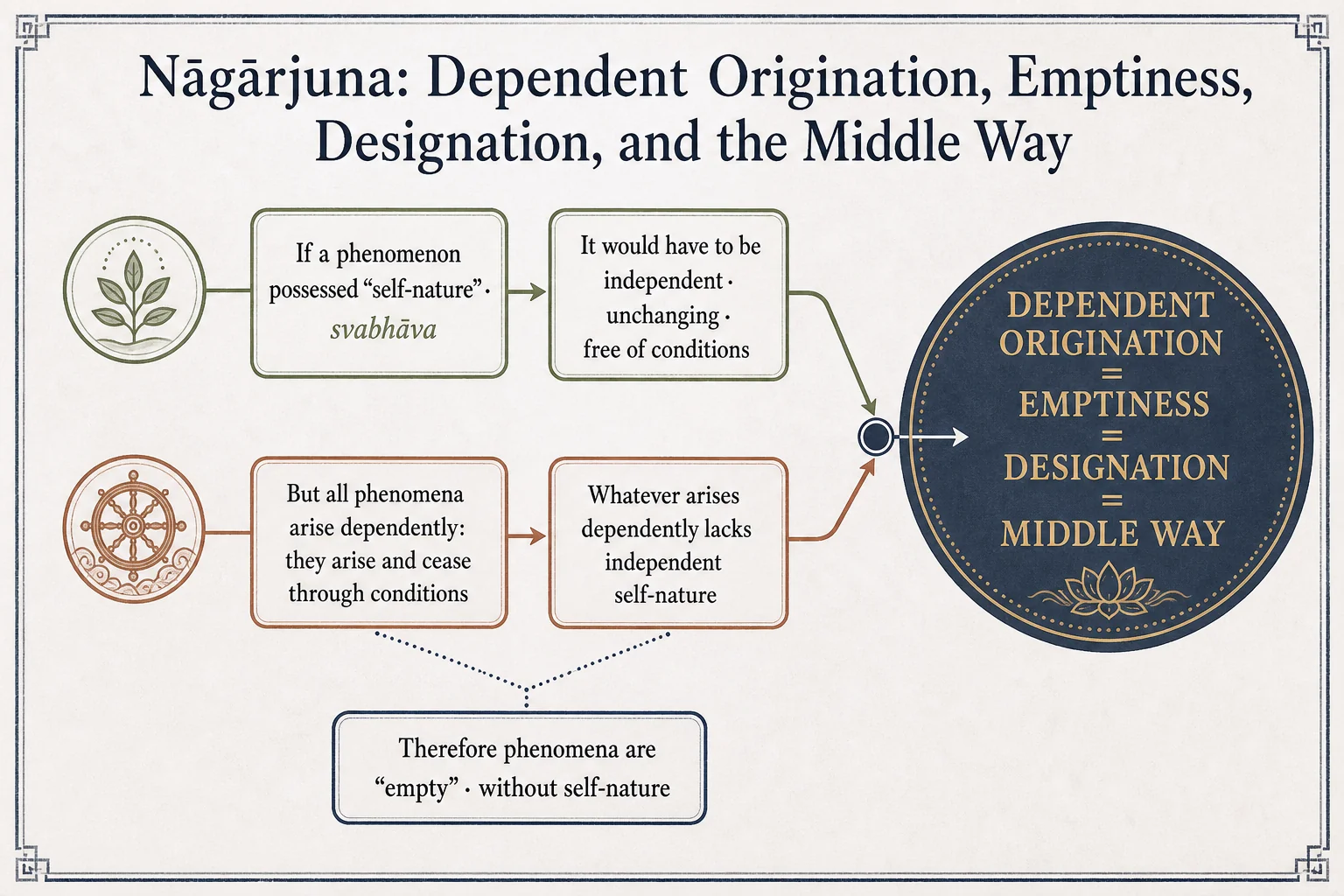
Everything turns on "intrinsic nature." It means a mode of existence that is independent, unconditioned by anything else, and permanently self-identical. Nāgārjuna argues that whatever arises through conditions, whatever is dependently arisen, cannot possess such a nature. Its existence is borrowed, relational, and subject to change. "Emptiness" therefore does not mean that nothing exists. It means that phenomena lack an independently self-subsisting intrinsic nature. Emptiness and dependent arising are two faces of one fact. Precisely because phenomena are empty of intrinsic nature, they can arise and cease through conditions and affect one another.
This step has a ready witness in the old commentaries. Expounding the corner of arising from another in the "Examination of Conditions," Piṅgala writes that since there is no self-being there is no other-being either, for where there is self-being there is other-being. Self and other are established in dependence on each other, and once the self is cancelled the other has no way to stand. The sentence states the use of a pair of words, self and other; it issues from no empirical finding about the world. Part II, Part 18, Chapter 4 takes it as the foremost classical witness for the relationality premise, which holds that whatever exists must have identity conditions involving difference and relation. The first clause in the definition of intrinsic nature is precisely that a thing is established in dependence on nothing other than itself, and the two collide head-on. The derivation of this book's central proposition sets out from this point.3
Before proceeding, the word svabhāva itself must be distinguished carefully; otherwise the Mūlamadhyamakakārikā is easily misread. It has at least two senses that should not be conflated. The first is descriptive: a thing's characteristic feature, such as heat in fire or cold in ice—what ordinary language calls its "nature." The second is ontological: a mode of existence independent and self-subsisting, dependent on no conditions. When Abhidharma says a dharma has intrinsic nature, it means that the dharma is a real, ultimate existent, self-sufficient rather than constructed from something else.
Nāgārjuna attacks the second sense, not the first. The distinction must be preserved. If he denied the first, he would produce absurd conclusions such as "fire has no attribute of heat" and dissolve conventional common sense. Critics, including some modern scholars, argue that his reasoning sometimes crosses the boundary and unintentionally slides from criticizing the second sense into denying the first. The issue lies at the center of contemporary disagreement over Nāgārjuna. This chapter only establishes the distinction; chapters 3 and 4 will return to the controversy in the context of Svātantrika and Prāsaṅgika.
The argument strikes at the foundation of Part III. Abhidharma worked to assign each "dharma" an intrinsic nature—ultimate dharmas and permanently existing dharma-natures. Nāgārjuna says that no dharma possesses one and that even the category "dharma" is empty. Part IV identified Mahāyāna emptiness as a historical response generated by the difficulty of the schools' metaphysics. The Mūlamadhyamakakārikā is the project that forged that response into a rigorous argument.
3. Method: Dismantling without Establishing
Nāgārjuna argues in an unusual way. He rarely establishes a positive thesis. He accepts an opponent's presuppositions, derives absurd consequences, and lets the claim of intrinsic nature collapse from within. Chapter by chapter, the Mūlamadhyamakakārikā criticizes ordinary concepts (motion, coming, causes, effects, time, self and aggregates, and even nirvāṇa), showing that as soon as they are assumed to possess intrinsic nature, contradiction follows. In the chapter on motion, for example, if what is moving, what has moved, and what has not yet moved each possess intrinsic nature, no coherent event of "moving" can be constructed. This consequence argument (prasaṅga) became Madhyamaka's signature method.
The twenty-seven chapters each examine a class of concepts:
| Chapter | Traditional title | Topic and central criticism |
|---|---|---|
| 1 | Examination of Conditions | The four conditions (causal, immediately preceding, object, and dominant) cannot independently produce an effect |
| 2 | Examination of Motion | If what has gone, has not gone, and is now going possess intrinsic nature, motion cannot occur |
| 3 | Examination of the Six Faculties | The eye, ear, nose, tongue, body, and mind lack intrinsic nature and cannot independently serve as subjects of seeing and hearing |
| 4 | Examination of the Five Aggregates | Form, feeling, perception, formations, and consciousness lack intrinsic nature |
| 5 | Examination of the Six Elements | Earth, water, fire, air, space, and consciousness lack intrinsic nature |
| 6 | Examination of Desire and the Desirous | Desire and the one who desires depend on one another and lack intrinsic nature |
| 7 | Examination of the Three Characteristics | The arising, duration, and cessation of conditioned dharmas cannot be established under intrinsic-nature assumptions |
| 8 | Examination of Action and Agent | Karma and the agent mutually depend on one another and lack intrinsic nature |
| 9 | Examination of a Prior Entity | Rejects the presupposition of an "inhabitant" existing before faculties and objects |
| 10 | Examination of Fire and Fuel | Uses fire and fuel to show that dependent and support cannot be established through intrinsic nature |
| 11 | Examination of Prior and Posterior Limits | Saṃsāra lacks beginning and end; temporal boundaries cannot exist intrinsically |
| 12 | Examination of Suffering | Suffering is not produced by self, other, both, or no cause and lacks intrinsic nature |
| 13 | Examination of Formations | All formations are deceptive; includes an examination of the claim of emptiness itself |
| 14 | Examination of Combination | Seer, seeing, and seen lack intrinsic nature, and "combination" cannot be established |
| 15 | Examination of Existence and Nonexistence | Directly examines intrinsic nature itself: it cannot arise from conditions or exist without conditions |
| 16 | Examination of Bondage and Liberation | Explains how bondage and liberation operate conventionally under emptiness |
| 17 | Examination of Karma | Explains karmic results under emptiness through conventionally designated continuity rather than transmission of a real intrinsic entity |
| 18 | Examination of Self and Dharmas | Self and dharmas are empty; rejects self-view without falling into annihilationism |
| 19 | Examination of Time | The three times lack intrinsic nature, and time cannot be established intrinsically |
| 20 | Examination of Cause and Effect | A combination of causes and conditions cannot produce an effect possessing intrinsic nature |
| 21 | Examination of Arising and Destruction | Production and destruction cannot be established under intrinsic-nature assumptions |
| 22 | Examination of the Tathāgata | The Tathāgata is neither the five aggregates nor different from them and possesses no fixed intrinsic nature |
| 23 | Examination of Error | A deep refutation of the four inversions, such as taking the impermanent as permanent |
| 24 | Examination of the Four Truths | The work's pivot: uses the two truths to answer the charge that emptiness destroys Buddhism; dependent arising = emptiness = designation = the middle way |
| 25 | Examination of Nirvāṇa | Nirvāṇa is not a really existing place; saṃsāra and nirvāṇa are nondual (25.19–20) |
| 26 | Examination of the Twelve Links | Every link of dependent arising is empty; echoes chapter 1 and closes the main argument |
| 27 | Examination of Wrong Views | Uses not-self to refute sixty-two eternalist and annihilationist views; the final chapter |
The table gives the "Examination of the Four Truths" only one row, but because it is the work's pivot it deserves further explanation. The chapter directly confronts the most urgent objection: "If everything is empty, the Three Jewels, Four Truths, saṃsāra, and liberation do not exist; Nāgārjuna, you are destroying Buddhism." It answers on three levels.
First, it corrects the misunderstanding. Emptiness is not "nonexistence" but "lack of intrinsic nature." It is another expression for dependent arising and does not deny that things exist.
Second, it establishes the ladder of the two truths: "Without relying on conventional truth, the ultimate cannot be taught; without attaining the ultimate, nirvāṇa is not attained." Conventional truth is a stairway to ultimate truth, not a switch between two parallel worlds. Suffering, origin, cessation, and path can be discussed, the path practiced, and fruition attained only from the conventional level. The ultimate cannot be approached without it.
Third, it turns the objection back on the opponent. If dharmas possessed fixed intrinsic nature, everything would be frozen and incapable of change. Suffering could neither arise nor cease, the path could not be practiced, and results could not be transformed. That would genuinely destroy Buddhism. "Because emptiness is possible, all dharmas are possible; without emptiness, nothing is possible."
These three responses were repeatedly invoked for centuries within Madhyamaka. Candrakīrti, Śāntideva, and Tsongkhapa all treated this chapter as a principal authority.
Nāgārjuna also repeatedly employs the tetralemma (catuṣkoṭi) to deny propositions. A thing is, is not, both is and is not, or neither is nor is not: all four alternatives are rejected, leaving no position on which to stand.
Most importantly, Nāgārjuna claims that he has no position. In the Vigrahavyāvartanī he states that if he held a thesis, an assertion of intrinsic nature, he would be at fault; since he has no thesis, no fault applies.4 Whether this "no-position" stance truly avoids every philosophical risk will be examined in Volume II. Emptiness is not another substance or an annihilationist claim that "nothing exists." It is the act of relinquishing every view. Nāgārjuna therefore warns that emptiness itself must not be grasped as a view: "The great sages taught emptiness to relinquish all views; those who take emptiness as a view are declared incurable."5 This is the recurring "emptiness too is empty" of 3.1 and 1.5. The medicine must be discarded, or it becomes another illness.
4. The Two Truths: Emptiness Does Not Destroy the World
In the Mūlamadhyamakakārikā, Nāgārjuna's imagined opponent objects that if everything is empty, the Four Truths, karmic results, practice, and the path all disappear. This destroys Buddhism.
Nāgārjuna replies with the two truths (satya-dvaya):
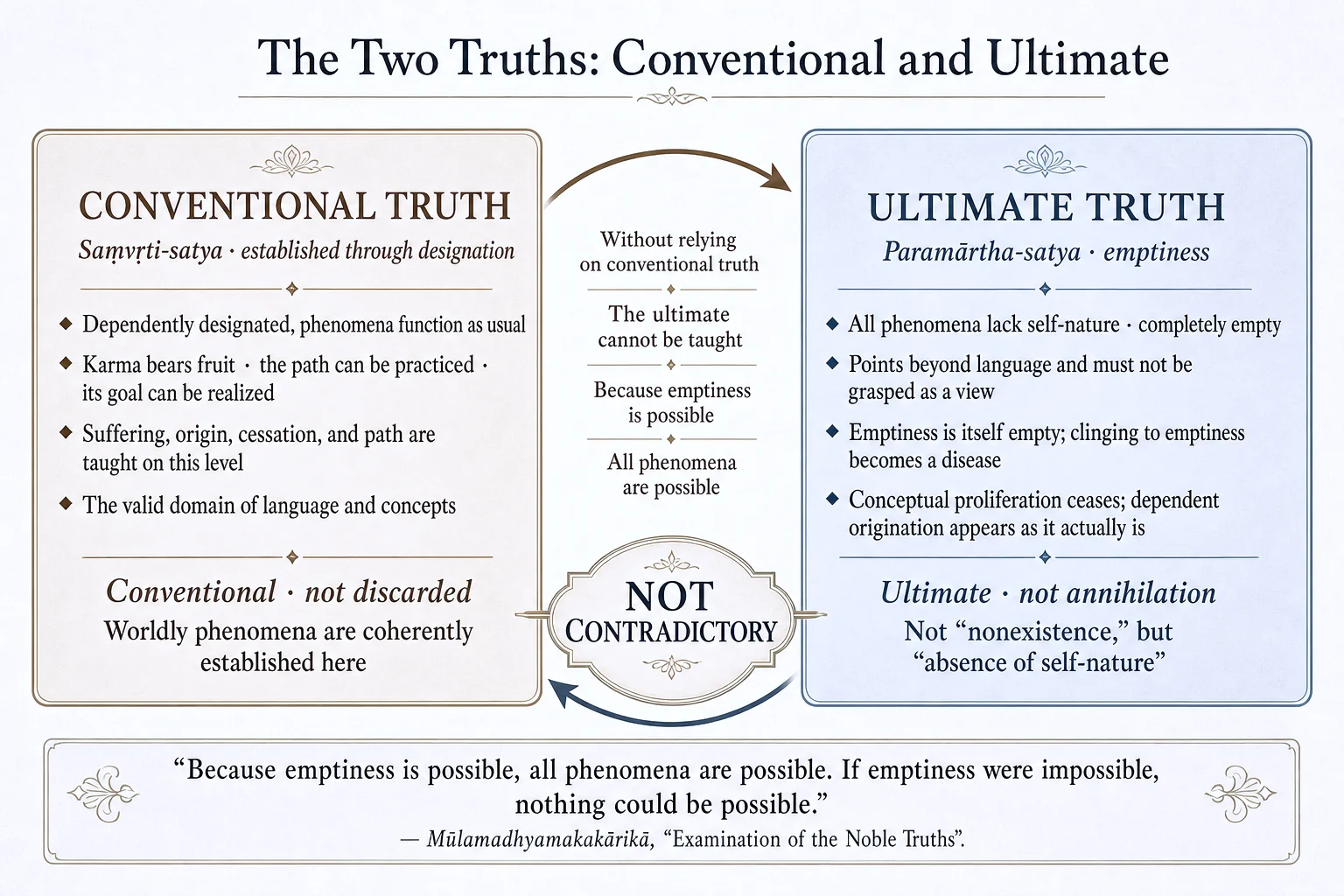
This book's notation is fixed here. What the two truths divide is levels of assertion, not two worlds. There is one world and two levels of speech: conventional truth registers the legitimacy of assertions at the everyday level and at the level of names and conventions, while ultimate truth registers the metaconstraint on intrinsic nature itself. The reading that takes the two truths for two domains of objects is called the two-domains reading in Part II, Part 19, Chapter 6, and is ruled out there; the reason is that every resident of the second domain falls back within the scope of assertions of intrinsic nature and is refuted under the rule.6
He turns the accusation around: "Because emptiness is possible, all dharmas are possible; without emptiness, nothing is possible."5 If phenomena truly possessed fixed and unchanging intrinsic nature, they could not move, change, or arise through a conjunction of conditions. Nothing could happen. Precisely because they are empty (without intrinsic nature), arising and cessation, causality, practice, and the path can function. Far from destroying the world, emptiness is the condition that makes it possible. In this book's view, the two truths are Madhyamaka's lifeblood. They make "everything is empty" and "karma, the path, and liberation still function" true at once and rescue emptiness from annihilationism.
The middle line must still be preserved. Grasping intrinsic existence is eternalism; misreading emptiness as "nothing exists" is annihilationism. Madhyamaka adopts neither. This is the "middle way," another development of the Buddha's path between existence and nonexistence in the Kaccānagotta Sutta discussed in 1.5. Nāgārjuna explicitly cites the discourse.
5. What Is It Doing? Historical Position and Liberation
Nāgārjuna's Madhyamaka performs two tasks.
Internally, against the schools, it systematically negates. It dissolves the system of intrinsic natures laboriously constructed by Abhidharma at the level of its presuppositions. It denies the premise that "a carrier must be a really existing thing with intrinsic nature" rather than adding another carrier to the problem of continuity without a self. This is the historical exit repeatedly indicated in Part III.
Toward its source, the Buddha, it presents itself as a return. Nāgārjuna explicitly cites the Kaccānagotta Sutta and connects Madhyamaka with the Buddha's middle way of dependent arising beyond existence and nonexistence. In this book's view, Madhyamaka can be understood as an attempt to forge the restraint of 1.5 (establish no fixed doctrine and avoid conceptual proliferation) into an operative discipline for dismantling attachment, replacing silence with fierce consequence arguments.
The liberation theory of the Mūlamadhyamakakārikā culminates in the cessation of conceptual proliferation (prapañcanirodha). Prapañca is the mind's operation of automatically conceptualizing and reifying objects and producing from them attraction, aversion, selection, and rejection. Every "this is X," "X is good," and "I want X" is conceptual proliferation. The implications for liberation in the Mūlamadhyamakakārikā, especially the chapters on the Four Truths and nirvāṇa, can be organized into the following sequence. This is the interpretive framework this book infers from the text rather than a direct account from an authoritative secondary source; scholarship disagrees about the precise path, and readers may check the references against the text.
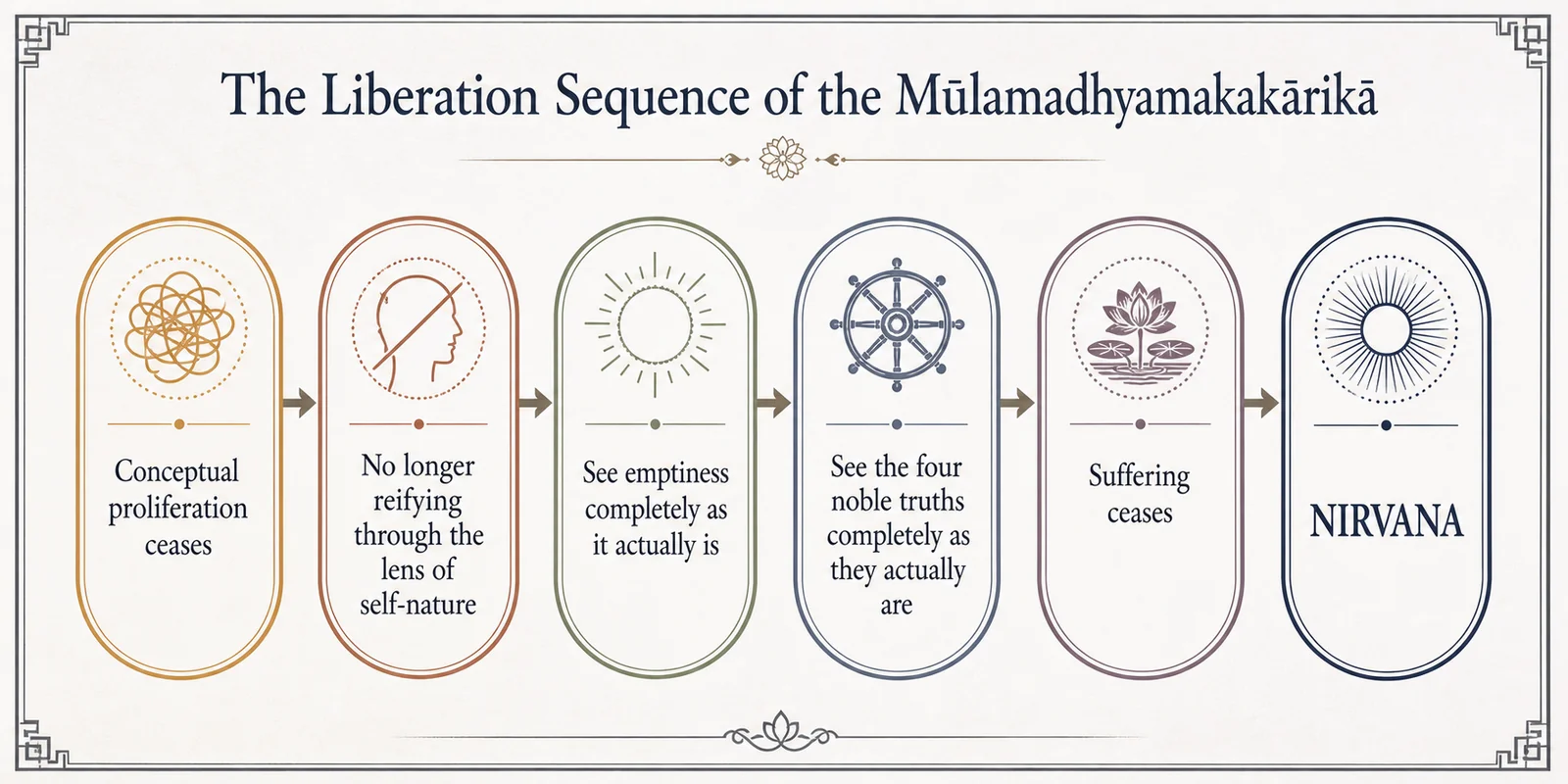
In this sequence, nirvāṇa is not a separate state to be sought elsewhere. When the multiplication of conceptual grasping ceases and reality appears, that is nirvāṇa. Hence one of the work's most famous declarations:
There is not the slightest difference between nirvāṇa and saṃsāra; there is not the slightest difference between saṃsāra and nirvāṇa. ("Examination of Nirvāṇa," 25.19–20)5
This is the "nonduality of saṃsāra and nirvāṇa." The difference lies not in two levels within the world itself but in whether the observer views it through intrinsic nature.
A comparison with modern philosophy may aid understanding, without implying historical influence. Nāgārjuna's method of "dismantling without establishing" and holding "no position" has often been compared to Wittgenstein. At the end of the Tractatus, those who understand his propositions recognize them as nonsensical and throw away the ladder after climbing it; later Wittgenstein approaches philosophical problems therapeutically, dissolving rather than answering them. Both resemble Madhyamaka consequence arguments and the ideas that "emptiness too is empty" and the raft should be abandoned after crossing. Pyrrhonian skepticism, which suspends every assertion, supplies another comparison. A strong modern reading can be proposed: ultimate truth (paramārtha-satya) is a semantic metaconstraint. It supplies no positive content, only a prohibition: every assertion of intrinsic nature becomes self-contradictory at this level and is therefore "empty." It establishes a boundary condition for language, not a substance. It does not tell us "what the world is" but stipulates that "nothing can be asserted about intrinsic nature without contradiction." This reading comes closest to a Wittgensteinian "unsayable." Madhyamaka says that its purpose is liberation and the cessation of grasping, not doubt for its own sake; this distinguishes it from simple skepticism or analytic dissolution.
This strong reading receives a formal execution in Part II of this book. Part 18, Chapter 5 writes it out as three clauses of hierarchy. A clause of domain of application stipulates that the quantifier of the metaconstraint ranges over object-level assertions of intrinsic nature and over nothing else. A clause of the inventory of resources states that the metaconstraint's own standing draws on no more than the definitions, logic, and a single analytic truth, and requires no really existent thing to stand behind it. A clause of the exit for self-application handles the reifying reading of its own name. The term "metaconstraint" is set up in this chapter, and Part II keeps it for the same thing throughout; Part I supplies its philosophical placing, Part II its formal clauses.7
In formal terms, the metaconstraint is:
Ultimate analysis(X) ≡ emptiness, where the range of X is every object-level assertion that something possesses intrinsic nature.
"Emptiness too is empty" states exactly this metaconstraint's exit for self-application, and the direction must be got right. The metaconstraint itself does not fall within the range of X: it issues intrinsic nature to nothing and merely rejects the assertions that issue it. The legitimacy of the step rests on no exemption cut for its benefit. The range clause already places outside the scope every utterance that asserts no intrinsic nature, and statements at the level of logic and of conceptual grammar are all among them; the metaconstraint is excluded by that same clause and receives no separate dispensation. Were its exclusion to depend on an exception carved to its measure, the whole division into levels would be demoted to a privilege.
What "emptiness too is empty" actually rejects is the reading that takes the name "emptiness" for a thing possessed of intrinsic nature. To say that there is a thing called emptiness, that it does not break up under analysis, that it is established in dependence on nothing else, is a standard assertion of intrinsic nature and stands among what is refuted under the rule. Part II, Part 18, Chapter 5 sets this down as clause (c) of the hierarchy and records expressly that what is rejected is the reifying reading and not the metaconstraint itself.7
Modern scholarship substantively disagrees over what Nāgārjuna means. Several major interpretations are listed for reference:
| Interpretation | Central position | Representative scholar or tradition |
|---|---|---|
| Anti-essentialism | Denies only independent, self-subsisting intrinsic nature, not the relative existence of phenomena; clearly separates two levels of assertion | Garfield and Siderits, in an analytic-philosophical line |
| Relationalism | Every dharma exists relationally and has no independent property, but relation itself is real | Some recent English-language scholarship |
| Candrakīrti/Prāsaṅgika | Emptiness is thorough: even conventionally, no "truly existent" inherent feature exists; ordinary properties too are only conventions | Candrakīrti and later mainstream Tibetan traditions |
| Therapeutic dissolution | Nāgārjuna aims to undo philosophical views rather than establish ontology; closest to early Buddhist practice | Kalupahana and some pragmatist readings |
This book is closest to the anti-essentialist reading, which it finds most compatible with Nāgārjuna's text and the two-truths framework. Yet the Candrakīrti tradition dominates Tibetan systems of practice and is internally coherent; chapters 4 and 5 will examine its controversy in detail.
A common Mahāyāna practice posture can be discussed in passing. Nāgārjuna's theory supplies an internal logic for the high value placed on nonconceptual knowledge (nirvikalpa-jñāna). Buddhas are said to remain in the perspective of ultimate truth, seeing all dharmas as empty without intrinsic distinctions and making no discrimination toward objects. The cessation of conceptual proliferation means no longer automatically ontologizing objects or dividing them into higher and lower, good and bad. The more practitioners maintain a nonconceptual mind, the closer they come to the cessation of proliferation and thus to liberation in Madhyamaka theory. This is awareness without grasping through intrinsic nature, not the indifference that "nothing matters."
Finally, an introductory intuition may help, though it cannot replace the systematic argument of the Mūlamadhyamakakārikā. Starting from the emptiness of dependent arising, every thing, concept, and phenomenon depends on its parts, maintainers, contrasts, makers, and even on what it maintains or produces in order to be "itself." Each dependency then depends in the same layered way. This is the philosophical intuition behind the image of Indra's net. But it is only an intuition, not a proof. It does not show whether the dependency chain converges (whether something ultimately depends on itself) or exclude the existence of an independent subgraph, a locally self-sufficient system. Precisely because of these gaps, the chapter-by-chapter arguments of the entire Mūlamadhyamakakārikā cannot be omitted.
The next chapter examines Āryadeva and early Madhyamaka, followed by Madhyamaka's methods of argument and its internal division between Svātantrika and Prāsaṅgika. One concern should be anticipated: to call everything empty while claiming to hold no position easily invites the objection that the view collapses into nihilism or makes speech impossible. Yogācāra consciousness-only would develop an alternative path in part to provide emptiness with a more reliable ground (Part VI).
References
References
-
Joseph Walser. Nāgārjuna in Context: Mahāyāna Buddhism and Early Indian Culture. New York: Columbia University Press, 2005. ↩
-
David Seyfort Ruegg. The Literature of the Madhyamaka School of Philosophy in India. Wiesbaden: Harrassowitz, 1981. ↩
-
Mūlamadhyamakakārikā, fascicle one, Piṅgala's commentary on MMK 1, the "Examination of Conditions" (T1564): "Since there is no self-being, there is no other-being either. Why? Because where there is self-being there is other-being." The formal entry of this comment as the classical witness for the relationality premise is in Part II, Part 18, Chapter 3 (filing) and Chapter 4 (service). ↩
-
Mark Siderits and Shōryū Katsura. Nāgārjuna's Middle Way: Mūlamadhyamakakārikā. Boston: Wisdom Publications, 2013; for "no position," see Vigrahavyāvartanī 29. ↩
-
Jay L. Garfield. The Fundamental Wisdom of the Middle Way: Nāgārjuna's Mūlamadhyamakakārikā. New York: Oxford University Press, 1995. (Translation and commentary, including verses 24.18, 24.14, 13.8, and 25.19–20.) ↩↩↩↩
-
The formal placing of the two truths is in Part II, Part 18, Chapter 6, "The Preservation Theorem," which rules that what the two truths divide is levels of assertion and not two worlds. The removal of the two-domains reading is decided in Part II, Part 19, Chapter 6, "The Two Truths Debate." ↩
-
Part II, Part 18, Chapter 5, "Self-Application and Immunity." That chapter writes this metaconstraint of ultimate truth as three clauses of hierarchy (domain of application, inventory of resources, exit for self-application) and fixes "emptiness too is empty" as clause (c): what is rejected is the reifying reading of the name of emptiness. ↩↩