Chapter 5 Candrakīrti and Prāsaṅgika Madhyamaka
The preceding chapter clarified the disagreement between Buddhapālita and Bhāviveka and identified the unresolved tension beneath it: at what level does ultimate analysis itself belong? Candrakīrti, around the seventh century, became the final adjudicator of the controversy, at least in later Tibetan classification. Siding with Buddhapālita, he gave the most systematic defense yet of the consequence method and constructed a complete philosophical system for Prāsaṅgika Madhyamaka. This chapter develops his arguments in detail.
1. Candrakīrti and His Works
Biographical information remains scarce. Tibetan sources say that he was born at Samanta in southern India and served as abbot of Nālandā. Legends in which he rides a painted cow or provides curds for the monastery are naturally not historical. The approximately reliable facts are that he was active in the early to middle seventh century, roughly contemporary with Dharmakīrti, was familiar with the Yogācāra and epistemological traditions then flourishing, and wrote extensively against Bhāviveka and Yogācāra thinkers.1
Two works are most important.
The Madhyamakāvatāra uses the ten bodhisattva grounds as a framework for a systematic presentation of Madhyamaka. The first five grounds receive brief treatment; the sixth, the Face-to-Face, contains by far the longest exposition of emptiness; later grounds culminate in nonconceptual knowledge and liberation. This is Candrakīrti's representative philosophical work and later became one of Tibetan Buddhism's central Madhyamaka textbooks.
The Prasannapadā is a commentary on the Mūlamadhyamakakārikā and the only complete Sanskrit commentary on that text to survive. Candrakīrti criticizes Bhāviveka's interpretation chapter by chapter, defends Buddhapālita, and states most clearly why Madhyamaka cannot offer autonomous arguments.2
His other works include commentaries on the Yuktiṣaṣṭikā, Śūnyatāsaptati, and Catuḥśataka, surviving only in Tibetan.
2. The Complete Logic of Consequence: Why Autonomous Argument Fails
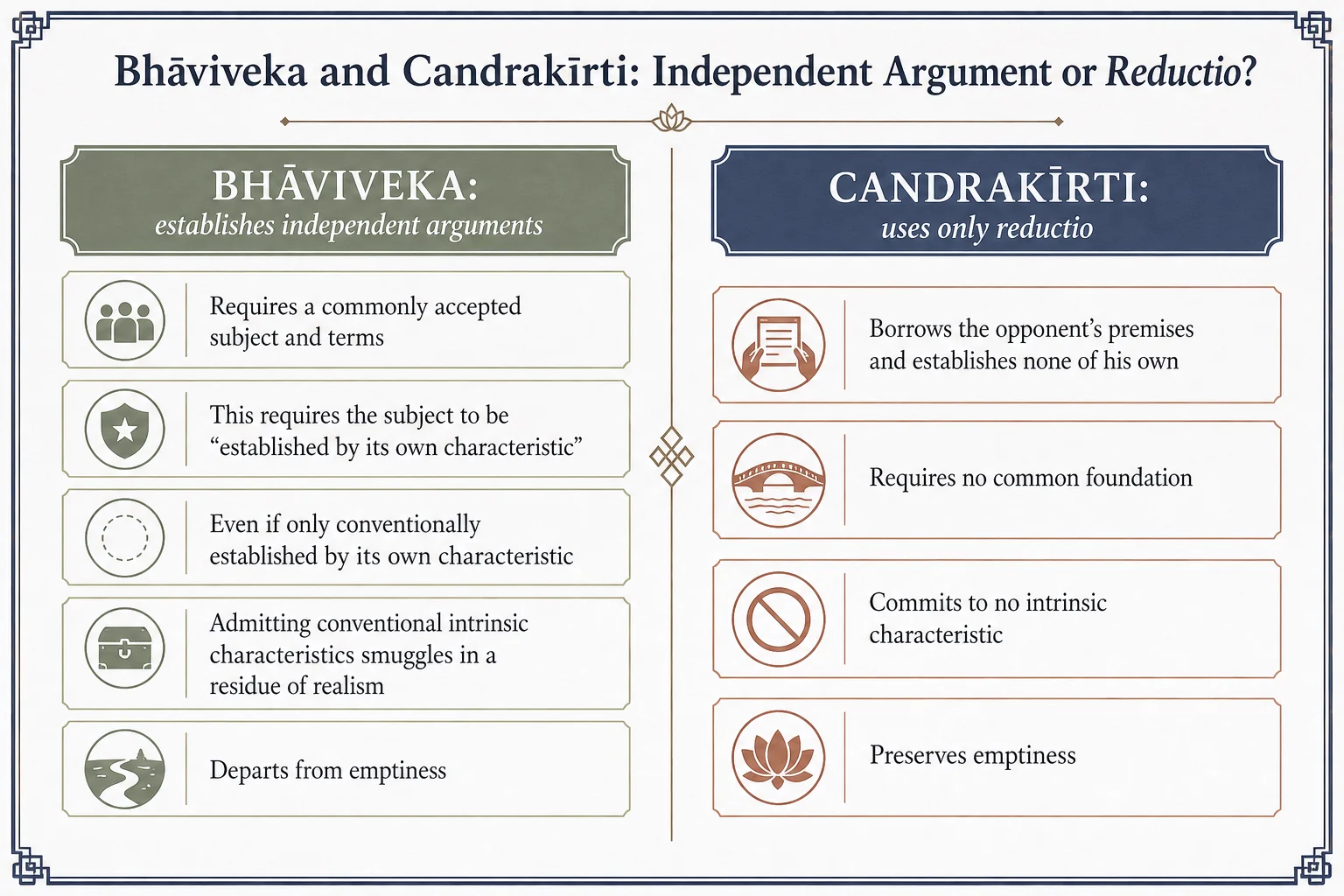
The previous chapter identified Candrakīrti's central criticism of Bhāviveka. An autonomous argument requires both sides to regard its terms and subject as "established by a valid instrument of knowledge." Madhyamaka holds that everything lacks intrinsic nature and accepts nothing as established by its own characteristic, even conventionally. Bhāviveka's conventional own characteristic retains a residue of realism. Here the argument is expanded in its complete structure.
Bhāviveka appealed to Dignāga's logical standards. A complete inference must contain a proposition, reason, and example, and the terms used in the proposition and reason must already be established for both parties by direct perception or inference—that is, by an accepted valid instrument of knowledge. Bhāviveka's argument that "dharmas lack intrinsic nature" has roughly this form: the reason is "because they arise dependently," a pot supplies the example, and the proposition is "ultimately, dharmas lack intrinsic nature." The problem is that if the subject, "dharmas," must be established by a valid instrument, cognition must confirm dharmas as a shared object of debate. Under Dignāga's epistemology, such cognition must rest on an own characteristic of the object.
Dignāga and his successor Dharmakīrti, around the seventh century, formed the main line of Indian Buddhist epistemology. Philosophically they belong to Yogācāra and will receive detailed treatment in Part VI. The tradition's core terms are introduced here to clarify Candrakīrti's target:
| Term | Sanskrit | Meaning | Treatment by Dignāga and Dharmakīrti |
|---|---|---|---|
| Valid instrument of knowledge | pramāṇa | A valid means or route of cognition; source of all valid knowledge | Only two are recognized: direct perception and inference; all knowledge must be established through them |
| Direct perception | pratyakṣa | Immediate, nonconceptual awareness | Takes the object's own characteristic (svalakṣaṇa) as its basis; the object presents that characteristic directly to the senses |
| Inference | anumāna | Reasoning from known facts to the unknown | Operates through the object's general characteristic (sāmānyalakṣaṇa), a conceptual commonality; the inferred object is conceptually constructed |
| Own characteristic | svalakṣaṇa | The object's unique particularity, irreducible to concepts | Immediate object of direct perception; only own characteristics really exist, while general characteristics are conceptual products |
| General characteristic | sāmānyalakṣaṇa | The common property corresponding to a concept, such as "potness" | Object of inference; constructed by cognition rather than independently real |
Candrakīrti's criticism focuses here. By invoking Dignāga's pramāṇa standards to present an autonomous argument, Bhāviveka must accept some degree of establishment for the own characteristics known in direct perception, even if only conventionally. Candrakīrti regards the concession as a residue of realism.
His reply is that an epistemological structure has been imposed on Madhyamaka. Dignāga's system of instruments of knowledge, including its claim that cognition must rest on the object's own characteristic, is itself an object of Candrakīrti's criticism. To use Dignāga's standards inside Madhyamaka is first to accept the premise that cognition has a basis in own characteristics, although that premise is precisely what must be examined and cannot serve as common ground.2
A detail deserves attention. Bhāviveka does not claim that own characteristics exist in the Sarvāstivāda manner. He speaks of "own characteristics established by convention" (vyāvahārika-svalakṣaṇa), existent only at the conventional level rather than ultimately. Candrakīrti regards the qualification as insufficient. As soon as one admits conventional own characteristics, even with the word "conventional," one says that something is itself through a degree of self-establishment at that level. This is exactly what emptiness analysis rejects. "Conventional own characteristic" softens the wording without removing the realist presupposition beneath it.3
Candrakīrti's logic of consequence therefore has two layers.
The first is methodological. Consequence accepts only premises acknowledged by the opponent and derives a conclusion that the opponent cannot accept. Madhyamaka establishes no thesis and therefore needs no shared terms or own characteristics. The argument's power comes from the opponent's own position. The opponent's premise is defective; Madhyamaka does not replace it with a superior theory.
The second is ontological. Madhyamaka can use only consequence because emptiness thoroughly forbids admitting that anything is established by an own characteristic. Were Madhyamaka to propose an autonomous argument, it would need shared ground. Anything capable of serving as shared ground introduces a commitment that "this thing is sufficiently self-established to be mutually acknowledged." Such a commitment is incompatible with emptiness.
3. Establishment through Designation: Candrakīrti's Conventional Truth
If consequence only refutes and establishes nothing, how do things exist conventionally? Candrakīrti supplies a Prāsaṅgika theory of conventional truth.
His answer is that conventional things exist through designation alone (prajñaptimātra), conceptual labeling, without any own characteristic beneath them. A chariot does not exist through an entity called "chariot-nature," nor because it presents its own characteristic to the senses. It depends on wheels, body, axle, and other parts and on the conventional use of the word "chariot." On this basis a thing called a chariot is designated.4
Candrakīrti systematizes the intuition through a sevenfold analysis (saptadhā yukti), again using a chariot. If it possessed intrinsic nature, the relationship between chariot and parts must be one of seven kinds: (1) the chariot is identical with its parts; (2) it differs from its parts; (3) it depends on its parts; (4) its parts depend on it; (5) it possesses its parts; (6) it is the collection of its parts; or (7) it is the shape of its parts. Each fails. If chariot and parts are identical, any single part is the chariot and a wheel alone becomes a chariot. If they differ, after removing every part an independent "chariot itself" should remain, but none can be found. If parts depend on chariot, the chariot must exist independently before the parts, which again cannot be found. The remaining alternatives fail by parallel arguments.
The purpose is exhaustive: every place in which an "intrinsically existent chariot" might be located is eliminated. The conclusion is that the chariot genuinely exists, but only as something designated on the basis of its parts within a conventional framework. No "chariot itself" exists independently of them. Tsongkhapa later applied the analysis widely to attachment to a personal self. Replace "chariot" with "person" and "parts" with "five aggregates." The seven arguments again show that no self can be located under intrinsic analysis, while a conventionally designated "I" still exists dependently on the aggregates and ordinary language continues to function.
The theory must answer an urgent question: how is causality preserved? If everything is only designated and lacks intrinsic nature, what does "A produces B" mean? Candrakīrti treats causality as designated too. "A is the cause of B" is a conventional label for temporal sequence and stable covariation. It requires no metaphysical "substantial transfer" between intrinsically real A and B. This fundamentally differs from Dharmakīrti, for whom reliable inference depends on an "intrinsic connection" (svabhāvapratibandha) between cause and result, grounded in their own characteristics. Candrakīrti reduces causality to convention rather than own characteristics. A doctrinal analogy with Hume may help, without implying historical influence. Hume analyzes causation through constant conjunction rather than logical necessity; Candrakīrti analyzes it as conventional designation rather than intrinsic transmission. Both refuse to seek an ontological foundation for causality beyond convention, though their motives differ. The cost resembles that of his conventional truth overall: causal efficacy is ultimately anchored in conventional agreement without metaphysical support.
One crucial difference warrants careful explanation:
| Bhāviveka, Svātantrika | Candrakīrti, Prāsaṅgika | |
|---|---|---|
| How conventional things are established | Own characteristics established by convention (vyāvahārika-svalakṣaṇa): conventionally things possess a characteristic sufficient as a foundation for argument, though not ultimate reality | Designation alone (prajñaptimātra): no own characteristic, even conventionally |
| Does conventional cognition have a basis in valid instruments? | Yes; following Dignāga in part, conventional cognition rests on conventionally established own characteristics | Yes, but the objects of valid conventional cognition are designated and rest on no own characteristics |
| Attitude toward epistemology | Partially accepts Dignāga's framework at the conventional level | Criticizes the epistemological foundation of Dignāga and Dharmakīrti, especially self-cognition |
Candrakīrti distinguishes two conventions: accurate convention (tathya-saṃvṛti) and false convention (mithyā-saṃvṛti). Accurate convention is cognition accepted by the world (loka-prasiddha): healthy senses encounter a normal object and produce a perception under conventions shared by ordinary people. False convention consists of hallucinations, dreams, and erroneous perceptions that fail even by conventional standards. A chariot is an accurate convention: people with normally functioning senses see it and commonly call it a "chariot." A chariot in a hallucination is a false convention.3
The essential point is that Candrakīrti judges conventional cognition by worldly shared convention, not by "the object's presentation of its own characteristic to the senses." This bypasses Dignāga's premise that cognition must rest on an object's own characteristic and defends conventional knowledge through a more elementary standard: this is how the world commonly recognizes things.
The strategy has a price. Dependence on worldly agreement means that conventional truths are customary, varying across times and communities, rather than universally true in an epistemological sense. Candrakīrti appears to accept this consequence. Convention is convention. Its validity comes not from a guarantee beyond convention but from the stability of practices within a community. This sharply differs from ultimate truth. Ultimate emptiness analysis breaks all conventional reifying presuppositions, while conventional agreement supplies the language and practice through which life continues after attachment is dismantled.
Candrakīrti's account is a serious attempt, but in this book's view it does not resolve the tension between conventional and ultimate truth. Rather, it reveals the tension again in a more refined form. Once conventional truth rests on "worldly shared practices" while ultimate emptiness analysis itself must use conventional language and inference, the question of their status has only been postponed. Emptiness reveals that convention lacks intrinsic nature, but the revelation depends on the same convention. Candrakīrti does not break the circle, and his framework does not seek to. It states that within the circle, worldly agreement is enough and no more is needed.
The circle is handled in Part II of this book, and the method is to change the anchor. Part II, Part 19, Chapter 7 points out that what supports the argument is not the class of conventions that vary with the age and the community, but a few public instruments of convention: the use of same and different, the procedure of individuation, the law of non-contradiction. They are inventoried under clause (b) of the hierarchy in Part 18; realists and Madhyamikas have used them in common from the beginning, and the two parties' own centuries of debate are the receipt for that use. Take the public instruments for what is commonly admitted, and Candrakīrti's prohibition against making a dharma-substance the basis of a thesis can stand together with the positive force Bhāviveka wanted.5
Part II, Part 18, Chapter 6 handles the other half of the circle, that the analysis of emptiness must itself be conducted in conventional language and inference. On the strength of Piṅgala's comment that the ultimate meaning is in every case had by way of speech, and speech is conventional, that chapter rules that the ultimate must be spoken from the conventional, and that the conceptual grammar and logic employed at the meta-level are themselves instruments of the conventional level. This is the design of the two-truths framework and not a hole in it.5
4. Criticism of Yogācāra: Consciousness Likewise Lacks Intrinsic Nature
Candrakīrti's criticism of Yogācāra is concentrated in chapter 6 of the Madhyamakāvatāra.6
The basic Yogācāra position is that external objects, the material world, do not really exist; only consciousness (vijñāna) exists. Every so-called external object is a transformation of consciousness (vijñāna-pariṇāma). Yogācāra adopts this view to solve a realist difficulty. If external objects exist independently of consciousness, how can they be known with certainty? Treating the external object as content of consciousness directly removes the epistemological problem.
Candrakīrti sees Yogācāra as realism facing the other direction. Replacing "external objects possess intrinsic nature" with "consciousness possesses intrinsic nature" does not eliminate the presupposition of an intrinsically existent thing; it merely moves reality from the object into consciousness. Emptiness analyzes self-establishment itself and does not care whether what supposedly self-establishes is external matter or consciousness.6
His attack has several points.
First, consciousness cannot know itself. Yogācāra accepts reflexive awareness (svasaṃvedana): when consciousness knows an object, it simultaneously illuminates itself. Consciousness thereby certifies its own existence without a second consciousness. Candrakīrti replies that a knife cannot cut itself, a finger cannot touch itself, and consciousness likewise cannot know itself. Cognition is a relation directed toward another; if its object is itself, the relation cannot be established. Reflexive awareness is incoherent in its logical structure and cannot ground the self-certification of consciousness.2
Second, the establishment of consciousness by its own characteristic is itself an object of emptiness analysis. Candrakīrti's logic is thorough. Anything claimed to possess intrinsic nature, whether material or mental, is a target of consequence. To say that consciousness is established by an own characteristic encounters exactly the same emptiness analysis as a claim that an external object is so established. Yogācāra thinks that moving reality from the object to consciousness makes it safe; Candrakīrti sees no difference.
Third, Yogācāra complicates the explanation of common sense. Candrakīrti argues that the direct statement "I see a cup; the cup is dependently assembled, designated, and conventionally established" is simpler than the Yogācāra account: "what I see is actually a cup-image transformed by consciousness, and consciousness alone is real." The latter takes a longer route without gaining explanatory power.4
The criticism shows that Prāsaṅgika is both a technical view about method and a thorough ontological critique. Material, mental, or epistemological—anything claimed to be established with intrinsic nature is eliminated. Bhāviveka permits conventionally established own characteristics and therefore leaves Yogācāra room to claim that consciousness has only a conventional own characteristic. Candrakīrti admits no conventional own characteristic and includes the response within his criticism. Does this end the debate? This book thinks not. Yogācāra offers deeper arguments for the reality of consciousness; Candrakīrti hits one part of the system without necessarily settling the controversy. Part VI returns to it.
5. The Two Truths Reconsidered: Candrakīrti's Solution and the Residual Tension
The preceding chapter left a question: does the ultimate analysis of dharmas itself belong to conventional or ultimate truth? Candrakīrti answers explicitly, but the answer does not eliminate the tension completely.
He says that the operation of emptiness argument (including consequences, conceptual analysis, and statements that "everything lacks intrinsic nature") is a conventional activity. Philosophers use language and concepts conventionally to lead listeners to see something. What is seen, emptiness, is the "indicated" object at the ultimate level, while the act of expression occurs conventionally. Ultimate truth is not another territory or higher content. It resembles a negative boundary condition: whatever is established through intrinsic nature cannot be established ultimately. Conventional argument reveals that boundary condition.3
The answer is coherent within Prāsaṅgika. It avoids two extremes. It does not elevate emptiness analysis into discourse occurring at the ultimate level, which would turn emptiness into an intrinsically real claim about the ultimate. Nor does it leave emptiness merely conventional, because emptiness is not a customary agreement but applies everywhere and at every time.
Internal coherence does not dissolve the tension. It remains here:
The concepts used in consequences (intrinsic nature, dependent arising, designation) are themselves products of designation; Candrakīrti agrees. Does the analysis conducted with designated concepts apply to itself? If "designation" is itself designated, on what does its use in analyzing the absence of intrinsic nature depend? Candrakīrti says that it depends on conventional agreement. People use these concepts, and inferences using them are conventionally valid. But this ultimately anchors the force of ultimate emptiness analysis in conventional agreement, which varies and is customary. This is less an oversight than the price Prāsaṅgika pays. The more thoroughly it preserves the lack of intrinsic nature, the more it must finally assign the validity of every argument to convention. Convention has no deeper metaphysical support; it simply functions through shared worldly practice.
This book's judgment is that Candrakīrti carries the treatment of the two-truths tension as far toward internal coherence as Prāsaṅgika can go. But if someone asks "why is convention itself valid?" Candrakīrti supplies no metaphysical answer. He would say that the question has passed beyond any meaningful scope because "meaningful question" itself is a product of worldly convention. This is both the strength and the limitation of his position.
6. The Madhyamakāvatāra: Joining Emptiness and the Bodhisattva Path
The structure of the Madhyamakāvatāra joins the philosophy of emptiness with the ten bodhisattva grounds. The combination is not decorative; it has an internal logic.
The ten grounds form the work's spine, and the argument for emptiness is placed at the sixth, the Face-to-Face ground (abhimukhī-bhūmi). Why there? In traditional classifications, the sixth ground perfects prajñāpāramitā and directly sees emptiness. Candrakīrti uses it as an anchor. The first five grounds present the bodhisattva's preliminary practices—generosity, discipline, patience, diligence, and meditation. Only at the sixth does emptiness receive full development; the later grounds express the fruition of compassion and wisdom operating together.
Arguments for emptiness are concentrated in chapter 6, far longer than all others. Its structure can be summarized:
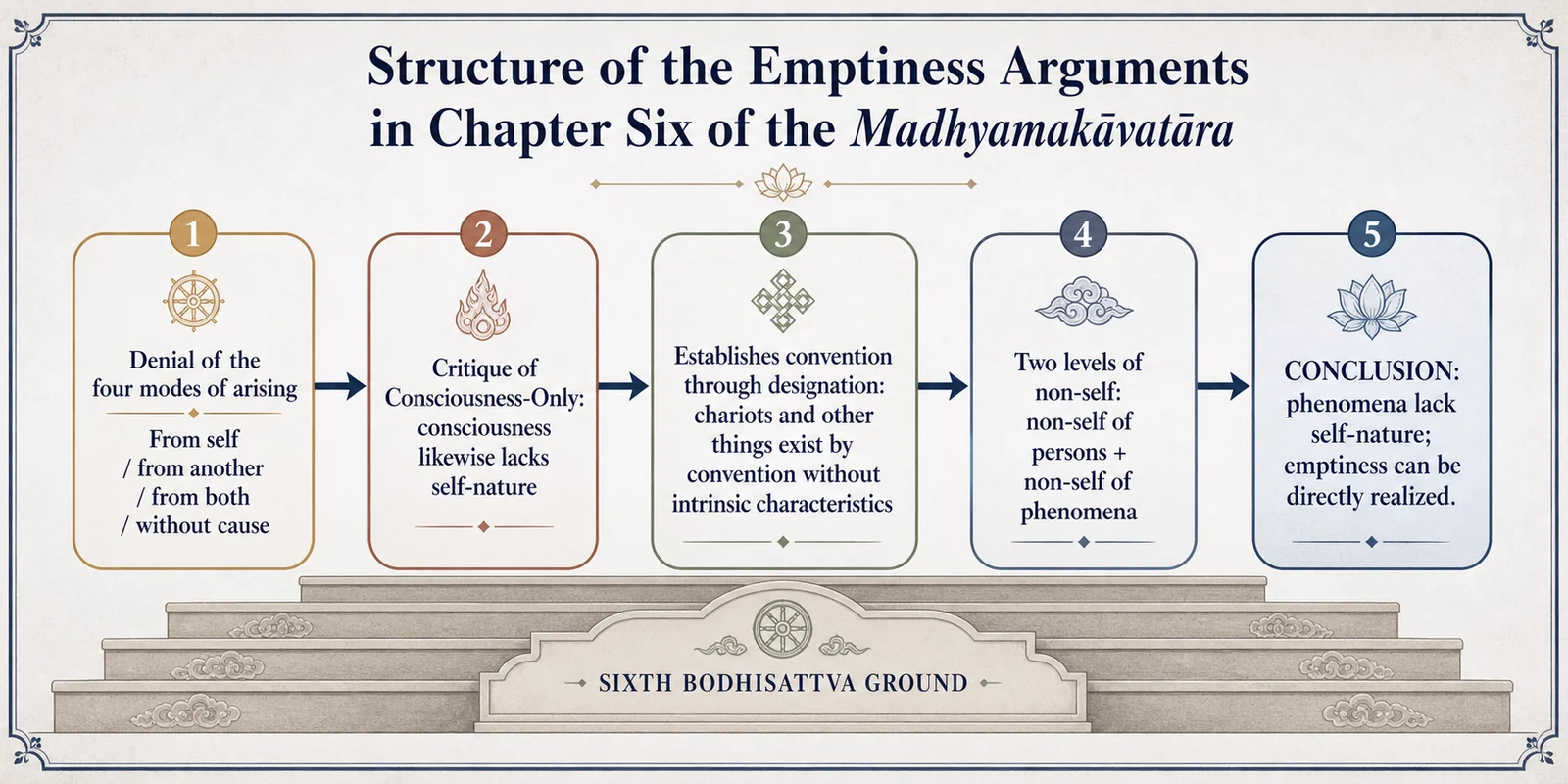
At the chapter's end, Candrakīrti divides not-self into two dimensions: the not-self of the person (pudgala-nairātmya) and the not-self of dharmas (dharma-nairātmya). He uses the distinction differently from Yogācāra. Yogācāra constructs a hierarchy: realization of not-self of the person comes first, while not-self of dharmas is the deeper Mahāyāna insight. Candrakīrti rejects the hierarchy. Early liberation-path practitioners too realized the not-self of dharmas, though with a different emphasis. For him the pair identifies two aspects of analysis rather than higher and lower stages.1
This book's terminological principle should be repeated. When discussing early Buddhism, it does not use the Mahāyāna framework of "not-self of the person/not-self of dharmas." The pair presupposes a hierarchical classification added retrospectively by Mahāyāna. Early Buddhist analysis is described in its own language. The terms are appropriate here because Candrakīrti operates within the Mahāyāna framework and his particular use of them is one of this chapter's subjects.
7. Nonconceptual Knowledge: How Emptiness Connects with Liberation
Candrakīrti's theory of liberation continues the "cessation of conceptual proliferation" identified in the chapter on Nāgārjuna, but Prāsaṅgika epistemology gives it a more precise formulation.
Ordinary cognition always brings a conceptual framework: it classifies an object ("this is a chariot"), assigns a quality ("the chariot is good"), and generates attraction or aversion—"I want the chariot." In the process, the object is treated as an entity established by its own characteristic. Nonconceptual knowledge (nirvikalpa-jñāna) does not mean that "nothing is cognized." The point is that cognition does not frame the object as "an X established by its own characteristic." Cognition continues, but no longer reifies objects through the lens of intrinsic nature. The cessation of conceptual proliferation (prapañca) is the stopping of this automatic reification.4
Candrakīrti associates the cessation with direct perception of emptiness on the sixth ground. When practitioners directly see emptiness rather than understand it only conceptually, no act establishes the seen object through its own characteristic at that moment. The decisive feature is not special content (seeing "a thing called emptiness"), but a special mode: seeing without a reifying frame.
This explains why the Madhyamakāvatāra places direct perception of emptiness at the sixth ground rather than earlier. The first five grounds prepare the conditions, but practitioners still handle emptiness as a concept. Direct perception at the sixth is the moment the conceptual framework itself is released.
Yet a tension deserves attention. If nonconceptual knowledge consists in "not establishing an object through its own characteristic when encountering it," would a newborn infant or animal lacking abstract concepts not naturally occupy the same condition? Their experience does not contain a self-conscious reifying frame or an active establishment of "an X possessing its own characteristic." To distinguish liberation from such conditions, Candrakīrti must explain their difference. This is not a minor issue; it bears directly on whether nonconceptual knowledge is a purification of cognitive capacity or a suspension of cognition. Volume II will return to the tension.
8. Historical Influence and Position
Candrakīrti's influence in India was not especially dominant during his life or the following two centuries. Mainstream Indian Buddhism from the seventh to eleventh centuries centered on Dharmakīrti's logic and epistemology and on the synthesis of Svātantrika with Yogācāra represented by Śāntarakṣita and Kamalaśīla. Candrakīrti's Prāsaṅgika was an important voice in the academic environment of Nālandā but did not monopolize it.7
His principal historical influence came in Tibet; see Part XI. From the eleventh century, his works were translated into Tibetan on a large scale, and the Madhyamakāvatāra became a central text in Tibetan Madhyamaka education. When Tsongkhapa systematized the Geluk school in the fourteenth and fifteenth centuries, Candrakīrti's Prāsaṅgika was elevated as the highest form of Madhyamaka, above every Svātantrika route. The classification became so influential that "Prāsaṅgika Madhyamaka" is now often equated directly with Candrakīrti. The equation has reason behind it but obscures the complexity of the Indian landscape.
One historical detail deserves emphasis. Dharmakīrti was one of Candrakīrti's Indian opponents. Around the seventh century, Dharmakīrti was the great systematizer of Indian Buddhist epistemology. His Pramāṇavārttika established a rigorous system of direct perception and inference. Philosophically associated with Yogācāra, it accepts reflexive awareness and the establishment of consciousness by its own characteristic. Candrakīrti's attack on reflexive awareness directly targets a key structure of Dharmakīrti's epistemology, while his denial of conventionally established own characteristics strikes the core thesis that an own characteristic grounds direct perception.
The Dharmakīrti line responds that reflexive awareness has a direct basis in experience and Candrakīrti's analogy that "a knife cannot cut itself" is insufficient as proof; cognition and cutting need not share a logical structure. More fundamentally, without reflexive awareness, how can memory be explained? A memory such as "I was happy yesterday" requires yesterday's pleasure to have left a trace of having been known at the time; reflexive awareness supplies that trace. Without it, the explanation of memory contains a gap. Candrakīrti replies that memory too can be understood through designation: remembering yesterday's happiness is the conventional linking of a dependently arisen sequence of events and requires no foundation of reflexive awareness. Critics find this too brief and less precise than Dharmakīrti's account of memory.
The controversy had no clear winner in India. Both traditions continued and attracted followers. In Tibet, the Geluk scholar Tsongkhapa also studied Dharmakīrti's epistemology closely and attempted to find a place for it within Candrakīrti's Madhyamaka. That synthesis is itself a complex story, reserved for Part XI.8
This book's position is that Candrakīrti pushed "refuting without establishing" to its philosophical extreme. Consequence, designation, rejection of reflexive awareness, and the replacement of every metaphysical foundation with worldly convention form a system of considerable internal coherence. Its limitation has already been stated: the more thorough it becomes, the more it must anchor the validity of every argument in worldly agreement and forbid further questions about that anchor. This is less Candrakīrti's mistake than the necessary cost of carrying the absence of intrinsic nature through without compromise. Part VI turns to Yogācāra because some thinkers regarded the price as too high and sought another route that could positively describe the structure of cognition and practice.
References
References
-
Tom J. F. Tillemans. Materials for the Study of Āryadeva, Dharmapāla and Candrakīrti. Vienna: Arbeitkreis für Tibetische und Buddhistische Studien, 1990. ↩↩
-
Candrakīrti. Prasannapadā. For the Sanskrit edition, see Louis de la Vallée Poussin (ed.), Mūlamadhyamakavṛtti Prasannapadā. St. Pétersbourg: Académie Impériale des Sciences, 1903–1913. ↩↩↩
-
Elizabeth Napper. Dependent-Arising and Emptiness: A Tibetan Buddhist Interpretation of Mādhyamika Philosophy. Boston: Wisdom, 1989. (Detailed discussion of Candrakīrti on designation and valid conventional cognition.) ↩↩↩
-
Jay L. Garfield and Geshe Ngawang Samten (trans.). Ocean of Reasoning: A Great Commentary on Nāgārjuna's Mūlamadhyamakakārikā. New York: Oxford University Press, 2006. (Tsongkhapa's commentary, representing the Geluk systematic interpretation of Candrakīrti.) ↩↩↩
-
Part II, Part 19, Chapter 7, "Verdict and Handoff," fixes the basis of what is commonly admitted upon the public instruments of convention, the use of same and different, the procedure of individuation, and the law of non-contradiction, which the two parties have used in common from the beginning. Part 18, Chapter 6, "The Preservation Theorem," cites Piṅgala's commentary: "The ultimate meaning is in every case had by way of speech, and speech is conventional; therefore, if one does not rely on the conventional, the ultimate meaning cannot be spoken." (Mūlamadhyamakakārikā, fascicle four, MMK 24, the "Examination of the Noble Truths," T1564.) On that basis it rules that the ultimate must be spoken from the conventional. ↩↩
-
Sara McClintock. "Knowing All through Knowing One: Mystical Communion or Logical Trick in the Tattvasaṃgraha and Tattvasaṃgrahapañjikā." Journal of the International Association of Buddhist Studies 23, no. 2 (2000): 225–244. (Includes comparisons of Yogācāra and Madhyamaka epistemology.) ↩↩
-
David Seyfort Ruegg. The Literature of the Madhyamaka School of Philosophy in India. Wiesbaden: Harrassowitz, 1981. ↩
-
Georges Dreyfus. Recognizing Reality: Dharmakīrti's Philosophy and Its Tibetan Interpretations. Albany: SUNY Press, 1997. (On Dharmakīrti's Tibetan transmission and interaction with the Candrakīrti tradition.) ↩