Chapter 1: The Early Diffusion—Imperial Tibet and the Samye Debate
Geographically, Tibet is an enclosed highland world, separated by mountains and deserts from India, Central Asia, China, and Southeast Asia. In the history of civilization, however, it stood precisely between the two great Buddhist traditions of India to the south and China to the east. The eventual choice shaped the entire character of Tibetan Buddhism. This chapter examines how the choice occurred: how Buddhism entered and took root in Tibet from the seventh through ninth centuries and how, between a debate and a persecution, the basic meaning of “Tibetan” Buddhism was established.
I. The Difficulty of the Sources
Writing early Tibetan Buddhist history faces a structural predicament common to nearly every external history of religion: the most important sources were religious histories written one or two centuries after the events by later authors with clear commitments.
The earliest and most important surviving Tibetan source is the ** Dba’ bzhed , composed around the ninth or tenth century. It recounts Buddhism’s entry into the Tibetan Empire and is essentially a narrative presenting Samye Monastery and its Indian gradualist tradition as orthodox while deliberately excluding Chinese Chan. Later Tibetan histories, including Butön’s History of Buddhism, the Blue Annals, and sectarian lineage histories further strengthened this frame.1
The discovery of the Dunhuang manuscripts at the beginning of the twentieth century opened another window. They contain firsthand documents written by Chinese and Tibetan people during the imperial period. Chinese accounts of the Samye debate differ significantly from later Tibetan narratives. Recent scholarship has compared the sources and substantially changed our understanding of early Tibetan Buddhism.2
This book’s method is to acknowledge the commitments of every source, extract a credible skeleton from several of them, and mark uncertainty through phrases such as “we can infer” and “this book’s position.” Where material appears only in a particular partisan narrative and favors the narrator’s side, the source will be identified.
II. The Encounter between Bön and Buddhism
Before Buddhism arrived, Tibet possessed its own religious traditions, usually called Bön. Two points require clarification.
Bön was not a single, monolithic religious system. Early Bön (more accurately, the traditional religion of the Tibetan Empire) principally consisted of ritual specialists serving the monarchy. Their functions included military protection, funerals, divination and oracles, and invocation of mountain gods and spirits. It had no unified canon or doctrinal system and more closely resembled a shamanic ritual tradition.3
The “Bön” we see today is, to a considerable degree, a product of Buddhist influence. After Buddhism entered Tibet, long competition and interaction led Bön gradually to establish scriptures, graded paths of practice, and philosophical discourses of its own, many formally very similar to Buddhism. Contemporary Bön claims more ancient origins, but its received forms crystallized historically later than their claimed beginnings.
The early Tibetan monarchy was closely connected to the Bön tradition, and its sacred authority was maintained through Bön rites, especially funerary and sacrificial practices. At first, Buddhism both directly challenged existing Bön (for example, abolishing certain rites) and incorporated it by bringing local divinities into a Buddhist cosmos. The tension persisted throughout the early diffusion and continued in other forms later.
III. Songtsen Gampo: Three Beginnings
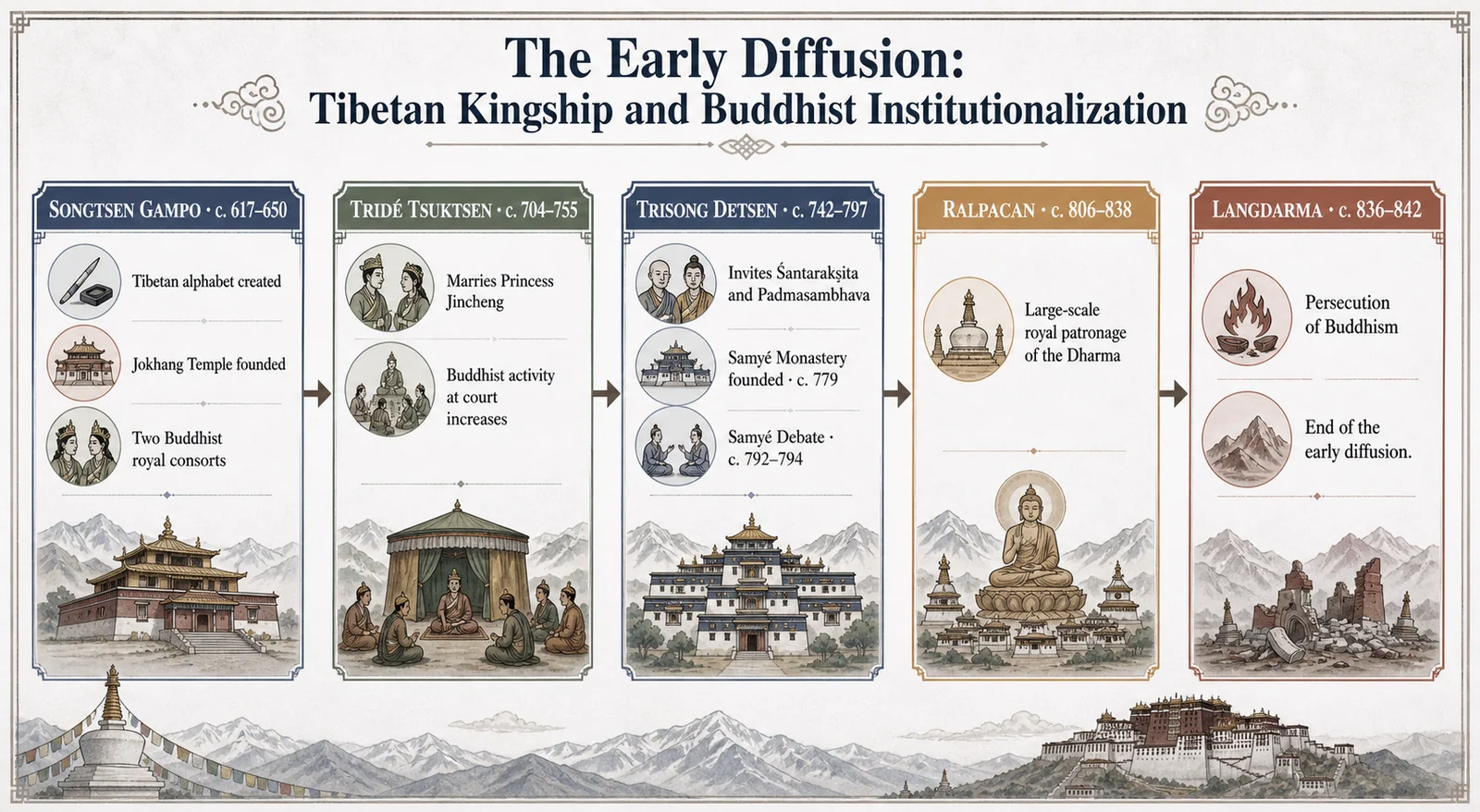
Tradition credits the first phase of Buddhism’s introduction to Songtsen Gampo (Srong-btsan-sgam-po, approximately 617–650), the founding monarch of the Tibetan Empire who unified the plateau.
Legend presents him as an emanation of Avalokiteśvara. His two wives, the Nepalese princess Bhrikuti and the Tang princess Wencheng, each brought a famous image of Śākyamuni (the Jowo Rinpoche now at Jokhang is said to be Wencheng’s), and he founded Jokhang as Tibetan Buddhism’s originator. This book suspends judgment on the mythic image. The more secure historical statements are:
- Songtsen Gampo had marriage alliances with Tang China and Nepal, through which Buddhist elements entered.
- He ordered the minister Thönmi Sambhoṭa to travel to India and study Sanskrit. After returning, Thönmi designed the Tibetan alphabet. This was the most important technical foundation in Tibetan Buddhist history: without written Tibetan there could be no translation, and without translation no Tibetan Buddhist knowledge system. The alphabet was designed around the 630s or 640s on the basis of Indian Brāhmī scripts and adapted to Tibetan phonology.2
- Jokhang and Ramoche temples were built during this period, supported by archaeology and inscriptions.
IV. Trisong Detsen: Inviting Teachers, Building a Monastery, and the Great Translation Project
Trisong Detsen (Khri-srong-lde-btsan, reigned approximately 742–797) was the most important king of the early diffusion and the key figure in Tibet’s comprehensive adoption of Buddhism.
Śāntarakṣita and Padmasambhava Enter Tibet
Around 762, Trisong Detsen invited the Indian master Śāntarakṣita (approximately 725–788) to Tibet. He represented the Nālandā–Vikramaśīla tradition and philosophically belonged to Yogācāra-Svātantrika-Madhyamaka. Chapter 8.3 treated his system, so it will not be repeated here.
Tibetan narratives say that on first entering Tibet, Śāntarakṣita encountered “calamities” produced by Bön divinities (epidemics and floods), regarded as resistance to Buddhism. He therefore recommended inviting Padmasambhava, known in Tibetan as Pema Jungné, who came from Uḍḍiyāna in present-day northwestern Pakistan and was renowned for subduing demons.
With Padmasambhava, the boundary between history and legend is even harder to determine than with Śāntarakṣita. The later Nyingma or Ancient Translation tradition venerates him as a “second Buddha,” surrounded by extraordinarily rich miracle stories. What can safely be said is that he entered Tibet in the eighth century, participated in establishing Samye Monastery, and brought important elements of Vajrayāna tantra. His historical person differs substantially from the mythic figure of Nyingma tradition.4
The claim that “Padmasambhava introduced dual cultivation”: a clarification
A fairly widespread claim in Chinese Buddhist circles says that Padmasambhava introduced “dual cultivation” (sexual yoga between male and female practitioners) to Tibet and is therefore responsible for the later existence of sexual tantric practices in Tibetan Buddhism. The statement serves different purposes in different contexts. Some use it to criticize Tibetan Buddhism for presenting “licentious practices” as religion; others to justify modern sexual behavior carried out under a Tibetan label. Both uses require historical clarification.
The actual place of “dual cultivation” in Tibetan tantra
What is called “dual cultivation” usually corresponds to the “action seal,” karmamudrā, in tantric terminology. It is an advanced practice within Highest Yoga Tantra and involves ritual union with an actual or imagined consort. Its purpose is to induce a particular epistemic breakthrough, awareness of emptiness, through the experience of the nonduality of bliss and emptiness. Such practices are described in major Indian tantras including the Hevajra Tantra, Cakrasaṃvara Tantra, and Guhyasamāja Tantra. All were transmitted from India to Tibet through multiple lines.
Padmasambhava’s relation to this tradition
Padmasambhava was closely associated with tantra and is regarded as an important transmitter of Highest Yoga Tantra. In Nyingma, his principal consorts are Yeshe Tsogyal and Mandāravā. Yet the claim that he was “the person who introduced dual cultivation” requires correction on several points.
First, sexual yoga was neither Padmasambhava’s invention nor his exclusive import. It formed part of the late Indian Buddhist tantric tradition and had developed in India before him.
Second, the principal basis for attributing particular practices to Padmasambhava comes from treasure texts, terma, said to have been “hidden” by him and “discovered” by later revealers. Scholars classify these treasures historically as later literary reconstructions of the early period, not firsthand documents left by Padmasambhava in the eighth century; see Chapter 11.3 on Nyingma. Using treasure texts to conclude that Padmasambhava personally transmitted a particular practice is methodologically unreliable.
Third, another important body of Highest Yoga Tantra was brought from India by Marpa (1012–1097). The Kagyü graded path of Mahāmudrā and its Cakrasaṃvara and Hevajra practices have historical sources independent of Padmasambhava. Assigning “dual cultivation” to him alone obscures the plurality of tantric transmission.
This book’s position
The claim “Padmasambhava introduced dual cultivation” oversimplifies a complex historical process into one person’s act. More accurately, sexual yogas entered Tibet as part of Highest Yoga Tantra through multiple channels—the Padmasambhava transmissions of the early diffusion and several translators in the later diffusion. Nyingma is among their largest inheritors, but not the only one. Using “Padmasambhava introduced dual cultivation” as a lever to condemn Tibetan Buddhism as a whole is a historical misreading. Using it to authorize modern sexual behavior in the name of “Tibetan tantra” fabricates authority in history’s name. Both stand far from the historical evidence.5
Samye Monastery and the Full-Ordination Lineage
Around 779, Tibet’s first formal Buddhist monastery, Samye, was completed in the Yarlung region. This was an institutionally momentous event. Samye’s importance did not lie only in its architecture; it meant that the Saṅgha had formally been established in Tibet. Indian monks came and conferred full ordination upon the first Tibetan monastics. Tibet acquired its own lineage of renunciation.
The Beginning of the Great Translation Project
After Samye’s establishment, systematic translation began on a broad scale. Trisong Detsen created translation commissions bringing together Indian masters and Tibetan translators, lotsāwas, to render Sanskrit and Chinese Buddhist texts systematically into Tibetan.
Two features deserve emphasis. First, the standardization of terminology. Around 814, the court produced the Mahāvyutpatti, a great collection of translation terminology prescribing Tibetan equivalents for approximately twenty thousand Buddhist terms and unifying translator usage. This was a systematic linguistic infrastructure project that ensured a high degree of terminological consistency across periods and translators, indispensable to translation on such a scale.
Second, the choice of an intellectual frame. Śāntarakṣita’s Indian academic framework (Madhyamaka, Buddhist logic, and a gradual path) defined the priorities of translation. What was translated and what was placed at the center reflected philosophical choices, not a neutral arrangement. The frame profoundly influenced the later structure of Tibetan Buddhist learning.
V. The Samye Debate: Sudden versus Gradual
Around 792–794, a debate occurred near Samye between the Indian gradualist tradition represented by Kamalaśīla, Śāntarakṣita’s disciple, and the Chinese Chan tradition represented by Hvashang Mahāyāna, “the monk Mahāyāna.” Trisong Detsen presided.
Chapter 8.3 discussed the philosophical content in detail: gradual cultivation versus sudden awakening, the theoretical basis of Kamalaśīla’s Stages of Meditation, and the content of Mahāyāna’s position. Here the focus is the historical event’s reliability and political meaning.
Inconsistency among the Sources
Tibetan sources represented by the Dba’ bzhed report that Trisong Detsen declared Kamalaśīla victorious, ordered Mahāyāna to leave Tibet, and systematically excluded Chinese Chan influence. Chinese and early Tibetan manuscripts discovered at Dunhuang present a different picture. Mahāyāna’s texts contain no record of defeat, while some Tibetan documents show Chan remaining active in Tibet for a considerable time rather than vanishing overnight.6
This book’s position is that the debate has a historical core, but the narrative “a formal debate before the king determined victory and defeat, and the losing side was immediately expelled” was clearly constructed later. It served Tibetan Buddhism’s subsequent need to establish a boundary against Chinese Chan. A more credible picture is that the two Buddhist routes competed in Tibet for a period, royal power ultimately favored the Indian gradualist route, and Chinese Chan gradually became marginal. This outcome is historical, but resulted from a political process over time rather than one debate.
The Meaning of the Choice
Whatever the exact process, Trisong Detsen’s age established Tibetan Buddhism’s Indian and gradualist orientation. The choice was historic:
- Tibetan philosophical language was based on Sanskrit terminology through Tibetan translation, not Chinese.
- Practice was framed through gradual accumulation (ethical discipline, concentration, and wisdom; learning, reflection, and cultivation; the five paths and ten stages), not sudden awakening.
- Indian logic, Madhyamaka, and Consciousness-Only became scholarly standards.
- Later Chinese Buddhist influence, including Chan, upon Tibetan Buddhism was extremely limited.
The consequences extended through the entire history of Tibetan Buddhism. Tsongkhapa’s reforms in Chapter 11.6 and the schools’ Madhyamaka debates in 11.7 all operated with reference to this Indian frame.
VI. Ralpachen and Langdarma: The End of the Early Diffusion
Ralpachen: The Cost of Extreme Patronage
Ralpachen (Khri-gtsug-lde-btsan Ral-pa-can, reigned approximately 806–838) was the last early-diffusion king actively to support Buddhism, and did so with historically exceptional intensity. According to Tibetan sources, he issued ordinances favoring monastics: three hundred households were assigned to support each monk, and monastics sat on either side of the king at court to demonstrate reverence.7
This extreme patronage produced a backlash. Aristocrats at court eventually murdered Ralpachen around 838. His brother Langdarma (Glang-dar-ma, also called King Darma, reigned approximately 836–842; dates disputed) succeeded him and began systematic suppression of Buddhism.
Langdarma’s Persecution and the End of the Early Diffusion
Tibetan narratives cast Langdarma as the archetypal “king who destroyed the Dharma”: closing monasteries, forcing monks to return to lay life, destroying statues, and prohibiting Buddhist rites. Religious literature amplified the image, but the historical core of a policy-driven suppression targeting Buddhist institutions has high credibility. Around 842, the monk Lhalung Pelgyi Dorje assassinated Langdarma and fled to eastern Tibet. This was also how portions of the ordination transmission survived the persecution: repression was less severe in the east than in central Tibet.
After Langdarma’s assassination, the Tibetan Empire rapidly disintegrated. Succession struggles, regional fragmentation, and external pressure combined, and the empire effectively dissolved in the middle ninth century. The disappearance of a unified Buddhist monarchy marked the end of the early diffusion.
VII. The Historical Legacy of the Early Diffusion
The early diffusion lasted only about two centuries, from the middle seventh to middle ninth, yet left Tibetan Buddhism several indispensable inheritances.
The Tibetan alphabet and translation tradition. Without Thönmi Sambhoṭa’s alphabet there could have been no translation, and without translation no Tibetan Buddhist knowledge system. This was the most basic material condition and the most enduring legacy.
Establishment of the Indian gradualist route. Whether through debate, political decision, or some other process, Trisong Detsen’s age established Indian academic frameworks (Madhyamaka, logic, and the gradual path) as Tibetan Buddhism’s center. However the schools later diverged, all operated within this broad frame.
Samye and the first Saṅgha. Establishing an indigenous ordination lineage gave Buddhism institutional roots in Tibet rather than leaving it an import of the court.
The Nyingma “transmission of the early diffusion.” Later Nyingma, the Ancient Translation school (nyingma means “ancient”), regarded the tantric transmission of Padmasambhava and Trisong Detsen’s age as the source of its legitimacy and called it the “transmission of the early diffusion.” It formed a basic division within Tibetan Buddhism against the New Translation schools, sarma, introduced during the later diffusion; see Chapter 11.3.
The psychological imprint of Langdarma’s persecution. The early diffusion ended in persecution, leaving a profound collective memory: the loss of a Dharma-protecting king, the shadow of suppression, and the perseverance of the eastern transmission. This became the starting point of the later diffusion.
Further Reading
- Ronald M. Davidson. Tibetan Renaissance: Tantric Buddhism in the Rebirth of Tibetan Culture. New York: Columbia University Press, 2005. (A historical analysis of translation traditions and continuities and ruptures between the early and later diffusions.)
References
References
-
Pasang Wangdu and Hildegard Diemberger (trans.). dBa’ bzhed: The Royal Narrative Concerning the Bringing of the Buddha’s Doctrine to Tibet. Vienna: Verlag der Österreichischen Akademie der Wissenschaften, 2000. (A modern English translation and study of the Dba’ bzhed.) ↩
-
Matthew T. Kapstein. The Tibetan Assimilation of Buddhism: Conversion, Contestation, and Memory. Oxford: Oxford University Press, 2000. (A synthetic study of the early diffusion and an important reference for source criticism and historical reconstruction.) ↩↩
-
Geoffrey Samuel. Civilized Shamans: Buddhism in Tibetan Societies. Washington: Smithsonian Institution Press, 1993. (A detailed analysis of Bön and early Tibetan religion.) ↩
-
Janet Gyatso. “The Logic of Legitimation in the Tibetan Treasure Tradition.” History of Religions 33, no. 2 (1993): 97–134. (The treasure tradition and the historical construction of Padmasambhava’s image.) ↩
-
On the history of sexual yoga in Highest Yoga Tantra, see Ronald M. Davidson, Indian Esoteric Buddhism: A Social History of the Tantric Movement. New York: Columbia University Press, 2002. (A social history of Indian tantra, including the place of sexual yoga); on Yeshe Tsogyal and Padmasambhava’s consort tradition, see Gyurme Dorje (trans.), The Tibetan Book of the Dead. London: Penguin, 2005, introduction; on the historical nature of treasures, see the note on Gyatso below and Tulku Thondup, Hidden Teachings of Tibet: An Explanation of the Terma Tradition of Tibetan Buddhism. London: Wisdom, 1986. ↩
-
Luis O. Gómez. “Indian Materials on the Doctrine of Sudden Enlightenment.” In Early Ch’an in China and Tibet, eds. Lai and Lancaster. Berkeley: Asian Humanities Press, 1983. (A comparative analysis of Chinese and Tibetan sources for the Samye debate and a textual study of Mahāyāna’s position.) ↩
-
David Snellgrove and Hugh Richardson. A Cultural History of Tibet. Boulder: Prajñā Press, 1980. (A foundational reference on early Tibetan Buddhist history, including the three Dharma kings and Langdarma.) ↩