Chapter 4: Kagyu and Mahāmudrā
Kagyu (Bka'-brgyud, meaning "oral lineage" or "lineage of instructions") possesses the most distinctive practice tradition among the schools of Tibetan Buddhism. Its legitimacy derives from direct transmission from master to disciple, generation after generation, rather than from textual criticism or sectarian history. This living communication cannot be wholly replaced by texts, and it marks the most fundamental difference in temperament between Kagyu, Nyingma with its reliance on treasure texts, and Gelug with its reliance on textual learning and debate.
Kagyu's highest teaching is Mahāmudrā (Pali Mahamudda, Tibetan phyag rgya chen po, literally "great seal"): the direct recognition of the nature of mind without elaborate visualizations or graduated stages, requiring only direct introduction here and now. Such "direct introduction" is not the proclamation of a doctrine. At the appropriate moment and by an appropriate means, the master enables the disciple to recognize the original condition of the disciple's own mind in the present instant.
I. Sources: The Lineage from India to Tibet
Indian Roots: Nāropa and Maitrīpa
Kagyu traces its Indian transmission to two mahāsiddhas, or great adepts:
Nāropa (ca. 1016–1100; the dates are disputed) was a celebrated scholar at Vikramaśīla. Tradition relates that after a sudden awakening he abandoned monastic life and set out in search of the master Tilopa. He underwent twelve major and twelve minor ordeals, finally received direct transmission, and became a central figure in the Mahāmudrā lineage. The Six Dharmas of Nāropa, which he organized and transmitted, comprise inner heat (gtum mo), illusory body (sgyu lus), dream yoga (rmi lam), luminosity ('od gsal), the intermediate state (bar do), and transference of consciousness (pho ba). These central completion-stage practices later became a cornerstone of the Kagyu system.1
Maitrīpa (ca. 1007–1085), a contemporary of Nāropa, was known for the direct transmission of Mahāmudrā. The essential Mahāmudrā instructions received from him emphasized a sudden approach that recognizes the nature of mind in the present moment. Marpa received teachings with different emphases from the two masters and brought them together in their Tibetan transmission.
It is difficult to distinguish these figures' historical profiles from the miraculous narratives surrounding them—the stories of Tilopa holding fish and of Nāropa's ordeals, for example. This book accepts the existence of the central figures as historically credible but treats the specific details of such ordeals as edifying narratives rather than as individual historical facts.
Marpa: Translator and Founder of the Transmission
Marpa (Marpa Lotsāwa, Mar-pa Chos-kyi-blo-gros, 1012–1097) was the effective founder of Kagyu. A Tibetan lay practitioner with a wife and children who managed farmland, he was not a monk. This is a meaningful traditional marker: Kagyu originated in the direct transmission of lay masters, not in the monastic system.
Marpa made three arduous journeys to India, around 1042, 1059, and 1073. Each cost him greatly, and he carried gold to exchange for teachings and texts. He systematically studied tantra with Nāropa and Maitrīpa. After returning to Tibet he began to teach, and Milarepa became his most important disciple. His translations earned him the title lotsāwa, "translator," but unlike Rinchen Zangpo, whose primary concern was textual translation, Marpa cared more for the living transmission of practice. Texts were only its medium.2
II. Milarepa: The Most Charismatic Practitioner in the History of the Lineage
Milarepa (Mi-la-ras-pa, 1052–1135; the dates are disputed) is one of the most famous figures in all Tibetan Buddhist history and the spiritual emblem of the Kagyu transmission.
His life, preserved in the biography composed by Tsangnyön Heruka (gTsang-smyon Heruka, “the Madman of Tsang”; lay name Sangye Gyaltsen, 1452–1507), became one of the major works of Tibetan literature and one of the most accessible Tibetan Buddhist texts for modern readers. The biography is itself a fifteenth-century creation, and its literary and religious construction is as important as its degree of historical reliability. This book reads it with that fact in mind.2
According to the biography, the young Milarepa learned black magic to avenge wrongs done to his family and killed many people. Overcome by remorse, he turned to Buddhism and sought Marpa. Marpa subjected him to exceptionally severe training, ordering him repeatedly to build and demolish stone towers alone. Only after Milarepa had repaid all the evil karma he had accumulated through this ascetic suffering did Marpa finally transmit the teachings. Milarepa then practiced alone in mountain caves for many years. It is said that austerities turned his body green, that he taught by singing songs of realization (mgur), and that he ultimately attained accomplishment.
Within the Kagyu transmission, Milarepa represents the proposition that Mahāmudrā can be realized through a lifetime devoted wholly to practice, without extensive monastic learning. He was not a scholar but an ascetic and yogin who committed his whole being to practice. This stands in conspicuous contrast to the Gelug route, with its emphasis on systematic study.
III. Gampopa: Systematizer of Kagyu
Kagyu truly became an organized school with Gampopa (Dvags-po Lha-rje, 1079–1153).
Gampopa had an unusual background. In his early life he was a well-trained Kadam monk and had also been a physician, which is why he was sometimes called the "Physician of Dakpo." After meeting Milarepa, he turned to Kagyu practice. He combined the two traditions: Kadam's graduated exoteric path (from ethical training to meditative concentration, beginning with Atiśa's stages-of-the-path framework) served as the foundation, and direct recognition through Mahāmudrā as the summit. This synthesis became Kagyu's most influential framework of practice.1
Gampopa's most important surviving work is The Jewel Ornament of Liberation (Dvags-po Thar-rgyan), a systematic treatise on the bodhisattva path that integrates the Kadam stages of the path with the Mahāmudrā tradition. It became a foundational Kagyu textbook and remains widely transmitted.
Gampopa had several important disciples, each of whom founded a distinct branch. They became the sources of Kagyu's many later lineages.
IV. The Many Branches of Kagyu
Kagyu has more branches than any other Tibetan Buddhist school. Its principal branches are shown below:
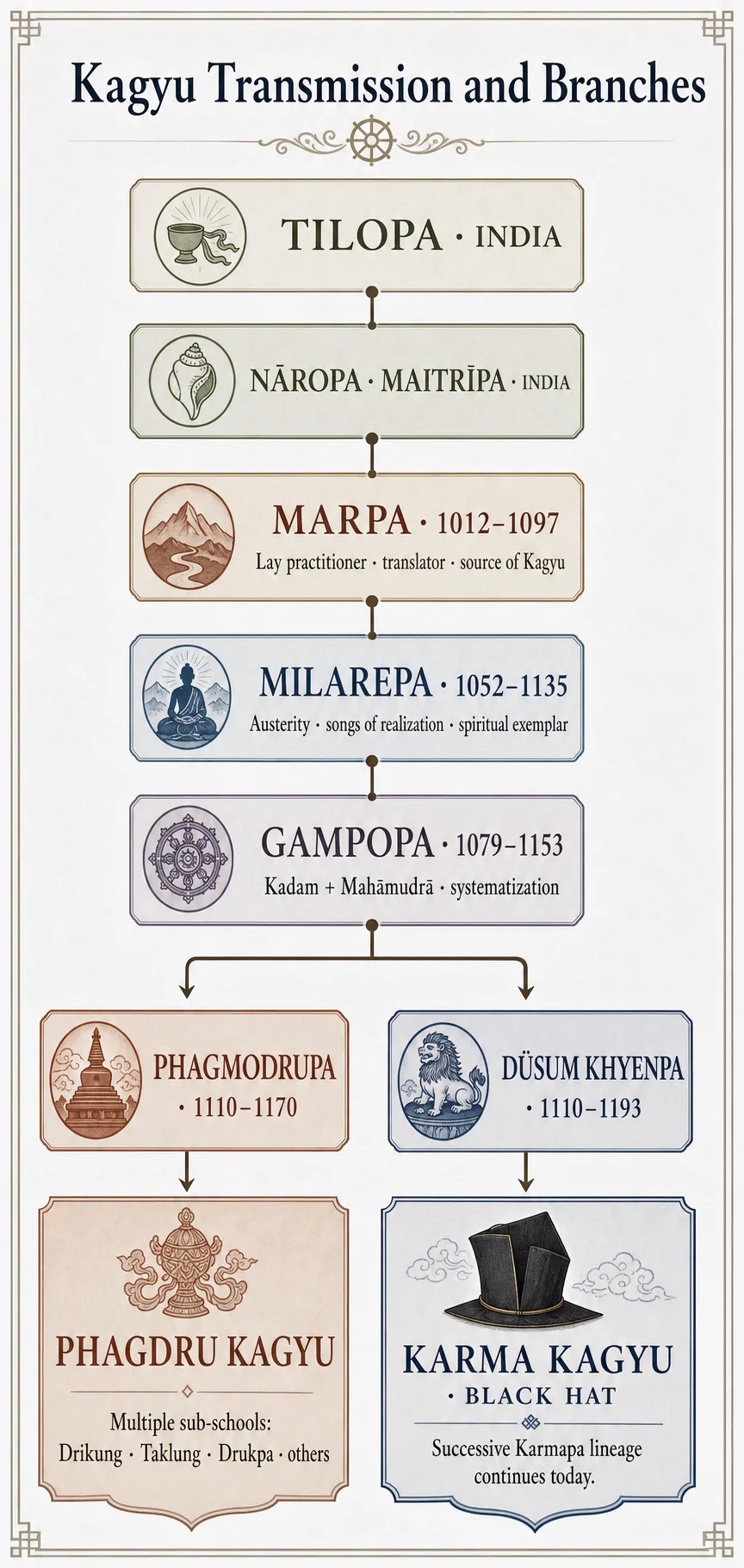
The "four great and eight minor lineages" is the traditional formula. The four great lineages descended from direct disciples of Gampopa, while the eight minor lineages issued from disciples of Phagmo Drupa:
| Principal Branch | Founder | Characteristics |
|---|---|---|
| Karma Kagyu | Düsum Khyenpa, the First Karmapa (1110–1193) | Black Hat lineage; the largest surviving branch, with the Karmapa succession still continuing |
| Phagmo Drupa Kagyu | Phagmo Drupa (1110–1170) | For a time the strongest political power in the thirteenth century |
| Drigung Kagyu | Drigung Kyobpa Jigten Sumgön (1143–1217) | Known for the teaching of consciousness transference, or phowa |
| Drukpa Kagyu | Descended from Tsangpa Gyare (1161–1211) | State religion of Bhutan today; Tibetan drukpa means "thunder dragon," represented on Bhutan's flag |
| Taglung Kagyu | Taglung Thangpa (1142–1210) | A smaller branch, much of which has now converged with other transmissions |
The Karmapa lineage is Kagyu's longest-lasting and best-known lineage today. Düsum Khyenpa is regarded as the first person in Tibetan history to be identified as a "living buddha," or reincarnate lama (tulku, sprul sku). The system later became one of Tibetan Buddhism's most distinctive mechanisms of succession. The Dalai Lama and Panchen Lama systems of Gelug are extensions of it.
V. Mahāmudrā: Direct Recognition of the Nature of Mind
Mahāmudrā is Kagyu's highest teaching and one of the Tibetan Buddhist practice traditions most difficult to describe in words, precisely because its center points to what words cannot fully capture.
Three Levels of Mahāmudrā
Kagyu commonly divides Mahāmudrā into three approaches:
Ground Mahāmudrā: a philosophical description of the nature of mind itself (sems nyid). The nature of mind is empty and at the same time luminously knowing—the indivisibility of luminosity and emptiness (stong gsal). It neither comes nor goes and cannot be fully described by any concept, yet it is the foundation of every act of knowing. This is Mahāmudrā's ontological dimension.
Path Mahāmudrā: the method of practice. One rests in mind's present condition without pursuing or rejecting anything, allowing thoughts to arise and cease naturally without being carried away by them, and gradually becomes familiar with mind's original face. In concrete terms, practice is divided into calm abiding (śamatha) and insight (vipaśyanā). Calm abiding settles the mind; insight directly recognizes the original condition of the settled mind.
Fruition Mahāmudrā: the perfected state of practice. The ordinary mind of saṃsāra ('khor ba'i sems) and awakened mind (byang chub sems) are nondual. Discriminating mind dissolves, and luminous-empty awareness becomes stable and continuous. This is no different from buddhahood; it is simply the "recognition" of what was present all along.3
Mahāmudrā and Calm Abiding–Insight
The core of Mahāmudrā practice is a change in one's attitude toward "practice" itself. In many gradual systems, such as Buddhaghosa's seven purifications, practice advances step by step toward a goal not yet realized. Mahāmudrā adopts a different attitude: the goal, awakening, is present in the mind's condition right now. Nothing need be added and nothing removed; it need only be "recognized."
In Kagyu practice, this "recognition" often occurs through a master's direct transmission. At the proper moment, the master uses any of various means (a question, a demonstration, a shove, or a gesture) to indicate the recognition when the disciple is least guarded and least expectant. This mode of transmission places exceptionally high demands and exceptionally deep emphasis on the master–disciple relationship in Kagyu.
Mahāmudrā and Madhyamaka
Are Mahāmudrā's nature of mind and Madhyamaka's emptiness the same thing or two different things?
Kagyu's usual answer is that they ultimately point to the same reality but approach it by different routes. Madhyamaka begins with analysis, analyzing all phenomena as lacking intrinsic nature. Mahāmudrā begins with direct recognition, directly recognizing the nature of mind. The two arrive at the same destination. In The Jewel Ornament of Liberation, Gampopa even positions Mahāmudrā as "a direct path that need not depend upon Madhyamaka analysis." This is a remarkably bold claim in the history of Tibetan philosophy, because it implies that Mahāmudrā can bypass exoteric philosophical systems and arrive directly at awakening.
The claim provoked controversy. Gelug, as Chapter 11.6 will explain, holds that without an understanding of the correct Madhyamaka view, genuine recognition of the nature of mind is impossible. Such "recognition" would at most be a tranquil state of meditative absorption, still one step removed from true awakening. Kagyu replies that this is precisely the language of people restricted by scholastic learning. The Mahāmudrā tradition began with Tilopa and Nāropa and has produced countless mahāsiddhas over the centuries; the experience of these adepts is itself the best evidence.
This book's position is that the controversy consists to a large degree of two linguistic systems describing different paths of practice. Both sides possess ample textual support. Their substantive disagreement is whether "recognizing the nature of mind" presupposes the correct Madhyamaka view. This is a debate about the theory of practice, and no generally accepted conclusion has yet been reached.
VI. The Six Dharmas of Nāropa: Embodied Completion-Stage Practice
Mahāmudrā is Kagyu's epistemological summit; the Six Dharmas of Nāropa are its completion-stage practice. They are two mutually reinforcing dimensions of the same transmission. The six dharmas were introduced above; the following table briefly expands their content:
| Dharma | Tibetan | Core of the Practice | Function |
|---|---|---|---|
| Inner heat | gtum mo | Generates heat within the central channel, thereby dissolving obstructions in the winds and channels and leading toward an experience of luminosity | Purifies the winds and channels; foundational practice |
| Illusory body | sgyu lus | Recognizes dreams and apparent phenomena as illusion-like and nondual with emptiness | Counteracts grasping at "reality" |
| Dream yoga | rmi lam | Maintains lucid awareness in dreams and recognizes the awareness of dreaming | Prepares for recognition in the intermediate state of death |
| Luminosity | 'od gsal | Recognizes the luminosity that appears in sleep, meditation, and at death | Maintains awareness in unconscious states |
| Intermediate state | bar do | Recognizes and masters the state between death and rebirth | Uses the intermediate state to attain liberation or choose rebirth |
| Transference of consciousness | pho ba | Transfers consciousness to a pure land or particular location at death | Secures one's direction at death and provides an exit for those unable to attain immediate liberation |
Practice of the six dharmas requires empowerment, oral instructions, and suitable preliminaries; it is not taught publicly. Some elements, especially the teachings on luminosity and the intermediate state, are widely known today through the popularity of the Bardo Tödol, commonly called The Tibetan Book of the Dead in the West. The Bardo Tödol is itself a Nyingma treasure text, not a Kagyu canonical work, although the two traditions have considerable spiritual affinity.4
VII. Kagyu's Historical Influence
Kagyu once held a position of considerable importance in Tibetan political history. Phagmo Drupa Kagyu gained political control over most of Tibet for a time in the fourteenth century. From the fifteenth through the seventeenth century, the Karmapa lineage of Karma Kagyu maintained close relations with the imperial house of Ming China, received the title "Great Treasure Dharma King," and exerted influence throughout the Tibetan region.
In contemplative tradition, Kagyu's deepest contribution was to establish a distinctive Tibetan Buddhist emphasis: awakening does not consist in accumulating more and more knowledge but in relinquishing every contrived effort and recognizing in the present moment what has always been there. This emphasis, Gelug's extensive textual study, and Nyingma's reliance on the authority of treasure texts constitute different temperaments and paths within Tibetan Buddhism.
Kagyu's contemporary influence continues principally through several lines:
- The Karmapa lineage continues today. There are currently two candidates for the Seventeenth Karmapa, Ogyen Trinley Dorje and Trinley Thaye Dorje, each recognized within a different political context. This is one of the most complex controversies over lineage recognition in modern Tibetan Buddhist history (see 11.8).
- Drukpa Kagyu is the state religion of Bhutan and comprehensively shapes Bhutanese religious culture.
- Many masters of Karma Kagyu and other branches are active in Europe and North America, making Kagyu one of the Tibetan Buddhist transmissions most commonly encountered in the West.
- Mahāmudrā as a method of practice has attracted considerable attention from both Western scholars and practitioners. Comparative study of Mahāmudrā and the Chan tradition of encounter dialogues has been a prominent area of cross-traditional research over the past thirty years.
Esoteric Buddhism and Chan: Vastly Different Appearances, a Structurally Kindred Logic of the "Shortcut"
Here I wish to state explicitly an observation that runs through this history: although esoteric Buddhism (Vajrayāna) and Chan differ enormously in outward appearance, their core logical structures share the same kind of "shortcut." More precisely, both bypass the conventional gradual path in the same general way.
Chan's path: it establishes no dependence on written words, points directly to the human mind, and sees one's nature to become a buddha. Awakening is not a goal reached through accumulation; it is the present recognition of "what has always been here." Time collapses: this recognition in this very moment is awakening, and the path and destination become one.
The esoteric path, especially Mahāmudrā and Dzogchen: it takes the fruition as the path (phala-yāna), directly instantiating the result of buddhahood within practice. In contemplation, the practitioner operates with a buddha's identity, speech, and consciousness—buddha pride (jñānasattva). The emphasis is not on cultivating causes that lead to buddhahood but on directly embodying buddhahood's result. This too fundamentally reverses the structure of time: the result appears immediately within the cause, compressing the linear sequence of cause and effect.
Their shared logic is that the goal is already here; practice recognizes or manifests it rather than building it. Gradual traditions (including the stages of Southern Buddhist insight, Buddhaghosa's seven purifications, and Gelug's five paths and ten grounds) presuppose a journey "from here to there." Chan and esoteric Buddhism alike maintain that at the deepest level the journey is unnecessary because one has never truly departed from the destination.
The enormous superficial difference should not conceal this structural affinity. Chan prizes simplicity, rejects ritualism, and treats elaborate formalities as obstacles. Esoteric Buddhism appears as a highly complex body of rites, visualizations, deities, mudrās, mantras, and initiatory qualifications. Outwardly they could scarcely be more different, yet the deep structure of their philosophies of practice addresses the same question: how does a person cross from "unawareness" to "awareness"? Chan says one arrives in a single leap; esoteric Buddhism takes the result as the path, placing the practitioner directly in the condition of "already awakened."
At the academic level, several considerations support this comparison. The historical context of the Samye debate in Chapter 11.1 already suggests it. The Indian gradualists and Chinese Chan debated at the Tibetan court during the same period in which Vajrayāna was entering Tibet, and Vajrayāna itself belongs to the family of practices that "compress time." The gradualist Madhyamaka lineage of Buddhapālita and Candrakīrti faced competition from "rapid paths" in two directions—sudden awakening and tantra. In analyzing the context of Heshang Moheyan's position, Gómez notes this juxtaposition, while Kapstein's study of the Later Diffusion identifies a structural similarity between Mahāmudrā and Chan in their "opposition to sequential accumulation."5
The comparison also has a dangerous dimension, likewise shared. Chan history produced a considerable number of abuses claiming that "ethical discipline is unnecessary after awakening" (noted in 11.8). In esoteric Buddhist history, abuses of the maxim that "tantra is higher than the Vinaya" were even more severe; this is exactly what Atiśa criticized in Chapter 11.2. The traditions' structural risk has a common source: if one is originally a buddha and practice merely consists in recognizing it, what necessity remains for ethical discipline and rules? Chan and esoteric Buddhism have their own answers. Chan holds that observance of ethical discipline is precisely the natural expression of awakened nature. Esoteric Buddhism insists that initiatory qualifications and samaya vows must still be maintained, for heedlessness arising from misunderstanding the essence is the greatest misunderstanding. In practice, however, neither answer has always prevented abuse of the logic.
This book maintains that articulating this structural affinity between esoteric Buddhism and Chan helps explain why these two outwardly dissimilar traditions occupy such similar positions in both their "critique of the gradual path" and the "criticism directed at them by representatives of gradualism," whether Gelug or Southern Buddhism. They are two answers to the same question, clothed in entirely different cultural forms.
Further Reading
- David Seyfort Ruegg. Buddha-Nature, Mind and the Problem of Gradualism in a Comparative Perspective. London: School of Oriental and African Studies, 1989. (Philosophical analysis of the relationship between Mahāmudrā and Madhyamaka and a comparative study of gradual and sudden approaches)
References
References
-
Herbert V. Guenther (trans.). The Life and Teaching of Nāropa. Oxford: Oxford University Press, 1963. (Nāropa's biography and an academic study of the Six Dharmas of Nāropa) ↩↩
-
Tsangnyön Heruka. The Life of Milarepa, trans. Andrew Quintman. London: Penguin, 2010. (Modern English translation of Milarepa's biography; see also Lobsang P. Lhalungpa [trans.], The Life of Milarepa. New York: Dutton, 1977) ↩↩
-
Takpo Tashi Namgyal. Mahamudra: The Quintessence of Mind and Meditation, trans. Lobsang P. Lhalungpa. Boston: Shambhala, 1986. (One of the most important traditional Mahāmudrā treatises, by Dakpo Tashi Namgyal, ca. sixteenth century); see also Roger Jackson and John Makransky (eds.), Buddhist Theology: Critical Reflections by Contemporary Buddhist Scholars. London: Curzon, 2000 (section on the Mahāmudrā–Madhyamaka controversy). ↩
-
Chögyam Trungpa and Francesca Fremantle (trans.). The Tibetan Book of the Dead: The Great Liberation through Hearing in the Bardo. Boston: Shambhala, 1975. (English translation of the Bardo Tödol; for the relationship between the Six Dharmas of Nāropa and the Nyingma tradition, see the translators' introduction) ↩
-
For comparative studies of Mahāmudrā or esoteric Buddhism and Chan, see David Seyfort Ruegg, Buddha-Nature, Mind and the Problem of Gradualism in a Comparative Perspective. London: SOAS, 1989. (A foundational study that closely analyzes the philosophical position of the "sudden–gradual" question in Indian and Tibetan traditions); Matthew Kapstein, The Tibetan Assimilation of Buddhism. Oxford: Oxford University Press, 2000, chapters 6–7 (the opposition between sudden and gradual approaches and the position of tantra in the context of the Samye debate); Luis O. Gómez, "Indian Materials on the Doctrine of Sudden Enlightenment" (cited in Chapter 1); Sam van Schaik, "The Origin of the Term 'Mahāmudrā.'" Journal of the International Association of Tibetan Studies 7 (2013) (textual comparison between Mahāmudrā and early Chan materials); and Robert Sharf, "Buddhist Modernism and the Rhetoric of Meditative Experience" (cited in Chapter 10.8). Sharf's concept of a "rhetoric of immediacy" applies precisely to the discourse of "skipping the intermediate steps" shared by Chan and esoteric Buddhism. ↩