Chapter 3: Nyingma and Dzogchen
Nyingma (rnying ma, meaning "ancient" or "old") is both the oldest school of Tibetan Buddhism and the one most resistant to neat summary. Its designation as "old" is relative to the New Translation schools that arose during the Later Diffusion. Nyingma grounds its legitimacy in the translations and transmissions of the Early Diffusion (the Tibetan imperial period from the seventh through the ninth century), takes Padmasambhava as its spiritual founder, employs treasure revelation (terma) as a distinctive mechanism of knowledge, and regards Dzogchen (rdzogs chen) as its highest teaching.
This chapter first examines Nyingma's historical composition, then sets out its system of knowledge through its nine-vehicle classification, and finally concentrates on the philosophical content of Dzogchen.
I. Historical Identity: The Oldest, and Therefore the Most Contested
Nyingma's claim to be the "oldest" is double-edged. On the one hand, it can present itself as the Tibetan Buddhist school with the longest history and the most direct connection to the first transmission of Buddhism from India to Tibet. On the other, its principal texts come from the Early Diffusion, which was already separated from the Later Diffusion by two centuries. The authenticity and continuity of its transmission therefore remained a constant target of criticism by the New Translation schools.
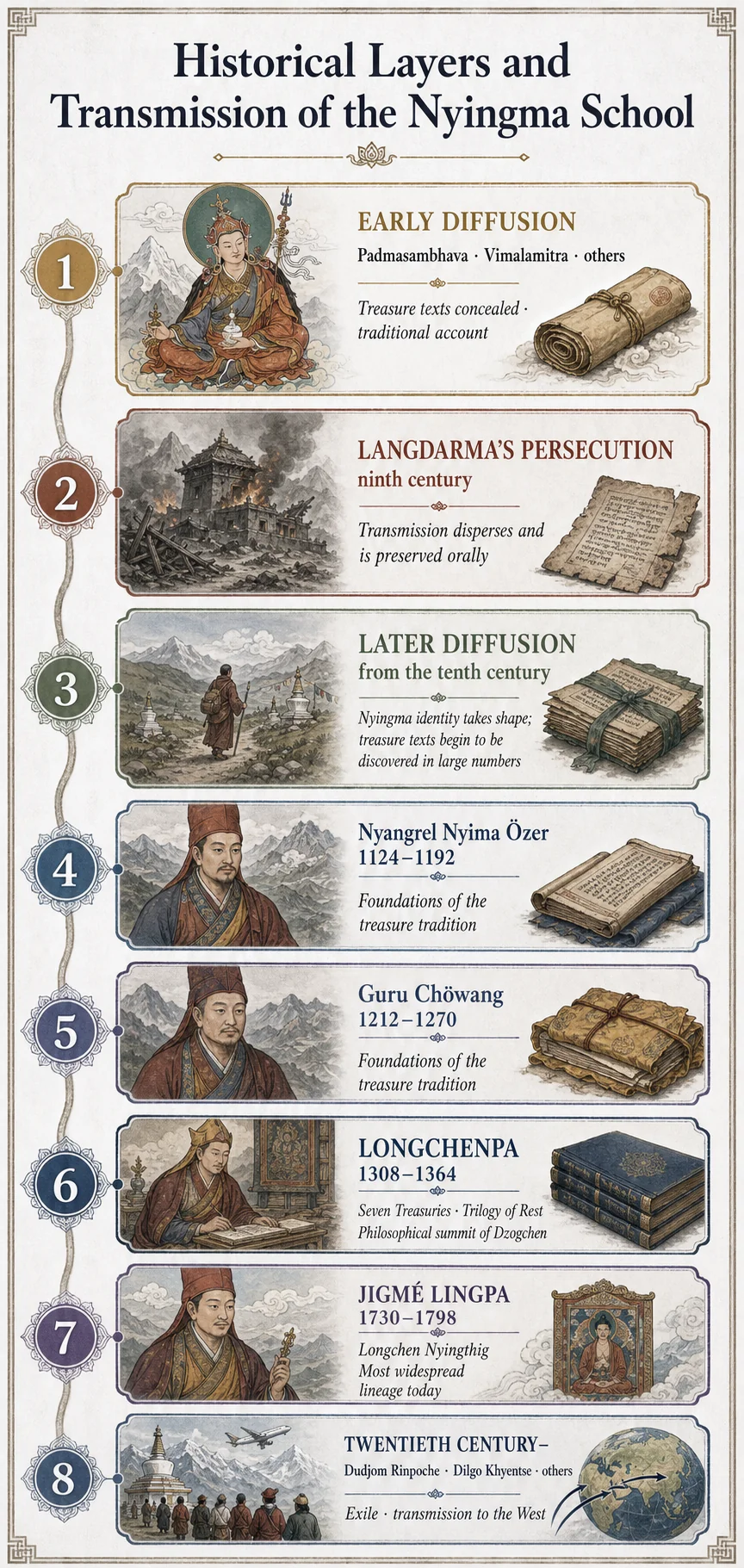
Nyingma actually took shape as an identifiable "school" only during the Later Diffusion. The Early Diffusion had no self-designated "Nyingma school," only groups of people transmitting various tantras and traditions of practice from that earlier period. As the New Translation schools (Kadam, Kagyu, Sakya, and Gelug) successively emerged, the holders of the Old Translation transmissions began to define themselves as "old." Nyingma gradually assumed an identifiable sectarian form from roughly the tenth through the twelfth century.1
This historical picture means that Nyingma has no single founder, founding date, or founding place that can be stated with precision. It is better understood as a community gathered around shared textual sources and a common lineage identity. Its internal traditions are diverse. Although there is considerable agreement concerning its central teaching, Dzogchen, its styles of practice, monastic traditions, and treasure revealers vary enormously.
Padmasambhava's mythic image and historical profile. As the preceding two chapters noted, Padmasambhava's historical profile is quite indistinct. His mythic image within Nyingma (as the Second Buddha, the ultimate source of treasure teachings, and a sacred presence available at any time through supplication) was built up layer by layer over several centuries. This book's position is that the construction of this mythic image is itself intelligible. When a tradition confronts persistent challenges to its legitimacy, it needs to anchor itself in a source of authority beyond historical verification. The narrative that "Padmasambhava foresaw the needs of later ages and concealed in advance all the teachings they would require" responds precisely to the challenge that "your texts have no identifiable Indian source." Understanding this function does not amount to denying the value of the Nyingma tradition of practice.
II. Three Kinds of Transmission
Nyingma has a standard internal classification of its own sources of transmission known as the "three transmission lineages" (brgyud pa gsum):
| Type of Transmission | Tibetan | Meaning | Principal Medium |
|---|---|---|---|
| Long transmission of the canonical teachings | ring brgyud bka' ma | Passed orally from Indian masters through successive generations of teachers and disciples | Canonical transmission of various tantras and practical instructions |
| Short transmission of treasures | nye brgyud gter ma | Texts and teachings concealed by masters such as Padmasambhava and later discovered by treasure revealers | Treasure texts and their related practice lineages |
| Pure-vision transmission | dag snang | Manifestations of a deity or master received directly by a practitioner in meditation | Records and transmissions of an individual's pure visions |
The long transmission includes many historically traceable chains of transmission through successive teachers and students, although the most distant, Indian portions of these chains are often difficult to verify. The short transmission of treasures is Nyingma's most distinctive and controversial mechanism of knowledge and merits a separate discussion. Pure-vision transmission is the most difficult kind to evaluate externally; this book records it without judging the authenticity of the experiences involved.
III. The Treasure Tradition: Tibetan Buddhism's Most Distinctive Mechanism of Knowledge
What Is a Treasure?
A treasure (terma, gter ma, literally "treasure") is a doctrinal text or practical instruction intentionally concealed to await discovery by later generations at the appropriate time. According to Nyingma tradition, eighth-century masters such as Padmasambhava and Vimalamitra foresaw that Langdarma's persecution would place many precious teachings in danger of extinction. They therefore sealed these teachings away in various forms: beneath the ground, inside rocks, at the bottom of lakes, or within their disciples' minds, to await discovery by a specific treasure revealer (tertön, gter ston) at a specific time.
Tradition identifies treasure revealers as reincarnations of Padmasambhava's former disciples. Each possesses a karmic connection with a particular treasure, and only that revealer can discover and transmit its teaching. Modes of discovery also vary. Some treasures are material texts, sometimes only a few lines on a "yellow scroll," which the revealer can read and then unfold from memory. Others are "mind treasures" (dgongs gter) that emerge directly from the depths of the mind and possess no material medium.2
The Historical Significance and Controversy of Treasures
The treasure system has served several important functions in the history of Tibetan Buddhism.
Function one: providing Nyingma with legitimacy. When the New Translation schools objected that Nyingma's texts lacked Indian sources, the treasure narrative supplied a rejoinder: Padmasambhava, an Indian master, was the source of these texts; he had simply chosen concealment and revelation rather than direct textual transmission as their means of communication. This transferred the question of legitimacy to a domain that historical method can neither verify nor falsify.
Function two: responding to present needs. Each teaching discovered by a treasure revealer is held to have been "specially prepared for the beings of this age." Treasure revelation thus provides an organic mechanism through which a religious tradition can articulate itself anew under changed historical conditions. New teachings can be explained as teachings "concealed by Padmasambhava more than a thousand years ago for the present day," rather than as something "created by this teacher."
Function three: maintaining a direct connection with contemplative experience. The discoveries of treasure revealers are normally accompanied by experiences in practice—dreams, appearances in meditation, and the like. Treasure revelation therefore maintains a more direct relationship to contemplative practice than does purely textual transmission.
The focus of controversy is whether these texts' "authenticity" can be established in the historical sense. Modern Buddhist scholarship's general answer is that the literary style, language, and intellectual content of most treasure texts indicate composition in the period of the revealer rather than in the eighth century. This does not negate their value for practice. It means only that the historical assertion that "Padmasambhava personally concealed them" is difficult to sustain by the methods of historical study. Nyingma does not assess its transmission within this historical framework. Two different standards of legitimacy are confronting one another, and the matter should not be reduced to a simple question of "true or false."
Principal Treasure Revealers
Nyingma histories speak of "108 great treasure revealers," though the number is symbolic. Among the most influential are the following:
| Treasure Revealer | Dates | Principal Treasures | Historical Influence |
|---|---|---|---|
| Nyangral Nyima Özer | 1124–1192 | Important tantras including the Eight Great Herukas | Established the basic framework of the treasure tradition |
| Guru Chöwang | 1212–1270 | The Gathering of the Great Compassionate One and other treasures | Systematized the treasure tradition |
| Longchenpa (Klong-chen Rab-'byams) | 1308–1364 | A great adept rather than a typical treasure revealer, but crucial as a systematizer | Philosophical summit of Dzogchen (see Section VI) |
| Jigme Lingpa ('Jigs-med-gling-pa) | 1730–1798 | Longchen Nyingthig | One of the most widely transmitted Nyingma practice lineages today |
IV. The Nine-Vehicle Classification: Nyingma's System of Practice
Nyingma developed a distinctive classification of the stages of the path known as the "nine vehicles" (theg pa dgu), dividing every Buddhist path of practice into nine ascending levels:
| Vehicle | Name | Content | Classification |
|---|---|---|---|
| 1 | Śrāvakayāna | Four truths; ending all suffering | Common vehicle (exoteric foundation) |
| 2 | Pratyekabuddhayāna | Twelve links of dependent origination; solitary awakening and liberation | Common vehicle |
| 3 | Bodhisattvayāna | Six perfections, ten grounds, and bodhicitta | Common vehicle |
| 4 | Kriyātantra | Tantra centered on purificatory rites and external conduct | Three outer tantric vehicles |
| 5 | Caryātantra | Combines inner and outer methods, giving equal weight to visualization and conduct | Outer tantra |
| 6 | Yogatantra | Centers on internal visualization | Outer tantra |
| 7 | Mahāyoga | Generation stage: visualizing the deity and recognizing the pure nature of body and cosmos | Three inner tantric vehicles |
| 8 | Anuyoga | Completion stage: practice with channels, winds, and drops at the energetic level | Inner tantra |
| 9 | Atiyoga, or Dzogchen | Direct recognition of intrinsic awareness (rigpa), the highest teaching beyond all practice | Summit of inner tantra |
Through this nine-vehicle classification, Nyingma incorporates the whole of Buddhism (from the Southern Buddhist path of liberation to the highest Dzogchen) within its own framework. It is worth noting that the first three vehicles, those of śrāvakas, pratyekabuddhas, and bodhisattvas, are included but designated "common vehicles": foundations shared by all Buddhist traditions. The last six are tantric, and through them Nyingma locates itself above the exoteric Mahāyāna. This classification is itself Nyingma's doxographical position and differs from the classifications of other schools, especially Gelug's ordering of tantra.
V. Dzogchen: Intrinsic Awareness and Primordial Purity
Dzogchen (rdzogs pa chen po, "Great Perfection" or "Great Completeness") is Nyingma's highest teaching and one of the most philosophically distinctive and controversial traditions in Tibetan Buddhism as a whole.
Three Divisions
Dzogchen is internally divided into three divisions (sde gsum):
- Mind Series (Sems-sde): enters through direct recognition of the "nature of mind" (sems nyid) and emphasizes that mind is originally awareness.
- Space Series (Klong-sde): enters through recognition of the ground-space (klong) of all phenomena and emphasizes emptiness together with unbounded awareness.
- Instruction Series (Man-ngag-sde, Upadeśa): employs direct introduction, through which a master's immediate transmission enables a disciple to recognize intrinsic awareness (rigpa) in the present moment. The Instruction Series is the highest and most widely transmitted division of Dzogchen and is especially known for two modes of practice, Trekchö and Tögal.5
The Central Concept: Intrinsic Awareness
The central concept of Dzogchen philosophy is intrinsic awareness (rigpa, Sanskrit vidyā). To understand this term, one must first distinguish it from "awareness" in its ordinary sense.
Ordinary awareness takes an object: "I know that this is a table." It involves a knowing subject, an object known, and a discriminating act of awareness.
In Dzogchen usage, intrinsic awareness (rigpa) is awareness in its original condition: nondiscriminating, non-grasping, neither coming nor going, yet vividly lucid. It is different from torpor or an indeterminate state in which nothing is present. It also differs from awareness with some special content, which would still be a discriminating mind directed toward an object. It is the immediate presence of awareness itself—clear, unobstructed, and complete in itself.
Dzogchen's fundamental claim is that this intrinsic awareness need not be "created" or "acquired" through practice. It is already the actual condition of mind, primordially pure (ka dag). Saṃsāra arises because sentient beings fail to recognize this intrinsic awareness and a condition of "being lost" arises within it (rang ngor ma shes pa, failure to recognize one's own face). When a master's direct introduction and the practitioner's own recognition expose this error, intrinsic awareness is directly known. This is what Dzogchen calls "liberation."
Trekchö and Tögal
The Instruction Series has two principal modes of practice:
Trekchö (khregs chod, "cutting through"): completely cuts through contrived thoughts, effort, and discrimination, allowing mind to rest in the natural condition of intrinsic awareness. It does not mean simply doing nothing. The point is to seek no state and reject no thought, but to allow awareness to be naturally present here and now. Trekchö corresponds to the aspect of "primordial purity" (ka dag).
Tögal (thod rgal, "direct crossing"): on the basis established by Trekchö, it uses particular postures, eye positions, and conditions of light to allow manifestations of luminosity ('od) to appear directly in the meditator's perception, culminating in recognition of the primordial purity of all appearances. Tögal corresponds to the aspect of "spontaneous presence" (lhun grub): pure, naturally complete manifestation that requires nothing further to be established.
According to Nyingma tradition, these two practices together form the path to the rainbow body ('ja' lus). At death, the body of a highly accomplished Dzogchen practitioner is said to dissolve into light, leaving only hair and nails. Nyingma literature records many such accounts. This book records them without adjudicating their truth or falsity from the perspective of historical study.
The Relationship of Dzogchen to Madhyamaka and Yogācāra
The relationship of Dzogchen philosophy to Madhyamaka and Yogācāra is one of the enduring philosophical controversies in Tibetan Buddhist history.
Its relationship to Madhyamaka. Gelug, a firm defender of Prāsaṅgika Madhyamaka, has historically criticized Dzogchen on the ground that its "intrinsic awareness" (rigpa) and "nature of mind" sound as though they establish an abiding, self-subsistent entity "within" the mind. Such a view would be incompatible with Madhyamaka's denial of intrinsic nature and self and would risk falling into eternalism—an ātman-like substantial self. Nyingma responds that intrinsic awareness is not a "thing possessing intrinsic nature." It is no entity that can be fixed or objectified; it is the original openness of all phenomena and therefore the most thoroughgoing emptiness. The debate is to a considerable extent about how to interpret the relationship between the words "emptiness" and "intrinsic awareness." This book holds that the controversy has not been finally resolved: both sides have substantial textual support, and their differences arise partly from divergent interpretations of "intrinsic awareness" and partly from the two traditions' different ways of describing liberation.3
Its relationship to Yogācāra. Dzogchen is sometimes read as approximating the Yogācāra position that "mind is the foundation of everything." Nyingma generally rejects this reading. Yogācāra, it argues, treats consciousness (vijñāna) as something possessing a certain self-defining characteristic, whereas Dzogchen's intrinsic awareness is not "a consciousness with intrinsic nature" in any sense. Nevertheless, the proximity between the two in the central importance they assign to inward awareness has generated continuing internal debate.
Self-emptiness and other-emptiness. Tibetan Buddhism also contains a classificatory debate concerning emptiness. Nyingma and traditions such as Jonang are sometimes assigned to the camp of "other-emptiness" (gzhan stong): buddha-nature is empty of what is "other," namely the afflictions, but is itself positively existent. This is contrasted with Gelug's "self-emptiness" (rang stong), according to which all phenomena, including buddha-nature itself, are empty. Nyingma does not uniformly accept this label, and its transmissions adopt different positions. Chapter 11.7 will examine the controversy more closely.
VI. Longchenpa: The Philosophical Summit of Dzogchen
Within Nyingma, no one equals the stature of Longchenpa (Klong-chen Rab-'byams, 1308–1364). He was the greatest systematizer in Nyingma history and the most profound philosophical exponent of Dzogchen.
Longchenpa wrote prolifically. His most important works include:
- The Seven Treasuries (mDzod bdun): seven independent major treatises that synthesize all Nyingma doctrine and the philosophy of Dzogchen. Among them, the Treasury of the Dharmadhātu (Chos dbyings rin po che'i mdzod) is regarded as Dzogchen's most profound written expression.
- The Trilogy of Rest (Ngal gso skor gsum): three treatises devoted respectively to mind, meditation, and primordial purity, presenting Dzogchen in a relatively accessible form.
- The Fourfold Heart Essence (sNying thig ya bzhi): a collection of foundational works from the Nyingthig tradition and a central body of material for Dzogchen's Instruction Series.6
Longchenpa organized the Dzogchen materials previously dispersed among different treasure cycles and transmissions into a coherent and philosophically rigorous system. He employed a great deal of Madhyamaka and Yogācāra philosophical language to interpret Dzogchen while maintaining its distinctiveness. Dzogchen was neither another way of stating Madhyamaka nor a duplicate of Yogācāra, but a distinctive way of directly recognizing reality (chos nyid, dharmatā).
Jigme Lingpa (1730–1798) was the most important Nyingma thinker after Longchenpa. In meditation he repeatedly encountered Longchenpa's "wisdom body" (a nonmaterial meeting and direct transmission within meditative absorption), and discovered and transmitted the Longchen Nyingthig. It is now the most widely transmitted Nyingma practice lineage in the world, and Jigme Lingpa's line of transmission leads directly to many Nyingma masters active today.4
VII. Nyingma's Historical Position
Nyingma's place in the history of Tibetan Buddhism can be considered from several angles.
The oldest, but also the most historically layered. Nyingma is rooted in the Early Diffusion, yet it formed as an identifiable school only during the Later Diffusion. Some parts of its textual tradition belong to the Early Diffusion; others emerged in new forms through the treasure mechanism; still others are new compositions of the Later Diffusion. Clearly distinguishing these layers is a prerequisite for understanding Nyingma.
Dzogchen is one of Tibetan philosophy's most contested summits. Its central concepts, intrinsic awareness and primordial purity, have generated continuing debate in the history of Tibetan philosophy, and the tension between Dzogchen and Madhyamaka, especially Gelug Prāsaṅgika, has never been entirely resolved. That tension is itself one manifestation of Tibetan Buddhism's philosophical vitality.
Nyingma practice is one of the most active sources of Tibetan Buddhism's modern transmission to the West. From the twentieth century onward, many Nyingma masters either left Tibet or emerged from exile communities and taught Dzogchen to Western students. This transmission changed Western understandings of Tibetan Buddhism and also generated new interpretation and reconstruction. That is a subject for Chapter 11.8, on Tibetan Buddhism in the modern and contemporary periods.
The next chapter turns to Kagyu. Its structure of transmission is entirely different: rather than depending upon the textual sources of the Early Diffusion, it centers on direct transmission from master to disciple (the mind-to-mind transmission), and the immediate experience of Mahāmudrā.
Further Reading
- Matthew T. Kapstein. The Tibetan Assimilation of Buddhism. Oxford: Oxford University Press, 2000. (Historical context of the relationship between Nyingma and the New Translation schools)
References
References
-
Dudjom Rinpoche. The Nyingma School of Tibetan Buddhism: Its Fundamentals and History, 2 vols. Trans. Gyurme Dorje and Matthew Kapstein. Boston: Wisdom Publications, 1991. (Authoritative synthetic source on Nyingma history and doctrine) ↩
-
Janet Gyatso. "The Logic of Legitimation in the Tibetan Treasure Tradition." History of Religions 33, no. 2 (1993): 97–134. (Analysis of the historical construction of the treasure tradition) ↩
-
David Higgins. The Philosophical Foundations of Classical rDzogs chen in Tibet. Vienna: Arbeitskreis für Tibetische und Buddhistische Studien, 2013. (Philosophical analysis of Dzogchen's relationship to Madhyamaka and Yogācāra) ↩
-
Janet Gyatso. Apparitions of the Self: The Secret Autobiographies of a Tibetan Visionary. Princeton: Princeton University Press, 1998. (Study of Jigme Lingpa's biography and autobiographical literature) ↩
-
David Germano. "Poetic Thought, the Intelligent Universe, and the Mystery of Self: The Tantric Synthesis of rDzogs Chen in Fourteenth Century Tibet." PhD dissertation, University of Wisconsin–Madison, 1992. (Systematic academic study of Dzogchen, including detailed analyses of Trekchö and Tögal) ↩
-
Longchenpa. Kindly Bent to Ease Us (trans. Herbert Guenther). Berkeley: Dharma Publishing, 1975–1976. (English translation of the Trilogy of Rest.) You Are the Eyes of the World (trans. Kennard Lipman and Merrill Peterson). Novato: Lotsawa, 1987. (English translation of a Dzogchen Mind Series text; for academic study of Longchenpa's principal works, see Germano above.) ↩