Chapter 7: The Madhyamaka Debate—Self-Emptiness and Other-Emptiness
No controversy in the entire history of Tibetan Buddhist philosophy has been more enduring, more profound, or more deeply entangled with politics than the dispute between self-emptiness (rang stong) and other-emptiness (gzhan stong). On the surface, it is a hermeneutical dispute within Madhyamaka about how emptiness should ultimately be understood. In substance, it touches the foundations of Buddhist soteriology: when we say that all phenomena are "empty," what exactly are they empty of? What, if anything, remains after this "emptiness"?
Previous chapters have approached the dispute from different directions. Part VII, on tathāgatagarbha thought, established its scriptural basis. Part V, on the Madhyamaka school, supplied its philosophical language. Chapter 11.6, on Gelug, explained the Gelug position and its repression of Jonang. This chapter develops the debate as a whole.
I. The Framework of the Debate
The Meaning of the Two Terms
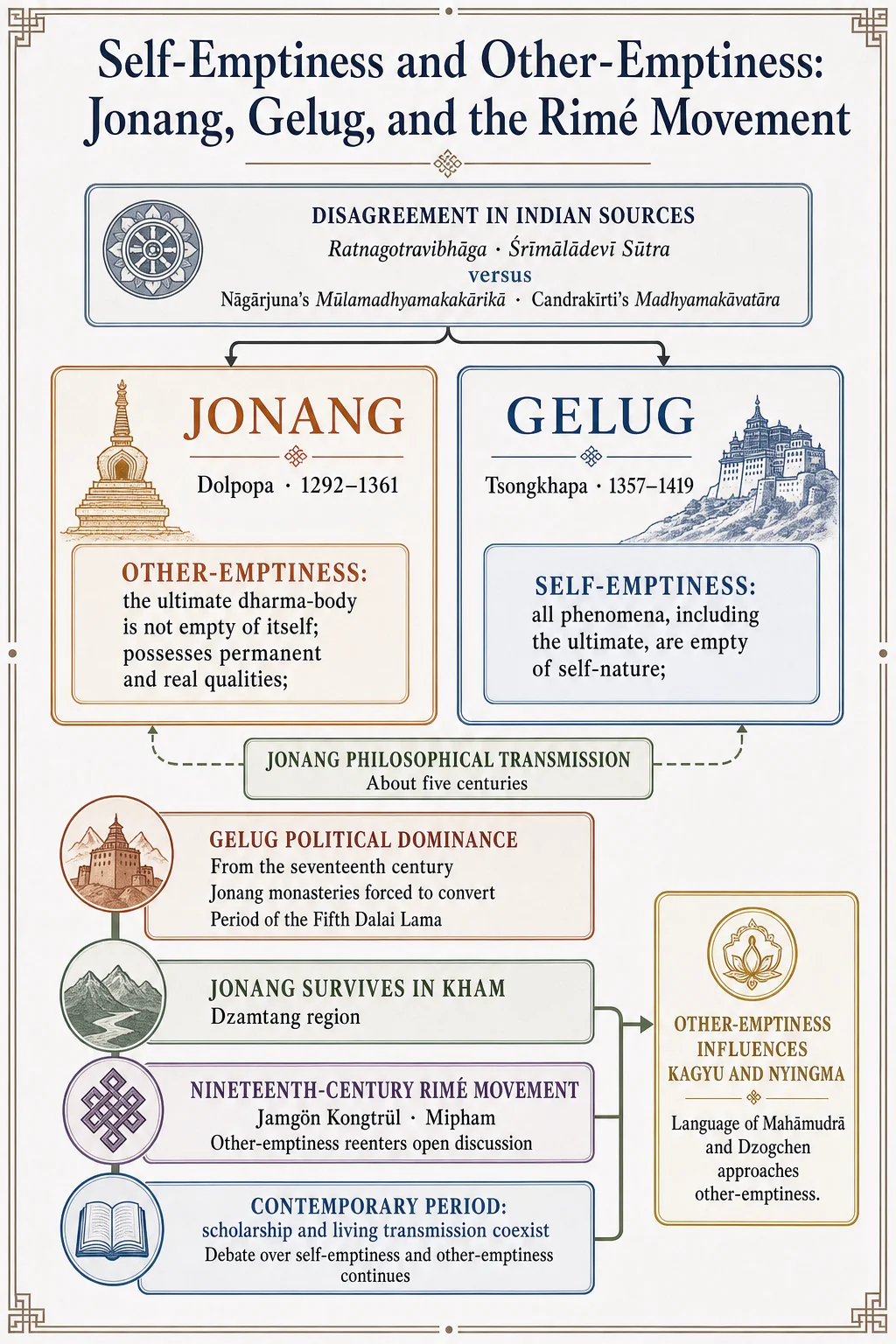
Self-emptiness (rang stong, rangtong) literally means "empty of itself": every phenomenon is empty of its own nature (svabhāva). This is the most basic proposition of Nāgārjuna's Madhyamaka. Phenomena lack intrinsic nature, including emptiness itself (emptiness too is empty), and including tathāgatagarbha or the dharmadhātu, if one speaks of them. Self-emptiness leaves no "existent" at the ultimate level. Every phenomenon, whether conventional or "ultimate," is empty of intrinsic nature.
Other-emptiness (gzhan stong, shentong) literally means "empty of other": ultimate reality (the dharmakāya, tathāgatagarbha, or dharmadhātu) is empty of what is "other," namely illusory, impermanent, conventional phenomena, but is not empty of the innumerable qualities of a buddha that it primordially possesses. Other-emptiness makes a fundamental ontological distinction between illusory conventional phenomena and true ultimate reality. Everything conventional is self-empty and possesses no reality, but the ultimate, the dharmakāya or tathāgatagarbha, is real and not empty; it is only empty of the delusive conventional.1
The distinction is crucial. Self-emptiness says, "empty all the way down, with nowhere to stand." Other-emptiness says, "the illusory is empty, but the real is ultimately there."
The Dispute over Indian Sources
Both sides claim to interpret the meaning of Nāgārjuna and Maitreya.
The principal Indian sources invoked by proponents of other-emptiness include the Ratnagotravibhāga, attributed to Maitreya or Sāramati and discussed in Chapter 7.2, which describes tathāgatagarbha as possessing the qualities of a buddha, such as the thirty-two major marks, and as not empty of its pure nature; the Śrīmālādevī Siṃhanāda Sūtra's "nonempty tathāgatagarbha," which is "endowed with immeasurable, inseparable, indivisible, inconceivable buddha qualities more numerous than the sands of the Ganges"; the four qualities of permanence, bliss, self, and purity in the Mahāparinirvāṇa Sūtra, especially the word "self," which proponents read as pointing to ultimate reality; and descriptions of tathāgatagarbha in the Laṅkāvatāra Sūtra.
Proponents of self-emptiness, chiefly Gelug, principally invoke Nāgārjuna's Fundamental Verses on the Middle Way: every phenomenon is empty, including emptiness itself, and "those for whom emptiness is a view are said to be incurable"; Candrakīrti's Introduction to the Middle Way, which systematizes Prāsaṅgika Madhyamaka; and the Heart Sūtra: "form is emptiness; emptiness is form," with no exception even for nirvāṇa.
The two sides' attitudes toward each other's texts converge on a hermeneutical question. Are the positive descriptions of the qualities of tathāgatagarbha in the Ratnagotravibhāga and related works of definitive meaning, expressing their actual purport, or of interpretable meaning, a skillful teaching requiring interpretation? Proponents of other-emptiness regard them as definitive. Proponents of self-emptiness consider them expedient means intended to guide beings attached to a substantial self, not direct expressions of ultimate truth.
II. Dolpopa: The Systematization of Other-Emptiness
Dolpopa Sherab Gyaltsen (Dol-po-pa Shes-rab-rgyal-mtshan, 1292–1361), the most important Jonang thinker, was the great systematizer of other-emptiness. His position is an internally coherent philosophical system, not an arbitrary claim.
Central Claims
Dolpopa divides all phenomena into two levels:
The conventional or phenomenal level, the conventional truth. Everything on this level (including the five aggregates, twelve sense fields, eighteen elements, and even the nirvāṇas of śrāvakas and pratyekabuddhas) is relative, temporary, and impermanent. In this sense it is "self-empty," empty of its own nature. This agrees with Madhyamaka's basic assertion.
The ultimate or dharmadhātu level, the ultimate truth. This is the level of the dharmakāya and tathāgatagarbha. Here Dolpopa's claim differs categorically from that of proponents of self-emptiness: ultimate reality is not "empty of its own nature"—it is not self-empty. It is empty of "other," the delusive phenomena of the conventional, but it itself possesses real, permanent, and pure buddha qualities. The four qualities—permanence, bliss, self, meaning a pure true self distinct from the delusive self, and purity—truly exist within ultimate reality.2
The philosophical logic of the position is this. If ultimate reality were "self-empty," it would be like conventional phenomena: relative, impermanent, and dependent on conditions. But how could a nirvāṇa dependent upon conditions constitute genuine liberation? Liberation requires a stable, ultimate support that does not change with conditions; otherwise, "liberation from saṃsāra" would merely exchange one form of conditional dependence for another. Other-emptiness supplies soteriology with a "solid destination": something real is there, not a blank void.
Dolpopa's principal work, Mountain Dharma: An Ocean of Definitive Meaning (Ri chos nges don rgya mtsho, early 1330s), is the most systematic expression of other-emptiness.2
The Appeal of Other-Emptiness
Other-emptiness possesses genuine soteriological appeal: it answers the question, "Where does practice lead?" Practice points toward the dharmakāya and the real qualities primordially present in tathāgatagarbha; it does not collapse into empty nothingness. It also gives compassion and bodhicitta a more intuitively intelligible foundation. Sentient beings innately possess tathāgatagarbha. This inherent treasure is both the destination of practice and the source of compassion: one sees that beings already possess the treasure but do not know it.
Other-emptiness also resonates with Tibetan contemplative traditions. The positive descriptions of "intrinsic awareness" (rigpa) or the "nature of mind" in Kagyu Mahāmudrā and Nyingma Dzogchen are close in both experience and language to other-emptiness's "nonempty ultimate." Although Kagyu and Nyingma do not always accept the whole philosophical system of other-emptiness, this proximity has given other-emptiness an influence broader than Jonang itself.
III. The Self-Emptiness Rebuttal: Tsongkhapa's Central Criticisms
Criticism One: Establishing an "Existent" at the Ultimate Level Violates Madhyamaka
Tsongkhapa's central argument is that Madhyamaka analysis applies impartially. Whether the object analyzed is a conventional table or the "ultimate dharmakāya," if one asserts that it is "established by its own characteristic" and exists intrinsically, the reductio of the four alternatives of arising and other Madhyamaka arguments will refute it.
Dolpopa says that the dharmakāya and tathāgatagarbha "truly exist" and "possess permanent qualities." What do "truly exist" and "permanent qualities" mean here? If they are established by their own characteristics, they fall under the kind of "existence" that Madhyamaka negates. If they are only conventionally designated, they are self-empty just like conventional phenomena, and Dolpopa's distinction collapses. Tsongkhapa holds that Dolpopa is caught in a dilemma: either concede that the dharmakāya is conventionally designated, which makes it self-empty, or concede that it is intrinsically established, which makes the position eternalist.3
Criticism Two: Reading "Permanence, Bliss, Self, and Purity" as Nirvāṇa Mistakes an Expedient Teaching for a Definitive One
The Mahāparinirvāṇa Sūtra ascribes four qualities to nirvāṇa: permanence, bliss, self, and purity. Proponents of other-emptiness read "self" (ātman) as pointing to a real, pure self. Tsongkhapa argues that this is provisional language intended to counteract nihilism in beings who become rigidly attached to no-self. It does not say that nirvāṇa contains an intrinsically established, substantial self. Treating an expedient teaching as definitive is a hermeneutical mistake.
Criticism Three: Other-Emptiness Is a Form of Eternalism
Tsongkhapa classifies other-emptiness as a form of eternalism (śāśvatavāda), because it posits an abiding, unchanging entity at the ultimate level—the dharmakāya endowed with real qualities. Structurally, this resembles Brahman in the Brahmanical tradition or the ātman of the Upaniṣads: an ultimate reality that is permanent, real, and endowed with qualities. Of the two extremes Madhyamaka most rigorously avoids, eternalism and nihilism, other-emptiness inclines toward the eternalist pole.
The Other-Emptiness Response
A fair presentation of the debate requires acknowledging that the Jonang side has replies. Dolpopa and the later Tāranātha (1575–1634) systematically answered the foregoing criticisms in three main ways.24
First, regarding the dilemma. Tsongkhapa's dilemma presupposes a Gelug framework: every "existent" is either established by its own characteristic, in which case Madhyamaka reasoning negates it, or conventionally designated, in which case it is self-empty like conventional phenomena. Jonang rejects the presupposition itself. In the other-emptiness framework, the ultimate is not one phenomenon among phenomena and does not fall within the jurisdiction of conceptual analysis. Madhyamaka reductio arguments target entities posited by concepts. Because the dharmakāya is beyond language and thought and directly realized only by nonconceptual wisdom, those arguments do not reach it. Saying that the dharmakāya "truly exists" does not use the kind of "existence" that Madhyamaka negates.
Second, regarding the classification as eternalism. Jonang points out that other-emptiness likewise accepts that every phenomenon accessible to concepts is self-empty, and in this respect it does not disagree with self-emptiness. The disagreement is only whether, once conceptual analysis has exhausted itself, anything remains that can be warranted by direct realization. Eternalism imputes a self to the aggregates and grasps phenomena established by concepts as permanent. Tathāgatagarbha, by contrast, is neither a conceptually established phenomenon nor an individual "self" in the other-emptiness system; the analogy with Brahman and ātman is therefore inapplicable. In other words, other-emptiness understands itself to establish "manifestation after negation," not "an entity left unnegated."
Third, Jonang appeals to scriptural and direct realization. It considers the positive descriptions of tathāgatagarbha's qualities in the Ratnagotravibhāga, Śrīmālādevī Sūtra, and related works to be definitive, and holds that yogic direct realization can confirm them. Classifying all these passages as expedient requires argument and cannot rest solely on a presupposition that Madhyamaka analysis takes priority.
Gelug responds again: declaring something "ineffable" does not exempt claims about it from examination. "The dharmakāya truly exists" is itself a conceptual assertion. It must either submit to analysis or amount to saying nothing. Once the debate reaches this point, the parties' disagreement no longer concerns a specific argument but a metaphilosophical question: can claims be made about a domain beyond language, and whose direct realization can warrant them? This is the deeper reason the controversy could not be concluded through debate over hundreds of years. The analysis in Section V below takes this as its background.
IV. Intermediate Positions and Plural Interpretations
Not every thinker occupied an extreme of self-emptiness or other-emptiness.
Śākya Chokden (Śākya-mchog-ldan, 1428–1507) was a Sakya thinker who criticized Gelug Prāsaṅgika Madhyamaka without completely accepting Jonang other-emptiness. He held that other-emptiness offered a valid angle from which to describe ultimate reality but needed to be understood together with Madhyamaka analysis of emptiness. His fierce written disputes with Gelug thinkers made him an intensely controversial figure in Tibetan history.5
The Eighth Karmapa, Mikyö Dorje (1507–1554), systematically criticized Tsongkhapa's interpretation of Madhyamaka, arguing that some of Tsongkhapa's interpretations sometimes inclined toward Svātantrika rather than Prāsaṅgika Madhyamaka. He represented philosophically substantive Kagyu doubts about Gelug thought.
Nyingma's distinctive position. Nyingma does not ordinarily call itself a proponent of other-emptiness, but the language of Dzogchen (its intrinsic awareness, primordial purity, and positively described qualities) has considerable affinity with it. Mipam Rinpoche (Ju Mipam Gyatso, 1846–1912) adopted a synthetic position: at the conventional level he accepted the Madhyamaka framework of self-emptiness, while in contemplative experience and final description he retained the positive language of other-emptiness. He engaged Gelug thinkers in written debate at a very high level.6
V. The Philosophical Depth of the Debate
Taken one step further, the debate touches a fundamental problem faced by every soteriology: what is the destination of liberation?
The answer of self-emptiness: liberation is the cessation of all erroneous views and afflictions; there is no separate terminal entity waiting for you. Tsongkhapa's formulation is that liberation cuts off the fundamental ignorance that "views things through the lens of intrinsic nature," and nothing remains. This is a thoroughly negative soteriology. Its strength lies in its thoroughness; its problem is that it has difficulty supplying practice with an intuitively positive direction—where is one going?
The answer of other-emptiness: liberation is a return to the dharmakāya and to the pure qualities innately present in tathāgatagarbha. It is the manifestation of what has always been there once obscurations are removed. This is a positive soteriology, giving practice a clear direction. Its problem is the philosophical risk that it establishes an "entity" at the ultimate level and thus comes into tension with Madhyamaka's thoroughgoing emptiness.
Part VII, on tathāgatagarbha, identified the Indian source of this tension. The tathāgatagarbha tradition after the Ratnagotravibhāga never fully resolved how the pure tathāgatagarbha and the afflictions of ignorance can coexist. To a considerable extent, the Tibetan dispute between self-emptiness and other-emptiness moves this unresolved tension onto the terrain of more rigorous philosophical debate.
This book's observation is that the dispute has continued for five or six centuries. Both sides possess substantial textual support and internally coherent arguments, and neither has been finally defeated. This "lack of resolution" is itself a signal. The two positions represent two orientations in soteriology that cannot be completely reduced to one another: a thoroughly negative soteriology in self-emptiness and a positive, affirmative soteriology in other-emptiness. They give structurally different answers to the question, "Toward what does liberation proceed?" For either to defeat the other completely would require sacrificing a genuine soteriological intuition.
VI. The Entanglement of Politics and Philosophy: The Repression of Jonang
During the rule of the Fifth Dalai Lama under the Gelug–Mongol government, Jonang suffered substantive political repression. Its monasteries were compelled to convert to Gelug, and a considerable number of Jonang monks were forcibly relocated.
This is a distinctive episode in Tibetan Buddhist history: a philosophical controversy was "concluded" by political power rather than philosophical argument. Self-emptiness did not defeat other-emptiness on the debate courtyard. Jonang monasteries were closed or converted by administrative force.
The historical fact shows two things. First, Gelug rulers regarded the danger of other-emptiness as extending beyond philosophical error to religious consequences. Second, philosophical truth is vulnerable when political conditions change. A tradition, however internally consistent its philosophy, can be suppressed by shifts in political power.
After Jonang was driven from central Tibet, it survived principally in the Dzamthang region of present-day Sichuan, developing into a small but persistent transmission. Since the end of the twentieth century, Jonang has received renewed attention and scholarly study to a certain degree, and its traditional vitality continues today.2
VII. The Rimé Movement: A Nonsectarian Ideal of Learning
In the nineteenth century, the Rimé (Ris-med, "nonsectarian") movement arose in Kham, eastern Tibet. It sought to transcend the sectarian barriers among Gelug, Kagyu, Sakya, and Nyingma and to study and preserve the teachings and texts of every school with a more open attitude.
Jamgön Kongtrul Lodrö Thaye (1813–1899) compiled the vast Treasury of Precious Revelations (Rinchen Terdzö) and Treasury of Instructions (Gdams ngag mdzod), which collected practical transmissions from many schools. He was sympathetic to other-emptiness and held that it did not fundamentally contradict self-emptiness in the ultimate reality expressed; the two simply approached it from different angles.
Jamyang Khyentse Wangpo (1820–1892), another central figure in the Rimé movement, carried out an enormous amount of important textual preservation in the history of Tibetan Buddhism.
Mipam Rinpoche (1846–1912) was the Rimé movement's most philosophically productive thinker. Working from a Nyingma background, his writings systematically criticized Gelug interpretations of Madhyamaka while accepting other-emptiness to a certain degree. His written debates with Gelug scholars rank among the most sophisticated exchanges in the history of modern Tibetan philosophy.6
The historical significance of the Rimé movement lies in its provision of an organic framework for preserving the traditions of other schools after Gelug's political dominance had become relatively secure. It also created a comparatively neutral academic setting for the self-emptiness–other-emptiness debate. Discussion was no longer decided by rulers suppressing dissent but continued through comparative study among thinkers of different schools.
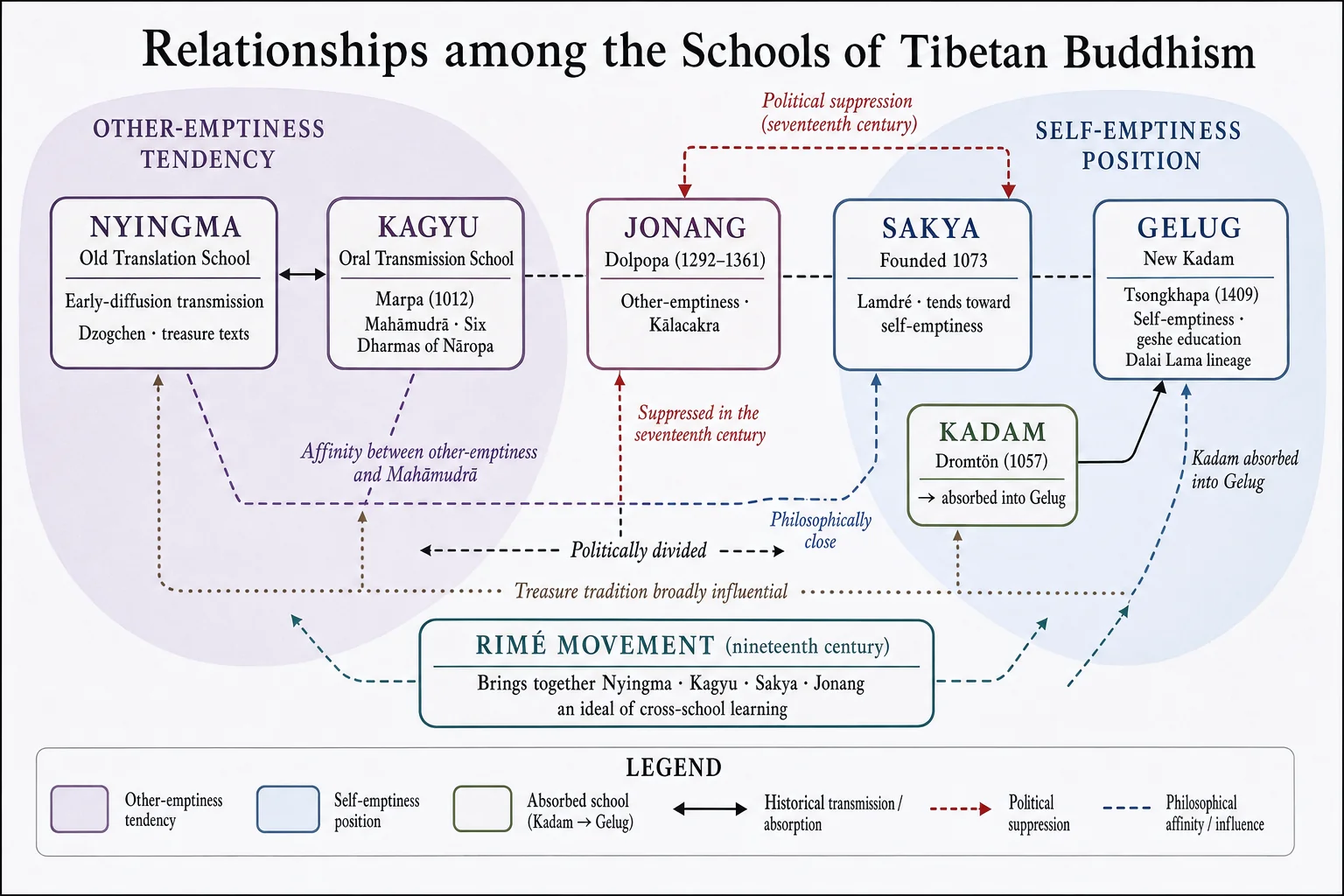
Appendix: A Diagram of Relations among the Tibetan Schools
The following diagram presents relations among the principal Tibetan Buddhist schools along two dimensions: philosophical position (self-emptiness or other-emptiness) and historical relationship, including transmission, absorption, repression, and Rimé collaboration.
VIII. Position in Intellectual History
The dispute between self-emptiness and other-emptiness is a philosophically dense region in Tibetan Buddhist intellectual history. Its distinctiveness lies in several features.
It is a genuinely philosophical controversy, not merely a hermeneutical disagreement. The parties disagree about more than "how to read this scriptural sentence." They reach the fundamental soteriological question of whether liberation's destination possesses some form of positive reality. Such a controversy can arise within any tradition centered on liberation. It arose in Tibet and left behind an extraordinarily rich philosophical literature.
Its entanglement with politics is the historical reality. Philosophical argument and political power became intertwined here, not independent of one another. The repression of Jonang cannot be whitewashed as a pure "result of philosophical debate," nor can it be reduced to nothing more than "political persecution." Both were real components.
It remains unresolved. The contemporary revival of other-emptiness shows that the soteriological tension represented by the dispute will not disappear through political repression or philosophical criticism. It may be a permanent internal fracture in Buddhist soteriology, on either side of which different traditions have found their respective positions.
Further Reading
- Karl Brunnhölzl. In Praise of Dharmadhatu: Nagarjuna and the Third Karmapa Rangjung Dorje. Ithaca: Snow Lion, 2007. (Kagyu's adoption of other-emptiness and its relationship to Madhyamaka)
References
References
-
Matthew T. Kapstein. "The Illusion of Spiritual Progress: Remarks on Indian and Tibetan Buddhist Soteriology." In Paths to Liberation, ed. Robert Buswell and Robert Gimello. Honolulu: University of Hawaii Press, 1992. (Philosophical analysis of the self-emptiness–other-emptiness framework) ↩
-
Cyrus Stearns. The Buddha from Dolpo: A Study of the Life and Thought of the Tibetan Master Dolpopa Sherab Gyaltsen. Albany: SUNY Press, 1999. (The most authoritative academic study of Dolpopa's life and the philosophy of other-emptiness) ↩↩↩↩
-
Robert A. F. Thurman (trans.). Tsong Khapa's Speech of Gold in the Essence of True Eloquence. Princeton: Princeton University Press, 1984. (Direct source for Tsongkhapa's criticism of other-emptiness) ↩
-
S. K. Hookham. The Buddha Within: Tathagatagarbha Doctrine According to the Shentong Interpretation of the Ratnagotravibhaga. Albany: SUNY Press, 1991. (The other-emptiness interpretation of the Ratnagotravibhāga and a systematic English presentation of the position) ↩
-
Klaus-Dieter Mathes. A Direct Path to the Buddha Within: Gö Lotsāwa's Mahāmudrā Interpretation of the Ratnagotravibhāga. Boston: Wisdom Publications, 2008. (Interpretation of other-emptiness within a Kagyu framework and analysis of Śākya Chokden's position) ↩
-
Douglas Duckworth. Mipam on Buddha-Nature: The Ground of the Nyingma Tradition. Albany: SUNY Press, 2008. (Mipam Rinpoche's position on other-emptiness and its relationship to Nyingma Dzogchen) ↩↩