Chapter 5: The Sakya School
Sakya (Sa-skya, meaning "gray-white earth," after the color of the soil at the monastery site) was historically the most politically influential school of Tibetan Buddhism. In the thirteenth century, Sakya hierarchs briefly ruled all Tibet with the power of the Mongol Empire behind them, forming the crucial link through which Tibet was first explicitly incorporated into the political jurisdiction of a Chinese central dynasty. At the same time, Sakya placed greater emphasis on logic and philosophical debate than any other Tibetan Buddhist school and produced Sakya Paṇḍita Kunga Gyaltsen, one of the most systematic philosophers in Tibetan Buddhist history.
This chapter first presents Sakya's sources and foundation, then examines Sakya Paṇḍita's philosophical contributions, the origins and consequences of Phagpa's political influence, and finally Sakya's central teaching of Lamdré, or "Path and Result."
I. Sources: Drogmi and the Virūpa Transmission
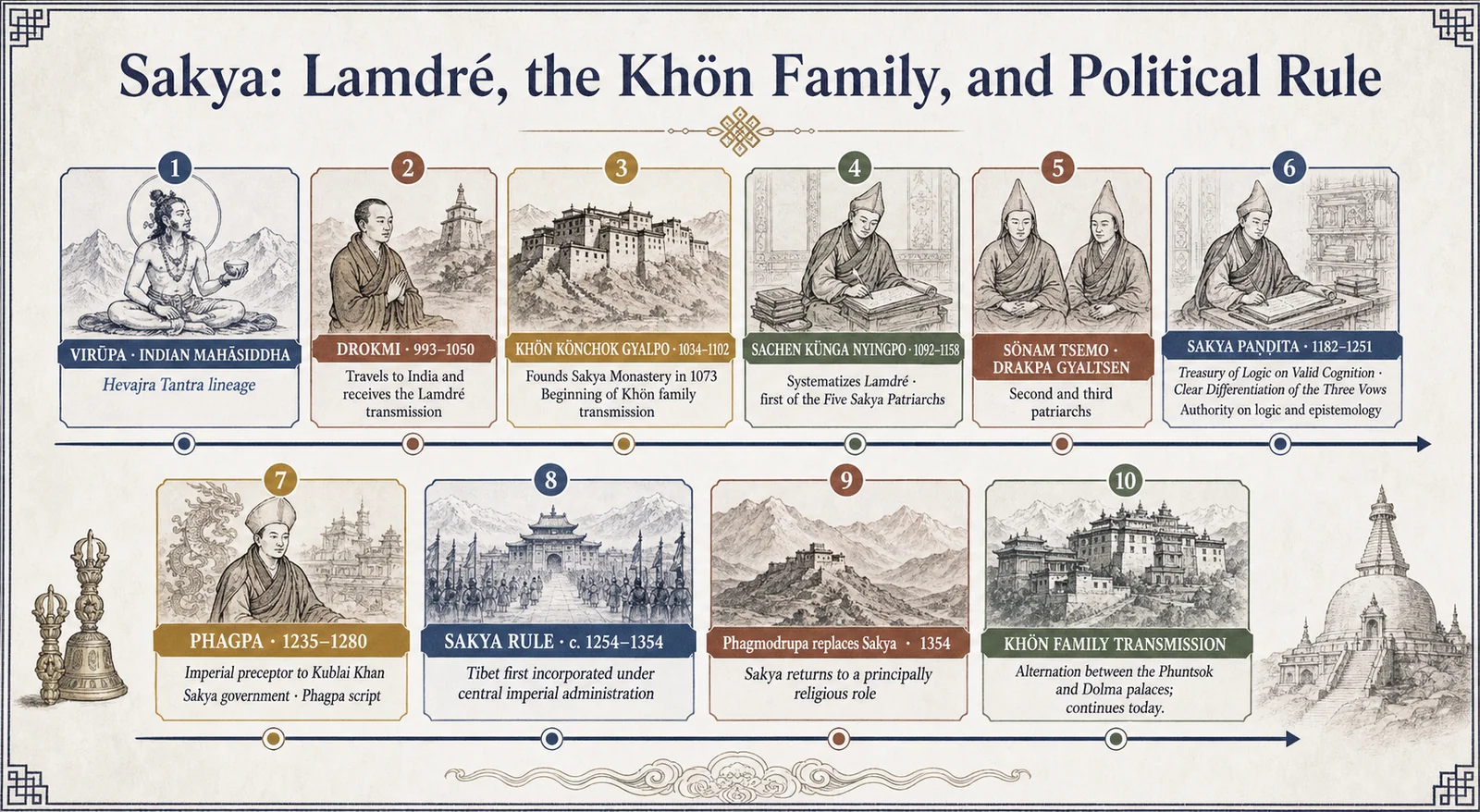
Sakya traces its Indian source to Virūpa (approximately eighth to ninth century; the dates are highly uncertain). Indian tantric history reveres him as a legendary figure who transformed from a meditation master at Vikramaśīla into a mahāsiddha. The practice lineage of the Hevajra Tantra was transmitted chiefly through him. Stories of Virūpa's life (such as pinning the sun in place while sitting in a tavern) are typical legends of the great adepts. This book treats the central figure as historical and the miraculous details as edifying narrative.
Drogmi ('Brog-mi Śākya-ye-shes, 993–1050) studied in India, where he received the essential transmission of Lamdré (Lam-'bras, "Path and Result") chiefly from holders of Virūpa's lineage. He also translated the Hevajra Tantra and its commentaries. The most important of his disciples after his return to Tibet was Khön Könchok Gyalpo (dKon-mchog-rgyal-po, 1034–1102). In 1073 Könchok Gyalpo founded Sakya Monastery on a tract of gray-white earth in central Tibet, giving the Sakya school its institutional beginning.
Könchok Gyalpo was ordained but later returned to lay life and married. Sakya subsequently developed a tradition in which the Khön family ('Khon) transmitted the abbacy. This is one of Sakya's most conspicuous institutional differences from most other Tibetan schools. Other schools transmit authority by reincarnation or from master to disciple; Sakya transmits it through a family. The Khön family has continuously held the throne for more than a thousand years and does so to the present day.1
II. The Five Sakya Patriarchs and Early Development
Könchok Gyalpo's son, Sachen Kunga Nyingpo (Sa-chen Kun-dga'-snying-po, 1092–1158), completed Sakya's foundational work and became the first of its "Five Patriarchs." He systematically organized the Lamdré teaching while studying a wide range of tantras and exoteric scriptures and treatises, making Sakya a tradition that gave equal weight to learning and practice.
| Order | Name | Dates | Principal Contribution |
|---|---|---|---|
| First | Sachen Kunga Nyingpo | 1092–1158 | Systematically received and transmitted Lamdré; established Sakya's framework of practice |
| Second | Lopon Sonam Tsemo | 1142–1182 | Wrote extensively; classified and commented upon tantra |
| Third | Jetsun Drakpa Gyaltsen | 1147–1216 | Central organizer of the Lamdré transmission; wrote numerous works on the teachings |
| Fourth | Sakya Paṇḍita Kunga Gyaltsen, or Sakya Paṇḍita | 1182–1251 | One of Tibet's foremost scholar-philosophers; exerted decisive influence on the Mongols |
| Fifth | Phagpa Lodrö Gyaltsen ('Phags-pa Blo-gros-rgyal-mtshan) | 1235–1280 | Imperial Preceptor to Kublai Khan; led Sakya's political rule over Tibet |
III. Sakya Paṇḍita: Epistemology and Philosophical Debate
Sakya Paṇḍita Kunga Gyaltsen (1182–1251) was the most philosophically influential of the Five Sakya Patriarchs and one of the most systematic thinkers in the whole history of Tibetan Buddhism. "Sakya Paṇḍita" is shortened to "Sakya Paṇḍita" or "Sapan" in Tibetan usage, while paṇḍita designates a scholar of the highest rank in the Indian tradition. From childhood he received rigorous training in both exoteric and esoteric Buddhism, mastered Sanskrit, and could debate Indian scholars directly in Sanskrit—an exceedingly rare ability among Tibetans of his time.
Treasury of Epistemological Reasoning
Sakya Paṇḍita's systematic synthesis of the pramāṇa tradition (epistemology and logic) is one of the most important Tibetan works on the subject. It relies principally on Dharmakīrti's epistemological system, but Sakya Paṇḍita offers interpretations and criticisms of his own and makes numerous corrections to earlier Tibetan understandings of Dharmakīrti.
Central position: Sakya Paṇḍita maintains Dharmakīrti's basic epistemological framework. There are only two forms of valid cognition (pramāṇa): direct perception and inference. Nothing else constitutes valid cognition. He particularly criticized misconceptions about logic then current in Tibet. The work established Sakya's authority in the study of pramāṇa and decisively influenced later Gelug developments in logic, including those of Tsongkhapa's disciple Khedrup Je.2
A Clear Differentiation of the Three Codes and Philosophical Critique
A Clear Differentiation of the Three Codes (sDom gsum rab dbye) examines the relationship among the three systems of discipline: the prātimokṣa vows of monastic liberation, the bodhisattva vows, and tantric samaya. It argues that each system has its own valid sphere and that they must not be confused. Tantric practice must rest upon the foundations of monastic discipline and the bodhisattva vows. Directed against disorder in contemporary Tibetan tantric practice, the position continues Atiśa's insistence on strict tantric qualifications.3
Sakya Paṇḍita also advanced a philosophically important criticism. He argued that some Tibetans mistook "meditative contemplation" (the tranquil state of calm-abiding meditation) for direct recognition of emptiness, which he considered one of the gravest errors in Tibetan practice at the time. Recognition of emptiness, he insisted, must presuppose a correct Madhyamaka view and cannot be replaced directly by intuition or meditative experience. This line of criticism closely resembles Tsongkhapa's later Gelug critique of certain modes of Mahāmudrā practice. Sakya Paṇḍita can be viewed as an early representative of this approach, almost two centuries before Tsongkhapa.3
Debate with Indian Scholars
Between approximately 1204 and 1214, Sakya Paṇḍita engaged in extensive scholarly exchange with the elderly Kashmiri paṇḍita Śākyaśrī (1127–1225). Invited to Tibet in 1204, Śākyaśrī remained there for ten years. Around 1208 he presided over Sakya Paṇḍita's full ordination and subsequently transmitted numerous scriptures and treatises to him. Tibetan tradition portrays the meeting as a landmark moment in which Sakya Paṇḍita demonstrated that Tibetan learning had become capable of equaling the Indian tradition. Indian Buddhism was already in decline, as Part VIII explained, and opportunities for direct dialogue with Indian scholars were becoming increasingly rare. Sakya Paṇḍita used this moment to display Tibetan Buddhism's scholarly independence.
IV. Phagpa and the Sakya Government
Phagpa ('Phags-pa Blo-gros-rgyal-mtshan, 1235–1280) was the fifth of the Sakya Patriarchs and one of the most politically influential figures in Tibetan Buddhist history. In 1244 he accompanied the elderly Sakya Paṇḍita to Mongolia, where he spent the pivotal years of his life.
Patron–Priest Relations and the Imperial Preceptor
Phagpa taught Kublai Khan (1215–1294) and conferred tantric empowerments upon him, establishing a patron–priest relationship (mchod-yon): Kublai supplied material protection and political power, while Phagpa supplied religious services and spiritual authority. In 1253 Kublai invested Phagpa as "State Preceptor" and later elevated him to "Imperial Preceptor," the highest religious adviser at the Yuan court.
The Sakya government (ca. 1254–1354) was the direct political consequence of this relationship. Kublai authorized Sakya hierarchs to rule Tibet, and Sakya became Tibet's effective political center for approximately a century. This marked the first explicit incorporation of Tibet into the system of political jurisdiction of a Chinese central dynasty and became one of the historical precedents for subsequent Chinese claims of sovereignty over Tibet. The historical status of the Mongol-ruled Yuan dynasty itself remains contested within the sovereignty dispute between China and Tibet. This book records the historical facts without adjudicating the question of sovereignty.4
The Phagpa Script
Phagpa made another historical contribution when, at Kublai's commission, he created the Phagpa script in 1269. It was designed as a unified script capable of writing Mongolian, Chinese, Tibetan, and other languages and served as the "national script" of the Yuan dynasty. It was used politically for approximately a century and gradually fell out of use after the Yuan dynasty's collapse. Linguistically, it left important materials that preserve information on the phonology of Yuan-period Chinese and Mongolian. In religious culture, it became a material emblem of the central place Sakya and Tibetan Buddhism occupied in the Mongol Empire.
The End of Sakya Rule
In 1354, the Phagmodrupa government, supported by the Kagyu school, overthrew Sakya rule in Tibet and ended approximately a century of Sakya political hegemony. Sakya did not disappear as a religious tradition when it lost political power; it simply returned to its position as a contemplative and scholastic tradition.
V. Lamdré: Sakya's Central Teaching of Practice
Lamdré (Lam-'bras, "Path and Result") is Sakya's central teaching of practice and the tantric tradition that most clearly distinguishes the school from others.
Sources and Central Idea
Lamdré traces its Indian origin to Virūpa's practice system for the Hevajra Tantra. The Hevajra Tantra is an important scripture of Highest Yoga Tantra (Anuttarayogatantra) centered on the deity Hevajra. Its system of practice includes the generation stage, or deity visualization, and the completion stage, involving the channels, winds, and drops.
Lamdré's central idea may be summarized as the "nonduality of saṃsāra and nirvāṇa." At the deepest level, saṃsāra and nirvāṇa, suffering and happiness, are different manifestations of a single ground (gzhi). The key to practice lies not in fleeing saṃsāra but in recognizing the ground common to saṃsāra and nirvāṇa. That recognition is the "result."5
Structure and Transmission
Lamdré has two levels. The common path (spyi lam) is suitable for ordinary disciples, can be studied without holding the Lamdré empowerment, and emphasizes foundations common to the Buddhist vehicles. The distinctive path (khyad lam) is the specialized practice of the Hevajra Tantra. It requires full empowerment and transmission and contains the generation stage, completion stage, and instructions for recognition.
Transmission likewise takes two forms. Lamdré for assemblies (tshogs pa lam 'bras) is taught to a relatively broad group of disciples. Secret Lamdré (gsang ba lam 'bras) is transmitted to a small, private group and contains more profound completion-stage material. The distinction reflects the Lamdré tradition's strict requirements concerning qualifications and the proper time for transmission. Compared with Kagyu transmission by direct introduction from the master, Sakya Lamdré places greater emphasis on systematic preparation by stages.
VI. Sakya's Philosophical Positions
Sakya's central philosophical orientation was established by Sakya Paṇḍita: Dharmakīrti's epistemology forms its epistemological foundation; Madhyamaka, chiefly within a Svātantrika framework, is its highest philosophy; and tantra is rigorously graduated and regulated.
Sakya also holds a philosophical position clearly different from those of other schools, sometimes called the "neither-one-nor-many doctrine." It is a distinctive description of the interrelationship of all phenomena and has received extensive discussion within Tibetan philosophy. It differs subtly but substantively from Gelug interpretations of Madhyamaka and forms part of the background to Chapter 11.7's debate over self-emptiness and other-emptiness.
VII. Sakya Today
The Khön family transmission of Sakya is one of the oldest living lineages in Tibetan Buddhism. After almost a thousand years, the Khön family continues to hold the Sakya throne. Traditionally, the throne alternates between two branches, the Phuntsog and Dolma households, whose members take turns serving as the Sakya Trizin. The system continues today.
In 2017, Gendun Rinchen, the son of the incumbent Sakya Trizin, was selected as a future Sakya Trizin. He subsequently married a woman from outside the Khön family, who became a Sakya royal consort. Sakya's family lineage gives succession a distinctive institutional guarantee while also presenting challenges and possibilities different from those of other Tibetan Buddhist schools in a modern setting.
Further Reading
- Matthew T. Kapstein. The Tibetan Assimilation of Buddhism. Oxford: Oxford University Press, 2000. (Synthetic analysis of Sakya's historical context)
References
References
-
Ronald M. Davidson. Tibetan Renaissance: Tantric Buddhism in the Rebirth of Tibetan Culture. New York: Columbia University Press, 2005. (Detailed analysis of early Sakya history and Drogmi) ↩
-
Georges B. J. Dreyfus. Recognizing Reality: Dharmakīrti's Philosophy and Its Tibetan Interpretations. Albany: SUNY Press, 1997. (Sakya Paṇḍita's Treasury of Epistemological Reasoning, Dharmakīrti's epistemology, and an authoritative analysis of the Sakya epistemological tradition) ↩
-
Sakya Paṇḍita Kunga Gyaltsen. A Clear Differentiation of the Three Codes: Essential Distinctions among the Individual Liberation, Great Vehicle, and Tantric Systems, trans. Jared Douglas Rhoton. Albany: SUNY Press, 2002. (English translation of A Clear Differentiation of the Three Codes and a direct source for Sakya Paṇḍita's philosophical positions) ↩↩
-
Tsering Shakya. The Dragon in the Land of Snows: A History of Modern Tibet since 1947. New York: Columbia University Press, 1999. (Historical background on Sakya rule and its relationship with the Mongol Yuan) ↩
-
Ngorchen Konchok Lhundrub. The Beautiful Ornament of the Three Visions, trans. Lobsang Dagpa and Jay Goldberg. Ithaca: Snow Lion, 1991. (An important treatise on the common path of Lamdré and a systematic presentation of Sakya's structure of practice) ↩