Chapter 2: The Beginning of the Later Diffusion
The Early Diffusion ended with Langdarma's persecution and the dissolution of the Tibetan Empire. For almost a century thereafter, organized Buddhist activity was largely absent from central Tibet: monasteries had been destroyed, monks dispersed, the ordination lineage survived in name only, and contact with Indian sources had been severed.
The concept of the "Later Diffusion" (phyi dar, "the later propagation of the Dharma," as opposed to the Early Diffusion, snga dar) is a narrative organization of Tibetan Buddhist history by the tradition itself. It marks the Buddhist activity that reemerged in the east and west around the turn of the ninth to the tenth century as the "rebirth" of Buddhism in Tibet. This narrative of rebirth is itself partly constructed: the death of Buddhism in the center and its sudden revival at the margins were not so neatly demarcated. Yet it identifies a real historical juncture: around the tenth century, Tibetan Buddhism began developing anew, in a new form and under new political conditions.
I. Embers in the East: The Lower Route and the Preservation of the Saṅgha
The Flight of Three Monks and the Amdo Transmission
During Langdarma's persecution (ca. 836–842), almost all ordained monks in central Tibet were forced to disrobe or were expelled. According to Tibetan historical sources, three bhikṣus fled during the persecution, carrying the Vinaya ordination lineage eastward until they reached what is now the Amdo region of Qinghai. Tibetan narratives gave their escape an almost mythic significance: it was because of them that the ordination lineage did not die out entirely.1
The historical reality was probably more complex. The eastern regions had already acquired a Buddhist foundation during the Early Diffusion, and Langdarma's persecution was concentrated most heavily in central Tibet, reaching the peripheral regions only to a limited extent. From this we may infer that preservation of the ordination lineage depended more on the space for survival provided by the Buddhist environment already present in the east.
The monks active in Amdo later conferred full ordination upon a number of Tibetans, among them Lachen Gongpa Rabsal (ca. 832–915). Gongpa Rabsal became a major Buddhist figure in Amdo, and through the efforts of him and his students the ordination lineage was preserved there in relatively complete form.
Around the end of the tenth century, two of Gongpa Rabsal's disciples, Lu-mes and Lo-sdon, led a group of monks back to central Tibet, where they reestablished monasteries and the Saṅgha. Tibetan narratives call this return from Amdo to the center the "Lower Route of the Dharma" (because Amdo lies east of the central Tibetan region). Lu-mes and his disciples founded several monasteries in Ü-Tsang and rebuilt the institutional foundations of monastic life.2
The Lower Route was primarily distinguished by the restoration of the Vinaya lineage, not by the introduction of new doctrines or systems of practice. It resolved the institutional question—whether there were legally ordained monastics. The question of content—what they were to practice—was answered chiefly by another current: the Upper Route from the west.
II. Patronage in the West: The Kingdom of Guge and Rinchen Zangpo
Descendants of the Tibetan Dynasty and Guge
After the dissolution of the Tibetan Empire, members of the royal house dispersed to different regions and established several small kingdoms in western Tibet, in what is now Ngari. Of these, Guge became the most important center of Buddhist patronage. Guge faced the Indian subcontinent from its location in present-day Ngari, a geographical position that made it easier for the kingdom to maintain contact with India than it was for central Tibet.
The tenth-century king of Guge, Yeshe Ö (Ye-shes-'od, ca. 947–1024; the precise dates are disputed), was one of the most important patrons of the Later Diffusion. He became a monk while retaining political influence and devoted enormous energy to reviving Buddhism in Tibet: he sent young Tibetans to study in India and invited eminent Indian masters to Tibet.3
Rinchen Zangpo: Founder of the New Translation Era
Among the students dispatched by Yeshe Ö was a man who would become the most important translator of the Later Diffusion: Rinchen Zangpo (Rin-chen-bzang-po, 958–1055). Rinchen Zangpo traveled to India three times and studied there for a total of roughly seventeen years. He mastered Sanskrit, Buddhist philosophy, and the tantras, and after returning to Tibet translated a large body of texts, including many new tantras and exoteric treatises that had not been translated into Tibetan during the Early Diffusion.
His temple construction and translation work in western Tibet formed the core of the Upper Route of the Dharma, which came from the west. Tradition credits him with founding 108 monasteries in Ngari (an auspicious number that need not be exact), and with laying the linguistic and textual foundations of the Later Diffusion's New Translation tradition.4
Rinchen Zangpo occupies a special place in the history of Tibetan Buddhism. He stood at the beginning of the Later Diffusion's New Translation movement, yet also linked two eras. He lived for nearly a century and personally witnessed the first stirrings of several new scholastic traditions nurtured by the texts he had translated. It is said that after Atiśa reached Tibet, he met the elderly Rinchen Zangpo and discussed with him certain questions of tantric practice. If historical, this encounter brought two currents of the Later Diffusion together in a single moment.
III. Atiśa Enters Tibet: The Establishment of the Stages-of-the-Path Tradition
The Invitation
Yeshe Ö recognized that Rinchen Zangpo's translation project needed the authoritative approval of a first-rank Indian scholar. At the same time, the state of Tibetan practice (tantric abuse and lax discipline) called for reform from India. He extended several invitations to India, ultimately seeking its most celebrated Buddhist master of the time, Atiśa (full Sanskrit name Dīpaṃkaraśrījñāna, 982–1054).
According to Tibetan accounts, Yeshe Ö was captured during a military conflict, possibly by a neighboring Muslim polity, which demanded a large ransom. Yeshe Ö's nephew Jangchub Ö informed Atiśa of the event and conveyed the old king's last wish: he would rather exchange his own life for Atiśa's coming to Tibet. Later Tibetan tradition placed great emphasis on this story. This book treats it as a narrative with a historical core that has been intensified by religious literature. In any case, Atiśa entered Tibet in 1042, at about sixty years of age. He worked there for twelve years, never returning to India, and died at Reting in 1054.5
Atiśa and A Lamp for the Path to Awakening
Atiśa was born into a royal family in eastern India and received a complete Indian Buddhist scholarly education. He studied at great monasteries including Nālandā and Vikramaśīla, eventually becoming one of the abbots of Vikramaśīla. His learning embraced Madhyamaka (especially the Prāsaṅgika tradition of Candrakīrti), Yogācāra, logic, and a variety of tantras; he was also known for his strict observance of the Vinaya.
Soon after entering Tibet, he wrote A Lamp for the Path to Awakening (Bodhipathapradīpa, whose Tibetan title means "Lamp Illuminating the Path to Awakening"). It became one of the most influential texts of the Later Diffusion. The treatise arranges the entire Buddhist path according to the capacities of practitioners. It proceeds from persons of lesser capacity, concerned with this and future lives and seeking fortunate rebirth among humans and devas; to persons of middling capacity, concerned with liberation and renunciation of saṃsāra; and finally to persons of greater capacity, who generate bodhicitta, follow the Mahāyāna path, and seek buddhahood. In this way it embraces the full path of both exoteric and esoteric teaching.5
This framework of the "paths of the three capacities" became one of the most influential structures in Tibetan Buddhist accounts of practice. Tsongkhapa later systematized it in the Great Treatise on the Stages of the Path to Awakening (Lamrim Chenmo) as a central teaching of the Gelug school (discussed in detail in 11.6).
Several of Atiśa's Philosophical Positions
Several of Atiśa's philosophical positions deserve emphasis because they decisively influenced the subsequent direction of Tibetan Buddhism.
Acceptance of Prāsaṅgika Madhyamaka. Atiśa explicitly supported Candrakīrti's Prāsaṅgika Madhyamaka rather than Śāntarakṣita's Svātantrika Madhyamaka. The underlying orientation of the Early Diffusion had been Śāntarakṣita's Svātantrika system. Atiśa brought the authority of Prāsaṅgika Madhyamaka into Tibet, laying the foundation for Tsongkhapa's later classification of Prāsaṅgika as the highest view (discussed in detail in 11.7).
Strict requirements for tantric qualification. Atiśa criticized the disorder surrounding tantric practice in Tibet at the time: many people practiced tantra without an adequate exoteric foundation or the proper initiatory qualifications. He insisted that tantra was the highest level of practice and could be undertaken only by those who had systematically mastered the exoteric stages of the path and received valid empowerment. Tantra could not be practiced in isolation from the ethical and philosophical foundations of the exoteric teachings. This was the historical source of the Gelug school's later strict regulation of tantric practice.
A Brief Historical Background to Atiśa's Criticism of Tantric Disorder
This criticism was not groundless. It had a quite specific historical background, whose relevant lines are summarized below:
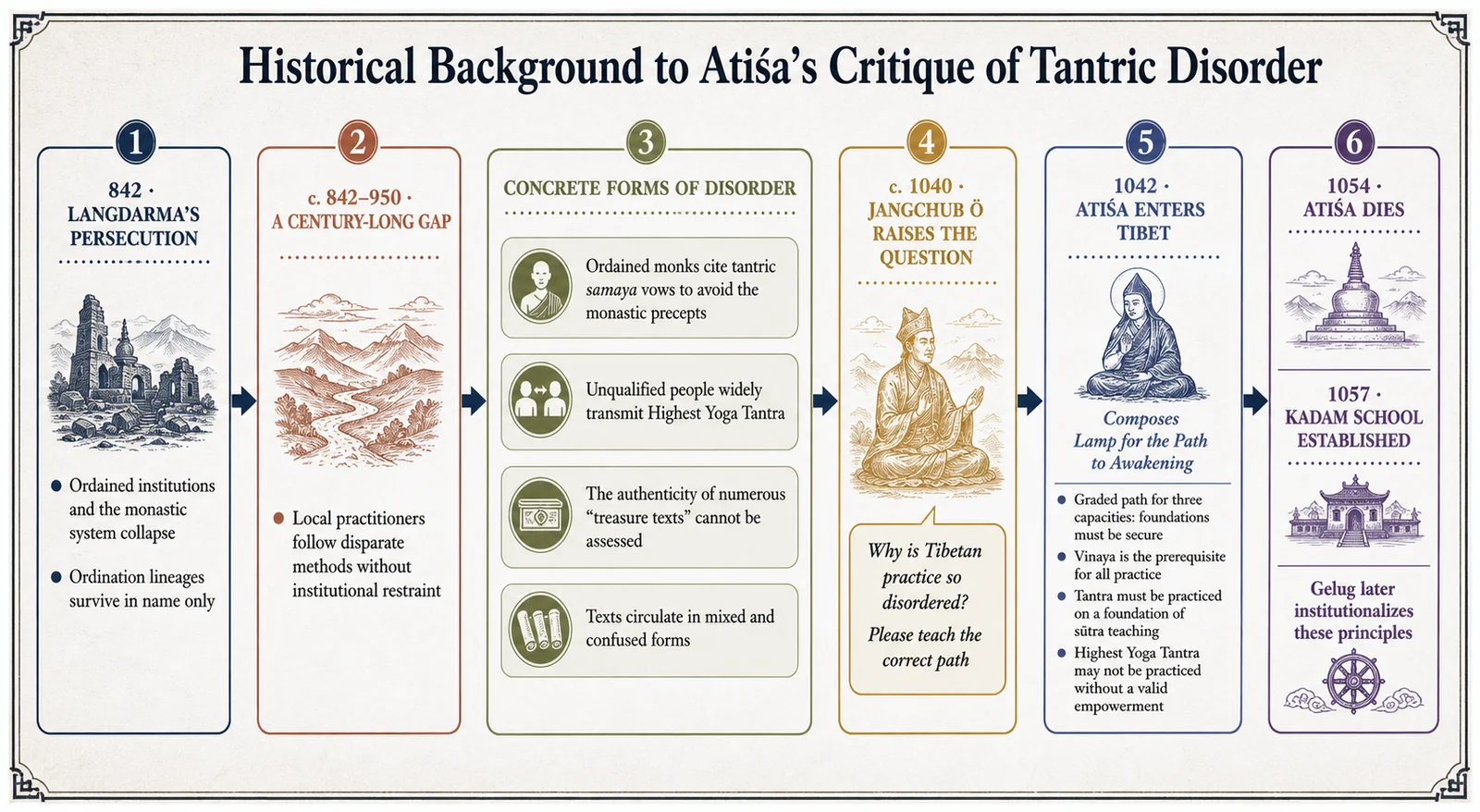
Atiśa's criticism touched a structural problem that has persisted throughout esoteric Buddhist traditions. In theory, the Highest Yoga Tantras (especially texts involving sexual-union practices) are intended for practitioners who already possess a firm exoteric foundation and exceptionally high realization. In actual transmission, however, this threshold is exceedingly difficult to verify, and some people therefore bypass the foundation and act in the name of "tantra being higher than the Vinaya." By confronting the problem directly, Atiśa achieved a historical significance that extends beyond Tibetan Buddhism. The issue bears a structural resemblance both to comparable problems in late Indian esoteric Buddhism and to the recurring logic of any religious movement that treats "advanced practices" as independent of ordinary ethical discipline.6
A sequence of practice in which the Vinaya comes first. In Atiśa's system, ethical discipline is the foundation of all practice, bodhicitta the heart of the Mahāyāna path, the correct view of emptiness its most profound understanding, and tantra its summit—but only when erected upon this foundation.
IV. Kadam: Atiśa's Direct Transmission
Atiśa's most important Tibetan disciple was Dromtön ('Brom-ston Rgyal-ba'i-'byung-gnas, 1005–1064). A lay practitioner known for his exceptionally strict way of life, Dromtön attended Atiśa throughout his time in Tibet, absorbed his complete teaching, and continued to transmit it after his master's death.
In 1057 Dromtön founded Reting Monastery (Tibetan Rwa-sgreng), which became the chief seat of the Kadam school (Bka'-gdams-pa, meaning "those who follow the instructions of the Buddha's word"). The Kadam school was not organized around a distinctive tantric instruction. Its core lay in systematic exoteric study of the Tripiṭaka, rigorous discipline, and Atiśa's framework of the stages of the path.7
The Kadam school had several distinguishing characteristics:
- Priority of exoteric teaching: Kadam imposed particularly strict limitations on tantric practice and devoted much of its work to exoteric learning and the practice of the Vinaya;
- The stages-of-the-path framework: it organized practice through Atiśa's paths of the three capacities—gradual, systematic, and without skipped steps;
- Open transmission: it tended to make its teachings available to anyone willing to learn, without imposing the special hierarchical thresholds of tantric transmission;
- Four principal scriptures: it placed special emphasis on the study of Atiśa's Lamp for the Path to Awakening together with several major scriptures and treatises.
After Tsongkhapa's reforms in the fourteenth and fifteenth centuries, Kadam essentially ceased to exist as an independent school and was absorbed into Gelug. Gelug understood itself as Kadam's heir and culmination and was sometimes called the "New Kadam." Reting became an important Gelug monastery.
V. The Great Translators and the Seeds of the Schools
The history of the Later Diffusion did not consist solely of Atiśa's lineage. At almost the same time, several other great translators brought entirely different transmissions back from India, planting the seeds of other schools that would emerge later.
Appendix: An Overview of the Principal Translators in Tibet
Translation was an independently sacred vocation in Tibetan Buddhist history. Its practitioners were called lotsāwa ("translator") and enjoyed extraordinarily high status. The following table lists the most important translators of both the Early and Later Diffusions and shows the sources and subsequent directions of their respective transmissions:
| Period | Translator | Background | Principal Contributions | Influence on Later Transmission |
|---|---|---|---|---|
| 7th century | Thonmi Sambhoṭa | Sent to India by Songtsen Gampo | Created the Tibetan alphabet; translated the earliest Buddhist texts | Linguistic foundation of the entire Tibetan translation project |
| 8th century | Vairocana | Active under Trisong Detsen; studied with Padmasambhava | Numerous Dzogchen and Mind Series texts | One of the principal lineage holders of Nyingma |
| 8th century | Kawa Paltsek | Active under Trisong Detsen | Exoteric sūtras and treatises; helped compile the Mahāvyutpatti | Foundation of standardized translation during the Early Diffusion |
| 8th century | Chogro Lui Gyaltsen | Active under Trisong Detsen | Tantras and exoteric treatises | Tantric transmission of the Early Diffusion |
| 958–1055 | Rinchen Zangpo | Sponsored by the Guge royal house; traveled to India three times and studied for about seventeen years | More than one hundred translations, including Highest Yoga Tantras, medicine, and logical treatises; important retranslations of works first translated during the Early Diffusion | Founder of the Later Diffusion's New Translation movement; the title "Great Translator" became associated above all with him |
| 1011–1064 | Nagtso Tsultrim Gyalwa | Sent by Guge to Vikramaśīla to invite Atiśa | Accompanied Atiśa to Tibet and helped translate his works | Key figure in bringing Atiśa's Kadam transmission to Tibet |
| 993–1050 | Drogmi Śākya Yeshe | Spent many years in India; received the transmission descending from Virūpa | Hevajra Tantra, Lamdré, and related teachings | Textual foundation of the central Sakya teachings |
| 1012–1097 | Marpa Lotsawa | Traveled to India three times; studied chiefly with Nāropa and Maitrīpa | Six Dharmas of Nāropa, Cakrasaṃvara and Hevajra tantras, Mahāmudrā, and related teachings | Textual and practical foundation of the Kagyu transmission |
Several points require explanation. The standardized language of translation during the Early Diffusion (the Mahāvyutpatti, compiled around 814) was developed under royal sponsorship through the joint work of many translators. This institutional system ensured the relative uniformity of translation during that period. During the Later Diffusion, by contrast, individual translators sought their own Indian sources; the transmissions they introduced differed, and their terminology sometimes did as well. This is the textual-historical root of the coexistence of distinct schools and the conspicuous doctrinal differences among them during the Later Diffusion.8
Marpa (Mar-pa Chos-kyi-blo-gros, 1012–1097) traveled to India three times and received the Six Dharmas of Nāropa and other tantric teachings chiefly from Nāropa and Maitrīpa. After returning to Tibet he transmitted them to Milarepa (Mi-la-ras-pa), thus inaugurating the transmission that later became the Kagyu school (Bka'-brgyud; discussed in detail in 11.4).
Drogmi ('Brog-mi Śākya-ye-shes, 993–1050) traveled to India and received the Lamdré (Lam-'bras, "Path and Result") teaching from the lineage of Virūpa. After returning to Tibet, he transmitted it to Sachen Kunga Nyingpo (Sa-chen Kun-dga'-snying-po), the founder of the Sakya school (Sa-skya-pa), laying the foundation of its central teaching (discussed in detail in 11.5).
These lines of transmission show that the Later Diffusion was not a single "revival movement." Multiple independent channels operated nearly simultaneously or in close succession, and different transmissions from India each found their own Tibetan foundations.
VI. The New–Old Translation Dispute: An Enduring Divide
One of the most important structural features of the Later Diffusion was the distinction between the "New Translations" (gsar ma) and the "Old Translations" (rnying ma).
The Old Translation school, Nyingma, treats the translations of the Early Diffusion (the Tibetan imperial period) as authoritative; Padmasambhava's treasure transmission is a central authority, and Dzogchen is its highest teaching.
The New Translation schools, which emerged during the Later Diffusion, treat texts newly obtained directly from India during that period as authoritative. Great translators such as Rinchen Zangpo established their translational foundation, while each school drew upon different Indian sources.
The dispute centered on scriptural authenticity. Many tantric works of the Old Translation school, especially treasure texts, had no verifiable Sanskrit original in the eyes of the New Translation schools. They therefore criticized some Old Translation texts as later fabrications. The Old Translation school replied that the treasure tradition had its own legitimacy: Padmasambhava had foreseen the needs of later ages and concealed these texts for them. It also pointed out that the authenticity of some Indian texts relied upon by the New Translation schools could likewise be questioned.
This book's position is as follows: the dispute continued for centuries, and each side possesses textual evidence and historical arguments of its own. Modern Buddhist scholarship has supplied more historical clues concerning the authenticity of the Old Translation tantras, but the matter remains an open academic question. The controversy is itself an expression of Tibetan Buddhism's internal vitality. The schools were debating what constituted the "genuine teaching of the Buddha" through textual comparison and philosophical argument, not merely asserting authority.
VII. The Convergence of the Later Diffusion's Several Currents
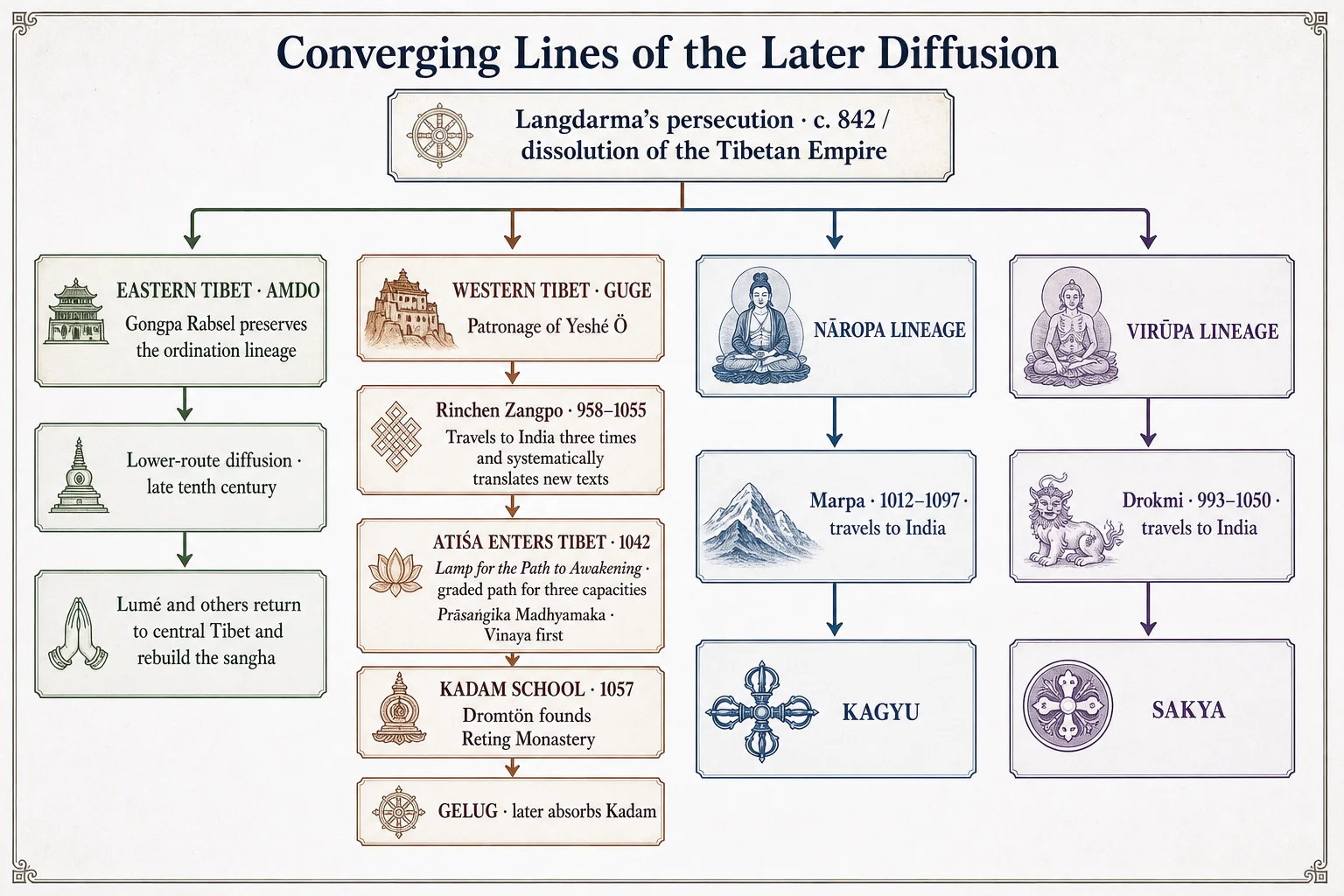
As the diagram shows, the configuration of the Later Diffusion was woven from several parallel currents, not generated by a single revival movement. The Lower Route resolved the institutional problem—the ordination lineage. The Upper Route, represented by Rinchen Zangpo, resolved the textual problem through new translations. Atiśa supplied a framework of learning and a sequence of practice, while Marpa, Drogmi, and others brought back different tantric transmissions that became the sources of other schools.
This multichannel configuration, together with the New–Old Translation tension separating it from the Nyingma tradition of the Early Diffusion, formed the historical setting in which the schools of Tibetan Buddhism later coexisted, competed, and debated one another.
The next chapter turns to Nyingma. It is the oldest of these schools and the one whose dialogue with the New Translation traditions has endured the longest.
Further Reading
- Matthew T. Kapstein. The Tibetan Assimilation of Buddhism. Oxford: Oxford University Press, 2000. (Historical analysis of the New–Old Translation dispute)
References
References
-
E. Gene Smith. Among Tibetan Texts: History and Literature of the Himalayan Plateau. Boston: Wisdom Publications, 2001. (Sources and discussion concerning the preservation of the eastern transmission) ↩
-
Ronald M. Davidson. Tibetan Renaissance: Tantric Buddhism in the Rebirth of Tibetan Culture. New York: Columbia University Press, 2005. (The authoritative study of the general history of the Later Diffusion, with detailed analysis of the Lower and Upper Routes) ↩
-
David Snellgrove and Hugh Richardson. A Cultural History of Tibet. Boulder: Prajñā Press, 1980. (Historical background on Yeshe Ö and the kingdom of Guge) ↩
-
Erberto F. Lo Bue. "Rinchen Zangpo." In The Encyclopedia of Religion, 2nd ed., vol. 11. Detroit: Macmillan Reference, 2005. (Overview of Rinchen Zangpo's life and works) ↩
-
Alaka Chattopadhyaya. Atīśa and Tibet: Life and Works of Dīpaṃkara Śrījñāna in Relation to the History and Religion of Tibet. Calcutta: Indian Studies: Past & Present, 1967. (The most important biographical study of Atiśa, including a textual analysis of A Lamp for the Path to Awakening) ↩↩
-
For Atiśa's criticism of the disorder surrounding tantra in Tibet, see the original text of A Lamp for the Path (Richard Sherburne, trans., A Lamp for the Path and Commentary. London: Allen & Unwin, 1983); for the historical background of that disorder, see Davidson, Tibetan Renaissance, chapter 6 (on the abuse of tantra in the eleventh century); for Atiśa's position on the relationship between the Vinaya and tantra, see the introduction to Thubten Jinpa (trans.), Mind Training: The Great Collection. Boston: Wisdom Publications, 2006. ↩
-
George N. Roerich (trans.). The Blue Annals. Calcutta: Royal Asiatic Society of Bengal, 1949–1953; reprinted Delhi: Motilal Banarsidass, 1976. (The principal traditional source on the establishment of Kadam and the life of Dromtön.) ↩
-
For an overall study of the principal translators in Tibet, see Ronald M. Davidson, Tibetan Renaissance (cited above), chapters 3–5 (historical analyses of the translators' transmissions); for a detailed catalogue of Rinchen Zangpo's translations, see Helmut Eimer, Rnam par thar pa rab gsal gser gyi snying po. Wiesbaden: Harrassowitz, 1979; for Marpa's transmission, see Tsangnyön Heruka (trans. Nalanda Translation Committee), The Life of Marpa the Translator. Boston: Shambhala, 1986. ↩