Chapter 8: Tibetan Buddhism in the Modern and Contemporary Periods
The preceding chapters established the historical framework of Tibetan Buddhism: from the Early Diffusion to the formation of the major schools, and from the philosophical debate over self-emptiness and other-emptiness to the summit of Gelug's united religious-political system. This chapter turns to the history since the nineteenth century, when Tibet was hurled from the relative isolation of a "peripheral civilization" into the shocks of imperialism, nationalism, communism, and globalization.
This history is filled with political coercion, cultural destruction, and the perseverance of spiritual traditions. At the same time, it witnessed an ancient tradition spreading throughout the world in an unprecedented way. Nothing elsewhere in Buddhist history provides a direct parallel to Tibetan Buddhism's experience during this period.
I. The Thirteenth Dalai Lama: A Final Effort amid Crisis
Qing intervention in the Dalai Lama system from the time of Kelzang Gyatso. From the middle of the eighteenth century, Qing intervention extended deeply into the process of recognizing Dalai Lamas. The Qing court exercised influence in Tibet through its resident ministers, or Ambans, and in 1793 promulgated the Twenty-Nine-Article Ordinance for the More Effective Governing of Tibet, which included a provision for identifying reincarnations by drawing lots from a Golden Urn. The Qing court regarded the measure as a way to reduce political manipulation, but its actual implementation was historically complex. Almost none of the Eighth through Twelfth Dalai Lamas lived long enough to assume power as adults. Manipulation by regents was a serious problem, and official Qing records and Tibetan tradition narrate the period differently.
The Thirteenth Dalai Lama (Thubten Gyatso, 1876–1933) was the first in this succession to reach adulthood and exercise political power. He is sometimes called the "Great Thirteenth." His rule coincided precisely with the period in which several great powers competed most intensely over Tibet.
The British invasion of 1903–1904. Seeking to prevent possible Russian penetration of Tibet, Britain sent a military expedition led by Francis Younghusband that invaded as far as Lhasa. The Thirteenth Dalai Lama fled to Mongolia and made contact with Russian representatives during his absence. After returning to Tibet, he began exploring how Tibet might preserve its independence among Britain, Russia, and China.
The mutiny of Qing troops stationed in Tibet in 1911–1912, together with the Qing court's collapse in the Xinhai Revolution, led to the withdrawal of Qing forces. In 1913 the Thirteenth Dalai Lama issued a proclamation generally described by the Tibetan side as a "declaration of independence," announcing the end of the Tibetan government's relationship with China's central government and Tibet's assumption of self-rule. No successive Chinese government has recognized the proclamation's legal validity. This was the historical point of departure for the ensuing decades of controversy over Tibet's status.
During the final decade of his life, the Thirteenth Dalai Lama introduced a series of modernizing reforms: establishing a modern army, introducing telegraphy and postal services, and founding secular educational institutions. These reforms met resistance from the monastic class. He died in 1933, leaving a fragile Tibetan polity that had not completed its political modernization and remained highly dependent on the monastic system for its organization.1
II. 1950–1959: Incorporation, Uprising, and Exile
The 1950 Military Action and the Seventeen Point Agreement
In October 1950, the army of the People's Republic of China entered eastern Tibet in the Battle of Chamdo, rapidly defeating the Tibetan forces. Negotiations followed. In May 1951, Tibetan representatives and the People's Republic of China signed the Agreement of the Central People's Government and the Local Government of Tibet on Measures for the Peaceful Liberation of Tibet, known as the Seventeen Point Agreement. It confirmed Tibet's incorporation into the People's Republic of China while promising to preserve the existing political system and the Dalai Lama's position.
Chinese and Tibetan historical narratives differ sharply over the process and substance of the negotiations. The Chinese side views the agreement as a local settlement within China's sovereignty. The Tibetan side, especially the government-in-exile, regards it as a treaty signed under military pressure and contrary to Tibet's will. This book records the disagreement without adjudicating the agreement's legal nature.
The Accumulation of Tensions in the 1950s
While the political system in central Tibet, or Ü-Tsang, was temporarily preserved during the 1950s, political and religious reforms advanced more rapidly in eastern Tibet, Kham and Amdo. They included land reform and abolition of monastic privileges. These regional changes provoked large-scale resistance and drove great numbers of refugees and armed groups toward Lhasa.
The March 1959 Uprising and the Dalai Lama's Exile
Large-scale protest erupted in Lhasa on March 10, 1959. It was sparked by a rumor that the People's Liberation Army planned to detain the Dalai Lama, a claim denied by the Chinese side, and was subsequently suppressed. On March 17, the Fourteenth Dalai Lama secretly left Lhasa, crossed the Himalayas, and reached India, where he later declared the Seventeen Point Agreement void.
This was the most decisive moment in the modern history of Tibetan Buddhism. Thereafter, Tibetan religion, politics, and culture followed categorically different paths inside and outside Tibet.2
III. The Cultural Revolution: Destruction and Survival, 1966–1976
The Cultural Revolution of 1966–1976 inflicted the most severe destruction of the period upon Tibet's religious culture.
The scale of destruction. The vast majority of monasteries throughout Tibet were closed, damaged, or destroyed. Estimates range from hundreds to thousands and vary greatly among sources, but the immense scale is not in doubt. Large quantities of religious artifacts, thangkas, and scriptures were destroyed. Monastics were forced to disrobe and participate in struggle sessions; many were imprisoned or sent to labor camps. Religious activity ceased entirely for much of the period, and open practice became dangerous.
Means of survival. How did tradition survive under these conditions? There were several broad channels. First was private underground practice at extreme risk; some monastics and laypeople continued to practice in secret. Second was memory: without texts or monasteries, traditions relied on remembered transmission, echoing in some respects the oral recitation of the Early Diffusion. Third were communities in exile, where refugees in India and Nepal continued their lineages beyond the direct reach of this destruction. Fourth were small Tibetan Buddhist communities in Mongolia and inner China, whose experiences varied.
The post–Cultural Revolution legacy. After the Cultural Revolution ended, numerous monastic lineages had been severed, and many scriptures and traditional practices could be maintained only by exile communities. Yet those communities had themselves become separated from Tibetan culture in Tibet and developed changes of their own. An ever-deepening gap emerged between "Tibetan Buddhism inside Tibet" and "Tibetan Buddhism in exile or overseas."
IV. Since the 1980s: Limited Reconstruction and Continuing Pressure
After 1978, a degree of religious restoration was permitted. Some Tibetan monasteries reopened or were rebuilt, religious activity partially resumed under restrictions, and some imprisoned monastics were released.
During the 1980s, Hu Yaobang, then general secretary of the Chinese Communist Party, visited Tibet personally, acknowledged that the destruction of the Cultural Revolution had been wrong, and promoted relatively relaxed policies. The period was brief. Large-scale Tibetan protests around 1988–1989 led authorities to impose martial law in Tibet in March 1989, followed by stricter security controls and patriotic-education campaigns.
In 1995, the question of recognizing the Panchen Lama's reincarnation became a new and highly sensitive political juncture.
The dispute over recognition of the Panchen Lama's reincarnation. After the death of the Tenth Panchen Lama, Choekyi Gyaltsen (1938–1989), the Dalai Lama and the Chinese government separately selected his reincarnation in 1995:
- In May 1995, the Dalai Lama recognized Gedhun Choekyi Nyima, born in 1989, as the Eleventh Panchen Lama;
- In November of the same year, the Chinese government separately recognized Gyancain Norbu, born in 1990, as the Panchen Lama through the Golden Urn ceremony;
- Authorities removed Gedhun Choekyi Nyima several days after his recognition by the Dalai Lama, and his whereabouts remained unknown for many years thereafter.
The controversy remains unresolved. Superficially a technical matter of reincarnate recognition, it actually concerns the fundamental question of "who has the authority to identify a religious lineage." It also directly foreshadows the future course of the dispute over recognition of the Dalai Lama.2
V. Exile Traditions and Reconstruction Overseas
Dharamsala and the Government-in-Exile
After going into exile in 1959, the Fourteenth Dalai Lama received support from the Indian government and established a government-in-exile in Dharamsala, Himachal Pradesh. Dharamsala subsequently became Tibetan Buddhism's spiritual center overseas. Tens of thousands of Tibetans gathered there and built monasteries, schools, medical institutions, and political bodies, forming a highly organized exile community.
Rebuilding the Great Monasteries in South India
The three great Gelug monasteries historically located in Tibet (Drepung, Sera, and Ganden) were rebuilt on a smaller scale under conditions of exile in southern India, in what is now Karnataka, around Mundgod and Bylakuppe. Kagyu, Sakya, and Nyingma likewise established important lineage centers in India and Nepal. These rebuilt monasteries overseas are now among the most important global bases of Tibetan Buddhist scholastic transmission.
Textual Preservation
The large-scale destruction inside Tibet during the Cultural Revolution made textual recording and preservation an urgent task. From the 1970s onward, the Library of Tibetan Works and Archives in Dharamsala systematically collected, catalogued, and digitized texts brought out by the exile community. Scholars such as E. Gene Smith (1936–2010) made enormous contributions to comprehensive documentation of Tibetan Buddhist literature. The Tibetan Buddhist Resource Center that he founded, now named BDRC, remains one of the foremost digital libraries of Tibetan Buddhism.
VI. Tibetan Buddhism Goes Global
The Beginnings of Transmission
One largely unintended consequence of exile was to facilitate Tibetan Buddhism's transmission to the West. When Tibetan masters went into exile in India and later traveled from India to Europe and North America, they carried not only their individual presence but entire systems of transmission. Western audiences developed an intense interest in Asian spiritual traditions beginning in the 1960s, creating precisely the cultural conditions capable of receiving these lineages.
Several important early transmitters included:
Chögyam Trungpa Rinpoche (1939–1987), a master with both Kagyu and Nyingma backgrounds, established the Nālandā Foundation and Shambhala system in the United States in 1970. His distinctive presentation of Tibetan Buddhism to Western audiences, including secular forms, exerted enormous influence. His personal conduct, including drinking alcohol and not observing monastic vows, also provoked controversy.
Sogyal Rinpoche (1947–2019), from a Nyingma background, made Tibetan teachings on the bardo, or process of dying, widely known through The Tibetan Book of Living and Dying (1992), one of the best-selling Tibetan Buddhist books worldwide. Late in his life he was also investigated and criticized over allegations of misconduct toward disciples.
The Fourteenth Dalai Lama's own global teaching activities and his dialogues on neuroscience and cognitive science with scientists such as Richard Davidson, Francisco Varela, and Wolf Singer have formed the most influential mode of Tibetan Buddhism's global transmission to date.
Western Practice Centers and Academic Research
Tibetan Buddhist practice centers can now be found in the United States, Britain, France, Germany, Australia, Latin America, East Asia, and elsewhere, and every major school is represented. Academic research on Tibetan Buddhism, Tibetology, has likewise become a mature field at European and North American universities.
The transmission of Tibetan Buddhism among ethnic Chinese communities in mainland China, Taiwan, Hong Kong, and Singapore is another prominent development of the past three decades. The number of Chinese Buddhists studying Tibetan traditions has increased rapidly, generating what is sometimes called a "Tibetan esoteric Buddhism boom," especially in mainland China. The scale and complexity of this direction of transmission exceed anything seen in earlier periods and continue to develop.
VII. Several Continuing Controversies
The Dispute over Recognition of the Dalai Lama's Reincarnation
Chapter 11.6 identified this anticipated conflict. The Chinese government claims ultimate authority to recognize the Dalai Lama under the Golden Urn system. The Fourteenth Dalai Lama has said that he might not reincarnate within Chinese-administered Tibet and might even choose to end the lineage.
The controversy centers on a fundamental conflict between religious and political authority. Historically, recognition of Tibetan Buddhist lineages was decided by eminent religious figures rather than state power. The Chinese government's position is that the Qing dynasty historically created a system of state participation in recognition through the Golden Urn and that this system should remain valid. Each position has historical grounds, and they cannot be reconciled without taking sides.
This book anticipates that the dispute will become an international focus after the Fourteenth Dalai Lama's death and may produce two simultaneous Dalai Lama systems, paralleling the present situation of the Panchen Lama. This would make the question of "who legitimately represents Tibetan Buddhism" still more complex.
Two Candidates in the Karmapa Lineage
As Chapter 11.4 noted, two candidates are presently recognized by different parties as the Seventeenth Karmapa:
- Ogyen Trinley Dorje, born in 1985, was recognized by both the Dalai Lama and the Chinese government. He secretly left China in 2000, subsequently lived in India, did not return to Tibet, and maintained close relations with the Dalai Lama's system;
- Trinley Thaye Dorje, born in 1983, was recognized by some holders of the Karma Kagyu lineage, especially the late Shamar Rinpoche, and has been active principally outside Tibet.
The dispute has continued for decades and remains unresolved both legally and religiously. Each "Karmapa" has his own followers and practice centers, and the Karma Kagyu lineage is divided over the issue.
The Dorje Shugden, or Dolgyal, Controversy
Gelug contains a distinctive internal controversy surrounding Dolgyal, also known as Dorje Shugden, a dharmapāla or Dharma protector whom a considerable number of Gelug practitioners regard as their principal protector. In the 1990s, the Fourteenth Dalai Lama began strongly opposing the practice on the ground that it conflicted with his own protector tradition. This produced bitter conflict between the Dalai Lama and Dorje Shugden practitioners and even divisions within Gelug. This book records the controversy without adjudicating its religious meaning.
VIII. The Contemporary Configuration
Over the past two centuries, modern Tibetan Buddhism has endured the shocks of imperialism, annexation by a state, the destruction of the Cultural Revolution, exile and reconstruction, and global transmission. It is a history of a tradition's survival and transformation under extreme historical pressure.
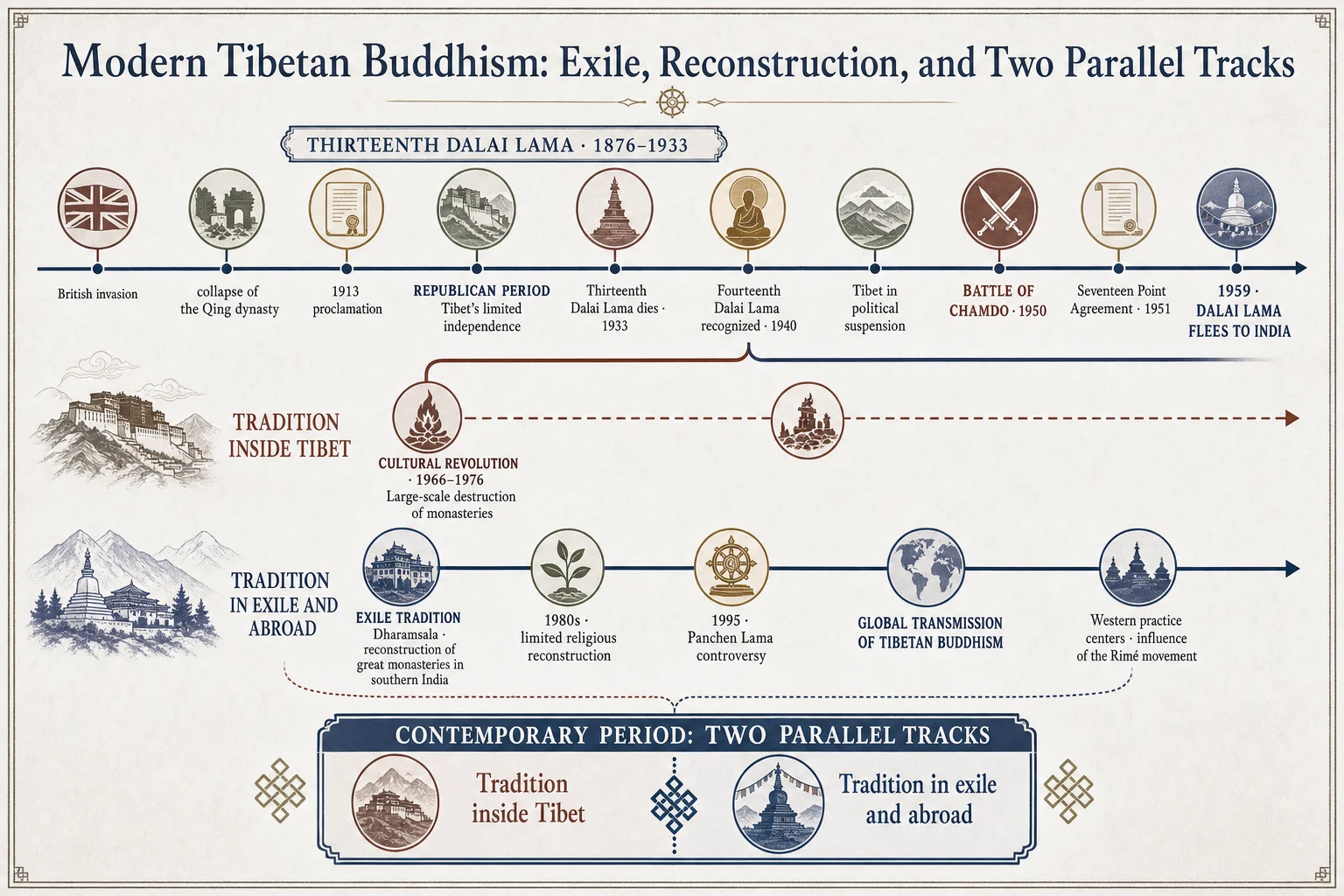
Two tracks are the most basic structural feature of contemporary Tibetan Buddhism. One is Tibetan Buddhism operating within Tibet and surrounding Tibetan regions under the administrative framework of the Party and state. This tradition endured the destruction of the Cultural Revolution and partial reconstruction and today operates under the policy framework of "patriotic education." The second is Tibetan Buddhism in exile communities centered on Dharamsala, in overseas practice centers, and in global circulation. Its connection with Tibetan culture inside Tibet is becoming increasingly attenuated.
Relations between the two tracks grow more complex over time. Some transmissions have preserved complete teachings only on one side, while certain controversies make contact between them a politically high-pressure zone.
Concerning the future, this book records only several definite structural constraints. Recognition of the Dalai Lama will remain highly politically sensitive for any foreseeable future. Religious administration within Tibet will remain state-led for the foreseeable future. Tibetan Buddhism's global transmission will continue to develop freely in environments without such pressure, while confronting the challenges of "separation from its roots" and commercialization. Dialogue between Tibetan Buddhism and modern science, especially cognitive science, will continue within the framework established by the Fourteenth Dalai Lama. These structural constraints are the reality within which Tibetan Buddhism will operate over the coming decades.
Further Reading
- Robert Barnett. Lhasa: Streets with Memories. New York: Columbia University Press, 2006; see also Robert Barnett (ed.), Resistance and Reform in Tibet. Bloomington: Indiana University Press, 1994. (Field research on Tibetan political culture and analysis of resistance movements)
- Dalai Lama (Tenzin Gyatso). Freedom in Exile: The Autobiography of the Dalai Lama. New York: HarperCollins, 1990. (The Fourteenth Dalai Lama's autobiography and a first-person account of the 1959 exile and subsequent history)
- John Powers. History as Propaganda: Tibetan Exiles versus the People's Republic of China. Oxford: Oxford University Press, 2004. (Comparative analysis of the historical narratives of the Chinese and Tibetan exile sides; a scholarly study that does not take either side)
- E. Gene Smith. Among Tibetan Texts: History and Literature of the Himalayan Plateau. Boston: Wisdom Publications, 2001. (Background to textual preservation and digitization in Tibetan Buddhism and the origins of BDRC)
- Matthew T. Kapstein (ed.). Buddhism Between Tibet and China. Boston: Wisdom Publications, 2009. (Historical exchange between Tibetan and Chinese Buddhism and an analysis of their mutual influence in the modern period)
References
References
-
Melvyn C. Goldstein. A History of Modern Tibet, 4 vols. Berkeley: University of California Press, 1989–2019. (The most authoritative academic study of modern Tibetan history; covers 1913–2008 and critically synthesizes sources from all sides) ↩
-
Tsering Shakya. The Dragon in the Land of Snows: A History of Modern Tibet since 1947. New York: Columbia University Press, 1999. (Authoritative account of Tibetan history since 1947, especially 1950–1959 and the Cultural Revolution) ↩↩