Chapter 1: Transmission and Early Sūtra Translation—An Shigao, Lokakṣema, and Dao’an
Part IX discussed Southern Buddhism; this part turns to Chinese Buddhism. In one sense, its history encompasses everything that occurred when Buddhism encountered China, a cultural world with a mature civilization of its own: translation, misreading, adaptation, and creation. Through countless accommodations and conflicts over several centuries, Buddhism eventually developed some of the world’s most original schools there.
This chapter examines the earliest phase: how Buddhism entered China, what its first translators did, and how Dao’an produced the first systematic organization and criticism of their early achievements.
I. Routes and Dates of Transmission
Several routes
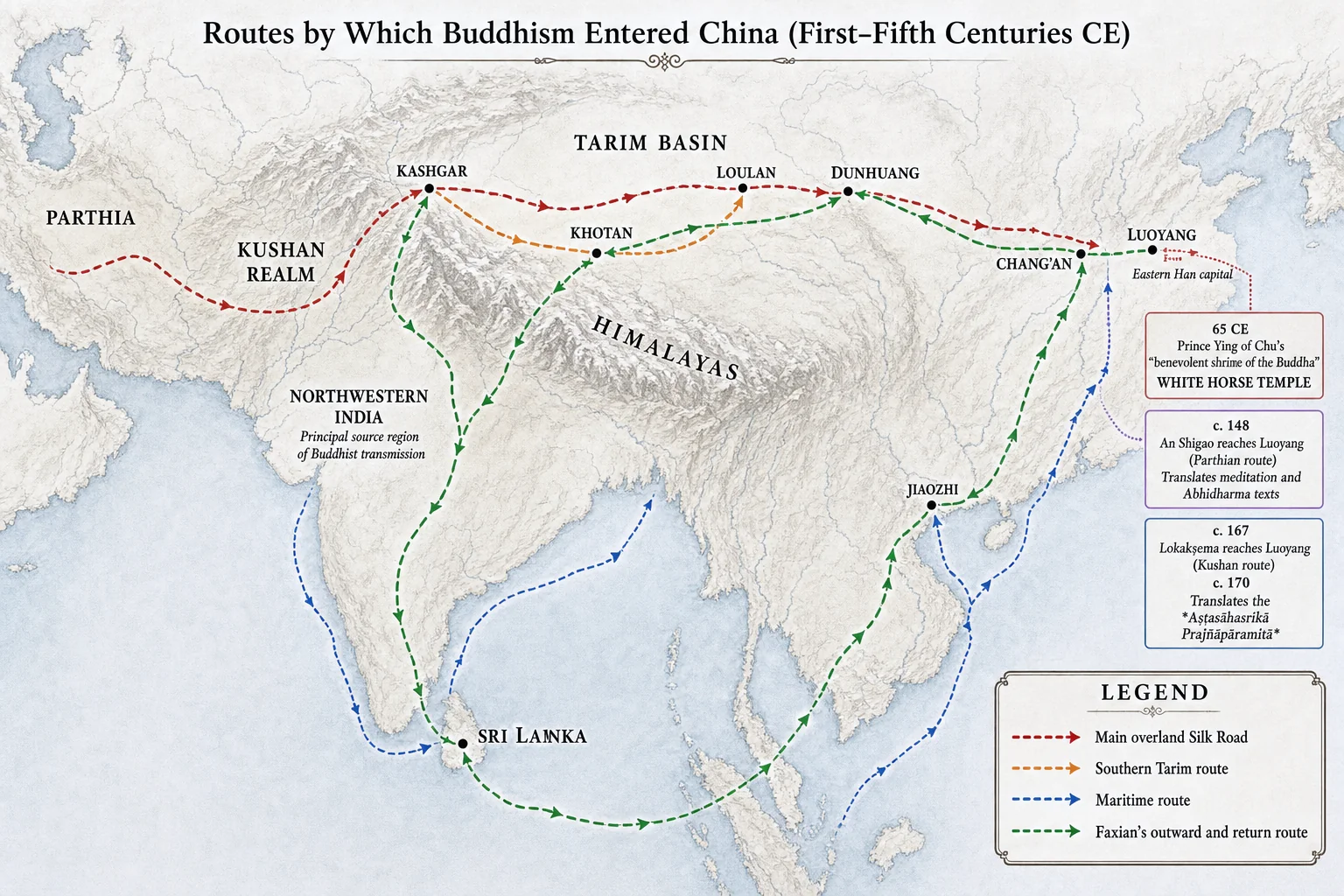
Buddhism entered China along several routes in parallel.
The overland Silk Road. This route ran eastward across the Central Asian steppes and oasis cities (through Sogdia, Bactria, the Kushan realm, and other regions), then through what is now Xinjiang along the northern and southern routes around the Tarim Basin. It reached Dunhuang, entered the Hexi Corridor, and ultimately arrived at the Han capitals of Luoyang or Chang’an. This was the principal early route and the direction from which the texts underlying the first Chinese translations came.
The maritime route. This route crossed the Indian Ocean, passed through the Strait of Malacca and the South China Sea, reached Jiaozhi in what is now northern Vietnam, and then continued north into China proper. It became increasingly important after the Wei and Jin periods. Faxian (337–422) of the Eastern Jin traveled to India overland and returned by sea.
The early translators who came to China along the overland Silk Road principally originated in two Central Asian cultural regions: Parthia, in what is now eastern Iran, whose name was abbreviated in Chinese surnames with the character An; and the Yuezhi or Kushan realm, abbreviated with the character Zhi. An Shigao came from Parthia, and Zhi Loujiachen (Lokakṣema) from the Yuezhi. The geographical markers within their Chinese names are important clues to understanding this period.
Approximate date of transmission
There is still no consensus on exactly when Buddhism entered China. The most widespread account dates it to the Yongping era (58–75) of Emperor Ming of Han. The emperor dreamed at night of a golden man flying toward him and sent envoys to India in search of the teaching. They returned with Kāśyapa Mātaṅga and Dharmaratna, who translated the Sūtra in Forty-two Sections, and the emperor built the White Horse Monastery at Luoyang—the legendary first Buddhist monastery in China.
Historians generally regard this story as an accretion of legends rather than a historical record. Whether the earliest version of the Sūtra in Forty-two Sections was really translated by Kāśyapa Mātaṅga is highly disputed. Moreover, a ruler’s dream introducing a new religion is a common narrative pattern used to legitimize religious transmission across cultures, and therefore has little evidentiary power in itself.1
The earliest confirmable historical record is an edict issued in 65 CE, the eighth year of the Yongping era, by Emperor Ming of the Eastern Han. It refers to Liu Ying, Prince of Chu (a son of Emperor Guangwu and Emperor Ming's half-brother), as one who “honors the benevolent shrine of the Buddha, has purified himself by fasting for three months, and has made solemn vows to the spirits.” The Chinese term futu here clearly refers to the Buddha and Buddhism. By 65 at the latest, Buddhism had therefore appeared in Han royal circles and acquired a body of adherents. This is the earliest reliable documentary record now available.1
This book’s treatment is as follows: the earliest historically documented Buddhism in China appeared in the first century CE. Emperor Ming’s dream is a legitimating narrative constructed later. White Horse Monastery predates large-scale scriptural translation, but the precise circumstances of its foundation can no longer be established.
II. The Background to Transmission: An Age of Disorder and an Intellectual Vacuum
Buddhism’s large-scale entry into China coincided with the political turbulence stretching from the end of the Han through the Wei, Jin, and Northern and Southern Dynasties, roughly the second through sixth centuries. The coincidence was not accidental.
In the late Eastern Han, the authority of Confucian state ideology weakened along with the political order. Daoist thought, especially the “pure conversation” current of xuanxue, rose to prominence, but it was chiefly a spiritual refuge for the literati and offered no sufficiently direct response to suffering and death. Buddhism arrived at precisely this moment with a remarkably complete set of answers: a direct treatment of birth and death through rebirth and liberation; a cosmological explanation of suffering through karma; detailed guidance for renunciant practice; and a religious community, the Saṅgha, capable of crossing social classes.
This history cannot be reduced to Buddhism “filling a void.” Chinese intellectual traditions remained active, and neither Confucianism nor Daoism withered upon Buddhism’s arrival. This was a genuine collision of ideas whose outcome was mutual transformation, not one-sided reception.
III. An Shigao: Foundations in Meditation Texts and Abhidharma
Life
An Shigao was active in Luoyang around 148–170. Tradition says that he was a Parthian crown prince who renounced his throne, became a monk, journeyed widely, and arrived in Luoyang, where he devoted twenty years to translating scriptures. The historical reliability of the biographical details is limited, but abundant documentary evidence supports his long activity in Luoyang and the large number of his translations.
He was the first historically documented systematic translator of Buddhist texts into Chinese. His status in this respect is undisputed.
Directions of translation
An Shigao’s translations concentrated mainly on two fields.
Meditation literature. He translated numerous texts on meditative cultivation (dhyāna), collectively called “meditation scriptures.” The most important was the Sūtra on Guarding the Mind in Mindfulness of Breathing, a text on ānāpānasati, along with the Greater Sūtra on Guarding the Mind in Mindfulness of Breathing and several others. These works focus on observation of the body and breath and directly influenced later Chinese traditions of meditation.
Abhidharma literature. He translated several texts with the analytical character of the Abhidharma of the early schools, including the Sūtra on the Aggregates, Elements, and Sense Fields, which discusses such frameworks as the five aggregates, twelve sense fields, and eighteen elements, and the Sūtra on the Stages of the Great Path. These texts introduced early Buddhism’s detailed analytical framework for embodied and mental experience.
Notably, An Shigao’s translations contain no Mahāyāna scriptures. What he brought was the meditative cultivation and doctrinal analysis of early, school-based Buddhism, not Mahāyāna narratives of the Prajñāpāramitā or Huayan kind. This gave the first Chinese understanding of Buddhism a basic “meditation–Abhidharma” orientation.1
Problems of translation method
An Shigao’s technical vocabulary borrowed extensively from terms already available in Chinese Daoism. Dao (“the Way”) was used to translate dharma, and wuwei (“non-action” or “the unconditioned”) to translate nirvāṇa. At the time, such borrowing was unavoidable because no specialized Chinese Buddhist vocabulary yet existed. It also produced profound misreadings, however, fitting Indian concepts into a Daoist intellectual framework. This was the root of “matching concepts,” discussed in the next chapter.
His translation team became the prototype for all later large-scale translation enterprises: a foreign monk recited or explained the text orally, while a group of Chinese scholars recorded and polished the wording.
IV. Zhi Loujiachen (Lokakṣema): The First Voice of Mahāyāna
Life
Zhi Loujiachen, commonly abbreviated Zhi Chen and known in Sanskrit as Lokakṣema, came from the Yuezhi within the Kushan Empire. He was active in Luoyang around 167–186, at approximately the same time as An Shigao, but brought a wholly different form of Buddhism.
Directions of translation
If An Shigao represented the meditative and analytical traditions of early Buddhism, Lokakṣema represented the first entry of Mahāyāna Prajñāpāramitā and Pure Land devotion. His principal translations included the following:
The Daoxing Bore Jing. This was a version of the Sanskrit Aṣṭasāhasrikā Prajñāpāramitā, the Perfection of Wisdom in Eight Thousand Lines, one of the earliest works in the Prajñāpāramitā corpus. Lokakṣema translated it in 170, inaugurating the transmission of the entire Prajñāpāramitā tradition in China.
The Pratyutpanna-samādhi Sūtra. Its central practice teaches that recollecting a Buddha, especially Amitābha, to a sufficient degree allows the practitioner to see the buddhas directly in meditative concentration. It later became one of the Pure Land school’s most important scriptural foundations.
The Sūtra of the Land of Akṣobhya. This scripture concerns the pure land of the Buddha Akṣobhya in the east. Its coexistence with the later-dominant devotion to Amitābha demonstrates the greater diversity of early Pure Land devotion.
The significance of Lokakṣema’s translations
Lokakṣema introduced two lines of thought crucial to the later development of Chinese Buddhism. The first was the textual foundation of Prajñāpāramitā emptiness. Nāgārjuna could influence China because Lokakṣema had first translated the Prajñāpāramitā scriptures. The second was the textual foundation of Pure Land devotion. The Pratyutpanna-samādhi Sūtra’s description of recollecting the Buddha in contemplative practice gave the Pure Land school its earliest scriptural support in China.
Lokakṣema’s style was more freely interpretive than An Shigao’s. He tended to convey meaning through fluent Chinese rather than adhere to the source’s word-by-word structure.
V. The Methods and Difficulties of Early Translation
Translating Sanskrit (or manuscripts in various Central Asian languages) into Chinese was extraordinarily difficult at the level of linguistic structure, and the early translators had to proceed without precedents.
Fundamental differences in linguistic structure
Sanskrit is a highly inflected language whose word forms vary by case, number, person, and other categories. Chinese is isolating, with almost no inflection and a reliance on word order and particles. Expressing the “five aggregates,” “twelve sense fields,” or “emptiness” in Chinese required not simply finding equivalent terms but transplanting an entire intellectual framework. Chinese readers already possessed two complete frameworks of thought, Confucian and Daoist. New concepts were inevitably interpreted through them.
Collaborative translation
The standard early process was “collaborative translation”: a foreign monk, usually familiar with Sanskrit or a Central Asian language, recited the text orally, and a group of Chinese scholars, usually literate in Chinese but ignorant of Sanskrit, recorded it and polished the language. The advantage was that Chinese texts could be produced quickly. The disadvantage was that understanding among the participants was often incomplete. The reciter’s Chinese might be limited, while the scribes’ understanding of the Dharma might be limited; misunderstandings on either side became fixed in the translation.
The cost of using Daoist and xuanxue vocabulary
The most serious early problem was the use of Daoist, especially Lao-Zhuang, and xuanxue vocabulary to translate Buddhist concepts:
- Sanskrit dharma → Chinese dao, “the Way”: the Buddha’s teaching and the Dao are not the same thing, but Chinese readers carried associations of the Dao into their reading of the Dharma.
- Sanskrit nirvāṇa → Chinese wuwei, “non-action”: in Daoism, wuwei is a cosmic condition of not acting coercively, entirely different from Nibbāna as the cessation of suffering, despite a superficial resemblance in “transcending all fabrication.”
- Sanskrit prajñā, wisdom → Chinese benwu, “original nonbeing,” or xuwu, “nothingness”: the wisdom of emptiness in Prajñāpāramitā was fitted into Daoist thought about nonbeing.
This conceptual confusion may have aided Buddhism’s dissemination at the time (“Ah, so the Buddha’s teaching has something in common with Laozi and Zhuangzi”), but epistemically it conflated two different philosophies. It produced serious misreadings of Buddhism during its first centuries in China, the problem of “matching concepts” to which the next chapter turns.
VI. Dao’an: Organization and Criticism
Life
Dao’an (314–385), living more than a century after An Shigao and Lokakṣema, was the figure who undertook the most important critical reflection on the emerging shape of Chinese Buddhism. Born in northeastern China and trained in Confucian learning as a child, he later became a monk. His life was unsettled by the warfare of the Sixteen Kingdoms. He moved through regions corresponding to present-day Shanxi, Henan, and Hubei, finally settling in Chang’an under the protection of the Former Qin regime, where he devoted himself to organizing Buddhist texts.2
Compiling a catalogue
Dao’an’s first major undertaking was the compilation of a catalogue of Buddhist scriptures, portions of which survive through references to the Dao’an Catalogue, also known as the Comprehensive Catalogue of the Scriptures. This was the first systematic bibliography of Buddhist literature in Chinese history. It classified scriptures circulating in China by translator, date, and reliability, and identified “suspect scriptures” of unknown provenance—works possibly composed pseudonymously in China rather than translated from an Indian source.
The significance of the work went far beyond “organization.” It showed Dao’an’s awareness that the “Buddhist scriptures” circulating in China varied widely in quality: some were genuine translations of Sanskrit originals, some might be Chinese pseudepigrapha, and others translated genuine sources but had already distorted them seriously. His attempt to approach the literature critically was remarkably advanced for its time.
The “five losses from the source” and “three difficulties”
Dao’an concentrated his reflections on translation in his theory of the “five losses from the source” and “three difficulties.”2
The “five losses from the source” identify five circumstances in which translation loses the original meaning. First, Sanskrit and Chinese employ different customary word orders, and accommodation to Chinese order loses the structure of the source. Second, the source is plain, and ornamenting its language to accommodate the reader loses its meaning. Third, the source includes repeated recitations in verse that translators often omit. Fourth, the source includes explanatory parenthetical passages that translators often delete. Fifth, after completing a passage, the source contains a recapitulation that translators treat as repetition and remove.
The “three difficulties” are three basic challenges of translation. First, it is difficult to explain ancient events in the present and conditions elsewhere through those here, while the distance separating sages from ordinary people is vast. Second, earlier Chinese sages valued plainness, and ornamenting the language to accommodate readers loses the scriptures’ plain virtue. Third, even Ānanda and others who directly witnessed the events sometimes had to ask the Buddha to repeat himself; modern translators know the original circumstances only through accounts transmitted across generations, making a complete and faithful presentation difficult.
This was the first systematic methodological reflection in the history of Chinese Buddhist translation, more than two centuries before Xuanzang’s theory of translation. It pushed beyond technical problems to the fundamental predicament of cultural translation: the gulf between two languages, two cultures, and two ages can never be crossed completely; distortion can only be reduced as far as possible.
Criticism of “matching concepts”
Dao’an also explicitly criticized the popular practice of “matching concepts” (geyi), the use of analogies from Confucianism and Daoism to explain Buddhist ideas, discussed in the next chapter. He held that although the method made Buddhism easier for Chinese readers to understand, it did so at the cost of distorting Buddhism’s actual meaning into a Confucian or Daoist form. He emphasized understanding the texts’ original meaning directly rather than continuing to interpret them through Confucian and Daoist frameworks.
Seeking the Dharma and Kumārajīva
Dao’an was directly connected to another important historical event. He wrote to the Former Qin court at Chang’an asking it to bring from the Western Regions a great master who knew Sanskrit and could supply reliable source texts, thereby correcting China’s longstanding problems with translation quality. Fu Jian sent an army to Kucha and brought back Kumārajīva. Dao’an, however, died in 385, sixteen years before Kumārajīva arrived in Chang’an in 401, and never saw the arrival of the “reliable translator” he had long awaited. Kumārajīva’s immense influence on Chinese Buddhism is reserved for Chapter 10.3.
VII. The Shape of Early Chinese Buddhism
From An Shigao to Dao’an (approximately 148 to 385, a period of roughly 240 years), Chinese Buddhism acquired several early features that profoundly shaped its later direction.
Two distinct lines of transmission. An Shigao brought meditation and Abhidharma, the direction of early Buddhism. Lokakṣema brought Prajñāpāramitā and Mahāyāna Pure Land thought. Both lines circulated simultaneously in China. From the beginning, there was no single face of “Buddhism,” but a plural tradition filled with internal tension.
Entanglement with Daoism. The use of Daoist vocabulary to translate Buddhist concepts was an unavoidable condition of early Chinese Buddhism and the historical root of the later philosophical integration of Daoist modes of thought in schools such as Tiantai and Huayan. This entanglement remains an indispensable background to understanding Chinese Buddhism today.
A pattern of reception through elite culture. The principal early recipients of Buddhism in China were the royal court and the educated literati. Buddhism’s first step into China began with elite culture, not with the populace. This resembled its mode of entry into Southeast Asia, where courts adopted it before it diffused among ordinary people.
A tradition of critical organization. Dao’an’s bibliography and translation criticism established an important methodological tradition for Chinese Buddhism: not simply accepting a “Buddhist scripture” as authoritative, but asking where it came from, how reliable its translation was, and how it related to other texts. This critical tradition continued through later scholarship on Dunhuang manuscripts and textual collation.
References
References
-
Erik Zürcher. The Buddhist Conquest of China: The Spread and Adaptation of Buddhism in Early Medieval China. 3rd ed. Leiden: Brill, 2007. (The authoritative study of early transmission of Buddhism to China, including detailed textual analysis of An Shigao, Lokakṣema, and Dao’an.) ↩↩↩
-
Tang Yongtong. A History of Buddhism in the Han, Wei, Jin, and Northern and Southern Dynasties. Beijing: Commercial Press, 1938. (A foundational Chinese-language study of the period; for Dao’an’s “five losses from the source and three difficulties,” see the chapter “Buddhist Studies in the Age of Dao’an.”) ↩↩