Chapter 8: The Chan School
The preceding chapters examined Tiantai’s perfect interpenetration of the Dharma-realm, Huayan’s nonobstruction among phenomena, and Faxiang’s precise classifications. All are highly systematic philosophical projects. Chan approaches from the opposite direction. It does not build systems, but dismantles them; it does not accumulate concepts, but brings them to rest in the present; it does not explain the Dharma, but points directly to the Dharma itself.
“A separate transmission outside the teachings; not establishing words and letters; directly pointing to the human mind; seeing one’s nature and becoming a buddha.” These four phrases express Chan’s account of itself. It deliberately holds itself apart from all writings, doctrines, and systems, claiming that genuine transmission occurs only in a direct meeting of mind with mind between master and student. The paradox is that Chan subsequently produced the most numerous and diverse literature in Chinese Buddhism: recorded sayings, kōans, verses on ancient cases, and critical commentaries. Those writings themselves became its most important instruments of “transmission.”
This chapter examines Chan’s history and thought, as well as the meaning of the paradox.
I. Bodhidharma and the Legends of Early Chan
Bodhidharma
Chan’s foundational legends center on Bodhidharma. He was a historical person who arrived in China from India or Central Asia around the end of the fifth or beginning of the sixth century, one among many Buddhist monks then coming to China.
The most famous legend is his dialogue with Emperor Wu of Liang, who reigned 502–549. The emperor asked: “Throughout my life I have built monasteries, ordained monks, made gifts, and given offerings. What merit have I gained?” Bodhidharma answered: “No merit.” The emperor asked: “What is the highest meaning of the holy truths?” Bodhidharma answered: “Vast emptiness, nothing holy.” The emperor asked: “Who is facing me?” Bodhidharma answered: “I do not know.” Bodhidharma then left, crossed the Yangtze northward, and “sat facing a wall for nine years” at Shaolin Monastery on Mount Song.1
Another famous legend tells of the future Second Patriarch Huike (487–593), who stood through a snowy night seeking Bodhidharma’s teaching. Bodhidharma ignored him. Huike cut off his left arm and presented it. Bodhidharma asked: “What do you seek?” Huike replied: “My mind is not at peace. I beg the master to pacify it.” Bodhidharma said: “Bring me your mind, and I will pacify it for you.” After a silence, Huike replied: “I have searched for my mind and found it unobtainable.” Bodhidharma said: “I have finished pacifying your mind.”
Modern scholars generally reserve judgment about the historicity of both accounts. The meeting with Emperor Wu appears only in much later records, while the story of Huike’s severed arm became progressively richer through textual accretion. Yet the central Chan spirit conveyed by the legends is clear: search for mind and it cannot be found; to pacify mind is to know its unfindability.
The historical Bodhidharma
Historically, Bodhidharma had a close relationship to the Laṅkāvatāra Sūtra. He was called a “master of the Laṅkāvatāra,” and early Chan principally relied upon that scripture. Its central themes are the relation between tathāgatagarbha and storehouse consciousness, introduced in Chapter 7.1, and analysis of the levels of consciousness. Early Chan was therefore doctrinally connected to Consciousness-Only and tathāgatagarbha, not an “antitraditional” movement arising from nowhere.
Among works attributed to Bodhidharma, the most reliable is the Treatise on the Two Entrances and Four Practices: entrance through principle, seeing the nature of suchness through meditation; and entrance through practice, comprising the four practices of repaying injury, following conditions, seeking nothing, and according with the Dharma. This relatively simple framework is far less dramatic than later Chan legends and closer to the historical Bodhidharma.1
II. From the First to the Sixth Patriarch: The Chan Lineage
The traditional Chan genealogy lists six patriarchs from Bodhidharma to Huineng:
| Patriarch | Life | Characteristics |
|---|---|---|
| First: Bodhidharma | Approximately late fifth to early sixth century | Founder; Laṅkāvatāra tradition; wall-gazing meditation |
| Second: Huike | 487–593 | Cut off his arm to seek the teaching; inherited and developed Bodhidharma’s tradition |
| Third: Sengcan | ?–606 | Author of the Inscription on Trust in Mind, the earliest surviving Chan philosophical poem |
| Fourth: Daoxin | 580–651 | Established the first permanent Chan community at Mount Shuangfeng |
| Fifth: Hongren | 601–674 | East Mountain teaching; teacher of Huineng and Shenxiu |
| Sixth: Huineng | 638–713 | Figure through whom the Southern school was established; protagonist of the Platform Sūtra |
The Inscription on Trust in Mind attributed to Sengcan begins: “The supreme way is not difficult; it simply rejects choosing.” Not choosing and not discriminating became central themes throughout the later Chan tradition.
At Mount Shuangfeng in Huangmei, Hubei, Daoxin founded a meditation community of several hundred. This was the decisive transition from itinerant, individual transmission to an organized communal form. His disciple Hongren expanded it into the “East Mountain teaching,” with reportedly more than a thousand students, including Shenxiu (approximately 606–706) and Huineng (638–713), whose lineages would later be divided into the Northern and Southern schools.
III. Huineng and the Southern School: Establishing Sudden Awakening
We must first discuss history, then the text. The legend of Huineng and the historical process by which he became established as the Sixth Patriarch are two different things.
Shenhui: an advocate who made the campaign, not a bystander
After Huineng (638–713) died, his status in Chan history was not immediately recognized. During his life and for some time afterward, the title “orthodox Chan” belonged in practice to another man: Shenxiu (approximately 606–706). Invited to Luoyang by Wu Zetian and honored in succession by both Wu and Emperor Zhongzong, Shenxiu was the most eminent Chan master of the time in both political and religious terms. His community far surpassed Huineng’s. Historically, he did not occupy the later narrative’s subordinate position of “gradual practice inferior to sudden awakening.”
What changed this situation was a long-planned polemical campaign organized by Huineng’s disciple Shenhui (670–762).
Around 732, Shenhui presided over a public debate at Dayun Monastery in Huatai, in present-day Henan, known as the “Huatai Dharma Assembly.” His central argument was that Hongren transmitted the orthodox Dharma, symbolized by robe and bowl, to Huineng rather than Shenxiu; the Northern school of Shenxiu’s disciples was a collateral line without orthodoxy; the Southern school was the genuine transmission, and Huineng the true Sixth Patriarch. He explicitly labeled the Northern school “gradual cultivation,” opposed it to the Southern school’s “sudden awakening,” and elevated differences in style of practice into a conflict between orthodoxy and deviation.
The debate provoked a strong reaction. Shenhui took up residence at Heze Monastery in Luoyang in 745. In 753, the twelfth year of the Tianbao era, he was impeached and banished for “gathering crowds,” moving in succession through Yiyang, Wudang, Xiangzhou, and Jingzhou. The political situation turned during the An Lushan Rebellion of 755–763. Shenhui helped the authorities sell ordination certificates to raise military funds, earned merit, was permitted to return to Luoyang, and continued teaching at Heze Monastery. His reputation grew enormously in his final years and he acquired many disciples. In this period, the narrative of “Southern orthodoxy and Northern collateral line” began crystallizing across a wider sphere.2
Huineng’s recognition as Sixth Patriarch: a century after his death
Huineng died in 713. His formal recognition as “Sixth Patriarch” at the imperial level came about a century later. During the reign of Emperor Xianzong, 806–820, the court granted Huineng the posthumous title “Chan Master of Great Discernment” and recognized his community at Caoxi in Guangdong as Chan’s direct lineage. Establishing the “orthodox Sixth Patriarch” was a multistep process (from Shenhui’s popular polemic, to local acceptance, to court recognition) extending over decades and two imperial reigns. It did not arise naturally during Huineng’s lifetime.
The historical transformation of the “illiterate woodcutter” whose single verse defeated all the monks into the “orthodox Sixth Patriarch” resulted from a carefully constructed movement. It genuinely began only after his death and was not completed until nearly a century later.
The text of the Platform Sūtra: from Dunhuang to Zongbao
The Platform Sūtra of the Sixth Patriarch was not written by Huineng and was not composed at a single definite moment. It underwent textual development from relatively simple to progressively richer forms. The surviving versions can be arranged chronologically:
| Version | Date | Characteristics |
|---|---|---|
| Dunhuang manuscript, Stein 5475, now in the British Library | Approximately late eighth to early ninth century | Earliest reliable manuscript; shorter; relatively simple narrative; recorded by the disciple Fahai |
| Huixin version | 967, early Northern Song | Edited and somewhat expanded |
| Qisong version | 1056 | Re-edited by the Northern Song Chan master Qisong, with additions and deletions |
| Zongbao version | 1291, Yuan | Present received version; edited by the monk Zongbao; longest and most literary |
The Dunhuang manuscript is crucial to understanding the Platform Sūtra’s historical origins. In 1900, the Daoist priest Wang Yuanlu discovered a great cache of manuscripts sealed for roughly a thousand years in Cave 17, the Library Cave, at the Mogao Caves in Dunhuang, Gansu. Among them was an early manuscript of the Platform Sūtra. It differs significantly from today’s Zongbao text. Even the famous pair of verses have different wording. Huineng’s verse in the Dunhuang manuscript reads: “Awakening originally has no tree; the bright mirror is also not a stand. Buddha-nature is constantly pure; where can dust arise?”—not the received “originally not a single thing.” The contrast between Shenxiu’s and Huineng’s verses is also less dramatic, and the account of transmission more concise.3
These differences show that the Platform Sūtra is not a faithful record of one historical scene. It was revised, enriched, and perfected continuously across centuries. Its formation accompanied the Southern school’s gradual acquisition of orthodoxy.
The two verses and the core of the myth
The famous verse competition in the Platform Sūtra (Shenxiu’s “constantly polish it diligently” against Huineng’s “originally not a single thing”) remains Chan’s best-known narrative. Whatever its historical authenticity, it concisely expresses the philosophical substance of the sudden-versus-gradual dispute.
Shenxiu’s verse represents gradual cultivation: the mind is like a mirror, capable of being stained by the dust of defilements and requiring constant polishing.
Huineng’s verse represents sudden awakening: no substantial “mirror of mind” requires polishing, and no “dust” can defile originally pure awareness. Directly knowing this is awakening.
This book’s position
This book’s position is that the Platform Sūtra has no ground to stand on as a record of historical fact. Huineng may have been a historical person, but the episodes in the scripture (the illiterate woodcutter whose verse defeats every worthy monk, Hongren’s secret nocturnal transmission of robe and bowl, Huineng’s flight to the south and years in hiding) are products of the Southern school’s narrative enterprise. They lack independent historical corroboration, and their textual sources accumulated across several centuries. The Dunhuang manuscript already demonstrates enormous differences between the early and received versions, proving that this “sūtra” underwent continuous mythologization and expansion while taking shape.
This does not make the Platform Sūtra valueless. Its value lies on two other levels.
First, it is a narrative archive of the conflict between the Northern and Southern schools. Shenhui’s movement required a story supporting its claim to “orthodoxy,” and the Platform Sūtra supplied that story. Through literature, it established “sudden awakening surpasses gradual cultivation” and “robe and bowl were transmitted to the Southern school” as self-evident truths. It reveals how monastic communities of the period used narrative to resolve questions of authority.
Second, it shaped the basic direction of all subsequent Chinese Chan. Whether or not it accurately reflects history, its framework of questions (sudden awakening, seeing nature, no-thought, and not establishing words) defined Chan’s self-understanding for the next thousand years. The later Linji and Caodong schools, and every tradition today bearing the name “Chan,” unfold within the imaginative space established by the Platform Sūtra. In the history of influence, it is a decisive text.
IV. The Philosophy of the Platform Sūtra
Its philosophy unfolds around several central concepts.
No-thought
No-thought is the scripture’s central practical idea. It means “remaining unattached while thinking,” not “thinking nothing,” which would be psychological suppression. When a thought arises, do not grasp, follow, or reject it. Thoughts come and go; the mind flows like water and retains no trace.
The Platform Sūtra says: “No-thought is the doctrine; no-form is the essence; nonabiding is the basis.” These three “noes” form the three guidelines of Southern Chan practice.
No-form. Establish no grasping upon the forms of external objects. This does not claim that external objects do not exist, but asks the mind not to produce discriminated forms concerning them.
Nonabiding. Do not remain in any thought or state. The nature of mind is flowing; “abiding” is itself attachment.
Seeing one’s nature and becoming a buddha
Chan’s theory of liberation is concentrated in the phrase “seeing nature.” “Nature” is buddha-nature, the awakened nature originally present in everyone. To “see” does not mean acquiring something new through accumulated merit or scriptural study; it means recognizing what was already there. It has always been present but has gone unrecognized beneath the concealment of deluded thoughts.
This position comes from tathāgatagarbha (the original purity of mind-nature and adventitious defilements, discussed in Chapter 7.1), but Chan radicalized it. Even the act of “practice,” if performed with the attitude “I am practicing in order to become a buddha,” is already a form of attachment and alienation from buddha-nature. Genuine practice is nonattachment, nondiscrimination, and responsiveness to conditions at every moment.
The Platform Sūtra says: “When self-nature is deluded, the buddha is a sentient being; when self-nature awakens, the sentient being is a buddha.” Buddha and I share the same nature; the difference is delusion or awakening.
Chan liberation and early Buddhist liberation: a necessary comparison
Something must be clarified here because the misunderstanding is so widespread.
Many people hear that “early Buddhism has meditation” and immediately think of Chan: sitting quietly, investigating a critical phrase, seeing one’s nature, and “directly pointing to the human mind.” The association is understandable. The Chinese word chan derives from dhyāna, Pāli jhāna, and early Buddhism certainly includes the cultivation of jhāna. Yet this etymological connection conceals fundamental differences in goal, philosophical presuppositions, and method of practice.
1. The early Buddhist theory of liberation
Early Buddhist liberation is structured by the Four Noble Truths, discussed in detail in Chapter 1.5: suffering, its origin, its cessation, and the path. The root of suffering is craving (taṇhā); the path is the Noble Eightfold Path; the goal is the complete cessation of craving and the end of suffering. This is a diagnostic-therapeutic framework. Practice is the instrument, and the goal can be described: defilements extinguished and rebirth ended.
In early Buddhism, jhāna, the four absorptions, is a particular stage of the path, not its goal. It has exact markers of entry. The first jhāna contains initial and sustained application; in the second they subside and inner unification arises; in the third joy fades and equanimity remains; in the fourth there is purity of mindfulness through equanimity. Its function is to cultivate concentration, supplying insight (vipassanā) with a stable epistemic foundation. Supported by concentration, the practitioner observes the five aggregates through the three characteristics of impermanence, suffering, and not-self. Grasping dissolves, craving ceases, and the fruits are realized.
Several things never appear in this framework. There is no “buddha-nature” (buddhadhātu) awaiting recognition, no presupposition that one is “originally already a buddha,” and no possibility of complete liberation through a single act of “seeing nature.” Liberation proceeds through describable stages (stream-entry, once-return, non-return, and arahantship), each corresponding to the abandonment of particular fetters. Nibbāna itself is described negatively: the cessation of craving, the ending of suffering, and no further rebirth. The emphasis is not “what has been recognized,” but “what has ceased.”
2. The Chan theory of liberation
Chan’s structure is entirely different. Its basic presupposition comes from the tathāgatagarbha tradition discussed in Part VII: all sentient beings are originally buddhas, buddha-nature has never been lost, and it is merely concealed by deluded thought and unrecognized. Liberation or awakening is therefore an act of recognition—recognizing something always already there, rather than acquiring something new through accumulating merit or systematic practice.
Chan practice consequently differs from early Buddhism’s systematic cultivation. It does not accumulate in the sequence “ethical discipline → concentration → wisdom.” At a particular moment, a teacher’s guidance, the pressure of a kōan, or a direct contact within ordinary activity breaks the conceptual covering and immediately reveals nature. This can occur at any time (the “Way is in everyday functioning”), and does not require prior entry into a particular meditative state.
Chan “seated meditation” is likewise not “entering jhāna” in the early Buddhist sense. It is closer to refraining from conceptual manipulation under physically quiet conditions and allowing awareness to manifest naturally. Hongzhi’s silent illumination moves in this direction. Dahui’s investigation of the critical phrase instead concentrates attention upon a phrase to create the conditions for a breakthrough. Both differ fundamentally from the early Buddhist route of systematically cultivating the four jhānas.
3. Structural comparison
| Dimension | Early Buddhism | Chan |
|---|---|---|
| Basic presupposition | Dependent origination and not-self; impermanence, suffering, and emptiness | All sentient beings inherently possess buddha-nature and are originally pure |
| Essence of liberation | Cessation of craving and suffering: something ceases | Seeing nature and recognizing what was already present: something is recognized |
| Direction of practice | Observe the three characteristics of phenomena and cultivate right view | Break the conceptual covering over phenomena and see nature |
| Content of “meditation” | Four jhānas with precise descriptions of stages | Need not correspond to a particular psychological state; determined by the manifestation of awareness |
| Sudden and gradual | Stages of fruition; breakthroughs possible, but based on accumulated foundations | Can be sudden; in theory, no gradual cultivation is necessary |
| Understanding “the Buddha” | The historical Gotama, a person who attained arahantship | Nature: everyone is originally a buddha |
| Description of liberation | Negative: craving ends and rebirth ceases | Tends positive: seeing nature and awakening |
4. Why the two are so often confused
The immediate cause is the word “Chan.” Because the school takes its name from dhyāna, people assume Chan is the Chinese transmission of early Buddhist jhāna. Yet in the Chan context, the word was substantially redefined. It no longer denotes entry into a particular state of absorption, but abiding in the condition in which “present awareness manifests.” The name remains the same; its content has shifted significantly.
The deeper difference concerns ontological presuppositions. Early Buddhism does not recognize “buddha-nature” as a positive basis of existence. Chan’s entire construction depends upon the tathāgatagarbha presupposition “nature is pure and universally present.” The difference exceeds method and reaches the question itself. Early Buddhism asks, “How does suffering cease?” Chan asks, “How is original nature recognized?” Both are genuine questions; their answers move in different directions from the outset.
This book holds that treating Chan’s “seated meditation and seeing nature” as a continuation of early Buddhist jhāna is a double misreading, historical and philosophical. Both deserve serious treatment, but seriousness first requires separating them.
V. Chan’s Full Flowering in the Tang: Mazu and Shitou
After Huineng, Chan entered a period of extraordinary creativity in the middle Tang.
Mazu Daoyi (709–788)
Mazu was Huineng’s spiritual grandson, in the line Huineng → Nanyue Huairang → Mazu Daoyi. His style of teaching moved Chan from relatively introspective seated meditation toward breakthrough dialogues in everyday life.
His famous teaching was “this very mind is Buddha.” Later he taught “neither mind nor Buddha,” eliminating students’ attachment to the first teaching.
Mazu’s method began to employ shouts and blows extensively to break students’ conceptual frameworks and habitual patterns. The style anticipated the later Linji school.
Shitou Xiqian (700–790)
Shitou was Mazu’s contemporary but had an entirely different style. Mazu represented a Chan of “doing” and direct action; Shitou represented a Chan of “suchness” and perfect interpenetration. His famous Song of the Grass Hut and Harmony of Difference and Equality describe a natural Chan in which “grasses, trees, mountains, and rivers are all the Buddha’s work.” The close connections with Daoism and Huayan are visible here.
VI. The Five Houses and Seven Schools
Extending from the lines of Mazu and Shitou, Chan formed five principal houses from the end of the Tang through the Five Dynasties and early Northern Song:
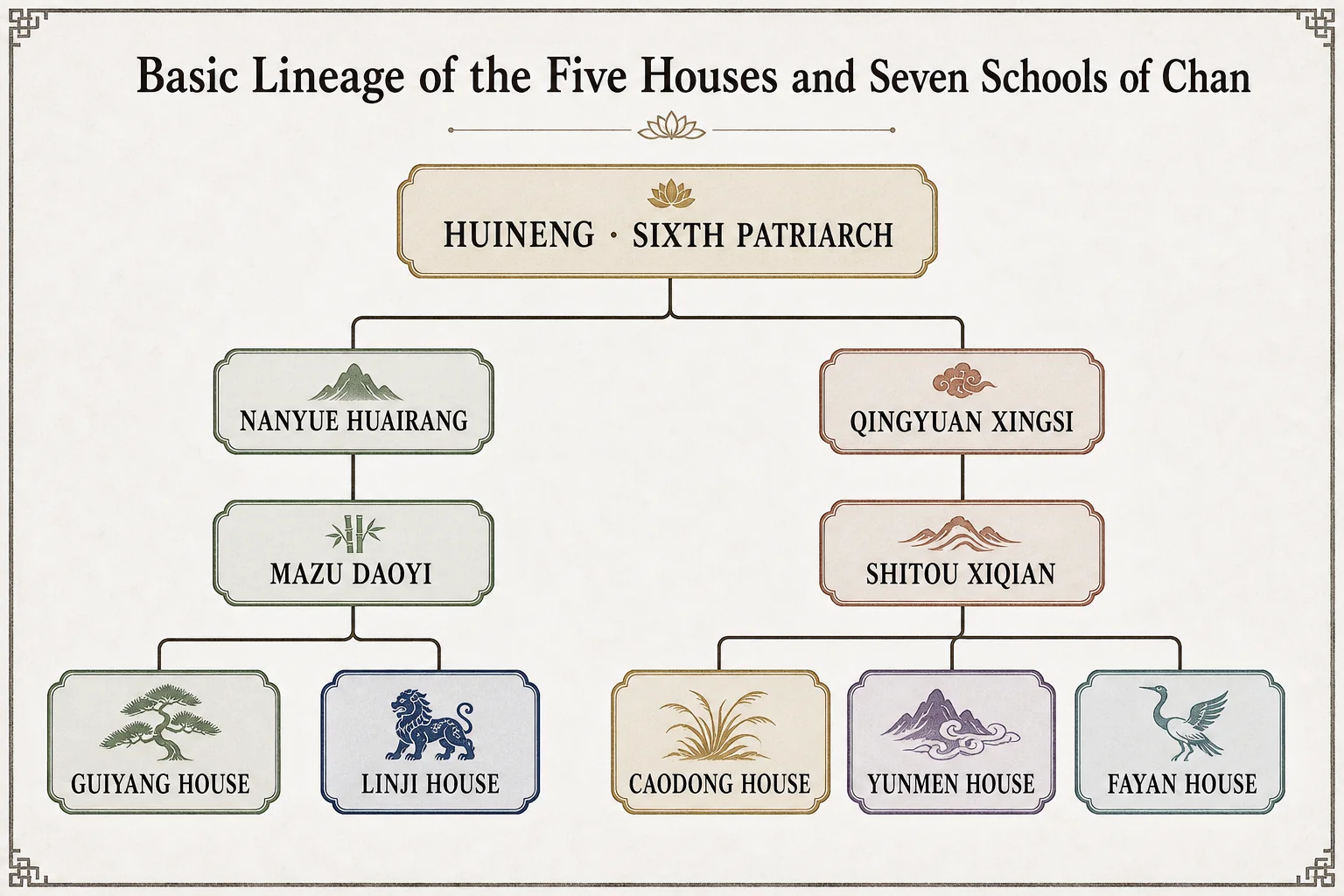
| School | Founders | Characteristics |
|---|---|---|
| Guiyang | Guishan Lingyou (771–853) and Yangshan Huiji (803–887) | Gentle style; used circular symbols; declined comparatively early |
| Linji | Linji Yixuan (?–866) | Shouts and blows; Three Mysteries and Three Essentials; later the most flourishing |
| Caodong | Dongshan Liangjie (807–869) and Caoshan Benji (840–901) | Five Ranks, or levels of awakening; silent illumination; refined |
| Yunmen | Yunmen Wenyan (864–949) | Extremely concise responses, including “one-word barriers”; poetic |
| Fayan | Fayan Wenyi (885–958) | More scholarly and connected to Huayan; declined comparatively early |
After the Song dynasty, only two of the five remained: Linji and Caodong. They continue as the principal Chan traditions of East Asia today.
Linji Yixuan (?–866)
Linji was one of the most forceful teachers in Chan history. His “Three Mysteries and Three Essentials” formed an analytical framework of instruction preventing students from remaining on any single level. He also taught the famous “True Person of No Rank,” shouting at his students: “You who do not distinguish good from bad—look at the True Person of No Rank!” This “True Person” is the “one” who sees, hears, and thinks at every moment, possesses no fixed position, cannot be bounded by concepts, and is always present.
VII. The Development of the Kōan System
The origin of the kōan
“Kōan” was originally a Song-dynasty legal term meaning a “public record” or precedent. Chan borrowed it to mean a “case already judged by the patriarchs”: records of exemplary dialogues between masters and students, investigated by later practitioners.
The function of a kōan is not to be “solved” through intellectual analysis. It focuses the practitioner’s whole attention upon a point concepts cannot resolve, until the conceptual framework collapses and nature is directly seen in that moment.4
The three great kōan collections
| Text | Date | Compiler | Content |
|---|---|---|---|
| Blue Cliff Record | 1125 | Yuanwu Keqin (1063–1135) | One hundred cases with critical commentary; the most literary |
| Gateless Gate | 1228 | Wumen Huikai (1183–1260) | Forty-eight cases; the best known is the first, “Zhaozhou’s No” |
| Book of Serenity | Thirteenth century | Wansong Xingxiu (1166–1246) | One hundred cases in the Caodong tradition |
Zhaozhou’s “No”
The first case of the Gateless Gate is the most famous kōan:
A monk asked Zhaozhou, “Does a dog possess buddha-nature or not?” Zhaozhou said, “No.”
According to the scriptures and treatises, Buddhism explicitly teaches that “all sentient beings possess buddha-nature,” so Zhaozhou ought to say “yes.” Instead he says “no.” The practitioner is instructed to concentrate completely upon “this ‘no,’” not to reason intellectually about why Zhaozhou said it, but to let “no” fill the whole of consciousness until all discrimination and inference cease and the word itself discloses something without speech.
VIII. Song-Dynasty Chan: Investigating the Critical Phrase and Silent Illumination
During the Song, Chan underwent a second large-scale division, principally expressed in the dispute between Linji investigation of the critical phrase and Caodong silent illumination.
Investigating the critical phrase: Dahui Zonggao (1089–1163)
Dahui systematized kōan practice by concentrating on a kōan’s “critical phrase,” usually the line most devoid of ordinary meaning and least susceptible to logical resolution. The practitioner focuses all energy upon it day and night until a breakthrough occurs.1
Dahui emphasized the “great ball of doubt.” Genuine practice must generate a deep sense of doubt before the phrase, like “a red-hot iron ball stuck in the throat, impossible either to swallow or spit out.” Only when this doubt accumulates to its extreme can a genuine breakthrough occur.
Silent illumination: Hongzhi Zhengjue (1091–1157)
Hongzhi’s route combined “silence,” allowing the mind to become still, and “illumination,” maintaining clear awareness. It required no concentration upon a particular critical phrase, but rested in open and objectless awareness, allowing all phenomena to manifest as they are without grasping or rejecting.
Dahui criticized it as “the heretical Chan of silent illumination,” arguing that without the support of a critical phrase it readily degenerates into “dead sitting” without the force of breakthrough. Hongzhi answered that Dahui’s investigation was too tense and lacked serenity. Genuine practice should be natural and noncoercive.
Philosophically, the dispute reaches a genuine question: is awakening produced by “doing” (requiring concentration and breakthrough), or by “releasing”—requiring relaxation and opening? The dispute continued throughout East Asian Chan history and appears in similar tension between Japanese Rinzai and Sōtō.
IX. The Intellectual Sources of Chan
Chan claimed “a separate transmission outside the teachings,” but in fact rested deeply upon multiple Indian and Chinese intellectual traditions.
Tathāgatagarbha and buddha-nature. Chan’s “seeing nature and becoming a buddha” comes directly from tathāgatagarbha. Nature is originally pure, all sentient beings possess buddha-nature, and awakening sees that nature rather than acquiring something new, as Chapter 7.1 explained. Without tathāgatagarbha, Chan’s central claim has no foundation.
The Vimalakīrti Sūtra and Diamond Sūtra. These are Chan’s most frequently cited scriptures, both in Kumārajīva’s translations, as Chapter 10.3 noted. Vimalakīrti’s silence (“a silence like thunder” entering the gate of nonduality) was Chan’s prototype for the end of speech. The Diamond Sūtra’s “give rise to the mind without abiding anywhere” was the scriptural source of “nonabiding” and the text through which Huineng was said to awaken.
Daoism and xuanxue. Chan’s language of nature (“bamboo is green, flowers are red”), its teaching that “ordinary mind is the Way,” and its emphasis on non-action and spontaneity all possess a Daoist background, the legacy of the matched-concept era discussed in Chapter 10.2. Mazu’s saying “When hungry, eat; when tired, sleep” as the highest Chan opportunity internally resonates with Daoist spontaneity.
The Three Treatise school and Sengzhao. The Three Treatise understanding that “all is empty and nothing can be grasped,” together with Sengzhao’s description of “not knowing” as the state of prajñā, supplied intellectual support for Chan’s “no-thought and no-form.”
X. The Transmission of Chan
To Korea
Chan entered Korea during the ninth century and formed the “Nine Mountain Seon Schools” under Silla and Goryeo. Jinul (1158–1210), the most important synthesizing master in Korean Seon history, sought to integrate meditation and doctrine, especially Huayan. Korea’s largest contemporary Buddhist denomination, the Jogye Order, remains a Seon tradition.
To Vietnam
The principal lineages of Vietnamese Thiền were often connected to Chinese Chan. Vô Ngôn Thông introduced a Chan lineage to Vietnam in the ninth century. Thiền remains an important component of Vietnamese Buddhism today.
To Japan
Eisai (1141–1215) traveled twice to Song China and brought the Linji school back to Japan as Rinzai, where it received enthusiastic support from the warrior class of the Kamakura shogunate. Dōgen (1200–1253) traveled to Song China, received transmission in Caodong from Tiantong Rujing, brought the school to Japan as Sōtō, and wrote the Shōbōgenzō, one of the most important philosophical works in Japanese Buddhist history.5
Japanese Zen became a cultural phenomenon widely disseminated in the West during the twentieth century through the writings of D. T. Suzuki.
XI. This Book’s Philosophical Assessment
Chan is Chinese Buddhism’s most original philosophical achievement. It reduced the complex conceptual systems of the whole Indian Buddhist tradition (the eight consciousnesses, three natures, Three Truths, four Dharma-realms) to one question: where are you? What is this seeing, this hearing, this active consciousness at this moment? Chan’s originality lies in finding a way to turn this question into practice (kōan, critical phrase, and everyday encounter) rather than leaving it as a philosophical topic.
Whether sudden awakening is possible is a genuine philosophical question. Tathāgatagarbha says that nature is originally pure and awakening recognizes this. Chan radicalizes the position by saying the recognition can occur in a single moment without preparation. During the Lhasa debate discussed in Chapter 8.3, Kamalaśīla criticized such a view: without correct conceptual understanding as a foundation, any “sudden awakening” is only a psychological blank and does not yet constitute genuine awakening. Chan answers that Kamalaśīla treats “correct conceptual understanding” as a necessary intermediate step, while that intermediate step is itself an attachment. The dispute remains unresolved. This book does not adjudicate it, but notes that it is a genuine philosophical controversy that cannot be treated as settled simply because Chan won an overwhelming cultural victory in China.
The tension between Chan’s “not establishing words” and its literary tradition is a creative contradiction. The Blue Cliff Record and Gateless Gate contain some of the most exquisite prose in world literature. The “realm where the path of speech ends” they describe is conveyed through those words. This contradiction is not Chan’s failure, but the site of its philosophical tension: language cannot directly transmit awakening, but can bring readers to the edge where language stops. There, something different may occur.
Whether Chan is really “a separate transmission outside the teachings” is doubtful. It rests deeply upon the resources of tathāgatagarbha, the Three Treatise school, Huayan, and Daoism, while concealing those sources within a narrative of patriarchal transmission. Understanding the sources clarifies Chan’s place in Chinese intellectual history and helps evaluate how “unique” its philosophical claims truly are.
Several structural problems within Chan
This section identifies several critical observations that deserve recognition. It does not deny Chan’s value as a tradition, but seeks an honest assessment of its philosophical claims.
First: a path of liberation without actual cultivation?
Historically, Chan’s theory of sudden awakening has repeatedly produced a practical danger. It can be understood as saying that epistemically “understanding” is equivalent to liberation: “Nature was already buddha; now I recognize it, and the task is complete.” This differs sharply from early Buddhist liberation, which requires the complete abandonment of the fetters with explicit markers of attainment, and from Mahāyāna accounts requiring practice over incalculable eons. The misunderstanding has recurred throughout history. People claiming “I have seen nature” remain filled with greed, aversion, and delusion in their conduct; people proclaiming “there are no precepts to keep,” because nature itself is the precepts, indulge their behavior. Tang and Song literature already records criticism of such abuses.
Second: what comes after “awakening is only the first step”?
In response to “sudden awakening is not liberation,” modern Chan communities often say that awakening, seeing nature or initial awakening, is only the first step and must be followed by long practice to deepen, stabilize, and embody it. The claim has a historical basis. The Korean master Jinul proposed “sudden awakening followed by gradual cultivation,” and the Japanese Rinzai kōan curriculum similarly continues through a series of cases after seeing nature.
Yet the answer leaves a question still insufficiently addressed: what is the content of “practice after awakening”? What are its standards? How does it know whether it is progressing rather than cycling in place? Early Buddhism supplies relatively clear answers through the four fruits and abandonment of the ten fetters. “Chan practice after awakening,” however, is described rather vaguely in most traditions. Sometimes it borrows tools from elsewhere, such as Theravāda insight practice or psychotherapy. Sometimes it appeals to “uncontrived functioning in life,” following circumstances and treating everyday activity as the Way. Sometimes it simply continues investigating kōans. All may possess value, but whether they constitute a testable, trackable path of liberation remains a genuinely open question.
Third: Chan as ritual and performance
In recent decades, English-language scholarship on Chan and Zen has advanced a critical analysis from within the field. Robert Sharf and others argue that many behaviors called “expressions of awakening” (blows, shouts, pointed repartee, silent responses, and displays of “Chan spirit” in ordinary acts) can be understood more appropriately as ritual performance than spontaneous manifestations of liberation. They are scripts learned and prescribed within Chan institutions. Striking a student, giving a shout, or smashing a teacup acquires meaning from the institutional framework of Chan and does not necessarily issue from a person’s inner liberation.6
Bernard Faure offers a related analysis. Chan constructed a rhetoric of “immediacy,” claiming that its transmission bypassed every intermediary and passed directly from mind to mind. Yet the rhetoric is itself a highly acculturated and institutional construction rather than genuine “absence of mediation.”7
The analysis does not deny genuine practice or inner change within Chan. It points out that the external signs used to judge “whether one is awakened” (flexible responses in encounter dialogue or possession of “Chan style”) may measure mastery of Chan narrative style and institutional culture far more than the degree of inner liberation.
Fourth: an intellectual game for clever people?
Taken together, the preceding points produce an uncomfortable question: have some forms of Chan become an intellectual game for clever people? How close or distant from liberation are the skills of flexibly manipulating paradoxical language, overturning ordinary logic, and displaying the wit of “nonabiding” in kōan dialogue?
This book has no answer, but regards the question as real and not to be obscured by Chan’s literary charm and cultural prestige. Historical Chan produced great quantities of brilliant literature and thought, and also many people who claimed to have “illuminated mind and seen nature” while showing no transformation in behavior or character. This exceeds isolated failures in practice and constitutes a systemic structural problem. When the standards themselves are “performance” and “linguistic expression” rather than testable embodied and mental change, the system lacks a mechanism of self-correction.
Early Buddhist stream-entry possesses clear criteria: unshakable confidence in the Three Jewels, unbroken observance of the Five Precepts, a certain foundation in concentration, and understanding of the Dharma. These can be indirectly assessed through conduct and statements. Chan’s “seeing nature” has no corresponding externally testable standard; judgment is surrendered entirely to mechanisms of recognition within the lineage. Institutionally, this planted the risks identified above.
References
References
-
Heinrich Dumoulin. Zen Buddhism: A History. Vol. 1: India and China. New York: Macmillan, 1988. (An authoritative English-language general history of Chan, including detailed accounts of Bodhidharma, Huineng, and Tang and Song schools.) ↩↩↩
-
John R. McRae. Seeing through Zen: Encounter, Transformation, and Genealogy in Chinese Chan Buddhism. Berkeley: University of California Press, 2003. (A critical reconstruction emphasizing the role of narrative construction.) See also McRae, The Northern School and the Formation of Early Ch’an Buddhism. Honolulu: University of Hawaii Press, 1986. (A historical reassessment of Shenxiu’s Northern school and a systematic dismantling of the narrative that “Northern gradual practice was inferior”; see Chapters 4–6 for Shenhui’s campaign.) ↩
-
Philip B. Yampolsky. The Platform Sutra of the Sixth Patriarch: The Text of the Tun-huang Manuscript. New York: Columbia University Press, 1967. (An English translation and study of the Dunhuang manuscript; its comparison with the received version is foundational to research on textual development, and Chapter 3 documents differences between the two verses.) ↩
-
Dale S. Wright. Philosophical Meditations on Zen Buddhism. Cambridge: Cambridge University Press, 1998. (A modern analysis of Chan and Zen philosophy.) ↩
-
Hee-Jin Kim. Dōgen on Meditation and Thinking: A Reflection on His View of Zen. Albany: SUNY Press, 2007. (A detailed study of Dōgen’s philosophy of Zen.) ↩
-
Robert H. Sharf. “Buddhist Modernism and the Rhetoric of Meditative Experience.” Numen 42, no. 3 (1995): 228–283; on ritualized exchange see p. 243: “this repertoire includes mastering vast selections from Zen koan collections and commentaries so as to be able to guide students through ritualized koan exchanges. Here too, prescriptive religious texts are treated not so much as practical guides for meditation, but rather as liturgies to be memorized for ritual performance.” For the same point see John R. McRae, “Encounter Dialogue and the Transformation of the Spiritual Path in Chinese Ch'an,” in Paths to Liberation: The Mārga and Its Transformations in Buddhist Thought, ed. Robert E. Buswell Jr. and Robert M. Gimello (Honolulu: University of Hawai'i Press, 1992), 339–369, who holds at p. 340 that the spontaneity of the Tang masters existed only in the mythic consciousness of later times, and that the records should be read as bounded by the precisely defined ritual contexts of the Song. On Zen authority and institutional performance see also Sharf, “The Zen of Japanese Nationalism.” History of Religions 33, no. 1 (1993): 1–43. For further discussion, see Sharf, “Experience.” In Critical Terms for Religious Studies, ed. Mark C. Taylor. Chicago: University of Chicago Press, 1998, pp. 94–116. ↩
-
Bernard Faure. The Rhetoric of Immediacy: A Cultural Critique of Chan/Zen Buddhism. Princeton: Princeton University Press, 1991. (A cultural critique of Chan’s rhetoric of “immediacy,” including ritual, gender, the body, and other dimensions.) ↩