Chapter 10: The Vinaya, Esoteric, and Other Schools
The preceding chapters concentrated on the five principal philosophical traditions of Chinese Buddhism: Tiantai, Huayan, Faxiang, Chan, and Pure Land. This chapter completes the picture with the remaining schools and problems: the Vinaya school, which supplied every other tradition with an institutional foundation; Chinese Esoteric Buddhism, which enjoyed a brief period of splendor during the Tang; several smaller schools; and an overall retrospective on Chinese Buddhism.
I. The Vinaya School: The Institutional Foundation
Why the Vinaya school is especially important
Every other school (Chan, Pure Land, Tiantai, and Huayan) teaches a method of practice or a doctrinal view. Yet all depend upon one thing: a valid disciplinary lineage. Without the Vinaya there is no valid ordination, without ordination no monks or nuns, without monastics no monasteries, and without monasteries no schools. The Vinaya school studies and transmits precisely this fundamental institution.1
Vinaya transmission in China
The principal disciplinary collection eventually established in China was the Dharmaguptaka Vinaya, translated by Buddhayaśas and Zhu Fonian between 402 and 412. It belonged to the Dharmaguptaka order and came into principal use during the Northern and Southern Dynasties, gradually becoming the sole basis of ordination in Chinese Buddhism.
The Dharmaguptaka Vinaya belongs neither to Sarvāstivāda, whose Mūlasarvāstivāda Vinaya is used in Tibetan Buddhism, nor to the Tāmraparṇīya transmission used in Southern Buddhism. Chinese, Tibetan, and Southern Buddhism therefore follow different disciplinary lineages while sharing the basic principles of monastic discipline, treated in the Vinaya chapters of Parts I and II.
Several Vinayas were translated into Chinese, including the Mahāsāṃghika Vinaya, Sarvāstivāda Vinaya in Ten Recitations, and Mahīśāsaka Vinaya in Five Divisions, and their early regional use was not uniform. During the Sui and Tang, three Vinaya masters established three traditions:
| Vinaya school | Founder | Characteristics |
|---|---|---|
| Xiangbu | Fali (569–635) | Advocated “procedures responsive to circumstances,” emphasizing practical application |
| East Pagoda | Huaisu (634–709) | Advocated the “meaning of the new commentary,” with a scholastic orientation |
| Nanshan | Daoxuan (596–667) | Most complete system; centered on the Dharmaguptaka Vinaya and integrated mind-only doctrine |
Of the three, Daoxuan’s Nanshan school, named for his long residence on Mount Zhongnan, was the most systematic and became the only main line of Chinese Vinaya learning to continue.
Daoxuan (596–667)
Daoxuan founded the Chinese Vinaya school. He organized the full Dharmaguptaka Vinaya into a complete practical system according to the highest doctrinal understanding of his time. His “three great works” were:
| Work | Content |
|---|---|
| Guide to Conduct According to the Dharmaguptaka Vinaya | General rules for the everyday practice of discipline; still the most important reference in Chinese Vinaya studies |
| Commentary on Supplementary Procedures Responsive to Circumstances in the Dharmaguptaka Vinaya | Detailed annotation of karman, the procedures for formal acts of the Saṅgha |
| Annotated Prātimokṣa of the Dharmaguptaka Bhikṣus | Commentary on the disciplinary code for monks |
Daoxuan combined Consciousness-Only with the practice of discipline. The Vinaya is an external standard of conduct and an expression of the purification of mind-nature. “Precepts arise from mind”; their fundamental observance lies in inner purity. This integration of doctrine and discipline took his work beyond institutional study and gave it philosophical depth.
Another major contribution was his compilation of historical and documentary sources, including the Continued Biographies of Eminent Monks and the Buddhist Gazetteer, which became important evidence for Chinese Buddhist history before the Tang.
Historical significance of the Vinaya school
The Vinaya school was never a popular movement. It had no vast lay following and was not distinguished by philosophical speculation. Yet it supplied the institutional conditions upon which every other school depended: a valid transmission of ordination for monks and nuns. To become a valid monastic, a person must be ordained according to the Vinaya before “three preceptors and seven witnesses,” all ten of whom must themselves be validly ordained monks. Once this chain is severed, it cannot restore itself.
The Vinaya transmission is therefore the institutional precondition of Chinese Buddhism as a whole. Few may say “I am a disciple of the Vinaya school,” but every monastic exists through the disciplinary lineage it transmitted.
Appendix: a comparison of the Vinayas in the world’s principal Buddhist traditions
Southern, Chinese, and Tibetan Buddhism each follow the Vinaya of a different early school. Historically, several versions entered China, each belonging to a distinct school, but Dharmaguptaka discipline ultimately became normative. The table lists the collections and present conditions of the major traditions:
| Tradition | Vinaya followed | School of origin | Language of Vinaya | Bhikṣu rules | Principal regions | Present condition |
|---|---|---|---|---|---|---|
| Southern Theravāda | Tāmraparṇīya Vinaya, Pāli Vinaya Piṭaka | Vibhajjavāda–Tāmraparṇīya | Pāli | 227 | Sri Lanka, Myanmar, Thailand, Cambodia, Laos | Most completely preserved disciplinary transmission; bhikkhunī lineage once ended and was partly restored in the late twentieth century |
| Chinese Buddhism | Dharmaguptaka Vinaya | Dharmaguptaka | Chinese translation; Sanskrit source lost | 250 | Mainland China, Taiwan, Hong Kong, Korea, Vietnam | All Chinese Buddhist monastics receive ordination under it; bhikṣuṇī transmission continuously preserved |
| Tibetan Buddhism | Mūlasarvāstivāda Vinaya | Mūlasarvāstivāda | Tibetan translation | 253 | Tibet, Mongolia, Bhutan, Nepal, Sikkim | Monastic transmission complete; no complete bhikṣuṇī lineage at present, because it was not introduced traditionally |
| Japanese Buddhism | Historically diverse; now rarely observed | Initially Dharmaguptaka; after Saichō, Brahmā’s Net bodhisattva precepts | — | — | Japan | Clerical marriage permitted since Meiji; monastic discipline greatly secularized; traditions such as Jōdo Shinshū no longer possess conventional bhikṣu ordination |
| Other Vinayas historically transmitted to China | Vinaya in Ten Recitations | Sarvāstivāda | Chinese translation | 263 | — | Used in some regions before Sui-Tang unification under Dharmaguptaka |
| Same | Mahāsāṃghika Vinaya | Mahāsāṃghika | Chinese translation | 218 | — | Brought from India by Faxian; used in parts of Eastern Jin and Southern Dynasties China |
| Same | Vinaya in Five Divisions | Mahīśāsaka | Chinese translation | 251 | — | Yijing participated in its transmission; used in the Southern Dynasties |
Several clarifications: rule counts differ among schools, but the gravest offenses, the pārājikas, are nearly identical; most differences concern secondary conduct. Most Sanskrit Vinaya originals have been lost. Surviving sources are principally Chinese or Tibetan translations and Sanskrit fragments, especially from Gandhāra. The discipline and lineage of bhikṣuṇīs constitute a tension common to all three major traditions: Southern Buddhism has partly restored it, Tibetan Buddhism continues to debate it, and Chinese Buddhism is the only one of the three whose lineage was never broken.2
II. Chinese Esoteric Buddhism: A Brief Splendor
Chapter 8.4 described in detail the entry of Esoteric Buddhism into China through the “Three Great Masters of the Kaiyuan Era”: Śubhakarasiṃha, Vajrabodhi, and Amoghavajra. Here we supplement that account with its fate in China.
Characteristics of Tang Esoteric Buddhism
The forms that entered China principally included Action Tantra, based on the Mahāvairocana Sūtra and transmitted by Śubhakarasiṃha, and Yoga Tantra, based on the Vajraśekhara Sūtra and transmitted by Vajrabodhi and Amoghavajra. They correspond to the earlier two categories among the four classes of tantra. The texts and transmissions of Highest Yoga Tantra were never systematically established in China.
Amoghavajra (705–774) was the most influential Tang esoteric master. Closely connected to Emperors Xuanzong, Suzong, and Daizong, he enjoyed honors comparable to a Teacher of the State, and his political influence far exceeded that of other Buddhist masters of his time. He translated many esoteric texts and promoted the use of esoteric rites in imperial ceremonies.
Transmission to Japan
Amoghavajra’s disciple Huiguo (746–805) was the final important heir of Tang Esoteric Buddhism and the direct teacher of Kūkai (774–835). Kūkai traveled to Tang China in 804 and, the following year, studied under Huiguo and received complete transmissions of both Action and Yoga Tantra. After returning, he established Japanese Shingon. Soon after Huiguo’s death, the esoteric lineage in China began to decline.3
Esoteric Buddhism after the Huichang Persecution
The persecution of 845 dealt Tang Esoteric Buddhism a severe blow. Its court background and dependence on monasteries made it especially vulnerable, and succession among its principal transmitters had already become weak. After Huichang, systematic Chinese Esoteric Buddhism essentially ended as an independent tradition.
Fragmented permeation of esoteric elements
Although Esoteric Buddhism disappeared as an independent school, its elements permeated other parts of Chinese Buddhism in fragmented form. Dhāraṇīs appear in the rites of every tradition. The Great Compassion Dhāraṇī, Śūraṅgama Mantra, and Mantra for Averting Calamities and Bringing Auspiciousness remain central to daily monastic liturgy. Images of esoteric deities, including Avalokiteśvara, Kṣitigarbha, and Mañjuśrī, became principal elements of Chinese Buddhist iconography.
III. Other Smaller Schools
In addition to its major traditions, Chinese Buddhism included several smaller and shorter-lived schools.
The Chengshi school
The Chengshi school was based on Harivarman’s Satyasiddhi Treatise, translated by Kumārajīva. Its understanding of emptiness approached the Prajñāpāramitā position and moved beyond Sarvāstivāda Abhidharma. It was quite active during the fifth and sixth centuries, but Jizang criticized it for “falling at the boundary between emptiness and existence” without a thorough middle-way position. By the Tang, it had largely been absorbed into the Three Treatise and Faxiang schools and ceased as an independent scholarly tradition.
The Kośa school
The Kośa school was based on Xuanzang’s translation of Vasubandhu’s Abhidharmakośa. Doctrinally, it became a “foundational stage” before Consciousness-Only: students first learned the Kośa’s Abhidharma classifications, then studied how Consciousness-Only transformed them. In the Tang, Kośa was more a scholarly discipline than an independent religious school. Nara Japan possessed an independent Kusha-shū, one of the six Nara schools, but it too was in substance a course of study rather than a religious organization.
The Dilun school
The Dilun school was based on Vasubandhu’s commentary on the Daśabhūmika Sūtra, the Treatise on the Ten Stages, translated by Bodhiruci in 508–512. It was an early form of Consciousness-Only in China preceding the Shelun school. It divided into a Southern Way, inclined toward integrating tathāgatagarbha, and a Northern Way, inclined toward pure Consciousness-Only analysis. During the Sui, it gradually merged with Shelun, then was displaced by Xuanzang’s Faxiang and had largely disappeared by the Tang.
The Shelun school
Shelun was based on Paramārtha’s translation of Asaṅga’s Mahāyānasaṃgraha and was introduced in Chapter 10.7 as Faxiang’s predecessor. It was the first wave of Consciousness-Only in China, integrated with tathāgatagarbha through Paramārtha’s immaculate consciousness, and disappeared after replacement by Xuanzang’s stricter Dharmapāla lineage.
IV. The Traditional Classification of Eight Schools
A later traditional scheme divided Chinese Buddhism into “eight schools”:
| School | Principal authority | Core feature |
|---|---|---|
| Vinaya | Dharmaguptaka Vinaya | Practice and transmission of discipline |
| Kośa | Abhidharmakośa | Precise Abhidharma analysis |
| Chengshi | Satyasiddhi Treatise | Transitional exploration of emptiness |
| Three Treatise | Three Madhyamaka treatises | Emptiness; refuting without establishing |
| Tiantai | Lotus Sūtra | Perfect interpenetration of the Three Truths; nature-inclusion |
| Huayan | Avataṃsaka Sūtra | Dependent origination of the Dharma-realm; nonobstruction among phenomena |
| Faxiang or Consciousness-Only | Cheng Weishi Lun | Eight consciousnesses, three natures, five natures |
| Esoteric | Mahāvairocana Sūtra and others | Practice of the three mysteries; deity yoga |
Chan and Pure Land are generally listed separately, sometimes producing “ten schools”; modes of counting differ.
The “eight schools” are a later traditional organization, formed chiefly during the Yuan and Ming, and do not accurately reflect the historical self-identities or mutual relations of the schools. Historically, their boundaries were never so clear. Many monks studied several traditions simultaneously, and much doctrine circulated among them. The eight-school scheme is an expedient description, still some distance from precise historical classification.
V. The Huichang Persecution and the Divergence of the Schools’ Fates
The Huichang Persecution of 845 under Emperor Wuzong was one of the most important turning points in Chinese Buddhist history and accelerated the divergence among the schools.
“Three Wus and One Zong”: four major political suppressions
Chinese history records four major state-led suppressions of Buddhism, collectively called the “Three Wus and One Zong”: three emperors whose temple names contained Wu, and one whose contained Zong.
| Suppression | Date | Emperor | Principal causes | Scale and outcome |
|---|---|---|---|---|
| Suppression under Emperor Taiwu of Northern Wei | 446–452 | Tuoba Tao, Emperor Taiwu | Promotion by the Daoist leader Kou Qianzhi and Confucian official Cui Hao; in 452 weapons, wine, and meat were allegedly found concealed in Buddhist monasteries in Guanzhong, furnishing a pretext for full suppression | Monasteries throughout the realm destroyed; monastics executed or forced to return to lay life. Taiwu was assassinated in 452; Emperor Wencheng swiftly restored Buddhism |
| Suppression under Emperor Wu of Northern Zhou | 574–578 | Yuwen Yong, Emperor Wu | A memorial by Wei Yuansong, a former monk, urging reduction of Buddhism; promotion by the Daoist Zhang Bin; economic pressure from tax-exempt monastics occupying land and labor | More than forty thousand monasteries destroyed and more than three million monastics forced to return to lay life in Northern Zhou; after annexing Northern Qi, suppression extended there. Wu died in 578; his successor briefly maintained policy, but Emperor Wen of Sui fully restored Buddhism after founding the Sui in 581 |
| Tang Huichang Persecution | 845 | Li Yan, Emperor Wuzong | Influence of the Daoist adept Zhao Guizhen; Wuzong’s devotion to Daoism and ingestion of alchemical elixirs; monasteries’ large landholdings and monastic tax exemption; promotion by anti-Buddhist court officials | More than 4,600 monasteries and 26,000 smaller temples destroyed; over 260,000 monks and nuns forced into lay life. Wuzong died ill in 846; Emperor Xuanzong immediately restored Buddhism |
| Suppression under Emperor Shizong of Later Zhou | 955 | Chai Rong, Emperor Shizong | Pragmatic reform: melting Buddhist images to mint currency and rationalizing state finance; milder than the first three, without mass violence | 2,694 monasteries retained and more than thirty thousand demolished; monastics required ordination certificates. The Song was founded in 960 and was generally tolerant of Buddhism |
Several observations follow. All four suppressions involved the promotion of Daoist interests or concrete economic pressure; ideology was not their sole cause. Huichang was the most thorough and extensive and most deeply affected the fates of individual schools. Buddhism was restored to varying degrees within a few years after each suppression. Chinese culture had accepted Buddhism too deeply for any regime to eradicate it entirely. Yet every persecution substantially damaged its institutional foundations (monasteries, literature, and lineages), and the schools’ different fates depended in large part on which forms could survive such repression.4
The scale of the Huichang Persecution and the schools’ fates
Influenced by Daoist adepts, Wuzong ordered a comprehensive suppression in the fifth year of Huichang, 845. More than 4,600 monasteries were destroyed nationwide, over 260,000 monks and nuns forced into lay life, and a vast quantity of Buddhist literature burned. It was the largest and most damaging of the “Three Wus and One Zong.”
Different fates of the schools
All traditions suffered, but their speed and degree of recovery varied in accordance with institutional structure.
Those that recovered quickly: Chan and Pure Land. Chan did not depend on large monastery complexes or literary collections; one-to-one teacher-disciple transmission could continue under almost any conditions. Pure Land recollection of the Buddha could be practiced anywhere. Both quickly recovered among the population after suppression ended.
Those that recovered slowly or not at all: Faxiang, excessively dependent on large academies and textual study, and Esoteric Buddhism, excessively dependent on court patronage and particular transmission relationships. Neither substantially recovered after Huichang.
In the longer view, Huichang was a “selection event” within Chinese Buddhism. It eliminated traditions dependent on elite scholarship and state protection while leaving those with broad popular bases and little dependence on particular institutional conditions. After Huichang, Chan and Pure Land became the principal forms of Chinese Buddhism. The result also resembles natural selection within a cultural ecology.
VI. Buddhism’s Overall Influence on Chinese Culture
Across fifteen centuries, Chinese Buddhism profoundly transformed Chinese culture in several major respects.
Language. Buddhism introduced thousands of Sanskrit-derived expressions into Chinese, including transcriptions such as Buddha, bodhisattva, Nibbāna, moment, Amitābha, and prajñā, and semantic translations such as awakening, liberation, emptiness, cause and effect, rebirth, and realm. Many now belong to ordinary Chinese even when speakers do not know their Buddhist origin.
Literature and art. Buddhist stories entered the imaginative world of Chinese literature. Bai Juyi and Su Dongpo were deeply influenced by Buddhism, while Journey to the West is a Buddhist-themed novel based upon Xuanzang’s journey. The sculpture of Dunhuang, Longmen, and Yungang constitutes some of the most important heritage in Chinese art history. Buddhist architecture (pagodas, halls, and bell towers) profoundly influenced Chinese cityscapes and architectural traditions.
Philosophy. The principal categories of Song-Ming Neo-Confucianism (principle, vital energy, mind, and nature) absorbed substantial Buddhist intellectual resources, especially from Huayan and Chan, even when Neo-Confucian thinkers denied the influence. Wang Yangming’s “innate knowing” internally resonates with Chan “self-nature.”
Ethics and social practice. Releasing animals, vegetarianism, charitable granaries, and distributing porridge were widespread Chinese social practices often promoted by Buddhism. The monastic tradition also supplied Chinese society with education, medical care, orphan support, and other services.
Death culture. Merit-transfer rites for the dead, recitation of the Buddha’s name at death, and devotion to Kṣitigarbha remain central parts of funeral custom in mainland China, Taiwan, and Hong Kong.
VII. The Overall Characteristics of Chinese Buddhism
Across these ten chapters, several words describe Chinese Buddhism’s overall character.
Creativity. Tiantai’s perfect interpenetration of the Three Truths, Huayan’s nonobstruction among phenomena, and Chan’s kōan system were independently developed in China after Indian materials had been digested. Chinese Buddhism created beyond them.
Synthesis. Unlike sectarian opposition in Indian Buddhism, Chinese Buddhism strongly inclined to synthesize traditions: dual cultivation of Chan and Pure Land, classificatory systems arranging different scriptures into layered wholes, and the tolerant attitude that “all teachings are skillful means.”
Secular integration. Compared with Indian monastic Buddhism, Chinese Buddhism placed greater emphasis upon lay practice and integrated more readily with the rhythms of ordinary life through everyday Pure Land recitation, Chan’s “equal emphasis on farming and meditation,” and monasteries’ public social functions.
Political character. From its beginning, Chinese Buddhism operated within China’s political environment and inevitably interacted in complex ways with imperial power and Confucian state ideology: dependence through state patronage, conflict through suppression, and compromise through state control. This dimension runs throughout its history.
Incompleteness. Chinese Buddhism never fully resolved its philosophical tensions with Indian traditions—tathāgatagarbha and not-self, sudden and gradual awakening, other-power and self-power. They persist in different forms within internal discussion and will continue to appear in Part XI on Tibetan Buddhism and Part XII on the modern period.
A structural characteristic: the absence of a tradition of debate
One environmental feature deserves separate emphasis: Chinese Buddhism almost never developed a culture of formal public debate among schools.
By comparison, Indian Buddhism possessed a vigorous debating tradition at Nālandā, where masters challenged one another publicly and victory or defeat affected monastic prestige and patronage. Tibetan Buddhism institutionalized debate as the center of monastic training. A monk’s thesis must withstand an opponent’s continuous questioning before he is qualified to teach. The Pānadura Debate of 1873, discussed in Part IX, was an outward-facing controversy produced when Sri Lankan Buddhism encountered Christian pressure, not an internal Buddhist debate.
In Chinese Buddhism, polemics among schools almost always occurred in writing rather than face-to-face debate. Jizang criticized Tiantai, and Tiantai answered Jizang, with each composing treatises of its own. Institutions of genuinely public cross-examination were rare. Occasional exceptions were more often internal disputes such as Tiantai’s Home-Mountain and Off-Mountain controversy, not formal debate across schools.
The difference reaches the level of ecological conditions. A debating culture produces continuous “stress”: one’s claims must remain coherent under an opponent’s questioning; adverse counterexamples cannot be avoided; weak points must be addressed directly. Such stress substantially drives theoretical precision. Tibetan Madhyamaka became increasingly exact through centuries of debate for historical reasons.
Chinese Buddhism generally lacked this external pressure. “Synthesis” does describe its cultural ability to integrate different traditions, but it is also a product of absent stress. In an environment emphasizing that “all teachings are skillful means, each appropriate to a capacity,” genuine conflicts among positions can be incorporated into a hierarchical classification and direct argumentative demands bypassed. This is not necessarily bad. It gave Chinese Buddhism immense inclusiveness and adaptability. It also meant that genuine philosophical contradictions (such as the fissure between tathāgatagarbha and not-self treated in detail in Part VII) were long “harmonized” rather than directly resolved.
Understanding this helps explain why Chinese Buddhism excelled in creativity and synthesis while leaving considerable room for systematic criticism and argumentative rigor relative to the Indian treatise tradition and Tibetan debate.
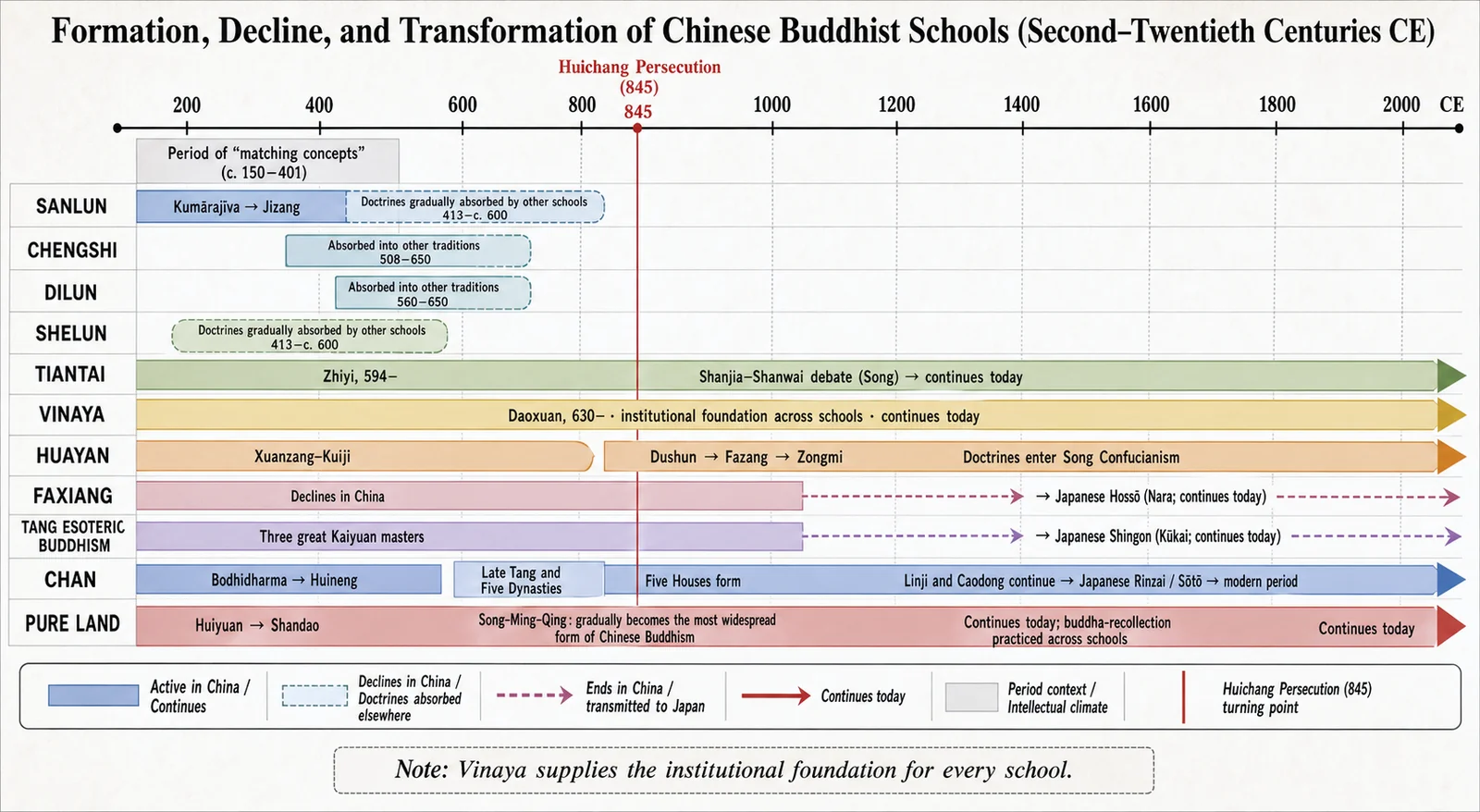
Appendix: A Historical Map of the Chinese Buddhist Schools
The following timeline presents the foundation, flourishing, ending, and transformation of the schools. Solid bars indicate periods of activity; pale or dashed lines indicate doctrinal afterlives or institutional continuation; the vertical red dashed line marks the Huichang Persecution of 845 as the historical divide.
References
References
-
Per Kvaerne. “Vinaya.” In Encyclopedia of Religion, ed. Mircea Eliade. New York: Macmillan, 1987. (An overview of Vinaya transmission.) See also Yifa, The Origins of Buddhist Monastic Codes in China: An Annotated Translation and Study of the Chanyuan Qinggui. Honolulu: University of Hawaii Press, 2002. (A study of Chinese monastic codes, including the influence of Daoxuan’s Vinaya scholarship.) ↩
-
For comparative study of Vinayas across the three major traditions, see Bhikkhu Anālayo, “The Legality of Bhikkhunī Ordination,” Journal of Buddhist Ethics 20 (2013): 310–333, on bhikṣuṇī lineages; Oskar von Hinüber, A Handbook of Pāli Literature. Berlin: Walter de Gruyter, 1996, on Pāli Vinaya literature; and Charles S. Prebish, Buddhist Monastic Discipline: The Sanskrit Prātimokṣa Sūtras of the Mahāsāṃghikas and Mūlasarvāstivādins. University Park: Pennsylvania State University Press, 1975, comparing the Mahāsāṃghika and Mūlasarvāstivāda Prātimokṣas. ↩
-
Michel Strickmann. Chinese Magical Medicine. Stanford: Stanford University Press, 2002. (Including the history and cultural influence of Tang Esoteric Buddhism.) ↩
-
On the historical analysis of the “Three Wus and One Zong,” see Jacques Gernet, Buddhism in Chinese Society: An Economic History from the Fifth to the Tenth Centuries, trans. Franciscus Verellen. New York: Columbia University Press, 1995. (The principal English-language study of the economic background to Buddhist suppressions.) See also Tang Yongtong, A History of Buddhism in the Han, Wei, Jin, and Northern and Southern Dynasties, for details of the suppressions under Emperors Taiwu and Wu; and Stanley Weinstein, Buddhism under the T’ang. Cambridge: Cambridge University Press, 1987, on the Huichang Persecution. ↩