Chapter 1: Formation of the Sangha and the Vinaya
Part I gave a brief account of the Buddha and his teaching. From this part onward, the story moves beyond the Buddha’s death. The first subject is the organization he left behind, the sangha (saṅgha), and the body of rules that sustained it, the Vinaya. As Chapter 1.4 observed, the sangha was among the Buddha’s most important inventions. Buddhism’s survival for more than two thousand years after its founder’s death owes much to its organizational form. This chapter examines how it formed and operated.
The nature of the sources should be noted at the outset. Vinaya texts are among the finest materials for studying the social history of early Buddhism. They incidentally record how monastics ate, dressed, traveled, and lived; how property was handled; and what conflicts arose. They stand closer to ordinary life than the doctrinally oriented discourses. Yet they too were compiled and idealized later. The Vinaya presents each rule in the form “a certain monk did a certain thing, whereupon the Buddha established this rule.” This one-incident-one-rule format is a narrative convention; not every rule necessarily arose from precisely such an event.1 This book therefore infers that the rules accumulated gradually over a long period and that the systematic legal code was compiled later.
I. The Sangha: Formation and Membership
In the broad sense, Buddhism has a “fourfold assembly”: monks (bhikkhu), nuns (bhikkhunī), male lay followers (upāsaka), and female lay followers (upāsikā). Strictly speaking, however, the “sangha” is the ordained community of monks and nuns.
The renunciants’ way of life came from the movement discussed in Chapter 1.3: shaving the head, wearing robes made from discarded cloth, living on alms, owning no private property, remaining celibate, and wandering as conditions allowed. The Buddha placed an organizational framework over this previously loose itinerant life: common rules, common rituals, and common procedures for deliberation. The decisive feature of a sangha is that those who assemble possess institutions capable of maintaining the group, rather than merely keeping company as fellow practitioners.
The evolution of ordination
The sangha began with the five ascetics at Isipatana, now Sarnath. They are called the “group of five” (pañcavaggiya), whom tradition says the Buddha converted after first turning the wheel of Dharma. The Mahāvagga of the Vinaya records that ordination was initially extremely simple. The Buddha said, “Come, monk. The Dharma is well taught; live the holy life,” and the person became a monk.2 This direct “come, monk” ordination (ehi bhikkhu) rested on the Buddha’s personal recognition and required neither ritual nor collective action.
As the number of candidates grew, the form became impractical. The Vinaya records several changes in ordination procedure: disciples were first authorized to ordain others; ordination through the three refuges followed, with three declarations of refuge in the Buddha, Dharma, and sangha; and finally the authority to confer ordination passed entirely to the sangha, which acted collectively through formal procedure.2 This development deserves attention. The transfer of authority from “personal recognition by the Buddha” to “the procedures of the sangha” was a central step in institutionalization and a prerequisite for the later principle that the Dharma and Vinaya would be the teacher.
Rate of expansion and social composition
The sangha expanded rapidly during the Buddha’s lifetime. According to the Vinaya, at the end of the first rains retreat the Buddha sent monks in every direction to teach. Sāriputta and Moggallāna later joined with hundreds of followers. Lay support also grew after King Bimbisāra donated the Bamboo Grove monastery. We may infer that by the Buddha’s final years there were hundreds or more fully ordained monks. Vinaya descriptions of “a thousand” need not be exact, but the general scale is plausible.
Members came from a wide social range. Mahākassapa, Sāriputta, and Moggallāna were born Brahmins; Ānanda and Anuruddha were Kshatriyas. Before going forth, Upāli had been a barber and ranked below both classes, yet he became the authority on discipline and led the recitation of the Vinaya at the First Council. This composition matches the renunciant tradition of the period: shaving the head meant relinquishing outward markers of caste, making everyone formally alike.
The position of this book is that optimism must nevertheless be restrained. Scattered Vinaya details show that monks from high castes sometimes received preferential treatment or were permitted to retain certain pre-ordination customs. When disciples raised questions of caste, the Buddha emphasized equality on the path to liberation but did not systematically reject the caste order. Caste did not disappear within the sangha. It was formally muted while continuing to exist in substance.3
II. From Wandering to Settlement: The Rains Retreat and the Rise of Monasteries
The earliest sangha probably consisted almost entirely of wandering mendicants without fixed residence. The rainy season brought them together.
During the three months of India’s monsoon, roads became muddy and insects and new plant life covered the ground. Travel was inconvenient, risked trampling living things, and drew criticism from laypeople. The “rains retreat” (vassa) therefore required monastics to stay in one place for three months and cease wandering. A retreat required lodging, and lay followers donated parks and buildings. Famous early examples include the Bamboo Grove outside Rājagaha, given by King Bimbisāra, and Jeta’s Grove at Sāvatthī, donated by Anāthapiṇḍika.4 What looked like a seasonal accommodation had far-reaching consequences:
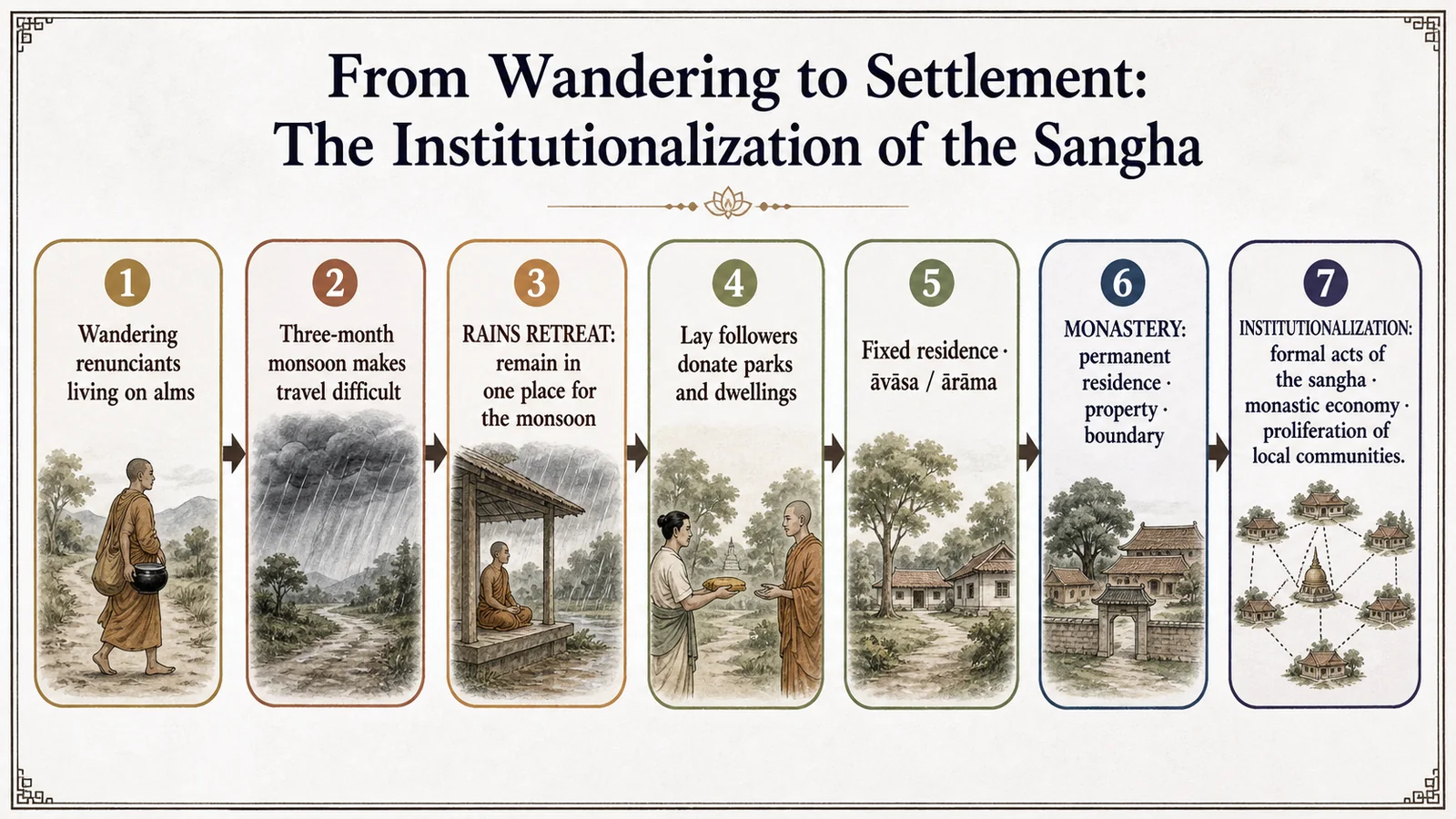
Settlement gradually transformed an itinerant group into an institution holding buildings, land, and a permanent economy. This connects directly with the urbanization, commercial wealth, and lay patronage discussed in Chapter 1.1: only prosperous urban donors could support settled communities. One issue may be anticipated here. The tensions produced once monastic property and the monastic economy became large will receive separate treatment in Volume III.
III. Formation of the Vinaya
At the center of monastic discipline is a collection of rules called the pātimokkha (Sanskrit prātimokṣa). The Vinaya Piṭaka is organized around it and consists broadly of three parts:
| Part | Contents |
|---|---|
| Suttavibhaṅga | Explains each rule: originating incident, rule, word-by-word interpretation, and permitted exceptions |
| Khandhaka, divided into Mahāvagga and Cullavagga | Institutions and procedures: ordination, observance ceremony, rains retreat, robes, medicine, lodgings, settlement of disputes, and accounts of the councils |
| Parivāra | Later summaries and catechetical questions |
The rules were not issued all at once. As the sangha expanded and new situations arose, rules were added one by one. The Vinaya’s own one-incident-one-rule format reveals the process. Still more direct evidence comes from the codes transmitted by different schools. Their cores overlap, but their details and totals vary: the Theravāda code contains 227 rules for monks, the Dharmaguptaka code 250, and the Mūlasarvāstivāda code 253.5 Approximately six complete Vinayas survive:
| Vinaya | School | Surviving form | Note |
|---|---|---|---|
| Pali Vinaya | Theravāda | Complete in Pali | Basis of the southern tradition |
| Four-Part Vinaya | Dharmaguptaka | Chinese translation | Basis of ordination in Chinese Buddhism |
| Five-Part Vinaya | Mahīśāsaka | Chinese translation | |
| Ten-Recitation Vinaya | Sarvāstivāda | Chinese translation | |
| Mahāsāṃghika Vinaya | Mahāsāṃghika | Chinese translation | |
| Mūlasarvāstivāda Vinaya | Mūlasarvāstivāda | Tibetan and partial Chinese translations | Basis of Tibetan ordination |
This book holds that the shared core of these Vinayas is early and common to the schools, while divergent details were compiled separately and became fixed later. The coexistence of several Vinayas is itself a fossil of the early sangha’s expansion and differentiation. It leads directly to the divisions discussed in the next two chapters.
IV. The Pātimokkha and Uposatha: How Discipline Operated
The rules of the pātimokkha are graded by severity. The Theravāda code for monks, for example, is divided as follows:
| Category | Number | Character and penalty |
|---|---|---|
| Defeat (pārājika) | 4 | Fundamental offenses—sexual intercourse, theft, killing a human being, and false claims of attainment; the offender is expelled and is no longer a monk |
| Requiring a meeting of the sangha (saṅghādisesa) | 13 | Next in severity; requires formal action by the community and a period of probation |
| Undetermined (aniyata) | 2 | Suspicious cases requiring investigation |
| Forfeiture and confession (nissaggiya pācittiya) | 30 | Improper possessions must be surrendered and the offense confessed |
| Confession (pācittiya) | 92 | Ordinary violations confessed to another monastic |
| Acknowledgment (pāṭidesanīya) | 4 | Minor offenses to be acknowledged |
| Training rules (sekhiya) | 75 | Detailed rules of deportment in walking, standing, sitting, lying down, and other activities |
| Settlement of disputes (adhikaraṇasamatha) | 7 | Methods for ending disputes within the sangha |
The four defeats form the lower boundary: crossing it means expulsion, a point on which the schools agree. How was the discipline maintained? Through the fortnightly uposatha ceremony. At the new and full moons, monks within the same boundary assembled and recited the pātimokkha. At each rule, anyone who had offended was required to disclose and confess it publicly; silence signified purity.6 At the end of the rains retreat came the “invitation” (pavāraṇā): each monk invited those who had lived with him to identify any offense seen, heard, or suspected, and accepted criticism. These regular forms of examination tied “purity in conduct” to “harmony in the sangha.”
V. Formal Acts and Consensus: A Community without a Supreme Head
The sangha conducted its business through “formal acts” (saṅghakamma): ordination, observance ceremonies, rains retreats, disciplinary action, and distribution all required a meeting of a legally sufficient number of monastics within a defined boundary (sīmā) and a decision made through fixed procedures. The usual procedure began with a motion, followed by three proclamations; if no objection was voiced, silence signified approval. Higher ordination (upasampadā) was likewise conferred in this way. The Buddha initially ordained candidates himself, then transferred the power to the sangha, whose assembled members ordained through a formal act.
The procedure looks familiar. Scholars have inferred that it closely resembled the deliberative practices of contemporary clan oligarchies (gaṇa-saṅgha), discussed in Chapters 1 and 4: assembly, motion, quorum, and decision by consensus or vote. The word saṅgha itself came from political and guild organizations of this kind.7 The Buddha transplanted the governance of the republican community of his homeland into the constitution of a community of practice.
Most consequentially, the Buddha appointed no successor. The Mahāparinibbāna Sutta in the Dīgha Nikāya records his final instruction: after my passing, let the Dharma and Vinaya I have taught be your teacher.8 The sangha was thereafter governed through the Dharma and Vinaya together with formal procedures, without a religious monarch or central church. Decentralization was double-edged. It gave Buddhism great resilience: destroying the sangha in one place could not eliminate the whole tradition, just as distributed oral transmission supplied redundant backups. Yet there was no central authority to decide disagreements. Once local communities diverged over rules and doctrine, no one could compel them to reunite. The institutional conditions for later division into schools were already present.
The same discourse contains another portent. The Buddha says that the sangha may, if it wishes, abolish the “minor and lesser rules.” He does not identify which rules count, and Ānanda fails to ask.8 At the First Council, no agreement can be reached, so the assembly abolishes none and preserves them all. The next chapter returns to this unresolved problem in its account of the councils.
VI. Dependence: The Teacher–Disciple Bond
Formal acts governed the collective and its procedures: ordination, observance ceremonies, and voting depended on an assembly with a quorum inside a boundary. Everyday monastic life, however, was held together by another and parallel bond: the system of “dependence” (nissaya).
A newly ordained monk had to live in dependence upon a senior. This preceptor was the upajjhāya, while one or more teachers (ācariya) assisted him. The period of dependence ordinarily lasted five years. The preceptor supervised daily conduct, doctrinal study, and training in ritual. A new monk reported to him every day, informed him before traveling, and consulted him on important matters.6
The institution served two purposes. First, it transmitted knowledge and practice. After the Buddha’s death, Dharma and Vinaya were passed on orally, as the next chapter explains, and teacher–disciple relationships formed the principal setting for recitation. Preceptors ensured that disciples memorized texts and learned procedures. Second, it supplied discipline and accountability. A preceptor bore responsibility for a disciple’s conduct and might be questioned if the disciple offended. A disciple who discovered that the preceptor was acting unlawfully likewise had a duty to admonish him.
The sangha consequently operated along two tracks. The formal-act track used the boundary as its unit and procedure as its standard to handle collective matters. The dependence track rested on interpersonal bonds and governed daily transmission and discipline. The tracks did not always join smoothly. If a preceptor broke the rules or teacher and disciple diverged doctrinally, tensions arose between them. Such tensions recurred in the later differentiation of schools on a larger scale.
VII. The Order of Nuns
Chapter 1.4 introduced the foundation of the nuns’ order. Tradition says that the Buddha’s aunt Mahāpajāpatī requested permission to go forth, that the Buddha repeatedly refused, and that he finally agreed on condition that she accept the “eight rules of respect.” This book has already noted that the repeated refusal and the eight rules show stylistic signs of later insertion.7 Institutionally, the nuns’ code contains more rules than the monks’ (311 in Theravāda), and the eight rules structurally subordinate the nuns’ order to the monks’.
The difficulty produced by the ordination rules should be explained, for it remains a living example of this chapter’s subject. A nun’s higher ordination must, under the Vinaya, be conferred by a “dual sangha”: first by an order of nuns and then recognized by an order of monks. The legally required quorum of both is indispensable. This creates a deadlock. If the transmission of nuns in one region disappears entirely, there is no longer a nuns’ sangha capable of conferring ordination according to the rule. No new nun can be produced, and the broken lineage cannot reproduce itself. The vulnerability resembles the break in a line of oral reciters discussed in the previous chapter: oral scripture is vulnerable to the extinction of reciters, while discipline is vulnerable to the extinction of an ordination lineage. The Theravāda nuns’ lineage ended in Sri Lanka around the eleventh century. Strictly speaking, the southern tradition had no fully ordained nuns for approximately nine hundred years.
The different Vinaya used in China must be noted here. Chinese Buddhism follows the Dharmaguptaka Four-Part Vinaya, distinct from the Pali Vinaya of the southern tradition and the Mūlasarvāstivāda Vinaya of Tibet. The Chinese nuns’ lineage remained uninterrupted; historical accounts say that its full establishment was assisted by Sri Lankan nuns who crossed the sea in the fifth century. Contemporary attempts to revive Theravāda ordination for nuns, such as the 1998 ceremony at Bodh Gaya, therefore invited Chinese Dharmaguptaka nuns to provide the nuns’ half of the dual sangha, ordaining candidates together with Theravāda monks. The method produced the controversy. Conservative Theravādins regard ordination across schools and Vinayas as invalid. Sangha authorities in Thailand, Myanmar, and elsewhere still generally refuse recognition. Reformers argue that the Vinayas share a common origin and that the ordination is transferable.9 This book does not decide this internal controversy. It identifies it as an acute practical consequence of the coexistence of several Vinayas and their distinct ordination lineages, discussed in Sections I and III. The issue recurs in the chapters on Theravāda, Chinese Buddhism, and modern developments.
The organization of the sangha, the origin and operation of its discipline, and its decentralized governance have now been established. The next chapter turns to the first major event after the Buddha’s death: the councils. How were orally transmitted teachings and rules communally recited and established, and where did the first fractures appear?
References
References
-
I. B. Horner (trans.). The Book of the Discipline (Vinaya-Piṭaka), 6 vols. London: Pali Text Society, 1938–1966. ↩
-
Vinaya Piṭaka, Mahāvagga I; see I. B. Horner (trans.), The Book of the Discipline, vol. 4. London: Pali Text Society, 1951. For the evolution of ordination, see Mv I.6–12; for ehi bhikkhu, see Mv I.6. ↩↩
-
Uma Chakravarti. The Social Dimensions of Early Buddhism. Delhi: Oxford University Press, 1987. See chapters 3 and 4 on caste and the sangha’s social composition. ↩
-
Sukumar Dutt. Buddhist Monks and Monasteries of India: Their History and Their Contribution to Indian Culture. London: George Allen & Unwin, 1962. ↩
-
Charles S. Prebish. Buddhist Monastic Discipline: The Sanskrit Prātimokṣa Sūtras of the Mahāsāṃghikas and Mūlasarvāstivādins. University Park: Pennsylvania State University Press, 1975. ↩
-
Mohan Wijayaratna. Buddhist Monastic Life: According to the Texts of the Theravāda Tradition. Trans. Claude Grangier and Steven Collins. Cambridge: Cambridge University Press, 1990. ↩↩
-
Richard F. Gombrich. Theravāda Buddhism: A Social History from Ancient Benares to Modern Colombo. London: Routledge, 1988. ↩↩
-
Maurice Walshe (trans.). The Long Discourses of the Buddha: A Translation of the Dīgha Nikāya. Boston: Wisdom Publications, 1995. (The instructions to take the Dharma and Vinaya as teacher and to abolish the minor rules if desired both appear in the Mahāparinibbāna Sutta, DN 16.) ↩↩
-
Bhikkhu Anālayo. The Foundation History of the Nuns’ Order. Bochum: Projektverlag, 2016; see also “The Revival of the Bhikkhunī Order and the Decline of the Sāsana.” Journal of Buddhist Ethics 20 (2013): 110–193. ↩