Chapter 3 The Root Schism: The Sthaviras and the Mahāsāṃghikas
The previous chapter ended with a question: what caused a single body of teachings to split into several independent recensions? The answer is the division into schools. The first and most fundamental fissure divided the early Saṅgha into two branches: the Sthaviras ("the elders") and the Mahāsāṃghikas ("the majority of the community"). The later so-called "eighteen schools" all arose from these two branches.
This chapter must first acknowledge a problem with the historical evidence. The sources contradict one another over when the root schism happened, what caused it, and which side was at fault. All we can do is set out the principal accounts in turn and then draw cautious inferences.
1. Disagreements among the Sources
The main accounts of the root schism include the Theravāda Dīpavaṃsa, Vasumitra's Sarvāstivāda Samayabhedoparacanacakra (translated into Chinese by Xuanzang), and the Mahāsāṃghikas' own traditions.1 They disagree on two points:
- Date: some place it about a century after the Buddha's parinirvāṇa, some more than a century afterward, and others around the reign of Aśoka. The estimates can differ by several decades, and the traditions do not even agree on the king under whom the event occurred.
- Cause: one side describes a dispute over the Vinaya, another a doctrinal dispute over the status of the arhat, and each portrays the other party as the instigator.
These two discrepancies alone show that the accounts were fixed in writing later by particular schools and were shaped by the desire to legitimate their own lineage while discrediting opponents. This book therefore does not take any side's claim that "we alone are orthodox" at face value.
One group of sources is exceptional. Rather than being a school speaking about itself, these are inscriptions issued by King Aśoka (r. ca. 268–232 BCE). Inscriptions with similar contents have been discovered at Sarnath, Sanchi, and Kosambi. Aśoka warns monks and nuns that anyone who causes a schism in the Saṅgha must be made to wear white and reside outside a monastery; at the same time, he declares that "the Saṅgha has been made united."2 These inscriptions do not speak for either faction, but they show that about two centuries after the Buddha's parinirvāṇa, a king intervening at the highest level already regarded the unity of the Saṅgha as a political objective that required legal protection. We may infer that by Aśoka's time differentiation had become pronounced enough to invite suppression by royal decree. This gives us an external terminus for the root schism: whether its cause was disciplinary or doctrinal, by the middle of the third century BCE differentiation was an accomplished fact.
2. Why Did They Divide: The Five Theses, or the Vinaya?
The two principal accounts locate the cause in doctrine and monastic discipline, respectively.
Account one: Mahādeva's five theses (doctrine). A monk named Mahādeva proposed five theses that together "lowered" the status of the arhat. An arhat might still be subject to something induced by an external condition (a nocturnal emission); might retain ignorance that was not itself defiling; might still have doubt; might require another person's indication before knowing with certainty that he had attained realization; and might even need an audible exclamation to give rise to the noble path.3 The five theses brought the arhat down from a state of absolute perfection. Traditions, mostly from the Sarvāstivāda line, attributed these claims to the Mahāsāṃghikas: the Sthaviras upheld the arhat's perfection, the Mahāsāṃghikas accepted the arhat's limitations, and the two sides divided.
The philosophical implications of the five theses deserve a little more discussion. In the early teachings, both the arhat (arahant) and the Buddha have destroyed all taints (āsava), and the two are equal in the ending of suffering. The textual warrant is the Sambuddha Sutta of the Saṃyutta Nikāya: a Tathāgata "awakens by himself to a Dhamma not heard before," reaches unsurpassed awakening, "gains what had not been gained, brings benefit where there had been none," and "knows the path, distinguishes it, teaches it, and masters it," while his disciples "follow the Dhamma and path afterward."4 The division of labor between pathfinder and follower is thereby fixed: they are equal in the ending of suffering and unequal in function. The ten powers and four kinds of fearlessness stand in the pathfinder's name and the follower need not possess them, yet the exhaustion of the taints is one and the same and liberation has a single taste. The canon itself, then, had already drawn a distinction. What was new in the five theses was not that they first drew a line between the Buddha and the arhat, but that they reassigned the level on which that line falls. The canon locates the difference in function and keeps Buddha and arhat of one taste on the side of abandonment and realization; the five theses locate the difference in abandonment and realization themselves. They conceded that an arhat had eliminated the defilements, yet maintained that certain "functional defects" might remain. Those defects were not enough to cause further rebirth, but they made the arhat less perfect than the Buddha on the very side of abandonment and realization. The fourth thesis (the need for confirmation by another) and the fifth (the need for an external sound to arouse the noble path) are especially important. If arhats cannot know for themselves that they have attained realization, then the declaration of awakening often found in the scriptures—"my taints are destroyed" (āsavā me khīṇā)—would be only approximate when spoken by an arhat; true certainty would seem to belong exclusively to a Buddha. Once this reassignment was admitted, arhatship became a secondary form of liberation. This directly prepared the direction later taken by the Mahāyāna claim that buddhahood is superior to arhatship and that the bodhisattva path differs from the path to individual liberation. The five theses may themselves have been no more than a scholastic controversy, but the affinity between their direction and the later course of Mahāyāna thought was not accidental.
Account two: the Vinaya. Yet the Theravāda tradition and modern scholars describe two very different things even when both speak of a "Vinaya dispute."
The traditional Theravāda account connects the schism to the Second Council discussed in 2.2. The Vajjian monks of Vesālī practiced the "ten points," which the council ruled unlawful; in resentment, the defeated party conducted a separate "great recitation" (Mahāsaṅgīti) and formed the Mahāsāṃghika school. The ten points were ten ways of relaxing monastic discipline:
- storing salt in a horn for later seasoning (effectively keeping food overnight);
- eating while the afternoon shadow was still within two fingerbreadths;
- going to another village and eating a second meal;
- conducting the uposatha separately within a single monastic boundary;
- performing a formal act of the Saṅgha without a quorum and obtaining approval afterward;
- justifying a practice on the grounds that "it has always been done this way";
- drinking unchurned buttermilk after the meal;
- drinking palm sap that had not yet fermented (and was nearly alcoholic);
- using a sitting cloth without a border or larger than the permitted size;
- accepting and storing gold and silver—that is, receiving money, the most consequential point of all.
This is the origin of the image of the Mahāsāṃghikas as laxists. But one fact must be stressed: even the Theravāda Vinaya's own account of the Second Council says only that the ten practices were ruled unlawful. It does not say that the Saṅgha divided at that time. It was the later chronicles, beginning with the Dīpavaṃsa tradition, that connected the ten points to the schism.1
The scholarly account advanced by Janice Nattier and Charles Prebish in 1977 nearly reverses the story. Comparing the extant disciplinary codes of the schools, they argued that the disagreement did not concern the ten relaxations at all, but the number of minor rules of deportment. The schools' prātimokṣas are almost identical in their weightier sections: the four pārājikas, thirteen saṅghādisesas, and thirty nissaggiya pācittiyas, including the prohibition on handling money. The real variation appears in the last category, the śaikṣa rules concerning such matters as eating, dress, and bodily conduct—for example, wearing one's robes neatly, not looking from side to side while eating, and not teaching the Dharma to someone holding an umbrella or staff. The Sthavira code has seventy-five such rules, the Mahāsāṃghika code sixty-six, while northern Sthavira-line codes, such as those of the Dharmaguptakas and Sarvāstivādins, contain about a hundred.5 The Mahāsāṃghikas' own account in the Śāriputraparipṛcchā likewise says that a group of elders sought to expand the Vinaya and that the majority of monks refused.6 On this reading, it was the Sthaviras who were more likely to have added rules. As for Mahādeva's five theses, this approach treats them as a later controversy internal to the Sarvāstivāda that was projected backward onto the root schism.
An apparently strong objection must be answered here. Could the Mahāsāṃghikas' shorter code not be the result of deletion, thereby proving precisely that they were lax? Taken by itself, the total number permits this objection: both additions and deletions can make one side's list shorter, and numbers alone cannot establish the direction of change. We therefore cannot decide the case simply by observing that one list contains fewer rules. We must ask where the codes differ and which side preserves the most sensitive rule, the prohibition on money.
As noted above, virtually all the variation lies in the comparatively trivial śaikṣa rules of deportment; the serious rules are shared. Most importantly, the Mahāsāṃghika Vinaya itself clearly prohibits handling money. This point exposes the chief weakness in the Theravāda story: the party supposedly accused of seceding so that it could accept gold and silver plainly retained that very prohibition in its own code. Had it actually split from the Saṅgha to relax the rule on money, it would make no sense to preserve the prohibition unchanged in its own Vinaya.
This book's position is as follows. The fact that the Mahāsāṃghika code has the fewest rules does not by itself exonerate that school, for a shorter list could be the result of deletion. Two firmer conclusions can nevertheless be drawn. First, the schools agree to a remarkable degree on substantive discipline, including the rule against money. The Mahāsāṃghikas did not relax that rule, and the specific accusation that "Mahāsāṃghika means lax heretic," especially in relation to money, fails on textual grounds. Second, the variations are limited to rules of deportment. Although numbers alone cannot determine whether these rules were added or removed, the śaikṣa category was a "soft" category especially susceptible to gradual accumulation. In combination with the Mahāsāṃghikas' own account, this tilts the balance slightly toward "Sthavira additions"—an inference, not a settled conclusion. The two stories do not even agree over which rules were contested (ten relaxations versus additions to or deletions from the deportment rules), which itself cautions against trusting the traditional narratives in full. On balance, the root schism more likely began in disputes over the extent of the Vinaya and the organization of the Saṅgha than in any clearly defined doctrinal opposition. Its date can be placed only on the broad scale of one or two centuries after the Buddha's parinirvāṇa.
3. The Character of the Two Branches: From Division to Divergence
The initial issue may have been only the number of disciplinary rules, but the two branches did eventually develop different intellectual profiles. It must be emphasized that the tendencies listed below formed gradually and are reconstructed from later literature; they cannot simply be read backward into the moment of the schism.
| Issue | Tendencies of the Mahāsāṃghika line | Tendencies of the Sthavira line |
|---|---|---|
| Conception of the Buddha | Supramundane and transcendent; his physical body regarded as a manifested appearance (Lokottaravāda, Mahāvastu) | Closer to the human sphere; the Buddha's physical body still belongs to the world |
| The arhat | Limitations acknowledged (the direction of Mahādeva's five theses) | Ultimately perfect, no different from the Buddha in liberation |
| Nature of mind | Mind is intrinsically pure; defilements are adventitious impurities | This teaching is not especially emphasized |
| Vinaya | Preserves a more original disciplinary code (according to account two) | Some branches added rules |
| Abhidharma | Less scholastically developed | Extensively developed (Sarvāstivāda and Theravāda) |
| Relation to later Mahāyāna | Numerous points of intellectual contact | More distant |
Two points merit emphasis. First, the Mahāsāṃghika view that "the Buddha transcends the world and his physical body is only a manifestation," together with the idea that mind is intrinsically pure, later supplied points of contact with Mahāyāna and even tathāgatagarbha thought. This book therefore infers that the Mahāsāṃghikas formed an important part of the background to the rise of Mahāyāna (see Part IV). Second, the Sthavira line devoted its principal energy to analyzing dharmas and constructing Abhidharma, producing the two great scholastic systems of the Sarvāstivādins and the Theravādins (see Part III). One branch tended to elevate the Buddha and regard the nature of mind as pure; the other tended toward increasingly fine analysis of the dharmas. The divergence in orientation is quite clear.
Geographical distribution
Although intellectual and geographical divergence did not stand in a simple causal relation, they roughly corresponded. The Mahāsāṃghika line was strong in southern India, especially Andhra, and in western India around the Caitya hills; many textual fragments belonging to its branches, including the Caitikas and Lokottaravādins, come from the south. The Sthavira line was more widely distributed. The Sarvāstivādins were based in the northwest, in Gandhāra and Kashmir. The Vibhajyavāda line spread through Sri Lanka into Southeast Asia. The Dharmaguptaka Vinaya reached northern China in the second and third centuries CE, while the Mūlasarvāstivāda Vinaya entered Tibet along with Esoteric Buddhism.1 Geographical separation and intellectual differentiation reinforced one another. In their respective regional environments, the schools evolved independently and their doctrinal differences became ever harder to reconcile. All this was the result of slow drift over centuries, not the decree of a single council.
4. The Eighteen Schools: A Genealogical Tree and the Misleading Word "Schism"
The two branches divided further into what tradition calls the "eighteen schools" (or twenty schools). The number is formulaic, and the various lists do not fully agree. The main lines can be sketched as follows:
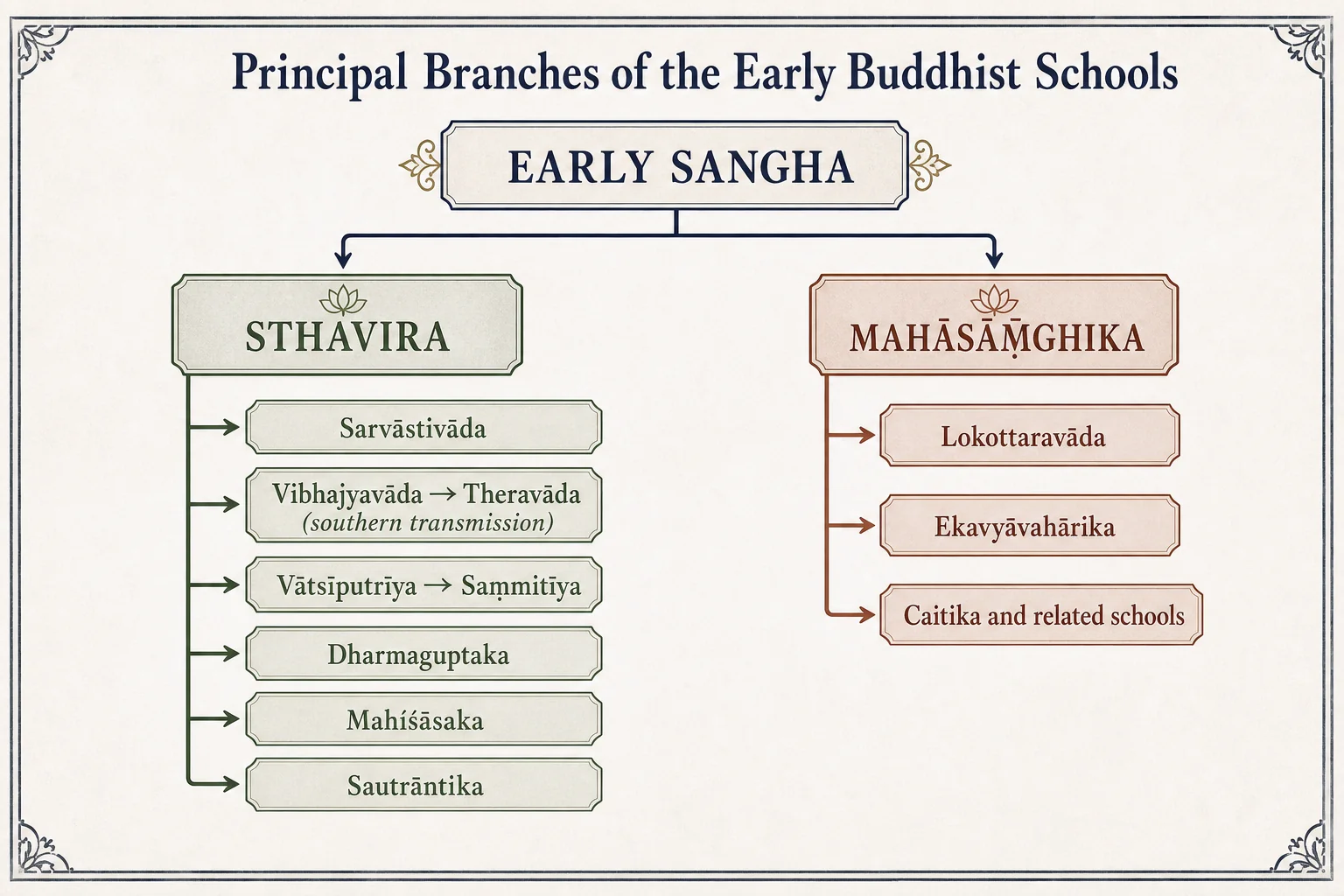
We should correct the impression created by the word "schism." In the Buddhist Vinaya, the grave offense of actually "splitting the Saṅgha" (saṅghabheda) means that monks within a single monastic boundary conduct separate uposatha ceremonies and perform formal acts of the Saṅgha independently. The formation of a school (nikāya), however, generally was not a schism in this disciplinary sense.7 A school was more like a distinct ordination lineage combined with particular doctrinal tendencies. Monks of different schools could often live in the same monastery, practicing according to their respective disciplinary codes and lineages without necessarily being at one another's throats. Instead of a succession of "schisms," it is therefore more accurate to speak of long-term differentiation and branching. This book's position is that imagining the history of the early schools as a series of bitter ecclesiastical ruptures is an artifact of the word "schism"; the reality was closer to the differentiation of lineages amid long coexistence.
5. What This Differentiation Left Behind
The root division and the differentiation that followed prepared the ground for the later parts of this book.
First, they produced the multiple independent recensions discussed in the previous chapter. It was precisely because the schools transmitted the teachings separately that we can now compare the Pāli texts, the Chinese Āgamas, and the Gandhārī fragments. Second, the scholastic impulse of the Sthavira line would unfold in Part III into the vast systems of Abhidharma and produce multiple solutions to the problem of "continuity without a self": the Sarvāstivādins' intrinsic nature of dharmas, the Sautrāntikas' seeds, and the Vātsīputrīyas' person. Third, the Mahāsāṃghika tendency to elevate the Buddha into transcendence and regard mind as intrinsically pure would become an important clue to the rise of Mahāyāna in Part IV.
The next chapter introduces a prerequisite for Part III: Abhidharma. We will see how the Sthavira line took the Buddha's teaching (his "handful of leaves"), and analyzed and arranged it into a precise and enormous system of dharmas, as well as what new problems this system generated in turn.
References
References
-
André Bareau. Les sectes bouddhiques du Petit Véhicule. Saigon: École française d'Extrême-Orient, 1955. For the geographical distribution of the schools, see the survey in chapter 1. ↩↩↩
-
For the edicts on schism found at Sarnath, Sanchi, and Kosambi, see Romila Thapar, Aśoka and the Decline of the Mauryas, rev. ed. Delhi: Oxford University Press, 1997, Appendix V. For a translation and discussion, see also Ven. S. Dhammika, The Edicts of King Asoka. Kandy: Buddhist Publication Society, 1993, "Minor Pillar Edicts." ↩
-
Jiryo Masuda. "Origin and Doctrines of Early Indian Buddhist Schools: A Translation of the Hsüan-chwang Version of Vasumitra's Treatise (Samayabhedoparacanacakra)." Asia Major 2 (1925): 1–78. The verse of the five points is at p. 15: “(Arhants) are tempted by others and ignorance (they have), Doubt (they have with regard to truths divine); (Arhantship) thro’ others’ help they realize and the path Thro’ utterance (they ascertain)”; the resulting division into Mahāsāṃghika and Sthaviravāda is at p. 14. For the Chinese source see the Mahāvibhāṣā, fascicle 99, where the verse reads “餘所誘無知猶豫他令入道因聲故起是名真佛教”. That text gives the first point as “天魔所嬈漏失不淨”, an emission provoked by Māra rather than one occurring in a dream, and classes the claim as a mistaking of non-cause for cause: “謂彼不淨從煩惱生。而說天魔所嬈故出”. ↩
-
Sambuddha Sutta (SN 22.58): a Tathāgata "awakens by himself to a Dhamma not heard before," "gains what had not been gained, brings benefit where there had been none," and "knows the path, distinguishes it, teaches it, and masters it," while his disciples "follow the Dhamma and path afterward." English translation in Bhikkhu Bodhi (trans.), The Connected Discourses of the Buddha. Boston: Wisdom Publications, 2000; the Chinese parallel is Saṃyukta Āgama no. 75. On this basis the two may be judged equal in the ending of suffering and unequal in function; see Part 13, Chapter 6 of this book. ↩
-
W. Pachow. A Comparative Study of the Prātimokṣa: On the Basis of Its Chinese, Tibetan, Sanskrit and Pāli Versions. Rev. ed. Delhi: Motilal Banarsidass, 2000 (first published 1955). ↩
-
Janice J. Nattier and Charles S. Prebish. "Mahāsāṃghika Origins: The Beginnings of Buddhist Sectarianism." History of Religions 16, no. 3 (1977): 237–272. ↩
-
Heinz Bechert. "Notes on the Formation of Buddhist Sects and the Origins of Mahāyāna." In German Scholars on India, vol. 1. Varanasi: Chowkhamba, 1973. ↩