Chapter 5 The Rise of Abhidharma
Part II concludes with the rise of Abhidharma, which also provides the necessary foundation for Part III's account of the philosophies of the early schools. The preceding chapters have prepared the way. Chapter 1.5 observed that the Buddha left the theoretical problem of "continuity without a self" outside the door; chapter 2.2 identified the mātṛkās as seeds of the Abhidharma and argued for a very early common core; chapter 2.4 showed that the era of the schools was an age of intense controversy. Put these three points together, and we can see how a new genre and a new mode of philosophy took shape. This chapter explains how Abhidharma formed, what it does, and how great a transformation it represents. The principal doctrines of the individual schools are reserved for Part III.
1. From Mātṛkā to Abhidharma Piṭaka: The Formation of a Genre
"Abhidharma" (older Chinese translations include "Dharma in relation to" and "higher Dharma") literally means "concerning the Dharma" or "higher Dharma." It refers to a metalevel, systematic organization of the teaching itself.
As chapter 2.2 noted, its seeds were the mātṛkās: classified lists that condensed the teachings into outlines. This method is already visible in the discourses—for example, Śāriputra's arrangement of teachings under headings from one to ten in the Saṅgīti Sūtra. Abhidharma developed gradually from such lists. First, every item in a list was precisely defined; next, the items were repeatedly cross-classified; finally, this work separated from the discourses and became an independent body of systematic treatises.1
The decisive shift is captured by a pair of technical terms. The discourses (sutta) teach in a "figurative or context-dependent manner" (pariyāya): they address particular people in particular situations, using similes and expedient instruction as circumstances require. Abhidharma presents itself as teaching in an "ultimate or unqualified manner" (nippariyāya): without a particular audience or figurative language, it states directly how things ultimately are.
| Method of the discourses (sutta) | Method of Abhidharma | |
|---|---|---|
| Audience | Particular people in particular situations | No particular audience; universal and systematic |
| Language | Responsive, figurative, expedient (pariyāya) | Direct, definitional, ultimate (nippariyāya) |
| Unit | Speaks as appropriate of "persons," "the world," and "the five aggregates" | Analyzes experience into minimal "dharmas," defining and classifying each one |
| Purpose | To end suffering in the immediate situation | To clarify exhaustively "what ultimately exists" |
| Example | "Conditioned things are impermanent; their nature is to arise and cease" | Enumerates all dharmas and determines the intrinsic nature, moment, associations, and conditions of each |
2. Two Sets of Seven Treatises: The Abhidharma Canons
The two best-preserved Abhidharma canons are independent collections of seven works each. They are not translations of one another and their texts differ. This precisely confirms the conclusion of 2.2: the upper layers of each Abhidharma Piṭaka were constructed separately by its school. Yet both collections employ the same method (mātṛkā, definition, and classification), and share a substantial core.
| Seven treatises of the Theravāda (southern tradition) | The Sarvāstivāda "body and six limbs" |
|---|---|
| Dhammasaṅgaṇī (Enumeration of Phenomena) | Body: Jñānaprasthāna (Kātyāyanīputra) |
| Vibhaṅga (Book of Analysis) | Limb: Saṅgītiparyāya |
| Dhātukathā (Discussion of Elements) | Limb: Dharmaskandha |
| Puggalapaññatti (Designation of Persons) | Limb: Prajñaptiśāstra |
| Kathāvatthu (Points of Controversy) | Limb: Vijñānakāya |
| Yamaka (Pairs) | Limb: Dhātukāya |
| Paṭṭhāna (Conditional Relations) | Limb: Prakaraṇapāda |
Both collections contain internal chronological layers. The works closest to the discourses (for example, the Theravāda Vibhaṅga and the Sarvāstivāda Saṅgītiparyāya and Dharmaskandha) largely rearrange and define topics already found in the discourses, and their genre remains rather "sūtra-like." Later works become increasingly abstract and systematic. The Theravāda Paṭṭhāna explains the mutual conditioning of phenomena through twenty-four kinds of relation, while the Sarvāstivāda Jñānaprasthāna is its most extensive programmatic treatise.1 This gradient from discourse to treatise traces the growth of the genre. It also picks up a thread left in 2.2: the Sarvāstivāda Saṅgītiparyāya is itself an Abhidharma expansion of Śāriputra's Saṅgīti Sūtra. The tradition's association of Abhidharma's origins with Śāriputra thus has a concrete, textual basis.
An Origin Legend and a Common Objection
The Theravāda tradition also preserves a more miraculous origin story, which gives us an opportunity to clarify a frequently raised objection. According to the legend, in the seventh year after his awakening the Buddha ascended to the Heaven of the Thirty-Three (Tāvatiṃsa) and spent the rainy season teaching the entire Abhidharma to the gods, headed by his deceased mother Māyā, who had been reborn there. Each day, when he descended to the human realm for his meal, he transmitted that day's "method" or "outline" (naya) to Śāriputra, who elaborated it for five hundred disciples. A commentary compares it to the Buddha standing on the shore and pointing to the ocean, while the elder expanded that indication into a vast sea.2 This must be noted carefully: the story belongs to the commentaries, specifically the line associated with Buddhaghosa around the fifth century CE; it is not part of the Abhidharma canon itself.
Why did this story arise? As already observed, Abhidharma does not begin with "Thus have I heard," and its genre does not resemble instruction delivered by the Buddha on a particular occasion. The story of its direct transmission in heaven was designed precisely to fill the gap around whether it should count as the word of the Buddha. That the tradition had to create a special origin for it effectively acknowledges that its provenance was doubtful by ordinary standards.
This prompts a retort: if we expose the Mahāyāna legend that Nāgārjuna entered the nāga palace and retrieved the Prajñāpāramitā scriptures (see Part IV), is the story of the Buddha teaching in heaven not equally implausible? The objection is half right and half oversimplified.
This book accepts the valid half without reservation. Both are legends, and the same demythologizing standard applies to both. We do not believe that the Buddha literally traveled to the Heaven of the Thirty-Three, just as we do not believe that Nāgārjuna literally descended to a nāga palace. Claims that authorize scriptures through a "superhuman channel" are never accepted as historical fact, with no exception for the tradition under discussion.
But treating both stories identically can obscure structural differences in what each one is intended to conceal. Even when both are regarded as legends, they attach to different objects:
| Point of comparison | The Buddha teaches Abhidharma in heaven | Nāgārjuna retrieves the Prajñāpāramitā from a nāga palace |
|---|---|---|
| Location of the legend | Added by commentaries; absent from the canon itself | Bound up with the self-presentation of the scriptures retrieved |
| Object it authorizes | A genre or method: the systematic organization of existing teachings | A large body of scriptures with substantially new content: emptiness, the superiority of the bodhisattva path over the śrāvaka path, and so forth |
| Relation to the common early teachings | Much can be developed from the Nikāyas and Āgamas, where the method already appears in embryo | Absent from the early Āgamas shared by the schools; appears around the turn of the Common Era and survives only in Mahāyāna traditions |
| Independent evidence after the legend is removed | A cross-school Abhidharma core, mātṛkās in the discourses, and the Śāriputra connection all point to an early origin for the method | Lacks early cross-school corroboration; textual history points to a later origin |
| What the legend itself claims | It says only that the Buddha gave Śāriputra an "outline," which the disciples elaborated—half acknowledging a process of human organization and transmission | Claims the scriptures are the Buddha's own words, hidden intact and later recovered |
The crucial differences lie in the last two rows. Remove the episode in heaven, and independent early traces of Abhidharma remain: Abhidharma collections transmitted independently by different schools share a common core (2.2); the mātṛkā method already appears in the discourses; and even the legend entrusts the human transmission to Śāriputra, saying that the Buddha provided only an "outline." This agrees in direction with the historical conclusion that the core of Abhidharma is early and consists of disciples' systematic organization of the Buddha's teachings. Remove the episode in the nāga palace, and scriptures such as the Prajñāpāramitā lack early, cross-school corroboration; their textual history points to a later appearance. This does not diminish their intellectual value, but it does produce a different answer to the question of whether they record the historical Buddha's words.
This book's position is therefore that neither origin myth should be accepted as history (the standard is consistent), but the status of a legend and the evidentiary status of the material to which it is attached are separate questions. The legends are symmetrical; the evidence for the objects they authorize is not. To infer from "both stories are fantastic" that both objects are equally credible or incredible is precisely what the objection oversimplifies. As a secondary point, this is the third time that the trail leads back to Śāriputra: from the Saṅgīti Sūtra (2.2), to the Saṅgītiparyāya (the preceding section), and now to this origin story. The legend cannot be accepted in full, but this repeated attribution is itself a feature of the historical evidence worth recording.
3. What Abhidharma Does: Definition, Classification, and Analysis
The work of Abhidharma can be divided into several procedures:3
- Definition: assigning each dharma its "intrinsic nature" (svabhāva), the defining characteristic that distinguishes it from other dharmas.
- Classification: placing dharmas again and again within intersecting sets of categories—the five aggregates, twelve sense fields, eighteen elements; wholesome, unwholesome, and indeterminate; with taints and without taints; and so on. The Dhātukathā and Yamaka locate every dharma within grids of this kind.
- Analysis of mind: at the center of Abhidharma lies its detailed analysis of "mind and mental factors" (citta and cetasika). A single moment of consciousness is divided into a primary mind and multiple mental factors, and their association and conditioned co-arising are specified. This is the "phenomenology of mind" discussed in 2.2.
- Determination of conditions: explaining the ways in which dharmas condition one another. The Theravāda Paṭṭhāna, for example, enumerates twenty-four kinds of conditional relation.
A specific example shows how these procedures analyze an act of seeing. A discourse says succinctly, "dependent on the eye and forms, eye-consciousness arises." Abhidharma expands this statement into the "eye-door cognitive process" (cakkhu-dvāra-vīthi). Two moments in which the object impinges on the eye faculty (a vibration of the life continuum and its arrest) are followed by five-door adverting, eye-consciousness, receiving, investigating, and determining. Seven moments of impulsion (javana) then process a wholesome or unwholesome reaction, followed by two moments of registration (tadārammaṇa) that complete the act of visual cognition. In Abhidharma, one sentence becomes seventeen successive moments of mind, each arising and ceasing with its own configuration of mental factors.4 Once the analysis is complete, no "I" that sees the flower and no stable, independently existing "flower" can be found in the event. There is only a sequence of momentary dharmas without an autonomous controller, each conditioned by the preceding moment and ceasing into the next.
Its original purpose must be emphasized: this analysis was meant to serve practice. By successively resolving a "person" or an "I" into a stream of momentary, dependently arisen dharmas, none under independent control, the practitioner was meant to see things as they are (yathābhūta) and break attachment to a self and to substantial objects. Analysis itself was an extension of insight (vipassanā). Abhidharma presented its undertaking as an effort to spread the Buddha's insight into an exact and exhaustive map.
Momentariness: the system's structural premise
The analysis just described depends on a structural premise that runs through the entire system: all conditioned dharmas arise and cease moment by moment, and no dharma remains numerically identical across two adjacent moments. This "theory of momentariness" (khaṇavāda) is not explicitly stated in the discourses. Abhidharma gradually derived it from the impermanence of all conditioned things. If a dharma passes through a transition from arising to cessation, then the same dharma exists in different states at different times. Carry the analysis further and only the two endpoints, "arising" and "cessation," remain. Each moment is discrete: the preceding moment ceases and the subsequent one arises. Although they form a conditioned continuity, they are not one and the same thing.3
Logically elegant, this premise immediately generates a cluster of problems. What continues between one moment and the next? How can the results of karma traverse many lives? On what basis do memory and personal identity arise? These became the sources of the controversies examined in Part III. The Sarvāstivāda doctrine that "the three times exist" was the first repair to the theory of momentariness, the Sautrāntika doctrine of "seeds" the second, and the Vātsīputrīya "person" the third. Momentariness produced the problem, and the schools filled the gap with different solutions; the incompatibilities among those solutions generated still more controversy. In other words, Abhidharma did not merely organize inherited teachings. It brought new theoretical problems to the foreground, and those problems drove the continued differentiation of Buddhist philosophy.
4. A Major Turn: From "How Should One Practice?" to "What Ultimately Exists?"
When this analytic project was pursued to its conclusion, however, it produced a consequential transformation.
Abhidharma culminates in "dharma theory": all experience is reduced to dharmas as the smallest real units. Each dharma has an intrinsic nature, arises and ceases in a moment, and originates through conditions. Persons and all coarse-grained objects are only "conceptually designated" (prajñapti); dharmas alone "really exist." This yields two levels of existence (conventional designations and ultimate dharmas, an early form of the distinction between conventional and ultimate truth) and a catalogue intended to exhaustively enumerate all dharmas, including the unconditioned dharmas of nirvāṇa and space.
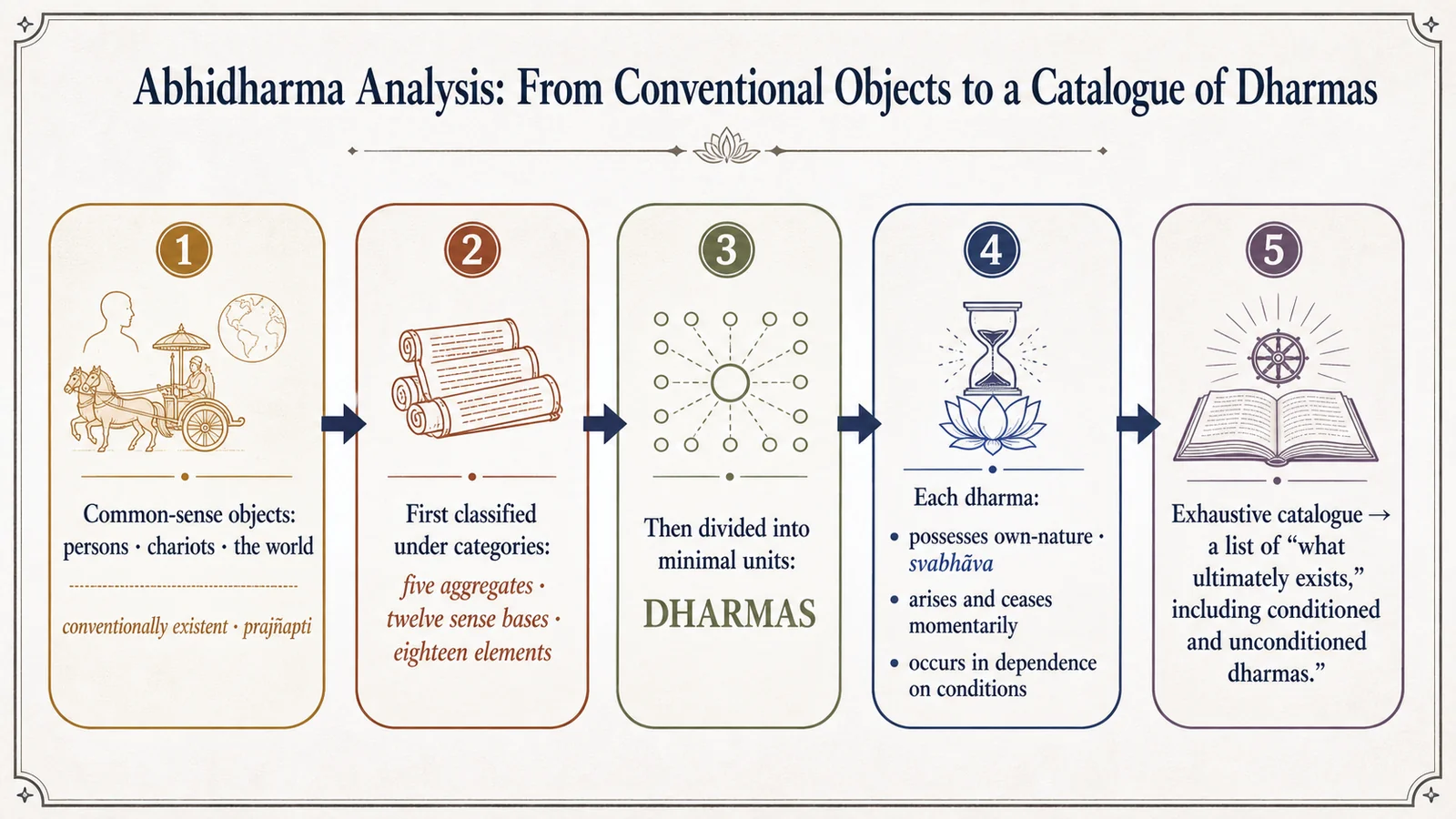
This catalogue divides all dharmas into the conditioned (saṃskṛta), which arise and cease through conditions, and the unconditioned (asaṃskṛta), which exist independently of conditions. Conditioned dharmas arise and cease moment by moment; unconditioned dharmas do not arise or cease. All schools count nirvāṇa as an unconditioned dharma, and this in itself creates no difficulty. The problem is that Abhidharma requires every dharma to possess an intrinsic nature. If nirvāṇa is a dharma, it too must have one. The Theravāda answer is that nirvāṇa's intrinsic nature is "the pacification of suffering" (dukkhūpasama). This move places nirvāṇa within the catalogue of dharmas. It genuinely exists as an unconditioned, non-arising, non-ceasing ultimate reality, rather than being merely the blank state left after greed, hatred, and delusion are extinguished. The conclusion that "nirvāṇa possesses an intrinsic nature" later became one target of Madhyamaka. In teaching emptiness, Nāgārjuna would argue that every dharma, including nirvāṇa, lacks intrinsic nature, requiring all the premises of dharma realism to be reconsidered. This chapter merely marks the thread; Part IV will develop it.
In this book's view, the importance of this step is considerable. Chapter 1.5 argued that the Buddha's teaching was practical and close to phenomenological: it described the stream of experience for the sake of ending suffering. Abhidharma transformed this description into an ontology. It moved from "experience flows in this way" to "these dharmas possessing intrinsic natures are what ultimately and really exist." The theoretical threshold identified in 1.5 was crossed here. Once crossed, it produced two lines of subsequent problems. First came disputes about the dharmas themselves: whether their intrinsic natures continue to exist through all three times, whether only present dharmas exist, whether a distinct "person" must be posited, and so forth—the subject of Part III. Second, several centuries later, Mahāyāna Madhyamaka would make "intrinsic nature" itself the object of criticism. Nāgārjuna's teaching of emptiness is directed precisely at Abhidharma dharma realism (Part IV).
Before asking exactly where this turn went wrong and how it was opposed step by step, several distinctions are needed. Abhidharma's analyses of mind, mental factors, and cognitive processes remain phenomenological in themselves and continue the early concern with the stream of phenomena. The problem lies not in analysis but in two later moves: ontologizing every momentary phenomenon as an "ultimate dharma" with intrinsic nature, and fixing cognitive processes into invariant sequences, such as the Theravāda five-door and mind-door processes. Part III will show how the schools increasingly reified these mechanisms and how others simplified and criticized them: the Sarvāstivāda categories of "acquisition" and unmanifest matter (chapter 2), the Sautrāntika simplification through "seeds" (chapter 3), the northern and southern schools' incompatible enumerations of minds, mental factors, and conditions (chapter 4), and a general critique of the entire project, including the irony that excessive analysis may itself obstruct liberation (chapter 6).
This chapter has explained how Abhidharma first organized the Buddhist teachings into a systematic philosophy. Its shared method (the mātṛkās, analysis of dharmas, and phenomenology of mind) forms the schools' common foundation. Their divergent conclusions (the existence of the three times, seeds, the person, and so on) will be examined individually in Part III. The dharma realism generated by this project also became the target of the Mahāyāna critique in Part IV. The next part turns to the doctrines of the schools themselves.
References
References
-
Erich Frauwallner. Studies in Abhidharma Literature and the Origins of Buddhist Philosophical Systems. Trans. Sophie Francis Kidd. Albany: SUNY Press, 1995. ↩↩
-
Buddhaghosa. The Expositor (Atthasālinī). Trans. Pe Maung Tin, ed. C. A. F. Rhys Davids. London: Pali Text Society, 1920–1921. For the teaching in the Heaven of the Thirty-Three, see also the Devorohana episode in the Dhammapada Commentary (commentary on Dhammapada verse 181). ↩
-
Noa Ronkin. Early Buddhist Metaphysics: The Making of a Philosophical Tradition. London: RoutledgeCurzon, 2005. ↩↩
-
Bhikkhu Bodhi (ed.). A Comprehensive Manual of Abhidhamma: The Abhidhammattha Saṅgaha. Kandy: Buddhist Publication Society, 1993. On Abhidharma method, see also Rupert Gethin, The Foundations of Buddhism. Oxford: Oxford University Press, 1998. ↩