Chapter 2: Councils and the Oral Transmission of Scripture
The Buddha’s death left the sangha with two practical questions: what exactly did he teach, the Dharma, and how should we live, the Vinaya? There was no appointed successor, as the previous chapter explained, and the available material depended entirely on memorized oral transmission, as Chapter 1.4 described. The answer could only be collective: bring together what people remembered, recite it, compare it, and establish a shared version. This mechanism is called a “council” (saṅgīti), literally a communal recitation. This chapter examines several councils, the form of the scriptures, the languages of transmission, and the transition to writing. As usual, it carefully distinguishes legends that authorize a canon from the history that can reasonably be inferred.
I. What Was a Council? The First Council
A council was a communal recitation. Participants assembled, recited passages of teaching and discipline from memory, corrected one another, and established an accepted version.
Tradition says that the First Council took place at Rājagṛha in the year of the Buddha’s death. Mahākāśyapa convened five hundred arhats, Ānanda recited the Dharma, or discourses, and Upāli recited the Vinaya.1 The unresolved problem of the “minor rules” from the previous chapter is concluded here. The Buddha had said that the sangha could abolish the minor rules without specifying which they were. Ānanda could not explain why he had failed to ask. The assembly therefore resolved to abolish none and preserve them all.
The scene cannot be accepted literally. A single assembly of five hundred arhats could not have finalized in full the enormous collections that later existed. It is an idealized foundation story whose function is to stamp a canon with the authority of having been recited on the spot by those who personally heard the Buddha.2 The position taken here is that the historical core of the First Council was, at most, a smaller effort to organize teachings and discipline after the Buddha’s death. The Sutta collection we possess accumulated and took shape through organization over a long subsequent period; it was not finalized in a single event. The Vinaya preserves one discordant report. The elder Purāṇa arrived afterward and said that he would continue to preserve what he had personally heard the Buddha teach, rather than necessarily submit to the council’s version.3 This small refusal itself suggests that early recitation was never completely uniform.
A narrative observation: the “blame” assigned to Ānanda
Ānanda bears an exceptional amount of negative narration in accounts surrounding the First Council, a fact deserving separate attention. Vinaya texts and related traditions assign him at least the following faults. First, he failed to ask the Buddha to remain. The Mahāparinibbāna Sutta says that the Buddha repeatedly hinted that he could live for an aeon if requested, but Ānanda never responded; Māra then urged him to leave, and he did. Second, Ānanda supported allowing women to go forth, supposedly reducing the lifespan of the true Dharma by five hundred years. Third, he allowed women to pay homage to the Buddha’s corpse first, and their tears allegedly wet the Buddha’s feet. Fourth, he failed to ask which rules were “minor,” making a decision impossible at the council and requiring every rule to be retained. One passage in the Saṃyutta Nikāya even attributes to him the statement, “Please be patient, Venerable Kassapa; women are foolish” (Khamatha bhante Kassapa bālo mātugāmo). Bhikkhu Bodhi translates it without concealment but notes that he doubts whether Ānanda actually said it or whether compilers placed the words in his mouth.4
Seen from another angle, Ānanda was precisely the figure in the early sangha most sympathetic to women. He supported admitting nuns, attended the Buddha longer than anyone else, remembered the most teachings, and was especially approachable to laypeople and ordinary followers. Mahākassapa acted at the council as presiding elder and prosecutor, representing a strict faction. The tension between them may reflect genuine competition within the early sangha between two tendencies, relatively open and strictly elitist. When oral transmission was committed to writing, one position had prevailed institutionally and found in the narrative a framework that justified its choices.
This remains an observation, not a conclusion. Whether any individual charge actually occurred, what Ānanda said, and how the debate unfolded at the council cannot be reconstructed historically. The point is to remind the reader that the inherited narrative has already been shaped by narrators. Its characterizations need not mirror the historical people themselves.
The technology of oral recitation
Communal recitation presupposed techniques capable of transmitting long teachings accurately by voice. Those techniques were built into the structure of the discourses and remain visible everywhere in the surviving texts:
- Standard openings: Almost every discourse begins with the same Pali words, evaṃ me sutaṃ, “Thus have I heard,” followed by the place of teaching and the audience present before the main text begins. The anchor tells a reciter exactly where the performance stands from its first words.
- Formulas and repetition: Questions, answers, arguments, and descriptions use fixed formulas. The same passage often recurs word for word across several discourses. Long texts mark repeated passages with the abbreviation peyyāla, “elision,” which a reciter restored during actual performance. These are mnemonic designs, not literary laziness.
- Numerical organization: The arrangement of the Aṅguttara Nikāya and the matrices as “one thing, two things,” and so forth essentially attaches teachings to numbers. Numbers are especially stable hooks for memory.
Specialization followed. The Vinaya and later commentaries refer to groups of “reciters” (bhāṇaka) assigned to different portions of the discourses. Reciters of the Dīgha, Majjhima, and Saṃyutta each preserved a separate corpus without mixing them.5 This division of labor stabilized each collection internally while planting the seed of separate development. After one or two generations, details in the versions held by different groups could quietly diverge even within a single school.
The structure explains an apparent paradox. Sentence-level agreement between independently transmitted southern and northern versions remains remarkably high (the wording of core discourses may overlap by more than seventy percent), while chapter order, selection, and contextual placement often differ substantially.6 Sentences were the basic units of recitation and were highly stable. Arrangement was an editorial decision and diverged earlier and faster.
Two further traditions show why the claim that “one great assembly fixed the entire canon” is idealized.
The first is the “recitation outside the cave.” According to one legend, Mahākassapa allowed only five hundred arhats into the Sattapaṇṇi Cave. The many monastics excluded from the gathering held another recitation outside and were called the “great assembly.” A later account connects the name Mahāsāṃghika, “those of the great assembly,” with this group outside the cave. This is one among several partisan origin stories considered in Chapter 2.3. Yet two concurrent recitations inside and outside already suggest that there was no single version of the canon from the beginning.
The second takes us forward more than a thousand years. Chan claimed a “separate transmission outside the teachings”: apart from written scriptures, another lineage began when the Buddha held up a flower and Mahākāśyapa smiled, transmitted from mind to mind without dependence on words. The claim is late and belongs to Chinese Chan; it is introduced here only to mark its existence. Its question (how a nontextual and noncanonical transmission can possess authority) is of the same kind as the problem of the origins of Mahāyāna scriptures in the next part. The book will treat it formally in the Mahāyāna section and return to Chan in its own chapter.
II. The Second Council and the Ten Points
Tradition places the Second Council at Vaiśālī about a century after the Buddha’s death. Its occasion was a dispute over discipline. In the southern account, local Vajjian monks practiced ten customs condemned as unlawful, collectively called the “ten points.” The most consequential concerned accepting and storing gold and silver—that is, whether monastics could accept and possess money. The assembly declared all ten unlawful.1
The Second Council is considerably more credible than the first. It concerns a specific, prosaic dispute over strict and loose observance. The exact ten practices, and the differing school accounts of their connection with the root division between Sthaviras and Mahāsāṃghikas, will be analyzed in the next chapter. The records disagree on many points, and “who broke away over the ten points?” is far more complicated than it first appears. One fact should be retained here: the first historically attested major fracture within Buddhism concerned disciplinary practice (money, according to the southern tradition), not abstruse philosophy.
III. The Third Council: A Theravāda Account
Tradition also records a Third Council, held at Pāṭaliputra under Aśoka around 250 BCE. Moggaliputta Tissa presided, purged alien doctrines that had entered the sangha, compiled the Kathāvatthu to refute heterodox views, and afterward dispatched missions, including one to Sri Lanka.1
This Third Council appears only in Theravāda, or southern, accounts. Other schools do not recognize it, and it is plainly sectarian. It serves to establish the southern transmission as orthodox. This book therefore judges it less an ecumenical Buddhist council than the starting point of one Sthavira lineage’s internal consolidation and external expansion. The three councils may be summarized as follows:
| Council | Place | Traditional date | Principal cause | Assessment of reliability |
|---|---|---|---|---|
| First | Rājagṛha | Year of the Buddha’s death | Communal recitation and establishment of Dharma and Vinaya | Idealized foundation narrative |
| Second | Vaiśālī | About a century after the Buddha’s death | Alleged dispute over the ten points | More credible; a real disciplinary conflict |
| Third | Pāṭaliputra | Reign of Aśoka, c. 250 BCE | Purge disputed doctrines and send missions | Preserved only by Theravāda; strongly sectarian |
IV. The Shape of the Three Baskets
The scriptures eventually took shape within the framework of the “three baskets” (tipiṭaka): Sutta, the Buddha’s teachings; Vinaya, discipline, discussed in the previous chapter; and Abhidharma.
The place of Abhidharma requires a careful judgment that avoids two extremes. One extreme treats it as a “third basket” personally fixed by the Buddha and equal in authority to Sutta and Vinaya. The other dismisses it wholesale as late, mutually unrelated doctrine peculiar to each school. Neither is accurate.
The evidence is layered. The Abhidharma systems of different schools share a common core and are not fundamentally unrelated. Their analysis of mind and mental factors and their methods of classification possess a substantial common nucleus, which may be called a shared “phenomenology of mind.” Upon this nucleus, however, every school built much clearly later material: systematic lists of dharmas and metaphysical theses such as “the three times all exist,” considered in Part III.7 The position taken here is that Abhidharma became a formal “third basket” only later and that its metaphysical layers were scholastic products of individual schools. Its central method, however, had a very early source shared across schools; it did not appear from nowhere at a late date.
The evidence points toward the “matrix” (mātṛkā), the “mother” of treatises: classified lists compressing teachings into headings that could be memorized and expanded. This practice already appears within the discourse collections. The Saṅgīti Sutta (DN 33) in the Dīgha Nikāya is a representative example. It depicts the Buddha lying down because of back pain and asking Sāriputta to teach in his place. Sāriputta organizes the teaching under one thing, two things, and so on through ten, and recites each in order.8 The result is virtually a prototype of Abhidharma embedded within the Sutta collection. Tradition had reason to regard Sāriputta as the disciple most skilled in analysis. The surviving Śāriputrābhidharma, transmitted by the Dharmaguptakas, preserves a relatively ancient common form and is regarded as a living fossil of early Abhidharma.7
The following is a historical conjecture, not an established fact. This book marks it explicitly. Analytical and classificatory “branch teachings” such as the matrices probably began to form during the Buddha’s lifetime. In a community so large, containing thinkers as capable as Sāriputta, it would be more surprising if no secondary organization of the teaching had arisen. Yet these remained the disciples’ systematic arrangements rather than the Buddha’s discourses; they do not open with “Thus have I heard.” They were consequently not included in the Sutta collection, developed separately, and were later expanded by individual schools into complete Abhidharma baskets. One further inference follows. The pattern of “a thick common core, with many divergent later additions” across Abhidharma systems suggests that the core, the matrix-style analysis of mind, formed very early, perhaps before the schools separated or even during the Buddha’s lifetime, whereas the divergent superstructures were built by the schools after their division.
The southern transmission organizes its discourses into five Nikāyas, while northern traditions have four Āgamas. The collections broadly correspond and were transmitted by different schools:
| Pali Nikāya | Corresponding Chinese Āgama | Approximate school of the Chinese translation |
|---|---|---|
| Dīgha | Dīrgha Āgama | Dharmaguptaka |
| Majjhima | Madhyama Āgama | Sarvāstivāda |
| Saṃyutta | Saṃyukta Āgama | Sarvāstivāda |
| Aṅguttara | Ekottarika Āgama | School affiliation disputed |
| Khuddaka | No complete counterpart | Not applicable |
The same body of teaching was recited independently in northern and southern schools and became several parallel corpora. Section VI returns to the significance of this fact.
V. Languages of Transmission and the Transition to Writing
A common misunderstanding must first be corrected: Pali was not the language spoken by the Buddha. He probably taught in a vernacular of eastern central India, close to Old Māgadhī, whereas Pali is a literary Middle Indic language with western features.9 The Theravāda claim that Pali was the “root language” and the Buddha’s own tongue is a later devotional assertion and is not accepted here.
More important is early Buddhism’s attitude toward language. The Vinaya records an episode in which two monks of Brahmin birth proposed recasting the Buddha’s words in the refined Vedic language called chandas. The Buddha refused and told disciples to learn the teaching “in their own language.”9 Whether “their own language” meant each listener’s dialect or the Buddha’s own speech has long been debated. Either reading points in the same direction: a rejection of Sanskritization in favor of vernacular language. This stands in contrast to the Brahmanical treatment of the Vedas as inviolable sacred speech, discussed in Chapter 1.1. Early Buddhism followed a popular route opposed to Sanskrit and adapted to local speech. Only later did individual schools adopt different languages: Theravāda used Pali; northwestern schools used Gāndhārī; Sarvāstivāda, Mahāsāṃghika, and later Mahāyāna adopted Sanskrit. Sanskritization was a later development that accompanied Buddhism’s entry into social worlds where Sanskrit marked high culture.
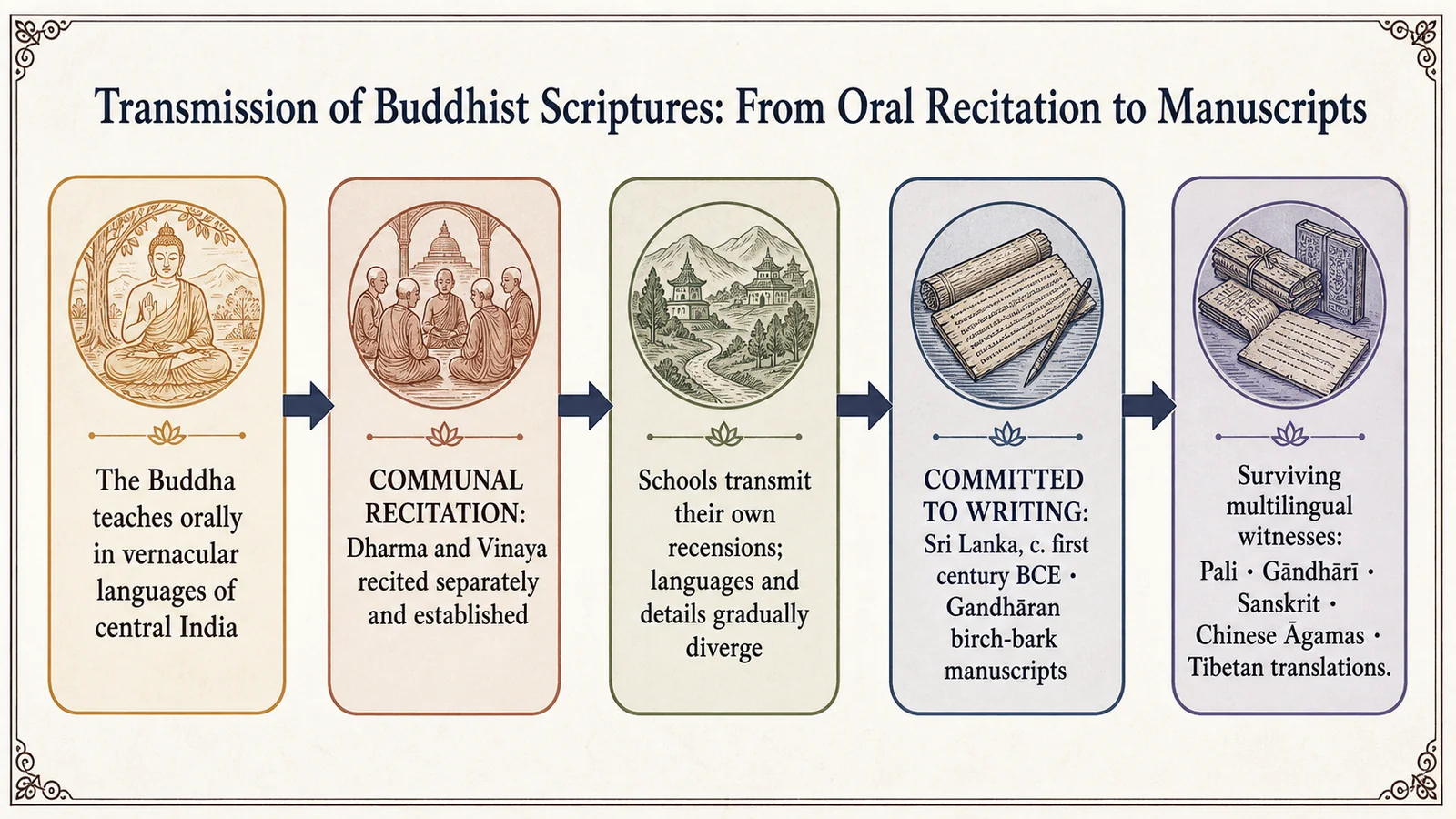
As for writing, the discussion continues Chapter 1.4. Oral recitation lasted three or four centuries, and the earliest manuscripts appeared only around the first century BCE. The southern tradition says that the Pali canon was first written down in Sri Lanka amid war and famine, when the extinction of the reciters threatened the teaching. The oldest surviving Buddhist manuscripts are birch-bark fragments found in the arid environment of Gandhāra. The complete line of transmission may be summarized as follows:
VI. What, Then, Do We Possess?
The conclusion drawn from the preceding sections is sober and two-sided.
We do not possess the Buddha’s exact words. Every version, in every language, stands behind several layers: centuries of oral transmission, repeated communal recitations and editorial decisions, separate transmission by several schools, and late commitment to writing. The “councils” themselves served, to varying degrees, to authorize particular recensions. No surviving single canon, including the Pali Tipiṭaka, can be treated as a transcript of the Buddha.
Conversely, because the same teachings were transmitted independently by several schools that separated early (the Pali Nikāyas, the Chinese Āgamas, and Gāndhārī fragments), we can compare them across traditions. Material preserved consistently by these independent witnesses very probably derives from a common source predating the divisions among the schools.6 The position taken here is that comparative study can recover, with considerable confidence, a layer of “shared pre-sectarian teaching.” This is the basis on which Part I used early discourses to discuss the “earliest teachings,” and it accords with Chapter 1.4’s assessment of oral fidelity.
What caused this common body of teaching to divide into several independently transmitted collections? The division into schools. The next chapter examines how it began, which groups emerged, and what the disputes were actually about.
References
References
-
Étienne Lamotte. History of Indian Buddhism: From the Origins to the Śaka Era. Trans. Sara Webb-Boin. Louvain: Peeters, 1988. See parts II and III on the three councils and the ten points. ↩↩↩
-
Charles S. Prebish. “A Review of Scholarship on the Buddhist Councils.” Journal of Asian Studies 33, no. 2 (1974): 239–254. ↩
-
Erich Frauwallner. The Earliest Vinaya and the Beginnings of Buddhist Literature. Rome: IsMEO, 1956. ↩
-
Bhikkhu Bodhi (trans.). The Connected Discourses of the Buddha: A Translation of the Saṃyutta Nikāya. Boston: Wisdom Publications, 2000. See his note on the relevant passage in the Bhikkhunī-saṃyutta, where he questions whether Ānanda spoke the words or compilers assigned them to him. ↩
-
Mark Allon. Style and Function: A Study of the Dominant Stylistic Features of the Prose Portions of Pāli Canonical Sutta Texts and Their Mnemonic Function. Tokyo: International Institute for Buddhist Studies, 1997. See chapter 2 on the specialization of bhāṇakas. ↩
-
Bhikkhu Anālayo. A Comparative Study of the Majjhima-nikāya. Taipei: Dharma Drum, 2011. See the introduction for statistics on verbal agreement between northern and southern transmissions. ↩↩
-
Erich Frauwallner. Studies in Abhidharma Literature and the Origins of Buddhist Philosophical Systems. Trans. Sophie Francis Kidd. Albany: SUNY Press, 1995. On the formation of matrices (mātṛkā), see also Rupert Gethin, “The Mātikās: Memorization, Mindfulness, and the List,” in In the Mirror of Memory, ed. Janet Gyatso. Albany: SUNY Press, 1992. ↩↩
-
Maurice Walshe (trans.). The Long Discourses of the Buddha: A Translation of the Dīgha Nikāya. Boston: Wisdom Publications, 1995. (Saṅgīti Sutta, DN 33; Dasuttara Sutta, DN 34.) ↩
-
K. R. Norman. Pāli Literature. Wiesbaden: Harrassowitz, 1983; and A Philological Approach to Buddhism. London: SOAS, 1997, for discussion of “in their own language.” ↩↩