Chapter 1 Sarvāstivāda: The Three Times Really Exist, and the Intrinsic Nature of Dharmas Always Exists
Part III turns to Abhidharma. Chapter 1.5 observed that the Buddha left the theoretical problem of "continuity without a self" outside the door, stopping at description and practice. It was the Abhidharma systems of the later schools that attempted to answer the problem systematically. Chapter 2.2 also noted that the Abhidharma texts are later and not shared among the schools. This chapter examines the largest branch of the Sthavira line, the Sarvāstivāda, and its most important teaching: the three times really exist, and the intrinsic nature of dharmas always exists.
1. Abhidharma: Dissecting the "Handful of Leaves"
The work of Abhidharma ("concerning the Dharma" or "higher Dharma") is to organize teachings dispersed throughout the discourses into a rigorous theory. It analyzes all experience into the smallest real units, "dharmas" (dharma); catalogues them; and explains how they arise and cease moment by moment and condition one another.
A crucial distinction appears here. A chariot or a person exists only by "conceptual designation" (prajñapti-sat). When dismantled, it disappears; no independent entity lies beneath the name. The dharmas that remain when analysis can go no further are what "really exist" (dravya-sat). The Sarvāstivādins classified these dharmas into five categories; the details of the list are reserved for the next chapter. Later commentarial literature added up the members of the five categories to reach seventy-five and gave the result the title "five categories and seventy-five dharmas." This book keeps that title, which is the current one in the Chinese tradition, while noting that it does not come from the Sarvāstivāda's own primary treatises.1
The distinctive feature of Abhidharma must be stressed. It transformed the practical, near-phenomenological description discussed in 1.5 into a theoretical analysis of existence itself. The Buddha offered only a "handful of leaves"; Abhidharma sought to number every leaf in the forest. Once it took this step, new problems followed. This chapter addresses one of the most difficult.
Principal texts: the Mahāvibhāṣā and the Abhidharmakośa
Two texts are the principal sources for Sarvāstivāda philosophy. The first is the Mahāvibhāṣā, compiled in Kashmir around the second century CE. This enormous commentary on the central Sarvāstivāda treatise, the Jñānaprasthāna, records controversies within the school and its official determinations. Those who accepted it became known as the Vaibhāṣikas, "adherents of the Great Commentary." The four theories discussed in section 4 below are preserved in this work. The second is Vasubandhu's Abhidharmakośa, composed around the fourth or fifth century. Vasubandhu systematically presents Sarvāstivāda teachings through a perspective tinged with Sautrāntika assumptions and criticizes them point by point. He later turned to Yogācāra (Part VI), but the Abhidharmakośa became the standard textbook for the study of Abhidharma in China and Tibet.2 We may therefore infer that the "Sarvāstivāda" familiar in Chinese and Tibetan contexts has usually been filtered through the Abhidharmakośa: Vasubandhu's critical perspective is built into the account, often without readers noticing it.
On the broader scale of intellectual history, the scholastic development of Abhidharma can be compared with Christian Scholasticism, despite the centuries and civilizations separating them. Their driving impulses were remarkably similar. Each sought to use rigorous reason to clarify a central truth in its own tradition that intrinsically resisted systematization. Each consequently continued for centuries, producing conceptual projects of extraordinary refinement and unending controversy.
Christian Scholasticism encountered its difficulty in "God." How can an infinite, omnipotent being beyond time be grasped through logical categories designed for a finite world? Anselm's ontological argument, Aquinas's Five Ways, and the exchanges between Duns Scotus and Ockham over universals ultimately probe the same fissure: when reason touches the boundary of God, it either makes God too small or fails to speak clearly.
Buddhist Abhidharma encountered its difficulty in "not-self." Once not-self is taken seriously, karmic retribution, rebirth, and liberation all become unresolved questions: who acts, who receives the result, and who is liberated? Denying a self did not end the inquiry into selfhood; it pushed the inquiry to a depth where it became harder to refute. The Sarvāstivādins anchored continuity in "the existence of the three times," the Vātsīputrīyas invoked an "inexpressible person," the Sautrāntikas invented "seeds," and the Yogācārins constructed "storehouse consciousness." Each step laid another theoretical layer over the fissure opened by not-self. Each temporarily stabilized the problem and simultaneously supplied the next generation of critics with a new target.
2. The Problems Created by Time
The Sarvāstivādins accepted two premises shared by nearly every school: every dharma arises and ceases in a moment (it disappears in an exceedingly brief instant), and there is no self or enduring entity. Pushed to their conclusions, these two premises immediately produce several unavoidable problems:
- How can karma bear fruit across time? An action performed today may produce its result many years later or even in another life. If a past action completely lapses into nonexistence as soon as it is performed, how can it generate a result in the distant future? Something cannot arise from nothing.
- How can the past and future be cognized? People remember past events and anticipate the future. The Sarvāstivādins insisted that the arising of consciousness requires a real object: cognition is always cognition of something. If past and future objects do not exist at all, would cognition directed toward them not be an empty process without an object?
- What anchors continuity? Without a self, how can a stream of momentarily ceasing dharmas continue from one moment to the next?
Thus, momentary cessation combined with not-self makes the existence or nonexistence of the past and future a question that must be answered. The Sarvāstivāda answer is bold: past and future dharmas also exist.
Why Did the Buddha Not State the Answer at the Outset?
At this point we should pause. Beginning with the Sarvāstivāda in this chapter, the schools repeatedly dispute a single question: how is continuity possible without a self—the leading theoretical problem identified in 1.5? If the question is so important, and if this book could state it explicitly in 1.5, why did the Buddha not simply give the answer and spare later generations a millennium of controversy?
We should first exclude an obvious but mistaken answer. One might suppose that the Buddha could not find a sufficiently rigorous metaphysical formulation and remained silent for fear that any claim would reveal a weakness that opponents could exploit—as though the entire later development could have been prevented had he built a sufficiently strong "metaphysical wall." This book's position is that the problem does not concern the wall's strength.
There are two reasons, both continuous with the argument of 1.5. First, at the descriptive level there is no "metaphysical answer" waiting to be revealed. As chapter 1.5 argued, the question "who continues?" dissolves under observation of experience as it is. There is only a bundle of dependently flowing phenomena, with no need for and no discovery of a bearer. The object that would have to be "stated explicitly" (an entity or mechanism explaining how continuity works) does not exist. What the Buddha offered was a practice through which people could see this for themselves: contemplation of not-self, the suspension of undeclared questions, and the reminder supplied by the simile of the raft.3 He did not supply a conclusion to be memorized. Moreover, even labeling the teaching a descriptive "phenomenology" cannot prevent further questions. Close inspection of experience still provokes the metaphysical inquiry into what kind of being is responsible for appearance itself; 1.5 compared this with Husserl's "transcendental ego." A descriptive framework does not keep metaphysics outside. It is more like an entrance.
Second, and more importantly, even the strongest wall and most rigorous doctrine would not have prevented what followed. The mind continually seeks an ultimate substance to grasp—through craving, conceit, and conceptual proliferation. The more rigorous the doctrine, the deeper grasping penetrates, reifying it and turning it once again into a battlefield. The Sarvāstivāda examined here is a living example. It took up the question and answered that "the intrinsic nature of dharmas always exists in the three times," building a remarkably strong wall. Yet this did not end controversy; it ignited still more of it. The Sautrāntikas, Vātsīputrīyas, and eventually Mahāyāna Madhyamaka all attacked the structure. The same hand can wrap itself around anything: it can fix momentary phenomena as "ultimate dharmas," cling even to "emptiness" as a view (which is why Nāgārjuna insists that emptiness too is empty in Part IV), or reify nirvāṇa as a permanent true self (see the discussion of nirvāṇa in 1.5 and Part VII on tathāgatagarbha). Even a raft for crossing the river will be cherished as a treasure and never released, though the Buddha plainly taught that the Dharma is like a raft, to be abandoned after reaching the further shore.
The Buddha's failure to "state the answer," then, did not arise from an inability to build the wall. He saw that building the wall was itself a wrong turn. The metaphysical answer to be established did not exist, and inventing one would only feed the grasping hand. This chapter and the remainder of Part III follow that hand as it builds one wall after another, and as each wall in turn is demolished.
3. The Three Times Really Exist; the Intrinsic Nature of Dharmas Always Exists
The Sarvāstivāda takes its name from this claim: all dharmas "exist" (sarva-asti) in past, present, and future.4
This must be stated precisely. Otherwise, it is easy to misunderstand the doctrine as saying that the past and future are active in the same way as the present. The Sarvāstivādins distinguish the dharma's intrinsic nature from its activity:
- The intrinsic nature of a dharma (svabhāva) always exists: the defining nature of each dharma exists permanently in the three times and neither arises nor ceases.
- Its activity (kāritra) occurs only in the present: only when a dharma occupies the present does it perform its momentary function; once that activity ends, the dharma "falls away" into the past.
A dharma therefore does not first "pop into being" from nonexistence and later "disappear" from existence into nothing. It has always existed. Only its temporal status changes: future (its intrinsic nature already exists but is not yet active), present (it is now active), and past (its intrinsic nature still exists but its activity has ceased).
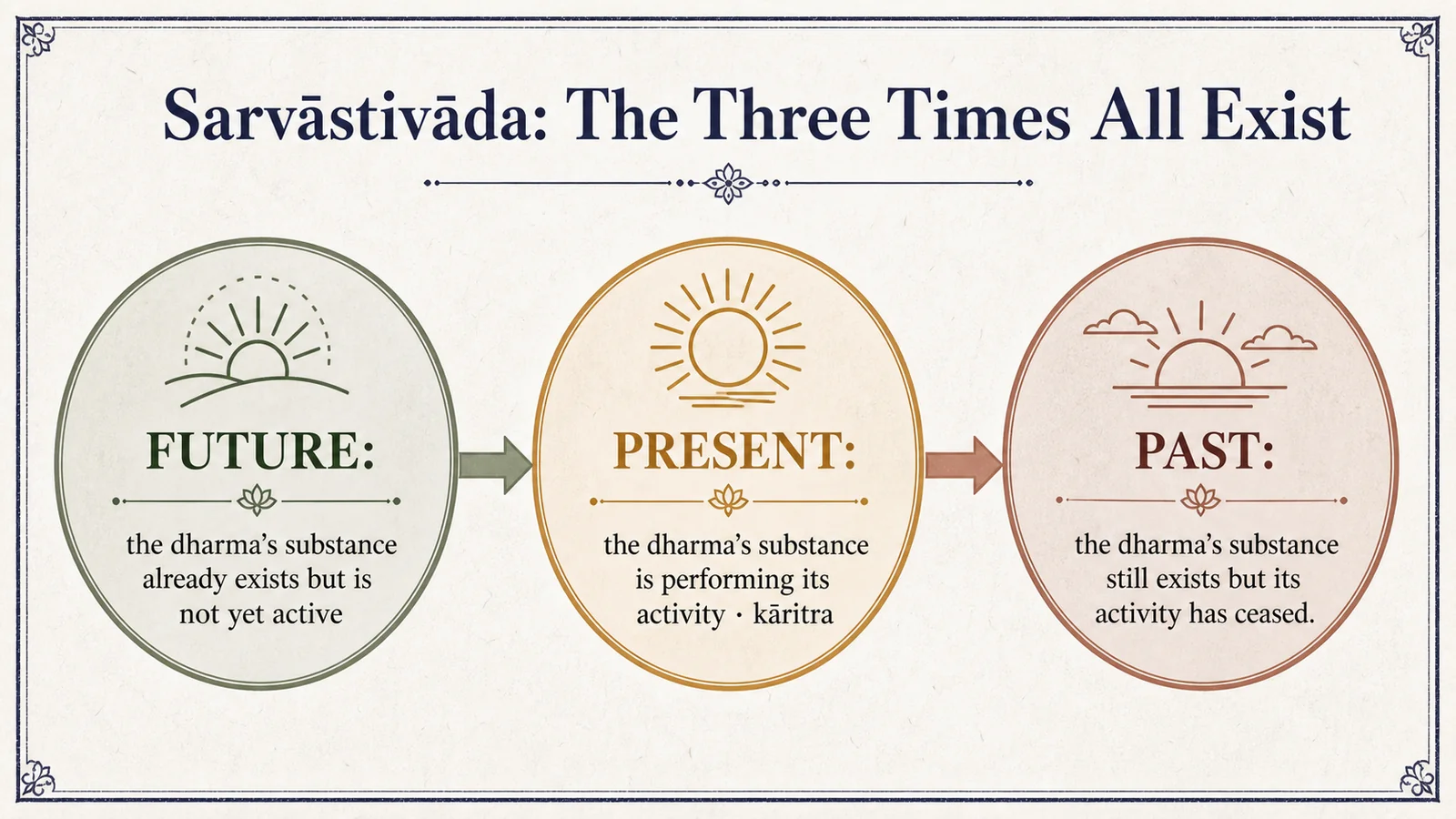
This gives each of the three problems an answer. The intrinsic nature of a past action continues to exist and can therefore condition its later result. Past and future objects continue to exist intrinsically and thus supply real objects for cognition. Dharmas in every stage of the stream retain an intrinsic nature on which continuity can rest. The price is the admission of a permanently existing "intrinsic nature of the dharma." Section 5 will assess that price.
Another tension must be noted. Chapter 1.5 discussed the Kaccānagotta Sutta, in which the Buddha identifies "everything exists" as one extreme to be avoided. The Sarvāstivādins made "everything exists in the three times" the defining thesis of their school; their very name directly conflicts with the wording of that discourse. The Sautrāntikas and Nāgārjuna's Madhyamaka would later make this point central to their criticism (see below and the chapters on Madhyamaka in Part V).
The conflict is not confined to the word "exists." The word "everything" fails to match as well. In Saṃyukta-āgama 319 the brahmin Jāṇussoṇi asks what "everything" is, and the Buddha answers: the twelve sense spheres. A further sentence matters more. If anyone should say that this is not everything and should wish to set up another everything, that would be mere words; questioned about it, he would not know.5 In the discourse, "everything" marks out the range of the knowable and serves at the same time as a sign to stop. The Sarvāstivādins took the word over as a collective name for the dharmas of the three times, and "exists" shifted in their hands from "can be included among the twelve sense spheres" to "possesses an intrinsic nature of its own." One and the same word: the discourse uses it to close an inquiry, the treatises to open a catalogue of existence.
Two supporting mechanisms: acquisition and unmanifest matter
The permanent existence of dharmas in the three times was not enough by itself. The Sarvāstivādins also had to explain how an enduring dharma is connected with a particular person and how the efficacy of a moral act continues after the action has ended. They introduced two supporting mechanisms.
Acquisition (prāpti, "possession" or "affiliation"). In this catalogue the Sarvāstivādins list acquisition as a conditioning force dissociated from mind. It is a special link that affiliates a particular dharma with a given psychophysical continuum.
The school itself once drew the boundaries of that office, and drew them more narrowly than the usual account allows. In the Abhidharmakośabhāṣya Vasubandhu lays out five objections in one breath: if acquisition were the productive cause of the dharmas acquired, the account could not be made to work for the unconditioned, for a dharma once acquired and afterwards relinquished, for insentient things, or for the graded differences among the defilements. The Sarvāstivāda reply was not a defense but a change of wording. It withdrew the claim that acquisition produces anything and reassigned it as the cause that establishes differences.6 The ground offered is that without acquisition, at the moment when an ordinary person and a noble one give rise to one and the same mundane thought, the difference between the two could not be established. At that moment the dharmas actually occurring in the two may be exactly alike, while the standing of the two must not be alike, and nothing but acquisition can carry that unlikeness.
The office of acquisition accordingly falls at the level of statements. It keeps a certain body of assertions about a person standing when there is no occurring dharma for them to rest on. It was posited for the sake of sentences, not for the sake of events. With no self to serve as a bearer, this is the level at which acquisition stands in.4
Unmanifest matter (avijñapti-rūpa, "matter that cannot be indicated"). When a person receives the precepts (making a vow to observe discipline) or performs a powerful wholesome or unwholesome act, the Sarvāstivādins believe that a special kind of matter arises in the psychophysical stream. It cannot be perceived by another person and is therefore "unmanifest," yet it continues to exist as a real dharma. The substantive discipline produced by ordination does not dissolve when an intention fades because this enduring unmanifest matter maintains it. The continuing potential result of an unwholesome action is likewise stored as unmanifest matter.
Both mechanisms address the two halves of one difficulty: without a self, how can the efficacy of karma persist across time, and on what ground is that efficacy reckoned to one person rather than another? The Sarvāstivāda answer is to make real dharmas serve as adhesives, unmanifest matter taking the first half and acquisition the second. They are impersonal and analyzable, so they do not introduce a "self," but they are capable of carrying causal connections across time. The later Sautrāntika criticism is directed precisely here: both concepts are unnecessary postulates, since a single mechanism of "seeds" is enough (3.3).
4. How Do the Three Times Differ? Four Theories
The central difficulty is this: if the intrinsic nature of a dharma remains forever unchanged through the three times, what establishes the difference among past, present, and future? Fascicle seventy-seven of the Mahāvibhāṣā records four explanations offered by four Sarvāstivāda masters, each illustrated by a simile:7
| Teacher | The difference lies in | Simile |
|---|---|---|
| Dharmatrāta | A difference in kind: a dharma changes its "type" in the three times | The same piece of gold fashioned into different vessels |
| Ghoṣaka | A difference in characteristic: a dharma always possesses the characteristics of all three times, but one manifests according to its temporal position | A man may be attached to one woman without being wholly free of desire for others |
| Vasumitra | A difference in position: the temporal position is designated according to the presence or absence of activity; the intrinsic nature does not change | The same counting rod signifies one in the units position and one hundred in the hundreds position |
| Buddhadeva | A difference in relation: the three times are established relative to one another | The same woman is a daughter to her mother and a mother to her daughter |
The Vaibhāṣikas determined that Vasumitra's "difference in position" was the correct interpretation. The intrinsic nature of the dharma does not move; the three times are designated only by whether or not its "activity" has arisen, like a counting rod whose value changes with position while the rod itself remains the same. This theory preserves most cleanly the distinction between "permanent nature" and "changing activity."
One feature of the procedure by which the Vaibhāṣikas reached that verdict deserves notice. The treatise refutes Buddhadeva, Ghoṣaka, and Dharmatrāta one at a time, and in every case the ground of refutation is that the three times so established become confused or offend against sound principle; the three refutations together run to roughly four times the length of the verdict, whose positive ground is a single clause, that conditioned dharmas do have a time at which they exercise activity.7 Vasumitra's theory survives chiefly because the other three were judged wrong, not because it was itself demonstrated. This is an elimination, and an elimination is no more reliable than it is complete; whether a fifth explanation might lie outside the four is a question the treatise never asks.
In the Abhidharmakośa, Vasubandhu scrutinizes all four theories. He judges Vasumitra's comparatively the soundest, yet still not entirely satisfactory, and subsequently turns toward the alternative approach of the Sautrāntikas (see 3.3).8 His strongest single blow against Vasumitra falls on the inactive faculty. To keep a dozing eye from falling out of the present, the Sarvāstivādins had added a patch: a present eye faculty standing in the corresponding-but-inactive state, not at this moment apprehending an object, is nonetheless present, because although it lacks the function of seeing it certainly has the function of grasping a fruit. Vasubandhu picks the patch up and presses it. What function does the inactive eye have? If grasping and giving a fruit are to count as function, then a past homogeneous cause also gives its fruit, and past dharmas would have function as well; some dharmas would then possess only half a function, and the characteristics of the three times would fall into confusion.9 Confusion is exactly the blade on which the treatise eliminated Buddhadeva and Ghoṣaka, and one of the reasons given for choosing Vasumitra was that on this master's account the times are not confused. Vasubandhu sets up no second ruler. He takes the school's own and measures the survivor with it.
5. Gains and Costs
The balance can be summarized as follows.
Through the doctrine that "the three times really exist and the intrinsic nature of dharmas always exists," the Sarvāstivādins gained a stable basis for causality and cognition. With permanent dharma-natures underneath, karmic results across time, cognition of the past and future, and continuity without a self all acquire an anchor. In this book's judgment, it is a remarkably coherent form of realism with substantial explanatory power.
Its cost is an awkward shadow. A "dharma-nature" that remains eternally unchanged throughout the three times closely resembles the permanent intrinsic existence that Buddhism was supposed to deny. Impermanence, the impermanence of all conditioned things, means that everything is in flux, yet here we are presented with a collection of permanent, indestructible dharma-natures. The Sarvāstivāda defense is that the intrinsic nature of a dharma always exists but is not a "self": it is impersonal, lacks autonomy, and can be analyzed. Impermanence applies to the momentary arising and ceasing of "activity" and is therefore preserved. For this defense to hold, intrinsic nature and activity must be separable, so that permanence may be predicated of the one and impermanence of the other; but whether they can be separated is precisely what Vasubandhu presses in the Abhidharmakośa, and the defense thus takes for a premise the very thing it has to prove. Part 15, Chapter 3, of this book's second division has already ruled on the matter: the school's thesis is driven by its own doctrine of position into a place where it cannot state itself clearly, and it is not a case of being misread; it is unfair to say that the Sarvāstivādins hold conditioned dharmas to be permanent, and equally unfair to say that they have settled permanence and impermanence satisfactorily. The fissure is real, and later critics attacked at precisely this point:
- The Sautrāntikas moved to the opposite extreme: only the present really exists, while the past and future are mere designations; they explained karmic continuity with "seeds" (3.3).
- Nāgārjuna's Madhyamaka was more radical, bringing "intrinsic nature" itself under criticism and arguing that the intrinsic nature of any dharma cannot be established (the chapters on Madhyamaka in Part V).
A comparison with modern categories may aid understanding, though it is not intended to imply historical influence. The Sarvāstivāda thesis that "all three times are real" resembles eternalism in contemporary philosophy of time, according to which past and future are as real as the present. The Sautrāntika view that "only the present really exists" resembles presentism. The ancient Indian dispute is substantially comparable with the modern Western one.
One misalignment in the comparison should be stated before the comparison is used. In the classical form of eternalism the three times are wholly equal in ontological standing, and the present is only a position marked out by an indexical, with no special character of its own. The Sarvāstivāda present is privileged: only a present dharma exercises activity, and only a present dharma can be seen by the five sense consciousnesses, can aggregate, and can constitute a wall. What the school wants is a structure in which all three times exist while the present remains distinctive, and such a structure sits badly inside the dichotomy of eternalism and presentism; forcing it in conceals the difficulty that is its own.10 The last row of the table below is therefore no more than a rough bearing.
| Sarvāstivāda | Sautrāntika | |
|---|---|---|
| The three times | All really exist; the intrinsic nature of dharmas always exists | Only the present really exists |
| Past and future | Possess intrinsic existence | Conceptual designations |
| Approximate Western analogue (the correspondence is not exact) | Eternalism | Presentism |
This book concludes with a constructive observation. A tradition founded on impermanence and not-self established, in attempting to solve the problem of continuity, an array of permanently existing, indestructible dharma-natures. This result became the central target of later Mahāyāna Madhyamaka criticism. The next chapter first examines the Sarvāstivāda system itself (that catalogue of five categories, and the Mahāvibhāṣā) before considering how it was criticized.
References
References
-
Neither of the two primary treatises ever states this title. The number seventy-five is not written out once in the thirty fascicles of the Abhidharmakośabhāṣya, and the count in the two hundred fascicles of the Mahāvibhāṣā is likewise zero. The word the Abhidharmakośabhāṣya itself uses for the classification is "five classes"; fascicle four reads, "all dharmas fall in brief into five classes: first matter, second mind, third mental factors, fourth formations dissociated from mind, fifth the unconditioned." The phrase "five positions" occurs in that treatise only once, in fascicle fifteen, where it means the intermediate state and the stages within and outside the womb and has nothing to do with a count of dharmas. The division into five categories and the members of each are indeed in the treatises; adding them into a single total and naming that total is the work of the later commentaries, in the line of Puguang's Jushe lun ji and Fabao's Jushe lun shu. This book keeps the current name and asks the reader to remember that it is a label added afterwards. See Part 15, Chapter 2, of this book's second division. ↩
-
Vasubandhu. Abhidharmakośabhāṣya, ch. 5 (the controversy over the existence of the three times and the four theories). Trans. Louis de La Vallée Poussin, L'Abhidharmakośa de Vasubandhu, 1923–1931; English trans. Leo M. Pruden, Berkeley: Asian Humanities Press, 1988–1990. ↩
-
For the simile of the raft, see the Alagaddūpama Sutta (MN 22): the Dharma is like a raft, made for crossing the river and to be abandoned upon reaching the other shore, not clung to. Trans. in Bhikkhu Ñāṇamoli and Bhikkhu Bodhi, The Middle Length Discourses of the Buddha. Boston: Wisdom, 1995. ↩
-
K. L. Dhammajoti. Sarvāstivāda Abhidharma. 4th ed. Hong Kong: Centre of Buddhist Studies, University of Hong Kong, 2009. ↩↩
-
Saṃyukta-āgama 319 (Taishō vol. 2): the brahmin Jāṇussoṇi asks what is meant by "everything"; the Buddha answers with the twelve sense spheres and adds that if anyone should set up another everything apart from these, "there would be words only; questioned, he would not know, and his perplexity would grow. Why so? Because it is not within his range." The Pāli parallel is the Sabba Sutta, SN 35.23. In the discourse, "everything" gives the range of the knowable and is used as a sign to stop; in the school's slogan that everything exists, "everything" is a collective name for the dharmas of the three times and "exists" means possessing an intrinsic nature of one's own. The conflict between the two is treated in Part 15, Chapter 1, of this book's second division. ↩
-
Abhidharmakośabhāṣya, chapter two, on the faculties, in the section refuting acquisition. Vasubandhu's objections are five, and the passage runs: "If it be said that this acquisition too has a function, namely that it acts as the productive cause of the dharmas acquired, then the unconditioned would have to be without acquisition... If the difference is owing to some other cause, then dharmas should arise from that cause, and what further use has acquisition?" The reply in which the school changes its wording runs: "Who said that this acquisition acts as the productive cause of dharmas? Then what function has acquisition? It is the cause that establishes differences. Why so? Because if there were no acquisition, then when an ordinary person and a noble one give rise to a mundane thought, the difference between the ordinary person and the noble ones could not be established." A sentence-by-sentence treatment of this retreat appears in Part 15, Chapter 4, of this book's second division. ↩
-
The four theories come from fascicle seventy-seven of the Abhidharma Mahāvibhāṣā Śāstra, not from the Abhidharmakośabhāṣya; the second part of the chapter on the latent defilements in the Abhidharmakośabhāṣya restates the four and puts a difficulty to each in turn. The Mahāvibhāṣā reads: "In the Sarvāstivāda there are four great masters, each establishing his own account... Venerable Dharmatrāta says the difference is in kind; Venerable Ghoṣaka says the difference is in characteristic; Venerable Vasumitra says the difference is in position; Venerable Buddhadeva says the difference is in relation." The order of adjudication reverses the order of presentation. Buddhadeva is refuted first: "the times this master establishes are confused... a present dharma occupying a single moment, by standing relative to what follows, to what precedes, and to both at once, would come to have three times; how can this be right?" Ghoṣaka is refuted next: "as for the one who says the characteristic differs, the three times he establishes are also confused, since he admits that every dharma in each time has all three temporal characteristics." Dharmatrāta is refuted last: "as for the one who says the kind differs, apart from the intrinsic nature of the dharma, what is this kind? Hence it is likewise contrary to principle." The verdict is a single clause: "therefore only the third way of establishing the times is sound, since conditioned dharmas do have a time at which they exercise function." The further reason for adopting Vasumitra stands in the same fascicle: "on this master's account the times are not confused, since the difference of the three times is established in terms of function." The three refutations together run to roughly four times the length of the verdict. A passage-by-passage treatment appears in Part 15, Chapter 3, of this book's second division. ↩↩
-
Collett Cox. Disputed Dharmas: Early Buddhist Theories on Existence. Tokyo: International Institute for Buddhist Studies, 1995. ↩
-
The objection from the inactive faculty stands in the second part of the chapter on the latent defilements in the Abhidharmakośabhāṣya (fascicle twenty). The Sarvāstivādins first supply a patch: among present eye and other faculties, the class that stands in the corresponding-but-inactive state and is not apprehending an object at this moment still counts as present, because although it lacks the function of seeing it certainly has the function of grasping a fruit. Vasubandhu takes that up and asks what function the inactive eye has; and if grasping a fruit and giving a fruit are also called function, then a past homogeneous cause and the rest do give their fruits, so past dharmas would have function as well, whereupon some dharmas would possess only half a function and the characteristics of the three times would fall into confusion. The criterion of confusion used here is exactly the one on which fascicle seventy-seven of the Mahāvibhāṣā eliminated the accounts of Buddhadeva and Ghoṣaka. For the text see this site's translation of the Abhidharmakośabhāṣya, fascicle twenty, rendered from the CBETA edition; for the judgment, Part 15, Chapter 3, of this book's second division. ↩
-
The Sarvāstivāda present is privileged: only a present dharma exercises activity, only a present dharma can be seen by the five sense consciousnesses and can accumulate. In the classical form of eternalism the three times are on an equal footing in existence, and the present is only a position marked by an indexical. On this point the two do not line up; see Part II, Part 15, Chapter 3. The distinction has been drawn in the existing literature and is not this book’s own: Kristie Miller places the Sarvāstivāda ontology among eternalist views while noting that it reserves causal efficacy for the present, which gives it the shape of what modern philosophy of time calls the moving spotlight.11 ↩
-
Kristie Miller. "A Taxonomy of Views about Time in Buddhist and Western Philosophy." Philosophy East and West 67, no. 3 (2017): 763–782. Discussed in Part II, Part 15, Chapter 3. ↩