Chapter 4 Theravāda Abhidhamma
The preceding three chapters examined the northern Sthavira line: Sarvāstivāda realism, its vast system, and the Sautrāntika simplification of it. This chapter turns to the southern Sthavira line, the Abhidhamma of the Theravāda tradition. Alongside the Sarvāstivāda corpus, it is the other complete Abhidharma system to survive. Unlike the Sarvāstivāda, which disappeared with Indian Buddhism, Theravāda Abhidhamma remains alive within its tradition. The study of Abhidhamma is accorded great importance in Theravāda countries, especially Myanmar, and it also supplies the theoretical framework for insight meditation (see Part IX).
1. From the Seven Treatises to the Abhidhammattha-saṅgaha: A Layered System
Theravāda Abhidhamma accumulated in layers. At its base stand the seven treatises of the Abhidhamma Piṭaka (see the table in 2.5). In the fifth century, Buddhaghosa composed the Visuddhimagga in Sri Lanka and systematized the commentarial traditions. Around the eleventh or twelfth century, Anuruddha's Abhidhammattha-saṅgaha supplied a concise manual and established the standard framework of "eighty-nine minds, fifty-two mental factors, cognitive processes, and twenty-four conditions."1 2
In keeping with this book's method, the layers must be distinguished. The precise schemas now commonly associated with "Theravāda Abhidhamma," especially the eighty-nine minds and the seventeen-moment cognitive process, are largely products of the commentaries and medieval manuals; they are not all found in the earliest seven treatises. Even a crucial idea such as the life-continuum (bhavaṅga) reached its mature form only in the commentarial period.3 Chapter 2.5 discussed the Southern tradition's legend that the Buddha personally taught Abhidhamma in the Heaven of the Thirty-Three before Śāriputra transmitted it. That story retroactively supplied a source in the Buddha's own words for this later system.
One of the eighty-nine minds reveals the system's connection to an earlier narrative layer with unusual clarity and therefore deserves separate attention: the functional mind that produces an arhat's smile (hasituppāda-citta, "smile-producing consciousness"). Most of the eighty-nine minds are arranged by cognitive function, with separate places for adverting, receiving, determining, producing karma, and other stages. This mind is an exception. It describes no cognitive function but is posited solely to explain a particular act: why an arhat or Buddha smiles. The manual classifies it as a "rootless functional mind" (ahetuka-kiriya). Of the three rootless functional minds, two perform the most basic forms of adverting—five-door and mind-door adverting. The smile-producing mind alone culminates in a smile, arising for a single moment without roots and without wholesome or unwholesome consequence. In a catalogue that seeks to exhaustively classify consciousness by function, it looks conspicuously like a later addition.4
It is conspicuous because it answers a problem posed by narrative rather than analysis. A recurring formula appears in Pāli literature: while walking or collecting alms, the Buddha suddenly smiles and light shines from between his teeth; Ānanda asks why, and the Buddha recounts the karmic course of the beings he has perceived through many lives. The "little sow" (Sukarapotikā) story in the Dhammapada Commentary is one example. The Buddha sees a small sow while on alms round and smiles. In response to Ānanda's question, he describes her long wandering through rebirth. In the age of the Buddha Kakusandha she had been a hen that heard the Dharma; later she became Princess Ubbarī, then a deity in the Brahmā world, and now had fallen into birth as a sow. She would continue to wander before finally attaining arhatship: "through wholesome and unwholesome karma, saṃsāra has no end." Such episodes ("smile and radiance, Ānanda's question, a revelation of former lives") became a recognizable formula in early Buddhist narrative. Beneath them lies a question requiring an answer: why would an awakened person who has abandoned desire and craving still laugh? Does laughter not express emotion and pleasant feeling? The smile-producing mind resolves the problem doctrinally. It classifies the smile as rootless and merely functional, neither wholesome nor unwholesome, thereby preserving the narrative fact of the Buddha's smile without compromising dispassion. It has an evident apologetic purpose: to prove to critics that the awakened person's smile does not relapse into attachment or emotion. For related apologetic narratives surrounding the Buddha, see 1.4.
This exposes a small fissure that contrasts with the origin legend at the beginning of the section. Tradition says that the Buddha delivered Abhidhamma as a complete system all at once in the Heaven of the Thirty-Three. Yet an item such as the smile-producing mind plainly resembles a slot added by the later commentarial layer to accommodate the long-circulating earthly motif of "the Buddha's smile." This book cannot assert that the category "directly originated" in a particular question asked by Ānanda; no traditional source explicitly says so. Only two points can be established. First, narratives in which the Buddha smiles on seeing beings wander through rebirth appear very early. The motif may reflect an actual event, or at least very early oral transmission, rather than a commentarial invention. Second, the category of smile-producing consciousness is a trace of Theravāda Abhidhamma absorbing and systematizing such early narratives and perhaps early apologetic explanations. The fissure can be read in two directions. In one, the community appears to have built a defense in advance around a phenomenon that need never have been a problem (an awakened person can smile), revealing unnecessary anxiety. In the other, Abhidhamma faithfully receives very old traditional material and incorporates even dispersed narratives into its system. Either reading points to the same conclusion: what appears to be pure analysis descending from heaven maintained an unbroken connection with early Buddhist narrative.
Buddhaghosa, around the fifth century, was the most important figure in this cumulative process. Born in India, he entered the Saṅgha and later sailed to Sri Lanka, where he systematically organized the old commentarial tradition at the Mahāvihāra. His Visuddhimagga, structured around the three trainings of virtue, concentration, and wisdom, integrates doctrines and practices scattered across many sources into a single great treatise and became the standard reference for subsequent Theravāda. He also rendered the old Sinhala commentaries into Pāli and produced new Pāli commentaries on the canonical works, tightly joining Sri Lankan local tradition to the Pāli Canon.5 The relatively strong doctrinal unity now associated with "Theravāda" is chiefly Buddhaghosa's achievement. His position in the Southern tradition resembles Xuanzang's in Chinese Buddhism, except that he was a commentator and systematizer rather than a translator of scripture. The comparison is inexact but directionally sound: the shape of a tradition is often determined less by its earliest texts than by a decisive moment of systematization.
The scale of the layers makes their differences obvious. The seven treatises form an enormous collection. The Paṭṭhāna alone occupies more than six thousand pages in the Siamese edition and is the longest work in the entire Pāli Canon; together, the seven are vast. Yet the Abhidhammattha-saṅgaha, now required reading for beginners and almost a synonym for "Abhidhamma," consists of only nine chapters and approximately fifty pages.1
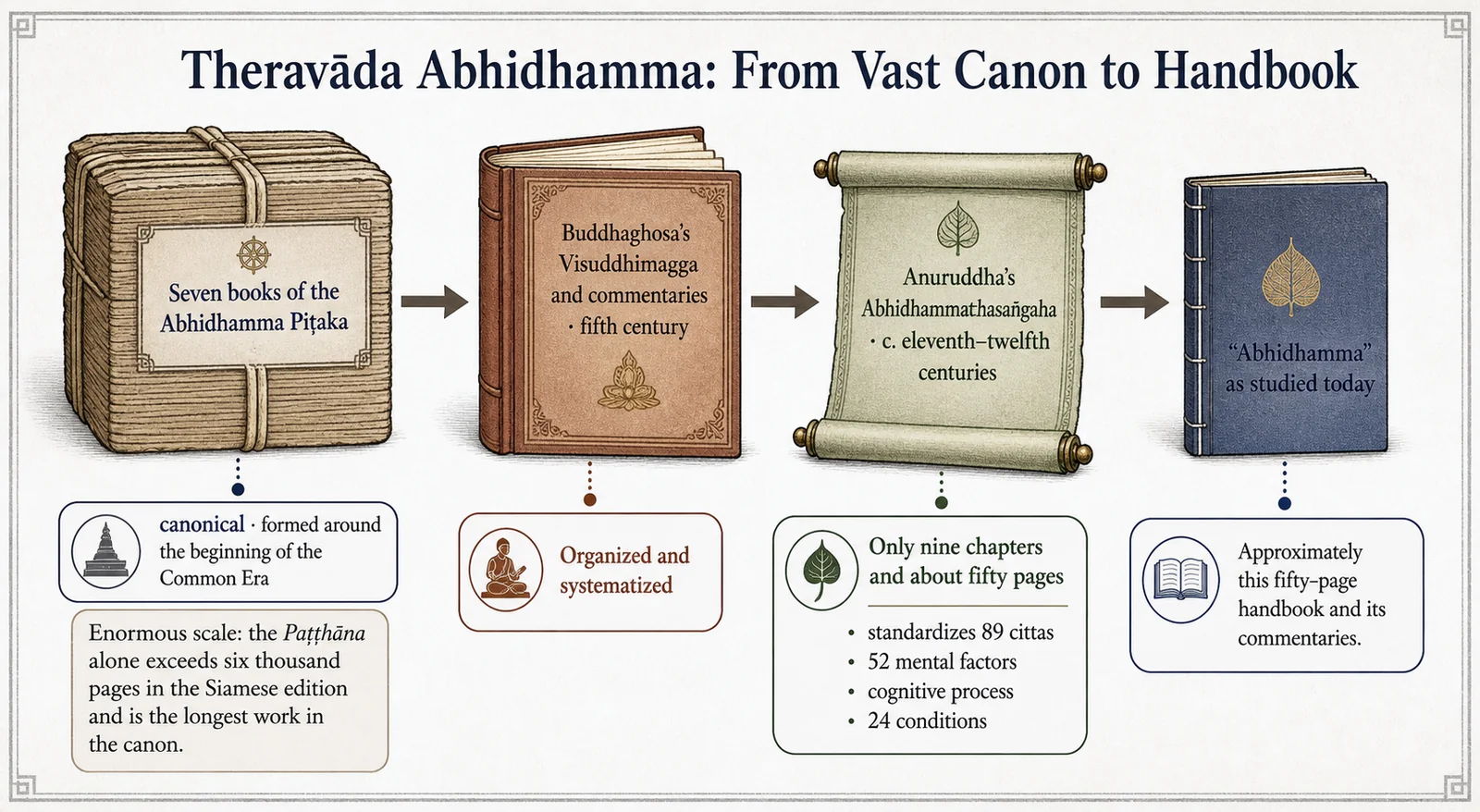
The contrast runs both ways: more than six thousand pages of extensive exposition on one side, a fifty-page distilled manual on the other. The former analyzes layer upon layer; the latter gathers everything into a few orderly lists and schemas. Most people today encounter Theravāda Abhidhamma as a highly condensed medieval product, far removed from its canonical form both in scale and in the degree to which its categories have been neatly fixed. It was precisely this small manual that turned mind, mental factors, and cognitive processes into their most "ultimate" and definitive form, as section 3 will show.
2. Differences from the Northern System: No Existence of the Three Times, the Life-Continuum, and Twenty-Four Conditions
Theravāda Abhidhamma likewise follows the path of analyzing dharmas, but several of its crucial premises differ sharply from those of the northern Sarvāstivāda. Most importantly, Theravāda does not teach that all three times really exist. The Kathāvatthu devotes a section to refuting the thesis that "everything in the three times exists." On the question of time, the Southern tradition recognizes only the present and thus stands closer to the Sautrāntikas than to the Sarvāstivādins.6
The two systems can be compared directly:
| Issue | Southern tradition (Theravāda) | Northern tradition (Sarvāstivāda) |
|---|---|---|
| Time (the three times) | Only the present; the Kathāvatthu refutes "everything exists" | The three times really exist; the intrinsic nature of dharmas always exists |
| Mind | 1 dharma (opened out by object, plane, and associated mental factors into 89 types, subdivided into 121) | 1 dharma (primary mind, manifest through the six consciousnesses) |
| Mental factors | 52 | 46 |
| Conditions | 24 conditions (Paṭṭhāna) | 4 conditions + 6 causes, with 5 results distinguished separately |
| Cognitive sequence | Fixed "cognitive processes": five-door and mind-door, including a seventeen-moment sequence | No equivalent fixed sequence |
| Bearer of continuity and karma | Life-continuum (bhavaṅga) + the mental continuum | Unmanifest matter + acquisition + existence of the three times |
Different numbers of dharmas: eighty-two and seventy-five
The table shows six more mental factors in the Southern system (fifty-two rather than forty-six), but a still larger numerical difference lies behind it. Theravāda counts eighty-two dharmas in all (one mind, fifty-two mental factors, twenty-eight kinds of matter, and one nirvāṇa), while the Sarvāstivāda counts seventy-five. The principal difference appears among material dharmas: the Sarvāstivādins posit eleven, the Theravādins twenty-eight. The Southern system analyzes matter more finely. In addition to the five faculties and five objects, it recognizes numerous kinds of "derived matter" (upādāya-rūpa), secondary forms dependent on the four great elements. These include lightness, malleability, and adaptability of matter; "bodily intimation" and "verbal intimation" associated with physical action and speech; the space element; and the material life faculty that subtly sustains a living body.3 The controversial Sarvāstivāda "unmanifest matter" is not posited in the Southern system at all, and what takes its place does not lie at the level of matter either. The systems also differ in their unconditioned dharmas. The Sarvāstivādins posit three (space, cessation through discernment, and cessation independent of discernment), while the Theravādins recognize only one, nirvāṇa. This numerical economy reflects a different treatment of "the unconditioned" and avoids some of the Sarvāstivāda tendency to assign a distinct intrinsic nature to every unconditioned category. The provenance of the two figures on the Sarvāstivāda side should be noted. Both the forty-six mental factors and the five categories and seventy-five dharmas state the settled position of the Abhidharmakośa. The two hundred fascicles of the Mahāvibhāṣā contain neither the number seventy-five nor any sealed total for the mental factors; the items belonging to the five categories of matter, mind, mental factors, formations dissociated from mind, and the unconditioned lie scattered through the work, and gathering them into a single table was Vasubandhu's doing.7
The Sarvāstivādins posited unmanifest matter in order to answer one question: where does the substance of a precept reside while the person who took it is asleep? Their answer was to establish a dharma, a kind of matter not outwardly manifest, which arises when the precept is taken and continues thereafter until the precept is abandoned or life ends. Theravāda has no entity bearing the substance of a precept. The continuity of the precept is carried by the arising of the abstinence mental factors whenever the relevant occasion occurs and by the conditions those events leave behind, which places it among the mental factors and the twenty-four conditions.8 The kinds of matter by which twenty-eight exceeds eleven are a product of the Southern tradition's finer division of matter and have nothing to do with the work unmanifest matter was doing. The Sarvāstivādins would rather establish an additional entity to bear continuity; the Theravādins would rather have continuity borne by conditions. The choice will be met again below, in the discussion of the twenty-four conditions.
The philosophical orientation of the twenty-four conditions
The difference between the twenty-four conditions and the Sarvāstivāda's four conditions plus six causes reflects more than degrees of classificatory detail. It also reflects different philosophical orientations. The Sarvāstivāda's six causes and four conditions emphasize a typology of causality, principally asking "what kind of cause produces what kind of result?" Causal relations are divided and clearly labeled. The Paṭṭhāna's twenty-four conditions are more like an exhaustive enumeration of "every possible conditional relation between any two dharmas." It asks which forms of conditionality can connect these two dharmas, rather than centering a one-way arrow from cause to result. The twenty-four include categories absent from the Sarvāstivāda list, such as decisive-support condition (upanissaya-paccaya), by which one dharma powerfully promotes another (as habitual meditation supports new meditation), and repetition condition (āsevana-paccaya), by which repeated impulsions strengthen subsequent minds of the same kind.1 The Sarvāstivādins do not distinguish these as separate conditions. Rather than posit special entities such as acquisition and unmanifest matter to carry karma, the Southern tradition makes exceptionally fine distinctions at the level of conditions. This is a characteristic choice: it explains continuity by refining conditional relations instead of multiplying entities.
The final row identifies the Theravāda solution to "continuity without a self," the leading difficulty of 1.5: the life-continuum (bhavaṅga, the "factor of existence"), a subliminal stream of life. When no active cognition occurs, as in deep sleep or between cognitive processes, consciousness does not cease but continues in the form of the life-continuum. It receives the ripened result of karma from the previous life, sustains the continuity of a lifetime, and supplies the background from which each cognitive process arises and into which it subsides.9 Functionally, the life-continuum belongs to the same class of solutions as Sautrāntika "seeds" and Yogācāra "storehouse consciousness": each installs a subliminal carrier in response to the same problem. Theravāda, however, locates it within the mental continuum itself rather than establishing a separate storehouse.
A distinction must be added to avoid going too far. Some scholars directly equate the life-continuum with Yogācāra storehouse consciousness. Their functions and causes do resemble one another. Both are subliminal forms of mind produced by the problem of continuity without a self and carry continuity and karmic results. But this book draws a boundary. The life-continuum remains a phenomenological treatment of continuity, a baseline consciousness that flows; it is not ontologized as an independent warehouse-like entity that stores seeds. In degree of ontologization, it does not stand on the same level as the person or storehouse consciousness and should not be doctrinally equated with them. This distinction agrees with the argument below that the Southern system remains tied to practical cultivation and is less heavily ontologized.
The boundary can be drawn more finely, and Part 14, Chapter 6, of this book's second division sets out three parts to it. First, the life-continuum adds no item to the inventory. Storehouse consciousness is the eighth consciousness, and to posit it is to add a layer beyond the original six; the life-continuum adds no dharma whatever. It is one of the nineteen resultant minds already standing in the table of eighty-nine, and "life-continuum" is only the name of one function that mind performs. Second, the life-continuum does not receive. Storehouse consciousness receives the impressions of every active consciousness and holds the seeds within itself; the object of the life-continuum is fixed at the moment of rebirth-linking, taken from the kamma, the sign of kamma, or the sign of destiny that appeared in the final cognitive process of the preceding life, and it does not change for the remainder of that life. Nothing occurring during the present life is recorded in it, and there is nowhere in it for such a record to go. Third, the life-continuum is not required to explain karmic result. Storehouse consciousness holds two offices at once, bearing continuity and storing karmic force; the life-continuum performs only the first and hands the second to the asynchronous kamma condition.10
3. Cognitive Processes: Fixing Cognition into Seventeen Moments
The most distinctive feature of Theravāda Abhidhamma, and the one most deserving of critical attention, is the "cognitive process" (citta-vīthi). It divides each complete act of cognition into a sequence of mind-moments in a fixed order. For cognition of a vivid object through one of the five sense doors, the standard schema contains seventeen moments:
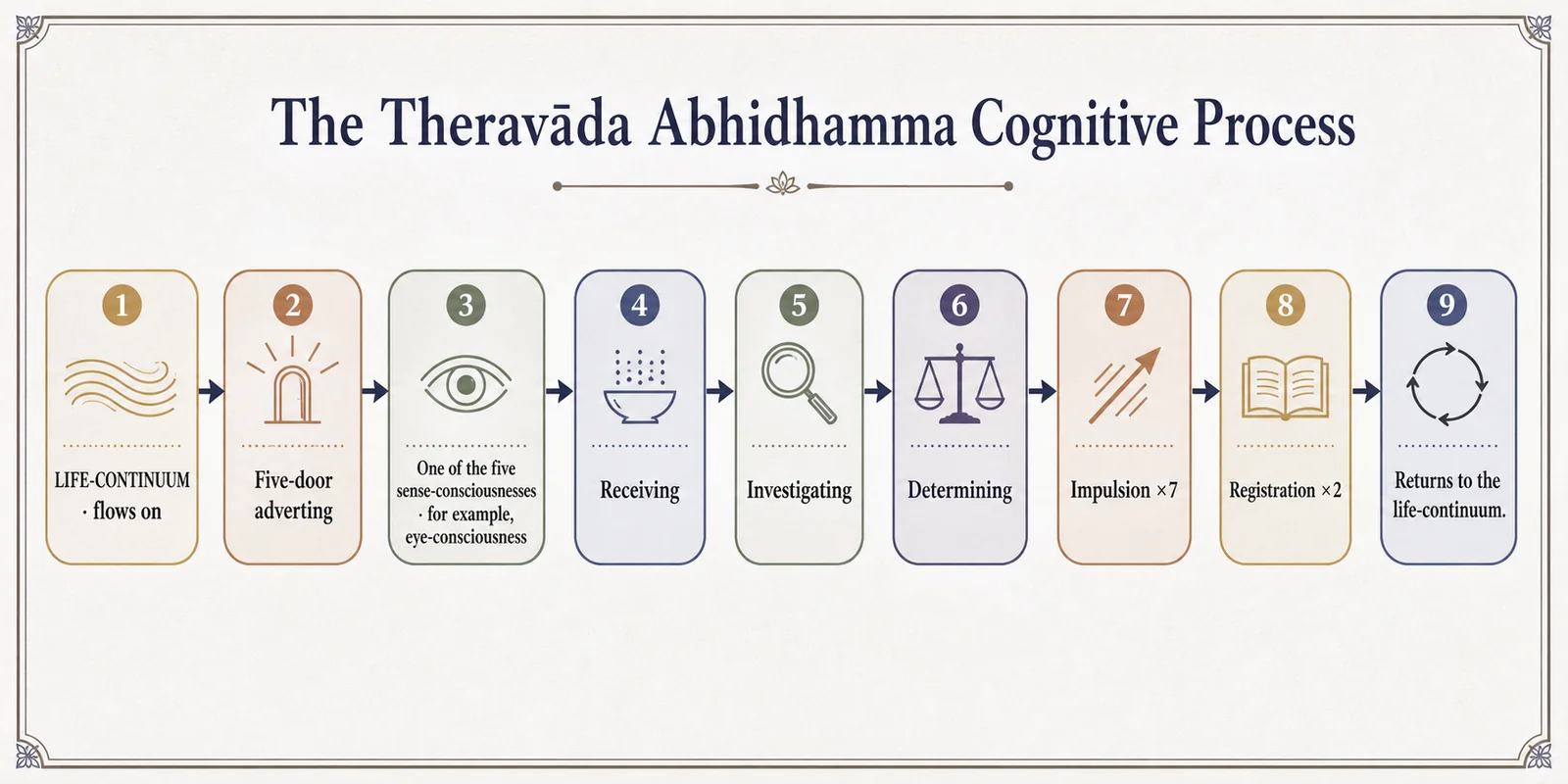
Purely mental cognition through the mind door has its own shorter sequence. The analysis is astonishingly detailed. Within a single instant of "seeing," it identifies the exact stages occupied by attention, reception, determination, karmic activity (the impulsion stage is where wholesome and unwholesome karma occur), and residual registration.
One simplification must first be corrected. To say that a cognitive process contains "exactly seventeen moments" understates the system's complexity. The discipline is much more precise than a single number suggests. A process varies in length and composition according to whether its object is desirable or undesirable, vivid ("great") or weak ("small" or even "very small"). An extremely weak object may fail to arouse impulsion at all and merely cause the life-continuum to vibrate several times before passing. Five-door and mind-door cognition have different sequences. Meditative absorption has an absorption process; noble beings' realization of the path and fruition has separate path and fruition processes. The result is a complete set of intricately classified diagrams responsive to different circumstances, not a rigid grid of seventeen identical boxes.
This refinement makes the underlying problem deeper. In this book's view, close, phenomenological examination of mental processes legitimately extends the early teaching of a "stream of phenomena" and poses no problem by itself. The problem is fixing the process: turning fluid, conditionally variable cognition into an exhaustive engineering diagram with invariant places, as though consciousness literally operated box by box according to it. The more finely the description is divided and the more complete the list becomes, the easier it is to mistake living flow for a fixed structure. This is the danger of becoming "too ultimate" identified in 2.5. It resembles the criticism in 3.2 that the Sarvāstivādins "reified every function," except that the Sarvāstivādins fixed "dharmas" while the Southern tradition fixed "processes."
A piece of corroboration shows that these diagrams contain traces of human construction rather than simply copying reality. Return to the comparison in the preceding section. The northern and southern traditions differ dramatically even when counting the same mental factors and the same conditions. Should there be forty-six or fifty-two mental factors? Should conditions number four plus six, or twenty-four? If the two systems were literally inventorying "ultimate reality as it is," their counts should not diverge so widely. The disagreement itself reveals that each is a system of selections and conventions.
One item must be subtracted from that discrepancy. The cell for mind does not enter it. Theravāda mind is a single ultimate dharma, and the eighty-nine are specifications produced by crossing one and the same dharma through the axes of object, plane, and associated mental factors; in this cell both traditions in fact posit one dharma.11 The eighty-two dharmas declared in the preceding section supply their own check: one mind, fifty-two mental factors, twenty-eight kinds of matter, one nirvāṇa. Were mind really eighty-nine, that total could not be reached. The force of the corroboration has to be recomputed on the two items that remain, mental factors and conditions.
4. Its Practical Foundation—and the Same Concern
In fairness to Theravāda Abhidhamma, it differs importantly from a purely scholastic system: it has always remained connected with meditation. Its analysis of mind, mental factors, and cognitive processes is not merely a catalogue. It supplies a working map for insight (vipassanā). Practitioners are to observe directly within present experience how dharmas arise and cease moment by moment, impermanent and not-self, reducing "I am seeing" and "I am thinking" to a sequence of momentary mental dharmas without an owner. In this book's view, because the Southern tradition kept Abhidhamma firmly tied to cultivation, it significantly limited the slide feared in 2.5, in which the means of analysis eclipses the end of liberation. Analysis exists to support seeing, not to inventory the world. The system remains connected to the practical and phenomenological core of the early teachings.
The concern, however, resembles that raised by the northern system. Theravāda dharmas do not permanently exist throughout the three times, yet each is still assigned its own "individual essence" (sabhāva) as a defining characteristic. The term is first used as a defining word for phenomena in the canonical Paṭisambhidāmagga; Buddhaghosa's commentaries made it the general practice; and in the hands of the sixth-century commentator Mahānāma it was parsed as sat-bhāva, existence, at which point the term acquired a reading concerning a mode of being. That step falls roughly a century after Buddhaghosa.12 13 Combined with the fixation of cognitive processes and the conflicting northern and southern enumerations, this makes it dangerous to treat the catalogue as reality's final hand. This book's overall judgment agrees with 2.5. Theravāda Abhidhamma is highly accomplished as a "phenomenology describing mind" and, through its connection with practice, avoids some of the worst turns. As to where the concern lands, Part 14, Chapter 7, of this book's second division revised its finding after re-examining the question, and the revision is adopted here. Ontologization does occur, but it occurs in none of the declared doctrines; it occurs in the procedures of cataloguing and under the pressure of format. The fixing of process, for its part, is a limit belonging to the analytic route itself, borne by every school alike and peculiar to none. The first half of the earlier judgment stands; the second half has been changed.
Theravāda Abhidhamma remains a living tradition and will appear again in Part IX's account of Southern Buddhism. The next chapter first concludes the survey of the schools with the most unusual branch, the Vātsīputrīyas. While other schools established alternative carriers under the doctrine of not-self, the Vātsīputrīyas approached the boundary of an eternal self and posited a "person."
References
References
-
Bhikkhu Bodhi (ed.). A Comprehensive Manual of Abhidhamma: The Abhidhammattha Saṅgaha of Ācariya Anuruddha. Kandy: Buddhist Publication Society, 1993. (For the twenty-four conditions, see chapter 8.) ↩↩↩
-
Anuruddha's exact dates and place of activity are undetermined. In his introduction to A Comprehensive Manual of Abhidhamma, Bhikkhu Bodhi lists both the century and the country of origin as open questions, and then presents the common Burmese twelfth-century view alongside the earlier Sinhalese one. This book accordingly offers only the broad placing "around the eleventh or twelfth century" and infers no year of birth from it; the chronological table in Part 14, Chapter 1, of this book's second division adopts the same range. ↩
-
Y. Karunadasa. The Theravāda Abhidhamma: Its Inquiry into the Nature of Conditioned Reality. Hong Kong: Centre of Buddhist Studies, University of Hong Kong, 2010. ↩↩
-
Smile-producing consciousness (hasituppāda-citta) is one of the three "rootless functional minds" among the eighteen rootless minds (the other two are five-door and mind-door adverting). It is the rootless mind of smiling, peculiar to arhats and Buddhas and neither wholesome nor unwholesome. See chapter 1 of the Abhidhammattha-saṅgaha and the relevant notes in chapter 1 of Bhikkhu Bodhi, A Comprehensive Manual of Abhidhamma. The category's specialized definition belongs to the commentarial and manual layers and is not prominent in the earliest seven treatises. For the "little sow" story, see the Dhammapada-aṭṭhakathā on verses 338–343 (Sukarapotikā-vatthu). The Buddha's smile and radiance, a disciple's question, and the consequent revelation of past-life causality form a conventionalized "smile" motif in Pāli narrative literature. ↩
-
Bhikkhu Ñāṇamoli (trans.). The Path of Purification (Visuddhimagga) by Bhadantācariya Buddhaghosa. Kandy: Buddhist Publication Society, 1991; for Buddhaghosa's life, see Bhikkhu Bodhi, "Introduction," pp. xix–xxxi. ↩
-
Shwe Zan Aung and C. A. F. Rhys Davids (trans.). Points of Controversy (Kathāvatthu). London: Pali Text Society, 1915. (For the dispute over "everything exists," see Sabbam-atthi-kathā.) ↩
-
The Sarvāstivāda figures of forty-six mental factors and of five categories and seventy-five dharmas (eleven kinds of matter, one mind, forty-six mental factors, fourteen formations dissociated from mind, three unconditioned dharmas) follow the account of the five classes in chapter one, on the elements, and chapter two, on the faculties, of the Abhidharmakośabhāṣya (T1558). A search of the two hundred fascicles of the Abhidharma Mahāvibhāṣā Śāstra (T1545) returns no occurrence of "seventy-five dharmas," and "five positions" does not appear there as the name of a classification either; the Mahāvibhāṣā still expounds by the older framework of aggregates, sense spheres, and elements, with the items of the five categories scattered through the work and no total sealed. Both points are treated in Part 15, Chapter 2, and Part 16, Chapter 6, of this book's second division. ↩
-
On the Theravāda handling of unmanifest matter, see Part 14, Chapters 3 and 7, of this book's second division. The Sarvāstivādins posit unmanifest matter to bear the substance of a precept; Theravāda posits no such dharma, the continuity of a precept being carried by the arising of the abstinence mental factors whenever the relevant occasion occurs and by the conditions those events leave behind, which is to say by mental factors and conditions rather than by matter. For the twenty-four conditions see Chapter 8 of the Abhidhammattha-saṅgaha, the Compendium of Conditionality (Paccayasaṅgahavibhāga). The Sarvāstivāda eleven kinds of matter (five faculties, five objects, and unmanifest matter) follow chapter one of the Abhidharmakośabhāṣya, on the elements. The finer divisions among the Theravāda twenty-eight kinds of matter have nothing to do with the work unmanifest matter was doing, and the two discrepancies cannot be set off against each other. ↩
-
Rupert Gethin. "Bhavaṅga and Rebirth According to the Abhidhamma." In The Buddhist Forum III, ed. T. Skorupski and U. Pagel. London: SOAS, 1994. ↩
-
For the three parts of the boundary between the life-continuum and storehouse consciousness, see Part 14, Chapter 6, of this book's second division. First, no item is added to the inventory: "life-continuum" is the name borne by one of the nineteen resultant minds while it performs a particular function, and a function is a position, not a new existent. Second, nothing is received: the object is taken at the moment of rebirth-linking from the kamma, the sign of kamma, or the sign of destiny that appeared in the final cognitive process of the preceding life, and it does not change for the remainder of that life, so that no impression is received. Third, karmic result is not its business: result is explained by the asynchronous kamma condition (nānākkhaṇika-kamma-paccaya), for which see Chapter 8 of the Abhidhammattha-saṅgaha, the Compendium of Conditionality. Taken together, the three show that the life-continuum has not been made into a storehouse. It is a series of minds of the same kind arising and ceasing one after another while taking the same object, not one enduring thing. ↩
-
That mind is a single ultimate dharma, and that eighty-nine and 121 are specifications obtained by crossing that one dharma through the axes of object, plane, and associated mental factors, follows Chapter 1 of the Abhidhammattha-saṅgaha; the figure of eighty-two dharmas is the sum of one mind, fifty-two mental factors, twenty-eight kinds of matter, and one nirvāṇa. See Bhikkhu Bodhi (ed.), A Comprehensive Manual of Abhidhamma, ch. 1; and Part 14, Chapter 1, together with Part 15, Chapter 2, of this book's second division. ↩
-
Noa Ronkin. Early Buddhist Metaphysics: The Making of a Philosophical Tradition. London: RoutledgeCurzon, 2005. ↩
-
Noa Ronkin. "The Rise of the Concept of Own-Nature (Sabhāva) in the Paṭisambhidāmagga." Oxford Centre for Buddhist Studies, 2003. Sabhāva is first used as a defining term for phenomena in the canonical Paṭisambhidāmagga; the ontological reading is fixed in the Saddhammappakāsinī, Mahānāma's approximately sixth-century commentary on that work, which the article cites explicitly for its parsing of sabhāva as sat-bhāva. The dating, the authorship, and the commentarial attribution all follow that article; the full citation is given in Part 14, Chapter 1, of this book's second division. ↩