Chapter 3 Sautrāntika: Seeds, Momentary Cessation, and Continuity
The preceding chapter concluded that the Sarvāstivāda system, constructed by positing additional real dharmas, needed to be simplified. The Sautrāntikas offered a more economical account. Developing from within the Sarvāstivāda, they eliminated one after another of the school's most important mechanisms and used "seeds" to explain karma and continuity. This chapter examines how they simplified the Sarvāstivāda system and where that simplification ultimately led.
1. Relying on the Sūtras Rather than the Treatises: The Origins of the Sautrāntikas
The name "Sautrāntika" means "those who take the sūtras as authoritative." They accepted the authority of the Buddha's discourses but not the determinations of treatises such as the Mahāvibhāṣā: they "relied on the sūtras, not the treatises." Standing next to them are the Dārṣṭāntikas, a current within the Sarvāstivāda known for teaching through similes. The standing opponent in the Mahāvibhāṣā is precisely the Dārṣṭāntikas, who appear there ninety times; by the Abhidharmakośa the Dārṣṭāntikas are down to two occurrences, their place taken by "the Sautrāntikas" at twenty and "the Sautrāntika masters" at eleven, the name having changed between the two books.1 Whether the two are the earlier and later stretches of a single line, or two parties read together by later hands, remains unsettled among scholars; it is entered here as a scholarly case, and this book builds no argument upon it. What can be established is only that the positions Vasubandhu takes at the decisive points run in the same direction as those the Mahāvibhāṣā records for the Dārṣṭāntikas.2
The difficulty of the evidence must be stated first. The Sautrāntikas left behind no canon of their own. Our knowledge of them comes chiefly from two sources: Vasubandhu's Abhidharmakośa, which ostensibly presents Sarvāstivāda orthodoxy but repeatedly criticizes it from a Sautrāntika standpoint in its commentary,3 and Saṅghabhadra's point-by-point attacks on the Sautrāntikas in the Nyāyānusāra. The school is therefore a figure reconstructed through criticism and secondhand reports. Modern scholarship even questions whether "Sautrāntika" named a sharply bounded school or was a label under which later classifications grouped several tendencies. The claims below should accordingly be understood as features of an intellectual tendency, not the creed of a monolithic religious institution.4
2. Three Simplifications: Rejecting the Existence of the Three Times and Eliminating Unmanifest Matter and Acquisition
The Sautrāntikas made three principal simplifications to the Sarvāstivāda system.
First, they rejected the existence of the three times. The Sarvāstivādins held that the intrinsic nature of dharmas exists permanently in past, present, and future. The Sautrāntikas denied it. Only the present moment really exists; the past has ceased and the future has not arisen. Both are mere designations without real entities—the "presentism" described in the preceding chapter. The general premise that the intrinsic nature of dharmas always exists was removed.
The Sautrāntika argument against the existence of the three times uses a "functional razor." The Sarvāstivādins distinguish intrinsic nature (svabhāva) from activity (kāritra), holding that the former exists permanently in the three times while the latter occurs only in the present. The Sautrāntikas ask: what is this intrinsically existing dharma in the past or future actually doing? If it performs no function, "existence" becomes an empty, unverifiable label. Only what exercises a function can truly be called existent; when its function ends, nothing remains. This alone accords fully with momentary cessation. "Past" and "future" merely label a dharma as having functioned or as going to function; they do not constitute independent domains of existence.2 The same functional criterion underlies the Sautrāntika rejection of unmanifest matter and acquisition: any entity that cannot be defined by "doing some identifiable thing now" is eliminated.
Second, they eliminated unmanifest matter and acquisition. The Sarvāstivādins used unmanifest matter to preserve karma and acquisition to attach a dharma to a given person. The Sautrāntikas regarded both as superfluous entities. The continuum itself sufficiently explains how karma remains and to whom a dharma "belongs"; no additional thing need be posited. They likewise classified most Sarvāstivāda "conditioning forces dissociated from mind," such as the life faculty and the four characteristics, as conceptual designations rather than real dharmas.
Third, they carried momentary cessation through to its conclusion. Without permanently existing dharma-natures beneath them, dharmas became things that genuinely disappear in a flash: each arises and perishes in the same moment, with no enduring "nature" behind it.
These three eliminations immediately create a problem. If dharma-natures no longer persist, and if unmanifest matter and acquisition have also disappeared, how can an action performed today produce a result many years later? If the preceding thought has completely ceased, how can the next one continue it? The theory of seeds in section 3 addresses the gap left by these removals.
| Issue | Sarvāstivāda | Sautrāntika |
|---|---|---|
| The three times | All three really exist; the intrinsic nature of dharmas always exists | Only the present really exists; past and future are designations |
| Continuity of karma | Unmanifest matter (the substance of karma) + acquisition | Perfuming the mental continuum plants a "seed" |
| Conditioning forces dissociated from mind | Many are real dharmas: acquisition, the four characteristics, and so forth | Most are conceptual designations and are eliminated |
| Object of cognition | Consciousness apprehends a real object, including past and future objects | Consciousness directly apprehends only the "aspect" arising within it; the external object is inferred |
3. Seeds: One Mechanism for Karma and Continuity
The Sautrāntikas filled the explanatory gap by introducing "seeds" (bīja). When a karmic act (a wholesome or unwholesome action of body, speech, or mind) is performed, the present thought ceases immediately but "perfumes" (vāsanā) the continuous stream of mind with a potential, as though planting a seed. The seed is reproduced from moment to moment in the continuum without being lost; when the appropriate conditions occur, it "ripens" and generates the corresponding result (vipāka).
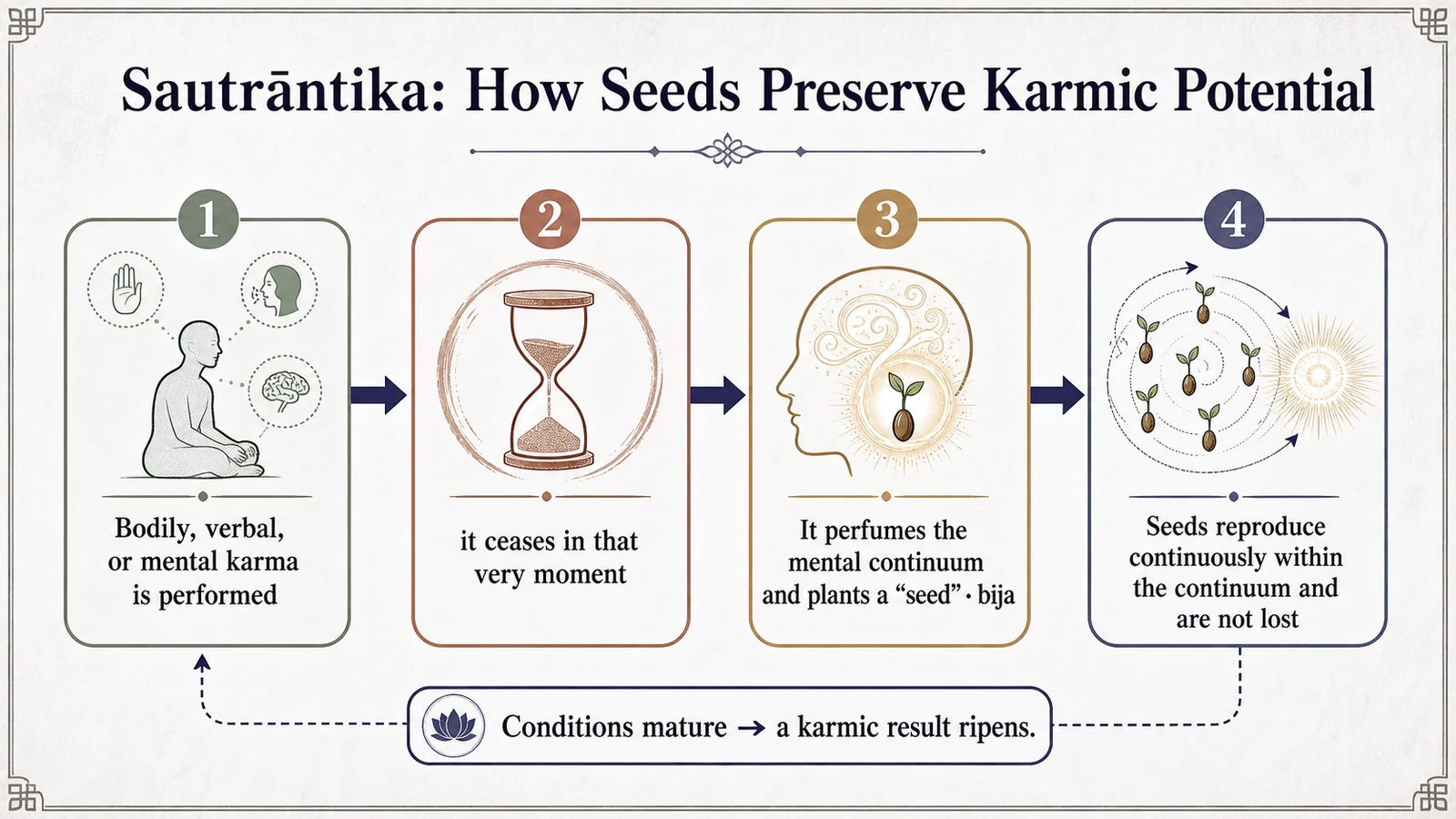
The crucial feature of the theory is that one mechanism replaces many. The Sarvāstivādins require three real mechanisms (unmanifest matter, acquisition, and the existence of the three times) to preserve karma, establish ownership, and secure continuity across time. A seed performs all three functions, and it is not a separate entity outside mind but a functional state of the mental continuum itself. In this book's view, the theory simplifies the Sarvāstivāda practice of assigning a real dharma to every function, approaching an application of Ockham's razor.
Yet the theory leaves a question unanswered: where exactly does a seed reside, and what carries it? The Sautrāntika answer is the "continuum of mind" (santāna). But this continuum is itself a sequence of momentarily arising and ceasing minds. Each moment ceases completely before the next arises. What mechanism transfers the seed from one moment to the next? The Sarvāstivādins used acquisition to attach dharmas to a person. The Sautrāntikas eliminated acquisition but did not explain "whose continuum this is." The continuum exists, but on what basis is its unity established?
More precisely, three limiting cases expose the gap in the account: the attainment without perception (asaṃjñi-samāpatti), an unconscious meditative attainment said to endure for several eons; the attainment of cessation (nirodha-samāpatti), a profound attainment in which feeling and perception cease completely; and the interval between death and rebirth. In all three states the ordinary stream of consciousness is interrupted. The preceding moment of mind has ceased and the subsequent moment has not yet arisen; a long span of time may lie between them. What carries the seed through this "gap in consciousness"? If the mental continuum itself has been interrupted, the statement that "the seed remains in the continuum" has nothing to which it can attach. The Sautrāntikas did not fully resolve these cases.
The Yogācāra answer fills precisely these three gaps. Storehouse consciousness is posited as a subliminal form of consciousness that continues even when ordinary consciousness is interrupted. It carries the seeds and does not cease at the deepest level of meditative absorption or at death. This is not a gentle extension of the Sautrāntika view. On the contrary, it places a new entity with a specialized function back into the very position from which the Sautrāntikas had just removed "superfluous entities." The Sautrāntikas said that the mental continuum itself was sufficient; Yogācāra said it was not and therefore had to posit something more stable than "continuity." The move from seeds to storehouse consciousness explicitly fills a gap left by the Sautrāntikas; it does not merely clarify an existing answer.5
4. Perceiving Only Representations: An Epistemological Turn
Rejecting the existence of the three times creates an epistemological problem as well. One Sarvāstivāda reason for maintaining that all three times exist was that "consciousness must have a real object," while people cognize past and future objects (the preceding chapter). The Sautrāntikas claim that past and future are not real and that every thing disappears in an instant. The difficulty is plain: by the time a consciousness arises to cognize an object, the object has already ceased. How can it be cognized?
The Sautrāntika answer marks an important shift. We do not directly apprehend the external object itself. We apprehend the "aspect" (ākāra) that the object leaves in consciousness—a representation. The external object itself can only be inferred from that aspect as something that "was there." Cognition becomes cognition of an aspect, while the external object withdraws behind a veil.
What is an aspect? It is not an independent additional mental factor. When cognition occurs, consciousness itself appears in a particular "form." When consciousness cognizes red, it itself presents the aspect of red. The aspect resembles the external object without being identical to it; it is the object's "imprint" within consciousness. The mainstream Sautrāntika position is that "consciousness possesses an aspect": in the act of cognition, consciousness already has the form of its object and need not additionally touch the external object itself. This position is a precursor of the representational form of Yogācāra consciousness-only. Later Yogācāra thinkers would continue to debate whether an aspect is part of consciousness; that thread is reserved for Part VI.
The Sautrāntika position must be stated accurately. Its representationalism affirms the existence of an external world but maintains that we cannot perceive it directly. The existence of external objects is established through inference (anumāna), not through direct perception (pratyakṣa). The inference rests on the fact that our representations possess determinate structure and order rather than occurring arbitrarily: the visual presentation of a red apple agrees with the felt weight of a round object. This order must have an external cause, and "an external object produced these representations" is the most reasonable explanation of their organization.4 The position is a realism tending toward representational consciousness-only: it acknowledges that an aspect is the immediate object of cognition while preserving the external world through inference.
The view has both internal stability and internal fragility. It is stable because it recognizes an external world, unlike the denial later associated with consciousness-only, while also recognizing the mediating role of representations, unlike Sarvāstivāda direct realism. It forms a compromise. It is fragile because once the external world can be known only through inference, it is difficult to prevent the next step. If representations themselves explain every cognitive phenomenon, why is an inferred external object needed? Eliminate it, and the result is Yogācāra. The Sautrāntikas originally applied this Ockham-style razor to the Sarvāstivādins; the Yogācārins would apply it to them.
A comparison with Western philosophy may help, without implying historical influence. The Sautrāntika position resembles Locke's representative realism: what we know directly consists only of ideas, while external things stand behind a veil of perception. The move from that position to Berkeley's idealism, which denies external material things, corresponds to the further step taken by Yogācāra. In this book's view, Sautrāntika representationalism is the junction at which Sarvāstivāda realism turns toward Yogācāra consciousness-only (discussed in detail in Part VI).
5. After Simplification: Still within Dharma Realism
The overall assessment is as follows. The Sautrāntika contribution was a drastic reduction in posited entities. They removed the dharma-natures that always exist throughout the three times, eliminated unmanifest matter, acquisition, and many conditioning forces dissociated from mind, and explained continuity with "seeds." They explained the same phenomena with far fewer entities. As a simplification of a realist system, the project was remarkably thorough.
But one point must be added in continuation of 2.5: simplification is not departure from dharma realism. The Sautrāntikas reduced the number of entities without leaving the underlying problem of "ontologization." They continued to treat momentary dharmas possessing intrinsic natures as real, merely changing permanent existence into existence for a flash. They also introduced "seeds," "continuity," and "aspects" to replace the discarded mechanisms. The impulse described in 1.5 (the recurring need to find a bearer of continuity) did not disappear. It replaced many real dharmas with finer explanatory mechanisms such as seeds and the mental continuum. The seed theory would subsequently develop into the Yogācāra theory of storehouse consciousness.
One distinction must be recorded exactly here, or the simplification will be read as a mere change of names. Acquisition is a real dharma for the Sarvāstivādins, while a seed is a conceptual designation for the Sautrāntikas, and what the two leave behind is not of the same kind. A real dharma leaves a new entity, and an entity breeds problems of its own; the "acquisition of acquisition" is the ready evidence (3.2). A conceptual designation leaves a description that has not yet been completed, and a description can go on being given without anything further having to be made. Both leave something unfinished, but on the one side the unfinished items accumulate, and on the other they stop increasing. Part 17, Chapter 3, of this book's second division rules on that basis: the simplification is a genuine simplification; what was unfinished remains unfinished, but it no longer breeds new unfinished business of its own.6
The Sautrāntikas therefore stand at a junction. Looking backward, they offer an internal correction of Sarvāstivāda realism. Looking forward, their representationalism points toward Yogācāra idealism. A genuinely different route (one that abandons the entire game in which "dharmas possess intrinsic nature" and rejects even momentary real existence) appears in Nāgārjuna's Madhyamaka teaching of "emptiness." The Sautrāntika position at this junction can be summarized in a diagram:
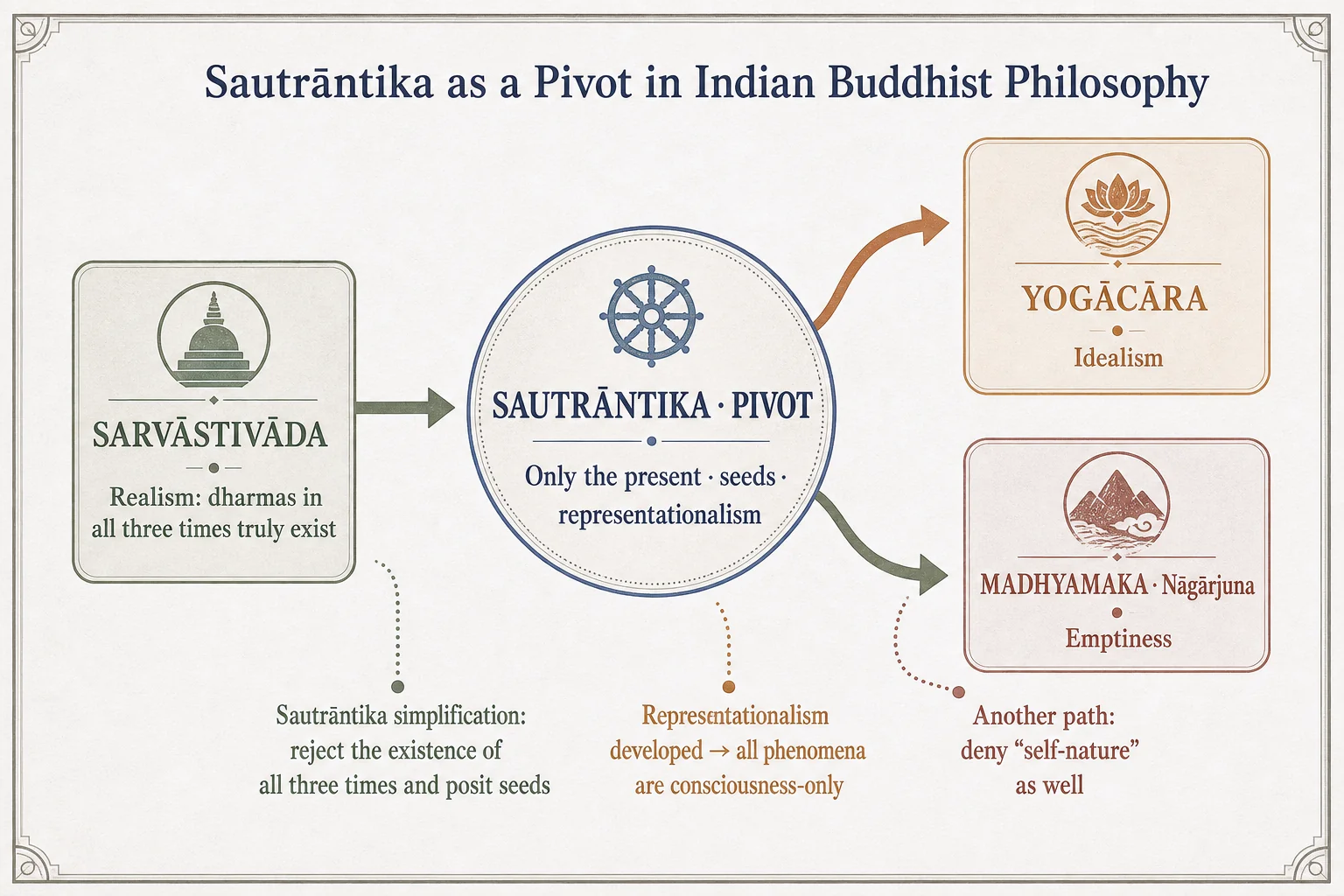
The next chapter concludes the survey of Abhidharma schools by examining how the Southern Theravāda tradition developed an Abhidhamma system of its own. Madhyamaka and Yogācāra are reserved for the later parts on Mahāyāna.
References
References
-
The two sets of figures, one for the name and one for the identity, were obtained by searching the classical text of the CBETA edition: in the two hundred fascicles of the Abhidharma Mahāvibhāṣā Śāstra, "the Dārṣṭāntikas" ninety times; in the thirty fascicles of the Abhidharmakośabhāṣya, "the Dārṣṭāntikas" twice, "the Sautrāntikas" twenty times, and "the Sautrāntika masters" eleven times. Whether the Dārṣṭāntikas and the Sautrāntikas are the earlier and later stretches of one line, or two parties read together by later hands, is unsettled among scholars; it is entered here as a scholarly case. This book uses only what can be established: the positions Vasubandhu adopts at the decisive points run in the same direction as those the Mahāvibhāṣā records for the Dārṣṭāntikas, and the question of lineage does not affect the standing of the doctrinal list. See Part 17, Chapter 2, of this book's second division. ↩
-
K. L. Dhammajoti. Sarvāstivāda Abhidharma. 4th ed. Hong Kong: Centre of Buddhist Studies, University of Hong Kong, 2009. (Includes the Dārṣṭāntikas and Sautrāntikas.) ↩↩
-
Vasubandhu. Abhidharmakośabhāṣya. Trans. Louis de La Vallée Poussin, L'Abhidharmakośa de Vasubandhu, 1923–1931; English trans. Leo M. Pruden, Berkeley: Asian Humanities Press, 1988–1990. ↩
-
Robert Kritzer. Vasubandhu and the Yogācārabhūmi: Yogācāra Elements in the Abhidharmakośabhāṣya. Tokyo: International Institute for Buddhist Studies, 2005. ↩↩
-
Jonathan C. Gold. Paving the Great Way: Vasubandhu's Unifying Buddhist Philosophy. New York: Columbia University Press, 2015. (On the seed theory and its path toward Yogācāra.) ↩
-
Acquisition is a real dharma and a seed a conceptual designation, so that what each leaves behind is not of the same kind: a real dharma breeds further entities, the acquisition of acquisition being the ready evidence, while a conceptual designation leaves only a description that has not yet been completed. The ruling in Part 17, Chapter 3, of this book's second division reads: the simplification is a genuine simplification; what was unfinished remains unfinished, but it no longer breeds new unfinished business of its own. The verdict in Chapter 8 of that part repeats it. For the Sautrāntika side, that acquisition is not real, see the Abhidharmakośabhāṣya, fascicle four: "it is by a difference in what they depend upon that the sense of a defilement's being abandoned or not abandoned is established... those not yet abandoned are said to be possessed, and those already abandoned are said to be not possessed; and these two are merely nominal and not real." ↩