Chapter 2 The Mahāvibhāṣā and the Sarvāstivāda System
The previous chapter presented the Sarvāstivāda's principal thesis: the three times really exist, and the intrinsic nature of dharmas always exists. It also promised to examine the system itself. This chapter therefore considers that system in detail: its foundational compendium, the Mahāvibhāṣā; its exhaustive catalogue of the dharmas that exist; and several of its crucial explanatory mechanisms. Continuing the argument of 2.5, Sarvāstivāda Abhidharma carries the turn toward "dharma theory" to its extreme and offers one of the fullest forms of dharma realism.
1. The Mahāvibhāṣā and the Vaibhāṣikas
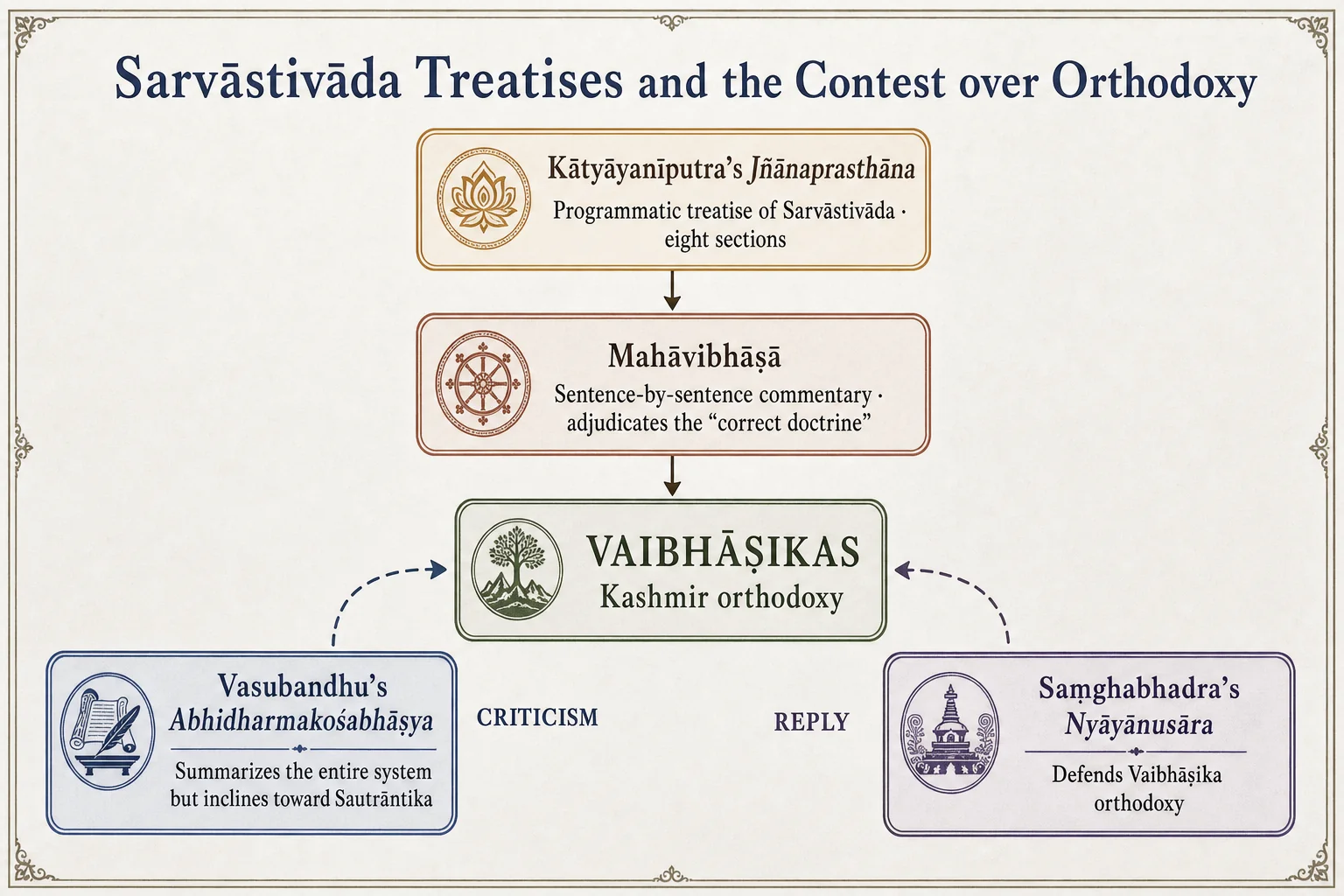
The central text of the Sarvāstivāda system is the Abhidharma Mahāvibhāṣā Śāstra. It is an enormous commentary on Kātyāyanīputra's Jñānaprasthāna, compiled in Kashmir around the second century CE. It records and adjudicates the divergent views of successive Sarvāstivāda teachers (including the four explanations of temporal difference discussed in the previous chapter), and determines the school's orthodox position.1 The line that took it as authoritative became known as the Vaibhāṣikas, the Kashmir orthodoxy.
The text it comments upon, the Jñānaprasthāna, should be introduced first. Composed by Kātyāyanīputra, it was recognized by the Sarvāstivādins as their programmatic work. Tradition honored it as the "body treatise," surrounded by six other treatises like six legs. It is divided into eight sections: miscellanea, bonds, knowledge, karma, great elements, faculties, concentration, and views. These contain forty-four subsections that determine the school's position topic by topic in a question-and-answer format, from decisive stages of practice such as the "highest mundane dharma," through defilements (bonds), knowledge, karma, matter (the great elements), faculties, meditative concentration, and views. The Mahāvibhāṣā comments on it sentence by sentence and adjudicates the positions it records; its chapters correspond directly to the eight sections of the Jñānaprasthāna.
Tradition supplied this great compendium with an imposing origin story. The Kuṣāṇa king Kaniṣka is said to have convened five hundred arhats in Kashmir under the leadership of Vasumitra to compile it, an event Northern Buddhism calls the "Fourth Council." The account must be discounted in keeping with the method of this book. It belongs only to the Northern, Sarvāstivāda line; the Southern tradition recognizes just three councils and does not accept it. The spectacle of a king convening five hundred arhats also repeats the idealized template for councils discussed in 2.2 (compare the First Council). Once this packaging is removed, the conclusion that can be established is more modest: the Mahāvibhāṣā was indeed the great synthesis gradually compiled by the Kashmir Sarvāstivādins around the second century CE.
We must also explain how this system reached later readers. It was transmitted principally through Vasubandhu's Abhidharmakośa, which is a critical digest rather than a neutral summary (see section 5). Saṅghabhadra's Nyāyānusāra then defended the orthodox position. Our modern view of the Sarvāstivāda is therefore usually mediated by a critic's account. The relationship among these works can be sketched as follows:
2. The Five Categories and Seventy-Five Dharmas: A Catalogue of Existence
The Sarvāstivādins exhaustively classified everything that exists (every "dharma") into five great categories, the members of which add up to seventy-five; the Chinese tradition commonly calls the result the "five categories and seventy-five dharmas." This is the complete version of their catalogue of "what ultimately exists."
A word about the name first. The expression is found in neither primary treatise. The number seventy-five is not written out once in the thirty fascicles of the Abhidharmakośabhāṣya, and the count in the two hundred fascicles of the Mahāvibhāṣā is likewise zero; the word the Abhidharmakośabhāṣya uses for its own classification is "five classes," and "five positions" occurs in it just once, meaning the intermediate state. The division into five categories and the members of each are in the treatises. Adding them into a single total and giving that total a name is the work of the later commentaries (see the note in 3.1). This book follows the current usage and asks only that the reader remember it is a label added afterwards.
| Category | Number of dharmas | Contents |
|---|---|---|
| Matter | 11 | Five faculties (eye, ear, nose, tongue, and body) + five objects (visible form, sound, smell, taste, and touch) + unmanifest matter |
| Mind | 1 | Primary mind, the principal act of discernment manifest through the six consciousnesses |
| Mental factors | 46 | Psychological functions that arise in association with mind, divided into six groups (below) |
| Conditioning forces dissociated from mind | 14 | Conditioned "forces" that are neither matter, mind, nor mental factors: acquisition, the life faculty, the four characteristics, words, phrases, and phonemes, among others |
| Unconditioned dharmas | 3 | Space, cessation through discernment (nirvāṇa), and cessation independent of discernment |
The forty-six mental factors are further divided into six groups:
| Group of mental factors | Number | Examples |
|---|---|---|
| Universals | 10 | Feeling, perception, intention, contact, desire, discernment, mindfulness, attention, resolve, and concentration |
| Universal wholesome factors | 10 | Faith, conscience, regard for others, non-greed, non-hatred, non-harming, pliancy, equanimity, heedfulness, and diligence |
| Universal defiled factors | 6 | Delusion, heedlessness, laziness, lack of faith, torpor, and restlessness |
| Universal unwholesome factors | 2 | Lack of conscience and lack of regard for others |
| Minor defiled factors | 10 | Anger, resentment, concealment, spite, envy, avarice, deceit, hypocrisy, harmfulness, and arrogance |
| Indeterminate factors | 8 | Initial application, sustained application, sleep, regret, greed, hatred, conceit, and doubt |
Two categories particularly deserve attention. First, there are only three unconditioned dharmas, and nirvāṇa is included among them as cessation through discernment. This continues the point made in 1.5: the scope of not-self includes the unconditioned, while the Sarvāstivāda system goes further by assigning the unconditioned a place among what "really exists." Second are the conditioning forces dissociated from mind. This category contains forces treated as real although they are neither material nor mental: "acquisition" (possession), the "life faculty" that sustains one lifetime, the four characteristics of arising, duration, change, and cessation, and the collections of names, phrases, and phonemes—the minimal units of language. Treating "possession," "being alive," and even "words" as independently real dharmas exemplifies the system's tendency to reify functions. It is also one of its most heavily criticized features.
Why this category had to be posited at all, the Mahāvibhāṣā explains itself. Fascicle fourteen asks why the treatise on the collections of names, phrases, and phonemes is composed. The first layer of the answer is the customary "because the author wished it so"; the second gives the real reason, in order to stop other schools and display one's own doctrine. Some hold that name-, phrase-, and syllable-bodies are not real dharmas, and the Dārṣṭāntikas are that party; some hold that they have sound as their own nature, and the Śabdikas are that party; to stop those two and show that name-bodies and the rest are real dharmas, included in the aggregate of formations dissociated from mind, this treatise is composed.2 The motive for the legislation is written in the open: the item is established as real because two opponents had to be refuted. Self-declarations of this shape, that a section exists in order to stop other schools and display what is correct, come to one hundred nineteen in the two hundred fascicles.
Relation to the five aggregates
How do the seventy-five dharmas relate to the earlier classification into five aggregates? The correspondence is approximate. The category of matter corresponds to the aggregate of form. Mind, the primary act of consciousness, corresponds to the aggregate of consciousness. Feeling and perception, though mental factors, correspond separately to the aggregates of feeling and perception. The remaining mental factors together with the conditioning forces dissociated from mind correspond to the aggregate of formations. The unconditioned dharmas lie outside the framework of the five aggregates. The Sarvāstivādins refined the coarse classification of the five aggregates more than tenfold, assigning every member a precise definition and boundary. The five aggregates supply a descriptive framework at the level of the discourses; the seventy-five dharmas supply an analytic framework at the level of the treatises. Both address the same world of experience at different resolutions.
The four characteristics and infinite regress
Among the conditioning forces dissociated from mind are the four characteristics of arising, duration, decay, and impermanence (jāti, sthiti, jarā, anityatā), the four stages in the arising and cessation of a conditioned dharma. Each is itself regarded as a really existing dharma. But this conceals a self-referential problem. If the four characteristics are themselves conditioned dharmas, then each should have its own arising, duration, change, and cessation. What are the arising, duration, change, and cessation of "arising" itself? Pursued consistently, this produces an infinite regress.
The question was not thought up for the school by an outsider. Fascicle thirty-nine of the Mahāvibhāṣā writes it into the textbook itself: does the characteristic of arising have a further characteristic of arising? Answer: arising has a further arising, and pressed in this way it becomes an infinite regress. The treatise first records an answer that accepts the infinity, that to allow it is no loss either, for the three times are broad and ample, and how should there be no room to lodge in; the ground being that the real existence of the three times can afford the storage. What is adopted instead is that nine dharmas arise together: when conditioned things arise, the dharma, arising, the arising of arising, duration, the duration of duration, change, the change of change, cessation, and the cessation of cessation arise at once, the division of labor being that arising can produce the other eight while the arising of arising produces one only, namely the arising that is its own root.3 The distinction between primary characteristics and subsidiary characteristics that Vasubandhu restates in the Abhidharmakośa comes from this passage. A principal dharma has four primary characteristics; each primary characteristic in turn has four subsidiary characteristics; and the process stops there, because subsidiary characteristics require no further characteristics.4
Both are called arising, yet the one produces eight and the other one. The answer the treatise gives is that such is the nature of dharmas and it should not be objected to, with the added example of fowls and dogs, some of which bear eight at a birth and some one.3 For why subsidiary characteristics need no further subsidiary characteristics, the Sarvāstivādins offer a normative determination and not a logical derivation. At this point the system ends inquiry by stipulation.
The same difficulty had appeared once already at "acquisition" (section 4), and the halt used there is of another kind. If acquisition is a real dharma it must itself be acquired, so acquisition would need an acquisition of its own. Fascicle one hundred fifty-eight of the Mahāvibhāṣā first records the answer that an infinite regress is no fault either, and that it is by this that birth and death are hard to sever and hard to cross. What it adopts is the other answer: that in a single moment there are only three dharmas, the dharma, its acquisition, and the acquisition of the acquisition; by the acquisition, the dharma and the acquisition-of-acquisition are acquired, and by the acquisition-of-acquisition, the acquisition is acquired, so that since the two acquire each other reciprocally there is no infinite regress.5 Here the chain is folded into a ring, the second level turning back to take charge of the first; at the four characteristics the rule was instead altered on the second level. Both Sautrāntika and Madhyamaka critics regard determinations of this sort as an arbitrary halt: once the question is accepted as meaningful but can be stopped only by decree, unresolved internal tension remains.
3. Six Causes and Four Conditions: The Skeleton of Causality
The five categories and seventy-five dharmas catalogue "what exists." To explain how these dharmas cause one another, the Sarvāstivādins also developed a theory of six causes, four conditions, and five results.6
The six causes (hetu, direct causes):
| Cause | Sanskrit | Brief explanation |
|---|---|---|
| Efficient cause | kāraṇa-hetu | Anything that does not obstruct the arising of a dharma is its efficient cause; the broadest category |
| Coexistent cause | sahabhū-hetu | Dharmas arising in the same moment serve mutually as causes, as when primary mind and mental factors arise together |
| Homogeneous cause | sabhāga-hetu | A dharma of the same kind in a preceding moment causes a later dharma of the same kind, as yesterday's greed contributes to today's greed |
| Associated cause | samprayuktaka-hetu | Mind and mental factors serve as mutually associated causes; a subclass of coexistent cause specific to mental dharmas |
| Universal cause | sarvatraga-hetu | A small number of universally pervasive defilements, such as ignorance, cause all other defilements |
| Ripening cause | vipāka-hetu | Wholesome and unwholesome karma causes pleasant and painful results; cause and result differ in kind, and the result may occur in a later life |
The four conditions (pratyaya, conditions in the broad sense) are the causal condition, which covers the first five of the six causes, the efficient cause being excluded from it and distributed among the other three conditions;7 the immediately preceding condition, by which one moment of mind opens the way for the next; the object condition, by which an object of cognition supports consciousness; and the dominant condition, encompassing all other contributing circumstances.
The five results (phala) are the dominant result, the broadest category; the humanly produced result, generated with the aid of an instrument; the outflow result, a continuous result of the same kind as its cause; the ripened result, the morally charged result of karma, different in kind from its cause; and the result of separation, nirvāṇa attained through separation from the defilements.
The significance of this theory does not lie in the individual items but in the transformation it performs. It changes the "narrative" of the twelve links of dependent arising in the discourses into a "typology." Dependent arising tells a story of circulation through birth and death. The six causes and four conditions set out the logically possible types of causal relations among dharmas, converting a description of process into structural analysis. This implements in causal theory the major Abhidharma transition from "context-dependent teaching" to "ultimate teaching" discussed in 1.5. The pair "ripening cause → ripened result" specifically handles the fruition of karma across lives; together with unmanifest matter and acquisition, discussed below, it forms the Sarvāstivāda's complete mechanism for causal continuity.
4. Crucial Explanatory Mechanisms: Unmanifest Matter, Acquisition, and the Existence of the Three Times
For the catalogue to explain the world, it requires several supporting mechanisms. They all address the leading difficulty identified in 1.5: without a self, how can karma and continuity be established?
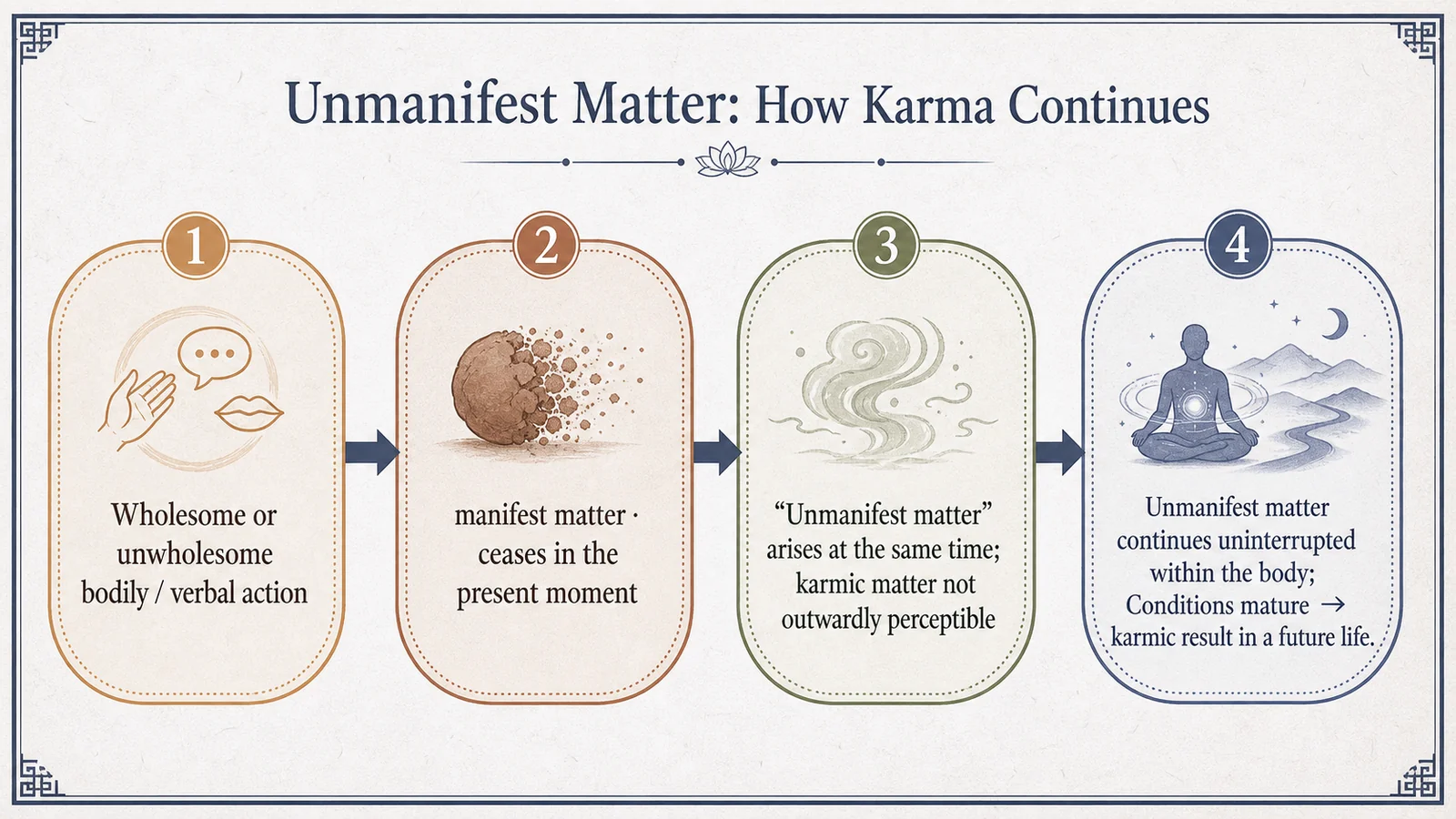
Unmanifest matter (avijñapti-rūpa, one of the material dharmas). The bodily or verbal act that constitutes wholesome or unwholesome karma, a manifest form, vanishes in an instant. The Sarvāstivādins maintain, however, that it simultaneously gives rise to an imperceptible, subtle material dharma called "unmanifest matter." This remains in the body as the continuing moral momentum of the act and, when conditions mature, produces its consequence.
Acquisition (prāpti, one of the conditioning forces dissociated from mind). What makes a dharma "belong" to a particular sentient being? The Sarvāstivādins posit acquisition as a real dharma that attaches another dharma to an individual's continuum. When you "acquire" greed, that greed counts as yours; abandoning a defilement means replacing its "acquisition" with "non-acquisition." Defilements, wholesome qualities, and even past actions remain registered to a person across time through acquisition.
The existence of the three times (discussed in detail in the previous chapter). The permanent existence of the intrinsic nature of dharmas in all three times is the general premise underlying these accounts of continuity. Unmanifest matter can persist, acquisition can bind, and karma can ripen across lives because past and future dharmas never cease to exist intrinsically.
Taken together, these three ideas reveal the Sarvāstivāda strategy for solving "continuity without a self." Whenever a function requires a bearer (maintaining karma, possessing a quality, or connecting the three times), the school posits another really existing dharma to perform it. In this book's view, this is the full development of the "ontologizing" tendency identified in 2.5. Rather than accept continuity as a process without an owner, it assigns an entity to each function. The result is stable, but its theoretical cost is high.
5. Internal Criticism: Vasubandhu and Saṅghabhadra
The most famous critic of this edifice emerged from within it. Vasubandhu composed the Abhidharmakośa: its root verses present Vaibhāṣika orthodoxy, but his own commentary repeatedly answers from a Sautrāntika perspective. He questions acquisition as an unnecessary entity (continuity itself is enough to explain why a quality "belongs" to a stream, so why posit an additional acquisition?), reduces the role of unmanifest matter, and unsettles the doctrine that the three times exist.4 Saṅghabhadra, an orthodox Sarvāstivādin, responded with the Nyāyānusāra in eighty fascicles, which follows the root verses of the Abhidharmakośa and rewrites and rebuts its prose section by section, holding the Vaibhāṣika position.
What Saṅghabhadra did was more than answer point by point. The most substantial step in the counter-defense is a wholesale replacement of the criterion of real existence. The school's older criterion asked whether a thing survives being broken up: what disperses under analysis is nominal, what does not is real. Saṅghabhadra sets up a mark of his own, that to give rise to a cognition by being an object is the mark of what truly exists, and divides it in two: if a cognition arises with regard to a thing while waiting upon nothing else, that is the mark of the really existent, as with matter and feeling; if a cognition arises with regard to it only in dependence upon something else, that is the mark of the nominally existent, as with a pot or an army.8 What can make a cognition arise on its own is real; what needs something else in attendance is nominal. Once the criterion changes from breaking down to being taken as an object, the dharmas of past and future time, acquisition, and the unconditioned, every one of which Vasubandhu's criterion judges nominal, are retained without exception, since every one of them can serve as an object. Not an item is lost from the list, and the price is the independence of the criterion: to change it is to concede that the old one could not be held and to adopt instead one chosen because it saves the whole list. A criterion put to the service of a conclusion is the methodological reality of this defense.
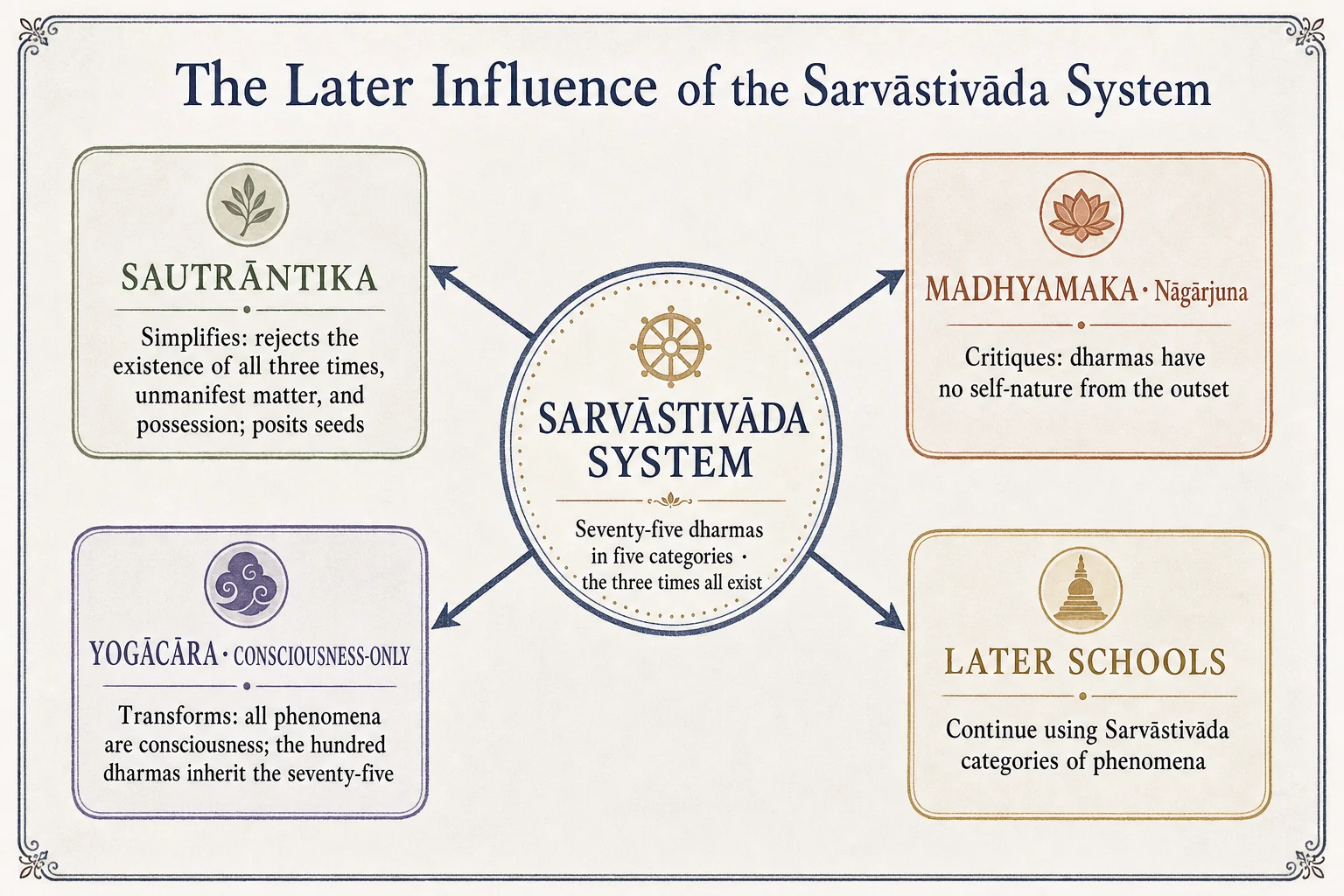
This internal controversy highlights the principal targets of later criticism: the mechanisms that reified functions (acquisition, unmanifest matter, and the existence of the three times) were precisely the features subjected to repeated scrutiny. The Sautrāntikas of the next chapter drastically reduce them and explain karma and continuity through "seeds." Later, Mahāyāna Madhyamaka attacks the very concept of "intrinsic nature" and argues that no dharma possesses one (Part V), while Yogācāra takes over the entire catalogue of dharmas and reconstructs it within "consciousness-only"—its catalogue of one hundred dharmas descends directly from these seventy-five.
6. The System's Importance
The Sarvāstivāda system is the extreme form of Abhidharma dharma realism: it offers the most complete catalogue of existence and is more willing than any other system to preserve causality and continuity by adding real dharmas. Precisely because it developed this project most fully, it became the principal target of later opponents. Any attempt to refute the claim that "dharmas possess intrinsic nature" had first to address the Sarvāstivāda.
In fairness, however, even those who criticized and rejected the system continued to speak its language. Its categories (primary mind and mental factors, matter, associated and dissociated forces, conditioned and unconditioned dharmas) together with its minute analysis of psychological phenomena became the common vocabulary of subsequent Buddhist philosophy, including the Mahāyāna schools that opposed it. The Yogācāra catalogue of one hundred dharmas is its direct descendant. Even Madhyamaka, in arguing for "emptiness," first relies on the Sarvāstivāda's determinations of the characteristics of dharmas in order to identify its objects of criticism. Later schools rejected the Sarvāstivāda, yet preserved its categories and continued to employ them in constructing new systems. Its influence on later thought can be summarized in a diagram:
The next chapter turns to the Sautrāntikas. We will see how they retain only the present, use "seeds" to explain what unmanifest matter and acquisition were intended to explain, and offer a more economical account than the Sarvāstivāda's cumbersome mechanisms.
Further Reading
- Collett Cox. Disputed Dharmas: Early Buddhist Theories on Existence. Tokyo: International Institute for Buddhist Studies, 1995. (On ontological controversies surrounding acquisition and other conditioning forces dissociated from mind.)
References
References
-
Charles Willemen, Bart Dessein, and Collett Cox. Sarvāstivāda Buddhist Scholasticism. Leiden: Brill, 1998. ↩
-
Abhidharma Mahāvibhāṣā Śāstra, fascicle fourteen, on the motive for the treatise on the collections of names, phrases, and phonemes: "in order to stop other schools and display one's own doctrine. That is, some hold that name-, phrase-, and syllable-bodies are not real dharmas, as the Dārṣṭāntikas do; or again some hold that name-, phrase-, and syllable-bodies have sound as their own nature, as the Śabdikas do. To stop those views and to show that name-bodies and the rest are real dharmas, included in the aggregate of formations dissociated from mind, this treatise is composed." On a search of the classical text of the CBETA edition, the formula "in order to stop other schools and display one's own doctrine" stands twenty-two times, "to stop other schools and display the correct meaning" twenty-four, and "to stop other schools and display the correct principle" fifty: one hundred nineteen in all for the family. The treatise assigns name-, phrase-, and syllable-bodies to the aggregate of formations dissociated from mind, that is, to a part of the aggregate of formations, and does not set them beside matter and mind as a category of their own. See Part 15, Chapter 2, and Part 16, Chapter 1, of this book's second division. ↩
-
The regress of the four characteristics stands in fascicle thirty-nine of the Abhidharma Mahāvibhāṣā Śāstra. The difficulty: "Question: does this characteristic of arising have a further characteristic of arising? Suppose it does; what fault follows? If it does, that one has a further one, and that one another, and so on in succession, which becomes an infinite regress." The answer recorded first: "Some say: to allow this infinity is no loss either, for the three times are broad and ample, and how should there be no room to lodge in." The settled verdict: "Here arising can produce eight dharmas, namely the dharma and its three characteristics and four secondary characteristics; the arising of arising produces one dharma only, namely arising; by this principle there is no fault of infinity." The reply to the asymmetry: "such is the nature of dharmas, and it should not be objected to," with the simile of fowls and dogs, some bearing eight at a birth and some one. On a search of the classical text of the CBETA edition, "infinite regress" occurs forty-seven times in the whole treatise, seven of them in fascicle thirty-nine and seventeen in fascicle one hundred fifty-eight, twenty-four in those two fascicles together; the remainder are for the most part the treatise charging other positions with an infinite regress. For a sentence-by-sentence treatment see Part 15, Chapters 4 and 7, of this book's second division. ↩↩
-
Vasubandhu. Abhidharmakośabhāṣya. Trans. Louis de La Vallée Poussin, L'Abhidharmakośa de Vasubandhu, 1923–1931; English trans. Leo M. Pruden, Berkeley: Asian Humanities Press, 1988–1990. ↩↩
-
For the regress of the acquisition of acquisition and the halt applied to it, see fascicle one hundred fifty-eight of the Abhidharma Mahāvibhāṣā Śāstra. The answer recorded first: "Question: if so, does this not become an infinite regress? Answer: an infinite regress is no fault either; it is by this that birth and death are hard to sever, hard to cross." The settled verdict: "It should be said thus. In a single moment there are only three dharmas: first the dharma, second its acquisition, third the acquisition of the acquisition. By the acquisition, that dharma and the acquisition-of-acquisition are acquired; by the acquisition-of-acquisition, the acquisition is acquired. Since they acquire each other reciprocally, there is no infinite regress." This halt differs from the one used at the four characteristics: here the chain is folded into a ring, there the rule is altered at the second level. See Part 15, Chapters 4 and 7, and Part 16, Chapter 3, of this book's second division. ↩
-
K. L. Dhammajoti. Sarvāstivāda Abhidharma. 4th ed. Hong Kong: Centre of Buddhist Studies, University of Hong Kong, 2009. ↩
-
On how the causal condition subsumes the six causes, fascicle sixteen of the Mahāvibhāṣā reads: "the first five causes are the causal condition; the efficient cause is the other three conditions." The same fascicle records a divergent view, on which the conditions subsume the causes but the causes do not subsume the conditions, the immediately preceding condition and the object condition not being included among the causes. The six causes and the four conditions are therefore not two equivalent lists in different words but a single list gathered on two levels: the four conditions cover everything, the causal condition alone covers the first five of the six causes, and the remaining efficient cause is distributed among the other three conditions. See Part 15, Chapter 5, of this book's second division. ↩
-
Abhidharma Nyāyānusāra Śāstra, fascicle fifty (T1562, composed by Saṅghabhadra, trans. Xuanzang): "I say here as follows. To give rise to a cognition by being an object is the mark of what truly exists. This is of two kinds in all, the first really existent and the second nominally existent, since they are established in dependence on the conventional and the ultimate truth. If a cognition arises with regard to a thing while waiting upon nothing else, that is the mark of the really existent, as with matter, feeling, and the rest. If a cognition arises with regard to a thing in dependence upon something else, that is the mark of the nominally existent, as with a pot or an army." On a search of the classical text of the CBETA edition, the phrase "giving rise to a cognition by being an object" occurs seven times in the whole treatise. For the school's older criterion of breaking down, see Part 15, Chapter 1, of this book's second division; for the treatment of this change of criterion, Part 17, Chapter 7. ↩