Chapter 5 The Vātsīputrīyas and the Problem of the Person
In the preceding chapters, each school installed a carrier for the problem of "continuity without a self" identified in 1.5. The Sarvāstivādins used acquisition, unmanifest matter, and the existence of the three times; the Sautrāntikas used seeds; the Southern tradition used the life-continuum. The Vātsīputrīya answer is the most direct: the carrier is a "person" (pudgala). Precisely because this move came so close to the forbidden "self," the school was the most fiercely condemned of its era. Paradoxically, it was also one of the most successful schools in India.
1. Vātsīputrīyas and Saṃmitīyas: Condemned as "Heretics," Yet a Major Tradition
The Vātsīputrīyas emerged from the Sthavira line and took their name from their lineage of teachers. They subsequently divided into the Dharmottarīya, Bhadrayānīya, Saṃmitīya, and Sannāgarika branches, among others. The Saṃmitīyas later developed into an especially large school. As noted in 3.2, Xuanzang encountered a considerable number of Saṃmitīya monasteries and monks on his journey. The later picture of the person as a "heresy," inherited from the polemics of the Theravāda and Sarvāstivāda lines, therefore does not reflect the school's actual strength at the time. In India it was for a period a major and mainstream tradition.
Most of its writings have been lost, and once again our knowledge is reconstructed through its critics. The longest opening controversy in the Theravāda Kathāvatthu refutes the person,1 while the final chapter of Vasubandhu's Abhidharmakośa, "Refutation of the Person and Self," is the most famous work in this debate.23 A small number of treatises related to the Saṃmitīya school, such as the Saṃmitīyanikāya Śāstra, also survive.
2. The Person: "Neither Identical with nor Separate from the Aggregates"
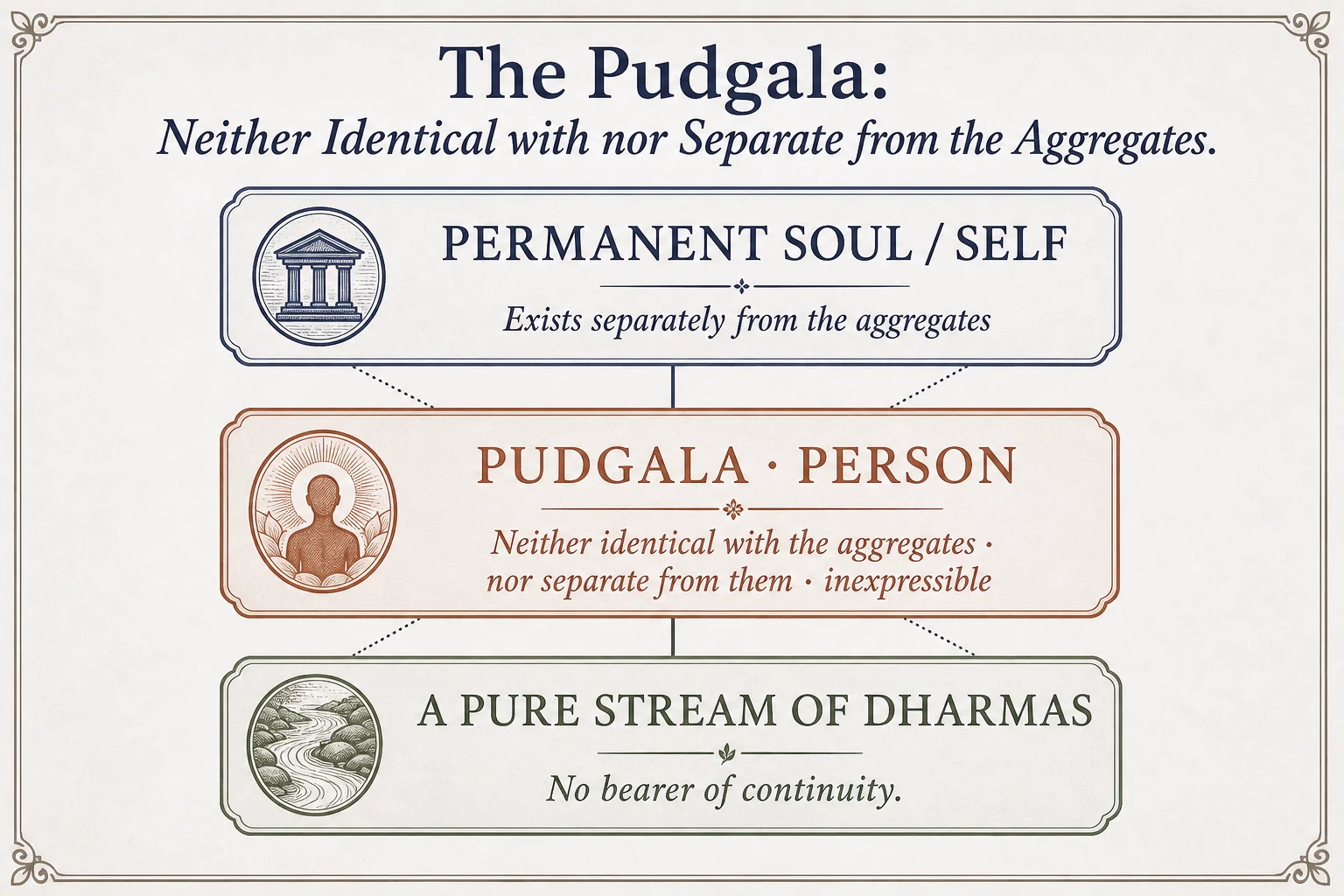
The Vātsīputrīya thesis can be summarized in one sentence. A "person" (pudgala) truly exists, but its relation to the five aggregates is "inexpressible" (avaktavya): the person is neither identical with nor separate from them.
"Not identical with the aggregates" means that the person is not reducible to the five aggregates. If it were, then because the aggregates arise and cease momentarily and disperse at the end of a life, the questions "who wanders through rebirth?" and "who remembers?" would again have no answer. "Not separate from the aggregates" means that the person is not another thing existing apart from them. If it were an independent, permanent entity beyond the five aggregates, it would become the Brahmanical self (ātman) and violate the central teaching of not-self. Neither identical nor separate, it can only be "designated in dependence on the five aggregates," yet it remains a real bearer. The Vātsīputrīyas favored the simile of fire and fuel. Fire is not identical with fuel, but no fire can be spoken of apart from fuel. Fire and fuel are neither one nor different, and so it is with the person and the five aggregates.3
This addresses the very sequence of questions that other schools leave ambiguous. Who wanders through the six destinations of rebirth? Who remembers previous events? Who acts and who receives the karmic result? Who finally realizes nirvāṇa? The Vātsīputrīyas answer: the person. They can also appeal to the discourses. In the Bhārahāra Sutta, the Buddha speaks of a "burden" and a "bearer of the burden," and the Vātsīputrīyas read that bearer as the person.
More important is the purpose of calling the relation "inexpressible." Refusing to answer whether the person and the aggregates are one or different is designed to pass between two extremes. To call them different produces a permanent soul; to identify them, or simply to say that no person exists, produces annihilationism and leaves no one to bear responsibility.
Positive arguments: why is a person needed?
The Vātsīputrīyas did more than say "a bearer is needed, therefore the person must be established." They offered several positive arguments.
First is the ownership of memory. When I remember something done yesterday, I identify it as "what I did yesterday"; a line of recognition connects yesterday's and today's streams of dharmas. Yet every dharma from yesterday has completely ceased, and no dharma existing now could literally "cognize" a dharma that no longer exists. Only a person that persists across time can treat the events of both days as "one person's experience." Second is the ownership of karma. The actor and the recipient of a result may be separated by many lives. If continuity is merely a sequence of ownerless, momentary dharmas, it becomes impossible to explain "who should receive" the result. Only the person can bear responsibility across lives. Third is the subject of realization. A semantic gap separates "this configuration of five aggregates has attained arhatship" from "this person has attained arhatship." The person fills that gap.
The Vātsīputrīyas could cite several passages as scriptural support. In the Bhārahāra Sutta (SN 22.22), the Buddha says: "What is the burden? The five aggregates subject to clinging. Who is the bearer? A person (puggala)." Read literally, "that person" is the pudgala. Other early passages speak positively of "oneself" (attā), as in "oneself is one's island; oneself is one's refuge." Such language is not easily reduced in every case to "expedient speech," and the Vātsīputrīyas treated it as evidence of the Buddha's actual intent.3
They could even reverse the accusation. When asked whether a self exists, the Buddha refused to answer either way (the exchange with Vacchagotta in 1.5). Our "inexpressible" person, they might say, alone preserves the middle way of the Buddha's silence. We are more faithful than schools that simply assert "there is no self."
Viewed through modern categories, the Vātsīputrīyas touched a theoretically valuable possibility. "Neither identical with nor separate from the aggregates" indicates something grounded in the structure of the aggregates yet irreducible to them and not external to them. Today this is called emergence or supervenience. The person is real by virtue of the structure of the five aggregates, not through an additional entity beyond them. Modern researchers often interpret the position as an anti-reductionism approaching emergence theory.4 The difficulty is that the Vātsīputrīyas did not possess the concepts of "emergence" or "supervenience." They could only call the relationship "inexpressible." A potentially fertile intuition therefore remained an obscure posture. Not only did other schools reject it; the Vātsīputrīyas themselves do not appear to have fully developed it. Their later division into Dharmottarīya, Bhadrayānīya, Saṃmitīya, Sannāgarika, and other branches with divergent views likewise suggests the internal tension of the core claim. This book's view is that the person identifies an important problem (whether a person can exist as an irreducible unity), but under the conceptual conditions of the time, the position was difficult to articulate and equally difficult to defend in debate.
3. A Universal Target: Did It Smuggle in a "Self"?
The other schools naturally objected. Chapter 9 of Vasubandhu's Abhidharmakośa, the "Refutation of the Person and Self," provides the fullest surviving text of the controversy. Its central argument can be reconstructed as follows.
Vasubandhu first asks in what sense the person "really exists." The Vātsīputrīyas have only two alternatives. Either (A) it rests on its own intrinsic nature like other dharmas and truly exists ultimately (dravya-sat), or (B) it is only a conceptual designation dependent on other things (prajñapti-sat). If they choose (A), it should be separately identifiable. Yet they themselves call it "inexpressible" and cannot define its relationship to the five aggregates. On what basis can something whose very nature cannot be stated be called "real"? If they choose (B), it exists only conceptually and cannot perform the function they demand of it: the real bearing of karmic results. Both paths are blocked. "Inexpressibility" merely inserts an escape clause into the gap between (A) and (B).2
As far as the surviving literature shows, the Vātsīputrīya response was to assert a third category. Not everything must fall under either ultimate reality or conceptual designation. The person is established in dependence on the five aggregates. It is not independently established beyond them and therefore is not ultimately real; but neither is it a mere concept that can be arbitrarily discarded, because it performs the real functions of memory and karmic responsibility. It is functionally real without being an ontologically independent entity. Vasubandhu replies that an appropriate configuration of dharmas already explains the functions attributed to it. Why posit another thing?
Neither side fully convinced the other because the debate touches a deeper question: is "functionally real but without an ontologically independent entity" a coherent position? The Vātsīputrīyas said yes; Vasubandhu said no, because a function is only an effect of dharmas and does not constitute a new entity. The issue remains unsettled even in contemporary debates over emergence. The Vātsīputrīya intuition is not philosophically trivial; it could not be clearly expressed with the conceptual tools available at the time. The person consequently became a perennial target in controversies among the schools—not only because it "resembled a self," but because it confronted a problem everyone else avoided without resolving.
It would nonetheless be unfair to treat the Vātsīputrīyas alone as heretics. Recall the preceding chapters. The Sarvāstivādins posited acquisition, unmanifest matter, and the existence of the three times; the Sautrāntikas posited seeds; the Southern tradition posited the life-continuum; and Yogācāra would later posit storehouse consciousness. All were installing some kind of carrier for the same problem. The difference is that the other schools chose names that sounded less like a "self" (a function, a seed, a subliminal stream), while the Vātsīputrīyas directly called it a "person."
| School or system | Carrier assigned to continuity |
|---|---|
| Sarvāstivāda | Acquisition, unmanifest matter, and dharma-natures that always exist in the three times |
| Sautrāntika | Seeds in the mental continuum |
| Theravāda | Life-continuum (bhavaṅga) |
| Yogācāra | Storehouse consciousness (see Part VI) |
| Vātsīputrīya and Saṃmitīya | The person (pudgala) |
This book's position is therefore that the person is not a unique departure from the teaching. It is a direct illustration of the conclusion reached in 3.1: under the doctrine of not-self, Buddhist schools repeatedly sought a bearer of continuity. The Vātsīputrīyas reached the boundary of an eternal self and said so explicitly. Other schools avoided the words "person" or "self" but responded to the same theoretical demand.
4. The Same Logic, Two Opposite Conclusions
The logical form "neither identical with nor separate from the aggregates" deserves special attention. Several centuries later, Nāgārjuna would reproduce it exactly. Madhyamaka argues that a self and the five aggregates are neither one nor different, just as fire and fuel are neither one nor different. Yet the two traditions draw opposite conclusions. The Vātsīputrīyas use the argument to establish an inexpressible but real person; Nāgārjuna uses it to deny any intrinsic nature and establish emptiness (Part V). The same argument of "neither one nor different" establishes in Vātsīputrīya hands and dismantles in Nāgārjuna's. The contrast sharply illuminates the division between the early schools and Mahāyāna.
A comparison with modern philosophy may help, again without implying historical influence. Schools that reduce persons to streams of five aggregates and deny any bearer beyond them resemble the "reductionism" defended by Derek Parfit. Personal identity is not an additional, "further fact" beyond the continuity of physical and mental events.5 The Vātsīputrīyas insist that such a further fact does exist: the person, real yet irreducible to the five aggregates. On this comparison, most Buddhist schools stand with Parfit, while the Vātsīputrīyas defend precisely the "further fact" that Parfit rejects.
5. It Identified a Genuine Problem
The Vātsīputrīya and Saṃmitīya schools disappeared with the decline of Indian Buddhism and have no living lineage today. The problem they raised did not disappear. If there is radically no self and continuity has no owner, on what basis do coherent memory, ownership of karmic results, and personal unity arise? Other schools evaded a direct answer through various carriers. The Vātsīputrīyas explicitly stated that "there must be a bearer," at the price of approaching the boundary of an eternal self.
To loosen the problem, rather than keep adding to the "bearer," one can step back and question the assumption that "a bearer must be a really existing thing." Historically, Nāgārjuna's Madhyamaka took up this move through "emptiness" (Part V). It denied every intrinsic nature, and with them the premise that "the bearer must be real." This book nevertheless reserves judgment. Madhyamaka is the historical form that this route actually took, but it may not be the only or best destination of not-self.
In this book's view, a more ideal response would return to a silent, phenomenological posture closer to the Buddha's original intent: add no carrier to continuity, but also do not turn "lack of intrinsic nature" into another doctrine that must be demonstrated and defended. Stop at seeing experience as it is and not grasping (1.5). Not-self as insight did not itself require a new philosophical system. Yet, as the next chapter's discussion of "external opponents and pressure" will show, and as later parts will repeatedly confirm, that silent posture had almost no room to survive in the debates of the time. Faced with opponents who continually asserted real entities, refusing to speak or establish a thesis made one's own position difficult to sustain. Not-self was therefore repeatedly drawn into systematic expression: first through the carriers of the early schools, later through Madhyamaka emptiness. In this sense, Madhyamaka was an outcome of historical conditions, not the route that not-self intrinsically had to follow. The next chapter concludes the survey of the schools by gathering their central controversies over time, causality, and mental factors, and assessing the Abhidharma project as a whole.
References
References
-
Shwe Zan Aung and C. A. F. Rhys Davids (trans.). Points of Controversy (Kathāvatthu). London: Pali Text Society, 1915. (The opening Puggala-kathā refutes the person.) ↩
-
Vasubandhu. Abhidharmakośabhāṣya, chapter 9, "Refutation of the Person" (Pudgala-pratiṣedha). Trans. Louis de La Vallée Poussin; English trans. Leo M. Pruden, Berkeley: Asian Humanities Press, 1988–1990. ↩↩
-
Leonard C. D. C. Priestley. Pudgalavāda Buddhism: The Reality of the Indeterminate Self. Toronto: University of Toronto, Centre for South Asian Studies, 1999. ↩↩↩
-
James Duerlinger. Indian Buddhist Theories of Persons: Vasubandhu's Refutation of the Theory of a Self. London: Routledge, 2003. For an "anti-reductionist/emergentist" interpretation of the person, see also "Pudgalavāda Buddhist Philosophy," Internet Encyclopedia of Philosophy. ↩
-
Derek Parfit. Reasons and Persons. Oxford: Oxford University Press, 1984. (Reductionism about personal identity and the debate over a "further fact.") ↩