Chapter 1: India Before the Buddha—The Vedas, Brahmanism, and Social Structure
To discuss Buddhism, we must first understand the world into which the Buddha was born. This chapter provides that background: what northern India experienced from the second millennium BCE to around the sixth century BCE, and what forms its society, religion, and thought had accumulated by the Buddha’s time. These conditions directly determined the problems the Buddha faced, the vocabulary available to him, and the opponents to whom he had to respond. They are not optional preliminaries.
A word on method is necessary. This period has no reliable chronicle. The written materials available are either religious texts (the Vedas and Upaniṣads) or later works marked by sectarian commitments. This book will identify the legends and acknowledge their existence, but it will reconstruct historical conditions chiefly from linguistics, archaeology, and recent evidence from ancient DNA. As far as possible, the discussion will distinguish what can be established, what is inferred, and what represents the judgment of this book.
The following broad timeline provides an initial outline; later sections will fill in the details.
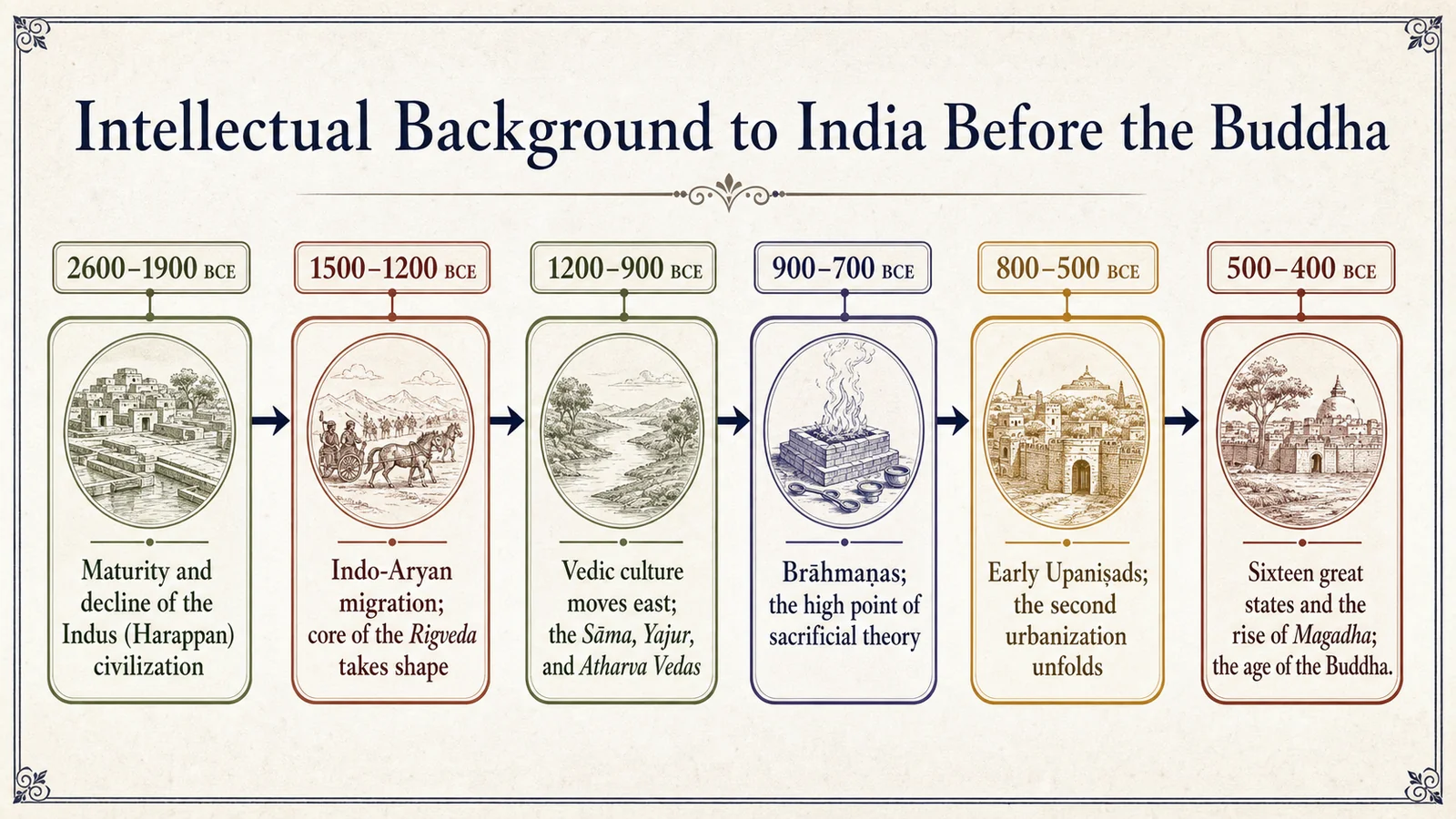
I. When Did the Buddha Live?
Before speaking of the period “before the Buddha,” we must know when the Buddha lived. That question itself remains unsettled.
The dates given by Theravāda tradition derive from Sri Lankan chronicles. They are numbers transmitted within a sectarian tradition and cannot be accepted directly as reliable history. Since the 1980s, a series of critical studies led by Heinz Bechert has persuaded many scholars to move the Buddha’s final nirvana several decades later.1 It must be stressed that no genuine consensus has emerged. The collections edited by Bechert themselves include conflicting conclusions. Some scholars continue to defend a long chronology close to the traditional one, while others hold that existing evidence does not allow a decision between the alternatives. The two chronologies differ as follows:
| Long chronology | Short/revised chronology | |
|---|---|---|
| Source | Sri Lankan chronicles | Critical studies by Bechert and others |
| Date of final nirvana | c. 483 BCE | c. 400 BCE (with a margin of several decades) |
| Position of this book | Not accepted as reliable history | Adopted |
This book adopts the revised chronology and places the Buddha’s activity roughly around the turn of the fifth to the fourth century BCE. This is a working hypothesis, not a settled conclusion. Adopting the long chronology would not materially alter the philosophical narrative of this book; it would merely move several relative dates earlier together. On this basis, “before the Buddha” covers the millennium from the beginnings of Vedic civilization (c. 1500 BCE) to about 500 BCE. Individual dates retain margins of uncertainty extending across several decades and are therefore treated as approximate throughout. Their general scale, however, is reliable enough to support the account that follows.
II. The Indus Civilization: A Discontinuous Beginning
Many general histories begin with the Indus, or Harappan, civilization. This civilization flourished between 2600 and 1900 BCE, with carefully planned cities, drainage systems, and a script that remains undeciphered. It declined around 1900 BCE.2
The temptation is to identify the cross-legged figure on certain Harappan seals as a “proto-Śiva” or “proto-yogi” and thus make it the source of later Indian religion or even meditative traditions. Such interpretations rest on undeciphered images, and the evidence is too slight. This book notes them but will not build a causal chain from them to Buddhism. On current evidence, no direct line of doctrinal inheritance can be established between the Indus civilization and the later Vedic-Brahmanical tradition. The position taken here is that the beginning was marked by discontinuity, not seamless succession.
III. The Aryans and the Formation of the Vedas
The bearers of the Vedic tradition were Indo-European-speaking peoples who called themselves “Aryans” (ārya, “noble ones”).
Their origins have been heavily politicized. The nineteenth-century theory of an “Aryan invasion” was abused; in reaction, an “Out of India” theory arose, according to which the Aryans were indigenous to India and expanded outward. The latter has strong nationalist motivations in contemporary India. Recent research into ancient DNA has produced a clearer conclusion: during the early second millennium BCE, populations with ancestry from Central Asian steppe pastoralists did enter South Asia, and the timing and route correspond to the arrival of Indo-European languages, including what later became Vedic Sanskrit.34 The evidence therefore supports a migration model. This book adopts that model and regards the “Out of India” theory as unsupported by evidence and politically driven. One qualification is necessary: this was a long-term movement of populations and languages by gradual infiltration, not a one-time conquest by an army. The old word “invasion” is misleading.
The earliest text left by these peoples is the Rigveda. Its core was compiled in roughly 1500–1200 BCE in the Punjab, the Vedic “land of the seven rivers.”5 It was transmitted orally and preserved through an elaborate set of memorization techniques with astonishing accuracy. It is, in other words, a body of work memorized and passed down from generation to generation. Later orthodox Brahmanism held the Vedas to be beginningless revelation and “not of human authorship” (apauruṣeya). This book does not accept that claim. The Vedas are historical texts compiled by particular peoples, in particular regions and periods, by groups of human authors.
What Are the Four Vedas About?
The four Vedas are divided according to different functions in sacrifice; they are not four parallel systems of doctrine.6
| Veda | Contents | Ritual use | Intellectual/religious significance |
|---|---|---|---|
| Rigveda | 1,028 hymns | Recited by the invoking priest (hotṛ) | Praise of many gods; late hymns begin to speculate about the source of all things |
| Samaveda | Verses set to melodies, mostly drawn from the Rigveda | Sung by the chanting priest (udgātṛ) | The musical and professional specialization of ritual; little original thought |
| Yajurveda | Sacrificial formulas and operating instructions, in Black and White recensions | Manual for the officiating priest (adhvaryu) | The textual foundation of the idea that sacrifice is all-powerful |
| Atharvaveda | Spells, cures, love and hate magic, curses, and a few speculative hymns | Closer to everyday practice and to the royal priest (purohita) | Strongly magical; also includes speculation on time, breath, and the cosmic pillar |
Several gods of Vedic religion recur throughout the later history of Indian religions and in Buddhist texts, and are worth noting here.
| Deity | Sanskrit | Principal function |
|---|---|---|
| Indra | Indra | God of thunderstorms and war, praised more than any other god in the Rigveda; defeats the drought demon Vṛtra |
| Varuṇa | Varuṇa | Guardian of cosmic order (ṛta) and moral judge |
| Agni | Agni | God of fire and intermediary who conveys offerings between humans and the gods |
| Soma | Soma | God of the ritual drink and the name of a possibly psychoactive plant |
| Yama | Yama | Lord of death and the underworld |
| Prajāpati | Prajāpati | Creator god who rose to prominence in the Brāhmaṇa period and later developed into Brahmā |
These gods were greatly demoted after entering Buddhism. Indra became Śakra, a protector of the Dharma; Yama became the ruler of hell; and Brahmā appears in biographical literature to entreat the Buddha to teach, but everything depends on the Buddha’s consent. This change of rank is itself a statement of position: Buddhism does not deny that these gods exist, but it refuses to recognize them as ultimate authorities.
Several philosophical hymns from the late Rigveda, in its tenth book, deserve closer attention. The “Hymn of the Cosmic Man” (Puruṣa-sūkta, 10.90) explains the origins of the cosmos and the social hierarchy through a cosmic sacrifice. The “Hymn of the Golden Embryo” (Hiraṇyagarbha, 10.121) asks who the creator might be. Most intriguing is the “Hymn of Non-Being” (Nāsadīya-sūkta, 10.129), which asks how the world arose from what was “neither being nor non-being” and ends by wondering whether even the overseer in the highest heaven knows the answer. This suspension of inquiry, which questions even the omniscience of the highest god, is a very early form of metaphysical skepticism in Indian thought.
Two tendencies were therefore already pulling within the Vedas. One, represented by the Yajurveda and Samaveda, drove religion toward increasingly elaborate ritual technologies. The other, represented by the late Rigveda and speculative hymns of the Atharvaveda, began to ask about “the One” and the source of all things. This book argues that the latter line of inquiry formed an undercurrent leading toward the Upaniṣads and, beyond them, all of Indian philosophy. It had already been flowing for centuries before the Buddha’s birth.
The Strata of Vedic Literature
Vedic literature accumulated layer by layer and may be divided roughly into four chronological strata. This sequence shows that the Brahmanical tradition itself was continually changing. By its final stage, its concern had shifted from “how to perform sacrifice correctly” to “what are the self and ultimate reality?”
| Stratum | Approximate dates (BCE) | Principal concern |
|---|---|---|
| Saṃhitā | 1500–1000 | Hymns, spells, and sacrificial formulas |
| Brāhmaṇa | 900–700 | Explanations of sacrifice and its cosmic efficacy |
| Āraṇyaka | 800–600 | Internalization of sacrifice and forest practice |
| Upaniṣad | 800–500 (early texts) | Brahman, self, and liberation |
The Upaniṣads are the immediate intellectual prelude to the Buddha’s age and will be discussed in detail in Chapter 2.
IV. Brahmanism: Sacrifice, Priests, and a Worldview
Sacrifice (yajña) lay at the center of Vedic religion. In this worldview, cosmic order (ṛta) had to be maintained through correctly performed sacrifices. Not one step in the fire offering, its oblations, or its formulas could go wrong. The Brahmin priestly class possessed a monopoly on this technology.7
One consequence is especially important. By the Brāhmaṇa period, the proposition that “sacrifice works” had been taken to an extreme: its efficacy was held to depend on the correctness of the ritual itself, not on the gods’ will. The gods, in effect, became objects moved by sacrifice. Brahmins consequently wielded immense power as the monopolists of ritual technology. This pursuit of results through external rites was precisely what the renunciant movement and early Buddhism would later confront. Buddhism shifted the center of gravity from external sacrifice to inward intention and conduct. This opposition should be kept in mind, for it will recur throughout the book.
The Brahmanical tradition also devised an ideal schedule for life in four stages (āśrama): the stage of the religious student (brahmacarya, studying the Vedas under a teacher); the householder stage (gṛhastha, marrying, having children, and fulfilling a householder’s duties); the forest-dweller stage (vānaprastha, withdrawing into the forest to practice after one’s children had established households); and the renunciant stage (sannyāsa, completely giving up property and social identity to seek liberation). This framework shows that renouncing the world did not count as deviance within the Brahmanical system; it was the proper path for the latter part of life. What made the renunciant movement, including Buddhism, radical was its decision to bring renunciation much earlier. Its members left home in youth rather than waiting for old age, and often remained renunciants for life, never returning. This was a crucial difference between the Buddhist sangha and the Brahmanical four-stage system. It also helps explain both why the sangha was culturally intelligible and why conservative Brahmins could regard it as heretical.
V. Varna: The Theoretical Prototype of Caste
The Brahmanical tradition offered a scheme of social order based on four varṇas. Its canonical source is the “Hymn of the Cosmic Man” mentioned above, which claims that the four classes were born from different parts of the Cosmic Man’s body at his sacrifice, thereby clothing hierarchy in a cosmic origin myth.8
| Varna | Function | Part of the body in the “Hymn of the Cosmic Man” |
|---|---|---|
| Brahmin | Priests and custodians of scripture | Mouth |
| Kshatriya | Warriors and rulers | Arms |
| Vaishya | Farmers, pastoralists, artisans, and merchants | Legs |
| Shudra | Servants | Feet |
Two points must be distinguished. Varna was a theoretical model. The rigid hereditary occupational groups of later history (jāti, caste or birth-group) matured much later; caste in the Buddha’s time was far less fixed than it subsequently became. A second point is crucial for understanding Buddhism: in the eastern Ganges basin, Kshatriyas and newly affluent merchants were gaining status, and Brahmanical theoretical authority was less secure there than in the western heartland. The Buddha was born a Kshatriya, and his order admitted people from every social class. This book argues that these facts accord with the geographical and social setting in which he was active.
VI. The Second Urbanization and the Eastern World
Around the sixth century BCE, the central and lower Ganges plain underwent a profound material transformation. Iron tools became widespread; forests were cleared for cultivation; and rice agriculture produced dependable surpluses. Surplus brought cities, specialized artisan and merchant classes, and long-distance trade. The earliest coinage, including punch-marked silver coins, began to circulate. This is conventionally known as India’s “second urbanization,” the first being the Indus civilization.9
Politically, the plain was divided among several states. Buddhist and Jain texts both preserve the idea of “sixteen great states.” Magadha was rising and would later annex its neighbors, forming the foundation of India’s first great empire.2 Alongside these monarchies, another kind of political community existed in the Ganges basin: clan oligarchies jointly governed by aristocratic assemblies. Indian sources call such a community a gaṇa (“group”) or saṅgha (“assembly”), and sometimes gaṇa-saṅgha. The Śākyas belonged to this type. They had no hereditary autocratic monarch; important decisions were decided in assemblies of aristocratic members.2 This background bears directly on Buddhism. The order founded by the Buddha was likewise called a saṅgha and likewise decided important matters by collective vote through procedures such as a motion followed by three proclamations. The word saṅgha already carried the political meaning of egalitarian deliberation. The Buddha’s direct appropriation of it was probably deliberate: he placed a republican logic of organization against Brahmanical hierarchical authority.
For intellectual history, the important point is that this transformation created a new population: urban residents with money, loosened from the old clan-and-sacrifice order and prepared to support new ideas. We may infer that wandering thinkers now found both audiences and patrons, and that new doctrines acquired a market through which to circulate. The Buddha’s order could not have arisen, or won the support of kings and wealthy merchants, without these material conditions. The position taken here is that it is a mistake to treat Buddhism as a purely spiritual event appearing from nowhere. It grew in a particular socioeconomic setting undergoing drastic change.
VII. Intellectual Ferment and the Problem of “Greater Magadha”
By the Buddha’s time, several ideas were already in circulation: karma, the proposition that actions have consequences; saṃsāra, the continuing cycle of birth and death; and the quest for liberation from that cycle. These formed a shared problem-space for nearly every Indian school of the time, including Brahmanism, Buddhism, and Jainism. Their details will be discussed in Chapters 2 and 3.
One contemporary debate must be noted here. The traditional account treats karma, rebirth, and the pursuit of liberation through austerity as products of the Vedic-Brahmanical tradition, making Buddhism simply a “reaction” against it. In Greater Magadha (2007), Johannes Bronkhorst proposed a different view: the eastern Ganges basin in which the Buddha was active already possessed a culture distinct from the Brahmanical western heartland, and certain central ideas about karma and rebirth may have originated in that eastern culture rather than in the Vedas.10 The hypothesis remains disputed. This book does not treat it as established, but considers it worthy of serious attention. At a minimum, it shows that tracing karma, rebirth, and liberation entirely to the Vedas is not the only available explanation. The eastern Ganges basin may have had intellectual sources of its own.
The next chapter turns to the Upaniṣads and examines how the problem of self, ultimate reality, and liberation was formulated. Chapter 3 then moves to the renunciant schools, which bring us still closer to the Buddha’s own situation.
References
References
-
Heinz Bechert (ed.). The Dating of the Historical Buddha / Die Datierung des historischen Buddha, 3 vols. Göttingen: Vandenhoeck & Ruprecht, 1991–1997. ↩
-
Romila Thapar. Early India: From the Origins to AD 1300. Berkeley: University of California Press, 2002. ↩↩↩
-
Vagheesh M. Narasimhan, Nick Patterson, et al. “The formation of human populations in South and Central Asia.” Science 365, no. 6457 (2019). ↩
-
David W. Anthony. The Horse, the Wheel, and Language: How Bronze-Age Riders from the Eurasian Steppes Shaped the Modern World. Princeton: Princeton University Press, 2007. ↩
-
Michael Witzel. “Vedas and Upaniṣads.” In The Blackwell Companion to Hinduism, ed. Gavin Flood. Oxford: Blackwell, 2003. ↩
-
Jan Gonda. Vedic Literature: Saṃhitās and Brāhmaṇas. Wiesbaden: Harrassowitz, 1975. ↩
-
Gavin Flood. An Introduction to Hinduism. Cambridge: Cambridge University Press, 1996. ↩
-
Wendy Doniger O’Flaherty (trans.). The Rig Veda: An Anthology. London: Penguin, 1981. ↩
-
F. R. Allchin. The Archaeology of Early Historic South Asia: The Emergence of Cities and States. Cambridge: Cambridge University Press, 1995. ↩
-
Johannes Bronkhorst. Greater Magadha: Studies in the Culture of Early India. Leiden: Brill, 2007. ↩