Chapter 5: The Earliest Teachings—The Four Truths, Dependent Origination, Non-Self, and the Five Aggregates¶
This chapter is the book’s first direct treatment of Buddhist philosophy. A word about method is necessary (see the “Editorial Principles” for the fuller statement). This book sets out the central conclusions of the early teachings, reconstructs their arguments in terms a modern reader can follow, and shows what problems they were intended to solve. It may present objections and evidence bearing on whether these arguments succeed philosophically, but it does not issue a final verdict.
The sources are the early scriptures represented by the Pali Nikāyas and the Chinese Āgamas. Although they were written down late and underwent some organization, they preserve the stratum of teaching closest to the Buddha himself. Where an elaboration plainly belongs to later scholasticism, or Abhidharma, this book will identify it and leave its detailed treatment to Part III.
I. The Character of the Teaching: Diagnosis and Prescription¶
The Buddha’s teaching was practical above all. Its goal was the cessation of suffering (dukkha), not the satisfaction of curiosity about the cosmos. Practicality alone, however, is not enough to classify the early teaching as anti-metaphysical. Beside the list of questions refused stands a list of commitments undertaken: dependent origination as a regularity that stands whether or not a Tathāgata appears; the moral causality of karma and its results; rebirth continuing across lives; the impermanence of all conditioned formations; the non-self of all phenomena; and nirvana as an unconditioned element belonging to a different class from the conditioned formations. Every one of these positions sits comfortably inside language. It can be stated, argued, and taught. The position taken here is that the early teaching is centered on the four noble truths, that its metaphysical commitments are strictly restrained by a practical purpose, and that it always comes to rest on the ending of suffering. A blanket anti-metaphysics is too small to hold it: the outline has to be drawn from the two lists together, the refusals and the commitments (for the full argument see Part 13, Chapter 1). Consider first the restrained side, an orientation the Buddha made clear himself.
The Cūḷamāluṅkya Sutta in the Majjhima Nikāya contains the famous simile of the poisoned arrow. A man is struck by a poisoned arrow. When others try to remove it and treat his wound, he refuses: “Do not pull it out yet. First I need to know who shot me, what caste he belongs to, what kind of bow he used, and what feathers were on the arrow.” He dies before his questions can be answered.1 With this simile, the Buddha refuses a set of metaphysical questions: whether the world is eternal, whether it is finite, whether the Tathāgata exists after death, and so forth. He sets them aside without answer as “undeclared” (avyākata). The reason is singular: they do not conduce to liberation, and pursuing them delays the removal of the arrow.
This should be compared with Sañjaya in Chapter 3. Sañjaya refused to commit on every question. The Buddha’s silence was selective. He set aside what did not aid liberation but said a great deal about suffering, its origin, its cessation, and the path.
The undeclared questions have a dimension deeper than mere “irrelevance.” The dozen or so questions set aside (whether the world is eternal or not, finite or infinite, whether the Tathāgata exists after death or not) may have been questions asked incorrectly from the outset. Take “Does the Tathāgata exist after death?” It presupposes a substantial “Tathāgata” whose continued existence or nonexistence can be discussed. Once non-self is accepted, as Section IV explains, the presupposition falls away and the question ceases to apply. It is like asking in which direction an extinguished fire has gone: “direction” is simply not an applicable category. This is exactly the simile of extinguished fire the Buddha used in reply to Vacchagotta, discussed in Section VI. This book argues that at least some of these questions arise from category mistakes. They do not merely lack answers; the questions themselves fail.
They have sometimes been compared to Kant’s “antinomies”: reason forces concepts valid only within the field of experience beyond experience, at which point both a thesis and its opposite seem “provable” and stand in contradiction.2 The comparison is especially apt for questions about whether the world is finite or infinite and has or lacks a beginning; Kant’s first two antinomies concern almost exactly the same subjects. This book agrees with only one point, independent of whether a question is classified as an antinomy or a category mistake. As soon as an answer becomes a public thesis (even the thesis “your question is mistaken”), it generates a new round of controversy. The Buddha’s correction of a particular person’s question in a particular conversation is another matter, as Section VI explains. Early Buddhism calls the self-multiplication and entanglement of concepts papañca, conceptual proliferation. Under the conditions of the time, silence was the most economical way to stop proliferation at its source. The position taken here is that the Buddha’s refusal to declare was less an expression of humility or evasion than a clear calculation that “an answer gives birth to dispute.” Once later Buddhists abandoned silence and answered these boundary questions, controversies multiplied. Much of the remainder of this book is, in one sense, the chain reaction that followed that abandonment.
Method: Meditation and the Analysis of Psychological Motivation¶
Two further observations about how the Buddha taught support the characterization above.
First, the largest and most frequently repeated body of material in the Nikāyas concerns meditation. Descriptions of the meditative states from the first through the fourth jhāna recur almost word for word in dozens of discourses; repeated reading makes their formulaic quality unmistakable. This alone shows that the center of the teaching was a path of attainment that could be practiced in one’s own experience (the training in ethical conduct, concentration, and wisdom), not a doctrine to be accepted on faith.
The characteristics of the four jhānas (cattāro jhānā) can be summarized as follows:
| Factor | First jhāna | Second jhāna | Third jhāna | Fourth jhāna |
|---|---|---|---|---|
| Applied thought (vitakka, directing the mind to the object) | Present | Absent | Absent | Absent |
| Sustained thought (vicāra, continued examination) | Present | Absent | Absent | Absent |
| Rapture (pīti, exhilaration of body and mind) | Present | Present | Absent | Absent |
| Pleasure (sukha, bodily ease) | Present | Present | Present | Absent |
| Equanimity (upekkhā, steady impartiality) | — | Emerging | Prominent | Purified |
| Basis of entry | Seclusion from sensuality and unwholesome states | Applied and sustained thought subside; inward composure | Rapture fades; one abides in equanimity, mindfulness, and clear comprehension | Pleasure and pain cease; equanimity and mindfulness are purified |
| Canonical formula | Rapture and pleasure born of seclusion | Rapture and pleasure born of concentration | “One who is equanimous and mindful dwells in pleasure” | Neither painful nor pleasant; purification of mindfulness by equanimity |
One point deserves particular emphasis. The discourses directly define “right concentration” (sammā samādhi) in the noble eightfold path as these four jhānas (see MN 141, the Saccavibhaṅga Sutta). Concentration in early accounts of practice therefore had specific levels and was a describable object of attainment, not a vague state of focus.
Two discourses merit individual introduction as textual foundations for practice.
The Mahāsatipaṭṭhāna Sutta (DN 22) is the most systematic program of practice in the Nikāyas. It is organized around four “establishments of mindfulness” (satipaṭṭhāna):3
- Contemplation of the body (kāyānupassanā): Mindfulness of breathing (ānāpānasati) is the principal entry, alongside clear comprehension of the four postures (walking, standing, sitting, and lying down), contemplation of the body’s unattractiveness, analysis into the four elements, and the nine cemetery contemplations tracing nine stages of a corpse’s decay.
- Contemplation of feeling (vedanānupassanā): Continuous awareness of feelings as painful, pleasant, or neither-painful-nor-pleasant, and as worldly or unworldly.
- Contemplation of mind (cittānupassanā): Direct awareness of the mind’s present condition—with lust or without lust, distracted or collected, liberated or not liberated, and so forth.
- Contemplation of phenomena (dhammānupassanā): Observation of the five hindrances (sensual desire, ill will, sloth and torpor, restlessness and remorse, and doubt), the five aggregates, the six sense bases, the seven factors of awakening, and the four noble truths. In the PTS recension, the most conspicuous expansion in DN 22, compared with the corresponding version in the Majjhima Nikāya (MN 10), occurs in this last establishment, where the four noble truths receive an independent and detailed exposition at the end of the discourse. In the Burmese Chaṭṭha Saṅgāyana recension the two discourses carry the same four sections on the truths, divided alike and of almost equal length, so the contrast disappears. The divergence is itself an instance of manuscript transmission at work.
The Ānāpānasati Sutta (MN 118) takes breathing as its specific point of entry and organizes practice into sixteen steps, four groups of four, each corresponding to an establishment of mindfulness:1
| Group | Four steps | Corresponding establishment |
|---|---|---|
| First | Know long and short breaths; experience the whole body; calm bodily activity | Contemplation of the body |
| Second | Experience rapture; experience pleasure; experience mental activity; calm mental activity | Contemplation of feeling |
| Third | Experience the mind; gladden the mind; concentrate the mind; liberate the mind | Contemplation of mind |
| Fourth | Contemplate impermanence; fading of passion; cessation; relinquishment | Contemplation of phenomena |
The discourse then displays a complete chain of practice: mindfulness of breathing leads to the four establishments of mindfulness; these lead to the seven factors of awakening (mindfulness, investigation of phenomena, energy, rapture, tranquility, concentration, and equanimity), and these lead to knowledge and liberation. One point of entry, the breath, runs through the entire path to liberation.
The relation between the two discourses is straightforward. DN 22 supplies a complete map of the four establishments, including the objects of practice at each level. MN 118 supplies an operational route through all four by way of breathing. Read together, they offer the most direct primary evidence for understanding early Buddhist calm and insight practice.
Second, the Buddha’s customary way of handling intellectual disagreement was to analyze its psychological motivation rather than become trapped in metaphysical confrontation. The Brahmajāla Sutta of the Dīgha Nikāya provides an excellent example. The discourse first organizes contemporary views about the world and the self into sixty-two kinds, yet the Buddha does not defeat them by arguing one by one that each is false. He instead points out that every view is produced by a sequence: contact conditions feeling, feeling conditions craving, and craving conditions clinging. Contact gives rise to feeling, feeling arouses craving, and craving leads to grasping; only then do these positions arise.3 In other words, he reduces a “view” to a conditioned sequence of psychological events and diagnoses it as a symptom rather than confronting it as a proposition. This is the same approach seen in the undeclared questions and the refusal of conceptual proliferation: do not enter the drama; disclose the mechanism by which one enters it.
The Buddha once used a simile to explain this selection. In a siṃsapā grove near Kosambī, he picked up a handful of leaves and asked the monks whether the leaves in his hand or those in the grove were more numerous. The monks answered that the leaves in the grove were far more numerous. The Buddha replied that what he had directly known but had not taught was like the leaves in the grove; what he had taught was only the handful in his palm. Why had he not taught the rest? Because it did not conduce to release from suffering or lead to nirvana. What had he taught? “This is suffering; this is the origin of suffering; this is the cessation of suffering; this is the path leading to cessation”—the four noble truths.4
This “handful of leaves” is precisely the four truths, showing that in the Buddha’s own ordering they contain the whole point of the teaching and everything else is set aside. This book offers one reconstructive conjecture: since he described the leaves in the grove as things he had “directly known,” not as things he did not know, he may well have had views about philosophical and cosmological questions. He knew but did not teach; the only criterion governing speech was whether it helped remove the arrow.
The four truths that he did teach were later compared to four steps in medicine: diagnose the disease (suffering), identify its cause (origin), determine that it can be cured (cessation), and prescribe the treatment (the path). The discussion now follows those four steps.
II. The Four Truths¶
The four truths are the organizing framework of the early teaching and are traditionally associated with the first turning of the wheel in the Dhammacakkappavattana Sutta.4
| Truth | Content | Medical analogy |
|---|---|---|
| Suffering (dukkha) | Birth, aging, illness, death; association with what is disliked, separation from what is loved, and not obtaining what one seeks; in summary, “the five aggregates subject to clinging are suffering” | Disease |
| Origin (samudaya) | The cause of suffering is craving (taṇhā): craving for sensual pleasure, craving for existence, and craving for nonexistence | Cause of disease |
| Cessation (nirodha) | The complete cessation of craving, which is nirvana | Curability |
| Path (magga) | The noble eightfold path leading to cessation | Prescription |
The truth of suffering includes a frequently misunderstood point. “Suffering” here is not limited to felt pain. It has three levels: the suffering of pain, or direct distress; the suffering of change, the loss that comes when pleasant conditions deteriorate; and the suffering of conditioned formations, the instability and unreliability of everything conditioned. The last is the most important. Even a presently pleasant experience falls within “suffering” because it is impermanent and will change. The Buddha condensed the conclusion into one statement: the five aggregates under clinging are themselves suffering.
The truth of origin identifies craving as the cause. Craving has three forms: craving for sensual pleasure, craving for existence and renewed birth, and craving for nonexistence or annihilation. The last two deserve notice. Both the desire to exist forever and the desire to disappear entirely count as craving, bringing the two extremes discussed in Chapter 3, eternalism and annihilationism, within the cause of suffering.
The truth of cessation holds that craving can be completely extinguished. That extinction is nirvana (nibbāna, literally “blowing out”). The truth of the path gives the route: the noble eightfold path, traditionally organized under the “threefold training”:
| Noble eightfold path | Threefold training |
|---|---|
| Right view, right intention | Wisdom |
| Right speech, right action, right livelihood | Ethical conduct |
| Right effort, right mindfulness, right concentration | Concentration |
Ethical conduct, concentration, and wisdom became the framework for every later Buddhist account of practice.
III. Dependent Origination¶
Behind the truths of origin and cessation, the same principle is at work: dependent origination (paṭicca-samuppāda; Sanskrit pratītya-samutpāda). It is among the most consequential ideas in Buddhist philosophy, but its position must first be clarified. Dependent origination is the theoretical engine of the second and third truths. It explains how suffering arises in dependence on conditions and how it ceases when those conditions cease. It does not itself supply the “path”: the eightfold path is needed to explain how ignorance and craving are to be ended. Dependent origination explains why the practice works, not the concrete steps of practice. This book therefore cautions against treating dependent origination as more fundamental than the four truths. The framework the Buddha repeatedly declared was the four truths—the “handful of leaves” in the Siṃsapā Sutta. Dependent origination is the mechanism embedded in the second and third truths, not a higher principle that replaces them.
Its abstract formula is concise:
When this exists, that exists; with the arising of this, that arises. When this does not exist, that does not exist; with the cessation of this, that ceases.
It means that every phenomenon arises in dependence on conditions. Nothing is self-sufficient, independently existent without a cause, or permanently unchanging. The principle entails both impermanence (all conditioned phenomena are impermanent) and non-self—all phenomena are not self. If everything depends on conditions, everything changes, and nothing exists autonomously as a “self.”
Applying this principle to the way suffering arises link by link yields the twelve links of dependent origination:
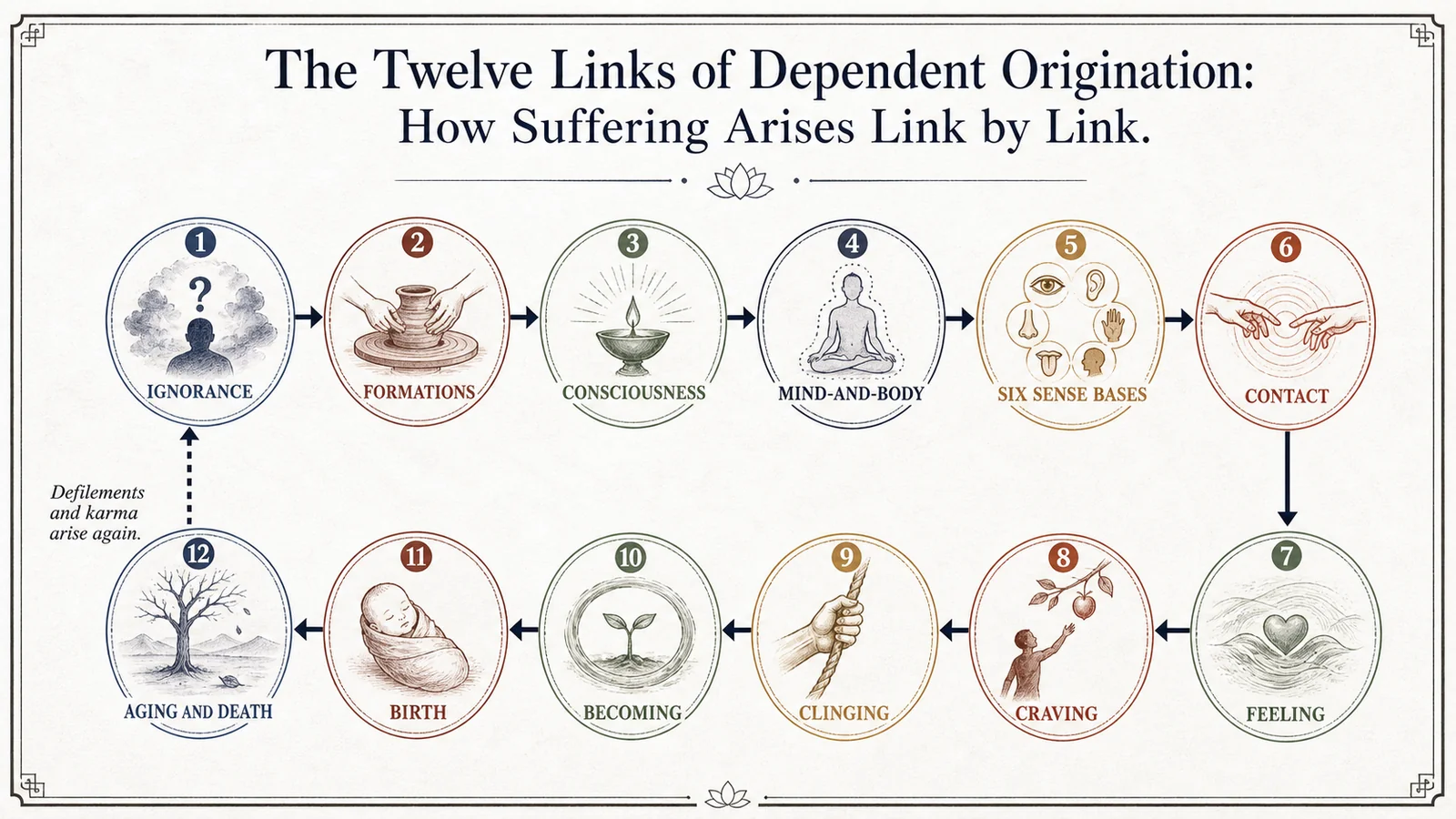
Not knowing the four noble truths is ignorance. From ignorance come formations, consciousness, mind-and-body, the six sense bases, contact, feeling, craving, clinging, becoming, birth, and finally aging, death, sorrow, and suffering. Break any link (especially ignorance or craving), and the entire chain disintegrates and suffering ceases. The truths of origin and cessation are thereby joined within one mechanism.
The Cosmological Framework: Three Modes of Existence and Five Destinations¶
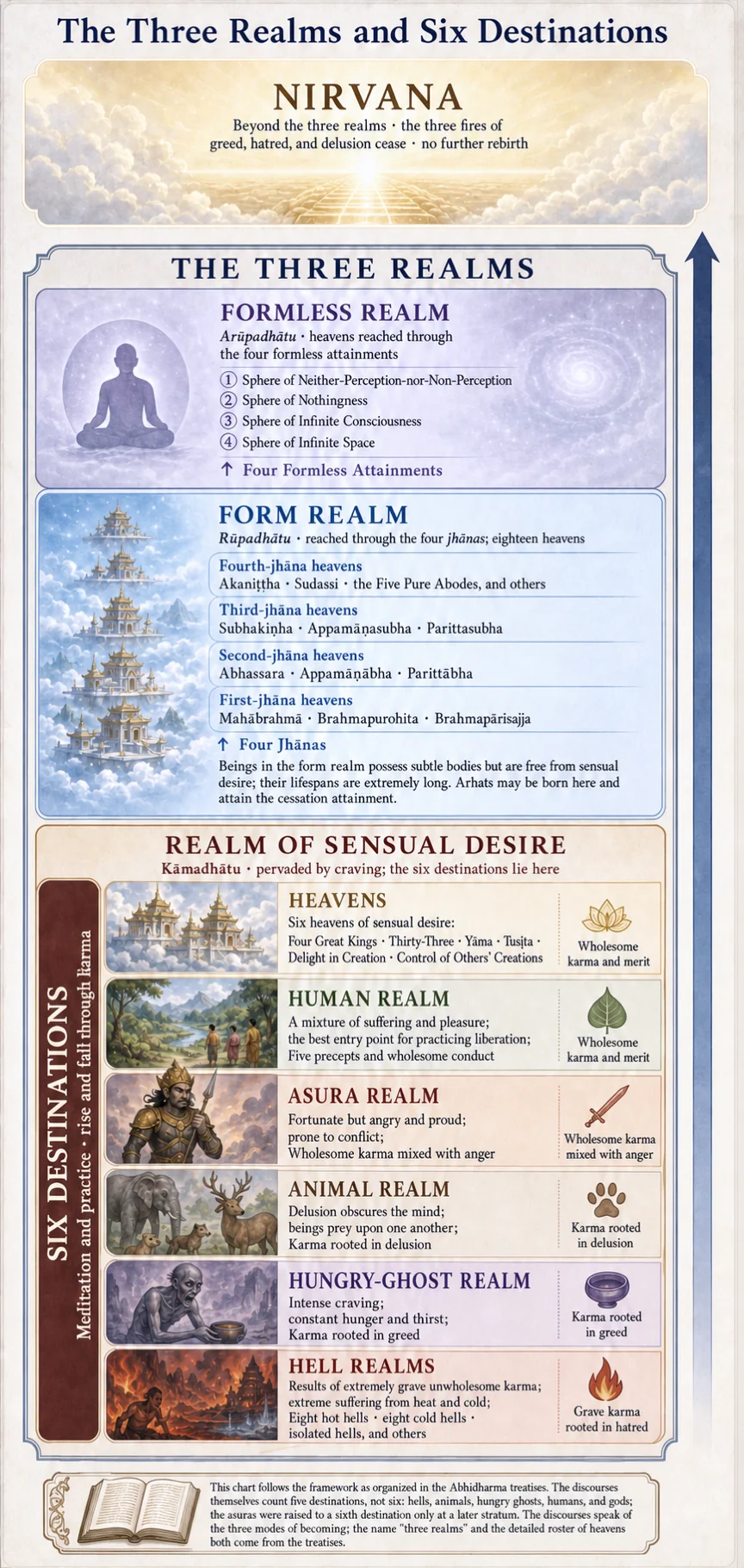
“Rebirth” is not merely an abstraction. The early discourses contain concrete cosmological pictures of the locations through which beings continue to transmigrate, but the vocabulary of the canon itself does not coincide with the names that later became popular. What the canon speaks of is the three modes of existence (tayo bhavā): sensual existence, form existence, and formless existence, which are simply the unfolding of the link of becoming among the twelve links. The name three realms (triloka: the realm of sensual desire, the realm of form, and the formless realm), together with the itemized accounting of thirty-one planes, comes from the compilations of the Abhidharma period.5
The list of destinations is layered in the same way. The canonical number is five: hell, animal, hungry ghost, human, and deva. The Mahāsīhanāda Sutta enumerates the five destinations and the courses leading to them, with nirvana following last. The asuras are elevated into a sixth destination only at a later stratum, and the round number of six destinations therefore does not belong to the earliest layer of the teaching.6
Stated in terms of the framework as the treatises compiled it, the realm of sensual desire (kāmadhātu) is the level at which desire operates most strongly, and all the destinations fall within it. It provides the setting in which the sequence “birth → aging and death → renewed rebirth” described by dependent origination occurs. The realm of form (rūpadhātu) consists of subtler heavens reached through the four jhānas of the form realm. Beings there possess form but are free from coarse desire. The formless realm (arūpadhātu) consists of purely mental heavens reached through the four formless attainments; beings have no material body, only consciousness. Beyond the three realms is nirvana: craving has been released, greed, hatred, and delusion have ceased, and the cycle driven by karma no longer continues.
This precise classification did not exist as a complete framework from the beginning. Elements occur throughout the Nikāyas and Āgamas in functional and figurative forms, but systematic cosmological charts were chiefly organized and standardized in the Abhidharma treatises of the various schools (see Chapter 2.5). The diagram below is drawn according to the framework as the treatises compiled it; the round number of six destinations and the itemized thirty-one planes both belong to that layer, while on the canonical side the count remains five destinations. The broad outline is supplied here to orient later chapters. For the settings in which accounts of the realms occur in the canon, and for the uses the several schools made of them, see Part 13, Chapter 5.
Two points require either clarification or suspension of judgment.
First, the complete twelve-link formula was probably standardized later. Early discourses present chains of different lengths and numbers of links. The most secure element is the abstract formula; the twelve links are one elaboration of it, principally used to explain how birth and death continue without an unchanging self.
Second, Buddhist traditions disagree about how the twelve links should be read. Theravāda commentaries distribute them across past, present, and future lives as a “double sequence of cause and effect through three lives.” Other readings understand them as a cycle arising and ceasing in every present moment. This book treats the disagreement as a later interpretive controversy, presents both accounts, and does not decide between them.
One dialogue best reveals the Buddha’s attitude toward dependent origination. In the Mahānidāna Sutta of the Dīgha Nikāya, Ānanda remarks that dependent origination is said to be profound, yet to him it appears transparent and simple. The Buddha immediately stops him: “Do not say that, Ānanda; do not say that.” Dependent origination is profound and appears profound. Because beings do not understand and penetrate it, they become like a tangled skein or a knotted ball of thread and cannot escape the round of rebirth.3 The Buddha calls it “profound” but does not explain directly where the depth lies. He does not expand the claim into a system of metaphysical argument. Instead, he returns it to practice: penetration and direct realization. This is another refusal to make metaphysical declarations. It is profound, but its depth is left to practice to reach, not speculation to describe.
Dependent origination also planted a seed of immense importance for later thought. In the Kaccānagotta Sutta of the Saṃyutta Nikāya, the Buddha says that the world generally relies on the two extremes of “existence” and “nonexistence.” Avoiding both, he teaches by the middle way: formations arise with ignorance as condition, and so forth.4 Dependent origination is thus positioned as a middle way between eternalism and annihilationism: there is continuity, but no permanent entity. This middle way later became a foundation for Nāgārjuna’s Madhyamaka and for Yogācāra. This book adds a reconstructive conjecture. Perhaps the Buddha insisted that dependent origination was “profound” and stopped Ānanda from treating it as shallow precisely because he understood how vast a system the principle could generate. He saw the whole grove but handed over only a leaf in his palm.
Two Cosmological Narratives: Reading beyond the Literal¶
In addition to static schemes such as the three modes of existence and the destinations, the early discourses include two cosmological narratives with plots. They particularly test the patience of modern readers because, taken literally, they plainly conflict with what is now known about the history of the earth and evolution. Two responses are common: dismiss them as inconsequential myths or insist on their literal truth as records of prehistory. This book proposes a third path. The point of both narratives probably lies somewhere other than in “what actually happened in the cosmos.” A literal reading loses what they were trying to say.
The first is an origin myth in the Aggañña Sutta (DN 27). At the beginning of a world cycle, it says, beings were gods from the Ābhassara heaven: mind-born, self-luminous, feeding on delight, and moving through the air. A delicious, honey-like “essence of earth” later appeared on the ground. One god became greedy and tasted it; others followed. The more they ate, the coarser their bodies became and the more their radiance vanished. Only then did the sun, moon, and stars appear and the divisions of day, night, and season emerge. The essence of earth, earth-cakes, and forest creepers successively grew coarser. Rice, fields, private property, theft, and finally a collectively chosen leader and social classes followed as means of governing conflict. Scholars such as Richard Gombrich generally read the discourse as a satire of Brahmanical claims: caste was not created by Brahmā but arose from human conditions and actions. The Buddha uses a narrative of “degeneration” to undermine the divine foundation of caste.7 This book accepts that reading.
The story also admits another layer, closer to the concern with liberation in this book: it can be read as a phenomenology of the mind. It begins from a state of lightness, brightness, and lack of want. A single movement of greed leads to tasting, competition for food, and deeper immersion. What was initially a burden becomes ordinary through repeated consumption, and new pleasures arise within the ordinary. No one remembers that the entire development began from “one unnecessary taste.” This is a parable opposed to Camus, discussed further in Section VI. Camus says that we must imagine Sisyphus happy—that human beings can establish happiness within the futility of pushing the stone uphill. The Buddha would say that happiness established in this way is self-deception. The Aggañña Sutta stages that very deception: the capacity to “make a home in suffering, find pleasure there, and then forget the suffering” is the mechanism by which beings descend step by step into coarseness. It is not that beings are unhappy. They are precisely too skilled at manufacturing happiness within their fall to remember that they are falling. The discourse is not about how the earth formed billions of years ago; it is about how the mind, now, turns suffering into what seems only natural.
The second narrative, about the rise and decline of human lifespans, appears in the Cakkavatti-Sīhanāda Sutta (DN 26), with a Chinese parallel in the Dīrgha Āgama.8 Popular accounts treat it as a precise timetable of cosmic “aeons”: lifespans decline from eighty thousand years to ten and then rise again to eighty thousand; we now live in an “aeon of decline,” losing one year of lifespan every century; and buddhas appear when the human lifespan is around one hundred years. This formula, however, accumulated in several textual layers. The earliest layer is much simpler.
The basic structure of the Pali discourse is an admonition about government. If a universal monarch follows the Dharma and gives aid to the poor, the realm enjoys peace. Once a king fails to give property to those in poverty, poverty arises, followed in conditioned succession by theft, weapons, killing, false speech, and continuing moral decline. Human lifespans fall with them from eighty thousand years. On its strongest reading, including the future tense of the discourse, it is not merely a memory of a golden age in the past but a forward-looking prophecy. If minds continue to deteriorate, lifespans will fall to ten years. After disaster, remorse and renewed good conduct will cause lifespans to rise in stages to eighty thousand, at which time the future Buddha Metteyya will appear. The sixth discourse of the Chinese Dīrgha Āgama likewise states directly that future lifespans will decline to ten years. Crucially, neither the Pali nor the Chinese text provides any rate of decline or chronological table. The discourse begins and ends with the injunction to “be an island unto yourselves and your own refuge,” the same teaching of self-reliance repeatedly cited in this book’s account of the Buddha’s death in Chapter 4. Its center of gravity is therefore the use of a cosmic scale to urge present self-reliance and goodness, not the construction of a timetable for the cosmos.
It was later Abhidharma cosmology that turned this account into a clock running at a uniform rate. In Vasubandhu’s Abhidharmakośabhāṣya, specific rates and coordinates appear: during the declining phase, the human lifespan falls by about one year every century, from eighty thousand years to ten; buddhas appear only during the decline from eighty thousand to one hundred, and Śākyamuni appeared when the lifespan was one hundred. This precise account of increase and decline within an intermediate aeon was translated into Chinese first by Paramārtha and then by Xuanzang and became common knowledge in Chinese Buddhism. A didactic prophecy urging self-reliance was thus processed, layer by layer, into a timetable of cosmic operations. The decisive step of literal systematization belongs to the Abhidharma stratum. It again confirms the warning repeated in this chapter: the early texts offered a simple prophecy and exhortation; the precise cosmic clock was a product of later system-building.
One narrative degenerates and the other rises and falls, yet both point toward the same reading. These early “cosmological” stories mostly use the shell of the world to speak about minds and human affairs. Their satirical, didactic, and liberative purposes matter far more than cosmography. Defending them as literal prehistory and dismissing them wholesale because they conflict with science are two sides of the same misreading: both mistake the narrative shell for its intended point. The move to make them literal and systematic usually came from later organizers, again matching the pattern seen in the preceding discussion of the three modes of existence and the five destinations: scattered early material, standardized later.
Beginningless Rebirth: A Philosophical Note¶
One term remains suspended within this cosmological picture and requires separate explanation: “beginningless.” The canonical formula appears in the Anamatagga-saṃyutta of the Saṃyutta Nikāya and its parallels in the Chinese Saṃyukta Āgama: “The beginning of this wandering-on is not discerned. Beings obstructed by ignorance and fettered by craving wander through the long night, not knowing the first point of suffering.”9 The accompanying similes are extravagantly hyperbolic. The tears shed over aeons exceed the waters of the four oceans; even if every plant on earth were made into counting sticks, one could not enumerate “the mothers of one’s mothers” back to a beginning. The wording nevertheless deserves attention. The key Pali phrase says that “a prior limit is not discerned” (pubbā koṭi na paññāyati). Read together with the undeclared questions in Section I, the posture is consistent. The Buddha refuses to state whether the world has or lacks a beginning, while “beginningless rebirth” offers not a cosmological answer but a negative epistemic report: when one traces backward, no identifiable beginning can be found.
Even stated with this restraint, “beginninglessness” has attracted two familiar objections from critics ancient and modern. They do not have equal force and should be recorded together here.
The first is probabilistic: if the past is infinite and beings have wandered for limitless time, why has everyone not already been liberated? One ready reply is that infinite duration does not entail arrival at any destination. An undirected random walk can return to its origin infinitely often over infinite time without ever converging on a goal.10 The mechanisms of rebirth, ignorance and craving, are precisely what keep the wandering directionless. In this doctrine, liberation is never a result delivered automatically by time. It requires the conjunction of exacting conditions: encountering the true Dharma, attending to it properly, and practicing over time. Time itself performs none of these tasks. In other words, the objection imagines rebirth as a conveyor belt with its terminus ahead, whereas the doctrine’s own picture is an open expanse without a direction toward an exit. Practice has to open the exit.
The second objection is metaphysical and considerably weightier. If the past is actually infinite, an infinite series must already have elapsed before the present could be reached. How can an infinite series be “completed”? This is the argument for the thesis of Kant’s first antinomy (the antinomies were compared to the undeclared questions in Section I) and a key premise in the medieval kalām cosmological argument for the necessary beginning of the world.11 The response to the first objection does not help here. No matter how often a random walk returns, it does not explain how an infinite past could have been traversed.
This book argues that the force of the second objection comes from a substituted picture of time. The question “How was an infinite past completed?” tacitly presupposes a starting point, as though a “beginning” stood infinitely far away and beings had to travel an infinite distance from it before reaching the present. The journey would then indeed be impossible to complete. But the literal meaning of “beginningless” is precisely the removal of this starting point. A more coherent picture has no first point at all. With the present as origin, past and future can both extend without bound, as the integers extend on either side of zero. On this picture, every actual past moment lies only a finite distance from the present. “Infinite” describes the unboundedness of the set of moments, not a distance that someone had to complete. No one was ever assigned the task of “traversing infinity.” That task exists only at the imaginary starting point invented by the objection. This is the standard criticism in contemporary philosophy of religion of the kalām argument: to treat a beginningless series as a series with an infinitely distant beginning is to misread “beginningless.”12 The canonical wording accords well with this picture. The first point does not lie infinitely far away; there is no first point anywhere to indicate. “Not discerned” describes the absence of anything that could be indicated, not excessive distance.
The argument can be taken a step further. Beginninglessness is not merely defensible; within the metaphysics implied by these teachings, it is required by dependent origination. Dependent origination says, “When this exists, that exists”: the arising of every link requires conditions. If rebirth had a beginning, the first link would have only two possible sources. It arose without a cause, or some self-existent entity outside the chain set it in motion. The former contradicts dependent origination itself; the latter is precisely the kind of first cause Buddhism never affirms. If dependent origination is followed through consistently, “there is no first link” is not an additional cosmological hypothesis but a conclusion of the principle itself. The picture in the preceding paragraph (taking the present as origin and extending without bound in both directions) is dependent origination drawn on a timeline. The discourses are not unaware of this implication. The Aṅguttara Nikāya says that a “prior limit” of ignorance cannot be discerned, then immediately adds that ignorance has nutriment and arises from conditions. Without a starting point and yet not unconditioned, the two statements together yield the very structure of “a beginningless chain of dependent origination.”13
A broader piece of corroboration may be noted. The early teaching does not construct a metaphysical system; this chapter has repeatedly observed that posture in the undeclared questions, the handful of leaves, and the refusal to explain the “profound.” Yet statements scattered through different contexts accord with one another. The undeclared questions refuse to say whether the world has a beginning. The Anamatagga-saṃyutta says that no first point can be discerned. The Aṅguttara Nikāya says that ignorance is beginningless but conditioned. The principle of dependent origination, considered metaphysically, requires beginninglessness. The texts belong to different collections and address different occasions, yet together they form a coherent position. No sentence has to be repaired by another. To remain consistent everywhere without building a system is rarer than to build one and then patch its parts. This chapter previously offered a reconstructive conjecture while discussing dependent origination: the Buddha saw the entire grove but handed over only one leaf in his palm. Here is another leaf, and its pattern matches the grove.
Finally, the character of these defenses should be stated. The response to the second objection is negative: it only removes an accusation of incoherence. The derivation from dependent origination is structural: it shows that beginninglessness is required within the principle. Neither establishes that rebirth is real. Whether rebirth actually exists, and how much weight it bears within the theory of liberation, is a different question. This section settles only the issue of coherence. On beginninglessness, the early Buddhist position is more secure than its critics suppose and more restrained than later systems eager to supply a precise cosmic clock.
IV. Non-Self¶
Non-self (anattā; Sanskrit anātman) is often treated as Buddhism’s most counterintuitive claim: nowhere within or outside body and mind can a permanent, unchanging, autonomous “self” be found. It directly rejects the permanent self identical with Brahman in the Upaniṣads discussed in Chapter 2, and the Jain soul (jīva) stained by karmic matter in Chapter 3. This book argues that the impression of “counterintuitiveness” must be divided into two levels. As a description of experience, non-self is nearly obvious. The real difficulty lies in the constructive questions that follow the description. We begin with the arguments of the discourses.
The arguments proceed principally through analysis of the five aggregates, discussed in the next section. The Anattalakkhaṇa Sutta offers two lines of reasoning:4
- From lack of control: If form were truly “self,” it should obey me. I should be able to say, “Let my form be thus; let my form not be thus.” In fact, the body falls ill and ages without permission. It cannot be controlled. The same is true of feeling, perception, formations, and consciousness. What cannot exercise control does not qualify as an autonomous “self.”
- From impermanence to non-self: Is form permanent or impermanent? Impermanent. Does what is impermanent bring ease or suffering? Suffering. Is it therefore appropriate to regard what is impermanent, suffering, and subject to change as “This is mine, this I am, this is my self”? It is not. One should accordingly see things as they actually are: “This is not mine; this I am not; this is not my self.”
The argument is applied in turn to all five aggregates, concluding that no self exists within them and that none can be established outside them.
Is Non-Self a Difficulty, or an Almost Obvious Observation?¶
Beneath these two arguments lies something more basic. If we look honestly at experience itself, the “self” is never given as an object. The Buddha repeatedly used fire and oil lamps as similes in the Nikāyas. A flame looks like one continuous thing, but in each moment it arises dependent on fuel and ceases instantly. It is a process, not an enduring “core of fire” burning behind the appearances. The continuity of body and mind is the same: continuity exists, but no permanent core. This is exactly what the practice of establishing mindfulness does. One watches feelings, perceptions, and thoughts arise and pass away. Feelings can be found; thoughts can be found; the independent subject “who feels and thinks” never appears. What is called “I” is an appropriation added afterward (the early texts call it the conceit “I am,” asmimāna), not an existent entity observed in experience.
Non-self is therefore first a quasi-phenomenological descriptive conclusion. Suspend metaphysical presuppositions and admit only what is actually given in experience: what remains is a bundle of changing phenomena, with no additional self. The step is not esoteric but remarkably plain. Western philosophy contains an almost identical observation. Hume wrote that whenever he searched inwardly for “myself,” he always encountered some particular perception (cold or heat, love or hatred), and never caught a “self” apart from perceptions. He therefore described the self as a “bundle of perceptions.”14
The comparison reaches its greatest precision with Husserl. Phenomenology “brackets” the natural attitude and describes only what appears in consciousness as it appears. Husserl’s analysis of internal time-consciousness comes especially close to the Buddhist account: the continuity of consciousness is constituted in the flow of retention and protention, not guaranteed by a static entity. The Buddha and Husserl nearly meet in the proposition that body and mind form a constituted stream of continuity. They separate at the last step. In his transcendental phase, Husserl continued to place a “transcendental ego” behind the stream as the pole of every act; the Buddha judged this “I” to be another construction and did not preserve it. That final move is not uniquely Eastern. Sartre criticized Husserl for unnecessarily positing a transcendental ego and argued that the ego is merely an object constituted by consciousness, a position closer to non-self.1516 This book holds that early Buddhist non-self is best read as a quasi-phenomenological descriptive conclusion. It appears astonishing largely because later thinkers, including Husserl, repeatedly feel compelled to install another “I” within the phenomenal stream.
The “self” to be eliminated must also be divided into levels; otherwise, non-self is easily misunderstood as self-erasure. There are at least three. The first is a metaphysical, substantial self (ātman), a permanent and autonomous entity hidden behind experience. The description above denies precisely this level, saying that it cannot be found. The second is experience’s intrinsic “for-me” structure: every experience is given from a perspective, here and now, and naturally possesses a first-person orientation. This is a form of experience and cannot, or need not, be eliminated. Contemporary phenomenologists such as Dan Zahavi refer to it as the “minimal self” or “for-me-ness.”17 What early Buddhism seeks to uproot is the third level: on the material supplied by this “for-me” structure, the mind adds the claim “this is me; this is mine.” It claims and possesses experience, producing the sense of “I” and the conceit “I am,” and thereby converts the simple fact that “an experience is occurring” into “I am the subject who owns this experience.” This move may be called subjectification: appropriating experience as the property of a subject. The Buddha’s formula “not mine, not I, not my self” is directed at this added appropriation, not at the abolition of experience itself.
This distinction resolves an apparent difficulty. An arhat who has exhausted the conceit “I am” still sees, hears, senses, and knows; this is nirvana with remainder, discussed in Section VI. The “for-me” stream of experience continues. What has been removed is only the appropriating feeling “I am the owner.” Contemporary debates about non-self (whether it denies the minimal self or only a constructed self) often become stuck here. The position taken in this book is that early Buddhism targets the appropriative sense of “I” at the third level. It neither denies nor needs to deny the second-level “for-me” structure. Otherwise, the questions “Who walks the path?” and “Who realizes nirvana?” would become unintelligible. This returns us to the characterization in Section I. The early teaching aims to change the way experience is lived, which is to say to release the appropriative sense of “I.” Its commitments on metaphysical questions are restrained by its practical purpose, and it remains centered on the four truths.
One often overlooked restraint must be added. When the wanderer Vacchagotta asks directly, “Is there a self?” the Buddha remains silent twice. He later explains to Ānanda that answering “there is a self” would fall into eternalism, while answering “there is no self” would fall into annihilationism and would confuse Vacchagotta further: “Did the self I formerly had now disappear?”4 In the most cautious context, non-self therefore functions as a practical instruction: do not grasp anything as self. It need not be a bare metaphysical declaration. The resulting interpretive dispute (whether the teaching literally “denies the existence of a self” or strategically instructs practitioners “not to take anything as self”) has received extensive scholarly discussion.1819 This book decides for doctrine, on grounds of two kinds. The first lies inside the present chapter. Section VII will point out that the third of the three characteristics changes its subject: conditioned formations are impermanent, whereas all “phenomena” are not self, and “phenomena” covers the unconditioned, so that nirvana too is placed within the jurisdiction of non-self. A device of attention designed only to break attachment would have no need to draw unconditioned phenomena into that jurisdiction; a scope drawn this far is an assertion. The second kind of ground comes from the fuller argument in Part 13, Chapter 3, which supplies two more. First, when the Buddha explains his silence to Ānanda he invokes the non-self of all phenomena as his fixed point, and only an assertion can be contradicted by an answer. Second, the grammar of the stability of phenomena (whether or not Tathāgatas arise, this element stands, phenomena stand fixed: all formations are impermanent, all formations are suffering, all phenomena are not self) has the tone of a law of nature, and the “seeing as it actually is” that accompanies it presupposes that there is something actual to see. Deciding for doctrine does not cancel what the strategic reading sees. It describes the operative side of the teaching correctly, for non-self does come with rules of use of its own: it is not answered inside a question about persons, it does not run free of the inventory of the aggregates, and it licenses no inference to annihilation.20
Without a Self, Who Continues? A Misdiagnosed Problem¶
“If there is no self, who is reborn, who receives karmic results, and who remembers?” The question sounds forceful, but from the quasi-phenomenological perspective just described it has already dissolved. There was only ever a stream of phenomena moving in dependence on conditions. Continuity belongs to the stream itself and does not require the separate positing of “one who continues.” Dependent origination says exactly this: there is continuity, but no continuer. As description, the matter ends there.
The real trouble begins at the next step. If one is not satisfied to say “this is simply how the stream flows” and seeks to explain how it continues (how memory is retained, how karma bears fruit across lives, how one moment gives rise to the next), one reenters theoretical controversy. Abhidharma provides the first major example. To explain the stream, it divided phenomena into discrete moments and reified them as “ultimate phenomena” (paramattha dhamma), ultimately real dharmas. Once phenomena became discrete, really existing particles, however, their connection became a new problem. Additional connective devices had to be supplied: the Sautrāntika “seed,” the ineffable “person” of the Pudgalavādins, and the Yogācāra “storehouse consciousness” are all patches over this seam. Later chapters consider them in turn.
The principal difficulty is therefore not “whether continuity exists,” which presents no descriptive problem. It is how to give a theoretical account of continuity without smuggling back a quasi-self or falling into conceptual proliferation. The Buddha stopped at description and practice and did not develop the theoretical problem. The early schools, Madhyamaka, and Yogācāra repeatedly returned to it.
V. The Five Aggregates¶
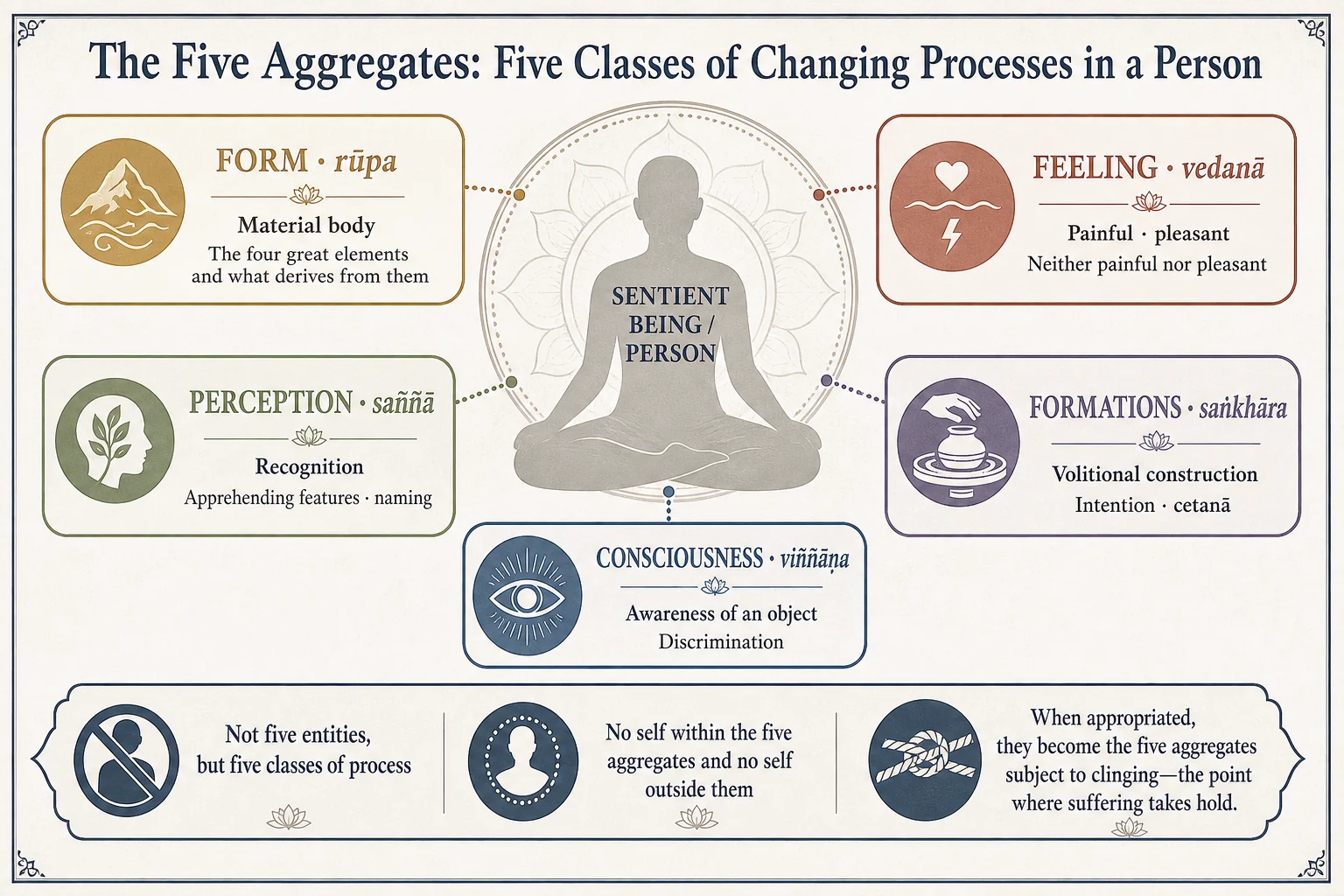
The five aggregates are the Buddha’s instrument for analyzing a “person”: divide a sentient being into five categories of constantly changing process, then ask whether any self can be found among them.
| Aggregate | Meaning |
|---|---|
| Form (rūpa) | The four great elements (earth, water, fire, and air) and what is derived from them, comprising internal and external form alike |
| Feeling (vedanā) | Painful, pleasant, and neither-painful-nor-pleasant feeling |
| Perception (saññā) | Recognition, apprehension of features, and naming |
| Formations (saṅkhāra) | Volitional construction and various mental factors, centered on intention (cetanā), which propels karma |
| Consciousness (viññāṇa) | Awareness and discrimination of an object |
Form deserves separate attention, and one popular narrow reading has to be blocked first, the identification of form with the physical body. The formula of the Anattalakkhaṇa Sutta sweeps across all form: past, future, and present; internal and external; coarse and subtle; inferior and superior; far and near. The Mahāhatthipadopama Sutta divides the earth element into internal and external, with hair, body hair, nails, teeth, skin, flesh, sinews, and bones belonging to the internal earth element and the great earth to the external. To shrink form inside the skin is to throw the earth and the mountains, and the very paper on which this line is printed, out of the classification. On this basis Part 13, Chapter 3 states a general verdict: the five aggregates are an inventory of processes, not an inventory of parts. Form is likewise named for what it is doing, and the discourses gloss it as what is afflicted, afflicted by cold and heat, hunger and thirst, and contact with flies, mosquitoes, wind, and sun.21
The last four aggregates (feeling, perception, formations, and consciousness) address the subjective side: feeling, cognition, volition, and awareness. They form a phenomenological survey of mental events. Form is their counterpart on the material side, and it performs an equivalent phenomenological reduction, analyzing into the four great elements (cattāro mahābhūtāni): earth, water, fire, and air.
In early Buddhism, these are not a cosmological claim that “the world is made of four substances.” They are qualitative descriptions of immediate experience. Earth denotes hardness and softness; water, cohesion and fluidity; fire, heat and cold; air, motion and pressure. When practitioners analyze themselves in this way during contemplation of the body in the Mahāsatipaṭṭhāna Sutta, they are not doing physics. They are breaking down what is ordinarily taken to be “my body” into a collection of physical qualities. There is no “I” here, only constantly changing hardness, softness, heat, cold, fluidity, motion, and pressure. The same solidity, wetness, warmth, and movement also serve to describe earth, water, fire, and air in the external world, internal and external sharing one set of names for the elements; contemplation of the body is one use of the four great elements, and their scope is wider than that use. The phenomenology of the material side and the phenomenology of mind converge within the five aggregates. The former dissolves clinging to “this is my body”; the latter dissolves clinging to “this is my feeling, my thought.” Together they serve seeing impermanence, suffering, and non-self as they actually are.
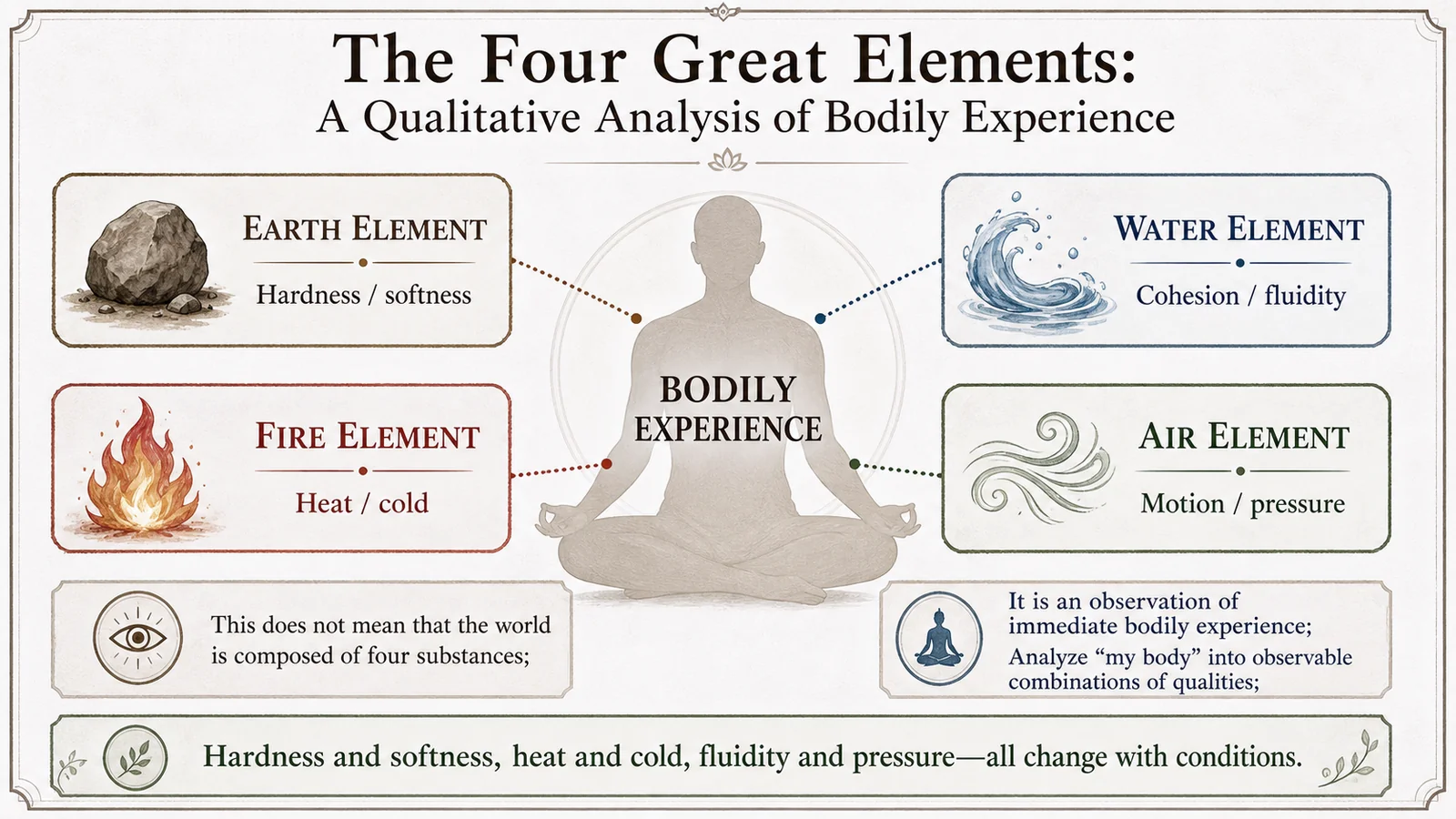
Chinese Buddhism has a widely known expression: “the four great elements are all empty.” It sounds as though these four elements are nothing. In the context of the early teaching, however, the elements are not “all empty.” They are phenomena immediately present as they are and must be observed accurately, not considered nonexistent. The formula “all are empty” belongs to the later interpretive framework of Madhyamaka. Emptiness (śūnyatā) is Nāgārjuna’s language, not the language of the Mahāsatipaṭṭhāna Sutta. Later chapters develop this distinction. Here it is enough to note that the word “emptiness” entered Buddhist vocabulary in historically layered senses. Answers from later philosophy should not be projected back upon the questions of early practice.
The four great elements also form a striking parallel to the four “roots” of the ancient Greek Empedocles (earth, water, fire, and air), and the two accounts arose at roughly the same time, around the fifth century BCE. This has prompted scholarly speculation about possible intellectual contact. Their philosophical purposes, however, are entirely different. The Greek four elements form a cosmology and answer “What is the world made of?” The Buddhist four great elements are a phenomenological tool of practice and answer “How does materiality present itself within experience, and how can it be seen accurately, thereby reducing clinging?” Similar in appearance, they perform different work.
The analysis into five aggregates has two uses. The first connects to non-self. A “person” is exhaustively divided into these five categories. No sixth thing remains to act as a self, nor can a permanent self be established outside the aggregates. The second connects to the truth of suffering. The Buddha’s point concerns the “five aggregates subject to clinging”: the five aggregates grasped tightly as “me” or “mine.” That grasp is exactly where suffering takes hold.
One caution is necessary. The five aggregates already display a strongly analytical tendency. Later Abhidharma continued dividing them into elaborate lists of dharmas—seventy-five dharmas, one hundred dharmas, and so forth. That was a scholastic enterprise and will be considered in Part III. The early teaching stops clearly at the five aggregates.
VI. Nirvana: The Cessation of Suffering and the Limits of Language¶
The literal meaning of nirvana (nibbāna; Sanskrit nirvāṇa) is “blowing out” or “extinguishing.” What is extinguished? The three fires of greed, hatred, and delusion (the Ādittapariyāya Sutta, the “Fire Sermon,” compares every kind of sensory experience to burning in these fires) and the craving that drives rebirth. Once craving ceases, the fire goes out. This is the “cessation of suffering” described in the truth of cessation.
Early texts distinguish two “elements” of nirvana. Nirvana with remainder (saupādisesa) refers to an arhat who remains alive: the fires of defilement have gone out while the five aggregates of body and mind continue. Nirvana without remainder (anupādisesa) refers to the arhat after death, when the aggregates no longer continue.22 The first is “liberation while alive.” The second repeatedly provokes the question “Does the arhat still exist after death?”—precisely one of the undeclared questions the Buddha refuses to answer.
Section I described the refusal as a response to a category mistake; the point can now be explained fully. In the Aggivacchagotta Sutta of the Majjhima Nikāya, the Buddha asks Vacchagotta in reply: when a fire has gone out, did it go east, west, south, or north? Vacchagotta says the question does not apply. A fire burns dependent on fuel; when the fuel is exhausted, it is called “extinguished.” It did not go in a direction. The Buddha says that asking whether the Tathāgata exists after death fails in the same way.1 Once there is no substantial self or Tathāgata, categories designed for entities (“exists or does not exist,” “where did it go?”) have nothing upon which to fasten.
An objection must be answered directly. Section I said that the Buddha did not answer such questions at all and was reluctant even to establish “you asked the wrong question” as a teaching, because any declared answer would generate dispute. Yet in the simile of the fire he plainly shows Vacchagotta that “where does the Tathāgata go after death?” does not apply. Is this not another way of saying “your question is wrong”?
Two things must be distinguished. First, the Buddha never answers with any of the four alternatives—exists, does not exist, both exists and does not exist, neither exists nor does not exist. The boundary of the undeclared remains intact. Second, what he does for Vacchagotta is to dissolve a particular question in a particular conversation, using a simile with a person then able to understand it, so that Vacchagotta can see for himself that the presupposition has fallen away. This is guidance adapted to a person, not a public declaration of the doctrine that “every question of this kind is meaningless.” The Buddha treats different people differently. Sometimes he remains entirely silent, as when Vacchagotta asks whether a self exists. Sometimes he says only that a question is unprofitable, as in the poisoned-arrow simile. Only sometimes does he use the fire simile to expose the error. Such adaptation shows that it is a method, what later Buddhism would call skillful means, not a fixed thesis.
Controversy truly begins when a local dissolution is abstracted into a universal claim (for example, “a certain class of questions commits a category mistake”), and one then argues for the claim, specifies which questions belong to the class, and explains the criteria. That is the step into conceptual proliferation. The Buddha stops with a simile and does not build a theory upon it. Later Buddhists did not stop. They disputed these boundary questions at length, including whether “remaining undeclared” was itself a position and whether a fourfold negation established yet another view. The position taken here is therefore that the Buddha’s “refusal to answer” means, more precisely, a refusal to establish a settled doctrine. It does not conflict with dissolving one person’s question within a particular conversation.
We can now return to the most direct question: what is nirvana? This book holds that most of what can be said is negative or functional. Nirvana is the extinction of the three fires, the ending of suffering, “the unconditioned” (asaṅkhata), and “the deathless” (amata). The Udāna speaks simply of “the unborn, unbecome, unmade, unconditioned,” indicating it entirely through negation. Language reaches its boundary when one tries to define nirvana positively. Even a question such as “Is it a state, or something else?” may already cross the line, because “state,” “substance,” and “existent thing” are categories made for the conditioned world. They may not fit something supramundane (lokuttara).23
The task is to avoid falling to either side, again a middle way. To interpret nirvana as sheer annihilation in which nothing remains is an annihilationist view explicitly rejected by the Buddha; an extinguished fire has not been “destroyed into nonbeing.” To reify nirvana as an eternally abiding realm, a higher “true self,” or another world is the return of eternalism. Some later traditions (especially those of tathāgatagarbha, discussed in Part VII) do show such a tendency, which this book will identify when the time comes. The restraint of the early teaching is to say no more than “the cessation of suffering.” Beyond that, it leaves silence.
Existentialism and Absurdism: Three Ways Out¶
A comparison with two currents of modern Western thought may aid understanding; it does not imply historical influence. Existentialism, absurdism, and the Buddha share one starting point: all hold that the world does not come with intrinsic meaning. The exits they offer are entirely different.
Existentialists such as Sartre argue that precisely because the world has no ready-made meaning, human beings must create meaning through their own choices. Absurdists such as Camus argue that an unbridgeable gulf separates the human demand for meaning from the world’s silence, yet Sisyphus can still make a home for his own meaning within the repeated futility of pushing the stone uphill. Hence the claim that “one must imagine Sisyphus happy.”24
The Buddha’s view differs from both. This book argues that from his perspective, whether one creates meaning or establishes it within futility, the result is still a mental formation (saṅkhāra), another operation of the craving that always wants something to grasp. It therefore remains within suffering, especially the suffering of conditioned formations: every construction is unstable. His exit points elsewhere—to see through this construction and bring the craving that manufactures meaning itself to cessation. Adding a layer of meaning to a meaningless world is still conditioned and constructed. Existentialism and absurdism build a meaning atop “meaninglessness” in which to live. The Buddha also puts down the hand that builds. This directly continues the discussion of the suffering of conditioned formations in Section II. “Creating a meaning for myself” is conditioned and thus still suffering. From the Buddha’s perspective, Camus’s injunction that “one must imagine Sisyphus happy” is a form of self-deception. It is not liberation but the conversion of a fall into happiness and the forgetting of the fall. The origin story in Section III describes how this self-deception develops step by step.
VII. The Three Characteristics, Their Integration, and the Origin of the “Three Dharma Seals”¶
When the components are assembled, the early teaching repeatedly offers three summary judgments:
- All conditioned formations are impermanent.
- All conditioned formations are suffering.
- All phenomena are not self.
The Pali tradition collectively calls these the “three characteristics” (tilakkhaṇa). All three statements occur in early texts such as the Dhammapada and the Saṃyutta Nikāya. A precise distinction deserves emphasis. The subjects of the first two statements are “conditioned formations” (saṅkhārā), whereas the subject of the third is “phenomena” (dhammā), a broader category. Impermanence and suffering apply only to conditioned things; non-self also includes unconditioned nirvana. Nirvana is beyond impermanence and suffering, yet it too is not a “self.” The early texts handle this distinction with precision.
A common formulation nevertheless requires correction. The label “three Dharma seals” is widespread today, especially with the contents “all conditioned phenomena are impermanent; all phenomena are not self; nirvana is peace,” sometimes expanded to “four Dharma seals” by adding “all conditioned formations are suffering.” It was not early Buddhism’s own formulation. The idea of a “Dharma seal” (dharmamudrā, a mark or seal of the Dharma) and the standardization of a set called the “three Dharma seals” belong principally to the northern transmission. “Dharma seal” in the singular appears in the Chinese Sūtra of the Noble Dharma Seal. The three seals as a set became fixed in the Chinese translation by Kumārajīva of the Mahāprajñāpāramitāśāstra, traditionally attributed to Nāgārjuna, and in later Chinese systems of doctrinal classification. Even the Pali collective term tilakkhaṇa, “three characteristics,” became fixed only in the commentarial period.25 The position taken here is that the three summary statements are early, but the category and label “three Dharma seals” are a later organization, especially in the northern tradition. It may be used as a convenient summary, but it should not be treated as a doctrinal label already fixed in the Buddha’s lifetime. The version that substitutes “nirvana is peace” for suffering as its third item reflects an even later doctrinal arrangement.
The relations among the parts can be summarized in one diagram:
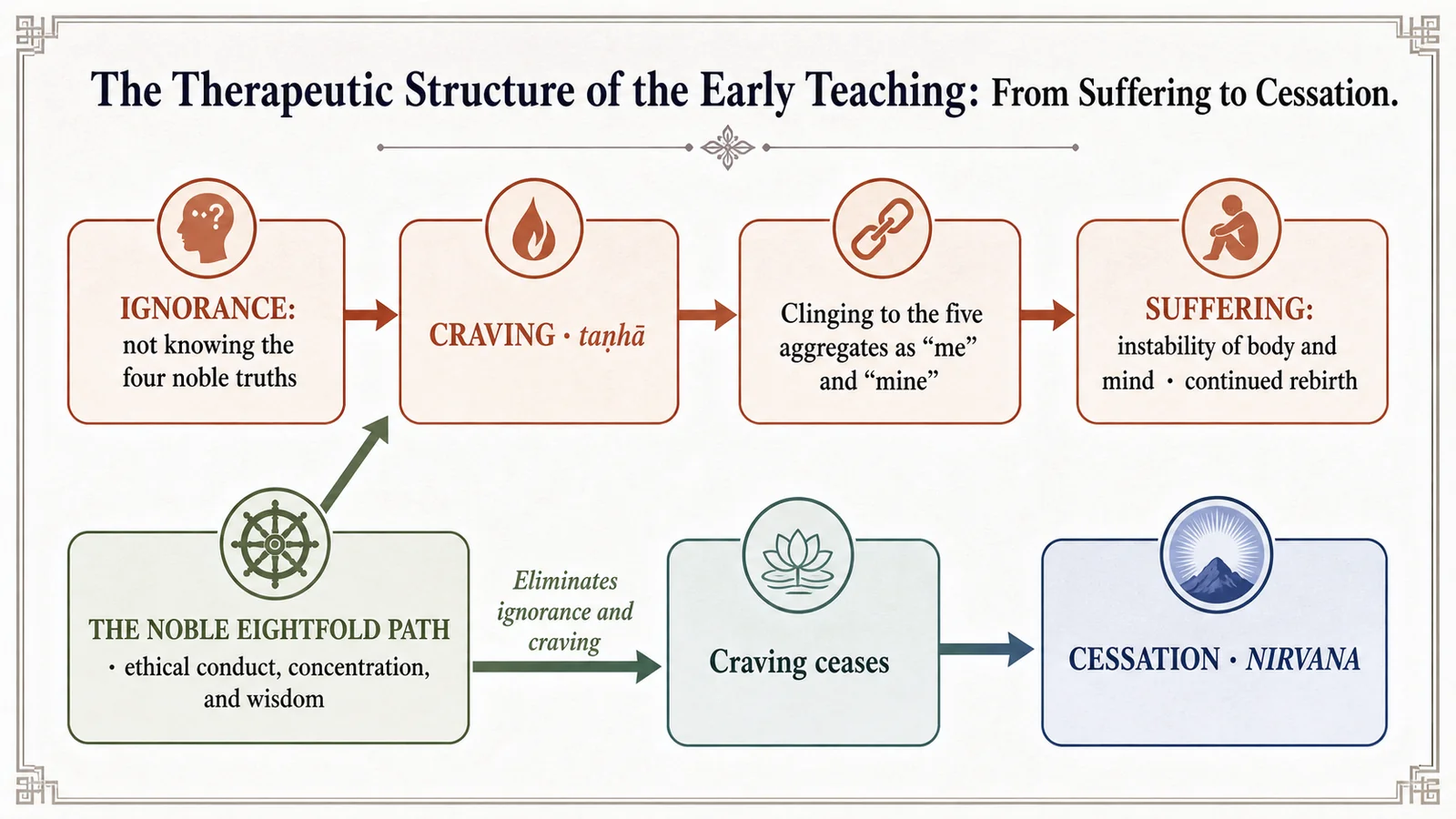
The diagram should be read as follows. Ignorance conditions craving; craving conditions clinging to the five aggregates as self; and this brings suffering and rebirth. This sequence corresponds to the truths of origin and suffering, and its mechanism is dependent origination. By practicing the eightfold path and using ethical conduct, concentration, and wisdom to eliminate ignorance and craving, one brings craving to an end. Suffering then ceases, which is nirvana. This corresponds to the truths of the path and cessation. The four truths, dependent origination, non-self, and the five aggregates are different aspects of one therapeutic structure.
Part I ends here. Its account of the setting in Chapter 1, the Brahmanical answer to which the Buddha responded in Chapter 2, the renunciant environment in which he participated in Chapter 3, the historical person in Chapter 4, and his earliest teachings in the present chapter establishes the premises for everything that follows. Part II turns to the period after the Buddha: how the scriptures were recited and collected, how the sangha divided, and how the problem of “rebirth without a self” was repeatedly explained by the early schools.
Further Reading¶
- Rupert Gethin. The Foundations of Buddhism. Oxford: Oxford University Press, 1998.
References¶
References
-
Bhikkhu Ñāṇamoli and Bhikkhu Bodhi (trans.). The Middle Length Discourses of the Buddha: A Translation of the Majjhima Nikāya. Boston: Wisdom Publications, 1995. (For the poisoned-arrow simile, see the Cūḷamāluṅkya Sutta; for silence concerning self, see the discourses involving Vacchagotta.) ↩↩↩↩
-
Immanuel Kant. Critique of Pure Reason (1781/1787), “The Antinomy of Pure Reason.” ↩↩
-
Maurice Walshe (trans.). The Long Discourses of the Buddha: A Translation of the Dīgha Nikāya. Boston: Wisdom Publications, 1995. (For “dependent origination is profound,” see the Mahānidāna Sutta, DN 15.) ↩↩↩
-
Bhikkhu Bodhi (trans.). The Connected Discourses of the Buddha: A Translation of the Saṃyutta Nikāya. Boston: Wisdom Publications, 2000. (Includes the Dhammacakkappavattana Sutta, the Anattalakkhaṇa Sutta, the Kaccānagotta Sutta, the Connected Discourses on Causation, and the “handful of leaves” in the Siṃsapā Sutta, SN 56.31.) ↩↩↩↩↩↩
-
The canonical formula speaks of three modes of existence (tayo bhavā): sensual existence, form existence, and formless existence, which are the content of the link of becoming among the twelve links. See the discourses analyzing dependent origination in the Connected Discourses on Causation (SN 12.2 and elsewhere). The name three realms (triloka) and the itemized thirty-one planes belong to the compilations of the Abhidharma treatises. The Chinese Dīrgha Āgama devotes an entire volume, the Discourse on Records of the World, to cosmography, and the Pāli Canon has no corresponding discourse; the Nikāyas contain no programmatic discourse on cosmology, and the details are scattered among examples, frameworks, and similes. See Part 13, Chapter 5 of this book. ↩
-
For the list of five destinations (hell, animal, hungry ghost, human, and deva), see the Mahāsīhanāda Sutta (MN 12), which enumerates the five destinations and the courses leading to them, with nirvana following last; for the English translation see 1 above. The elevation of the asuras into a sixth destination belongs to a later stratum, and the round number of six destinations became commonplace only in the later treatises and in the Chinese context. See Part 13, Chapter 5 of this book. ↩
-
The Aggañña Sutta (DN 27), in Walshe’s translation cited above; a parallel appears in the Chinese Dīrgha Āgama. Richard Gombrich reads it as a parody of the Brahmanical doctrine that caste was divinely created; see Chapter 8 of his What the Buddha Thought, cited at 19. This book’s additional reading of the “degeneration narrative as psychological phenomenology opposed to Camus” is its own interpretation. It is compatible with, rather than opposed to, the reading as satire. ↩
-
The Cakkavatti-Sīhanāda Sutta (DN 26), in Walshe’s translation cited above; the Chinese parallel is the Discourse on the Practice of the Wheel-Turning Sage King in the Dīrgha Āgama (Taishō no. 1, DA 6). The textual strata may be divided into three steps: (1) the Pali discourse is organized around whether a wheel-turning monarch acts according to Dharma. On its strongest reading, including the future tense, it predicts that future lifespans will decline to ten years, then rise to eighty thousand, with Metteyya appearing at that time, but it provides no rate or chronology; the discourse begins and ends with the injunction to be “an island unto oneself”; (2) the sixth discourse of the Chinese Dīrgha Āgama likewise states that future lifespans will decline to ten years, but supplies no timeline; (3) only in Vasubandhu’s Abhidharmakośabhāṣya, chapter on the world, is the account systematized into a uniform rise and decline within an intermediate aeon (during the decline, human lifespan falls by about one year per century, from eighty thousand to ten) and assigned a precise place for the appearance of buddhas (buddhas appear in the declining period when the lifespan lies between one hundred and eighty thousand years; Śākyamuni appeared when it was one hundred). Chinese translations by Paramārtha and Xuanzang made the account commonplace in China. The precise cosmic clock (“we are in a declining aeon; lifespan falls by one year per century; the Buddha appeared when lifespan was one hundred”) belongs to the third, Abhidharma layer and is absent from the original Dīgha Nikāya discourse. Ancient accounts differ over the rate of decline, giving either one year per century or one per two centuries; that issue need not be pursued here. ↩
-
The opening formula of the Anamatagga-saṃyutta (SN 15) says that the beginning of rebirth is not discerned (anamatagga): beings obstructed by ignorance and fettered by craving wander within it, and “a prior limit is not discerned” (pubbā koṭi na paññāyati). See Bodhi’s translation cited at 4. The corresponding Chinese formula appears in Saṃyukta Āgama discourse 266 and elsewhere. The simile of counting mothers with every plant on earth appears at SN 15.1; the simile of tears exceeding the four great oceans appears at SN 15.3. ↩
-
The comparison is drawn from the recurrence of random walks: a simple random walk in one or two dimensions returns to its point of origin infinitely often with probability one, without converging on any destination. See G. Pólya, “Über eine Aufgabe der Wahrscheinlichkeitsrechnung betreffend die Irrfahrt im Straßennetz.” Mathematische Annalen 84 (1921). The use here is only a structural analogy for the proposition that “infinite duration does not entail inevitable arrival.” ↩
-
The thesis of Kant’s first antinomy argues that if the world had no beginning, an infinite series would have elapsed before any given moment, but an infinite series cannot be completed (Critique of Pure Reason, A426/B454; see 2 above). The same argument forms a central premise of the kalām cosmological argument. For its medieval form, see al-Ghazālī; for its modern revival, see William Lane Craig, The Kalām Cosmological Argument. London: Macmillan, 1979. ↩
-
J. L. Mackie. The Miracle of Theism: Arguments For and Against the Existence of God. Oxford: Clarendon Press, 1982, ch. 5. A beginningless series has no starting point “from which one must set out”; to criticize it as though it began at an infinitely distant point misconstrues the hypothesis. ↩
-
Aṅguttara Nikāya 10.61: a prior limit of ignorance is not discerned, and one cannot declare, “Before this there was no ignorance; afterward it came to be.” Yet ignorance has nutriment and does not lack nutriment, with the five hindrances as its nutriment. The companion discourse, AN 10.62, treats craving for existence (bhavataṇhā) in the same way. The Chinese parallel, Madhyama Āgama discourse 51, likewise says that the “first point cannot be known” but that ignorance has a cause rather than being causeless, with the five hindrances as its cause. Nāgārjuna’s chapter on the prior limit in the Mūlamadhyamakakārikā (“The Great Sage has declared that a prior limit cannot be found”) follows this line of scripture; see Chapter 5.1 of this book. ↩
-
David Hume. A Treatise of Human Nature (1739–1740), Book I, Part IV, §6, “Of Personal Identity.” ↩
-
Edmund Husserl. Cartesian Meditations (1931); On the Phenomenology of the Consciousness of Internal Time (1893–1917), trans. John B. Brough. Dordrecht: Kluwer, 1991. ↩
-
Jean-Paul Sartre. The Transcendence of the Ego (1936), trans. Andrew Brown. London: Routledge, 2004. ↩
-
Dan Zahavi. Subjectivity and Selfhood: Investigating the First-Person Perspective. Cambridge, MA: MIT Press, 2005. On the debate over non-self and the minimal self, see also Miri Albahari, Analytical Buddhism: The Two-Tiered Illusion of Self. Basingstoke: Palgrave Macmillan, 2006; Jonardon Ganeri, Attention, Not Self. Oxford: Oxford University Press, 2017. ↩
-
Steven Collins. Selfless Persons: Imagery and Thought in Theravāda Buddhism. Cambridge: Cambridge University Press, 1982. ↩
-
Richard F. Gombrich. What the Buddha Thought. London: Equinox, 2009. ↩↩
-
Representative statements of the two sides, doctrine and strategy: Ṭhānissaro Bhikkhu, “No-self or Not-self?” (1996), in Noble Strategy. Valley Center, CA: Metta Forest Monastery, 1999; Bhikkhu Bodhi, “Anattā as Strategy and Ontology,” in Investigating the Dhamma: A Collection of Papers. Kandy: Buddhist Publication Society (first published 1993). This book takes the reading as doctrine; the three grounds are argued fully in Part 13, Chapter 3. For the grammar of the stability of phenomena, see the Uppāda Sutta (AN 3.136); the corresponding Chinese formula appears in Saṃyukta Āgama 262, the discourse to Channa. ↩
-
For the scope of form, see the formula of the Anattalakkhaṇa Sutta (past, future, and present; internal and external; coarse and subtle; inferior and superior; far and near; SN 22.59, with the Chinese parallel at Saṃyukta Āgama 34) and the division of internal and external earth elements in the Mahāhatthipadopama Sutta (MN 28, with the Chinese parallel at Madhyama Āgama 30). For the definition of each of the five aggregates by a verb, see the Khajjanīya Sutta (SN 22.79) and Saṃyukta Āgama 46. The full argument stands in Part 13, Chapter 3 of this book; see also Sue Hamilton, Identity and Experience: The Constitution of the Human Being According to Early Buddhism. London: Luzac Oriental, 1996. ↩
-
Peter Harvey. The Selfless Mind: Personality, Consciousness and Nirvāṇa in Early Buddhism. Richmond: Curzon, 1995. ↩
-
Steven Collins. Nirvana and Other Buddhist Felicities: Utopias of the Pali Imaginaire. Cambridge: Cambridge University Press, 1998. ↩
-
Albert Camus. Le Mythe de Sisyphe (The Myth of Sisyphus). Paris: Gallimard, 1942. On existentialism and the “creation of meaning,” see also Jean-Paul Sartre, L’existentialisme est un humanisme, 1946. ↩
-
For the three statements called the “three characteristics,” see Dhammapada 277–279. The name “Dharma seal” appears in the Chinese Sūtra Spoken by the Buddha on the Noble Dharma Seal (translated by Dharmarakṣa). The “three Dharma seals” as a set (impermanence, non-self, and the peace of nirvana) became fixed principally in the Mahāprajñāpāramitāśāstra, traditionally attributed to Nāgārjuna (Chinese translation by Kumārajīva, fascicle 22), and in later Chinese doctrinal classification. See Étienne Lamotte, Le Traité de la Grande Vertu de Sagesse de Nāgārjuna. Louvain, 1944–1980. ↩