Chapter 2: The Upaniṣads and the Core Problems—Karma, Rebirth, and Liberation
The previous chapter described the world before the Buddha: the Vedas, sacrifice, caste, populations moving eastward, and restless cities. This chapter narrows the focus to thought itself. The central problems with which the Buddha grappled throughout his life (karma, rebirth, and liberation from the cycle of rebirth) had already been posed before his birth and had received a powerful set of answers. The texts that principally posed these problems and offered those answers were the Upaniṣads. To locate Buddhism clearly, we must first understand what it was responding to.
The Upaniṣads are both a prelude to Buddhism and one of its most important opponents. The Buddha adopted their framework of problems but rejected their central answer.
I. What Are the Upaniṣads?
The word upaniṣad was traditionally interpreted as “sitting near,” and by extension as a secret teaching transmitted while a pupil sat close to a teacher. The Upaniṣads form the last accumulated stratum of Vedic literature and are therefore also called the “end of the Veda” (vedānta).
It is crucial to distinguish their dates. Otherwise, later material (including material influenced in turn by Buddhism) can easily be mistaken for ideas that already existed before the Buddha.1 This book takes the position that only the earliest prose Upaniṣads can securely be dated before the Buddha; the others either developed alongside Buddhism or postdate it.
| Approximate period | Principal texts | Relation to the Buddha |
|---|---|---|
| Early prose (before the Buddha) | Bṛhadāraṇyaka and Chāndogya Upaniṣads | Earlier; the principal sources for this chapter |
| Relatively early | Taittirīya, Aitareya, Kauṣītaki, and Kena | Roughly contemporary or slightly earlier |
| Later (verse) | Kaṭha, Śvetāśvatara, Muṇḍaka, and Īśā | Mostly after the Buddha; already show traces of Sāṃkhya and Buddhist influence |
| Latest (prose) | Praśna, Māṇḍūkya, and Maitrī | Clearly late |
“Upaniṣadic thought” in this chapter refers principally to the first two rows, especially the Bṛhadāraṇyaka and Chāndogya. We must avoid reading systems organized much later (Śaṅkara’s Vedānta, for example) back into the early texts.
II. From Sacrifice to Knowledge
As the previous chapter explained, the cosmic efficacy of sacrifice was carried to its furthest point in the Brāhmaṇa period. The Upaniṣadic turn was a movement away from “performing the sacrifice correctly” and toward “knowing the truth.”
The lever of this transformation was internalization: external rites were correlated with breath, mind, and self within the human body. The sacrificial fire was moved inside the body. What mattered most was no longer what happened on the altar, but what existed within the knowing subject. The path to liberation accordingly shifted from “action”—the ritual act—to “knowledge” (jñāna), the realization of the self and ultimate reality.2
This move had far-reaching consequences. It shifted the center of religion from external operation to inward knowledge and established a basic direction for later Indian theories of liberation: freedom requires some form of “seeing through.” Buddhist wisdom (prajñā, paññā) rejects the identity of Brahman and self, but it still develops within this framework of seeking liberation through knowledge.
III. The Central Concepts: Self (Ātman) and Brahman
Two concepts, and the relation between them, stand at the center of the Upaniṣads.
- Self (ātman): the permanent and unchanging self at the deepest level of an individual. The body, senses, and changing thoughts are not this self; it is the “knower” behind them all.
- Brahman (brahman): the ultimate reality of the cosmos and the ground of all that exists. It shares an etymology with brāhmaṇa, the word for the Brahmin priestly class, but the meanings differ. Throughout this book, “Brahman” denotes ultimate reality and “Brahmin” denotes the social class.
The most astonishing move made by the Upaniṣads was to assert that the two are one: the “self” at the depth of the individual is the cosmic Brahman. Several famous formulas express the equation:
| Formula | Source | Meaning |
|---|---|---|
| tat tvam asi (“You are that”) | Chāndogya 6.8.7 | Uddālaka tells his son: you are that ultimate reality |
| aham brahmāsmi (“I am Brahman”) | Bṛhadāraṇyaka 1.4.10 | The one who realizes and Brahman are not two |
| ayam ātmā brahma (“This self is Brahman”) | Bṛhadāraṇyaka 2.5.19 | The individual self is Brahman |
A common misreading should be noted. Later Advaita Vedānta in the lineage of Śaṅkara organized statements of this kind into a set of “great sayings” (mahāvākya), assigning one to each Veda and treating them as the program of a complete system. This organization is late. In the early Upaniṣads, the sayings are scattered through different contexts and should not be read as a doctrine that existed in fully formed shape from the outset.3
As to what Brahman or the self actually “is,” the Upaniṣads answer by negation. In the Bṛhadāraṇyaka, Yājñavalkya repeatedly points to it with the formula “not this, not this” (neti neti): whatever can be spoken or objectified is not it; it is the “knower” that can never itself be made an object.1 Uddālaka, by contrast, uses analogies such as salt dissolved in water and the convergence of different trees’ sap to explain how the one “Being” (sat) pervades everything.
Before proceeding, a distinction is necessary. The “ineffable” under discussion here is not always the same as the “ineffable” that will recur in later chapters. Confusing these senses is one of the most common difficulties in reading Indian philosophy.
Ineffability may be divided roughly into the following kinds:
| Type | Nature of the problem | Typical example |
|---|---|---|
| Limits of linguistic tools | The available vocabulary lacks sufficient resolution, but a richer language might improve matters | An intensely personal feeling for which no precise word can be found |
| Category mistake | The available categories do not apply to the object; using them produces error rather than mere imprecision | Nirvana: applying “exists” or “does not exist” to the unconditioned imposes a framework of conditioned phenomena upon what does not fall within it |
| Self-dissolution of the subject | The structure of cognition itself prevents the knowing subject from becoming an object of knowledge; describing the act already puts the object in the wrong place | The Upaniṣadic ātman: this is precisely the kind of ineffability toward which neti neti points |
| Beyond propositional knowledge | The knowledge is essentially non-propositional (know-how or acquaintance), and cannot be translated into a set of statements; words yield only approximations | Knowing how to ride a bicycle; awakening can be demonstrated and experienced but cannot be reduced to a body of doctrine |
| Strategic silence | An answer may in principle exist, but giving any answer would reinforce a mistaken framework and thereby mislead the questioner | The Buddha’s undeclared questions (avyākata): the problem is not that questions such as whether the cosmos is finite exceed the capacity of language, but that their presuppositions are already mistaken and any answer would confirm them |
These five types intersect in the Indian philosophical traditions and are sometimes superimposed upon the same object. Upaniṣadic Brahman involves the first type (ordinary vocabulary is indeed inadequate), the second (“existence” and “nonexistence” do not apply to it), and the third (it is itself the knowing subject and cannot be reduced to an object). The ineffability of nirvana is chiefly of the second type, with elements of the fourth. Recognizing these differences is of practical help in reading the controversies of later chapters. Different schools often mean different things when they call something “ineffable.”
The “knower” rests on an argument, not merely on a metaphor. Yājñavalkya’s logic is that anything of which one can be conscious has already become an “object” of consciousness and therefore cannot be the “subject” of that consciousness. The body, sensations, thoughts, and even the thought “I am thinking” can all be “seen”; none can therefore be the “seer.” Once every observable layer is stripped away, what remains (what in principle cannot be observed as an object) is ātman. In the Bṛhadāraṇyaka, he says that “the knower cannot be known, for there is no second thing by which it might be known.”1 The argument gives ātman a transcendental position in epistemology. It is not any particular thing, but the condition under which every “particular thing” can be known, and in principle it cannot be falsified by experience.
Buddhism did not later posit some other “true observer.” Instead, it questioned the premise of this argument: observation is itself a process and does not require an independently existing, continuously unchanging “observer” behind it. The disagreement between Buddhism and the Upaniṣads begins with this premise.
An internal tension must also be identified. In the early Upaniṣads, the relation between Brahman and the self is not always one of “primordial identity.” “You are that” seems to assert direct identity. Read in context, however, other passages speak more as though one “returns to Brahman through practice,” presupposing distance at the beginning and convergence at the end. This is closer to “union” than to “identity from the outset.” The early texts do not address this tension systematically. Only later did Indian philosophy divide around it into several major positions: Śaṅkara’s Advaita (difference is an illusion produced by ignorance; Brahman and self have always been one), Rāmānuja’s qualified nondualism (individual selves are real internal differentiations of Brahman, and union is a real relation rather than the dissolution of an illusion), and Madhva’s dualism (Brahman and self remain forever distinct). The position of this book is that the early Upaniṣads do not support any of these later, neatly ordered systems, although their fundamental direction toward an equation of Brahman and self is clear.
IV. Karma and Rebirth: A “New” Teaching
Karma and rebirth are often treated as the underlying fabric of Indian thought, as if they had existed from the beginning. The textual evidence is more complicated.
In the Bṛhadāraṇyaka, Yājñavalkya is asked what happens after death. He takes the questioner aside and teaches him “in private” that people receive future consequences in accordance with what they have done: good action leads to a good destination, evil action to a bad one. This is among the earliest clear formulations of karma and rebirth, and the text makes a point of calling it a secret teaching.1
Still more revealing are the passages on the “five fires and two paths” in the Chāndogya and Bṛhadāraṇyaka. The knowledge of postmortem destinations is said originally to have belonged to Kshatriyas and to have been unknown to Brahmins. A king, Pravāhaṇa, tells a Brahmin who has come to learn from him that this knowledge had never before reached the Brahmins.
Scholarship offers two readings of these passages, both of which should be presented:
| Position | Representative | Claim |
|---|---|---|
| Karma arose from Vedic sacrifice | Herman Tull | Rebirth and karma are internal extensions of the Vedic ritual logic that every act must bear fruit |
| Karma arose outside the Vedic tradition | Johannes Bronkhorst | It belonged originally to the eastern culture of “Greater Magadha” and was absorbed by the Upaniṣads; hence the texts treat it as new and foreign esoteric knowledge |
The position of this book is that the texts’ own presentation of karma and rebirth as a “new and secret” teaching associated with Kshatriyas carries considerable weight. It lends greater support to the view that the ideas were absorbed from beyond the Brahmanical heartland rather than developing naturally out of Vedic sacrifice. This judgment accords with the previous chapter’s treatment of the “Greater Magadha” hypothesis: it deserves serious consideration but remains uncertain.
The Upaniṣadic picture of postmortem destinations may be summarized as follows:
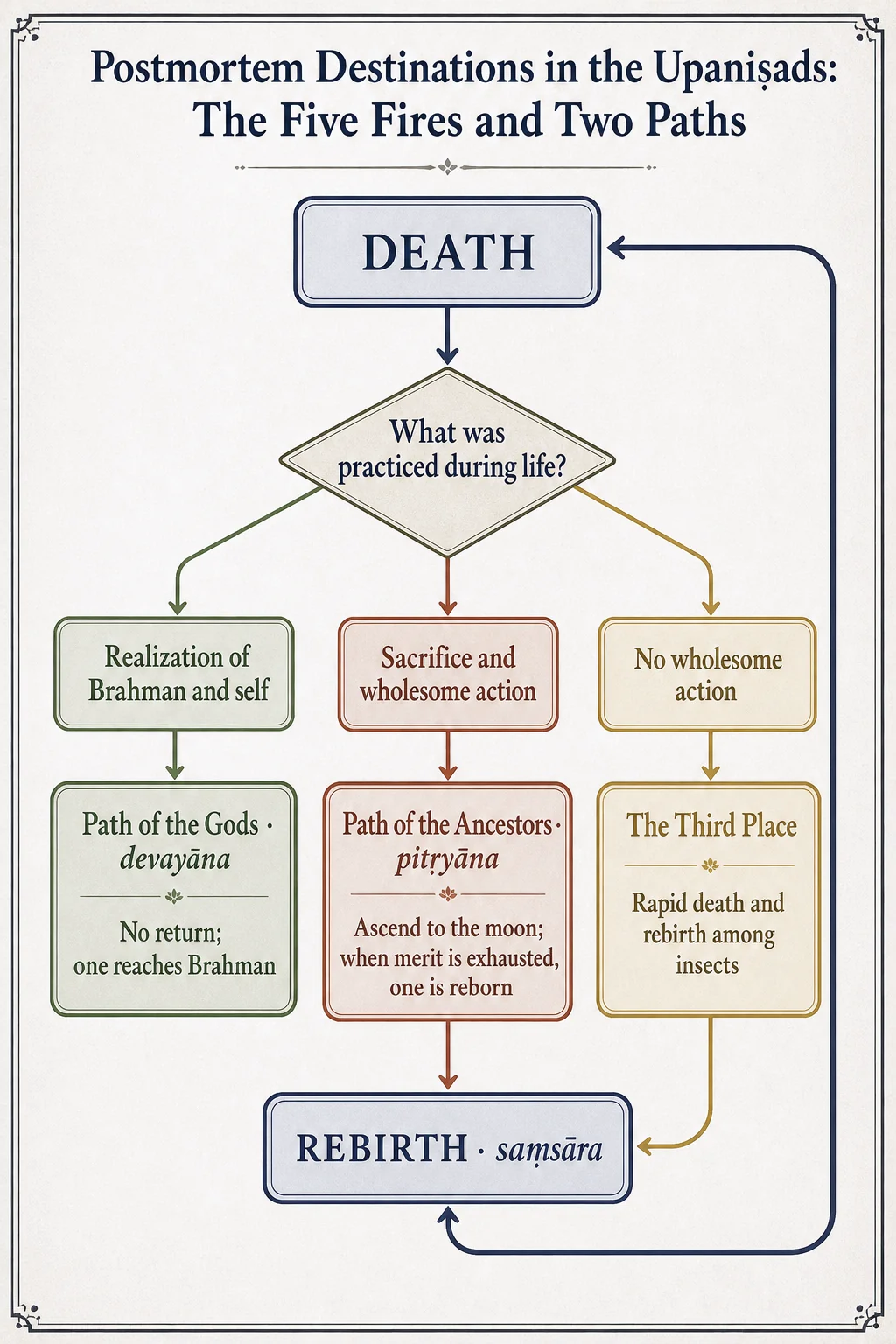
In this diagram, only the “path of the gods” provides an exit; every other path returns to rebirth. The key to the exit is knowledge, not sacrifice. This is where the turn described in Section II leads.
V. Liberation: Escaping Rebirth through Knowledge
The Upaniṣadic theory of liberation becomes clear once the preceding sections are combined:
- Beings undergo rebirth because of karma. The continuing round of birth and death is suffering and must be transcended.
- At the depth of every individual is a permanent self (ātman), identical with the cosmic Brahman.
- Ignorance is the root of rebirth: one does not know this truth and mistakes the changing body and mind for the self.
- Once one truly realizes “I am Brahman,” ignorance is destroyed. Karma no longer exerts its pull, and one is liberated from rebirth.
The key word for liberation is knowledge (jñāna). Sacrifice can at most bring a favorable future birth and thus remains within the round of rebirth. Only the realization of Brahman and self offers complete escape.
The Upaniṣads approach the state of “realization” through one experience in particular: deep sleep (suṣupti). Both the Chāndogya and the Bṛhadāraṇyaka observe that during deep sleep the differentiating activity of consciousness ceases. There is neither pain nor pleasure and no division between subject and object. This is treated as evidence that the identity of Brahman and self takes place each night, though it is forgotten upon waking. True liberation means abiding continuously in such non-differentiating realization while awake. The active path to that state is meditation (dhyāna). Meditation is not yet described systematically in the Upaniṣads; the later Sāṃkhya-Yoga tradition organized it into a graded path from coarse to subtle states.
During his period of training after leaving home, the Buddha studied in succession with two teachers, Āḷāra Kālāma and Uddaka Rāmaputta, and mastered the most advanced meditative attainments of the time. He abandoned each after reaching it and began a path of his own. His criticism was that such states of extreme stillness and non-differentiation remained conditioned and impermanent. Once a practitioner emerged from meditation, they would still fall back into rebirth. Meditation could not itself be liberation. The Buddha did not reject meditation as an instrument, but he completely changed the goal to which it led. Chapter 4 will examine this turning point in detail. For now, its origin should be kept in view: the Buddha rejected the Upaniṣadic, and later Yogic, interpretation of meditative stillness as the abode of a permanent self identical with Brahman.
VI. What Did the Upaniṣads Leave to Buddhism?
The Upaniṣads gave the Buddha both a set of problems and a set of answers. He accepted the problems and rejected the answers.
What Buddhism inherited: the complete framework of karma, rebirth, and liberation; the basic idea that liberation comes from “seeing through to the truth” rather than sacrifice; and the diagnosis of ignorance as the root of rebirth.
What Buddhism rejected: the permanent and unchanging self (ātman) identical with Brahman. The Buddha’s teaching of non-self (anātman, anattā) was directed precisely at this central answer. He retained rebirth and liberation but removed the unchanging subject that supposedly passed through rebirth. How rebirth without a permanent self is possible became a problem Buddhism had to answer for itself—and one over which Buddhists argued for more than a thousand years. This book will return to it repeatedly.
Restraint is required here to avoid overinterpretation. This book holds that the Buddha was more probably responding to ideas of a permanent self widespread among the renunciants and Brahmins of his time than to the wording of these particular texts. Early Buddhist literature does not clearly show the Buddha naming any particular Upaniṣad.4 There is insufficient evidence to present Buddhism as a point-by-point refutation of the Bṛhadāraṇyaka or Chāndogya.
The next chapter turns to the renunciant movement: Jainism, forms of fatalism, materialism, and skepticism. These schools, rather than the tradition of Brahmanical sacrifice, were the Buddha’s closer and more direct interlocutors.
Further Reading
- Herman W. Tull. The Vedic Origins of Karma: Cosmos as Man in Ancient Indian Myth and Ritual. Albany: SUNY Press, 1989.
References
References
-
Patrick Olivelle (trans.). The Early Upaniṣads: Annotated Text and Translation. New York: Oxford University Press, 1998. ↩↩↩↩
-
Joel P. Brereton. “The Upanishads.” In Approaches to the Asian Classics, ed. Wm. Theodore de Bary and Irene Bloom. New York: Columbia University Press, 1990. ↩
-
Signe Cohen. The Upanishads: A Complete Guide. London: Routledge, 2018. ↩
-
Johannes Bronkhorst. Greater Magadha: Studies in the Culture of Early India. Leiden: Brill, 2007. ↩