Chapter 4: The Historical Buddha—Reconstructing a Life without the Myths
The life of the Buddha is one of the most frequently told stories in the world, and much of it consists of legends added layer by layer over several centuries. This chapter follows the method used throughout this book: it first states the legends, then asks what historians can actually say. We will find that the Buddha’s life can be recovered only in outline. For a history of Buddhist philosophy, however, that is enough.
I. The Sources: Where the Biographies Came From
The first fact is already disquieting. No contemporary written record survives from the Buddha’s lifetime. The earliest firm external evidence that mentions him is a pillar erected by Aśoka roughly a century and a half after his death. All the material available to us consists of religious texts transmitted orally within the community and committed to writing only later.
More troubling still, the early literature contains no continuous biography of the Buddha. Its oldest stratum (the scattered passages in the Nikāyas and Āgamas, and narrative settings in the Vinaya) consists only of episodes embedded in teachings and monastic rules. The process of joining those fragments into a complete life from conception to final nirvana unfolded gradually over the following centuries. The later the biography, the more prodigious its miracles.
| Source | Approximate date | Character |
|---|---|---|
| Scattered accounts in the Nikāyas and Āgamas; narrative settings in the Vinaya | Orally transmitted; written down around the first century BCE | Earliest stratum; fragmentary, not a continuous biography |
| Mahāvastu | Accumulated from c. second century BCE to fourth century CE | A Vinaya text of a Mahāsāṃghika-related school; increasingly miraculous |
| Aśvaghoṣa’s Buddhacarita | c. second century CE | Sanskrit narrative poem; a literary complete life |
| Lalitavistara | c. third century CE or later | Mahāyāna-inflected and rich in miracles |
| Nidānakathā | c. fifth century CE (Pali commentary) | The continuous biography that became standard in Theravāda tradition |
This book applies the following principle to its sources: the earlier a detail is, the more incidental its mention, and the less it embellishes the Buddha, the more credible it is. Systematic narratives filled with miracles deserve less confidence.1 A simple criterion is that reports which make the Buddha appear more human, or even undignified (his back pain in old age or his death from illness, for example), offer the least motive for invention and are therefore more likely to approach historical fact.
Excursus: How Reliable Was Oral Transmission in That Period?
To a modern reader, saying that the sources were “orally transmitted and written down only later” instinctively invites a discount: can unwritten material remain accurate after several centuries? That intuition requires correction. In India before the Common Era, well-organized oral transmission was a mature, high-fidelity technology and was not necessarily inferior to manuscript copying as it then existed.
Consider the Vedic precedent discussed in Chapter 1. To preserve the efficacy of sacrifice, Brahmins required every word, sound, and pitch of the Vedas to remain free of error. They therefore developed extremely demanding methods of memorization. In addition to continuous recitation (saṃhitā-pāṭha) and word-by-word recitation (pada-pāṭha), they used “patterned recitations” that repeatedly interlaced word order (krama, jaṭā, ghana): the same sequence might be recited 1-2, 2-1, 1-2-3, 3-2-1, and so forth. Any error in the sequence became immediately obvious and could be corrected on the spot. By these methods, the Rigveda crossed some three millennia with astonishing fidelity.2 In this culture, oral recitation was the prestigious, precise orthodoxy; writing was regarded instead as inferior and impure, unworthy of sacred texts.
Buddhism inherited this culture of recitation and reorganized it for its own needs. A “council” (saṅgīti) was literally a “communal recitation.” The sangha included specialist “reciters” (bhāṇaka) assigned to memorize different collections. Reciters of the Dīgha Nikāya and reciters of the Majjhima Nikāya each kept their own portion, effectively dividing the canon into multiple sets of distributed backups across distinct lines of transmission. The texts themselves were composed for memorization. Formulaic expressions, extensive repetition, teachings organized by number, and summary verses (uddāna) at the ends of sections all supplied redundant error correction. The repetitions modern readers find tedious were precisely the safeguards against corruption.3 Recitation was also collective. If one participant remembered a passage incorrectly, the assembled voices corrected it immediately. The vehicle of transmission was a community, not an individual copyist.4
Under the conditions of the time, the two methods had different strengths and weaknesses:
| Dimension | Oral transmission | Manuscript copying (at the time) |
|---|---|---|
| Fidelity | Formulaic content, patterned recitation, and mutual checking in communal recitation supplied built-in error correction; fixed passages were highly stable | A lone copyist’s mistakes silently accumulated and spread into every downstream copy, without immediate verification |
| Resilience to disaster | Distributed among the minds of many monastics in many monasteries, without a single point of failure; fire, war, and flood could not erase everything at once. If war or famine killed all the reciters in one line, however, its portion disappeared permanently and could not later reemerge like a buried manuscript | Manuscripts were physical objects vulnerable to fire, water, insects, and mold; the destruction of one library could erase it in full |
| Climate | Independent of writing materials | In the South Asian monsoon climate, palm-leaf and birch-bark manuscripts decayed within decades and had to be recopied continually. The oldest surviving Buddhist manuscripts come precisely from arid Gandhāra in the northwest, where the dry climate preserved them12 |
| Cost | Required no materials, only the support of a community of reciters | Writing materials and literate copyists were both scarce and expensive |
The fatal weakness of oral transmission was a break in the succession of reciters. Buddhism turned to manuscripts at precisely the point when this threat became real. According to the Sri Lankan chronicles, the Pali canon was first written down during war and famine in the first century BCE because the reciters were in danger of dying and the teaching of being lost.5 Writing functioned here as insurance for oral transmission, directed at its single most serious weakness.
Returning to the subject of this chapter, a two-sided conclusion follows. This book holds that the organized oral transmission of the period was reliable enough for repeatedly recited, highly formulaic doctrinal content (the four truths and dependent origination discussed in the next chapter) to have been preserved with high fidelity from an early date. This is the basis for using the early discourses to discuss the “earliest teachings.” Two cautions remain. First, accurate transmission does not make the transmitted content true; something invented at the beginning may also be preserved faithfully. Second, biographical narrative was far less fixed than doctrinal formulas and was especially liable to embellishment and accumulation during recitation. This explains the discrepancy between this chapter and the next: why “what the Buddha taught” is more recoverable than “what happened in his life.”
II. A Credible Historical Core
Once the miracles are removed, the firm outline looks roughly as follows:67
- Name: Siddhārtha Gautama (Pali Siddhattha Gotama). “Buddha” (buddha, awakened one), “Śākyamuni” (sage of the Śākya clan), and “Tathāgata” are titles.
- Clan and region: He came from the Śākya clan in the Himalayan foothills and was active on the Ganges plain around Magadha and Kosala.
- Dates: Under the revised chronology adopted in Chapter 1, he reached final nirvana around the turn of the fifth to the fourth century BCE. Tradition says that he lived for eighty years.
- Class: Kshatriya.
One of the most familiar images must be unsettled here. Legend makes the Buddha the crown prince of “King Śuddhodana,” raised amid luxury in palaces for the three seasons. History more probably suggests that the Śākyas formed a small clan oligarchy (gaṇa-saṅgha) led by a chief chosen by an aristocratic council, not a large hereditary kingdom. It also lived under the shadow of Kosala.8 The position taken here is that the “prince” and “palace” were later elevations fitted to a template for great men. Siddhārtha’s actual status was that of a Kshatriya son in a second-tier aristocratic republic. The difference is considerable: he renounced the security of a prominent local family, not an imperial court.
The following table places legend alongside historical inference for several major episodes:
| Episode | Legend | Historical inference (this book) |
|---|---|---|
| Birth and status | Crown prince, son of King Śuddhodana, raised in a palace | Son of a Kshatriya aristocratic family in the Śākya republic; “prince” is an elevation |
| Conception and birth | A white elephant enters his mother’s womb; he is born from her right side, takes seven steps, proclaims “Above heaven and below heaven, I alone am supreme,” and the earth shakes | Miraculous narrative; historically set aside |
| Reason for leaving home | On four excursions he sees an old person, a sick person, a corpse, and a renunciant and resolves to leave home | Didactic legend; its core is that he followed the renunciant way current at the time |
| Night of awakening | He defeats Māra’s army, attains the three knowledges, and causes the earth to quake in six ways | He claimed to have attained awakening and taught on that basis; miracles set aside |
| Final nirvana | Twin trees turn white, the earth shakes, and gods gather | In old age, he became ill after a meal and died; plain and credible |
Traditional biographies divide his life into several stages. Most of their numbers are formulaic approximations, but the following timeline is supplied for reference:
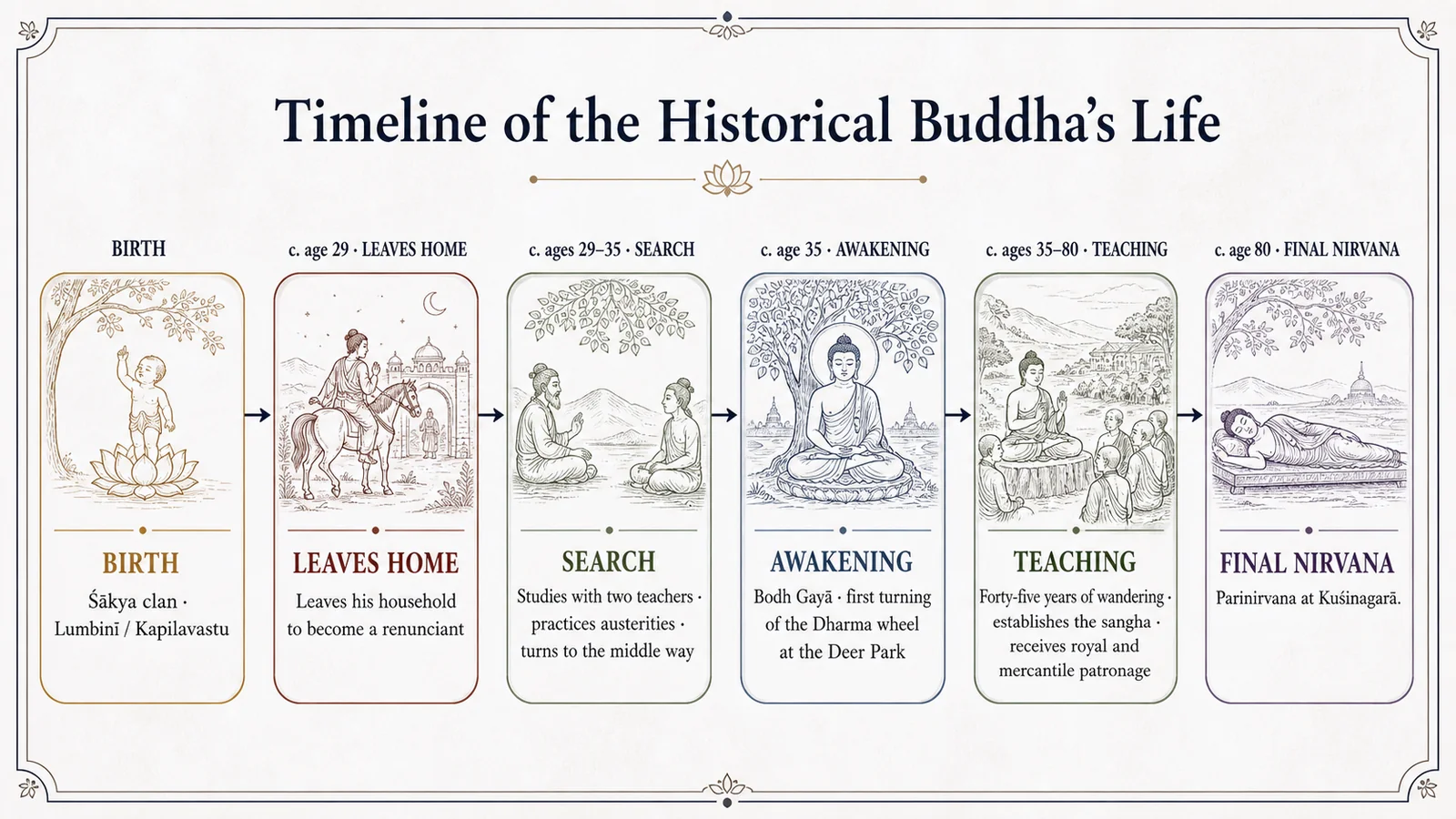
III. Leaving Home and Seeking the Way
In the context supplied by Chapter 3, there was nothing extraordinary about Siddhārtha leaving home to become a renunciant. In that time and place, wandering away from one’s household in search of liberation was an established path.
The story of the “four excursions” says that outside the city he encountered in turn an old person, a sick person, a corpse, and a serene renunciant, and thus realized that life was suffering. The account is too neatly structured as a didactic story and should be treated historically as an allegory. The core that remains is simply that he left his household in the prime of life and entered the renunciant path.
The early texts present what followed in relatively plain terms, giving the account greater credibility. He studied successively under Āḷāra Kālāma and Uddaka Rāmaputta and mastered advanced meditative attainments—the sphere of nothingness and the sphere of neither-perception-nor-non-perception. Finding that these states did not bring an end to birth and death, he left. He then turned to extreme austerity and nearly starved to death, before concluding that self-mortification was equally useless. This was his point of departure from the Jain path discussed in Chapter 3. He abandoned austerity, accepted nourishment, and turned toward what later became known as the middle way (majjhimā paṭipadā).
Abandoning austerity had an immediate social consequence. The five companions (pañcavaggiyā) who had practiced with him saw him accept food, judged that he had fallen into indulgence, and left him for the Deer Park. The detail offers little motive for invention: no religious community would readily record that its founder had been abandoned by fellow practitioners who thought him corrupt. After the Buddha’s awakening, these same five became the audience for his first teaching. The discourse records that he first had to overcome their suspicions before he could begin. The need to “dispel a prior judgment” derives from this episode.
This circuitous sequence, trying two paths and rejecting them both, hardly resembles an invented aura of perfection. This book holds that it preserves a substantially authentic trajectory of spiritual search.
An Objection: Was the Buddha’s Biography Borrowed from Mahāvīra?
The Buddha and the Jain Mahāvīra, Nigaṇṭha Nātaputta in Chapter 3, lived in the same region and period, and their legendary biographies bear striking similarities. Some have therefore asked whether the Buddha’s life story was patterned on Mahāvīra’s.
The parallels are real. Both men were Kshatriyas from the eastern Ganges basin. Both left home in the prime of life, practiced austerities in search of liberation, claimed complete awakening (the Buddha’s bodhi and Mahāvīra’s perfect knowledge, kevala), organized communities, taught for decades, and received the patronage of kings and wealthy merchants. Donors such as Bimbisāra and Ajātasattu appear in both traditions’ lists. Many later titles also overlap, including Conqueror (jina), arhat, omniscient one (sarvajña), and even “Tathāgata”; these belonged to the common vocabulary of renunciants at the time.9 The miraculous structures of the two late, complete biographies match point for point: an extraordinary conception and birth, the great departure, harsh austerities, awakening, teaching, final nirvana, and relics.
This book offers a two-part response. First, what resembles each other is precisely the layer already treated as legend. As Section I explained, both complete biographies are late and both were assembled according to a template for the “great man” (mahāpuruṣa), discussed again in Section VIII. Chapter 3 also noted that titles such as Conqueror and arhat were shared renunciant terms. It is unsurprising that later communities shaped two teachers from similar historical settings and the same renunciant milieu with a common template and vocabulary. A shared template and a shared age are enough; neither life need have been copied from the other.
Second, the layer accepted here as historical does not derive from Mahāvīra. The core recovered above—a Kshatriya from an eastern clan oligarchy, leaving home to become a renunciant, studying with and rejecting two meditation teachers, trying and abandoning extreme austerity, teaching for decades, and dying from illness in old age—consists either of the general structure of any renunciant leader’s life in that period, making resemblance unsurprising, or of scattered, unfavorable details with the least motive for invention, such as death by illness and repeated changes of direction during the search. These are precisely not the features a community would borrow from an opponent.
Two further points tell against a theory of one-way copying. The two schools knew and opposed one another from an early period, as Chapter 3 explained; appropriating an entire biography from an archrival is implausible. The doctrines inserted into their narratives are also radically different—their theories of liberation and practice point in opposite directions. The evidence better fits two traditions filling the same template with different material than one copying the other. This book therefore rejects the claim that the Buddha’s biography derives from Mahāvīra’s. Their similarities corroborate the “great-man template plus a shared renunciant age” described in Section VIII, and they belong only to the legendary layer already set aside. Individual motifs probably did diffuse and move in both directions within the shared culture, but diffuse mutual influence is not wholesale borrowing of the Buddha’s life.
IV. Awakening
At Uruvelā, now Bodh Gaya, Siddhārtha sat in meditation beneath a tree and claimed to attain awakening (bodhi), thereby becoming the “Buddha.”
Biographies tell how Māra led an army against him and tempted him with daughters of desire; how the Buddha called the earth to witness and defeated Māra; and how he successively attained the “three knowledges” in the three watches of the night. These are highly mythologized descriptions. Different discourses give different accounts of the precise content of awakening (the four truths, dependent origination, the destruction of the taints), and these belong to doctrine rather than biography. They will be considered in Chapter 5. Historically, only one statement can be made with confidence: he underwent a transformation regarded by both himself and his disciples as complete liberation, and he began to teach on that basis.
Tradition says that at the Deer Park, now Sarnath, he first taught the five former companions with whom he had practiced austerities. This was the “first turning of the wheel of Dharma,” and the community began from there.
V. Forty-Five Years: The Sangha and the Work of Teaching
Tradition holds that after awakening the Buddha taught for forty-five years, wandering through the states of the middle Ganges basin and taking up a fixed residence only during the rains retreat.
“Forty-five years” is itself the product of a formula: awakening at about thirty-five and final nirvana at about eighty. Some later traditions, especially in China, often say that the Buddha “taught for forty-nine years,” corresponding to an awakening at thirty and perhaps also to the symbolic number seven times seven. The position taken here is that forty-five years is already an approximation; forty-nine is an even later and tidier construction, further removed from historical fact, and is not adopted in this book.
A precise chronology of these years cannot be recovered, but several developments are broadly credible:
- Establishment of the sangha: He organized a community of renunciants governed by rules for communal life. This organizational foundation allowed Buddhism to survive for more than two thousand years after its founder’s death and is of great importance.
- Lay patronage: He received support from kings and wealthy merchants. Bimbisāra, Pasenadi, and Anāthapiṇḍika recur as donors. This corresponds closely to the urbanization and new mercantile wealth discussed in Chapter 1.
- Establishment of the order of nuns: Tradition says that his aunt Mahāpajāpatī asked to go forth, that the Buddha repeatedly refused, and that he finally agreed on condition that she accept the “eight rules of respect.” The narrative of repeated refusal and the eight rules bears stylistic signs of later insertion. Many scholars now doubt that it preserves the original event and it should remain uncertain.11
- Devadatta’s schism: His cousin Devadatta demanded stricter rules of austerity and, after failing, established a separate community. An internal hard-line faction challenging a leader in the name of “greater austerity” has the texture of a real conflict; this book holds that the episode has a historical core.
Several disciples appear with very high frequency in early discourses and are credible historical figures. Sāriputta and Moggallāna were the two most prominent. As Chapter 3 noted, both had previously studied with Sañjaya Belaṭṭhiputta. They belonged to a group of serious seekers dissatisfied with his refusal to commit and eventually joined the Buddha. Ānanda, the Buddha’s attendant, is the interlocutor in many Nikāya dialogues. The oral tradition says that at the First Council he recited many discourses he had heard directly from the Buddha, making him a central figure in the transmission of the Sutta collection. Upāli was celebrated for preserving the Vinaya through recitation.
The geographical range of the Buddha’s teaching centered on the middle Ganges basin. Several cities recur as the settings named at the opening of Nikāya discourses and constitute credible historical information:
| City | Sanskrit/Pali | Principal association |
|---|---|---|
| Rājagṛha | Rājagṛha/Rājagaha | Capital of Magadha; patronage of Bimbisāra and his son Ajātasattu |
| Śrāvastī | Śrāvastī/Sāvatthī | Capital of Kosala; Jeta’s Grove in Anāthapiṇḍika’s Park; the most frequent setting of Nikāya discourses |
| Vaiśālī | Vaiśālī/Vesālī | Clan oligarchy of the Licchavis; associated with the establishment of the order of nuns; location of the Second Council |
| Vārāṇasī (Deer Park) | Vārāṇasī (Isipatana) | Location of the first turning of the wheel of Dharma |
| Kuśinagarā | Kuśinagarā/Kusinārā | Location of final nirvana |
This distribution shows that the Buddha taught throughout the eastern region of cities and clan oligarchies. He did not penetrate the major western centers of Brahmanical sacrifice. His range thus coincides closely with the setting of the second urbanization discussed in Chapter 1.
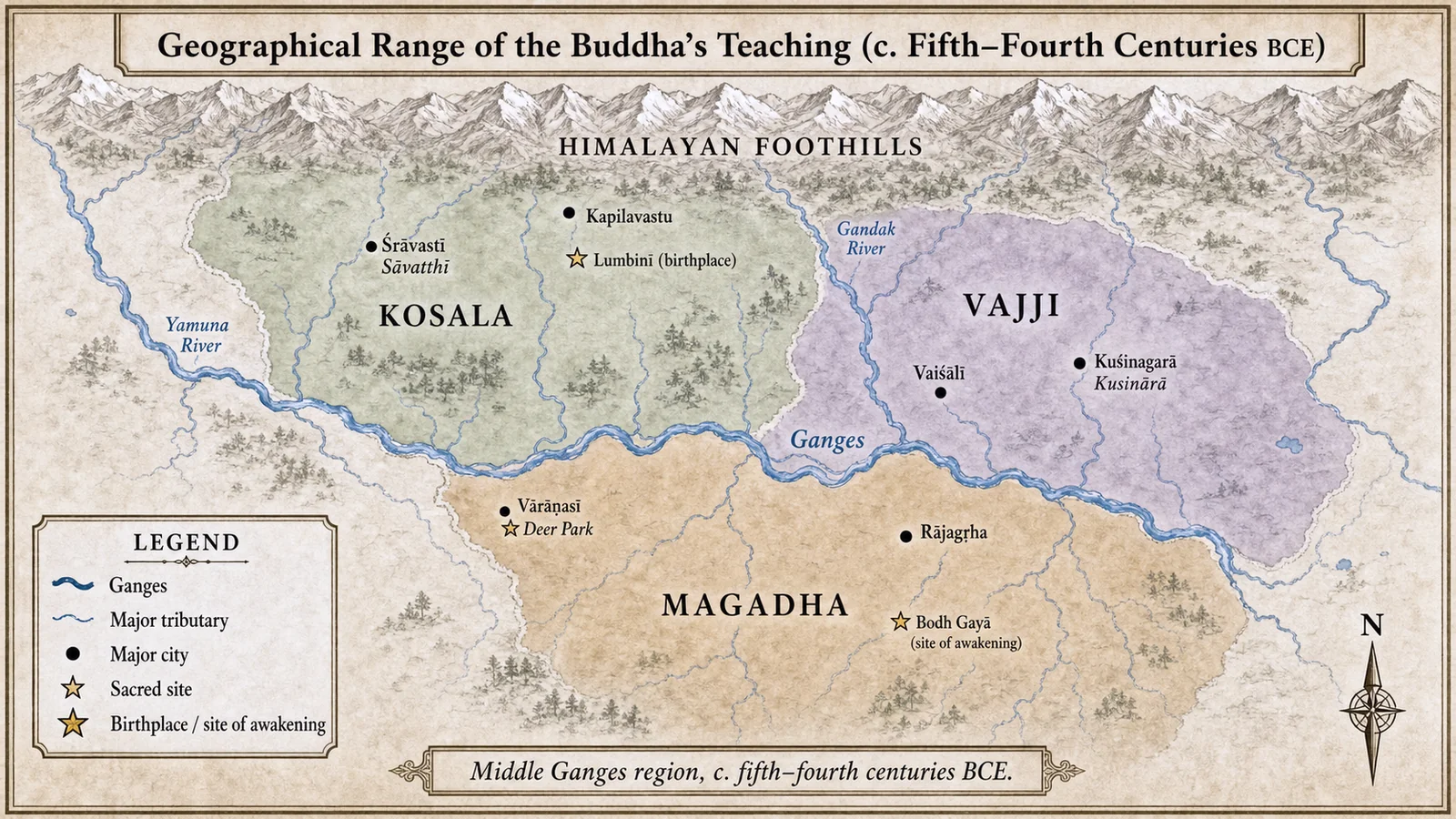
The early discourses consistently portray his style of teaching as beginning from an interlocutor’s concrete question and using analogy and counterquestion to expose problems in its presuppositions, rather than presenting a topic systematically on his own initiative. Hardly any early discourse has the Buddha independently laying out a sustained treatise from beginning to end. Almost every teaching occurs as a response to a particular occasion; audiences differ, and content is adapted to the person. What survives is consequently a large body of situational teachings rather than a unified doctrinal manifesto. This made later systematization difficult and left later generations ample room for interpretation.
VI. Final Nirvana
The Buddha’s death is particularly credible precisely because it is not miraculous.
According to the tradition of the Mahāparinibbāna Sutta, at the age of eighty he was in the territory of the Mallas near Kusinārā. After eating a dish offered by the smith Cunda, he developed an acute illness (possibly dysentery), and soon passed away between twin trees, entering “final nirvana” (parinibbāna). The dish was called sūkara-maddava, a phrase literally associated with “pig.” Whether it meant pork or some kind of mushroom has been disputed since antiquity and remains unresolved. The position taken here is that a religious founder growing ill after a meal and dying like an ordinary old man is such an undignified end that there is almost no motive to invent it. It is among the firmest historical facts in the entire biography.
Around this unadorned death, however, the same Mahāparinibbāna Sutta inserts an intriguing narrative deserving separate attention. It says that several months before his final nirvana, at the Cāpāla shrine outside Vaiśālī, the Buddha told Ānanda that anyone who had fully cultivated the four bases of spiritual power (iddhipāda) could, if they wished, remain for an aeon or the remainder of one. The Buddha said this three times. Ānanda did not understand the hint and failed to ask him to remain; the text says his mind was “possessed by Māra.” When Ānanda left, Māra appeared and urged the Buddha to enter final nirvana. The Buddha then relinquished his “life-force” (āyusaṅkhāra), the power sustaining his lifespan, and declared that he would enter final nirvana after three months. He later told Ānanda that the fault was his: the Buddha had given the sign three times, yet Ānanda had failed to ask him to remain. Had he asked three times, the Tathāgata would have consented.10
The structure of the story is revealing. It transforms an awkward question (why an awakened teacher of gods and humans, reputed to possess immense spiritual powers, did not live on but died in an aged and sick body) into a different account. It was not that the Buddha could not remain. He could have lived for an aeon, but the attendant Ānanda, momentarily confused and obscured by an external Māra, missed the opportunity to ask. The limits of “ability” and the issue of “willingness” are both quietly bypassed. The Buddha’s image of omnipotence is preserved, while responsibility for why he died falls upon Ānanda and Māra. As narrative, it functions almost as an apologetic: Ānanda’s failure and Māra’s interference explain away a death that was in itself natural.
This book does not avoid the two opposed implications toward which the story may point. Read at one extreme, it reveals an unease within the community. If the Buddha’s death were truly natural and ordinary, and if “even an awakened one cannot escape death” did no damage to the teaching, why invent the account that “he need not have died and did so only because of a mistake”? The covering may reflect an unspoken anxiety about the founder’s death and perhaps even about the completeness of his liberation. Read at the other extreme, it may simply represent a compromise forced upon the community by external pressure. Many religions competed at the time and opponents surrounded the Buddhists. “If your teacher was truly perfected, why did he die of illness like an ordinary person?” supplied a ready objection. The narrative may therefore reflect not inward anxiety but a defensive wall quickly built in answer to outsiders. The sources do not permit a decision between these readings. This book presents both and asks readers to notice that even the text recording the Buddha’s “plain death,” treated in this chapter as the most credible account, wraps that death in later apologetic fabric.
After his death, several clans divided his bones, or relics, and each erected a stupa over its portion. The later claim that Aśoka constructed “eighty-four thousand stupas” belongs to legend and is set aside.
VII. Did He Exist? The Archaeological Anchor
A few nineteenth-century scholars, influenced by theories of “solar myth,” doubted that the Buddha was anything more than a mythical figure. No scholar now maintains this extreme skepticism. This book takes the position that the Buddha was a real historical person, although his life can be reconstructed only in outline. The reason is practical: the biography of a wholly mythic object should not preserve so many plain, fragmentary, and even unfavorable details—his origins in a minor clan oligarchy, the reversals in his search, and the indignity of death by illness.
The earliest firm external anchor is the pillar erected by Aśoka at Lumbinī around 250 BCE. Its inscription says that Aśoka visited the place in person and remitted its taxes because “the Buddha Śākyamuni was born here.”7 This is the earliest epigraphic confirmation known to date. It nevertheless stands about a century and a half after the Buddha’s lifetime. It can show only that by Aśoka’s time the Buddha and his association with this place were venerated as historical fact, not supply a contemporary record of the Buddha’s life.
VIII. How the Legends Arose
To judge legends unhistorical does not mean that they were invented at random. Early India possessed a template for the “great man” (mahāpuruṣa): a person bearing the thirty-two marks would become either a universal monarch or a Buddha. The miraculous biography of the Buddha was largely assembled according to this model, making him a figure of cosmic stature who could guarantee his teaching and secure authority and patronage for his community. Legend therefore has functions and a logic of its own. This book’s method is to identify it, explain why it arose, and then set it aside when reconstructing history.
A broad historical outline can now be given: a man who left a local aristocratic republic, tried and rejected several approaches within the renunciant path, claimed awakening, organized a sangha, and taught for more than forty years. What exactly he “awakened” to, and what he taught, are the subjects of the next chapter.
References
References
-
André Bareau. Recherches sur la biographie du Buddha dans les Sūtrapiṭaka et les Vinayapiṭaka anciens. Paris: École française d’Extrême-Orient, 1963–1971. ↩
-
J. F. Staal. “The Fidelity of Oral Tradition and the Origins of Science.” Mededelingen der Koninklijke Nederlandse Akademie van Wetenschappen, n.s. 49.8. Amsterdam: North-Holland, 1986. ↩
-
Mark Allon. Style and Function: A Study of the Dominant Stylistic Features of the Prose Portions of Pāli Canonical Sutta Texts and Their Mnemonic Function. Tokyo: International Institute for Buddhist Studies, 1997. ↩
-
Alexander Wynne. “The Oral Transmission of the Early Buddhist Literature.” Journal of the International Association of Buddhist Studies 27, no. 1 (2004): 97–127. ↩
-
Steven Collins. “On the Very Idea of the Pali Canon.” Journal of the Pali Text Society 15 (1990): 89–126. ↩
-
Hajime Nakamura. Gotama Buddha: A Biography Based on the Most Reliable Texts. Tokyo: Kosei, 2000. ↩
-
Étienne Lamotte. History of Indian Buddhism: From the Origins to the Śaka Era. Trans. Sara Webb-Boin. Louvain: Peeters, 1988 (French original, 1958). ↩↩
-
Richard F. Gombrich. Theravāda Buddhism: A Social History from Ancient Benares to Modern Colombo. London: Routledge, 1988. ↩
-
Naomi Appleton. “The Multi-life Stories of Gautama Buddha and Vardhamāna Mahāvīra.” Buddhist Studies Review 29, no. 1 (2012). ↩
-
For the episode at the Cāpāla shrine, see the Pali Mahāparinibbāna Sutta (DN 16, third recitation section): the Buddha states three times that “one who has cultivated the four bases of spiritual power can remain for an aeon”; Ānanda fails three times to ask the Buddha to remain (the text says that his mind was “possessed by Māra,” pariyuṭṭhitacitto); Māra immediately urges the Buddha to enter final nirvana, and the Buddha relinquishes his life-force at the Cāpāla shrine. The Buddha later states that this was Ānanda’s fault. On relinquishing the life-force, see also Udāna 6.1. For discussion of the episode’s apologetic character and textual strata, see André Bareau, Recherches, and Ernst Waldschmidt, Die Überlieferung vom Lebensende des Buddha. Göttingen: Vandenhoeck & Ruprecht, 1944–1948. ↩
-
Michael Carrithers. The Buddha. Oxford: Oxford University Press, 1983. ↩
-
Richard Salomon. Ancient Buddhist Scrolls from Gandhāra: The British Library Kharoṣṭhī Fragments. Seattle: University of Washington Press, 1999. ↩