Chapter 3: The Renunciant Movement—Jainism, Fatalism, Materialism, and Skepticism
The Upaniṣads discussed in the previous chapter represent a transformation within the Brahmanical tradition. Most of the Buddha’s most direct peers and opponents, however, were not on the Brahmanical side. They belonged to another group: the renunciants (śramaṇa; Pali samaṇa). This chapter examines the renunciant movement, the intellectual arena in which the Buddha himself participated. The Buddha was a renunciant. To locate Buddhism, we must see who else stood in that arena and what each taught.
A difficulty with the sources must be stated first. Apart from Jainism, most renunciant schools left no scriptures of their own. What we know comes principally from Buddhist and Jain texts, which describe intellectual opponents from partisan points of view. This book therefore reads these accounts as secondhand material shaped by opponents and possibly simplified or even caricatured. Claims corroborated across traditions deserve more confidence; isolated testimony remains doubtful.
I. Who Were the Renunciants?
Around the sixth century BCE, the eastern Ganges basin (the setting of the second urbanization discussed in Chapter 1) saw the appearance of wandering practitioners who had left their homes. They were collectively called renunciants. They and the Brahmin priests represented two distinct traditions; texts of the time often pair “renunciants and Brahmins” as the two kinds of religious specialist in society.
Renunciant schools differed greatly, but they shared several underlying features:
- They rejected the authority of the Vedas and denied that sacrifice was all-powerful.
- Most accepted the problem-framework of karma, rebirth, and liberation (as Chapter 2 noted, this framework may itself have originated in the east).
- They “went forth” (pravrajyā), seeking liberation through personal practice rather than ritual.
The fundamental disagreement between the renunciant movement and Brahmanical orthodoxy thus concerned who or what brings liberation. Buddhism and Jainism were both developments within this movement, not simple offshoots of the Brahmanical sacrificial tradition.
The most conspicuous outward form of renunciant practice was bodily austerity (tapas). Its severity varied among schools, but it was a widespread cultural phenomenon: prolonged fasting or extreme restriction of food; going naked; holding difficult postures for long periods, such as standing on one leg or keeping both arms raised; exposing oneself to scorching sun or sitting motionless in bitter cold; refusing to wash; and making no effort to drive away biting mosquitoes. The theoretical justification differed. Jains held that austerity could exhaust accumulated past karma. Ājīvikas held that austerity changed nothing, for liberation would come automatically at its appointed time. Other groups believed austerity accumulated a spiritual heat powerful enough to affect cosmic processes—the word tapas itself connotes “heat.”
After leaving home, the Buddha also practiced extreme austerities. The texts describe him as having tried everything possible before judging such practices ineffective and turning toward what later became known as the “middle way.” This background is necessary if we are to appreciate the force the “middle way” possessed in its original context.
II. The Six Teachers and the Problem of Sources
Buddhist texts group several famous renunciant leaders contemporary with the Buddha as the “six heterodox teachers.” They appear together in the Sāmaññaphala Sutta (“Discourse on the Fruits of the Renunciant Life”) in the Dīgha Nikāya: King Ajātasattu visits all six without finding satisfaction, and only then goes to see the Buddha.1 The list is a Buddhist classification whose arrangement puts the rivals on display before having the Buddha surpass them one by one. This book treats it as a useful lead, not a neutral record.
| Figure (Pali name) | Doctrine | Central claim | Later history |
|---|---|---|---|
| Pūraṇa Kassapa | Non-action (akiriya) | Good and evil actions produce no consequences; killing and giving are alike without merit or fault | No surviving tradition |
| Makkhali Gosāla | Fatalism (niyati); Ājīvika school | Everything is determined by destiny; effort and karma are ineffective; beings are liberated automatically after a fixed number of rebirths | Ājīvikas continued for more than a thousand years before disappearing |
| Ajita Kesakambala | Materialism; annihilationism | A person is merely the four elements, which disperse at death; there is no afterlife and no karmic result | Forerunner of Lokāyata |
| Pakudha Kaccāyana | Eternalism of the seven bodies | Earth, water, fire, air, pain, pleasure, and life are seven eternally immobile principles; “killing” is merely a rearrangement of elements | A form of eternalism |
| Sañjaya Belaṭṭhiputta | Skepticism (amarāvikkhepa) | Withholds judgment and evades answers to all metaphysical questions | His pupils Sāriputta and Moggallāna later joined the Buddha |
| Nigaṇṭha Nātaputta (Mahāvīra) | Jainism | Karma is subtle matter that adheres to the soul; nonviolence and austerity stop and exhaust it, bringing liberation | Survives today |
The next four sections expand on the schools named in the chapter title. The other two figures, Pūraṇa and Pakudha, will be discussed where relevant.
III. Jainism: A Radical Theory of Karma and Nonviolence
Jainism is the only one of the six schools to survive to the present. The leader whom Buddhist texts call Nigaṇṭha Nātaputta is the figure honored by Jains as Mahāvīra, a rough contemporary of the Buddha.
Legend must first be distinguished from history. Jain tradition speaks of twenty-four “ford-makers” (tīrthaṅkara), with Mahāvīra the last. This book regards the sequence of twenty-four patriarchs as largely a sectarian construction. Historically, a community of “Nigaṇṭhas” (nirgrantha, “those without bonds”) in the line of Pārśva existed about two centuries before Mahāvīra. Mahāvīra reformed and reorganized this older community rather than founding a new school from nothing.2
Jain metaphysics makes a demanding set of commitments:3
- The world consists of “life” (jīva, ensouled beings) and “non-life” (ajīva).
- Karma is an extremely subtle kind of matter, not an abstract moral ledger. Passions and actions cause karmic matter to “flow in” (āsrava) and adhere to the soul. This soils and weighs down the soul, which is originally pure and luminous, and traps it in rebirth.
- Liberation requires first “guarding” (saṃvara) against the influx of new karma and then using austerity (tapas) to exhaust accumulated karma (nirjarā). Once completely purified, the soul is freed from bondage, rises to the summit of the cosmos, attains perfection (kevala), and is never reborn.
The mechanism may be represented as a sequence:
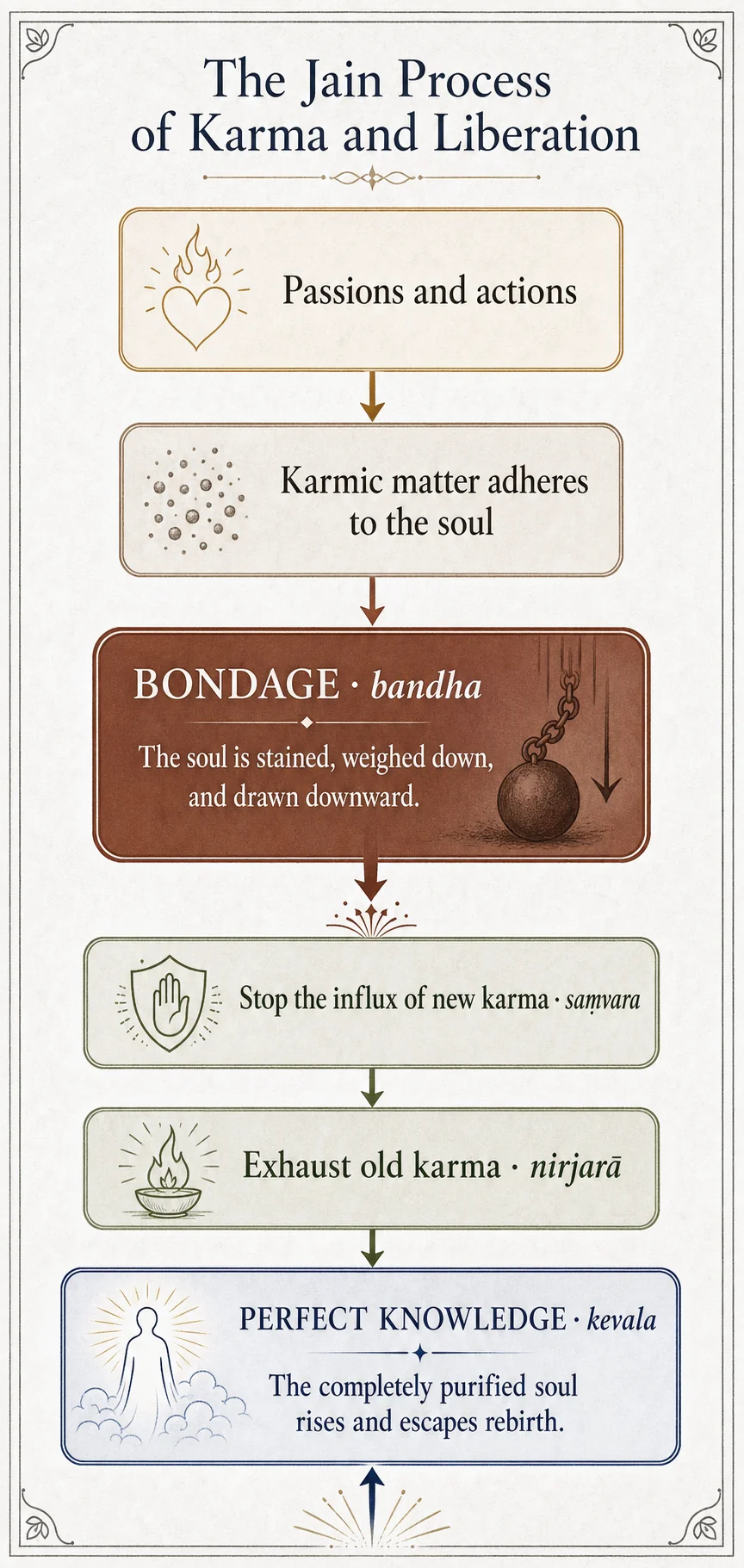
Two consequences deserve emphasis. First, if even unintended harm attaches karmic matter to the soul, ethics must tend toward radical nonviolence (ahiṃsā). Jain monks strain water, sweep the ground before them, abstain from agriculture, and in some orders go naked and possess nothing, all to minimize harm. Second, if past karma must be eliminated through austerity, practice tends toward severe self-mortification; fasting to death is regarded as the highest form of a good death.
Jainism also developed a celebrated epistemology of many-sidedness (anekāntavāda) and conditional predication (syādvāda, “perhaps it is so”). The mature form of this epistemology probably postdates Mahāvīra and should not simply be attributed to him. Since it has been raised, however, a basic explanation is appropriate.
The doctrine of many-sidedness holds that every object has innumerable aspects (anta). A single proposition can grasp only one perspective, and an absolute assertion about any question (ekānta, “clinging to one side”) is therefore partial. The proper procedure is to qualify each proposition with syāt (“perhaps,” or “from one point of view”), acknowledging its local correctness without excluding other perspectives. The classic form developed into “sevenfold predication” (saptabhaṅgī), seven combinations of claims about the same object, each qualified by “perhaps”: “perhaps it is,” “perhaps it is not,” “perhaps it both is and is not,” “perhaps it is inexpressible,” and so forth.
This theory marked a distinctive position in the renunciant arena. It absorbed the absolute assertions of other schools as partial truths and claimed a higher vantage point from which to judge them all. Critics responded that if every assertion is only partially correct, this Jain assertion must itself be only partially correct, generating a logical regress. The Jain reply was that syādvāda is a metaproposition about the limitations of assertions and is not subject to the same limitation. The dispute continued for centuries without a decisive victor.
Of all the Buddha’s contemporaries, Jainism offers the closest mirror. It too rejected the Vedas, taught karma and rebirth, sought liberation, and practiced renunciation. It differed on two points: whether karma was material and whether liberation required extreme austerity. The Buddha answered both differently, as a later section will show.
IV. Fatalism: Makkhali Gosāla and the Ājīvikas
The Ājīvika school founded by Makkhali Gosāla (formerly translated in Chinese as the “heterodox livelihood” school) held that everything was determined by destiny (niyati). Effort, spiritual practice, and karmic retribution were all illusions. No one’s actions could change anything. Beings were destined to pass through a fixed and immensely long number of rebirths, after which liberation would arrive automatically. The Sāmaññaphala Sutta records his analogy: it is like throwing a ball of thread, which simply rolls until it has completely unwound. Human liberation arrives in the same way at its appointed time, regardless of practice.1
The Ājīvikas were not insignificant. They attained considerable size and royal patronage; Aśoka and his successors donated caves to Ājīvika practitioners. The school survived in southern India for more than a thousand years before disappearing.4 We may infer that it was a consequential opponent in the Buddha’s time. The Buddha judged it with exceptional severity. In the Aṅguttara Nikāya, he called Makkhali’s fatalism the most harmful view because it erased the very meaning of practice.
V. Materialism: Ajita and Lokāyata
Ajita Kesakambala, whose epithet means “the one with a garment of hair,” taught thoroughgoing materialism. A person was nothing more than a temporary combination of earth, water, fire, and air. At death, the four elements dispersed and the person became nothing. There was no afterlife and no karmic result; generosity, sacrifice, and good deeds earned no future reward. This is a classic form of annihilationism (uccheda-vāda).1
The school later became known as Lokāyata or Cārvāka. A qualification is needed: systematic Lokāyata doctrine appears in later sources; Ajita was an early representative of this position in the Buddha’s time.5 His presence here is significant. In fifth-century BCE India, someone was already publicly advocating a purely materialist doctrine with neither soul nor afterlife. The spectrum of Indian thought stretched from the Upaniṣadic eternal identity of Brahman and self at one end to total extinction at death at the other.
Adjacent to Ajita stood Pakudha Kaccāyana’s “eternalism of the seven bodies.” Earth, water, fire, air, pain, pleasure, and life were seven eternal and immobile elements. When a sword passed through a body, it merely went through the spaces between these elements; no one killed and no one was truly harmed. From the opposite direction, the eternity of everything, this doctrine likewise abolished moral responsibility. The Buddha later treated the “eternalist view” and the “annihilationist view” as two extremes: precisely the two poles he sought to avoid.
VI. Skepticism: Sañjaya’s Refusal to Commit
Sañjaya Belaṭṭhiputta represented another response: he declined to take a position on any metaphysical question. Is there an afterlife? Does karma bear fruit? He would invariably answer, “I do not say it is so; I do not say it is not so; I do not say it is both so and not so,” and continue circling without settling on either side. Buddhist texts call this style “eel-wriggling” (amarāvikkhepa): it slips from one’s grasp like an eel.1
A distinction is required to avoid misreading. Sañjaya’s evasion was a skepticism that suspended judgment whenever it encountered a difficult question. The Buddha also remained silent on some issues—the undeclared questions (avyākata) discussed later—but his silence was selective. Questions that did not conduce to liberation and merely multiplied conceptual proliferation were set aside; what needed to be taught was taught. The two approaches look similar but differ in substance. One historical clue is worth remembering: before joining the Buddha, his two chief disciples Sāriputta and Moggallāna had been pupils of Sañjaya. This suggests that Sañjaya attracted serious seekers who nevertheless found a simple refusal to commit unsatisfying.
VII. Where Did the Buddha Stand?
Every position is relative. Compared with the renunciant leaders discussed in this chapter, the Buddha’s place becomes clear. He too was a renunciant. He shared the rejection of the Vedas, the framework of karma and rebirth, and the quest for liberation through leaving home, yet he also drew a boundary against every neighboring position.
| Issue | Opposing position | The Buddha’s position |
|---|---|---|
| Moral causation (the fruit of karma) | Denied by Pūraṇa (non-action) and Ajita (annihilation) | Affirmed: karma bears fruit |
| Effectiveness of effort | Denied by Makkhali (fatalism) | Affirmed: the practice of the path works and can change one’s destination |
| Existence of a permanent self | Affirmed by the Upaniṣads, Jainism (jīva), and Pakudha (the seven bodies) | Denied: non-self |
| What happens after death | Ajita teaches annihilation | Neither annihilation nor eternal survival: conditioned continuity without a permanent self |
| Method of practice | Extreme Jain austerity | The middle way: avoiding the extremes of self-mortification and sensual indulgence |
| Metaphysical problems | Sañjaya evades all of them | Answers selectively; sets aside questions irrelevant to liberation as undeclared |
One distinction is especially important. Jainism treated karma as matter adhering to the soul and sought to burn it away with austerity. The Buddha instead defined the core of karma as intentional action: the decisive element in karma is the intention (cetanā) behind an act. This change relocated the work of liberation from tormenting the body to training the mind.6 This book regards it as the decisive difference between the Buddha and the renunciants around him, especially the Jains who otherwise resembled him most closely.
The background to this entire field of renunciant thought lies in the eastern culture of “Greater Magadha” discussed in the preceding two chapters. Understanding the Buddha therefore requires more than beginning with Brahmanical sacrifice. He must also be returned to the company of the renunciant schools of his own age.
The first three chapters have now established three contexts: the social world in which the Buddha lived, the Brahmanical answers to which he responded, and the renunciant intellectual environment in which he participated. The next chapter returns to the Buddha himself, removes the covering of legend as far as possible, and asks what can be said about the historical figure.
References
References
-
Maurice Walshe (trans.). The Long Discourses of the Buddha: A Translation of the Dīgha Nikāya. Boston: Wisdom Publications, 1995. (For the six teachers, see the Sāmaññaphala Sutta.) ↩↩↩↩
-
Paul Dundas. The Jains, 2nd ed. London: Routledge, 2002. ↩
-
Padmanabh S. Jaini. The Jaina Path of Purification. Berkeley: University of California Press, 1979. ↩
-
A. L. Basham. History and Doctrines of the Ājīvikas: A Vanished Indian Religion. London: Luzac, 1951. ↩
-
Ramkrishna Bhattacharya. Studies on the Cārvāka/Lokāyata. London: Anthem Press, 2011. ↩
-
Richard F. Gombrich. What the Buddha Thought. London: Equinox, 2009. ↩