Chapter 4 The Proliferation of the Schools: Eighteen or Twenty?
The previous chapter discussed the root schism, when the Saṅgha first divided into the Sthavira and Mahāsāṃghika branches. This chapter follows their subsequent development: each branch divided again, spreading into what tradition calls the "eighteen schools"—although some accounts count twenty. One qualification must be made at the outset. The number is approximate, and the lists supplied by the different traditions do not agree. This chapter is therefore best understood as a map. It explains why the sources count differently, identifies the major schools, and surveys their principal territories and doctrines; detailed discussions of their philosophies are reserved for Part III. The conclusion reached in 2.3 still holds: a school was normally a differentiation of ordination lineage and doctrinal orientation, not a "split in the Saṅgha" in the strict disciplinary sense.
1. "Eighteen Schools" Is an Approximation
"Eighteen schools" is a traditional, almost formulaic number; it need not represent an exact census. The principal sources on the genealogies of the schools disagree over their number, names, order, and relationships:1
| Text or tradition | General framework | Perspective |
|---|---|---|
| Dīpavaṃsa and Mahāvaṃsa (Theravāda) | Eighteen schools arise during the second century after the Buddha's parinirvāṇa | Treats the Sthavira Vibhajyavāda as orthodox and all others as "splinter schools" |
| Vasumitra's Samayabhedoparacanacakra (Sarvāstivāda) | Nine Mahāsāṃghika-line and eleven Sthavira-line schools, twenty in all | Organizes the genealogy from a Sarvāstivāda viewpoint |
| Three accounts in Bhāviveka's Nikāyabhedavibhaṅgavyākhyāna (Tibetan translation) | Places three different lists side by side | Shows precisely that no single account was accepted within the tradition |
| Śāriputraparipṛcchā | Yet another genealogy | Not listed here |
The reason for the disagreement is not hard to imagine. Schools gradually formed over several centuries along lines of ordination, doctrine, and geography. Each tradition remembered the process differently, and each had an incentive to arrange the genealogy to its own advantage—the Theravādins, for example, represented themselves as orthodox and others as groups that "split away." This book's position is that no single list should be treated as an exact historical register. It is safer to read them as competing maps. The difference between "eighteen" and "twenty" probably results mainly from different methods of counting: whether the two root schools themselves are included.
2. Which Schools Emerged from the Two Branches?
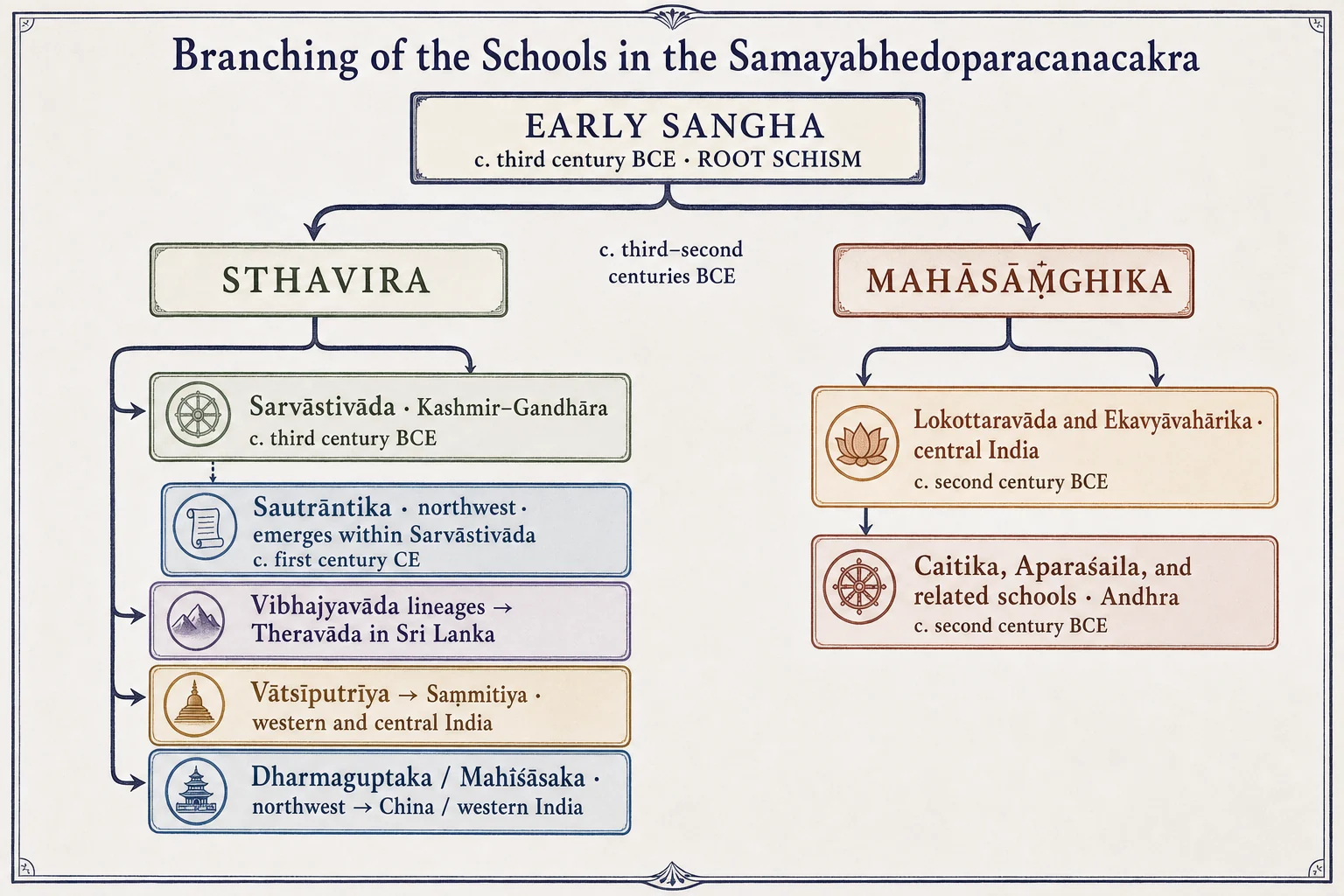
In the framework represented by the Samayabhedoparacanacakra, the branches are roughly as follows:
- The Mahāsāṃghika line (about nine schools including the original): the Mahāsāṃghikas, Ekavyāvahārikas, Lokottaravādins, Kaukkuṭikas, Bahuśrutīyas, Prajñaptivādins, and the southern Indian Caitikas, Aparaśailas, and Uttaraśailas.
- The Sthavira line (about eleven schools including the original): the Sarvāstivādins; the Haimavatas (the Sthaviras who remained in the original school); the Vātsīputrīyas and their further branches, the Dharmottarīyas, Bhadrayānīyas, Saṃmitīyas, and Sannāgarikas; the Mahīśāsakas; Dharmaguptakas; Kāśyapīyas; and Sautrāntikas.
Together they number about twenty; subtracting the two root schools leaves exactly eighteen. This is the principal basis of the differing totals. It bears repeating that this is the Sarvāstivāda arrangement. The Theravāda and Bhāviveka accounts change both the names and the lines of descent.
The following diagram sketches the principal branches according to the framework of the Samayabhedoparacanacakra. Dates in parentheses are scholarly estimates with wide margins and should not be read as an exact chronology:
3. The Principal Schools: Territories and Doctrines
The following table lists the lineages, principal territories, and central teachings of several major schools. For doctrinal details, see the chapters indicated.
| School | Lineage | Principal territories | Principal teachings | See |
|---|---|---|---|---|
| Sarvāstivāda | Sthavira | Kashmir–Gandhāra, Mathurā | Dharmas exist in all three times; the intrinsic nature of a dharma always exists; a vast Abhidharma | Part III.1 |
| Theravāda (Vibhajyavāda) | Sthavira | Sri Lanka, Southeast Asia | Analytical discrimination among dharmas; transmits the Pāli Canon | Part III.4 |
| Vātsīputrīya → Saṃmitīya | Sthavira | Western and central India | Posits a pudgala, a "person" that is neither identical with nor separate from the aggregates | Part III.5 |
| Sautrāntika | Sthavira (emerged from Sarvāstivāda) | Northwest | Only the present truly exists; continuity explained through "seeds" | Part III.3 |
| Dharmaguptaka | Sthavira | Northwest, Central Asia → China | Gives greater importance to the Buddha than to the Saṅgha; transmits the Dharmaguptaka Vinaya in Four Parts | Part II.1 |
| Mahīśāsaka | Sthavira | Western India | Transmits the Mahīśāsaka Vinaya in Five Parts | Not discussed separately |
| Lokottaravāda | Mahāsāṃghika | Central India | The Buddha's body is supramundane and transcends the world; transmits the Mahāvastu | Part IV |
| Caitika and related schools | Mahāsāṃghika | Andhra in southern India | Many points of contact with ideas resembling those of Mahāyāna | Part IV |
Several points require comment.
The Vibhajyavādins and the southern tradition: "Theravāda (Vibhajyavāda)" in the table refers to the branch that transmitted the Pāli Canon in Sri Lanka and is sometimes called Vibhajyavāda, the "doctrine of discrimination." This is how the tradition positioned itself. Against the Sarvāstivāda claim that "all dharmas in the three times truly exist," it held that no blanket assertion should be made; different dharmas must be examined and determined individually. After this lineage entered Sri Lanka, it came to be known as Theravāda. Modern scholarship distinguishes the "Southern Theravāda" from the much earlier historical Sthavira school. Depending on context, the term "Sthavira/Theravāda" can refer to either, and readers must note which is intended.
The Vātsīputrīyas and Saṃmitīyas: They posited a pudgala to address the problem of "continuity without a self." Other schools often accused them of smuggling a self back into Buddhism; their position is discussed in detail in section 5 and in Part III. Yet this school was once extremely successful in India. During Xuanzang's journey, he encountered a considerable number of Saṃmitīya monasteries and monks, possibly more than those of the Sarvāstivādins. The later picture of "orthodoxy versus heresy" inherited through Theravāda and Chinese Buddhist sources badly misrepresents the school's actual strength at the time.
The origins and legacy of the Sautrāntikas: The Sautrāntikas emerged relatively late, probably around the first century CE, from within the Sarvāstivāda. The central disagreement concerned their criticism of the Sarvāstivāda teaching that "the three times truly exist." To explain how karmic effects can persist across time, the Sarvāstivādins held that past and future dharmas possess some kind of reality. The Sautrāntikas regarded this as going too far and insisted that only present dharmas truly exist. This immediately created another problem: if the present arises and ceases in an instant, how can karmic effects continue? Their solution was the "seed" (bīja). Although the dharma of the preceding moment has ceased, it leaves a seed in the continuous stream of consciousness, which is transmitted into future moments. This seed theory directly inspired the Yogācāra doctrine of storehouse consciousness (ālaya-vijñāna). Storehouse consciousness can be understood as a more explicit and substantial formulation of the function assigned to Sautrāntika seeds. From the Sarvāstivāda's "permanent existence of the intrinsic nature of dharmas," through the Sautrāntika's "only the present exists, plus seeds," to the Yogācāra storehouse consciousness, runs a coherent chain of problems. The next two parts will continue along it.2
4. Geography: Distribution Shaped Later Developments
The geographical distribution of the schools almost prefigured the later spread of Buddhism in different directions. Aśoka's missions (2.2), together with the trade routes, helped form several major zones:
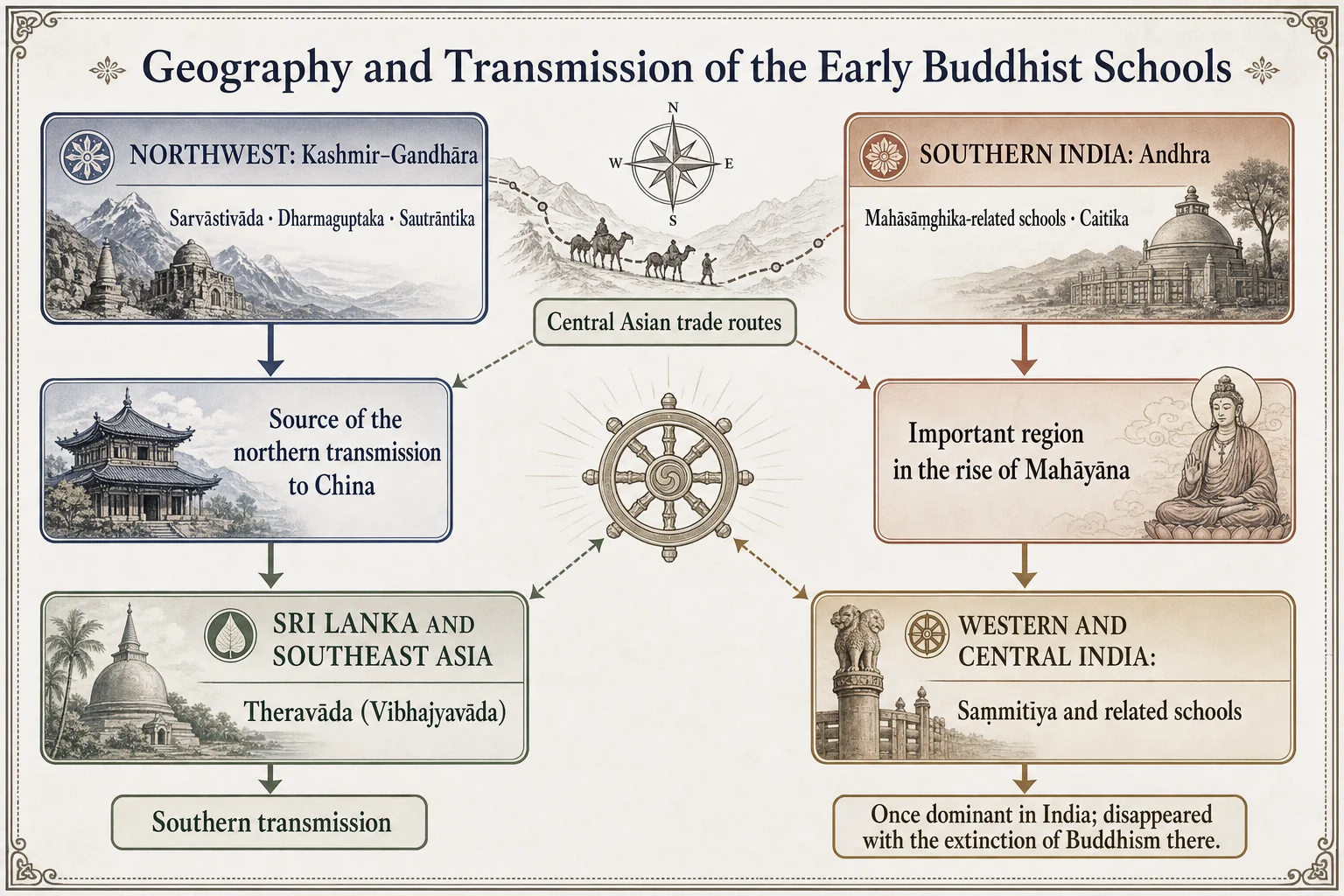
This diagram connects themes developed across several later parts of the book. The texts of the northwestern schools, especially the Sarvāstivādins and Dharmaguptakas, traveled through Central Asia and were translated in China, forming one source of Northern Buddhism. The southern Indian Mahāsāṃghika line's transcendent conception of the Buddha and ideas resembling those of Mahāyāna supplied an important background to Mahāyāna's rise (Part IV). The Vibhajyavādins entered Sri Lanka and became the Southern Theravāda tradition (Part V). Meanwhile, the Saṃmitīyas and other schools that had once flourished in India vanished with the general decline of Indian Buddhism. Historical prominence and long-term survival did not necessarily coincide.
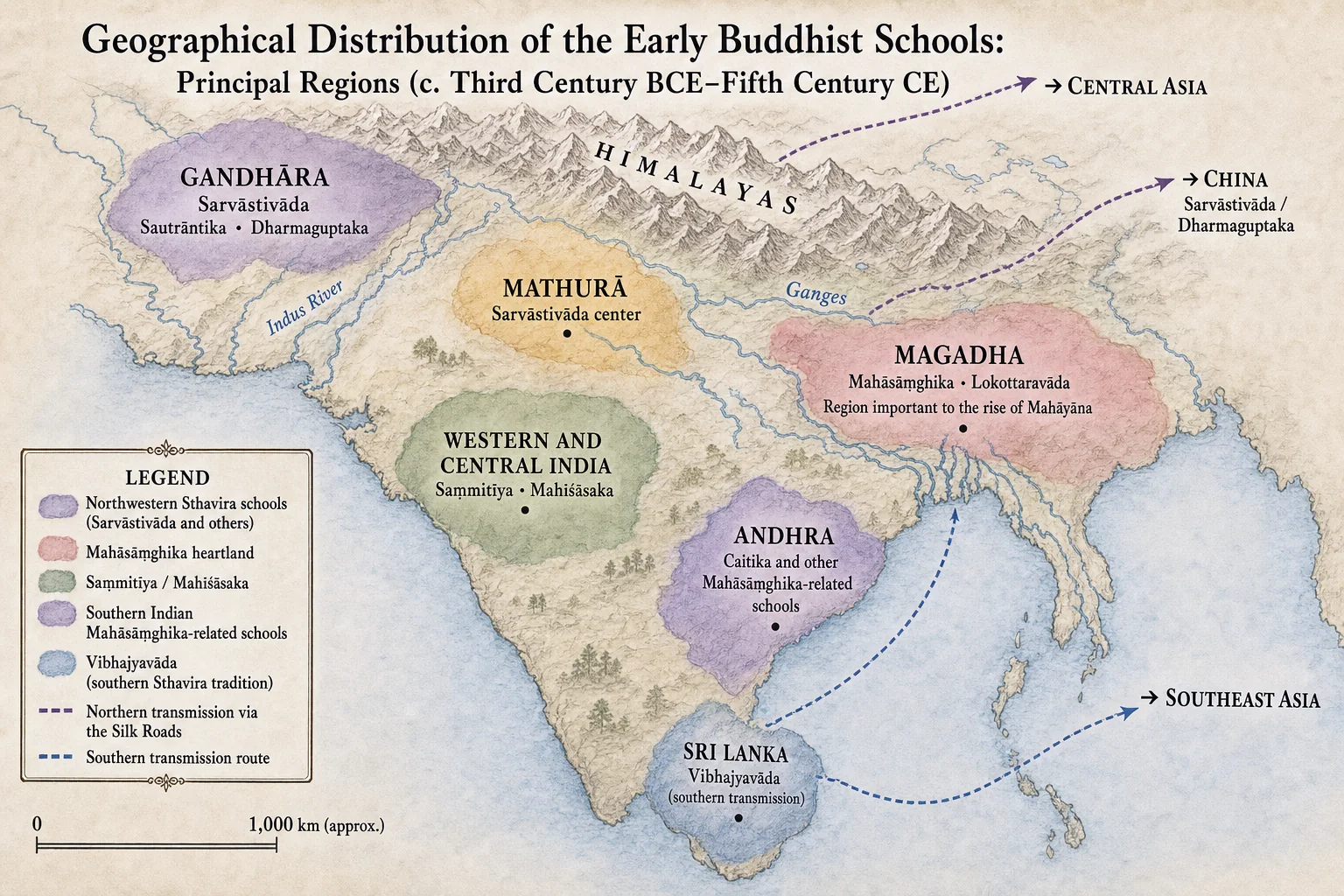
The map below places the principal territories of the major lineages on geographical coordinates. Five colored regions correspond to five principal directions, and dashed arrows mark routes of transmission:
5. How Did They Coexist, and What Did They Dispute?
What was the relationship among the schools? We should reiterate Bechert's view from 2.3: most schools were not mutually guilty of "splitting the Saṅgha." It was common for monks of different schools to live in the same monastery and share many disciplinary rules; differences centered on ordination lineages and doctrine.3 But the absence of formal schism did not mean the absence of controversy. On the contrary, the era of the schools was an era of intense debate.
The best material evidence is the Theravāda Kathāvatthu (Points of Controversy), one of the books of the Pāli Abhidhamma. It sets out claims attributed to contemporary schools one by one and then refutes them: the Vātsīputrīya person, the Sarvāstivāda existence of the three times, certain schools' views of the arhat, and so forth.4 That a treatise devotes most of its length to refuting fellow Buddhists of other schools itself shows that, although these communities did not necessarily eat at separate tables, they opposed one another directly and in earnest on matters of doctrine.
The dispute over the person is the most representative example from this period and deserves further attention. The early teaching of not-self (anattā) holds that there is no eternal, unchanging self. This immediately creates a practical problem: without an "I," how can karmic results persist across many lives? The Vātsīputrīya answer was to posit a pudgala, a "person" said to be "neither identical with nor separate from the aggregates." It was neither identical with any of the five aggregates nor existent independently outside them. This was a carefully designed compromise. The person was not an eternal self, yet neither was it a mere concept. It existed in a real but not fully articulable manner, enough to carry the continuity of karmic effects.5
The Kathāvatthu's objection is direct: any identifiable entity must ultimately be either permanent or impermanent. "Neither identical nor separate" merely evades the issue and clothes a hidden self in an escape clause. The Vātsīputrīyas reply that their critics themselves say, "this person has attained arhatship"—so what exactly is this "person"? The exchange reveals a deeper tension. The gap between not-self and the continuity of karmic effects cannot be closed merely by changing terminology. Yogācāra and tathāgatagarbha thought would each attempt to address this gap, though with radically different answers. That line of inquiry is reserved for Parts III and IV.
This culture of debate honed Abhidharma into an ever more precise instrument. The next chapter explains how Abhidharma arose; Part III will then analyze these positions and their difficulties in turn.
Ultimately, the proliferation of the schools was a history of long-term differentiation. The Sthavira and Mahāsāṃghika branches came first, followed by the competing genealogies of eighteen or twenty schools. The schools spread across the northwest, southern India, and the islands; they disputed one another yet coexisted for long periods. They produced multiple independent textual recensions, drove the development of Abhidharma, and supplied the historical conditions for Mahāyāna and for Buddhism's later transmission in three major directions.
References
References
-
André Bareau. Les sectes bouddhiques du Petit Véhicule. Saigon: École française d'Extrême-Orient, 1955. ↩
-
Collett Cox. Disputed Dharmas: Early Buddhist Theories on Existence. Tokyo: International Institute for Buddhist Studies, 1995. For the emergence of the Sautrāntikas and their seed theory, see chapters 3 and 4. ↩
-
Heinz Bechert. "Notes on the Formation of Buddhist Sects and the Origins of Mahāyāna." In German Scholars on India, vol. 1. Varanasi: Chowkhamba, 1973. ↩
-
Shwe Zan Aung and C. A. F. Rhys Davids (trans.). Points of Controversy (Kathāvatthu). London: Pali Text Society, 1915. ↩
-
Leonard Priestley. Pudgalavāda Buddhism: The Reality of the Indeterminate Self. Toronto: University of Toronto Centre for South Asian Studies, 1999. ↩