Chapter 5: Modern Reform and Development
Before the nineteenth century, Southern Buddhism generally operated as a tradition sustained by royal power in each region: the Saṅgha maintained educational and ritual functions, elites studied the texts, a minority engaged in intensive meditation, and laypeople made donations to generate merit. The arrival of the colonial era fundamentally disrupted this mode of operation. It brought challenges (Christian missions, secular education, and a reorganization of state power), but also new stimuli, including the spread of printing and the formation of international Buddhist networks. Beginning in the nineteenth century, this chapter traces several major transformations that Southern Buddhism has undergone over the past two hundred years.
I. The Colonial Encounter and Buddhist Revival
Sri Lanka: Reconstructing Itself under Christian Pressure
British rule in Sri Lanka (1796–1948) brought organized Christian missionary activity. Missionaries held advantages in education, publishing, and public debate. English was the passport to advancement, and Christian schools controlled English-language education. Under this pressure, Sri Lankan Buddhist intellectuals began to respond in a new way: no longer merely defending tradition, they actively defended Buddhism through Western forms of argument.
In August 1873, a public debate lasting three days and watched by more than ten thousand people took place at Pānadura, near Colombo. It became known as the Pānadura Debate (Pānadurā Vādaya). The principal Buddhist debater was Migettuwatte Gunananda (1823–1890), while the chief Christian representative was David de Silva. The significance of the encounter does not lie in deciding who persuaded whom. It inaugurated a new Southern Buddhist response: defending itself through public rational debate rather than appealing exclusively to traditional authority.1
The debate’s principal topics can be grouped into several areas. Theology and cosmology: the two sides debated God’s existence and attributes, the nature of the soul, creation, and causality. Gunananda argued, for example, that if an omniscient God later regretted his own acts, his regret would contradict his omniscience. This strategy of exposing contradictions within the opponent’s texts ran through the debate. Morality and exemplars: the Christian side attacked Buddhist moral standards, pointing to certain Jātaka stories and actions of the Buddha (such as his pardoning of the serial killer Aṅgulimāla) as contrary to ordinary morality. Gunananda responded with equally controversial narratives from the Bible. The reliability of scriptural transmission: this was perilous ground for both parties. Missionaries challenged Buddhism’s dependence on oral transmission as incapable of guaranteeing fidelity. Gunananda replied that the biblical text had itself undergone additions and omissions by copyists and diverged across versions; “preserving the original words without changing a single letter” was equally mythical. Both sides attacked the consistency of the other’s logic rather than simply defending their own position.
Whether the story of Prince Vessantara giving away his children was mentioned during this debate cannot be confirmed from presently accessible historical evidence. The Christian side did criticize “immoral stories” in Buddhist scripture, but the surviving documentary records—including the English account prepared from the debate by Gunananda’s follower J. M. Peebles—contain no clear citation of this particular story. This book leaves the question open. Interested readers may consult the original Sri Lankan records of the debate; the Sinhala version is more complete.
The debate’s subsequent influence extended far beyond the event itself. An English account reached the United States, where Henry Steel Olcott (1832–1907), one of the founders of the Theosophical Society, was deeply moved by it. In 1880 he traveled to Sri Lanka, where he collaborated with Gunananda and Dharmapāla to advance the next phase of the Sri Lankan Buddhist revival.
This style reached its fullest expression in Anagārika Dharmapāla (1864–1933), one of the most influential figures in modern Southern Buddhist reform. Several features are especially important:
- He emphasized the agency of the “lay Buddhist.” Without ordaining as a monk, he lived a rigorously ascetic life as an anagārika (“homeless one”), an intermediate identity that made the boundary between laity and monasticism more flexible.
- He promoted “Protestant Buddhism”: remodeling Buddhism through forms of action associated with Western Protestantism, including individual scriptural study rather than complete reliance on monks, the organization of voluntary associations, newspaper publishing, and political participation.
- He founded the Mahā Bodhi Society in 1891, working to restore sacred sites such as Bodh Gayā and to promote Buddhism internationally.
- He attended the 1893 World’s Parliament of Religions in Chicago, introducing Southern Theravāda to a Western audience.13
Dharmapāla’s legacy is double-edged. His encouragement of lay practice, social involvement, and international dissemination was an important force in Southern Buddhism’s modern transformation. At the same time, his Sri Lankan nationalism, which bound Buddhism to Sinhala identity, helped lay the ground for later Sinhala–Tamil ethnic antagonism in Sri Lanka, discussed in Section III below.
Thailand: King Mongkut’s Reform and the Dhammayut Order
Thailand did not undergo direct Western colonial rule, but Western pressure was nonetheless present. Neighboring Myanmar was colonized by Britain, while Vietnam and Cambodia fell under France; the Thai court felt an urgent need to reform.
King Mongkut (Rama IV, reigned 1851–1868) spent twenty-seven years as a monk before ascending the throne, making him a rare example of a scholar-king. During his monastic life, he became dissatisfied with established Buddhist practices that mixed different traditions (Brahmanical rites incorporated into Buddhist ceremonies, for example), and with lax observance of the Vinaya. In 1833 he founded the Dhammayut Nikāya, the “Order in Accordance with the Dhamma,” which emphasized strict observance of the Pāli Vinaya, a return to canonical texts, and the rejection of rites lacking canonical support.
The Dhammayut and Mahā Nikāya, the “majority order,” became two parallel systems within Thai Buddhism and remain so today. Mongkut’s reform had several consequences. First, it introduced the principle that canonical authority stood above custom. Second, it laid the institutional foundation for later centralizing reforms, as Mongkut’s successors brought Buddhist education further under state administration. Third, eminent monks from the Dhammayut order later played an important part in Buddhism’s transmission to the West; Ajahn Mun came from a Dhammayut background.2
Myanmar: Colonial Disruption and Lay Movements
Britain annexed Upper Burma in 1885, completing its control of the entire country. Under colonial government, the king’s traditional role as protector of the religion disappeared. The Saṅgha lost institutional state support, and its funding, order, and education were all disrupted.
One unexpected consequence was that the loss of state support for the Saṅgha encouraged the rise of an active lay Buddhist movement. Various Young Men’s Buddhist Associations were founded in the early twentieth century, linking Buddhism to national consciousness. This current continued to play a part in Burma’s independence movement.
II. The Democratization of Meditation: From Elites to the Public
One of the most profound changes in modern Southern Buddhism was the gradual opening of meditation, formerly the preserve of monastic elites, into a practice available to all laypeople. A key agent of this transformation was the Burmese monk Ledi Sayādaw (1846–1923).
Ledi was a deeply learned Burmese monk as well as an accomplished meditator and social activist. He made a distinctive historical judgment: under British colonial rule, the traditional monastic system had become unstable. If the path of liberation remained only in the monks’ hands, the entire transmission would be severed if the Saṅgha collapsed. He therefore argued that meditation—especially mindfulness of breathing (ānāpānasati) and insight practices observing impermanence—should be taught to laypeople, enabling more people to practice amid secular life.3
This was a small but important conceptual shift. In the traditional understanding, the entanglements of household life (spouse, children, property) made deep meditation all but impossible. One’s hope for practice rested on ordaining in a future life or accumulating merit by supporting monks. Ledi said no: laypeople could learn now, and they should.
Ledi’s influence passed through several generations of transmission and ultimately produced, in S. N. Goenka (1924–2013), a highly standardized course suitable for teaching on a massive scale. Goenka was not a monk but an Indian Burmese businessman. After learning insight meditation in Myanmar from Sayagyi U Ba Khin, he returned to India in 1969 and began offering ten-day insight courses. The courses were entirely free and sustained by donations from former students. They depended on no religious organization and did not require participants to believe in Buddhism; they asked only that participants observe basic precepts and complete the intensive practice during the ten days. The model achieved remarkable economies of scale. By the beginning of the twenty-first century, meditation centers in Goenka’s tradition existed in more than one hundred countries and served hundreds of thousands of participants each year.4
A tension deserves attention here. The route of Ledi and Goenka took meditation beyond the monastery to a vast population of laypeople and non-Buddhists, genuinely expanding its reach. Yet problems also arose when meditation was distilled into an operational technique requiring no doctrinal background. The technique focuses only on sensations of breathing and systematic observation of the body; it does not introduce the doctrinal frameworks of the Four Noble Truths, dependent origination, or not-self. Its relationship to its original setting thereby becomes complicated: is it still Buddhist practice, or merely a technique of psychological exercise? This question became still sharper in the global transmission of “mindfulness,” discussed in Section V.
III. Political Buddhism and Nationalism
Southern Buddhism has repeatedly become entangled in modern politics, sometimes participating actively and sometimes being drawn in. Several cases are representative.
Sri Lanka: The Bond with Nationalism
After Sri Lankan independence in 1948, the identity “Sinhala Buddhist” became a powerful instrument of political mobilization. In 1956, English was replaced by Sinhala as the official language. The policy seriously harmed the rights of Tamil-speaking minorities (including most Tamils and some Muslims), and directly intensified ethnic conflict.
Some monks helped drive this process forward. They cited historical narratives (Sri Lanka as a sacred Buddhist land and the final guardian of the Dharma), and presented political demands as religious duties. This line continued into the Sri Lankan Civil War (1983–2009) and the enduring ethnic tensions after the war’s conclusion.
This book cautions that what occurred was not “Buddhism causing nationalism.” A better formulation is that nationalist movements exploited Buddhism’s symbolic resources. A religious tradition originally concerned with liberation was reframed as a pillar of identity politics. Every major world religion has analogous examples, and this is not a problem unique to Southern Buddhism. Yet the Southern Buddhist case particularly demands acknowledgment because of the striking distance between these developments and Buddhism’s central values of compassion and not-self.5
Myanmar: The 969 Movement and the Radicalization of Buddhist Nationalism
In twenty-first-century Myanmar, a Buddhist nationalist movement represented by Ashin Wirathu (1968–) arose under the symbol “969,” referring to characteristic numbers associated with the Buddha, Dhamma, and Saṅgha. It directed extreme hate speech against Muslim minorities, including Rohingya and other Muslims, and was associated with violent conflicts targeting the Rohingya.
The phenomenon has been widely discussed internationally. One observation is worth recording here. The traditional Buddhist Five Precepts clearly prohibit killing, and the objects of compassion have never been restricted by ethnicity at the doctrinal level. The rhetoric of Wirathu and others cannot be sustained within the traditional doctrinal framework. This form of “Buddhist nationalism” is therefore more accurately described as “nationalism mobilized through Buddhist symbols” than as a reasonable extension of Buddhist doctrine.6
The 2007 Saffron Revolution presented another face: tens of thousands of Burmese monks marched in the streets against the military government’s oppression of the population. It was one of the largest monastic political protests in modern history. Placed side by side, the two events show that political Buddhism in Myanmar is not unitary. Attitudes within the Saṅgha toward power have ranged from compliance and resistance to exploitation.
Thailand: State Buddhism and Legal Orthodoxy
Since the beginning of the twentieth century, Thai Buddhism has undergone a relatively systematic process of state centralization. The government established a religious affairs department, brought the Saṅgha under unified administration, and enacted Saṅgha Acts in 1902, 1941, and 1962 regulating monastic promotion, ordination, and conduct. These developments made the Thai Saṅgha one of the most state-controlled Buddhist institutions in the world.
The cost of centralization is that the Saṅgha has become a symbolic support of the regime and finds it difficult to remain politically independent. During Thailand’s political turbulence in the 2010s, political statements by some senior monks drew widespread criticism and prompted debate over whether the Saṅgha should remain independent of politics.
IV. The Bhikkhunī Question: An Unresolved Institutional Knot
The restoration of the Theravāda lineage of fully ordained nuns (bhikkhunī) has still not gained uniform recognition from the official Saṅgha authorities of Southern Buddhist countries. It is one of the most important controversial issues in modern Southern Buddhism. One qualification is necessary at the outset: since the 2020s, developments in fact have outpaced institutional recognition. The scale of ordination in Sri Lanka has continued to grow and has produced a native generation of preceptors; a bhikkhunī Saṅgha has appeared in Cambodia; and Thailand’s bhikkhunī communities continue to expand without official recognition. See Chapter 12.5 for details. This section explains how the “institutional knot” arose.
The historical background is as follows. The Pāli Vinaya stipulates that a woman’s full ordination must be conferred jointly by valid communities of monks and nuns, a “dual ordination.” According to the historical chronicles, the Sri Lankan bhikkhunī lineage died out around the eleventh century. Thereafter, there were not enough fully ordained nuns to ordain new candidates validly, and the transmission ended.
The obstacle to restoration is not doctrinal. Nothing in the Pāli canon permanently prohibits bhikkhunīs, and its record that the Buddha agreed to establish an order of nuns is explicit. The obstacle is institutional. Elders of the existing tradition argue that an ordination ceremony without fully ordained nuns is not a valid bhikkhunī ordination, while without a valid bhikkhunī lineage no valid ordination ceremony can occur. The closed loop is institutional.
Attempts to break that loop began in the late twentieth century:
-
Bodh Gayā, 1998. A group of Sri Lankan women received full ordination from Mahāyāna bhikkhunīs of the Chinese lineage at Bodh Gayā, then received novice ordination under the Pāli Vinaya. Supporters of this route maintain that the Southern bhikkhunī lineage can be rebuilt through a Mahāyāna community of nuns; opponents argue that the Mahāyāna and Southern Vinayas differ and that such ordination is invalid.
-
2003. The Thai scholar and nun Dhammananda Bhikkhunī (lay name Chatsumarn Kabilsingh, 1944–) received full bhikkhunī ordination in Sri Lanka, becoming the first bhikkhunī in modern Thai history. Thai religious authorities explicitly refused to recognize her ordination, and her status remains contested.
-
Sri Lanka. The Sri Lankan Siam Nikāya has traditionally opposed bhikkhunī ordination, but the two smaller orders, the Amarapura and Ramañña Nikāyas, have been more open. Around 2023, several bhikkhunī ordinations took place in Sri Lanka with differing degrees of institutional recognition. The situation continues to change.14
This book’s position is that the disappearance of the bhikkhunī lineage was a historical event and that the obstacles to its restoration are institutional rather than doctrinal. That a tradition centered on compassion and not-self has maintained the status quo on this question for so long is an internal tension that must be faced. The legal arguments on every side have a textual basis, and debate will continue. Yet distinguishing “institutional tradition” from “doctrinal core” is the indispensable premise of any discussion.
V. Globalization and the Rise of “Secular Mindfulness”
During the second half of the twentieth century, insight meditation traveled to the West and underwent a transformation of far-reaching significance in the process.
The first wave of transmission, in the 1970s. Several young Americans (including Jack Kornfield, Sharon Salzberg, and Joseph Goldstein) studied insight meditation in Southeast Asia and returned to the United States. In 1975 they founded the Insight Meditation Society (IMS) in Massachusetts. IMS retained a relatively complete Buddhist framework: the Four Noble Truths, loving-kindness and compassion, and a measure of doctrinal background. This route developed into the American “Insight Tradition,” one of the principal forms of Buddhist meditation in the West today.7
The pivotal transformation, in 1979. The physician Jon Kabat-Zinn (1944–) founded the Mindfulness-Based Stress Reduction program (MBSR) at the University of Massachusetts Medical School. He extracted the core practice of insight meditation (awareness directed toward bodily sensations in the present moment), removed its explicit Buddhist doctrinal framework, and presented it as a clinical intervention for stress, pain, and illness. MBSR underwent systematic clinical study and was incorporated into mainstream health care.8
Thereafter, the word “mindfulness” (Pāli: sati) entered the discourse of the general public, corporate training, schools, and psychotherapy at unprecedented speed, becoming a technique of “mental hygiene” independent of a religious context.
The transformation prompted serious discussion within the Southern tradition. The central questions can be summarized as follows:
| Issue | Traditional Southern position | Secular mindfulness position |
|---|---|---|
| Purpose of mindfulness | To see impermanence, suffering, and not-self, and proceed toward liberation | Stress reduction, increased concentration, and emotional regulation |
| Objects of mindfulness | The four establishments of mindfulness (body, feelings, mind, and phenomena) with specific meanings | Primarily present-moment awareness, directed toward a broader range of objects |
| Doctrinal background | The Four Noble Truths, dependent origination, and other frameworks are necessary to understanding | Unnecessary, or deliberately removed |
| Place of compassion | A component of practice, including loving-kindness meditation | Sometimes added, sometimes omitted |
This book holds that secular mindfulness is a genuine historical phenomenon. It has indeed extracted something valuable from Southern Buddhist practice, and it has indeed changed the meaning and context of what it extracted. Critics such as the Pāli scholar Bhikkhu Bodhi have a legitimate concern: when “mindfulness” is separated from the doctrinal framework of impermanence, suffering, and not-self, and from an ethical structure directed toward liberation, what it transmits is no longer the same “mindfulness” found in the Buddhist tradition. The supporters’ case is not without force either: enabling more people to encounter even part of the tradition’s practical tools is better than leaving the entire system shut away. This book presents the tension without rendering a final verdict, but inclines to the view that the equation “mindfulness equals Buddhist meditation” must be questioned repeatedly.9
VI. Engaged Buddhism
Another form of social participation, distinct from political nationalism, is Engaged Buddhism: extending Buddhist compassion into social action, environmental protection, and peace movements.
Several examples are important in the Southern Buddhist world.
The Sarvodaya Shramadana Movement (Sri Lanka, founded in 1958) was established by A. T. Ariyaratne. It combined Gandhian shramadana, or the “gift of labor,” with Buddhist principles to promote rural community development, emphasizing the simultaneous awakening of individuals and communities: “awakening the world as we awaken ourselves.” It became an important model of Engaged Buddhism and was one of the few voices to maintain a commitment to reconciliation during the Sri Lankan Civil War.10
Sulak Sivaraksa (Thailand, 1933–) has critically examined the relationship between Thai Buddhism and power, promoted movements for social justice and environmental protection in Thailand, and criticized consumerism. He is an important organizer of Asian Engaged Buddhist networks.
Environmental Buddhism, or eco-dharma. In recent years, monks and laypeople in Sri Lanka, Thailand, and Myanmar have developed practices combining the Buddhist values of non-harming (ahiṃsā) and contentment with few desires with environmental protection. Some forest monasteries actively participate in preserving forests.
The philosophical basis of this route is the extension of loving-kindness and compassion (mettā, karuṇā) in early Buddhism to concern with non-individual suffering—that is, suffering produced by social structures, not merely personal suffering. Critics, including some traditionalists, argue that the extension departs from the heart of Buddhist practice, individual liberation. Supporters hold that ignorance of the collective causes of suffering is itself a form of ignorance.
VI.1. Pathways to the Canon: Three Figures of Exceptional Importance to Modern Access to Southern Buddhism
Southern Theravāda practice rests upon the Pāli canon, but Pāli is an insurmountable language barrier for most people. Modern practitioners have gained genuine access to these texts only through the labor of a few individuals who dedicated their lives to translation and dissemination. The following three have made crucial contributions to modern Chinese- and English-language readers’ access to Southern Buddhism.
Bhikkhu Bodhi (1944–)
Bhikkhu Bodhi, born Jeffrey Block in Brooklyn, New York, was ordained in Sri Lanka in 1972 within the lineage of Venerable Nyanatiloka and became president of the Buddhist Publication Society in Colombo in 1988. His most important contribution was to bring English translation of the four principal Pāli Nikāyas to an unprecedented degree of scholarly completeness:
- The Majjhima Nikāya (with Bhikkhu Ñāṇamoli, 1995)
- The Saṃyutta Nikāya (2000)
- The Aṅguttara Nikāya (2012)
Each translation includes extensive introductions and annotations drawing on the commentarial literature, enabling nonspecialists to understand the doctrinal background of the texts. His translations have become standard references for serious study of early Buddhism in the English-speaking world. He also edited In the Buddha’s Words (2005), a high-quality anthology for beginners. In addition, he co-founded Buddhist Global Relief and has continually sought to connect spiritual practice with social engagement.11
Bhikkhu Bodhi’s standing in the scholarly world is also reflected in his position on debates over ordination in Southern Buddhism: he has publicly defended the legal validity of bhikkhunī ordination, discussed in Section IV. His voice carries considerable authority between traditional conservatives and reformers precisely because no one can easily accuse a deeply learned Vinaya scholar of ignorance of the disciplinary texts.
Zhuang Chun-jiang
Zhuang Chun-jiang is a Taiwanese lay researcher who has devoted decades to a rare comparative project: translating each discourse of the Pāli Nikāyas into modern Chinese while comparing it with the Chinese Āgamas (the Dīrgha Āgama, Madhyama Āgama, Saṃyukta Āgama, and Ekottarika Āgama), and systematically identifying parallel texts and differences between the two transmissions. The results are published online with open access at agama.buddhason.org and are freely available to everyone.
His work matters because it fills a longstanding gap. For the vast majority of Chinese readers, access to the earliest Buddhist literature previously meant almost exclusively the Chinese Āgamas. The relationship between those collections and the Pāli Nikāyas (which discourses correspond, where they differ, and what those differences mean) had rarely been presented systematically. Zhuang’s work made it possible for Chinese readers, for the first time, to see the two traditions together in a systematic way without relying on Western scholarship or learning Pāli themselves.
In scholarly terms, his comparative work also draws on research by Bhikkhu Anālayo and others and displays substantial methodological awareness. He is a lay scholar outside the formal institutions who completed a systematic scholarly project through personal perseverance. His existence is itself a living example of the Southern Buddhist proposition that lay practice and study can be undertaken with great seriousness.
Bhikkhu Mahinda
Bhikkhu Mahinda is one of the most important monastic transmitters of contemporary Southern Buddhism in the Chinese-speaking world, and he has made a crucial contribution to establishing a systematic Theravāda transmission in Chinese. He practiced for many years at the Pa-Auk Meditation Centre in Myanmar and was deeply formed by the Pa-Auk system of teaching. He has subsequently devoted himself to teaching and writing in Chinese on Southern Buddhist doctrine and meditation.
One of his most important projects was a new modern Chinese translation of Buddhaghosa’s Visuddhimagga, more readable and richly annotated than earlier versions. He has also taught analysis of mind-and-matter, calm-and-insight meditation, and other central practices of the Pa-Auk system, attracting many educated Chinese-speaking practitioners. His lectures and writings circulate widely online in video, audio, and textual forms. For Chinese speakers who want to study Southern Buddhist doctrine and systematic practice in depth, he is one of the most important introductory guides.
The contributions of these three figures point in different ways toward the same thing: allowing modern people to bypass linguistic and institutional barriers and encounter the primary texts directly. Bhikkhu Bodhi’s English translations of the Pāli scriptures, Zhuang Chun-jiang’s Chinese–Pāli comparative database, and Bhikkhu Mahinda’s Chinese-language instruction all lower the barrier, making the literature of early Buddhism no longer the exclusive possession of specialists who can read Pāli. Their work carries forward, across generations, something of the spirit with which Ledi Sayādaw took meditation beyond the monastery: opening to more people something that only a few could previously enter.12
VII. Several Enduring Tensions
Several tensions in the modern history of Southern Buddhism have never been resolved, but repeatedly appear in different forms.
Individual liberation versus social responsibility. The central aim of Southern Buddhist doctrine is individual liberation. Is such an individualist soteriology adequate in modern political, ecological, and social conditions? No answer commands recognition across the whole tradition. Engaged Buddhism is one response, but remains contested.
Traditional authority versus modern needs. The bhikkhunī question, the opening of meditation to laypeople, and secular mindfulness all reflect a larger tension: how should an institutional and doctrinal framework formed hundreds or thousands of years ago adapt to the new demands of modern society without losing its core? Answers within each tradition span the full range from conservative to radical.
National identity versus universal values. Southern Buddhism’s deep bonds with national identity in different countries have sometimes strengthened Buddhist solidarity, and sometimes drawn Buddhism into political actions that conflict with its central values of compassion and not-self. There is no easy resolution to the tension.
Canonical authority versus experiential orientation. Modern meditation movements, from Mahāsi and Goenka to Kabat-Zinn, increasingly emphasize direct experience and no longer presuppose understanding of the discourses. In one sense, this returns to the Buddha’s practical orientation; at the same time, it marginalizes the doctrinal framework. Without an interpretive framework of impermanence, suffering, and not-self, where direct experience leads remains an open question.
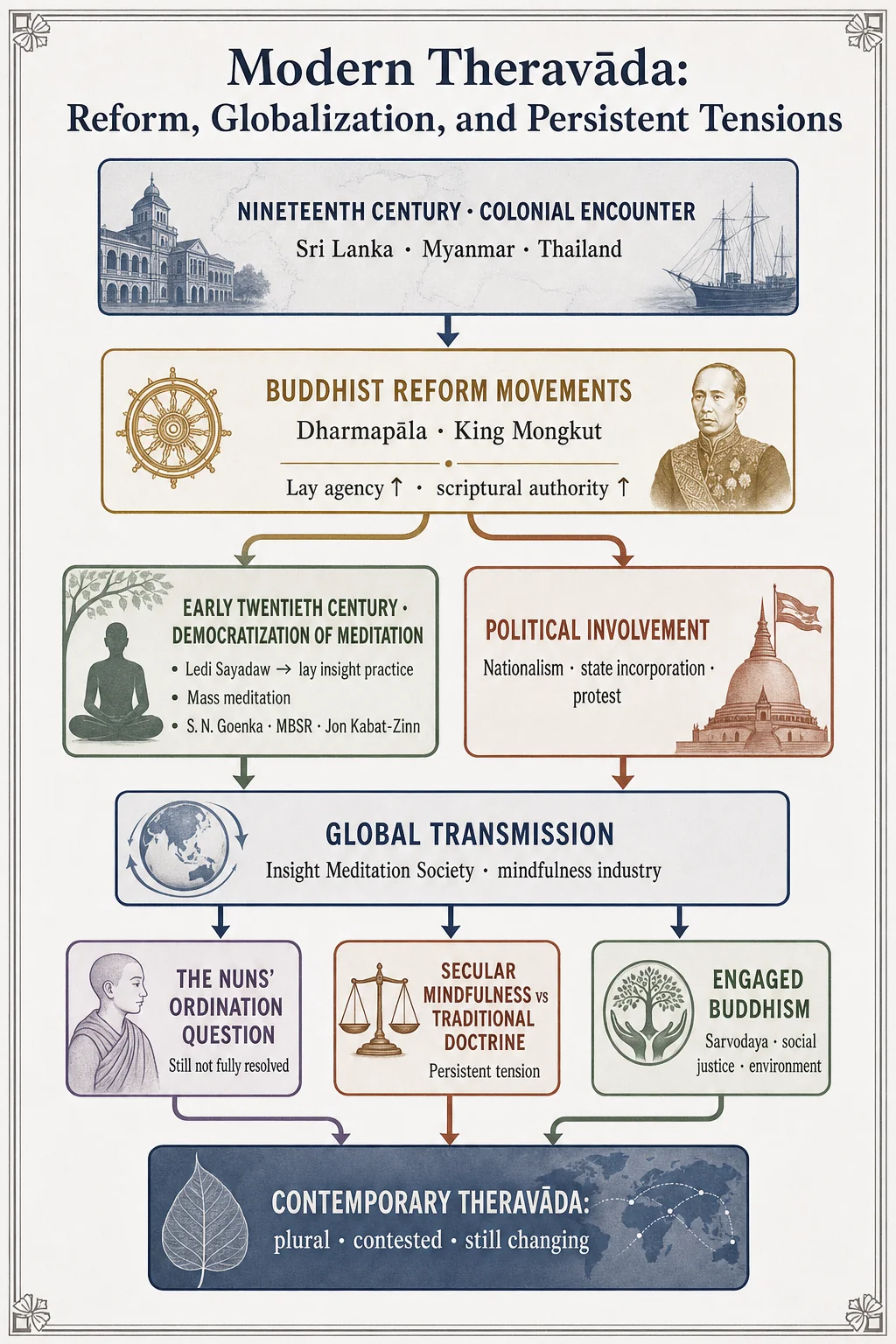
Southern Theravāda today is the tradition of roughly 150 million Buddhists in Sri Lanka, Myanmar, Thailand, Cambodia, and Laos, as well as immigrant communities and groups of Western converts throughout the world. It is diverse, not uniform. Forest-dwelling ascetic monks, ritual specialists in urban temples, rigorous scholastic experts, and designers of secular mindfulness apps all stand in some relationship to this tradition. That diversity is itself the truest result of Southern Buddhism’s modern history.
References
References
-
Richard Gombrich and Gananath Obeyesekere. Buddhism Transformed: Religious Change in Sri Lanka. Princeton: Princeton University Press, 1988. (The authoritative study of the modern transformation of Sri Lankan Buddhism; see Chapters 1–3 for analysis of the Pānadura Debate and Dharmapāla.) ↩
-
David K. Wyatt. Thailand: A Short History. 2nd ed. New Haven: Yale University Press, 2003. (King Mongkut’s reforms and the establishment of the Dhammayut order, Chapter 7.) ↩
-
Erik Braun. The Birth of Insight: Meditation, Modern Buddhism, and the Burmese Monk Ledi Sayadaw. Chicago: University of Chicago Press, 2013. (The authoritative study of Ledi Sayādaw and the democratization of meditation.) ↩
-
William Hart. The Art of Living: Vipassana Meditation as Taught by S. N. Goenka. San Francisco: Harper & Row, 1987. (An introduction to the Goenka tradition; current claims about course scale should be checked against the tradition’s dated official statistics.) ↩
-
Stanley J. Tambiah. Buddhism Betrayed? Religion, Politics, and Violence in Sri Lanka. Chicago: University of Chicago Press, 1992. (A critical analysis of Sri Lankan Buddhist nationalism and ethnic conflict.) ↩
-
Matthew J. Walton and Susan Hayward. Contesting Buddhist Narratives: Democratization, Nationalism, and Communal Violence in Myanmar. Honolulu: East-West Center, 2014. (A political analysis of Buddhist nationalism in Myanmar.) ↩
-
Joseph Goldstein. Insight Meditation: The Practice of Freedom. Boston: Shambhala, 1994. On the founding of IMS, see Jack Kornfield, After the Ecstasy, the Laundry. New York: Bantam, 2000. ↩
-
Jon Kabat-Zinn. Full Catastrophe Living: Using the Wisdom of Your Body and Mind to Face Stress, Pain, and Illness. New York: Delacorte, 1990. (The foundational text of MBSR.) ↩
-
David L. McMahan. The Making of Buddhist Modernism. Oxford: Oxford University Press, 2008. (A comprehensive analysis of Buddhist modernism, including the intellectual background of secular mindfulness.) ↩
-
Joanna Macy. Dharma and Development: Religion as Resource in the Sarvodaya Self-Help Movement. West Hartford: Kumarian Press, 1983. (A specialist study of the Sarvodaya movement.) ↩
-
For Bhikkhu Bodhi’s life and works, see the official website of the Buddhist Publication Society. His principal translations are Bhikkhu Bodhi (trans.), The Middle Length Discourses of the Buddha. Boston: Wisdom Publications, 1995; The Connected Discourses of the Buddha. Boston: Wisdom Publications, 2000; The Numerical Discourses of the Buddha. Boston: Wisdom Publications, 2012. For his anthology, see Bhikkhu Bodhi (ed.), In the Buddha’s Words: An Anthology of Discourses from the Pāli Canon. Boston: Wisdom Publications, 2005. ↩
-
On Zhuang Chun-jiang’s Nikāya–Āgama comparison project, see agama.buddhason.org (Taiwan, open access). Bhikkhu Mahinda’s writings circulate as online videos and texts, and his Chinese translation of the Visuddhimagga is available through platforms associated with Southern Buddhism. For an academic model of cross-collection comparison, see Bhikkhu Anālayo, A Comparative Study of the Majjhima-nikāya. Taipei: Dharma Drum Publishing Corporation, 2011. ↩
-
Anagarika Dharmapala. Return to Righteousness: A Collection of Speeches, Essays and Letters of the Anagarika Dharmapāla, ed. Ananda Guruge. Colombo: Government Press, 1965. For biographical analysis, see Stephen Kemper, Rescued from the Nation: Anagarika Dharmapāla and the Buddhist World. Chicago: University of Chicago Press, 2015. ↩
-
Nirmala S. Salgado. Buddhist Nuns and Gendered Practice: In Search of the Female Renunciant. New York: Oxford University Press, 2013. (Fieldwork on Sri Lankan nuns and ordination controversies.) See also Bhikkhu Anālayo, “The Legality of Bhikkhunī Ordination.” Journal of Buddhist Ethics 20 (2013). (A Vinaya-based argument for restoring the bhikkhunī lineage.) ↩