Chapter 4: Doctrine and Meditation Traditions
The preceding three chapters established the historical framework of Southern Buddhism: institutional disputes in Sri Lanka, Buddhaghosa’s systematizing project, and geographical expansion across Southeast Asia. This chapter turns to the content itself: the doctrinal positions of Southern Theravāda and the meditation traditions that developed upon their basis.
“Southern Buddhist doctrine” is not a monolith. Sri Lanka, Myanmar, and Thailand have each had their own emphases, and the tradition has seen considerable internal debate over the course of its history. The discussion below distinguishes as far as possible between their shared foundations and the interpretive differences of particular places and periods.
I. The Structure of the Path to Liberation: The Four Fruits and the Three Characteristics
At the heart of Southern Buddhist doctrine is a complete account of the stages of liberation. The basic framework of the early discourses, discussed in detail in Chapter 1.5, continues here: the three trainings of ethical discipline, concentration, and wisdom; the Four Noble Truths; and the three characteristics of impermanence, suffering, and not-self (Pāli: anicca, dukkha, anattā). Upon this basis, the Southern tradition developed an especially detailed framework of the “four stages of liberation.”
The path to liberation is marked by four “fruits” (phala), each preceded by a corresponding “path” (magga). Path and fruit arise in succession within a single meditative experience: the path-mind cuts off the defilements, and the fruition-mind confirms that they have been cut off.
| Stage | Pāli name | Fetters (saṃyojana) abandoned | Remaining rebirths |
|---|---|---|---|
| Stream-entry (first fruit) | sotāpatti | Abandons identity view, doubt, and attachment to rules and observances | At most seven more rebirths among humans and gods; never again in a lower realm |
| Once-return (second fruit) | sakadāgāmitā | Attenuates sensual desire and aversion | At most one more return to the human world |
| Non-return (third fruit) | anāgāmitā | Abandons sensual desire and aversion | No return to the sense realm; realizes final liberation in a form or formless realm |
| Arahantship (fourth fruit) | arahatta | Abandons craving for form, craving for the formless, conceit, restlessness, and ignorance | No further rebirth after this life |
Two points deserve elaboration.
The significance of stream-entry. The abandonment of identity view (sakkāyadiṭṭhi, the view that mistakenly identifies a permanent self within the five aggregates), doubt (fundamental doubt concerning the Three Jewels and the path), and attachment to rules and observances (the belief that liberation can be attained through external rites alone) is regarded in Southern Buddhism as an irreversible turning point in one’s history of practice. A stream-enterer will never again fall back into a state unaware that liberation can be realized. The framework therefore marks milestones on the path of liberation, not ranks in a moral hierarchy.
Seeing the three characteristics. The early discourses teach that seeing impermanence, suffering, and not-self is a cognitive condition of liberation, but they do not explain in detail how that seeing occurs or what stages it passes through. Buddhaghosa’s sixteen insight knowledges (see Chapter 9.2) fill precisely this gap: they divide the process of seeing into sixteen steps, enabling practitioners to track their present stage, the signs they encounter, and what comes next. This framework is the Southern tradition’s systematization of the early discourses, not a scheme already found in the early discourses themselves.
Among the three characteristics, “not-self” bears the greatest philosophical tension. The Southern position is clear: no permanent, autonomous entity of self can be found either within or outside the five aggregates. This directly inherits the position of the early discourses. The same is true of its understanding of Nibbāna. Southern Buddhism characterizes Nibbāna as the “unconditioned” (asaṅkhata) and the “deathless” (amata), yet consistently speaks of it in negative terms rather than reifying it as an eternally existing realm. Its vocabulary therefore remains at an evident distance from the Mahāyāna tradition of tathāgatagarbha discussed in Part VII.1
The Southern Bodhisatta Path: Another Road for a Very Few
The four fruits described above form the “standard goal” of Southern Buddhist practice: the attainment of arahantship and complete liberation. Yet Southern Buddhism also contains another path with an entirely different goal, as Chapter 4.3 has already noted. The Southern tradition is not without a concept of the “bodhisatta” (Pāli: bodhisatta; Sanskrit: bodhisattva).
In the Southern Buddhist context, a “bodhisatta” specifically means a practitioner who aspires to become a perfectly self-awakened Buddha (sammāsambuddha). Such a person is not satisfied with attaining arahantship in this or one of the next few lives, but vows instead to pass through incalculable rounds of birth and death, accumulate the perfections, and eventually awaken through their own power in an age when no one teaches the Dharma—thereby rediscovering it and proclaiming it to sentient beings. It is an exceptionally painful and lengthy path, walked by only a very few.
When the path took shape. The Southern bodhisatta path is often presented as a body of doctrine that was always there. In fact it has clear strata, and each of its four stages has its own texts and its own dates.
The first stage lies in the earliest canon. In the four Nikāyas, bodhisatta is only the Buddha’s term for that stretch of his own career before awakening. It is a biographical designation, not a road set out for others to choose. At this textual level the Buddha never teaches disciples to take up a bodhisatta path; the only goal placed before them is arahantship.2
The second stage is the period in which the Buddhavaṃsa, the Cariyāpiṭaka, and the Jātaka collection were incorporated into the Khuddaka Nikāya, broadly the last centuries BCE, with the Buddhavaṃsa usually dated to the first or second century BCE. The turning point is the story of Sumedha: the ascetic meets the past Buddha Dīpaṅkara, could attain arahantship on the spot, deliberately forgoes it, vows to become a fully awakened Buddha himself, and receives Dīpaṅkara’s prediction then and there. Only here does the bodhisatta path condense into something describable: a vow, a prediction, and thereafter countless lives cultivating the perfections. Twenty-four Buddhas before Gotama are said to have made their vows on the same pattern, which gives the scheme a repeatable doctrinal shape.
The third stage is commentarial, around the fifth century CE. Dhammapāla’s commentary on the Cariyāpiṭaka contains a section devoted to the perfections, and it is the first Southern work to treat the bodhisatta path as a subject in its own right. His reason for writing it is stated plainly: Mahāyāna already possessed an extensive bodhisattva literature and Theravāda did not. The range of his sources is worth recording as well. Besides the Buddhavaṃsa, the Cariyāpiṭaka, the Jātakas, and the Visuddhimagga, it includes the Mahāyāna Bodhisattvabhūmi, with the distinctly Mahāyāna features stripped out. He classifies bodhisattas by temperament into three types, predominant in wisdom, in faith, or in vigour, each requiring a different span of aeons to complete the perfections; and he holds that the perfections are not the exclusive discipline of those who aspire to Buddhahood but should be cultivated by anyone seeking awakening. That last point matters: it keeps the whole scheme compatible with the arahant ideal.3
The fourth stage is the period in which the path existed as a genuinely contested practice. Its principal setting is Abhayagiri (see 9.1), and it extends into kingship as well (see the close of this section).
Set the four strata side by side and the conclusion is not hard to draw. The Southern bodhisatta path was neither handed down unchanged from the earliest canon nor transplanted wholesale from Mahāyāna. It is something Theravāda grew for itself, only later than is usually assumed, and having grown it never became the universal road.4
This path has several important components in the Southern canon and its commentarial tradition:
The perfections (dasa pāramī, the ten perfections). Pāli literature, especially the commentarial traditions associated with the Kathāvatthu and the Cariyāpiṭaka, developed a system of ten perfections: generosity (dāna), ethical conduct (sīla), renunciation (nekkhamma), wisdom (paññā), energy (viriya), patience (khanti), truthfulness (sacca), determination (adhiṭṭhāna), loving-kindness (mettā), and equanimity (upekkhā). A bodhisatta must perfect these ten qualities over incalculable eons. This system differs from the Mahāyāna list of six perfections (generosity, ethical conduct, patience, energy, meditation, and wisdom), and places its emphases differently.3
The Jātaka and the Cariyāpiṭaka. The Jātaka contains 547 stories recounting acts of giving, sacrifice, and cultivation performed by the Buddha, as a bodhisatta, over innumerable former lives. Its extreme stories of offering up life, property, and even family are the principal textual evidence for the bodhisatta’s cultivation of the perfections. The Cariyāpiṭaka, a Khuddaka text outside the Abhidhamma collection, is devoted to thirty-five verse narratives of bodhisatta conduct, each illustrating the fulfillment of a perfection. These writings provide the most important canonical basis for the Southern bodhisatta path.
The necessity of a “prediction” (vyākaraṇa). In Southern Buddhist theory, a person can enter the bodhisatta path only after receiving a face-to-face prediction from a living Buddha: “You will become a Buddha in the future.” Without it, the aspiration remains a grand vow that cannot be fulfilled. The story of the Buddha Dīpaṃkara predicting the future Buddhahood of the bodhisatta Gotama is the central narrative of this tradition. The requirement makes entry onto the bodhisatta path extraordinarily difficult: in an age without a living Buddha, no such prediction can be received, and the path therefore cannot formally begin.
The boundaries of the Southern bodhisatta path. Southern Buddhist tradition explicitly reserves this road for the very few. In an age when the Buddha’s teaching already exists, as it does today, aspiring to become a perfectly awakened Buddha is not encouraged, because a faster and more direct road to liberation is available—the present path to arahantship. The specific future Buddha recognized by the Southern tradition is Metteyya (Sanskrit: Maitreya), who now waits in Tuṣita Heaven and will descend to the human world after Gotama’s teaching has disappeared, there to proclaim the Dharma anew. Metteyya is an active object of popular devotion in Southeast Asia. In some Thai and Burmese popular contexts, people make aspirations concerning Metteyya in the hope that they will be present to hear the teaching when he descends.
The fundamental difference from the Mahāyāna bodhisattva path. The Mahāyāna position is that all sentient beings should arouse the aspiration to awakening, follow the bodhisattva path, and aim at Buddhahood; the path to arahantship is judged to be the lower “vehicle of the disciples.” The Southern position is the reverse: the bodhisatta path is an exceedingly rare exception, while most people should follow the more direct path of liberation. Arahantship is a complete and perfect exit, not an inferior rank. The two traditions thus differ structurally in both their goal of practice and their evaluation of arahantship; this is not a difference of detail.
Scriptural warrant for three vehicles, and the royal template. That the Southern tradition recognizes three kinds of awakening has identifiable textual anchors in Pāli. The Nidhikaṇḍa Sutta of the Khuddakapāṭha sets the awakening of a disciple, of a solitary buddha, and of a fully awakened Buddha side by side; and the Upāsakajanālaṅkāra, written in the twelfth century by the Mahāvihāra elder Ānanda, likewise argues from three bodhis. Rahula pressed one point on this basis: the doctrine of three vehicles has its own documentary footing inside Theravāda and is not a foreign body grafted on from Mahāyāna.
Institutionally the path left another kind of trace: it became a template for kingship. Between roughly the third and fifteenth centuries a number of Sri Lankan kings were described as bodhisattas, their royal conduct read as the ten perfections made good; the third-century king Sirisaṅghabodhi (r. c. 247–249) is the example most often cited, revered for a compassion carried to the point of self-sacrifice. Thailand developed a parallel discourse around the Vessantara Jātaka and the notion of bāramī (perfection, and the charisma accruing from it), grounding royal legitimacy in accumulated perfections well into the modern period. The bodhisatta path never became the universal road of practice in the South, yet in the language of kingship it found its most institutionally weighty use.4
II. Calm and Insight: Two Paths or One?
The most persistent internal debate in Southern Buddhist theories of practice concerns the relationship between calm (samatha) and insight (vipassanā). Chapter 9.2 introduced the issue in its discussion of Buddhaghosa; here we consider its philosophical substance.
The early discourses allow some flexibility in the relation between calm and insight. One passage in the Aṅguttara Nikāya (AN 4.170, the discourse on the ways to arahantship) describes four roads to arahantship: calm followed by insight, insight followed by calm, calm and insight developed in tandem, and direct seeing occasioned by a particular circumstance.5 The passage suggests that calm and insight do not admit only one fixed sequence.
Buddhaghosa’s framework of the seven purifications places at its center the route of “first attaining concentration (at least access concentration) and then developing insight knowledge.” This does not mean that he denied every other route; it was the main line that his system presented. To a considerable degree, subsequent Southern Buddhist debates over whether calm must precede insight have been debates over how Buddhaghosa ought to be read.
In twentieth-century Myanmar, the dispute became exceptionally concrete and divided into several clearly defined approaches:
The Mahāsi tradition (Mahāsi Sayādaw, 1904–1982) teaches that practitioners may begin with “bare insight” (suddha-vipassanā) without first cultivating absorption concentration. Access concentration is sufficient to begin immediate observation of mental and bodily phenomena. Its specific method takes the rise and fall of the abdomen as the primary object, supplemented by mental noting (the continuous labeling of whatever is perceived: “rising … falling … hearing … thinking …”) during both seated meditation and ordinary activity. The threshold for beginning is relatively low, and its influence has been enormous. The Mahāsi lineage has spread extensively in Myanmar, Sri Lanka, and the West.6
The Pa-Auk tradition (Pa-Auk Sayādaw, 1934–) strictly requires practitioners first to cultivate the four jhānas and even the eight attainments, using a kasiṇa or mindfulness of breathing to establish absorption concentration, and only then to proceed to the analysis of mind-and-matter and the development of insight knowledge. This method follows the main line of Buddhaghosa’s Visuddhimagga more closely. Its demands on concentration are high and the entry threshold difficult, but supporters maintain that the concentration thus established makes insight deeper and more stable.7
The Mogok tradition (Mogok Sayādaw, 1899–1962) has yet another style. It places special emphasis on beginning from dependent origination (paṭicca-samuppāda): practitioners first gain a thorough conceptual understanding of the causal chain of its twelve links, establish right view on that basis, and then directly observe the chain in operation during meditation. This route gives conceptual understanding a place at the front end, in contrast to Mahāsi’s “direct observation of phenomena.”8
The Goenka tradition will not be treated in detail here. Chapter 9.5 gives a fuller account of its modern history—the lineage from Ledi Sayādaw through U Ba Khin to S. N. Goenka, and how it transformed Southern insight meditation into mass courses offered in more than a hundred countries. For now, it is enough to note that it developed alongside the three Burmese approaches above and became the Southern meditation tradition of that period with the widest geographical reach, while taking a wholly different route: nonsectarian presentation addressed to the general public.
The doctrinal disagreement between Pa-Auk and Mahāsi, and its practical effects. The differences among these approaches are not merely methodological. After the Pa-Auk tradition expanded rapidly beginning in the 1990s, it had a concrete institutional impact on meditation circles in Myanmar, Sri Lanka, Malaysia, and other Southern Buddhist countries. Large numbers of meditators who had previously practiced in the Mahāsi system or other bare-insight centers moved to Pa-Auk centers, and some monasteries experienced a substantial loss of practitioners. Pa-Auk’s requirement that stable absorption concentration (the four jhānas or even all eight attainments) must be established before insight knowledge attracted serious seekers, who regarded it as more faithful to the main line of Buddhaghosa’s Visuddhimagga. In practice, however, this high threshold also created a new predicament. Some practitioners spent years attempting to meet Pa-Auk’s standard for jhāna without ever being able to confirm that they had entered absorption, and were repeatedly told to “go back and cultivate calm further,” producing new frustration and confusion. Supporters of the Mahāsi line argue that Pa-Auk rigidifies the commentarial descriptions of jhāna beyond the meaning of the discourses and conflicts with the diversity of routes presented in AN 4.170. The debate continues within Southern Buddhism. This book presents the disagreement without endorsing either side. What must be remembered is that systematizing and standardizing meditation methods is itself a choice with real costs.76
The divergence among these three (and other) routes reflects a flexibility already present in the early discourses. Buddhaghosa’s systematization did not close that space altogether; it provided a principal route through it.
III. The Forest Tradition: Another Mode of Transmission
Southern Buddhism has always contained a route that both complements and sometimes stands in tension with the scholastic commentarial tradition: the forest tradition (dhutaṅga forest tradition).
The forest tradition has a basis in the Pāli canon. The Buddha mentions thirteen ascetic practices (dhutaṅga), such as possessing only three robes, dwelling in the open air, and not remaining at a fixed residence. They are optional forms of additional exertion, not mandatory rules. Historically, urban monasteries principally served textual study, ritual performance, and their local communities, while intensive meditation often took place outside them. This division appeared in all Southern Buddhist countries, but received its most systematic modern expression in Thailand.
The Ajahn Mun lineage. Ajahn Mun Bhūridatta (1870–1949) was the most influential figure in the twentieth-century Thai Forest Tradition. He spent most of his practicing life in the forests of northern and northeastern Thailand, living on alms, observing strict ascetic practices, and pursuing deep concentration and direct insight into the mind. His system centered on mindfulness of breathing and emphasized direct awareness of the mind (citta), relying comparatively little on systematic maps of the stages of insight. Several of his students subsequently became more widely known teachers.9
Ajahn Chah (1918–1992) was known for straightforward teachings and an inclusive style. He founded a network of forest monasteries whose influence extended to the West; his students included Ajahn Sumedho and Ajahn Brahm, who established monasteries in Europe and Australia. His teaching integrated intensive meditation with mindfulness in daily life. It did not emphasize technical stages, but the mind’s basic attitude: letting go, contentment, and presence. One of his frequently repeated sayings is: “If you let go a little, you will have a little peace. If you let go a lot, you will have a lot of peace. If you let go completely, you will have complete peace.” This simplicity typifies one of the ways the forest tradition differs from the systematic commentarial tradition.
The Luangpor Teean tradition (Luangpor Teean, 1911–1988) went further. It held that meditation does not require sitting still and used rhythmic hand movements as an anchor for mindfulness, with the essential aim of maintaining continuity of awareness through every action. This was called “natural insight.” Critics regarded it as too distant from canonical descriptions; supporters believed it restored the establishments of mindfulness to their most original form.
The tension between the forest and scholastic commentarial traditions corresponds, in one sense, to a more basic question: what exactly is the relationship between the clear but concise accounts of practice in the discourses and the precise, systematic commentaries developed later? Forest practitioners tend to return to the simpler accounts in the discourses, bypassing layer upon layer of commentarial elaboration. The scholastic tradition holds that the commentaries provide indispensable operational guidance. This book presents the tension without adjudicating it.
IV. Loving-Kindness Meditation and the Four Divine Abodes
One major category of “calm meditation” in Southern Buddhist theories of practice is the four divine abodes (brahmavihāra):
- Loving-kindness (mettā): the wish that all sentient beings be happy
- Compassion (karuṇā): the wish that all suffering sentient beings be free of suffering
- Sympathetic joy (muditā): joy in the happiness of all sentient beings
- Equanimity (upekkhā): an impartial and even-minded attitude toward all sentient beings
Meditation on the four divine abodes systematically generates the corresponding state of mind toward particular objects (beginning with oneself, then extending to friends and family, neutral persons, and finally all sentient beings), and gradually stabilizes it into absorption concentration. In the early discourses, the four divine abodes are described as capable of producing extremely deep states of concentration, but they are generally classified as “worldly concentration,” insufficient by themselves to bring about liberation. Insight knowledge must be added on their basis for the path to liberation to be completed.
Loving-kindness meditation (mettā bhāvanā) has spread most widely in the modern period, partly because its threshold is comparatively low: it can promote emotional stability and goodwill toward others even without a strong prior foundation in concentration. It has become one of the practices most readily taught across religious boundaries. This is itself worth reflection. When a method of practice is distilled into a technique that can be performed without its complete doctrinal framework, its relationship to the original context demands attention.
Within the structure of its doctrine, the central goal of Southern Buddhist practice is individual liberation—the attainment of arahantship. Compassion is one of its conditions, not the fundamental driving force of the path. This differs at the architectural level from the Mahāyāna bodhisattva path, which begins from compassion’s arousal of the aspiration to awakening and aims at Buddhahood. The difference is not whether Southern Buddhism values compassion, but the structural position compassion occupies in the two traditions.
V. Several Internal Controversies in Southern Buddhist Doctrine
Several doctrinal controversies within Southern Buddhism reflect different understandings of what liberation ultimately is:
Is there anything beyond arahantship? The mainstream Southern position is that an arahant has exhausted every defilement and reached the end of liberation; there is no “higher attainment” beyond it. Yet the early discourses also describe different types of arahants, including a distinction between one “liberated through wisdom” and one “liberated in both ways,” the latter having attained the deepest concentration as well as wisdom. At the level of practice, this difference has prompted debates about whether an arahant without deep jhāna is fully accomplished, and lineages continue to disagree.
Is Nibbāna “nothing at all,” or some kind of “positive existence”? Most Southern teachers emphasize Nibbāna as the extinguishing of the defilements and describe it negatively. Yet some voices describe Nibbāna as a kind of “pure awareness,” implying a positive quality. Critics argue that this risks moving toward tathāgatagarbha thought and replacing “there is nothing” with “there is a special something.” This book holds that the tension is related to two modes in which the early discourses themselves speak of Nibbāna—purely negative language on the one hand and the Udāna’s “there is an unborn, unbecome” on the other. No internal consensus has been reached.1
The dispute over the sequence of calm and insight has been treated in detail in Section II and need not be repeated.
Sri Lanka’s “crisis of attainments”: a historical interlude. The question of whether it remained possible to attain the fruits “in the present age” once assumed a highly concrete form in Sri Lankan history and deserves mention here. Sri Lankan Buddhism underwent a severe decline during the seventeenth and eighteenth centuries. The ordination lineage (upasampadā) was interrupted, fully ordained monks nearly vanished, and valid acts of the Saṅgha could no longer be performed. According to historical accounts, some Sri Lankan monks during this low point believed that under conditions of such decline the “paths and fruits” (magga-phala, the realizations of the four fruits) could no longer be attained in that very life. The pessimistic judgment had a doctrinal basis. The Pāli commentarial tradition contains systematic accounts of the “decline of the dispensation” (sāsana-parihāna), describing how the possibilities for various attainments are lost over time until only the written words of the discourses remain. For eighteenth-century Sri Lankan monks, this theory was no longer a distant narrative of the Dharma-ending age but a practical description of their present condition.10
This was one of the deeper motives behind Vēliviṭṭa Saraṇaṃkara’s (1698–1778) campaign to seek assistance from Siam. In 1753, Thai monks came by invitation and performed full ordination in Sri Lanka once more, establishing the Siam Nikāya. The restoration was not only an institutional reconstruction. It also implied an answer: practice, and the possibility of attaining the fruits, still existed. In one sense, the modern revival of insight meditation discussed in Chapter 9.5 continued the same logic. If the eighteenth-century crisis asked, “Does a Saṅgha still exist in which one can ordain?”, the twentieth-century insight movement asked, “Does a method still exist by which people can genuinely practice to the fruits?” Both reasserted the vitality of the Southern tradition.
VI. Southern Buddhism and Early Buddhism: Transmission or Interpretation?
One question must be faced directly: is Southern Buddhism the tradition that has most faithfully preserved early Buddhism, or is it itself an interpretation?
Southern Buddhist tradition has long defined itself in the former terms: the Pāli Tipiṭaka preserves the Buddha’s own words, and the commentarial tradition preserves their correct interpretation. The picture furnished by historical scholarship is more complex. Several observations are necessary.
Pāli is not the Buddha’s original speech. Pāli is a literary Middle Indo-Aryan language, not the dialect the Buddha actually spoke. It is the fixed form of one among several oral traditions, not a recording. The Pāli canon has immense historical value, but the claim that “Pāli contains the Buddha’s original words” is misleading.
Buddhaghosa’s systematization introduced particular choices of framework. As Chapter 9.2 has shown, the position that calm precedes insight, the teaching of the “counterpart sign,” and the systematic use of sabhāva (“intrinsic nature”) as a term defining the characteristics of dhammas are none of them the only routes supported by the early discourses. These belong to the choices of the commentarial period and may be entered under Buddhaghosa’s name. This section offers historical description only, neither praise nor blame.
The sabhāva item must be taken on two levels. Used as a defining term for dhammas, it begins in the canonical Paṭisambhidāmagga; Buddhaghosa took the usage over and extended it into standard commentarial procedure. Reading the word as sat-bhāva, that is, as existence, and thereby turning it into a claim about a mode of existence, takes fixed form in the hands of the sixth-century commentator Mahānāma, roughly a century after Buddhaghosa.11
Historically, “Sthavira” referred to different things. As Chapter 2.3 explained, the historical Sthavira school was a collection of sectarian lineages with many internal branches. What is now called “Southern Theravāda” refers specifically to the Sri Lankan branch of the Vibhajjavāda; its positions cannot be treated as the positions of every “Sthavira” lineage.
This book’s position is that Southern Theravāda is one of the many transmissions of early Buddhism. It has made an irreplaceable contribution through its preservation of the Pāli canon, and it has also introduced its own interpretive frameworks over the course of history—above all through Buddhaghosa’s systematization. In certain respects, it stands closer than Mahāyāna to the form of some early teachings: it does not posit an abiding self, and it does not replace liberation with Buddhahood as the ultimate goal. Yet it is itself a historical tradition, not a mirror image of early Buddhism. This position does not denigrate Southern Buddhism. It is simply the honest attitude that should be taken toward every tradition.
VII. The Overall Map: The Southern Buddhist Path of Practice
Bringing this chapter together with the preceding ones gives us a fairly complete map of the Southern Buddhist path of practice:
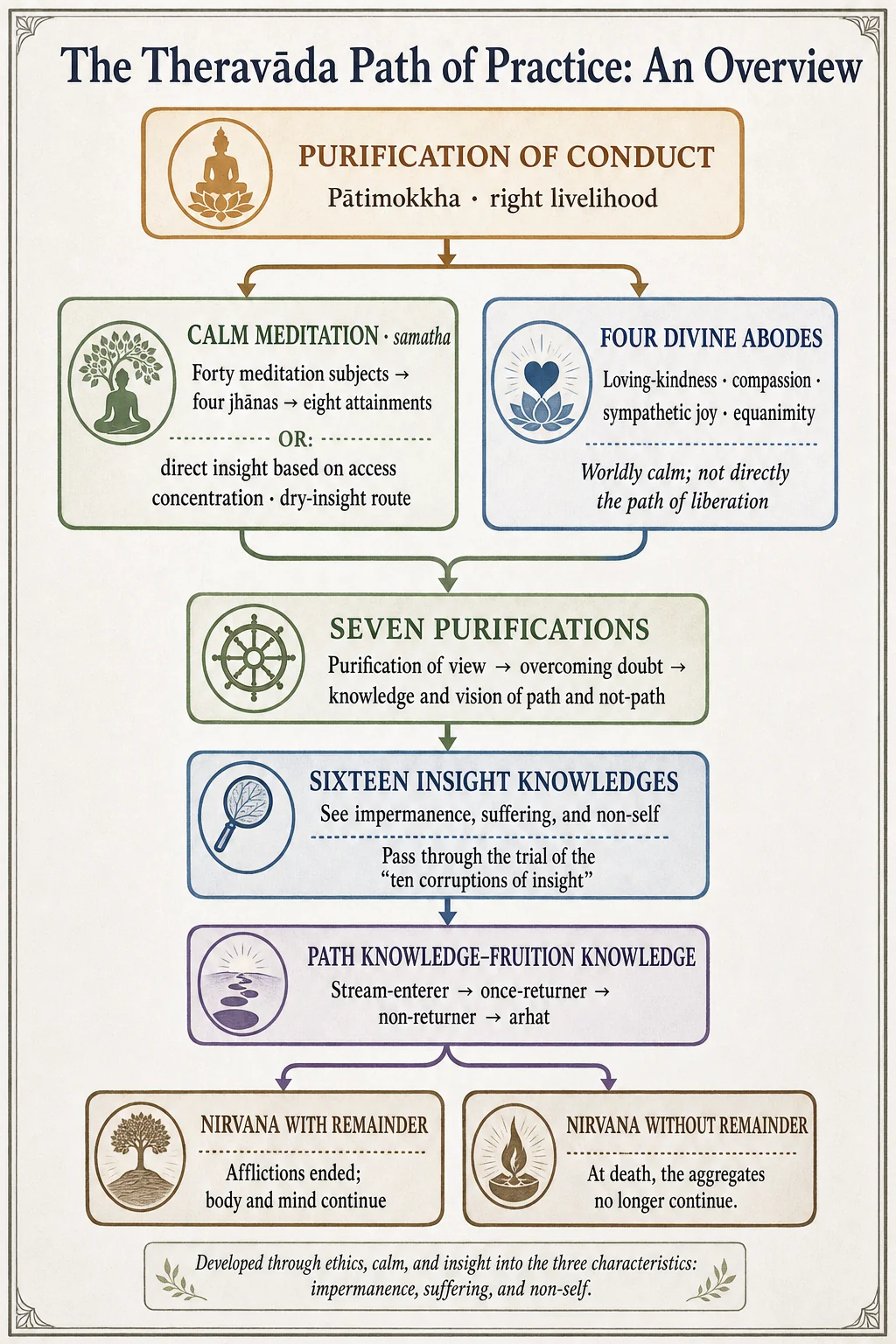
This map is not wholly uncontroversial within Southern Buddhism. Lineages differ over how necessary calm meditation is, whether the sixteen insight knowledges are universally applicable, and how particular signs are to be interpreted. Yet its overall structure (a foundation in ethical discipline, followed by calm concentration and insight knowledge, leading through the four fruits to liberation) is shared among them.
The next chapter enters the modern history of Southern Buddhism: colonialism, reform, the revival of insight meditation, and globalization since the nineteenth century, as well as Southern Buddhism’s place in the contemporary world.
Further Reading
- L. S. Cousins. “Samatha-yāna and Vipassanā-yāna.” In Buddhist Studies in Honour of Hammalava Saddhātissa, ed. G. Dhammapala et al. Nugegoda, 1984, pp. 56–68.
- Rupert Gethin. The Buddhist Path to Awakening: A Study of the Bodhi-Pakkhiyā Dhammā. Leiden: Brill, 1992.
References
References
-
Peter Harvey. The Selfless Mind: Personality, Consciousness and Nirvāṇa in Early Buddhism. Richmond: Curzon, 1995. (A detailed analysis of the Southern Buddhist concept of Nibbāna); on the debate over the “positive” character of Nibbāna, see also Steven Collins, Nirvana and Other Buddhist Felicities. Cambridge: Cambridge University Press, 1998. ↩↩
-
Bhikkhu Anālayo. The Genesis of the Bodhisattva Ideal. Hamburg: Hamburg University Press, 2010. (The book treats the earliest textual layer, the genesis of the bodhisattva concept in the Pāli Nikāyas and their Chinese and Sanskrit parallels, rather than Theravāda’s own historical development; the author states that for the latter one should consult Rahula 1971, Ratnayaka 1985, Endo 1996, Samuels 1997, Skilling 2003, Harvey 2007, and Chandawimala 2008. This section follows that division of labour: the first stage on this book, the remaining three on the latter.) ↩
-
The section on the perfections in Dhammapāla’s commentary on the Cariyāpiṭaka (fifth or sixth century), translated by Bhikkhu Bodhi as A Treatise on the Pāramīs, Wheel Publication 409, Kandy: Buddhist Publication Society. (The threefold classification by temperament, the claim that the perfections are not reserved for aspirants to Buddhahood, and the drawing on the Mahāyāna Bodhisattvabhūmi with its Mahāyāna features removed, are all in that translation and its introduction.) The names and sequence of the ten perfections follow it as well. ↩↩
-
For Theravāda’s own historical development of the bodhisatta path this section draws on Walpola Rahula, “Bodhisattva Ideal in Buddhism,” in Gems of Buddhist Wisdom, Kuala Lumpur: Buddhist Missionary Society, 1996; Jeffrey Samuels, “The Bodhisattva Ideal in Theravāda Buddhist Theory and Practice,” Philosophy East and West 47.3 (1997); and Peter Skilling’s studies of the early differentiation of the bodhisattva vehicle, one of which (2004) dates groups devoting themselves exclusively to that vehicle to around the first century BCE, as cited by Anālayo; see further Ratnayaka 1985, Endo 1996, Harvey 2007, and Chandawimala 2008. The two scriptural anchors, the Nidhikaṇḍa Sutta and the Upāsakajanālaṅkāra, come from Rahula’s essay. On bodhisatta kingship, the Sri Lankan material is in the works cited above; the Thai use of bāramī and the Vessantara Jātaka in royal legitimation is standard in Southeast Asian scholarship and is taken here from secondary surveys without independent verification against primary sources. Rahula’s own emphasis falls on this: it was a genuine development inside Theravāda, not a Mahāyāna graft, but unlike Mahāyāna it remained reserved for exceptional people and was never made the path for everyone. ↩↩
-
Bhikkhu Bodhi (trans.). The Numerical Discourses of the Buddha: A Translation of the Aṅguttara Nikāya. Boston: Wisdom Publications, 2012. (AN 4.170, the four roads to arahantship.) ↩
-
Mahāsi Sayādaw. Practical Insight Meditation: Basic and Progressive Stages. Trans. U Pe Thin and Myanaung U Tin. Kandy: Buddhist Publication Society, 1971. ↩↩
-
Pa-Auk Tawya Sayādaw. Knowing and Seeing. 4th ed. Kuala Lumpur: Wave Publications, 2003. ↩↩
-
Mogok Sayādaw. A Discourse on Vipassana Meditation. Ed. Bhikkhu Pesala. 1999. ↩
-
J. L. Taylor. Forest Monks and the Nation-State: An Anthropological and Historical Study in Northeastern Thailand. Singapore: Institute of Southeast Asian Studies, 1993. ↩
-
On the eighteenth-century decline of Buddhism in Sri Lanka and the interruption of its ordination lineage, see Kitsiri Malalgoda, Buddhism in Sinhalese Society 1750–1900. Berkeley: University of California Press, 1976 (Chapters 1–2, on the establishment of the Siam Nikāya and its background); and Heinz Bechert, ed., Buddhism in Ceylon and Studies on Religious Syncretism in Buddhist Countries. Göttingen: Vandenhoeck & Ruprecht, 1978. Specific accounts of the crisis of confidence over whether the “paths and fruits” remained attainable are scattered through the works above and Richard Gombrich, Theravāda Buddhism: A Social History from Ancient Benares to Modern Colombo. London: Routledge, 1988, Chapter 7. Interested readers may wish to verify the details further against the historical sources. ↩
-
Noa Ronkin. “The Rise of the Concept of Own-Nature (Sabhāva) in the Paṭisambhidāmagga.” Oxford Centre for Buddhist Studies, 2003. Sabhāva is first used as a defining term for dhammas in the canonical Paṭisambhidāmagga; the ontological reading takes fixed form in the Saddhammappakāsinī, Mahānāma’s commentary on that work, composed around the sixth century, where, in discussing the commentarial gloss, the study expressly cites his parsing of sabhāva as sat-bhāva, existence or a state of existing. The dating, authorship, and commentarial attribution follow that study; Part 14, Chapters 1 and 7 of the second division of this book cite it in detail. ↩