Chapter Three: Southeast Asia—Myanmar, Thailand, Cambodia, and Laos
The spread of Theravāda from Sri Lanka into Southeast Asia was not a single, orderly “missionary movement.” It unfolded in stages over six or seven centuries along several routes and under different political conditions. Myanmar, Thailand, Cambodia, and Laos now all belong to “Southern Theravāda,” but each has distinct historical strata and their interrelations are far more complex than their superficial “common school and origin” suggest. Sri Lanka transmitted directly, Southeast Asian regions influenced one another horizontally, and at several moments influence flowed back from Southeast Asia into Sri Lanka. This chapter traces the separate routes and then asks what overall picture the map presents.
I. General Remarks: Several Crucial Premises
Theravāda was not the first Buddhism in the region. Mainland Southeast Asia already possessed long-standing composite traditions of Buddhism (including Mahāyāna and esotericism) and Hinduism before Theravāda arrived. In most countries, establishing Theravāda meant transforming an existing religious order rather than planting seed in empty ground.
The Mon people were crucial intermediaries. Between Sri Lanka and Myanmar and Thailand, the Mon played a central role in transmission. Living in today’s southern Myanmar and central Thailand, they developed maritime ties with Sri Lanka at an early date, established their own Theravāda traditions, and carried them into Burmese and Thai kingdoms.
Kingship is the axis of the history. The establishment of Theravāda in almost every country was actively driven by one or more kings: supporting the saṅgha, inviting monks, sending missions to Sri Lanka for scriptures and ordination, and unifying internal order in the name of the Dhamma. Theravāda rooted itself in Southeast Asia because it met the needs of these kingdoms: a unified spiritual framework transcending tribes and a religious narrative legitimizing kings.
Reverse dependence also existed. Most strikingly, when Sri Lanka’s ordination lineage nearly died out in the eighteenth century, it invited monks from Thailand and received a renewed higher-ordination lineage, the origin of the Siam Nikāya. The source borrowing ordination from the recipient shows that relations between “headwaters” and “downstream” were never one-way.
II. Myanmar: A Mon Foundation and Pagan Integration
The Early Period before Pagan
The earliest historically documented state system in the region was that of the Pyu, approximately the second through ninth centuries, across the dry zone of central Myanmar. Pyu cities such as Śrī Kṣetra and Beikthano have produced diverse Buddhist remains: inscriptions in Pāli and Sanskrit and evidence of Theravāda, Mahāsāṃghika, and Mahāyāna traditions. The landscape was plural, not exclusively Theravāda. Pyu states declined after Nanzhao incursions in the ninth century.1
The Mon of southern Myanmar had more direct ties with Sri Lanka. They are said to have received Theravāda scriptures and ordination by sea at an early date, perhaps the fifth or sixth century. Their kingdom of Thaton became one of the region’s earliest stable Theravāda centers.
Pagan and Anawrahta
King Anawrahta (r. c. 1044–1077) of the Pagan dynasty (c. 849–1297) decisively established Theravāda as Myanmar’s mainstream.
Tradition says that a Mon monk, Shin Arahan, came from Thaton to Pagan and converted the king through his teaching. Anawrahta then conquered Thaton and returned with numerous Pāli texts, famously carried by thirty-two elephants, together with Mon monks and artisans, formally establishing Theravāda as the state religion.2
The narrative is heavily mythologized (the thirty-two elephants form an auspicious number), and this book doubts its details. Its central structure remains a credible historical framework: Mon mediation and political conquest accompanied religious import. Anawrahta was a historical ruler, and the numerous surviving temples and stūpas of Pagan corroborate the scale of his religious construction.
From the eleventh through thirteenth centuries, Pagan became a major Southeast Asian Theravāda center and more than two thousand religious monuments survive. It was also active in Pāli learning and Abhidhamma studies, establishing roots for Myanmar’s later intensive Abhidhamma tradition.
Mongol forces entered Pagan in 1287 and the dynasty dissolved. Theravāda foundations were already secure, and successor kingdoms including Ava continued to portray themselves as protectors of the teaching. In the fifteenth century, new ordination lineages from Sri Lanka (transmitted through Chiang Mai in northern Thailand) entered Myanmar and competed with existing traditions, becoming historical sources of later nikāyas.
The Depth of Myanmar’s Abhidhamma Tradition
Myanmar’s exceptionally deep Abhidhamma tradition deserves separate emphasis. It places compendia such as the Abhidhammattha-saṅgaha at the highest level of study and maintains educational tracks for “scriptural monks” devoted to pariyatti and “practice monks” devoted to paṭipatti. Each has its own lineage. The twentieth-century revival of insight meditation, including the Mahasi tradition discussed in 9.5, arose within this environment of intensive Abhidhamma study.
III. Thailand: The Mon Foundation of Dvāravatī and the Formation of Sukhothai
Dvāravatī: Mon Theravāda before the Thai Kingdoms
Before Thai peoples established kingdoms, the central plains of present-day Thailand already contained a Mon Theravāda state: Dvāravatī, approximately the sixth through eleventh centuries. Its Buddhist remains (stone wheels of Dhamma, bilingual Mon and Sanskrit inscriptions, and circular stūpas) are distributed around present-day Nakhon Pathom and U Thong and visibly share the background of contemporary Mon traditions in Myanmar.3
After the eleventh century, Angkor’s Khmer empire expanded west, Dvāravatī declined, and central Thailand entered a Khmer cultural sphere whose court religion blended Brahmanism and Mahāyāna. This is the source of a later Khmer court layer in Thai Buddhism.
Sukhothai and Lan Na
Sukhothai (c. 1238–1438) was the first independent Thai kingdom. King Ram Khamhaeng (r. c. 1279–1298) is known for creating the Thai script and promoting Theravāda. His inscription, the earliest surviving Thai text, describes a society organized around the Dhamma: the king is close to monks, places a seat before the palace for them to teach, and allows the people freedom in devotion.4
One source of Sukhothai Theravāda was Nakhon Si Thammarat in southern Thailand, which had early direct maritime contact with Sri Lanka. During Ram Khamhaeng’s reign, this Sri Lankan lineage entered the Sukhothai court and became royal orthodoxy.
At the same time, Lan Na in northern Thailand (the Chiang Mai region, c. 1292–1558) formed another Theravāda center. In the 1430s, it invited fully ordained monks from Sri Lanka and conducted a major ceremony in Chiang Mai to purify the ordination lineage under Sri Lankan standards. This Lan Na tradition later supplied monks and texts to Myanmar and Laos.
Ayutthaya and the Courtization of Buddhism
Ayutthaya (1351–1767) was a longer-lived and more influential Thai kingdom that first coexisted with and then replaced Sukhothai. Its court was deeply shaped by Khmer Angkor. The king appeared as a “god-king” (devarāja), court rituals combined Brahmanical and Buddhist elements, and the ruler was simultaneously Buddhism’s great protector.
This model of “Buddhist kingship” (the king as Dhamma ruler whose legitimacy depended upon supporting and purifying the saṅgha) recurs across Southeast Asian states. It is a structural integration of politics and religion, not superficial religious coloring.
Burmese forces captured Ayutthaya in 1767 and ended the kingdom. The succeeding Bangkok or Rattanakosin dynasty undertook a comprehensive reconstruction that included important Buddhist reforms, discussed in 9.5.
IV. Cambodia: From Angkor Mahāyāna to Theravāda
The Religious Complex of the Angkor Period
The Khmer empire or Angkor kingdom (c. 802–1431) was among the strongest states of premodern Southeast Asia, covering present-day Cambodia, much of Thailand, southern Laos, and southern Vietnam at its height.
Angkor’s religious order was a long coexistence and competition between Hinduism and Buddhism. Kings shifted between them according to personal preference: most were Śaivas, some Vaiṣṇavas, and only a few Buddhist.
The most important exception was Jayavarman VII (r. c. 1181–1218), Angkor’s final great builder and the only Cambodian ruler to leave extensive monuments explicitly as a Mahāyāna Buddhist king. Angkor Thom, the Bayon (with its many faces, often understood as the king in bodhisattva form or Avalokiteśvara), and Ta Prohm all come from his reign.5
After his death, successors restored Hindu orientations and destroyed some Mahāyāna sculpture. The reversal shows that Mahāyāna never achieved lasting dominance at Angkor; its flourishing depended heavily upon individual royal support.
The Theravāda Transformation: Thirteenth through Fifteenth Centuries
Angkor’s religious order changed fundamentally around the thirteenth century as Theravāda entered from the direction of Thailand. During Sukhothai expansion, Thai peoples brought a Theravāda based on Mon traditions and authorized by Sri Lankan lineage. Angkor’s kingship meanwhile weakened rapidly under repeated external pressure from Thai powers.
By the fourteenth and fifteenth centuries, Theravāda had clearly replaced Mahāyāna and Hinduism as the mainstream. In 1431 Ayutthaya forces captured Angkor, and the Khmer court moved toward the present Phnom Penh region, bringing it closer to Thailand’s cultural sphere. Since Thai Buddhism was Theravāda, the political shift accelerated the final religious transformation.5
There is a historical irony. Angkor’s most visually striking Buddhist legacy, the Mahāyāna faces of the Bayon, predates the establishment of Theravāda. Much of what visitors see today as “Buddhist” art at Angkor belongs to Mahāyāna, not the contemporary Cambodian Theravāda tradition.
In the twentieth century, Cambodian Buddhism suffered its most devastating blow. Under Khmer Rouge rule from 1975 to 1979, monks were killed on a vast scale, monasteries destroyed or repurposed, and transmission nearly broken. Its later reconstruction belongs to another period, briefly addressed in 9.5.
V. Laos: The Lan Xang Kingdom and the Establishment of Theravāda
Theravāda became established relatively late in Laos, chiefly with the founding of the Lan Xang kingdom, the “Land of a Million Elephants,” which lasted from 1353 to 1707.
Its founder Fa Ngum (r. 1353–1373) was raised at the Khmer court in Angkor and married a Khmer princess. After returning and unifying Lao polities by force, he brought Khmer Theravāda monks and texts together with the celebrated Pra Bang image, which became the kingdom’s protecting sacred object. The image remains one of Laos’s most important religious symbols and gave its name to Luang Prabang, the ancient royal capital.6
The direct source of Lao Theravāda was thus a tradition transmitted through Khmer mediation rather than directly from Sri Lanka. It came through Cambodian Buddhism already shaped by Khmer court culture, and was later supplemented by the Thai-Lan Na lineage from Chiang Mai. This double origin makes Lao Buddhism especially close in style to northern Thai traditions.
After the seventeenth century, Lan Xang divided into the smaller kingdoms of Luang Prabang, Vientiane, and Champasak. Each continued Theravāda until French colonial power incorporated them into French Indochina.
VI. Continuing Interaction between Sri Lanka and Southeast Asia
Taken together, these histories show that Sri Lanka’s relation to Southeast Asia was not the one-way model “Sri Lanka transmits and Southeast Asia receives,” but repeated bidirectional movement across centuries:
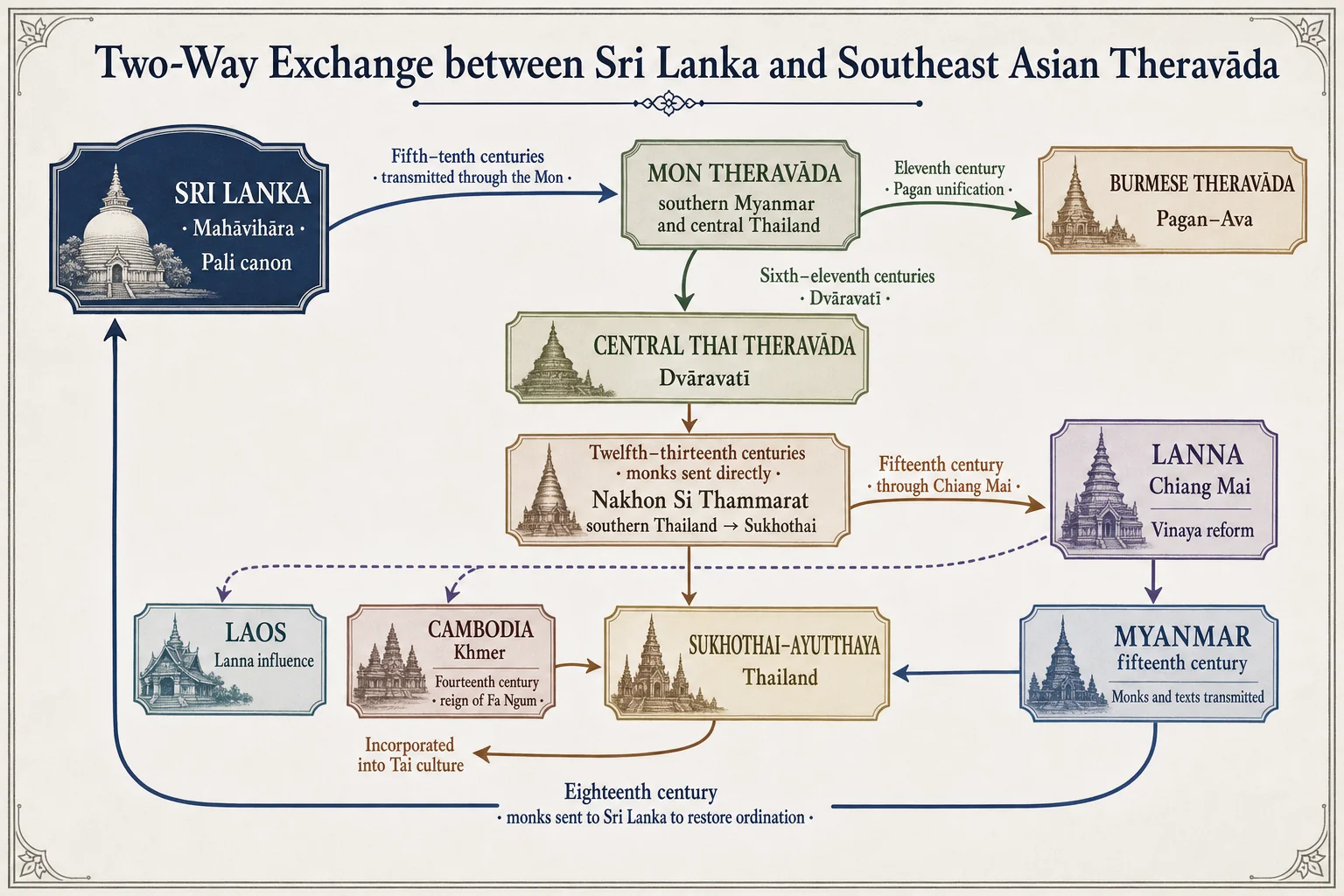
The final arrow is most revealing. By 1753, after centuries of war, Sri Lanka’s bhikkhu ordination lineage had nearly died out. Too few fully ordained monks remained to perform a valid ordination act together. Sri Lanka appealed to Siam, and Thailand sent monks who restored the higher ordination and established today’s largest Sri Lankan order, the Siam Nikāya.7 The island that had exported the tradition borrowed its ordination lineage back from a Southeast Asian recipient.
This reversal also shows that “the unity of Southern Theravāda” does not mean that a permanently stable center continually transmitted outward. The relations among regional traditions were dynamic, networked, and historically contingent.
VII. Common Features and Differences
The Southeast Asian Theravāda traditions share several structural features while retaining their own differences.
Common features:
- All treat the Pāli Tipiṭaka as canonical and Buddhaghosa’s commentarial tradition, especially the Visuddhimagga, as a foundational framework for doctrine and practice.
- All experienced moments when a fully ordained lineage was introduced or reconstructed from Sri Lanka.
- All developed deep integration between saṅgha and kingship: rulers presented themselves as protectors of the Dhamma, and the saṅgha reciprocated with legitimacy.
- All distinguish forest traditions from town or village traditions; the former emphasize meditation and the latter scriptural study and community service.
Principal differences:
| Myanmar | Thailand | Cambodia | Laos | |
|---|---|---|---|---|
| Principal source of transmission | Mon tradition plus later Lan Na lineages | Mon foundation plus direct Sri Lankan transmission | Thai lineage with Khmer court mediation | Khmer mediation plus Lan Na influence |
| Abhidhamma study | Exceptionally deep and systematically institutionalized | Substantial, together with strong meditation traditions | Comparatively weak after historical destruction | Comparatively limited |
| Modern meditation | Internationally influential insight traditions such as Mahasi and Pa-Auk | Far-reaching Forest Tradition in Ajahn Mun’s lineage | Still under reconstruction | Closely resembles Thai traditions |
| Nikāya structure | Several orders coexist, including Thudhamma and Shwegyin | Mahā Nikāya and Dhammayuttika Nikāya | Mahā Nikāya and Thai-derived Dhammayuttika | Principally one system |
| Modern political disruption | British colonialism followed by military rule | Remained independent; royal protection continued | Devastation under the Khmer Rouge | Communist government with limited control |
One observation deserves emphasis: the establishment of Theravāda in Southeast Asia always accompanied a narrative of “purification.” Each importation of a new Sri Lankan ordination lineage was described as correcting a local tradition that had become “corrupt.” The purification narrative itself had a political function. It allowed a new center of power (whether Anawrahta, Ram Khamhaeng, or Fa Ngum) to establish legitimacy through religious reform. This book advises reading purification narratives as political acts while acknowledging that they also produced genuine institutional renewal.
The next chapter turns to doctrine and meditation themselves, the central subject of this part’s account of Southern Theravāda philosophy and practice.
Further Reading
- Donald K. Swearer. The Buddhist World of Southeast Asia. 2nd ed. Albany: SUNY Press, 2010 (a general account of Southeast Asian Theravāda synthesizing the common features and differences among countries).
References
References
-
Michael Aung-Thwin. Pagan: The Origins of Modern Burma. Honolulu: University of Hawaii Press, 1985 (a synthetic history of Pagan’s foundation and religion; for the Pyu background, see also Luce, Old Burma—Early Pagan). ↩
-
G. E. Harvey. History of Burma: From the Earliest Times to 10 March 1824, the Beginning of the English Conquest. London: Longmans, Green, 1925 (traditional accounts of Anawrahta and Shin Arahan). ↩
-
Peter Skilling. “Theravāda in History.” Pacific World: Journal of the Institute of Buddhist Studies, 3rd series, no. 11 (2009): 61–93 (Dvāravatī and the overall framework of Theravāda transmission in Southeast Asia). ↩
-
David K. Wyatt. Thailand: A Short History. 2nd ed. New Haven: Yale University Press, 2003 (the religious histories of Sukhothai and Ayutthaya). ↩
-
Ian Harris. Cambodian Buddhism: History and Practice. Honolulu: University of Hawaii Press, 2005 (an authoritative study of Angkor’s religious landscape and the transformation to Theravāda). ↩↩
-
Grant Evans. A Short History of Laos: The Land in Between. Crow's Nest: Allen & Unwin, 2002 (the foundation of Lan Xang and a general history of Lao Buddhism). ↩
-
Kitsiri Malalgoda. Buddhism in Sinhalese Society, 1750–1900: A Study of Religious Revival and Change. Berkeley: University of California Press, 1976 (the establishment of the Siam Nikāya and eighteenth-century Sri Lankan ordination history). ↩