Chapter Two: Buddhaghosa, the Visuddhimagga, and the Commentarial Tradition¶
The previous chapter concluded that Buddhaghosa’s fifth-century work at Mahāvihāra was the decisive step in its intellectual tradition, raising interpretive authority from “guardianship of the authorized text” to “production of authoritative commentary.” This chapter examines that achievement: who Buddhaghosa was, what he did, how he did it, and in which respects the resulting commentarial system shaped the character of “Southern Theravāda.”
Section 3.4 already introduced Buddhaghosa from the perspective of Abhidhamma philosophy. This chapter does not repeat that material, but focuses upon three things: the historical background of his life and work, the structure and central content of the Visuddhimagga, and the commentarial system he established.
I. Buddhaghosa after Demythologization¶
As with most figures in Indian Buddhist history, biographical information about Buddhaghosa is scarce and survives chiefly in mythologized narratives.
The most widely circulated account, from Burmese Buddhist legend, says that Buddhaghosa was born into a Brahmin family near Bodh Gayā in northern India and mastered the Vedas. After debating an elder, he converted to Buddhism and ordained. He then heard that Mahāvihāra in Sri Lanka preserved complete ancient commentaries written in Sinhala and sailed to the island. Upon his arrival, the elders required him to compose a treatise to prove his qualifications. He wrote the Visuddhimagga, and the impressed elders granted him access to the scriptural repository.1
The narrative follows a conspicuous template: outsider, test, proof of qualification, permission to enter, great accomplishment. This book treats it as a typical “legend of a great man,” not historical fact. The introductory verses of the Visuddhimagga contain a few limited autobiographical remarks: he says that he was born “near the land of Magadha” and mastered the Tipiṭaka and commentaries.2 Beyond this, his life is almost a historical blank.
The outline that can be stated safely is:
- He was active around the fifth century CE, roughly in Xuanzang’s broader era but about two centuries earlier.
- He resided at Mahāvihāra; this is secure, and all his work rests upon its tradition.
- His work consisted of translation and compilation: translating the ancient Sinhala commentaries (Sinhala aṭṭhakathā) preserved by Mahāvihāra into Pāli, then reorganizing and expanding them.
- The Visuddhimagga is a new, independently composed treatise, not a translation.
Whether he was Indian-born or a native of Sri Lanka remains disputed. This book’s position is that birthplace matters little for understanding his work. What matters is that he stood within the Mahāvihāra tradition and possessed systematic command of the entire Pāli Tipiṭaka and its old commentaries. This made his integration possible.
II. Principal Works: A Project of Enormous Scale¶
Buddhaghosa’s output was astonishing. At minimum, he completed the following works:
| Work | Type | Object of commentary |
|---|---|---|
| Path of Purification (Visuddhimagga) | Independent treatise | Synthesizes the path around the three trainings in ethical conduct, concentration, and wisdom |
| Dispeller of Delusion or Universal Pleasing (Samantapāsādikā) | Commentary | Vinaya Piṭaka |
| Dispeller of Doubts (Kaṅkhāvitaraṇī), accompanying the vinaya commentary | Commentary | Pātimokkha rules |
| Expositor (Atthasālinī) | Commentary | Dhammasaṅgaṇī, the first Abhidhamma book |
| Dispeller of Delusion (Sammohavinodanī) | Commentary | Vibhaṅga, the second Abhidhamma book |
| Commentary on the Five Treatises (Pañcappakaraṇa-aṭṭhakathā) | Commentary | The remaining five Abhidhamma books |
| Ornament of Auspiciousness (Sumaṅgalavilāsinī) | Commentary | Dīgha Nikāya |
| Dispeller of Proliferation (Papañcasūdanī) | Commentary | Majjhima Nikāya |
| Illuminator of the Essential Meaning (Sāratthappakāsinī) | Commentary | Saṃyutta Nikāya |
| Fulfiller of Wishes (Manorathapūraṇī) | Commentary | Aṅguttara Nikāya |
This is almost a book-by-book commentary on the Pāli Tipiṭaka plus an independent treatise on practice. The volume seems too great for one or two people in only a few years, and scholarship questions the attribution of some works, especially whether a single Buddhaghosa composed all the vinaya and Abhidhamma commentaries. The main body of the attribution remains credible.3
Their source texts were the old Sinhala commentaries preserved by Mahāvihāra. According to its own tradition, they began with seeds of interpretation brought by Mahinda when he transmitted Buddhism to the island and accumulated through several centuries of Sri Lankan scholarship. Buddhaghosa rendered this Sinhala archive into Pāli and thereby made it available throughout the Theravāda world rather than only to local Sri Lankan readers.
The achievement had enormous historical significance and an unavoidable cost. After Buddhaghosa translated the old Sinhala commentaries, almost all of them disappeared because they no longer had an independent reason to survive. No complete version exists today in Sri Lanka or elsewhere; only Buddhaghosa’s Pāli renditions remain. We therefore cannot independently verify the fidelity of his translations or identify where he expanded, abridged, or altered them. He was not merely their translator, but to a significant degree their reconstructor.
III. The Structure and Content of the Visuddhimagga¶
The Visuddhimagga is the most important of Buddhaghosa’s works. It is his own treatise, not a translation, and does not restrict itself to commenting upon a single scripture or Abhidhamma book. It systematically lays out the entire Southern path of practice, taking one scriptural verse as its program:
“Established in virtue, developing concentration well, a wise person disentangles this tangle.”
Seven levels of “purification” (visuddhi), moving from purification of ethical conduct through concentration to wisdom, extend throughout the work and constitute a complete path from worldly life to liberation.2
Part One: Purification of Ethical Conduct¶
Ethical conduct (sīla) is the foundation and shortest part. Buddhaghosa chiefly treats the disciplinary framework for monastics: the Pātimokkha rules, restraint of the sense faculties, purification of livelihood, and contentment in the use of requisites. Lay ethics receives brief mention but is not the work’s focus.
The arrangement reflects the Visuddhimagga’s overall purpose: it is a systematic guide for monastic practitioners and assumes that its readers live within a complete saṅgha institution.
Part Two: Purification of Concentration¶
Concentration (samādhi) occupies almost half the work and is its most detailed part. Buddhaghosa systematizes forty meditation objects (kammaṭṭhāna), explains how practitioners should select objects appropriate to their temperaments, and describes the progressive development of calm meditation (samatha) through absorption concentration (appanā-samādhi).
| Type of meditation object | Content | Number |
|---|---|---|
| Ten kasiṇas | Earth, water, fire, air, blue, yellow, red, white, light, and space | 10 |
| Ten foulness contemplations (asubha) | Nine charnel-ground contemplations, such as a skeleton, plus one perception of impurity | 10 |
| Ten recollections (anussati) | Buddha, Dhamma, Saṅgha, ethical conduct, generosity, devas, death, body, breathing, and peace | 10 |
| Four divine abodes (brahmavihāra) | Loving-kindness, compassion, appreciative joy, and equanimity | 4 |
| Four immaterial absorptions (arūpa-jhāna) | Infinite space, infinite consciousness, nothingness, and neither perception nor nonperception | 4 |
| Perception and analysis | Perception of repulsiveness in food and analysis of the four elements | 2 |
The result of calm practice with these objects is the four jhānas and four immaterial attainments, together forming eight attainments (samāpatti). Buddhaghosa’s descriptions of each jhāna agree with the comparative table in 1.5: applied thought, sustained thought, rapture, pleasure, and equanimity progressively fall away. He also explains the development of the meditative “sign” (nimitta) in detail. With mindfulness of breathing, for example, a practitioner first sees the “learning sign” (uggaha-nimitta) and then the “counterpart sign” (paṭibhāga-nimitta). The latter is a lucid, luminous mental image marking absorption concentration.2 This later became controversial. Critics consider the counterpart sign peculiar to Buddhaghosa; early scriptures contain no equally clear description and do not justify treating it as a universally applicable landmark.
Part Three: Purification of Wisdom¶
Wisdom (paññā) is the culmination and covers the complete path from preliminary insight knowledge to final liberation. Its central framework is the “seven purifications” (satta-visuddhi):
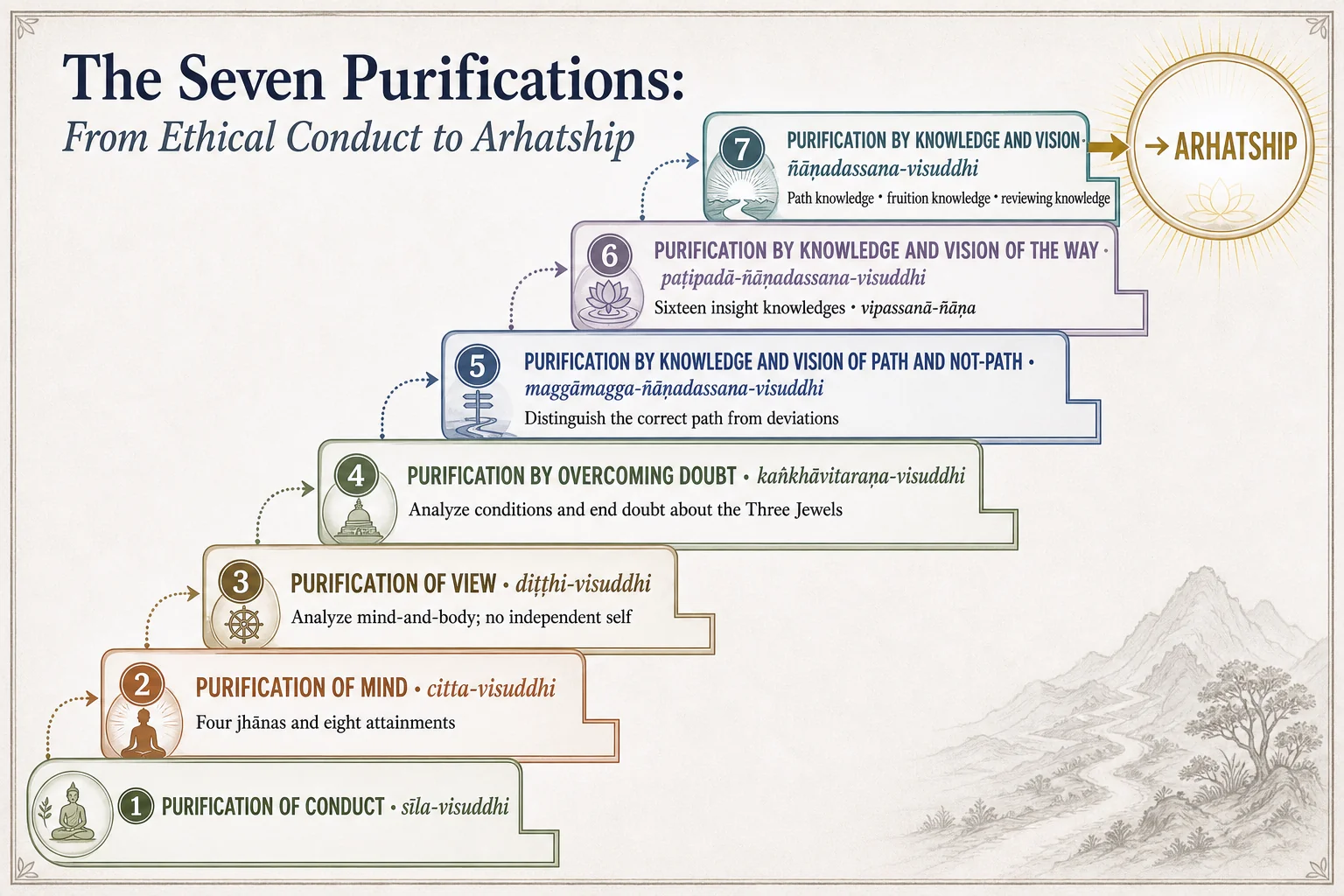
Within the sixth purification, the “sixteen insight knowledges” (vipassanā-ñāṇa) are the most precise element. They begin with “knowledge distinguishing mind and matter,” pass through “knowledge contemplating rise and fall” and “knowledge contemplating dissolution,” continue to “knowledge of equanimity toward formations,” then enter “conformity knowledge” and “change-of-lineage knowledge,” and finally break into “path knowledge.” Each step receives a concrete description, including ten “corruptions of insight” (vipassanā-upakkilesa)—luminosity, rapture, tranquility, faith, energy, and other experiences that practitioners may mistake for attainment. This sequence became the “standard map” of Southern insight practice, although modern Burmese and Thai systems interpret it differently, as 9.5 explains.
Buddhaghosa’s seven-purification and sixteen-insight-knowledge framework is a systematic integration of the early scriptural tradition. Early sources contain scattered pieces of the material but no equally orderly sequence. His achievement was clarity: he assembled them into an operable path. The price was fixing what had originally been flexible.
IV. Two Philosophical Positions Worth Noting¶
Buddhaghosa takes clear positions on Southern philosophy in the Visuddhimagga and commentaries. Two became especially controversial later.
First, calm meditation precedes insight. Buddhaghosa’s seven-purification framework requires practitioners to achieve the second purification, “purification of mind” (at least access concentration and perhaps absorption) before developing insight knowledge. Calm meditation (samatha) is thus a prerequisite for insight (vipassanā): calm comes first and insight afterward; the stage cannot be skipped.
This has some basis in early scriptures but is not the only interpretation. They also record “dry-insight practitioners” (sukkha-vipassaka), who attain fruition through insight without first entering absorption. Buddhaghosa accepts the path in his commentary, but his systematic presentation in practice emphasizes “calm before insight.” This becomes one historical origin of the later Southern dispute over their relation. Twentieth-century Burmese “pure insight” traditions and Pa-Auk meditation interpret the issue differently; some return to a pure-insight path and others emphasize prior cultivation of calm. Their disagreement can be traced to how Buddhaghosa is read.4
Second, the systematic use of intrinsic nature (sabhāva) as a defining term. Buddhaghosa’s commentaries use the expression that “each dhamma has its own nature” widely and systematically, applying it item by item to define the characteristics of dhammas. The usage already has a footing in the canon: Ronkin’s examination of the Paṭisambhidāmagga concludes that sabhāva is first employed there as a defining term for dhammas.5 What Buddhaghosa took over was an existing usage, and his own work extended it to the definition of the whole field of dhamma characteristics, making “each dhamma has an inherent characteristic, and by that characteristic it is defined” the standard procedure of Southern commentary. Section 3.4 has already noted this layer: the seven books of the Theravāda Abhidhamma do not use sabhāva language widely, and the commentarial period strengthened it.
To read sabhāva as a claim about a mode of existence is a separate matter, and it belongs to a later age. The same line of scholarship places that step in the hands of the sixth-century commentator Mahānāma. In the Saddhammappakāsinī, his commentary on the Paṭisambhidāmagga, he parses sabhāva as sat-bhāva, existence or a state of existing, and the ontological reading takes fixed form there.5 The step falls roughly a century after Buddhaghosa and comes from another man’s hand.
The two belong to two levels. Used as a defining term, the word says that a dhamma has a characteristic of its own by which it can be told apart from other dhammas under contemplation, and it says nothing about that dhamma’s mode of existence. Read as an ontological claim, it says that a dhamma is of itself what it is and depends on nothing else to be itself. Buddhaghosa stands in the first position. He made the defining usage into standard procedure, and the conditions for reifying dhammas were left in place along with the procedure, while the ontological step was completed by later hands. The tendency toward ontologization discussed in Part III stands to this passage as consequence to condition.6
This book regards the tension as an important part of Buddhaghosa’s legacy, but it cannot simply be labeled his “error.” In circumstances demanding clear doctrinal definition, he chose clarity at the cost of a certain philosophical rigidity.
V. The Commentarial Tradition before Buddhaghosa¶
Understanding Buddhaghosa requires seeing the commentarial tradition before him: how long it lasted, how extensive it was, and how invisible it has become.
Seven centuries before Buddhaghosa. Approximately seven hundred years separate Mahinda’s third-century BCE arrival from Buddhaghosa’s fifth-century work. During this period, Mahāvihāra did more than carry the Pāli canon in memory. It continuously produced interpretations in the local Sinhala language. These works are collectively called the “old commentaries” (Sinhala Aṭṭhakathā, or simply aṭṭhakathā).
In the prefaces to his commentaries, Buddhaghosa explicitly names three principal sources: the Great Commentary (Mahā-aṭṭhakathā), the Great Raft Commentary (Mahā-Paccari, literally “Great Raft,” traditionally said to have been compiled on a raft), and the Kurundī Commentary, perhaps named for a place. These were the source texts of his synthesis.3 According to Mahāvihāra lineage, their origins reached back to oral seeds brought from India by Mahinda, expanded and transformed over generations by Sri Lankan elders.
But there is a fundamental evidentiary predicament: all three works are lost and no independent manuscript survives. After Buddhaghosa’s translations, the Sinhala commentaries no longer seemed necessary and vanished over subsequent centuries. All we see today are his Pāli versions. Seven centuries of accumulated interpretation are visible only through Buddhaghosa’s eyes. The fidelity of his translation, the places of expansion, and the points of omission cannot be independently checked. He was both “translator of the old commentaries” and, to a substantial degree, their “reconstructor.”
Abhayagiri’s parallel tradition. Abhayagiri also had a commentarial tradition oriented differently from Mahāvihāra. As the previous chapter explained, it received varied Indian currents more openly. This left traces in its interpretive materials: Faxian says that it circulated Mahāsāṃghika vinaya and Mahāyāna scriptures, and its framework was correspondingly more plural. This parallel commentarial tradition ended with Mahāvihāra’s enforced unification in the twelfth century and is now almost entirely lost.
Before Buddhaghosa’s arrival, Mahāvihāra’s Sinhala commentaries were thus products of centuries of local transmission, allegedly beginning with Mahinda and evolving generation by generation. Their exact form is no longer knowable, but they clearly contained interpretation integrated with Sri Lankan culture and context.
Buddhaghosa’s Pāli translation had a double effect. It incorporated local tradition into a unified linguistic framework capable of crossing regions, making Sri Lankan commentary the shared inheritance of the whole Theravāda world. It also removed that tradition from its original local-language context, after which it could be known only through Pāli.
Several important successors continued Mahāvihāra commentary after Buddhaghosa:
- Dhammapāla, around the fifth or sixth century, supplied commentaries on Khuddaka Nikāya works Buddhaghosa had not treated, including the Udāna, Itivuttaka, Theragāthā, and Therīgāthā. He also wrote a subcommentary (ṭīkā) on the Visuddhimagga, establishing a three-level structure of scripture, commentary, and subcommentary. His commentary on the Cariyāpiṭaka further contains a section devoted to the perfections, the first Southern work to treat the bodhisatta path as a subject in its own right, drawing among other sources on the Mahāyāna Bodhisattvabhūmi with its Mahāyāna features stripped out (see 9.4, section one).
- Buddhappiya, around the eleventh or twelfth century, succeeded the tradition in Pāli grammar and literature.
- Anuruddha, around the eleventh or twelfth century, wrote the Abhidhammattha-saṅgaha, further condensing Buddhaghosa’s systematized Abhidhamma into a memorized outline, as 3.4 discussed.
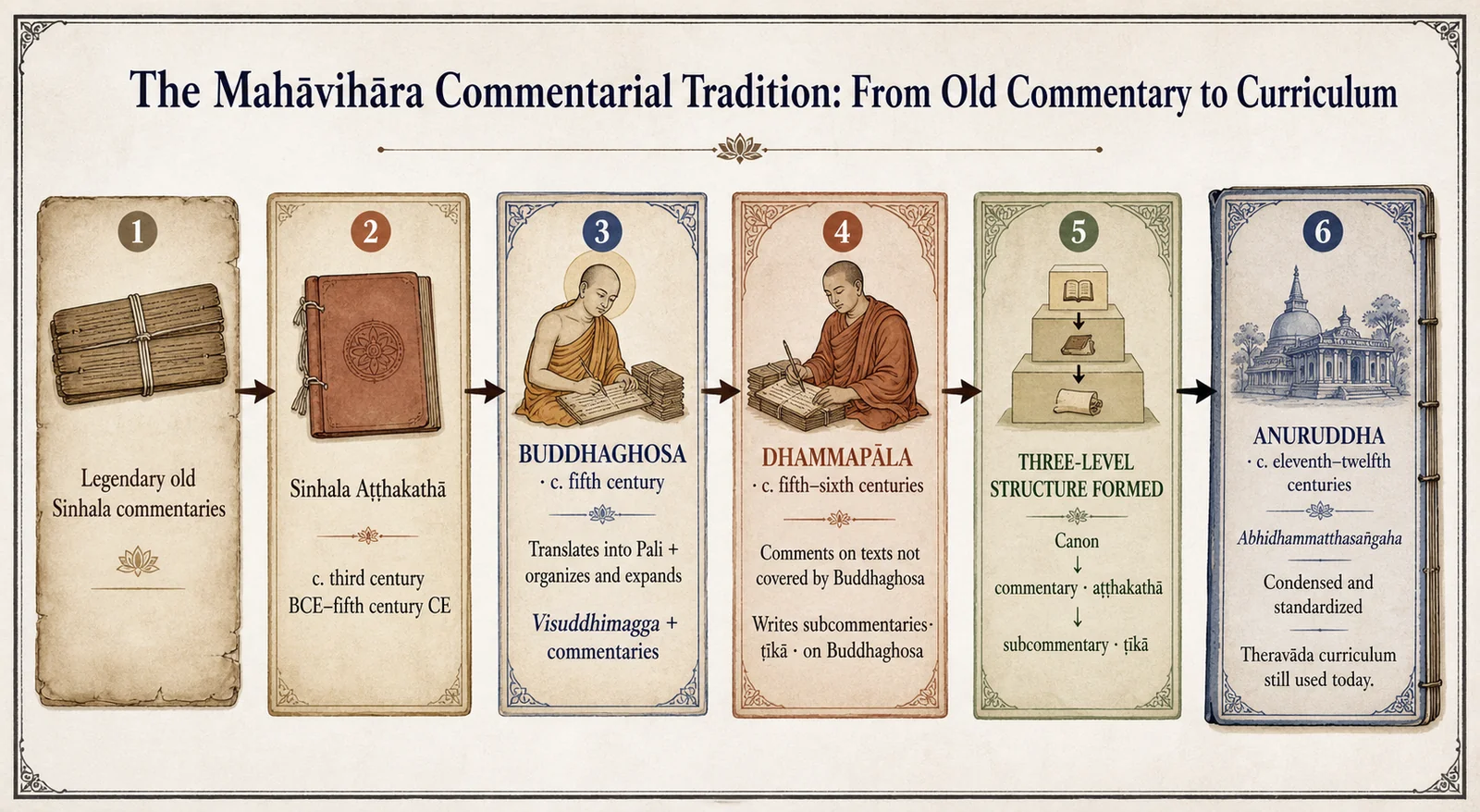
Once the three-tier structure of canon, commentary, and subcommentary was fixed, “learning Buddhism” in the Southern tradition largely meant learning these levels. A traditionally educated Theravāda monk often begins with a compendium such as the Abhidhammattha-saṅgaha, moves upward to Buddhaghosa’s commentaries, then reaches the Pāli canon. The canon is normatively supreme, but practically it is often read through Buddhaghosa’s eyes.
VI. What Did Buddhaghosa Shape?¶
Buddhaghosa accomplished several things that together define the concrete meaning of “Southern Theravāda.”
He unified the language of interpretation. Converting the old commentaries from Sinhala to Pāli moved interpretive authority from a local tradition into a Pāli framework that was global within the Theravāda world. Theravāda scholars thereafter read and wrote commentary in Pāli. Buddhaghosa’s project created this unity.
He supplied an “official map” of the path. The Visuddhimagga’s seven purifications and sixteen insight knowledges became the standard reference for later Southern theories of practice. It is not merely a theoretical framework but a practical guide against which practitioners can check their progress stage by stage. The map’s detail and clarity explain its endurance and also constitute the cost of its “fixing” effect.
He established a hierarchy of commentarial authority. The three levels of canon, commentary, and subcommentary mean in practice that understanding a Pāli scripture is not simply the result of direct encounter between reader and text; it is mediated by Buddhaghosa and successors such as Dhammapāla. This mediation is not transparent. It carries Mahāvihāra’s position, the fifth-century Indian and Sri Lankan setting, and Buddhaghosa’s own preference for systematization.
This book’s position is that Buddhaghosa’s commentarial enterprise was among the most important systematizations in Southern Buddhist history; both its merit and cost lie in systematization itself. It gave Southern Buddhism cohesion and transmissibility, allowing the Sri Lankan tradition to become the common source of the entire Southeast Asian Theravāda world. It also fixed the interpretation of one era and one school, Mahāvihāra, as an authoritative level that later generations could scarcely bypass. Modern Theravāda is, to a considerable degree, the Theravāda Buddhaghosa saw.
VII. The Khuddaka Nikāya: Composition, Dating, and the Boundary between Canon and Commentary¶
An account of Buddhaghosa’s project cannot avoid the corpus he commented upon. The fifth division of the Pāli Sutta Piṭaka is the Khuddaka Nikāya, the “Minor Collection.” It has the most heterogeneous composition, widest chronological range, and greatest susceptibility to misreading.
Composition and content. Standard Pāli tradition includes fifteen works, though Sri Lankan, Thai, and Burmese lists differ slightly:
| No. | Pāli title | Common English title | Brief description |
|---|---|---|---|
| 1 | Khuddakapāṭha | Minor Readings | Nine short texts used as introductory recitations for novice monks |
| 2 | Dhammapada | Dhammapada | 423 verses; the most widely circulated Pāli text |
| 3 | Udāna | Inspired Utterances | Exclamatory verses spoken by the Buddha in response to occasions, with prose settings |
| 4 | Itivuttaka | Thus It Was Said | 112 short discourses introduced as “thus the Buddha said” |
| 5 | Suttanipāta | Discourse Collection | A verse collection whose portions, including the Rhinoceros Sutta, are considered extremely old |
| 6 | Vimānavatthu | Stories of Celestial Mansions | 83 verse stories of heavenly mansions, good karma, and celestial rebirth |
| 7 | Petavatthu | Stories of Hungry Ghosts | 51 verse stories of hungry ghosts, bad karma, and ghostly rebirth |
| 8 | Theragāthā | Verses of the Elder Monks | Awakening verses of 264 male elders |
| 9 | Therīgāthā | Verses of the Elder Nuns | Awakening verses of 73 female elders |
| 10 | Jātaka | Birth Stories | 547 previous-life stories; only the verses are canonical, while the prose stories belong to commentary |
| 11 | Niddesa | Exposition | An ancient commentary on portions of the Suttanipāta, traditionally attributed to Sāriputta |
| 12 | Paṭisambhidāmagga | Path of Discrimination | An Abhidhamma-style analytical treatise traditionally attributed to Sāriputta |
| 13 | Apadāna | Legends | Verse biographies of the meritorious former lives of more than six hundred noble disciples |
| 14 | Buddhavaṃsa | Chronicle of Buddhas | Accounts of twenty-four buddhas preceding Gotama |
| 15 | Cariyāpiṭaka | Basket of Conduct | Thirty-five verse stories of a bodhisatta cultivating seven perfections |
Burmese tradition additionally includes the Nettippakaraṇa, Peṭakopadesa, and Milindapañha. Sri Lankan and Thai traditions treat the last as “quasi-canonical” rather than canonical.
The immense chronological span. The dates of these fifteen works vary far more than the four principal Nikāyas. Some sections of the Suttanipāta, such as the Rhinoceros Sutta, and the oldest strata of the Theragāthā and Therīgāthā are linguistically archaic and may be historically close to the Buddha’s time. The Apadāna, Buddhavaṃsa, and Cariyāpiṭaka are generally dated by scholars to the second or first century BCE, three or four hundred years after the Buddha. Their inclusion in one “collection” was an administrative choice of ancient reciters and does not make them homogeneous in date or content.7
The most important distinction: canonical and commentarial Jātaka. The Jātaka is the best known and most frequently misunderstood Khuddaka corpus. The canonical Jātaka contains only 547 verses (gāthā); each birth story has one or several verses but no prose narrative. The 547 complete stories, with plot, characters, and dialogue, all occur in the commentary, the Jātaka-aṭṭhakathā. Tradition attributes it to Buddhaghosa, though scholarship has reservations. The mainstream view places its compilation in the Mahāvihāra tradition around Buddhaghosa’s time rather than in the earlier canonical period.
This is not pedantic detail but crucial to understanding “the Pāli canon.” Widely circulated Buddhist birth stories (such as Prince Vessantara giving away his children in Jātaka no. 547) derive in their complete narrative form from commentary, not the canonical verses. Readers of “the Jātaka” generally read commentary without knowing it.
Appendix: Investigating the Sources of Several “Khuddaka Stories” Popular in the Chinese-Speaking World¶
During the transmission of Southern Buddhism in Chinese-speaking communities, several narratives labeled “stories from the Pāli canon” have circulated. Their actual sources need clarification.
The mustard seed and the bereaved mother—the story of Kisā Gotamī. A grieving mother carries her dead child from place to place seeking medicine. The Buddha asks her to bring a mustard seed from a household that has never known death. She searches the city, finds none, understands the universality of death, transforms her grief, ordains, and eventually attains liberation.
The canonical tradition does contain Kisā Gotamī. She appears in Therīgāthā 10.1, where verses describe her awakening, but the mustard-seed episode is absent. The complete mustard-seed story comes from two commentaries: the Dhammapada-aṭṭhakathā, compiled in Buddhaghosa’s tradition as the background story to Dhammapada verses 277–280; and Dhammapāla’s Therīgāthā-aṭṭhakathā. Both are fifth- or sixth-century commentarial texts, not early canon.8
This is a typical pattern in Southern literature: the canon names a person, and commentary completes the story. Readers know the narrative, but if asked where it appears in a “Pāli sutta,” the correct answer is that the canonical text contains the figure while the story itself belongs to commentary.
“Giving children to a yakṣa” and the “excellent gift.” In this narrative, a bodhisatta gives his children to a Brahmin who is actually a yakṣa in disguise. The yakṣa devours them before his eyes, but the bodhisatta feels no regret and instead rejoices that he has made “an excellent gift,” vowing that by this merit he will radiate light in a future life.
The story has a definite source in Pāli commentary. Its protagonist is the future Maṅgala Buddha, one of twenty-four past buddhas, and the yakṣa is named Daṃṭha, “Fang.” It occurs in the commentary on the Buddhavaṃsa, the Madhuratthavilāsinī, written by the elder Buddhadatta around the fifth century. The commentary explains how the physical characteristics of each past buddha resulted from great gifts in former lives. Maṅgala Buddha’s radiance is traced to this act and its accompanying vow.9
The source can therefore be classified precisely. The story does occur in Pāli commentarial literature, at the commentarial level of the Buddhavaṃsa, one work of the Khuddaka Nikāya, in a way comparable to the Jātaka commentary. It is not itself part of the Pāli canon. In its original setting, the practitioner of the bodhisatta path is Maṅgala’s former life and does not yet bear the title “Buddha.”
Controversy among practitioners. The story, especially the assertion “what an excellent gift” (watching one’s children devoured without the least distress and instead rejoicing bodily), has long caused unease within Theravāda and wider Buddhist discussion.
The controversy has several aspects. Some teachers treat extreme-giving stories as achievements possible only after a bodhisatta has cultivated for incalculable ages, not models for ordinary practitioners to imitate. They show the extreme to which a perfection can be carried. Others ask directly: what aspect of the Buddhist ideal of liberation is represented by a father feeling no pain while his children are eaten? Psychologically oriented critics see such total emotional calm before catastrophe to loved ones as closer to dissociation or emotional numbing than healthy equanimity (upekkhā). Calling it “the bliss of giving” may blur the line between mature nonattachment and pathological emotional severance.
Jātaka commentaries contain many stories of a bodhisatta’s extreme bodily sacrifice: giving his eyes in the Śibi story, feeding his body to a tigress in some traditions, and giving away wife and children in the Vessantara Jātaka. Some scholars criticize the genre as expressing an aesthetic of extremism not fully consonant with early canonical teaching. Early scriptural descriptions of generosity generally follow the principle that the gift should not cause another person to suffer. Giving children to a being who will eat them stands in evident tension with that principle.10
This book presents the controversy without deciding it. One point must be emphasized: the narrative belongs to the commentarial Buddhavaṃsa tradition and its context of explaining the former-life merit that produced the characteristics of past buddhas. It does not represent the normative account of giving in early canonical texts. Commentary and early canon are materials from different periods and regions and cannot be conflated.
VIII. The Modern Controversy over Buddhaghosa’s Attainments¶
In recent Southern critical circles, a claim has circulated that Buddhaghosa may have lacked experience of concentration; some go further and suggest that he attained no stage of the path, making the Visuddhimagga’s practical instructions untrustworthy. The claim deserves serious historical examination.
Where Does the Criticism Come From, and What Does It Say?
The criticism arose mainly in the late twentieth and early twenty-first centuries. Figures including Bhikkhu Sujato articulate it against the background of modern Theravāda disputes about jhāna. The substantive controversy is whether the Visuddhimagga’s account has drifted theoretically from descriptions in the Pāli Nikāyas. The commentarial model requires deep absorption (appanā-samādhi) and treats a “counterpart sign” (paṭibhāga-nimitta), a luminous internal image, as the mark of entry into absorption.11
The resulting chain of criticism runs approximately as follows: the Nikāya threshold for jhāna is lower than the one described by commentary; if Buddhaghosa had genuine experience of concentration, his description should have been closer to the Nikāyas; since it diverges, perhaps he had no such experience.
What the Historical Record Says—and Does Not Say
The portion answerable through historical method should be stated first: no ancient or medieval source records that Buddhaghosa lacked concentration or attainment. This negative statement matters.
Chapter 37 of the Mahāvaṃsa recounts his arrival but emphasizes his erudition (calling him paṇḍita, “learned man”) and literary work. It says nothing about meditative attainment. That does not imply the chronicle insinuates that he lacked it; the text simply does not present him from that angle. He appears as a scholar and commentator, not a meditation master.
Buddhaghosa’s introductory verses in the Visuddhimagga say that he knew the Tipiṭaka and commentaries and was born near Magadha. He neither claims nor denies any attainment. His own words provide evidence in neither direction.
The conclusion is that historical records are silent about his personal practice. There is no evidence supporting the criticism and none refuting it.
Problems in the Inference
The criticism moves from “the textual description differs from the Nikāyas” to “the author had no experience.” At least two parts of the inference are questionable.
First, the task of a commentator is to integrate a tradition, not report personal experience. Buddhaghosa translated centuries of Sinhala commentary into Pāli and systematized it. He followed a theory accumulated within Mahāvihāra, which had its own developmental trajectory and need not agree with canonical wording at every point. A person with genuine meditative experience could still write within the inherited commentarial framework without making private experience an argument.
Second, “the textual model differs from the original sources” establishes a theoretical choice, not the author’s state of practice. An interpretation can arise from inherited tradition, the need for doctrinal systematization, synthesis of a practicing community’s experiences, personal observation, or some combination. Inferring the absence of one possible source from the presence of another lacks sufficient logical support.
What Is the Dispute Really About?
This book regards it as a dispute over the relative merits of two interpretive models of jhāna, not a personal question about Buddhaghosa that historical evidence can resolve. There are genuine interpretive differences between Nikāya descriptions of jhāna and commentarial ones; this is a legitimate and important textual problem. Clarifying it matters to practitioners choosing a route today. Turning it into the personal inference “Did Buddhaghosa experience jhāna?” conflates two questions, cannot be settled historically, and readily sends the discussion off course.
The next chapter turns to the geographical spread of Southern Buddhism: how Myanmar, Thailand, Cambodia, and Laos received this tradition and added elements of their own.
Further Reading¶
- Bhikkhu Bodhi (ed.). A Comprehensive Manual of Abhidhamma. Kandy: Buddhist Publication Society, 1993.
- Rupert Gethin. The Foundations of Buddhism. Oxford: Oxford University Press, 1998 (the early sources of the seven purifications and their systematization by Buddhaghosa).
References¶
References
-
Wilhelm Geiger. Pāli Literature and Language. Trans. Batakrishna Ghosh. Calcutta: University of Calcutta, 1943 (the sources and evaluation of biographical legends about Buddhaghosa). ↩
-
Bhikkhu Ñāṇamoli (trans.). The Path of Purification (Visuddhimagga) by Bhadantācariya Buddhaghosa. Kandy: Buddhist Publication Society, 1991. For the autobiographical remarks in the introductory verses, see pp. 1–4; for the counterpart sign, see chapter 8. ↩↩↩
-
Oskar von Hinüber. A Handbook of Pāli Literature. Berlin: Walter de Gruyter, 1996. On the catalogue and attribution of Buddhaghosa’s works, see §§ 165–199. ↩↩
-
L. S. Cousins. “Samatha-yāna and Vipassanā-yāna.” In Buddhist Studies in Honour of Hammalava Saddhātissa, ed. Gatare Dhammapala et al. Nugegoda: Hammalava Saddhātissa Felicitation Volume Committee, 1984, pp. 56–68 (a historical analysis of the calm–insight controversy and Buddhaghosa’s position). ↩
-
Noa Ronkin. “The Rise of the Concept of Own-Nature (Sabhāva) in the Paṭisambhidāmagga.” Oxford Centre for Buddhist Studies, 2003. Sabhāva is first used as a defining term for dhammas in the canonical Paṭisambhidāmagga; the ontological reading takes fixed form in the Saddhammappakāsinī, Mahānāma’s commentary on that work, composed around the sixth century, where, in discussing the commentarial gloss, the study expressly cites his parsing of sabhāva as sat-bhāva, existence or a state of existing. The dating, authorship, and commentarial attribution follow that study; Part 14, Chapters 1 and 7 of the second division of this book cite it in detail. ↩↩
-
Noa Ronkin. Early Buddhist Metaphysics: The Making of a Philosophical Tradition. London: RoutledgeCurzon, 2005 (the development of sabhāva language in commentary, chs. 6–7). ↩
-
K. R. Norman. Pāli Literature: Including the Canonical Literature in Prakrit and Sanskrit of All the Hīnayāna Schools of Buddhism. Wiesbaden: Harrassowitz, 1983. For the dating of Khuddaka texts, see chs. 3–5; see also Oskar von Hinüber, A Handbook of Pāli Literature. Berlin: Walter de Gruyter, 1996. ↩
-
For Kisā Gotamī’s verses, see Therīgāthā 10.1 and K. R. Norman (trans.), Poems of Early Buddhist Nuns. Oxford: Pali Text Society, 1989. For the mustard-seed story in commentary, see Eugene Burlingame (trans.), Buddhist Legends, Harvard Oriental Series, vol. 29, 1921, an English translation of the Dhammapada-aṭṭhakathā, vol. 3, around the commentarial setting of verses 114–116; see also Bhikkhu Bodhi, “The Buddha and His Disciples,” BPS Newsletter, 1995. ↩
-
The story of the future Maṅgala Buddha giving his children appears in the Madhuratthavilāsinī, the commentary on the Buddhavaṃsa, by the elder Buddhadatta, around the fifth century. Modern Chinese translations occur in research materials on Southern Buddhism. The canonical Buddhavaṃsa, the fourteenth Khuddaka work, narrates twenty-four past buddhas; its commentary explains the former-life causes of their characteristics. ↩
-
On ethical criticism of Jātaka narrative types, see Naomi Appleton, Jātaka Stories in Theravāda Buddhism: Narrating the Bodhisatta Path. Farnham: Ashgate, 2010, chs. 5–6; and John Garrett Jones, Tales and Teachings of the Buddha: The Jātaka Stories in Relation to the Pāli Canon. London: Allen & Unwin, 1979. ↩
-
Bhikkhu Sujato and Bhikkhu Brahmali. The Authenticity of the Early Buddhist Texts. Kandy: Buddhist Publication Society, 2014; see also Bhikkhu Sujato, A History of Mindfulness, 2005, freely available online, and his discussions of jhāna. For academic analysis of differences between canonical and commentarial jhāna models, see Bhikkhu Anālayo, Satipaṭṭhāna: The Direct Path to Realization. Cambridge: Windhorse, 2003, ch. 10; and L. S. Cousins, “Samatha-yāna and Vipassanā-yāna,” pp. 56–68. ↩