Chapter 6: Gelug and Tsongkhapa
Gelug (dGe-lugs, meaning "virtuous discipline") was the last of the Tibetan Buddhist schools to take shape, yet it became the most influential. Founded at the turn of the fourteenth to the fifteenth century, it was the work of Tsongkhapa, who simultaneously reinterpreted Madhyamaka philosophy and rigorously restored the order of the Vinaya, establishing a philosophically precise and institutionally complete transmission. Through the Dalai Lama and Panchen Lama systems and political alliances with the Mongols and the Qing dynasty, Gelug gained political ascendancy over Tibet in the seventeenth century and became the first face encountered by the outside world under the name "Tibetan Buddhism."
I. Tsongkhapa
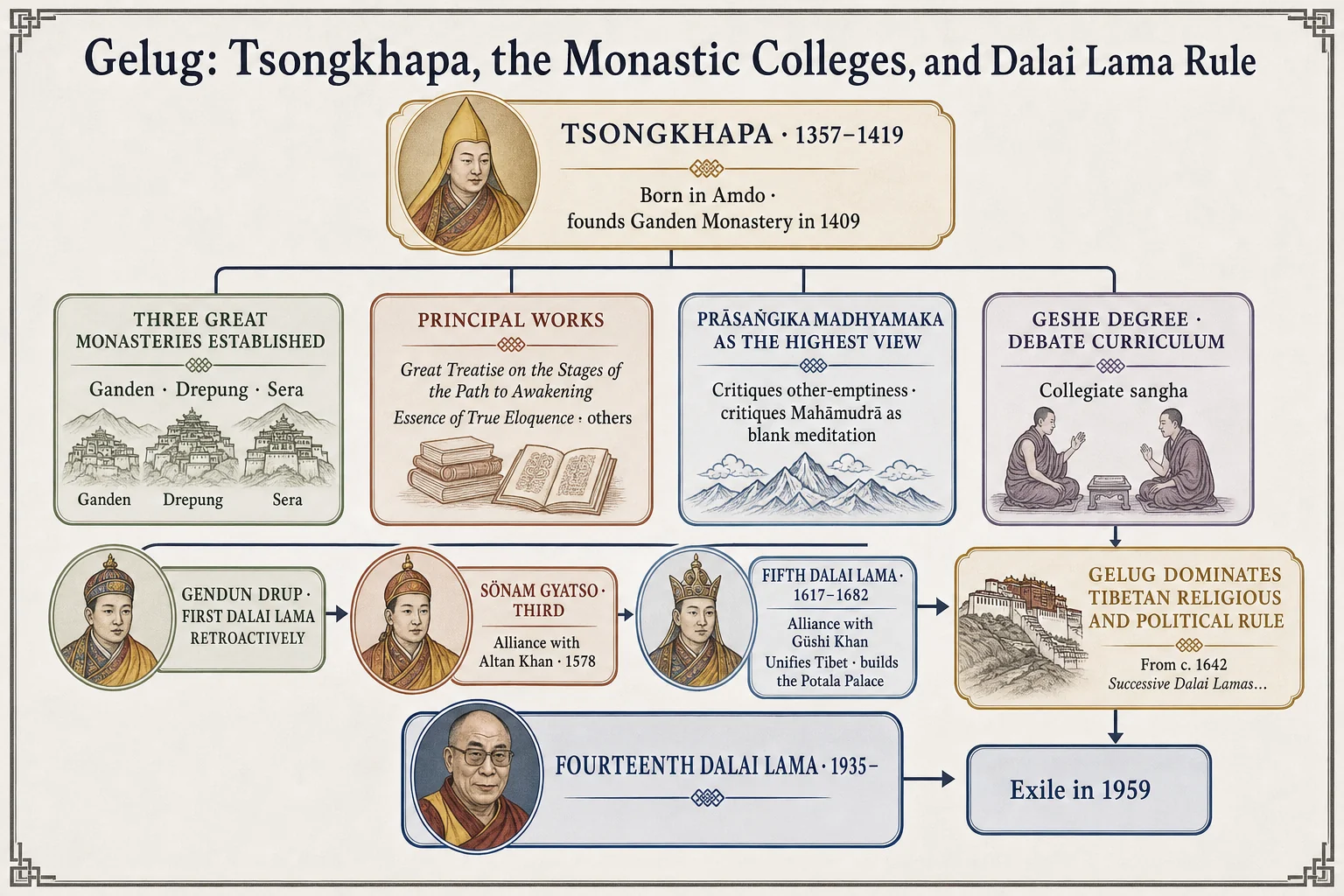
An outline of his life. Tsongkhapa (Tsong-kha-pa Blo-bzang-grags-pa, 1357–1419) was born in Amdo, near present-day Huangzhong County in Qinghai. Ordained from childhood and renowned for his intelligence, he spent most of his life in central Tibet and sought teachers from the Kadam, Sakya, Kagyu, Nyingma, and other transmissions. He accumulated nearly every teaching available at the time. He was especially known for systematic study of logic in the Dharmakīrti tradition, Madhyamaka (particularly Candrakīrti's Prāsaṅgika), and tantra, as well as for exceptionally strict observance of the Vinaya. In 1409 he founded Ganden Monastery (dGa'-ldan, "Tuṣita") near Lhasa, giving Gelug its institutional beginning. The same year he presided in Lhasa over the Great Prayer Festival (Mönlam Chenmo) at the Tibetan New Year, gathering large numbers of monks from different traditions in Gelug's first major display of influence. He died in 1419 at the age of sixty-two.1
A note on the treatment of mythic narratives. Biographies of Tsongkhapa abound in miraculous signs and extraordinary experiences, and Tibetan tradition regards him as an emanation of the bodhisattva Mañjuśrī. As elsewhere, this book records such narratives without using them as historical facts. His contributions are directly visible in his writings and in the institutional transmission he established; no mythic framework is needed to demonstrate them.
II. The Two Axes of Reform
The Tibetan Buddhism of Tsongkhapa's age confronted two problems that he believed required direct correction.
Laxity in the Vinaya. In some tantric contexts, claims such as "ultimately there are no precepts to observe" or "great practitioners transcend discipline" had become current and were used to justify abandoning ethical restraints. Tsongkhapa sharply criticized this tendency. He insisted that the prātimokṣa vows of monastic discipline were a prerequisite for every form of practice and could be bypassed neither in exoteric teaching nor in tantra. He strictly observed monastic discipline throughout his life, and Gelug accordingly became renowned for rigorous discipline, making it the school of the Later Diffusion closest to the traditional ideal of the Saṅgha.
Errors in understanding Madhyamaka. Tsongkhapa believed that Tibetan interpretations of Madhyamaka in his time displayed several mistaken tendencies: understanding emptiness as the nihilistic claim that "nothing exists"; equating the cessation of all mental activity in meditation with recognition of emptiness; and treating the Jonang position of other-emptiness, according to which tathāgatagarbha is not empty, as the correct Madhyamaka view. He systematically criticized all three and grounded the correct position in Candrakīrti's Prāsaṅgika Madhyamaka.
III. Principal Works
Tsongkhapa wrote an enormous body of work. The most important titles include:
| Work | Nature | Position |
|---|---|---|
| Great Treatise on the Stages of the Path to Awakening (Lamrim Chenmo) | Systematic treatise on the stages of the exoteric path | Central text of practice for Gelug and Tibetan Buddhism |
| Great Exposition of the Stages of Mantra (Ngagrim Chenmo) | Systematic treatise on the stages of tantric practice | Programmatic work for the Gelug tantric system |
| Essence of True Eloquence (Legs bshad snying po) | Analysis of Madhyamaka views involving and not involving distinctions | Central text of Tsongkhapa's philosophical position |
| Treatise Differentiating the Definitive and Interpretable Meanings | Distinguishes scriptures of definitive and interpretable meaning | Scriptural hermeneutics |
| Ocean of Reasoning (commentary on the Mūlamadhyamakakārikā) | Detailed commentary on Nāgārjuna's Fundamental Verses on the Middle Way | Profound development of Madhyamaka philosophy |
The Great Treatise on the Stages of the Path to Awakening systematizes and greatly expands Atiśa's framework of the paths of the three capacities, giving extremely detailed guidance for every stage. Its sequence (path of lesser capacity, path of middling capacity, and path of greater capacity) remains the basic organizing framework of Gelug practice and is one of the most important introductory texts in the transmission of Tibetan Buddhism to the West.2
IV. Philosophical Core: Establishing and Interpreting Prāsaṅgika Madhyamaka
Tsongkhapa's most philosophically significant work was his establishment and specific interpretation of Prāsaṅgika Madhyamaka. It amounted to an explicit "reranking" in the history of Tibetan Buddhism as a whole. He placed Candrakīrti's Prāsaṅgika Madhyamaka highest, ranked Bhāviveka's Svātantrika Madhyamaka below it, and also classified Śāntarakṣita's Yogācāra-Svātantrika-Madhyamaka (the underlying orientation of the Early Diffusion) as a form of Svātantrika.
Three Commitments in Correctly Understanding Emptiness
Emptiness is not nothingness. To say that "phenomena lack intrinsic nature" is not to say that "phenomena do not exist." Tsongkhapa distinguished two senses of nonexistence: ultimate nonexistence, in which phenomena possess no intrinsically established status under ultimate analysis, and conventional nonexistence, in which phenomena do not exist at the level of conventional designation. The error he criticized was mistaking the negation of intrinsic nature for the negation of existence itself. This error led practitioners to stop all mental activity in meditation and mistake blankness for emptiness.
Dependent origination is emptiness; emptiness is dependent origination. Tsongkhapa established an internal relation between emptiness and dependent arising through a two-way argument: "because things arise dependently, they are empty" (dependent origination to emptiness), and "because they are empty, they can arise dependently"—emptiness to dependent origination. In his view, this reciprocal relationship is the central insight of Nāgārjuna's Fundamental Verses on the Middle Way and the mark of a correct understanding of emptiness. For one who genuinely recognizes emptiness, the appearance of dependent origination becomes clearer rather than confused.1
"Not finding" is not the same as "finding nonexistent." When wisdom analyzes an object and discovers that it has no independent, self-sufficient intrinsic nature, this means only that the object is "unestablished under ultimate analysis," not that it disappears at the conventional level. This distinction is the technical core of Tsongkhapa's interpretation of Madhyamaka. It also underlies his criticism of some Mahāmudrā and Dzogchen practitioners for supposing that "finding nothing" already amounts to recognizing emptiness.
Criticism of Other-Emptiness
Tsongkhapa explicitly criticized the Jonang school's position of other-emptiness. Jonang maintained that phenomena are empty, but tathāgatagarbha or the dharmadhātu is not; it truly exists and possesses the qualities of a buddha. Tsongkhapa held that this effectively established an existent at the ultimate level, violating Madhyamaka's thoroughgoing denial of intrinsic nature and constituting a form of eternalism. Chapter 11.7 takes this controversy as its principal subject; here it is enough to identify its source.
V. Institution Building: The Three Great Monasteries and the Lineage System
Tsongkhapa's philosophical systematization proceeded together with institution building. Soon after his death, Gelug established an extraordinarily complete monastic system:
| Monastery | Founded | Distinguishing Feature |
|---|---|---|
| Ganden | 1409, founded by Tsongkhapa | Gelug's spiritual center and the seat of the Ganden Tripa |
| Drepung | 1416, founded by Jamyang Chöje | Historically one of the world's largest monasteries, with more than ten thousand monks at its height |
| Sera | 1419, founded by Shakya Yeshe | Especially renowned for its tradition of logical debate |
The Gelug system of monastic education centers on debate (rtsod pa) and advances through a rigorous curriculum, normally requiring fifteen to twenty years for the exoteric course of study. Its highest degree is the geshe (dGe-bshes, "spiritual friend"). The system enabled Gelug to produce the largest and most systematically trained scholarly Saṅgha in Tibetan Buddhist history.
The Gelug throne, the Ganden Tripa, is filled by election at religious assemblies for a term of seven years. This differs from both Sakya's family system and Kagyu's reincarnate succession. The Dalai Lama and Panchen Lama are the highest spiritual authorities, while the Ganden Tripa holds the lineage throne in the sense of Dharma transmission. The two systems coexist.
VI. The Dalai Lama System
"Dalai" is a Mongolian word meaning "ocean," a translation of Tibetan gyatso. The title was first bestowed in 1578 by the Mongol ruler Altan Khan upon Sonam Gyatso (1543–1588), the third-generation heir of Tsongkhapa's lineage. Sonam Gyatso therefore became the "Third Dalai Lama"; the title was retrospectively conferred upon his two predecessors. This history shows that the title "Dalai Lama" originated as a grant from a Mongol ruler, institutionally establishing a special link between Gelug and Mongol political power and constructing its lineage retrospectively.
| Number | Name | Dates | Historical Significance |
|---|---|---|---|
| First, retrospectively | Gendun Drup | 1391–1474 | Disciple of Tsongkhapa; founded Tashilhunpo Monastery |
| Second, retrospectively | Gendun Gyatso | 1475–1542 | — |
| Third | Sonam Gyatso | 1543–1588 | Met Altan Khan; first use of the title "Dalai Lama" |
| Fourth | Yonten Gyatso | 1589–1617 | Born into Mongol nobility; symbol of the Gelug–Mongol alliance |
| Fifth | Ngawang Lobsang Gyatso | 1617–1682 | The "Great Fifth"; unified Tibet and built the Potala Palace |
VII. The Fifth Dalai Lama: The Summit of Religious and Political Unity
The Fifth Dalai Lama was both the most politically influential and one of the most broadly learned figures in the entire Dalai Lama lineage. Tibetan tradition calls him the "Great Fifth."
Alliance with Güshi Khan. In 1642, Gelug's military alliance with the Mongol Khoshut khan Güshi Khan (ca. 1582–1655) ended the rule of the Tsangpa government, which had been supported by Kagyu, and gave the Gelug–Mongol coalition complete control of Tibet. Güshi Khan granted religious and administrative power over Tibet to the Fifth Dalai Lama while serving as secular protector himself. Structurally, this was a Gelug version of the Sakya–Mongol patron–priest relationship, with different protagonists.
This political reorganization transformed Gelug from one Tibetan Buddhist school among others into a ruling church with administrative power. Other Tibetan schools became politically subordinate. Jonang suffered substantive political repression during this period, and its monasteries were compelled to convert to Gelug. This was a historical event in which political and philosophical controversy became entangled.3
Relations with the Qing dynasty. In 1652, the Fifth Dalai Lama visited Beijing and met the Qing Shunzhi Emperor. The visit carried great symbolic significance, but Chinese and Tibetan parties have interpreted its nature differently. It remains one of the historical events invoked by the two sides in the sovereignty dispute between China and Tibet. This book records the historical facts without adjudicating their implications for sovereignty.
Intellectual pluralism. Although politically forceful, the Fifth Dalai Lama was one of the few great scholars among all Tibetan schools who deeply studied several traditions, including intensive study of Nyingma and Dzogchen. This was unusual within Gelug. He oversaw construction of the Potala Palace, which became the material emblem of Tibet's religious and political power.
VIII. Gelug's Philosophical Debates with Other Schools
Gelug is renowned for philosophical debate, and its controversies with other schools form one of the richest parts of Tibetan philosophical history. Chapter 11.7 will develop their philosophical content in detail; here it is enough to mark several principal lines.
Criticism of Jonang other-emptiness: Tsongkhapa and later Gelug thinkers systematically criticized Jonang for establishing an abiding entity at the ultimate level and thus violating Madhyamaka's thorough negation of intrinsic nature. Political repression occurred together with philosophical criticism.
Criticism of Dzogchen: Gelug thinkers argued that unless Dzogchen's "intrinsic awareness" (rigpa) undergoes the rigorous analysis of a correct Madhyamaka view, it can easily be misunderstood as an abiding entity resembling an ātman. Nyingma regarded this as a misreading. The controversy has still not reached a resolution satisfactory to both sides.
Criticism of Kagyu Mahāmudrā: Tsongkhapa criticized certain ways of transmitting Mahāmudrā, especially claims that directly equated "nonattachment" with recognition of emptiness. He believed that they lacked the foundation of a correct Madhyamaka view, so the "nondiscrimination" in which practitioners rested might be no more than a tranquil state of calm-abiding meditation and did not yet constitute genuine recognition of emptiness.
IX. Gelug Today
The Fourteenth Dalai Lama (Tenzin Gyatso, born 1935) is Gelug's present highest spiritual leader and one of the world's best-known religious figures. He went into exile in India after the failed resistance of 1959 and established a government-in-exile in Dharamsala. He received the Nobel Peace Prize in 1989. Politically, he advocates a "Middle Way" seeking a high degree of autonomy rather than independence. Religiously, he has led Gelug's large-scale transmission to the West. Philosophically, he actively engages in dialogue with modern science, especially neuroscience and cognitive science.4
The question of succession. The Fourteenth Dalai Lama has said that he might not reincarnate within Chinese-administered Tibet and might even choose to end the lineage. The Chinese government maintains that under its Golden Urn system, it possesses final authority to recognize the next Dalai Lama. The dispute over authority to identify the reincarnation is expected to become an international focus after the Fourteenth Dalai Lama's death, as Chapter 11.8 will explain in detail.
Further Reading
- John Powers. Introduction to Tibetan Buddhism. Ithaca: Snow Lion, 1995. (Overall comparison of Gelug with other schools)
- Guy Newland. Introduction to Emptiness: As Taught in Tsong-kha-pa's Great Treatise on the Stages of the Path. Ithaca: Snow Lion, 2008. (Introductory guide to Tsongkhapa's interpretation of emptiness)
References
References
-
Robert A. F. Thurman (trans.). Tsong Khapa's Speech of Gold in the Essence of True Eloquence. Princeton: Princeton University Press, 1984. (English translation of the Essence of True Eloquence and an authoritative academic introduction to Tsongkhapa's Madhyamaka philosophy) ↩↩
-
Tsongkhapa. The Great Treatise on the Stages of the Path to Enlightenment, 3 vols., trans. Lamrim Chenmo Translation Committee. Ithaca: Snow Lion, 2000–2004. (English translation of the Lamrim Chenmo) ↩
-
Tsering Shakya. The Dragon in the Land of Snows: A History of Modern Tibet since 1947. New York: Columbia University Press, 1999. (Modern Tibetan history and a political analysis of the Fifth Dalai Lama's alliance with the Mongols) ↩
-
Dalai Lama (Tenzin Gyatso). Freedom in Exile: The Autobiography of the Dalai Lama. New York: HarperCollins, 1990. (Autobiography of the Fourteenth Dalai Lama) ↩