Chapter 2 Āryadeva and Early Madhyamaka
Nāgārjuna turned Prajñāpāramitā emptiness into a method of argument. His disciple Āryadeva, around the third century, continued the work. This chapter examines what Āryadeva added to Madhyamaka, how the tradition was transmitted after him, and how it divided along two paths: one remaining in India and later splitting into Svātantrika and Prāsaṅgika, discussed in 5.4 and 5.5; the other entering China through Kumārajīva's translations and becoming the Three Treatises tradition.
1. Āryadeva and His Works
Legend must again be separated from what can be established. Āryadeva is also called Holy Deva and Kāṇadeva, "One-Eyed Deva." Tradition says that he was born in southern India or Sri Lanka, personally studied under Nāgārjuna, and became a formidable debater. Stories that he donated one eye and was ultimately assassinated by the disciple of a defeated opponent are mostly sectarian legend and difficult to verify. What can be established is that he continued Nāgārjuna's teaching and left two important works:
- the Catuḥśataka, sixteen chapters and four hundred verses, his principal systematic work;
- the Śataśāstra, translated into Chinese by Kumārajīva.
The survival of the Catuḥśataka requires explanation. Its first eight chapters survive only in Tibetan; the Sanskrit is fragmentary and they were not translated into Chinese. The final eight were translated by Xuanzang as the root verses of the Larger Treatise in One Hundred Verses, and survive in both Chinese and Tibetan. The chapters are as follows:1
| Chapter | Topic | Surviving version |
|---|---|---|
| 1 | Counters the view of permanence: impermanence breaks attachment to the eternal | Tibetan; Sanskrit lost, not translated into Chinese |
| 2 | Counters the view of pleasure: suffering breaks attachment to worldly happiness | Same |
| 3 | Counters the view of purity: impurity breaks attachment to the body's purity | Same |
| 4 | Counters the view of self: not-self breaks attachment to a substantial self | Same |
| 5 | The practical relationship between spiritual friend and disciple | Same |
| 6 | Instructions to a king: the social dimension of practice | Same |
| 7 | Eliminates attachments associated with the root defilements, class by class | Same |
| 8 | Distinguishes authentic practitioners and true Dharma | Same |
| 9 | Deep refutation of self-theory: systematically rejects a substantial self | Xuanzang's Chinese translation, chapter 1 of the Larger Treatise in One Hundred Verses |
| 10 | Refutation of time: time lacks intrinsic nature | Chinese chapter 2 |
| 11 | Refutation of characteristics: universals and related categories lack intrinsic nature; critiques Vaiśeṣika and others | Chinese chapter 3 |
| 12 | Refutation of existence: dismantles the categories of existence and nonexistence | Chinese chapter 4 |
| 13 | Refutation of the real existence of defilements: defilements lack intrinsic nature and are not real bonds | Chinese chapter 5 |
| 14 | Refutation of inverted views: a deep philosophical critique of the four inversions | Chinese chapter 6 |
| 15 | Refutation of the eternity of sound: critiques the Mīmāṃsā doctrine that Vedic speech is eternal | Chinese chapter 7 |
| 16 | Summary of remaining issues: rejects various residual attachments and concludes with emptiness | Chinese chapter 8 |
The Śataśāstra is especially important. The "three treatises" on which Chinese Madhyamaka rests are Nāgārjuna's Mūlamadhyamakakārikā and Dvādaśanikāya Śāstra, together with Āryadeva's Śataśāstra:
| Treatise | Traditional author | Chinese translation |
|---|---|---|
| Mūlamadhyamakakārikā | Nāgārjuna, with commentary by Piṅgala | Kumārajīva |
| Dvādaśanikāya Śāstra | Nāgārjuna, traditionally | Kumārajīva |
| Śataśāstra | Āryadeva | Kumārajīva |
The Śataśāstra originally contained twenty chapters; Kumārajīva translated only the first ten, each with ten verses and thus a total of one hundred. The chapters successively reject puruṣa, the real existence of matter, karma, the four great elements of earth, water, fire, and air, time, atoms, eternalism, annihilationism, the Sāṃkhya theory of cause, and the eternity of sound. Taken as a whole, it attacks non-Buddhist systems, especially Sāṃkhya and Vaiśeṣika. Its style is more direct than that of the Mūlamadhyamakakārikā and closer to live debate.
The Dvādaśanikāya Śāstra is the shortest of the three and is traditionally attributed to Nāgārjuna, though scholars doubt the attribution. Some regard it as a composite work by Madhyamaka transmitters rather than a text by a single author.2 Its twelve "gates" present the meaning of emptiness, moving from the examination of conditions and of effects as existent or nonexistent through examinations of agents, time, and characteristics. Its method substantially overlaps the Mūlamadhyamakakārikā and can be read as an epitome and teaching manual. The Three Treatises tradition used it as an introductory text because it presents the overall meaning of emptiness more concisely and systematically.
2. His Task: Eliminating Views while Establishing None
Āryadeva generally continues Nāgārjuna's path, using lack of intrinsic nature and emptiness to counter particular attachments. He emphasizes controversy and "therapy," eliminating erroneous views one at a time. The first eight chapters of the Catuḥśataka dismantle the four inversions of permanence, pleasure, purity, and self; the last eight directly confront claims of Sāṃkhya, Vaiśeṣika, and theorists of self.1
One logic runs throughout the philosophical criticism of the final eight chapters and deserves emphasis: intrinsic nature is fundamentally incompatible with relation. Whatever possesses fixed intrinsic nature must be self-sufficient and independent of anything else. Yet anything that enters a relation (causality, perception, long and short, desire and the one who desires) is partly what it is because of another thing. This is Āryadeva's point of attack against Sāṃkhya. Its puruṣa is defined as permanent and unchanging, yet it must "witness" the transformations of primordial nature, witnessing pain at one moment and pleasure at another. "Witnessing different contents" is itself a temporally changing relation, which an unchanging entity cannot possess. When intrinsic nature, relation, and change are all assigned to puruṣa, at least one must fail. Chapter 5.3 develops this logic systematically.
Before proceeding, the difference between the two halves of the Catuḥśataka should be made explicit; otherwise the work can be misread as merely a collection of debates. The first eight chapters, now surviving only in Tibetan, emphasize practical guidance. Through impermanence, suffering, impurity, and not-self they successively counter the four inversions of permanence, pleasure, purity, and self. They then address the relationship between spiritual friend and disciple and the cultivation of a king. Together they form a sequence of bodhisattva practice. Only the final eight turn to direct controversy with non-Buddhist and Buddhist schools. The combination makes the Catuḥśataka unusual in Madhyamaka literature. It is among the few Madhyamaka treatises that attend simultaneously to a sequence of practice and philosophical debate. Āryadeva uses it to show that emptiness is not merely an instrument of controversy but is embedded within a framework of practice. The tension between that framework and early Buddhist training in immediate awareness will return below.
Āryadeva makes Nāgārjuna's "no position of one's own" still more explicit. A frequently cited verse says that no fault can be discovered, however much time passes, in someone who adopts no position concerning "existence," "nonexistence," or "both existence and nonexistence," for such a person holds no thesis to refute.1 This continues Nāgārjuna's no-thesis position and anticipates the Prāsaṅgika commitment to "refute only, establish nothing," which Candrakīrti revives in 5.5.
One of Āryadeva's therapeutic sequences is especially noteworthy: first eliminate demerit, or unwholesome action; next eliminate "self," the wrong view of self; finally eliminate every view, including attachment to emptiness. The three steps advance like a physician who first stops harmful behavior, then removes the cause of the disease, and finally withdraws the medicine. This carries the same meaning as the Buddha's simile of abandoning the raft in 1.5 and the previous chapter's "emptiness too is empty." Views are instruments for treating attachment; when the treatment succeeds, they should be released, not replaced by another set of views for worship.
The sequence further clarifies the operating method of Madhyamaka as a whole. It always acts upon "views." First identify the view you hold, then give a reason to release it. This is not necessarily mistaken; eliminating wrong views is part of cultivation. Yet compared with early Buddhist practice it contains an unsettling difference. Early meditative training observes body, feeling, mind, and dharmas, directly seeing impermanence and not-self in present experience. It does not presuppose that practitioners must first be competent conceptual analysts. Madhyamaka is different. You must first identify the view you hold and understand its structure before elimination can take hold. This is precise engineering of views, a different kind of activity from early Buddhist present-centered awareness.
3. Āryadeva's Opponents
The Catuḥśataka addresses opponents both outside and within Buddhism.
Non-Buddhist systems
| Opponent | Sanskrit | Central claim | Āryadeva's point of attack |
|---|---|---|---|
| Sāṃkhya | Sāṃkhya | Puruṣa is permanent and unchanging; active primordial nature (prakṛti) evolves into the world | If puruṣa is unchanging, it cannot perceive; if it perceives, it is not unchanging. The concept contradicts itself |
| Vaiśeṣika | Vaiśeṣika | Atoms (paramāṇu) really exist and the world is composed through six categories: substance, quality, action, universal, particularity, and inherence | If atoms have no difference in size, they cannot aggregate into macroscopic things; inherence itself requires another entity to make it inhere, generating infinite regress |
| Mīmāṃsā | Mīmāṃsā | The sound of Vedic speech is eternally existent and independent of a speaker | Sound arises and ceases dependent on breath; if permanent, it cannot communicate new information. Eternal sound directly conflicts with dependent arising |
| Lokāyata/Cārvāka | Lokāyata/Cārvāka | Only the four great elements really exist; karmic results, future lives, and liberation are fabrications | Denying karma cannot explain moral differences; materialist monism must still explain the distinctions of pleasure and pain |
| Brahmanical self-theories | Ātmavāda | The individual self (ātman) is identical with cosmic brahman and is real, permanent, and unchanging | If the self is permanent, changes in pleasure and pain cannot be explained; if it experiences suffering, it is not permanent, and the argument for not-self again applies |
Buddhist opponents
| Opponent | School | Central claim | Āryadeva's point of attack |
|---|---|---|---|
| Sarvāstivāda | Sarvāstivāda | The three times really exist, dharma-natures always exist, and every dharma possesses fixed intrinsic nature | If dharma-natures always exist, dharmas do not dependently arise and impermanence is violated; equal reality of the three times makes causal flow impossible |
| Vātsīputrīya/Saṃmitīya | Vātsīputrīya/Saṃmitīya | The person (pudgala) really exists as the bearer of karma through rebirth | If the person is real independently of the five aggregates, there is a self apart from them and not-self is violated; if it is identical with them, the aggregates themselves continue and no person need be added |
Stories of Āryadeva publicly debating a Brahmanical scholar and then suffering retaliation appear in several biographies. They cannot be historically secured, but reveal at least that Madhyamaka thinkers in third-century India were imagined not simply as conducting textual exercises inside monasteries but as directly engaging rival systems in a wider intellectual arena.
4. Transmission and Division of Early Madhyamaka
After Nāgārjuna and Āryadeva, Madhyamaka continued primarily through commentary and debate. Among the earliest commentaries, Piṅgala's explanation of the Mūlamadhyamakakārikā was translated by Kumārajīva and became the standard Chinese version. The tradition subsequently divided into two lines:
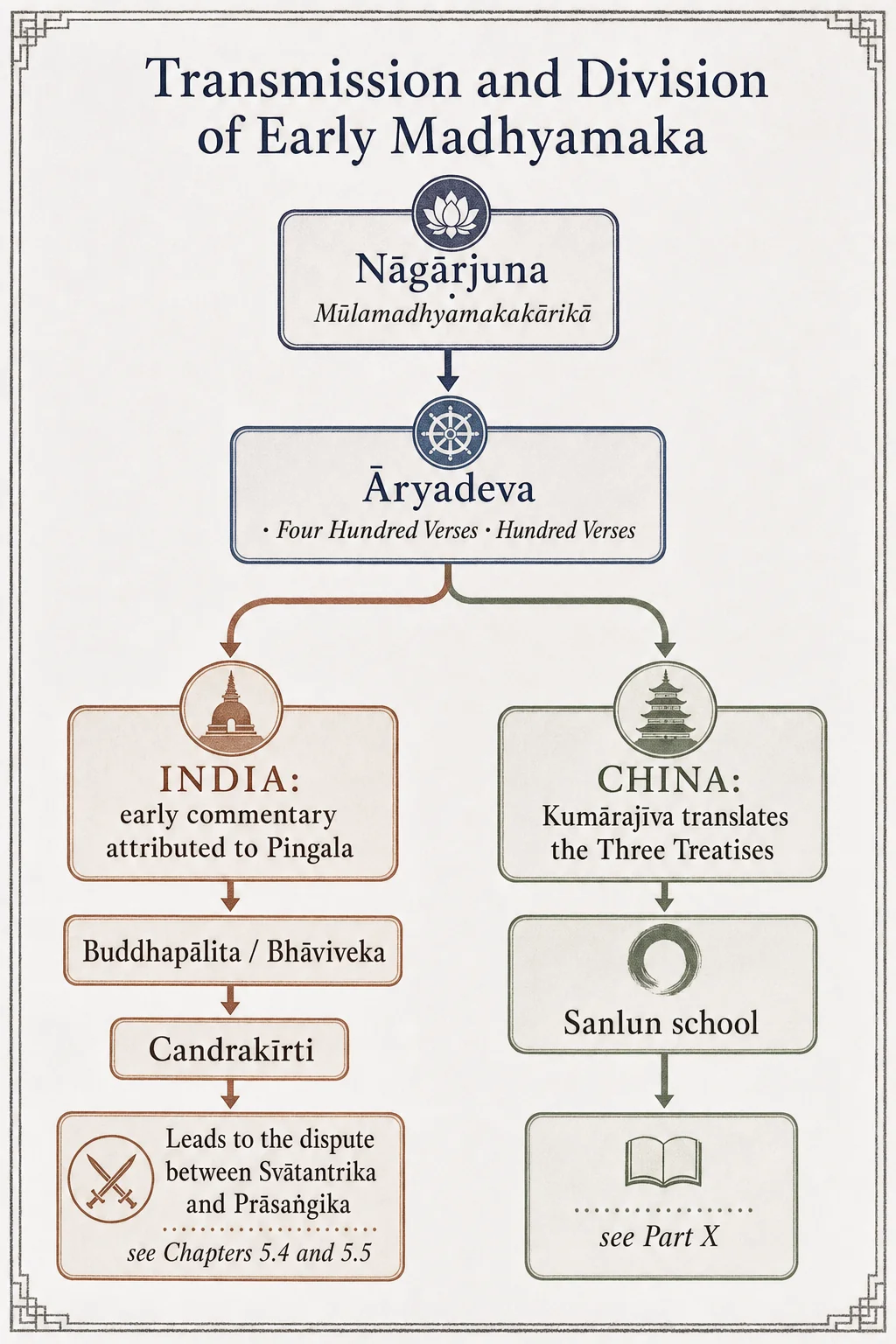
In India, Buddhapālita and Bhāviveka in the fifth and sixth centuries disagreed over whether Madhyamaka should offer independent arguments of its own. Candrakīrti in the seventh century adjudicated the controversy, crystallizing the later distinction between Svātantrika and Prāsaṅgika.3 Chapters 5.4 and 5.5 treat the dispute; here only its origin is marked.
The Chinese line centers on Kumārajīva. In the early fifth century he translated the Mūlamadhyamakakārikā, Śataśāstra, and Dvādaśanikāya Śāstra, establishing the textual basis of the Three Treatises tradition. His disciple Sengzhao then integrated Madhyamaka emptiness into Chinese philosophical language through the Zhaolun.2 Because these essays are among the most important Chinese assimilations of Madhyamaka emptiness, they deserve a brief explanation in comparison with the Indian line. The Zhaolun conventionally contains four essays:
- "Things Do Not Shift" argues that although movement and change appear, each dharma remains in its own position and never truly migrates. Its case is built on the sentence "the things of the past are of themselves in the past and do not come from the present to reach the past," and it closes on lines of the order of "the whirlwind that levels mountains is always still, and the rivers that race in torrents do not flow." Later Madhyamaka scholars have regarded phrasing of this kind as closer to permanence than to lack of intrinsic nature and therefore at some distance from Nāgārjuna's emptiness.4
- "Emptiness of the Unreal" centers on the claim "because things are not real, they are empty." Things do not exist in a truly self-established way and therefore are empty; emptiness is not nothingness but lies in their "unreality." Of the four, this essay stands closest to Nāgārjuna's emptiness of dependent arising.
- "Prajñā Is without Knowing" argues that genuine prajñā does not belong to an objectifying cognition. It is a nonconceptual "knowing that does not know," beyond the subject–object structure of cognition.
- "Nirvāṇa Is Nameless" uses questions and answers to show that nirvāṇa cannot be captured in words yet is not nothingness; it lies beyond naming.
Sengzhao's importance lies in using Chinese categories (root and branch, being and nonbeing, motion and stillness) to mediate Indian emptiness and open a distinctive path of localization. Yet the doctrine of "non-shifting" in "Things Do Not Shift" does subtly diverge from Nāgārjuna's emptiness of intrinsic nature. Chan and Tiantai later cited Sengzhao in different ways and with different selections. This book's judgment is that the Chinese Three Treatises interpretation of emptiness perceptibly diverged from Indian Prāsaṅgika because it traveled through this Sinicizing channel. Part X will examine the details.
The history of the Three Treatises tradition is likewise reserved for Part X. The important point here is that after Āryadeva, Madhyamaka's lifeline divided. One line continued to hone its arguments in India; the other took root in China.
5. Āryadeva's Position and the Tension in "Refuting without Establishing"
Āryadeva's contribution was to turn Nāgārjuna's arguments for emptiness into an operative practice: work by eliminating views while establishing no view of one's own. "Refuting without establishing" took recognizable form and became the mark of Madhyamaka, especially later Prāsaṅgika.
A tension should be identified, for this book will return to it. A school claiming "no position of its own" made dense controversy its profession. It explains that every argument exists only to eliminate your attachment, while it establishes nothing. The answer is agile but leaves a question suspended: can constant refutation truly avoid acquiring any position? Svātantrika will address the question directly, while Prāsaṅgika will defend the no-position stance as strongly as possible. The next chapter first examines Madhyamaka argument itself: how consequence and the tetralemma refute the opponent's assumptions of intrinsic nature one by one until they can no longer stand.
References
References
-
Karen Lang. Āryadeva's Catuḥśataka: On the Bodhisattva's Cultivation of Merit and Knowledge. Copenhagen: Akademisk Forlag, 1986. ↩↩↩
-
Richard H. Robinson. Early Mādhyamika in India and China. Madison: University of Wisconsin Press, 1967. ↩↩
-
David Seyfort Ruegg. The Literature of the Madhyamaka School of Philosophy in India. Wiesbaden: Harrassowitz, 1981. ↩
-
Zhaolun, "On Things Not Shifting" (Sengzhao, T1858): "The things of the past are of themselves in the past and do not come from the present to reach the past; the things of the present are of themselves in the present and do not come from the past to reach the present." "The whirlwind that levels mountains is always still; the rivers that race in torrents do not flow." "Each event abides by its nature in a single one of the times." An earlier draft cited at this place the phrase "what does not change does not move," which is not found anywhere in the Zhaolun; the verifiable sentences above have replaced it. The theorem-shaped review of the whole essay is in Part II, Part 19, Chapter 4, "The Zhaolun: China's First Digestion." ↩