Chapter 3 Madhyamaka Methods of Argument
The preceding chapters explained what Madhyamaka seeks to do (refute intrinsic nature while establishing no thesis), and traced its early transmission. This chapter examines how it does so. It lays out consequence arguments, the tetralemma, and several recurring patterns of reasoning in terms accessible to modern readers. In modern language, the fundamental aim of the Mūlamadhyamakakārikā is to refute every philosophical attempt to establish an "independent, self-sufficient, permanent ground of existence" behind phenomena. Whenever someone posits a "truly real X," whether primordial matter, atoms, puruṣa, or a dharma-nature, the text asks: on what basis can X be independently established? This is the underlying logic of "refuting without establishing" and the common foundation of every method in this chapter. The methods themselves form the focus of the next chapter's disagreement between Svātantrika and Prāsaṅgika.
1. General Method: Consequence and Tetralemmatic Negation
Madhyamaka's techniques ultimately reduce to two.
The first is consequence (prasaṅga). Rather than directly establishing a contrary thesis, Madhyamaka accepts an opponent's premise (that something has intrinsic nature), follows it through, and derives a contradiction or absurdity, allowing the premise to collapse by itself. Because it refutes without establishing, Madhyamaka can claim to have no thesis (chapters 1 and 2).
The second is the exhaustive refutation of the four alternatives (catuṣkoṭi). It lays out four possibilities: is, is not, both is and is not, and neither is nor is not; then it rejects all four together (the distinction between rejection and negation is explained in section 5). What exactly is denied must be clear. Madhyamaka denies that any alternative is established with intrinsic nature; it does not deny the conventional existence of phenomena. This connects the tetralemma with the two truths, as section 5 will explain. Why four alternatives rather than a binary? Why leave all four behind rather than merely reject two extremes? Section 5 addresses these questions.
Before considering specific arguments, a technical distinction must be established; without it, the later analysis repeatedly misses its target. Madhyamaka negation is a non-implicative negation (prasajya-pratiṣedha), not an implicative negation (paryudāsa-pratiṣedha). This pair of names is taken from Part II, Part 18, Chapter 3, with which this chapter is aligned; where other renderings for the pair are current, the same two things are meant.
An implicative negation denies P while implying or affirming non-P. In ordinary speech, "this is not white" implies that it is another color: denying one property places the object within the opposite class. A non-implicative negation denies only P and affirms nothing else. "There is no king here" says only that a king is absent; it does not imply that something else is present.
The division is no import from Western logic; the opposing camp set it up itself. Saṅghabhadra, the Sarvāstivāda master, divides expressions of negative signification in the Nyāyānusāra into two classes: some signify something and some signify nothing. Those that signify something are expressions such as "not a brahmin" and "impermanent"; those that signify nothing are expressions such as "non-existent" and "no thing." "Not a brahmin" runs over to the Kshatriya and the rest, for in denying the brahmin it places the man in another of the four classes, and it belongs to the class that signifies something; "non-existent" and "no thing" designate nothing at all. The negation Madhyamaka performs belongs to the second class. The classification comes from the pen of the realist party, and neither side disputes the distinction itself.1
Madhyamaka negation is non-implicative. Denying that "X possesses intrinsic nature" does not imply that "X is nothing" or that "emptiness truly exists." The distinction avoids two traps. If the negation were implicative, denying intrinsic nature would establish that "nothing exists" and fall into annihilationism. If the argument instead established that "emptiness truly exists," it would rebuild ontology at the other extreme. Nāgārjuna's warning that those who take emptiness as a view are incurable blocks precisely these paths. With this distinction in place, the analysis of the exhaustive refutation of the four alternatives in section 5 becomes easier to follow. In rejecting alternative ①, Madhyamaka performs a non-implicative negation; it does not thereby assert alternative ②, nor anything else.
2. Several Recurring Arguments
Madhyamaka repeatedly employs fixed patterns to refute intrinsic nature. Four of the most common are:
| Argument | Target | Outline | Source |
|---|---|---|---|
| Fourfold non-arising | Arising and causality | Arising from self, other, both, or no cause are all impossible | Mūlamadhyamakakārikā, "Examination of Conditions" |
| Three times of motion | Motion | What has moved, has not moved, and is moving cannot contain a motion with intrinsic nature | "Examination of Motion" |
| Refutation through mutual dependence | Paired concepts | Things established in dependence on each other cannot each possess independent intrinsic nature | "Examination of Action and Agent" and "Examination of Fire and Fuel" |
| Three temporal positions of causality | Temporal order of cause and effect | Whether cause precedes, coincides with, or follows its effect, causality as intrinsically real cannot be established | Dvādaśanikāya Śāstra, "Examination of the Three Times" |
The source given in the last row of the table has been verified and differs from the earlier draft. The complete form of the argument from the three temporal positions stands in the Dvādaśanikāya Śāstra, chapter 11, "Examination of the Three Times": a cause and the thing that has a cause cannot be got as arising at an earlier time, at a later time, or at one and the same time. Cause before effect, effect before cause, and cause and effect together are refuted one route at a time, and the passage closes with the words that therefore cause and effect in the three times are none of them to be obtained. Each route carries a simile, the potter making a pot, the master who exists through having a pupil, and the lamp with its light, and all three are turned back. The Vigrahavyāvartanī holds a debate over three times of its own, but the three times there govern the order of the negation and the thing negated; the three examples of a cause that is earlier, a cause that is later, and a cause that is simultaneous come from the opponent's mouth and serve to refute Nāgārjuna, and they are no argument of Nāgārjuna's own against causality. The earlier draft hung this row on the Vigrahavyāvartanī; the verifiable source has replaced it.2
The best known is fourfold non-arising. The Mūlamadhyamakakārikā begins: "Dharmas do not arise from themselves, from another, from both, or without cause; therefore they are known not to arise."3 If a thing possessing intrinsic nature "arises," it must arise in one of four ways, yet none is coherent:
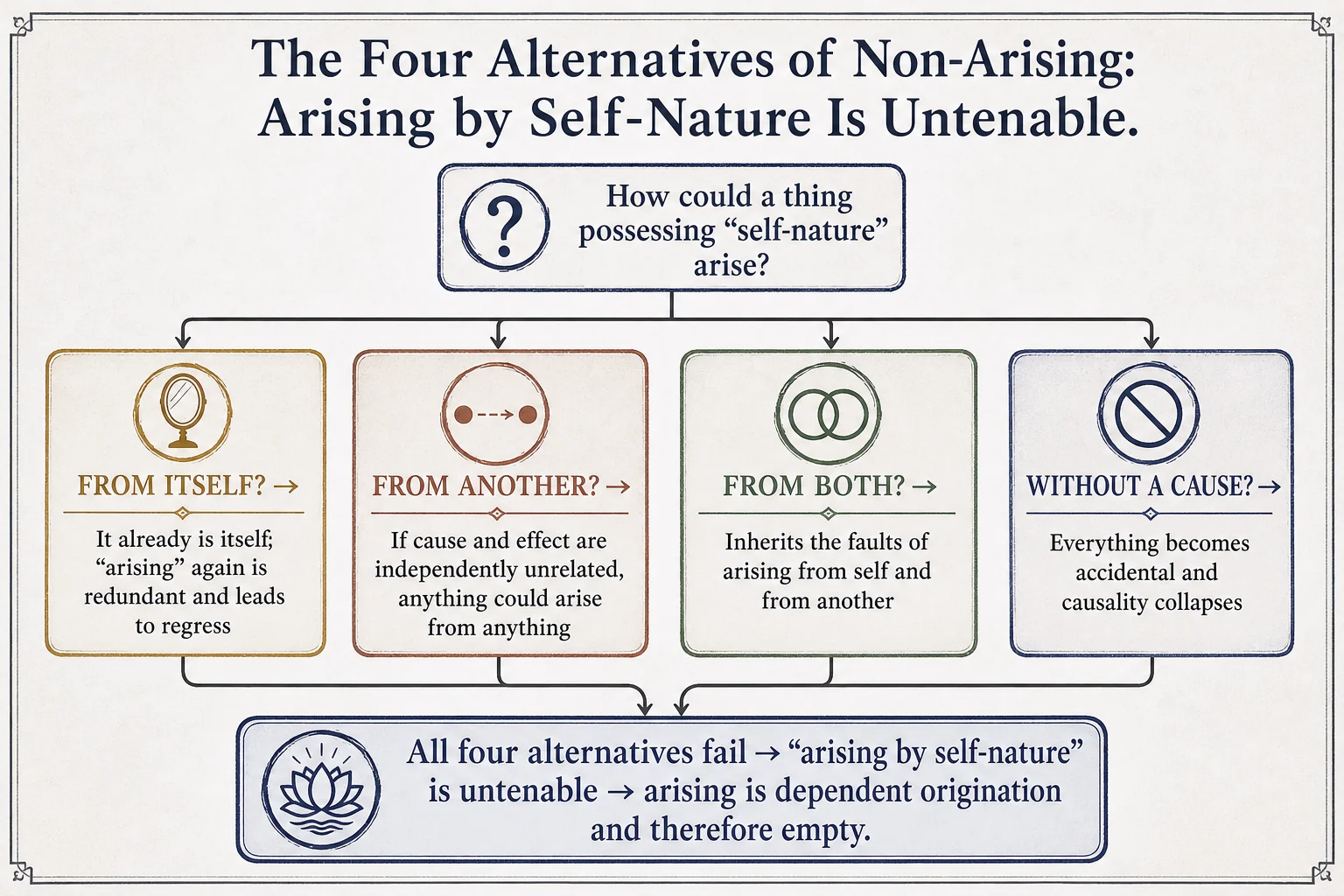
The flowchart provides an intuitive summary of fourfold non-arising and follows the route common in traditional commentaries such as those of Piṅgala and Candrakīrti. Some scholars criticize the precise arguments found in these commentaries. Criticizing a commentary's reasoning, however, is not the same as refuting the root verse; the two must be distinguished. If the root claim contains a genuine philosophical problem, its source does not lie here. The alternatives of "arising from another" and "arising without cause" can be stated more tightly, deriving contradiction solely from the presuppositions rather than empirical observation.
Arising from another: suppose A produces B and B possesses intrinsic nature. Would B still arise without A? Either answer is troublesome. If B still arises, it does not depend on A and the causal claim "A produces B" fails. If B does not arise, its existence depends on A and it lacks an independent intrinsic nature. The premise that B possesses intrinsic nature is refuted. "B has intrinsic nature" and "A produces B" cannot both be true.
Arising without cause: suppose A arises without any cause. Its arising then depends on no condition. If unconstrained by conditions, A should arise at every time and place. But that would mean that A is permanently present and never absent. If it is never absent, no moment exists when A "arises"; yet arising is the premise of causeless arising. Contradiction.
These are especially clear examples of consequence. Accept the premise that "B possesses intrinsic nature" or "A arises without cause," follow it through, and arrive at contradiction, allowing the premise to fall.
The refutation through mutual dependence examines paired concepts: agent and action, fire and fuel, long and short. Their meanings emerge through mutual contrast. Without "short" there is no "long"; without something done, there is no agent. Because each depends on the other, neither can independently subsist, while intrinsic nature is defined precisely as independent subsistence. Whatever is established mutually therefore lacks intrinsic nature.
The three times of motion, in the Mūlamadhyamakakārikā's "Examination of Motion," is as famous as fourfold non-arising and deserves equal development. The question is how motion ("going") can be established under assumptions of intrinsic nature.
The argument has three steps. First, what has gone (gata) is completed motion and contains no motion occurring now, since it has ended; motion is not in "what has gone." Second, what has not gone (agata) is motion not yet begun and likewise contains no present motion; motion is not in "what has not gone." Third comes "the going" (gamyamāna), what is currently moving, which appears to be where motion occurs. But for "the going" to be meaningful, it must already have begun (part is "gone") and not yet have ended—part remains "not gone." It therefore depends on what has gone and what has not gone in order to be identified as "currently going." If those two possess independent intrinsic natures while the going depends on them, the going lacks independent intrinsic nature. If the going possesses intrinsic nature, it should be independent of what has and has not gone; but then nothing explains what it possesses beyond the not-gone state, or why one is "currently going" while the other is not.
The "Examination of Motion" has another face that the three steps above do not reach: goer and going individuate each other. This face joins directly to the central proposition of this book. Piṅgala's commentary marks the layer: first the act of going establishes the goer, second the goer establishes the act of going. If the goer already carries a going of its own through intrinsic nature, then to say "the goer goes" has counted going twice over, as the root verse puts it, that if the goer has a going then there are two goings, the first the goer's going and the second the going's going. Take the going away from the goer instead, and what remains no longer answers to the name goer: apart from the goer the act of going is not obtained. The last step of the exhaustion runs that the goer does not go, the non-goer does not go, and apart from the goer and the non-goer there is no third goer; not one position is left in which a goer might be placed. Put the two ends together. The identity conditions of the goer have the going written into them, and the identity conditions of the going have the goer written into them, while the first clause in the definition of intrinsic nature is precisely that a thing is established in dependence on nothing other than itself, so that a goer made into a bearer of intrinsic nature may write nothing other than itself into its own identity conditions. One side must write it in, the other side forbids it, and the contradiction lies there. Part II, Part 18, Chapter 4 enters this passage as the native-place version of the core derivation and records that walking at the conventional level loses not a single step, its individuation being supplied by the network of relations.4
Conclusion: under assumptions of intrinsic nature, motion can be placed in no temporal position. This does not deny conventional motion, which plainly occurs. It says that a "motion with fixed intrinsic nature" has nowhere to stand logically. The argument concretely illustrates section 3's incompatibility of intrinsic nature and change. Motion requires crossing temporal positions; crossing temporal positions depends on temporal relations; temporal relations preclude independent intrinsic nature. The consequence is complete.
All the arguments share a structure: first assume that the object possesses intrinsic nature (independent, unchanging, and self-sufficient), then show that it cannot be established in arising, motion, relation, time, or anywhere else, thereby deriving that lack of intrinsic nature is emptiness.
3. The Incompatibility of Relation, Change, and Intrinsic Nature
The previous section introduced the refutation through mutual dependence: whatever depends on another lacks intrinsic nature. This section presses deeper and asks why intrinsic nature is fundamentally incompatible with both relation and change. Here we move beyond a single argument to the deepest logical basis of Madhyamaka's critique.
Intrinsic nature excludes relation. By definition, intrinsic nature subsists independently, depends on nothing else, and remains what it is. Relation means that some aspect of a thing is determined by its connection with another: without short there is no long; fire ceases without fuel; a cause has no "causal efficacy" apart from an effect. The conflict is direct. Something possessing intrinsic nature cannot enter a genuine relation, because relation makes some part of it determined by another and contradicts independent subsistence. Anything capable of genuine relation therefore lacks independent intrinsic nature.
The "Examination of Fire and Fuel" takes the argument further. Suppose fire possesses intrinsic nature. It should burn independently of fuel, but in experience fire ceases without fuel. Suppose fuel possesses intrinsic nature. It should always be "combustible," yet without ignition it does not burn. If "burning" is a third thing added to fire and fuel, what supports this third thing? If it too must connect with fire and fuel, a fourth thing is required to carry that connection, producing infinite regress; the relation never becomes grounded.
A comparison of doctrines, without implying historical influence, can be made with F. H. Bradley (1846–1924), who encountered the same fissure within Western metaphysics. If relation R is an entity independent of relata A and B, a new relation R₁ is needed to connect R and A; R₂ is then needed to connect R₁ with R and A, and so on without end. Relation is never grounded. Bradley's solution moved toward absolute idealism; Nāgārjuna's was emptiness. But both perceived the same break: independent substances and external relations cannot be coherently joined.
Change lies deeper still. If X has fixed intrinsic nature, X's intrinsic nature at t₁ should be the same at t₂, because permanence and immutability are part of the concept. But "change" means that X differs in some respect between t₁ and t₂. Placed together, an X with intrinsic nature cannot genuinely change through time, although experience shows every phenomenon changing.
Sāṃkhya provides the clearest example. Āryadeva subjected it to sustained pressure in the Catuḥśataka, as the opponent table in 5.2 noted. Puruṣa is permanent, unchanging pure consciousness; primordial nature evolves before it while it "witnesses." But puruṣa witnesses suffering now and pleasure later, and its relation to the witnessed contents differs across the two moments. If the difference belongs to puruṣa, then puruṣa changes and is not permanent. If it does not belong to puruṣa at all, and puruṣa is entirely indifferent to suffering and pleasure, what distinguishes them? Without a distinction, liberation (release from suffering) cannot be discussed. Sāṃkhya's liberation theory loses its foundation. Madhyamaka does not supply an alternative explanation. It identifies the source of the contradiction: once puruṣa receives fixed intrinsic nature, it cannot truly enter relations or change with them, though the theory requires both. Intrinsic nature, relation, and change cannot all belong to puruṣa.
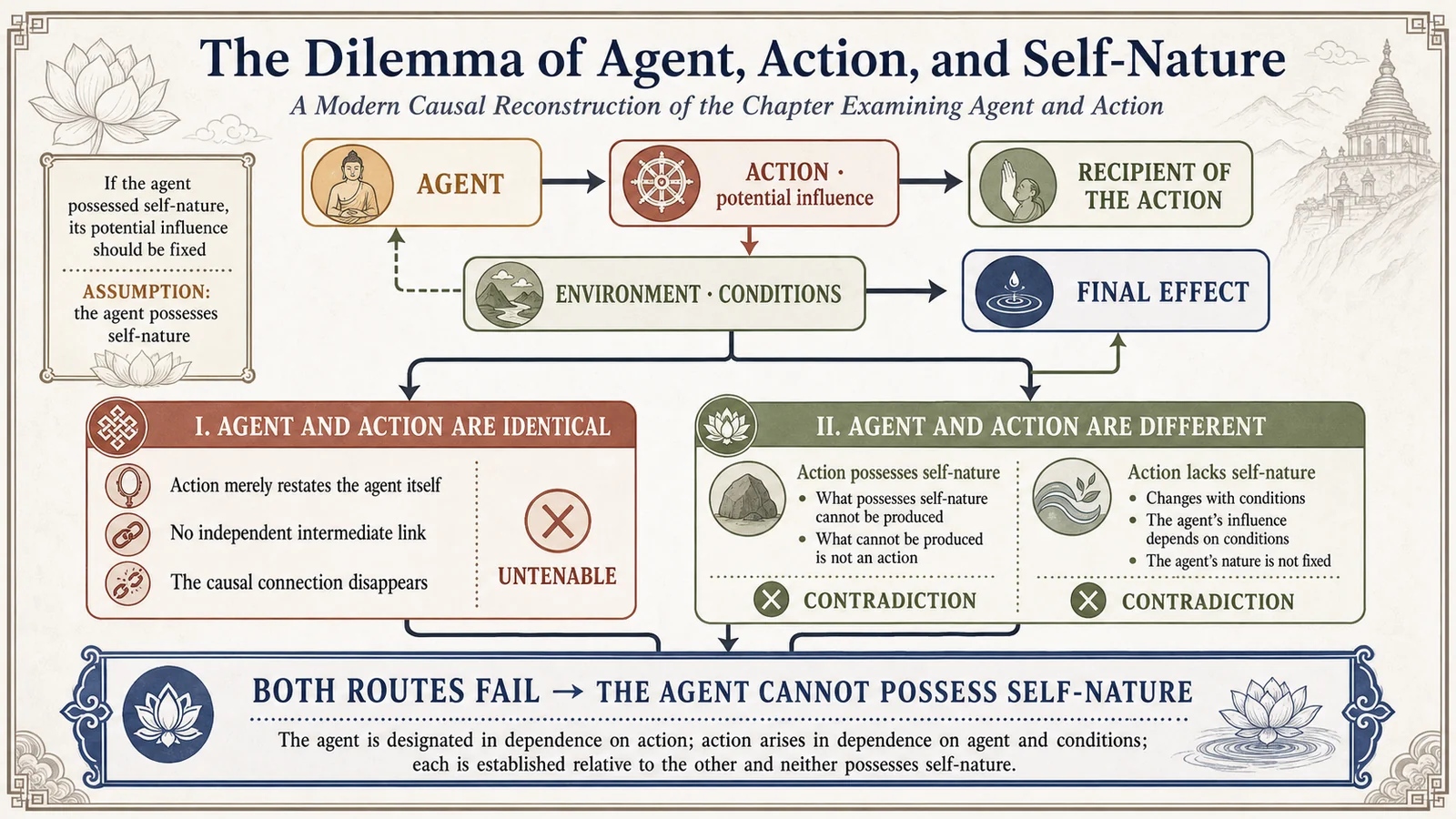
A modernized argument: agent, action, and intrinsic nature. The following reconstructs the logic behind the "Examination of Action and Agent" using more precise causal language. Introduce the following roles: the agent, which produces an influence; the action (karman), here specifically the agent's potential influence on a patient rather than the final realized effect; the patient, which receives the influence; the environment, all other relevant conditions; and the final effect, the actual result jointly imposed on the patient by action and environment. Distinguishing potential influence from final effect matters because the latter varies with conditions, while the former should belong to the agent. If the agent possesses intrinsic nature, its potential influence ought to be fixed.
Now suppose that the agent possesses intrinsic nature. The relationship between agent and action must be either identity or difference.
If agent and action are identical, they are one intrinsically existent thing. "Action" merely redescribes the agent and is not an independently existing intermediate step. But what we seek is a causal link between agent and patient. An identical substance cannot serve as a link, because a link requires two endpoints. The intermediate element required by "the agent affects the patient" disappears, and "action" is no longer the relation we sought.
If agent and action are different, ask whether action itself possesses intrinsic nature. If it does, the fourfold non-arising argument above shows that something with intrinsic nature cannot be produced. But action means precisely the potential influence produced by the agent; if it cannot be produced, it is not action in the relevant sense. Contradiction. If action lacks intrinsic nature, it changes according to conditions. The same agent then produces different potential influences under different conditions; what the agent can do to the patient depends on conditions rather than inhering in the agent. Since the agent's causal properties vary with conditions, it lacks a fixed, unchanging nature, contradicting the premise that the agent possesses intrinsic nature.
Neither alternative succeeds; therefore the agent cannot possess intrinsic nature. Structurally, the argument embodies the spirit of mutual dependence: an agent's identity depends on action, the content of action depends on agent and conditions, and neither has an independently self-subsisting fixed nature. □
The outline of Madhyamaka that emerges is negative. Everything that participates in relation or change lacks fixed intrinsic nature. All dharmas participate in relation and change; therefore all are empty. This does not mean that "only relations exist." If relation itself possessed intrinsic nature as a reality independent of its relata, the same consequence argument would apply: can a "relation" existing independently of its relata still be a relation? Madhyamaka rejects it too. Nor does it claim that "change is an illusion"; that route belongs to Vedānta or Sāṃkhya, not Madhyamaka.
Another modern doctrinal comparison may help, without implying influence. In quantum field theory, elementary particles do not appear as independent entities but as excitations of fields. Fields themselves can be described only through interactions with other fields, leaving no "thing" independent of relation. Ontic structural realism goes further and holds that relations are more fundamental than relata, with "particles" merely nodes in relational networks. Both approaches move in a direction resembling Madhyamaka's implicit outline. The difference is that Madhyamaka would reject the claim that "relations themselves possess intrinsic nature and form a more fundamental reality." That would be intrinsic-nature theory at the level of relation and could be reduced to absurdity in the same way. Madhyamaka is closer to saying that any fixed bearer one attempts to secure beneath relation or change is empty—and the proposition "only relations, without relata" is empty as well.
This passage has an echo in Part II. Part 18, Chapter 7 takes it up as the answer to failure mode two: should anyone rescue the relationality premise by making relations themselves a more fundamental reality, the lever of the central proposition strikes just the same, and the question of what stands behind the framework falls within the scope as well. Chapter 4 of the same part enters a further note, that this section's "relations too are empty," together with the comparison with Bradley, is the rehearsal of that answer; the outline Part I drew in its day is redeemed as a theorem in Part II, and the arch closes here.5
4. The Rejoinder: Can Empty Speech Refute Anyone?
The opponent immediately turns the argument back. You say that everything is empty. Are your own words of refutation not empty too? Empty speech carries no weight, so how can it overturn my position? The Vigrahavyāvartanī addresses this objection.
The "opponent" should first be identified as an imagined interlocutor constructed within the work. Nāgārjuna places the challenge in a fictional opponent's mouth and answers it himself. It is precisely the form of challenge Madhyamaka most wants to meet: the problem is constructed in a shape that emptiness itself can answer. Nāgārjuna's loop ("empty speech also functions through dependent arising") works conveniently within that frame. Whether an actual opponent would stop at the same point or accept the same formulation of the problem is uncertain. Madhyamaka chooses terrain particularly suited to its method, which warrants some reservation.
Nāgārjuna responds that his words are indeed empty and possess no intrinsic nature. Precisely because they are empty, dependently arisen, and able to function, they can refute an equally empty opposing position. An illusory person can still stop another illusory person. Emptiness does not mean impotence; exactly because something is empty (lacking intrinsic nature and dependent on conditions) it can act. This is the same point as the two truths in 5.1 and "because emptiness is possible, all dharmas are possible." Nāgārjuna also asks in return: you demand that I establish my claim using "valid instruments of knowledge" (pramāṇa), but through what are those instruments themselves established? If another instrument establishes them, infinite regress follows; if they establish themselves, analogies such as a lamp illuminating itself fail. The demand that "self-evident instruments of knowledge must come first" therefore lacks a foundation.6
This treatment of pramāṇa already touches a deep division in Nāgārjuna's period and directly anticipates the next chapter. He pushes epistemological demands back on the opponent: I have no thesis requiring proof; such demands are meaningful only where a thesis is asserted and therefore fail against someone with no thesis. If the opponent insists that an instrument of knowledge must itself be established, three possibilities remain. Another instrument establishes it, producing infinite regress; it establishes itself, producing circularity; or it is simply postulated as valid without proof, producing an unsupported assumption. Every path is defective, and the opponent's own epistemological foundation is unstable.
The response leaves a fissure. Madhyamaka's negative arguments, its consequences, are valid logical inferences, and valid inference requires acknowledging some valid rules. Must Madhyamaka explain an epistemological foundation for them? Svātantrika answers yes. Bhāviveka holds that Madhyamaka must supply independent logical support for its arguments, or opponents need not accept them. Prāsaṅgika answers no. Candrakīrti follows Nāgārjuna's no-thesis route and refuses to establish a separate epistemology for Madhyamaka negation. This is the subject of 5.4.
5. Does the Exhaustive Refutation of the Four Alternatives Violate Logic?
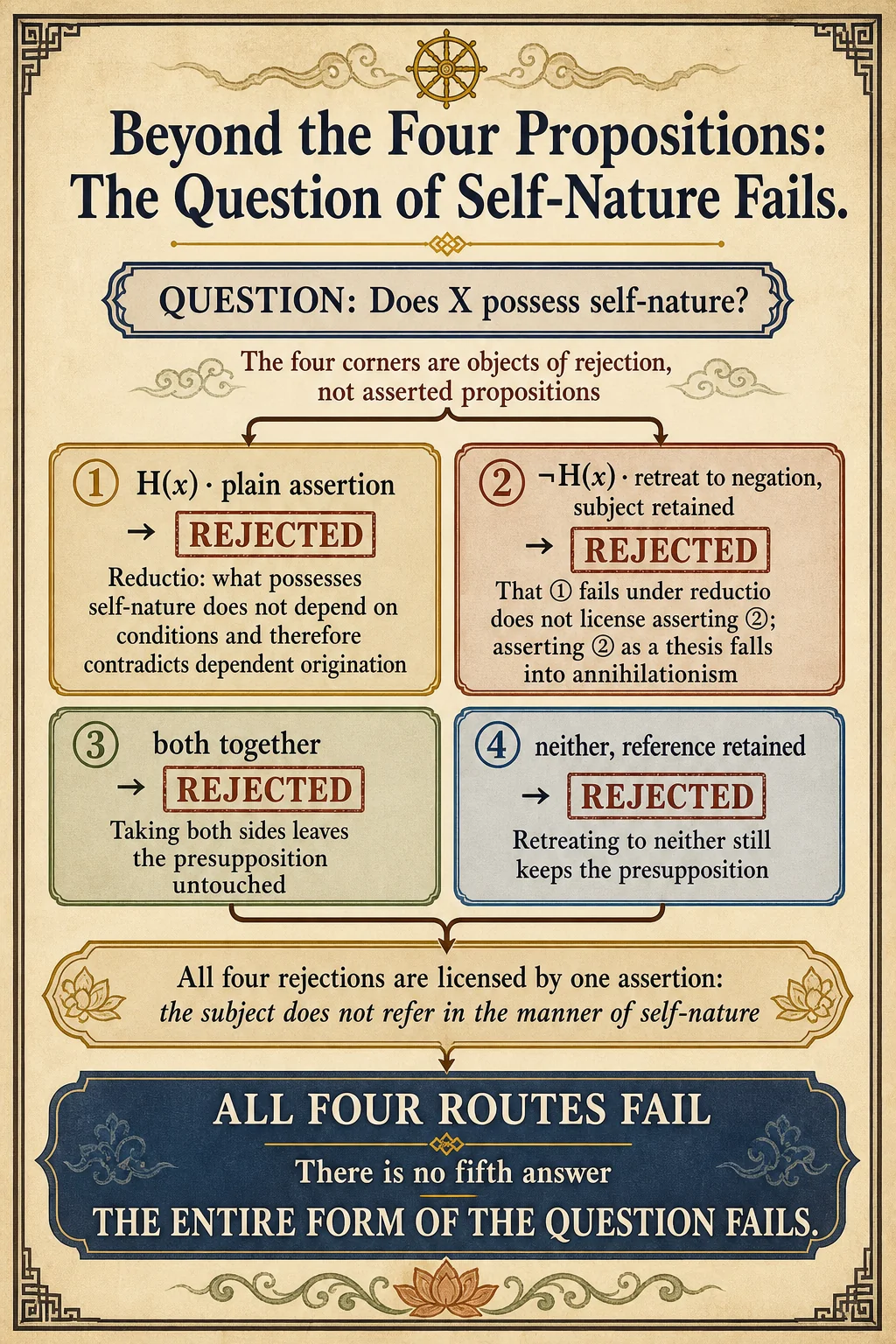
The reading must be fixed first; set it wrong and every step that follows runs astray. The four cells of the tetralemma are throughout objects of rejection, not asserted propositions. To reject a sentence and to assert its contrary are two different things, and the clearest witness is a sentence whose presupposition fails. "The present king of France is bald" is unacceptable; its negation takes it equally for granted that there is such a king and cannot be asserted either. The one correct move here is to push the whole sentence back. Part II, Part 18, Chapter 3 makes the distinction a lemma: rejecting A does not entail asserting not-A, the negation being the internal one, the kind that inherits the subject's presupposition.7
Once the reading is fixed, classical simplification has nowhere to operate. An earlier draft wrote ③ as P ∧ ¬P and ④ as ¬P ∧ ¬¬P, reduced the latter by double negation to ¬P ∧ P, and judged both to be contradictions. That route presupposes that the four alternatives are four asserted propositions. Since the four are objects of rejection, there is no conjunction available to simplify, and the step does not apply at all. This section now follows the principal reading of Part II.
An example unrelated to intrinsic nature can establish the intuition. Among the questions the Buddha refused to answer, the undeclared questions (avyākata), is whether the Tathāgata after death exists, does not exist, both exists and does not exist, or neither exists nor does not exist. A binary offers two alternatives only; what the tetralemma lays out is the four lines of repair by which the question might be kept alive:
| Alternative | Form | What it saves for the question |
|---|---|---|
| ① | The Tathāgata exists after death | Plain assertion |
| ② | The Tathāgata does not exist after death | Retreat to the negation, the subject unchanged |
| ③ | Both exists and does not exist | Taking up both sides at once |
| ④ | Neither exists nor does not exist | Withdrawal to the denial of both, the reference still kept |
The four cells must be rejected one by one precisely because they exhaust these four repairs. Only when all four have been rejected does the failure locate itself in the presupposition: that there is a fixed subject whose state after death can be investigated at all. The point of impact falls on no predicate whatever.7
The Buddha, in refusing to answer, therefore hid no correct answer among the four alternatives awaiting decipherment. What he identified is that the whole form of the question stands in the wrong place, treating "the Tathāgata" as a substantial object whose ultimate status can be determined in such terms. Here lies the substance of leaving the four alternatives behind: not the finding of a fifth answer, but the failure of the form of the question.
Apply the same reading to intrinsic nature, with H = "X possesses intrinsic nature":
| Alternative | Form | Madhyamaka treatment |
|---|---|---|
| ① | H(x) | Rejected. Consequence: what possesses intrinsic nature does not depend on conditions and collides with dependent arising |
| ② | ¬H(x) | Rejected. That ① is reduced to absurdity does not license the assertion of ②; freezing "X lacks intrinsic nature" into a categorical proposition about reality rebuilds ontology at the other extreme |
| ③ | Taking up both sides at once | Rejected. Take in both sides, and the presupposition has not been touched |
| ④ | Denial of both, the reference still kept | Rejected. Withdraw to the denial of both, and the presupposition is still there |
The four rejections are not four negations each fighting on its own. They are authorized uniformly by a single assertion: that the subject term does not denote in the manner of intrinsic nature.7
That uniform authorization is precisely the central proposition of the Mūlamadhyamakakārikā instanced at a particular subject term. The exhaustive refutation of the four alternatives is accordingly the working face of that proposition and constitutes no second, independent line of reasoning.
A distinction must be inserted here, or the tetralemma will be read in confusion: the same two-by-two grid has two uses within Buddhism. The Mahāvibhāṣā employs it in more than three hundred places as a classificatory device. Is there anyone who possesses the supreme mundane dharma and does not possess the acquisition of disjunction that goes with it? A fourfold answer should be made; each of the four cells is assigned a kind of person, and the whole domain is on the register. Nāgārjuna takes up the same grid to do something else: all four cells are rejected, and what is thereby shown is that the base they share has failed. The textual criterion separating the two families lies in the closing formula. Those that close with "this is the dharma of the buddhas," or with a note of instruction, are pedagogical tetralemmas, devices fitted to the hearer over time; those that close with "therefore one knows there is none," or with "that is not so," are refutative tetralemmas, and the present section treats the second family.7 A note on the history of the literature in passing: catuṣkoṭi as a technical term is not used in the text of the Mūlamadhyamakakārikā, the Catuḥśataka, or the Prasannapadā; the name is of later coinage.
Now back to the difficulty. If is, is not, both, and neither are all rejected, does this not violate excluded middle, or even contradict itself? Three responses follow, of unequal weight.
The first is the rejection reading itself, and it carries the main load. Excluded middle governs assertion: for every proposition, either it holds or its negation holds. Rejection does not enter that distribution, and the four rejections accordingly do not collide with excluded middle. Non-implicative negation (prasajya-pratiṣedha) is the corresponding name for this level on the side of Buddhist logic, negating and positing nothing: to say that the hair of a tortoise is non-existent is to posit nothing whatever in the saying. The warning in 5.1 that those who take emptiness as a view are incurable guards precisely against reading this rejection back as an assertion.
The second is the layering of the two truths: ultimately none of the four alternatives is established, while conventionally things go on functioning as they do. An earlier draft listed this response as equal in weight to the first; here it is demoted to an accompanying case. It requires each alternative to carry a hidden parameter (which truth, which temporal division, which correlate, and the like), and a parameter must be independently warranted. The textual warrant extends only as far as the places where the two truths are expressly marked, and in most of Nāgārjuna's exhaustive refutations they are not marked. Where the warrant is present the response works; where it is absent the response cannot be borrowed.7
The third is a more radical and more provoking modern reading. Graham Priest and Jay Garfield argue that Madhyamaka encounters genuine contradictions at the limits of thought and accepts them, the position called dialetheism.8 This book's view: the rejection reading together with presupposition cancellation already explains why the exhaustive refutation of the four alternatives does not violate logic, and that route does not step outside classical logic at any point. Dialetheism is provocative and illuminating but more radical; it is presented without being adopted.
6. The Method of Refuting without Establishing—and Its Concern
The method is extraordinarily precise. Centered on consequence, it repeatedly applies the tetralemma, mutual dependence, and temporal arguments to the presupposition of intrinsic nature while declaring that it establishes nothing of its own. What "emptiness too is empty" rejects is the reading that takes the name "emptiness" for a thing possessed of intrinsic nature (5.1); the argument is only a raft for crossing or a ladder to discard after climbing.
The concern left in 5.2 must nevertheless be repeated. A method that calls itself "refuting without establishing" became a demanding art of controversy. By the end, "refutation" itself could be grasped as a new scholastic method. This book stated its position in Part III and at the close of the preceding chapter: the method was a product of historical conditions, especially the competitive arena of debate described in 3.6. It is brilliant, but not necessarily the ideal course for the path of not-self. In any case, once the method took shape, the next problem was unavoidable. When Madhyamaka refutes opponents, should it use consequence alone and establish nothing, or may it also offer independent arguments? The disagreement produced Svātantrika and Prāsaṅgika. The next chapter turns to it.
References
References
-
Abhidharma Nyāyānusāra, fascicle fifty (composed by Saṅghabhadra, trans. Xuanzang, T1562): "As the world says 'not a brahmin' and 'impermanent' and the like, which, though they deny other things, do not make the substance nonexistent... Now of all expressions of negative signification, some signify something and some signify nothing. Those that signify something are expressions such as 'not a brahmin' and 'impermanent.' Those that signify nothing are expressions such as 'non-existent' and 'no thing.'" The twofold division of negative expression comes from the pen of the opposing camp; the taking up of this warrant is in Part II, Part 18, Chapter 3, "Tools: Two Negations and the Tetralemma." ↩
-
Dvādaśanikāya Śāstra, chapter 11, "Examination of the Three Times" (attributed to Nāgārjuna, trans. Kumārajīva, T1568): "Because a cause and the thing that has a cause cannot be got as arising at an earlier time, at a later time, or at one and the same time... That the cause should be first and the thing that has a cause after is not so... Therefore cause and effect in the three times are none of them to be obtained." The three similes (the potter making a pot, the master who exists through having a pupil, the lamp with its light) stand in the questions and answers of the same chapter. The attribution of the Dvādaśanikāya Śāstra is disputed; see 5.2. The debate over three times in the Vigrahavyāvartanī (T1631) concerns instead the negation and the thing negated: the opponent's verse runs that if the negation is earlier and the thing negated later they do not fit together, and that if the negation is later, or the two are simultaneous, one knows the thing has a substance; Nāgārjuna answers that if a cause is spoken of in three times, the earlier case stands on the same footing throughout. The passage giving the three examples, an earlier cause as a father to a son, a later cause as a master to a pupil, and a simultaneous cause as a lamp with its light, comes from the opponent, and Nāgārjuna refutes it by finding three faults in each. ↩
-
Jay L. Garfield. The Fundamental Wisdom of the Middle Way: Nāgārjuna's Mūlamadhyamakakārikā. New York: Oxford University Press, 1995. ↩
-
Mūlamadhyamakakārikā, fascicle one, MMK 2, the "Examination of Motion" (T1564), verses: "If the goer has a going, then there are two goings: the first the goer's going, the second the going's going." "Apart from the goer the act of going is not obtained; and since there is no act of going, how should there be a goer?" "The goer does not go, the non-goer does not go; and apart from the goer and the non-goer there is no third goer." Piṅgala's commentary: "First, the act of going establishes the goer; second, the goer establishes the act of going. That the goer should be established first and thereafter employ the act of going is not so." The treatment of the face of mutual individuation as the native-place version of the core derivation is in Part II, Part 18, Chapter 4, "The Main Argument," sample one. ↩
-
Part II, Part 18, Chapter 7, "Does It Go Through," treats the line of "relations too are empty" under failure mode two and rules that the rescue which makes relations a more fundamental reality falls within the scope as well. Chapter 4, "The Main Argument," places this section's modernized reconstruction in its table comparing the three proofs, as the link between the reductio in its native place and the universal distillation, and records this section's "relations too are empty" together with the comparison with Bradley as the rehearsal of the answer to mode two. ↩
-
Jan Westerhoff. Nāgārjuna's Madhyamaka: A Philosophical Introduction. New York: Oxford University Press, 2009; and The Dispeller of Disputes: Nāgārjuna's Vigrahavyāvartanī. New York: Oxford University Press, 2010. ↩
-
The settled reading of this section is taken from Part II, Part 18, Chapter 3. That chapter establishes three lemmas: weak rejection (rejecting A does not entail asserting not-A, the negation being the internal one that inherits the subject's presupposition); presupposition cancellation (when the referential presupposition of the subject term is denied, every predication inheriting that presupposition, together with its internal negation, is to be rejected and no more than rejected, the several rejections being authorized uniformly by that one assertion); and the scope-lock. It divides the readings of the tetralemma into three: the parameterized reading (each alternative carrying a hidden parameter such as which truth, which temporal division, which correlate) is demoted to an accompanying case because the warrant extends only to the places where the two truths are expressly marked; the presupposition-cancellation reading is adopted as the principal one; dialetheism with a four-valued semantics is kept as an interlocutor and not adopted. The criterion of closing formula that separates the two families, and the count of three hundred and twelve occurrences of "a fourfold answer should be made" in the Mahāvibhāṣā, are given in the same chapter, as is the note that catuṣkoṭi as a name is not found in the text of the Mūlamadhyamakakārikā, the Catuḥśataka, or the Prasannapadā and is of later coinage. ↩↩↩↩↩
-
Graham Priest and Jay L. Garfield. "Nāgārjuna and the Limits of Thought." Philosophy East and West 53, no. 1 (2003): 1–21. ↩