Chapter 2 Early Mahāyāna Scriptures: Prajñāpāramitā, Lotus, Avataṃsaka, Pure Land, and Vimalakīrti
The previous chapter addressed the origin of Mahāyāna and adopted a method: set aside the ancient claims of authorship and take the doctrines seriously. This chapter turns to the principal bodies of early Mahāyāna scripture. A reminder is necessary. These sūtras are a collection of texts from different sources, not yet a single system. Madhyamaka and Yogācāra later forged Mahāyāna into systematic philosophy. Here we ask what the scriptural collections on which they drew actually teach.
| Scriptural collection | Approximate date | Central ideas | Principal early Chinese translators | Principal later affiliation |
|---|---|---|---|---|
| Prajñāpāramitā: Eight Thousand Lines, Diamond, Heart | From ca. first century BCE | Emptiness (the lack of intrinsic nature in all dharmas) and the bodhisattva's non-attainment | Lokakṣema, Kumārajīva, Xuanzang | Madhyamaka |
| Lotus | Ca. first–second century CE | One vehicle, expedient means, the Buddha's immeasurable lifespan | Dharmarakṣa, Kumārajīva | Tiantai |
| Avataṃsaka | Ca. first–fourth century, cumulative | Mutual containment in the Dharma realm, the ten grounds, the three realms as mind-only | Buddhabhadra (60 fascicles), Śikṣānanda (80 fascicles) | Huayan |
| Pure Land: Larger Sukhāvatīvyūha, Smaller Sukhāvatīvyūha, Contemplation Sūtra | Ca. first–second century | Amitābha and Sukhāvatī, recollection of the Buddha, other-power | Lokakṣema, Saṅghavarman, Kālayaśas | Pure Land |
| Vimalakīrti | Ca. first–second century | Nonduality, the enlightened layperson, silence | Zhi Qian, Kumārajīva, Xuanzang | Chan and many other schools |
1. Prajñāpāramitā: Emptiness
The Prajñāpāramitā collection is the earliest (the Aṣṭasāhasrikā dates from around the turn of the Common Era), and philosophically the most consequential. Its center is a single word: emptiness (śūnyatā). All dharmas lack intrinsic nature (svabhāva); what it denies is precisely the intrinsic nature that the Abhidharma systems of Part III worked so hard to establish. The Heart Sūtra pushes the denial to its extreme. Not only are the five aggregates empty, but the Four Noble Truths, the twelve links, knowledge, and attainment are swept away as well: "no suffering, origin, cessation, or path; no knowledge and no attainment." Buddhism's own conceptual framework is no exception.1
Internal layers of Prajñāpāramitā literature. The collection is not a single scripture but a body of texts expanded and condensed over several centuries. Its development can be viewed in two directions. One is expansion: from the Aṣṭasāhasrikā, the Perfection of Wisdom in Eight Thousand Lines, around the turn of the Common Era, to versions in twenty-five thousand and then one hundred thousand lines. Xuanzang's six-hundred-fascicle Great Prajñāpāramitā Sūtra preserves sixteen distinct versions. The other direction is condensation, distilling the central doctrine into shorter works. The Vajracchedikā, or Diamond Sūtra, from around the second or third century, and the Heart Sūtra, from around the fifth to seventh century, whose shortest Sanskrit recension occupies only fourteen lines, represent two extremes. These condensed works are not simply summaries of longer versions; they have independent textual histories. The earliest surviving Sanskrit manuscript of the Heart Sūtra dates to the seventh century, while Xuanzang's Chinese translation of 649 became the basis of the received text. The controversy over whether the work was composed in India or adapted in China remains unresolved.2
The distinctive philosophical feature of the Diamond Sūtra is a recurring sentence pattern, preserved with particular clarity in Xuanzang's translation. In outline it reads:
"What is called X, the Tathāgata says is not X; therefore it is called X."
This three-part negation is more than rhetoric. It first presents a Buddhist category, X; then says that this category too lacks intrinsic nature and is therefore "not X"; finally it preserves the conventional name, "it is called X." The sentence performs two operations simultaneously. It affirms conventional language (we may use the term), while refusing to treat any term as referring to an entity with intrinsic existence. Nāgārjuna's Madhyamaka arguments later systematized the operation, but the Diamond Sūtra already made it the rhythm of its prose.1
It is no accident that Subhūti serves as the principal interlocutor in many Prajñāpāramitā texts. The Āgama tradition calls him foremost in understanding emptiness. Choosing him to lead the Prajñāpāramitā dialogues was deliberate casting. By making someone already recognized among the schools for his understanding of emptiness teach this doctrine, the sūtras attached Mahāyāna emptiness retrospectively to an early disciple.
The "perfection of wisdom" cultivated by the bodhisattva is the insight of "non-attainment": not grasping any dharma as really existent, not even emptiness or nirvāṇa, and not the idea that "I am saving beings." This continues the conclusion of 3.1. The historical response shifted toward dismantling the premise that "dharmas possess intrinsic nature" as a whole, rather than installing a stronger carrier. The Prajñāpāramitā scriptures explicitly propose this route; Nāgārjuna's Madhyamaka systematizes it in Part V. In this book's view, emptiness forms the philosophical pivot among these five bodies of scripture. The others develop primarily along religious, cosmological, and practical dimensions.3
The relationship between Prajñāpāramitā and Madhyamaka is not merely "scripture first, then a philosopher organizes it." The Mahāprajñāpāramitāśāstra, attributed to Nāgārjuna, comments on Kumārajīva's translation of the Large Prajñāpāramitā Sūtra, a version in the twenty-five-thousand-verse lineage. Madhyamaka arguments supply a philosophical defense of "emptiness," while the authority of the scriptures in turn supports the Madhyamaka position. The two are mutually reinforcing. This is a common Mahāyāna pattern: scriptures supply a direction, treatises supply arguments, and the authority of those treatises then consolidates the status of the scriptures.1
One point must be stated in advance, with details reserved for Part V. Mahāyāna "emptiness" (śūnyatā) does not completely overlap with emptiness in early Buddhism. Early teachings on emptiness move chiefly in two directions: no permanent, unitary, self-subsisting subject can be found in the stream of the five aggregates—the phenomena of a subject are not-self (anattā/anātman)—and, in certain meditative attainments, consciousness and its objects fall away. Caution is needed here. "Not-self of the person" is a term from the Mahāyāna framework. Mahāyāna pairs it with "not-self of dharmas" and treats the latter as a higher insight; on Mahāyāna reasoning, not-self of dharmas entails not-self of the person, but not vice versa. Volume II will examine this in detail. Early Buddhist teaching does not construct this hierarchy. It directly identifies the absence of a permanent, unitary, self-subsisting self in the stream of aggregates. Mahāyāna emptiness takes a further step. Not only the phenomena of a subject (the "person"), but also "dharmas," the fundamental elements painstakingly analyzed by Abhidharma, are empty. No dharma possesses intrinsic, self-subsisting reality. The Prajñāpāramitā scriptures opened this breach in the metaphysical structure of the schools, and Nāgārjuna's Mūlamadhyamakakārikā advanced through it.
2. The Lotus: One Vehicle and Expedient Means
The Lotus Sūtra, dating from around the first or second century, advances two important claims.
The first is the "one vehicle" (ekayāna). The three vehicles posited by Mahāyāna (the vehicles of the hearer, solitary buddha, and bodhisattva) are ultimately only one buddha vehicle. Everyone is destined for buddhahood. The liberation previously taught to those who sought only their own release was an expedient way to draw them in. The "three vehicles" are Mahāyāna's own categories and are presented here within its framework.
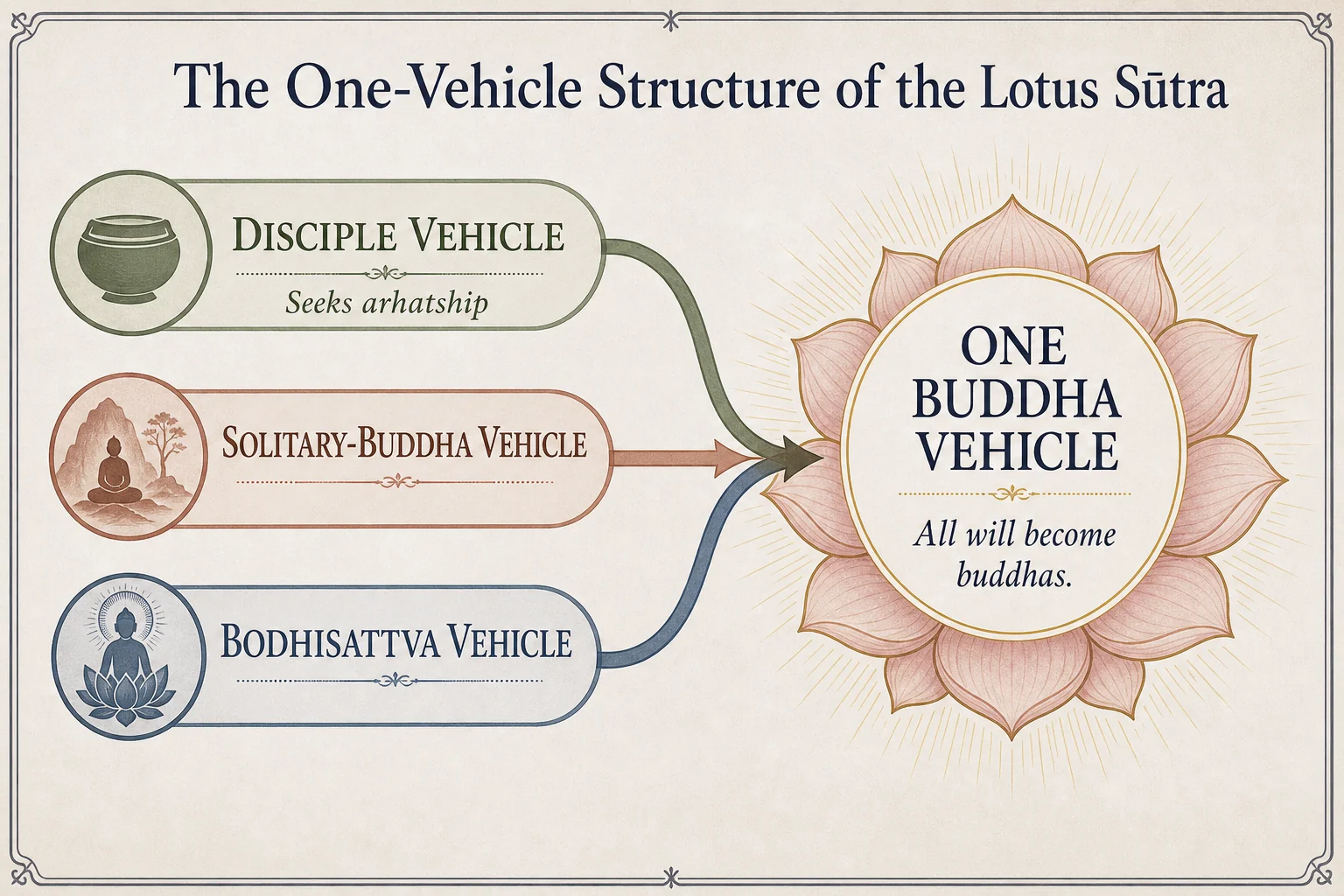
The second is "expedient means" (upāya). The Buddha teaches different doctrines according to beings' capacities; all are skillful methods leading toward the single buddha vehicle. The Lotus explains this through several famous parables: the father who lures his children from a burning house by promising three carts but gives them only a single great white ox cart; the poor son who fails to recognize his wealthy father; and the phantom city conjured to give exhausted travelers a place to rest.4 The doctrine also produces a striking claim: the Buddha's lifespan is in fact immeasurably long, and the historical parinirvāṇa was only an expedient display. The Buddha has always continued to teach, as the "Lifespan of the Tathāgata" chapter explains. This elevates the Buddha from a historical person into a being beyond time. It continues the Mahāsāṃghika tendency in 2.3 to treat the Buddha's body as supramundane and transcendent and echoes the Dharma-body view in the previous chapter, according to which the Buddha continues speaking.
The three parables deserve closer attention because they share a structure. The children playing in a burning house, the poor son who does not recognize his father, and the traveler who wants to turn back all place the recipient of the teaching in the same position: unable to see the actual situation, unwilling to believe a direct statement, and capable of movement only through promises or deception. This systematically removes the recipient's agency. The other party is defined as a child or weak person who must be deceived, enticed, and led by the hand, thereby highlighting the teacher's (the Buddha's or Mahāyāna's) omniscience and great compassion. In this book's view, it is a characteristic form of propaganda. It bypasses direct doctrinal persuasion by first degrading the opponent into someone "incapable of judgment and fit only to be manipulated," making the superiority of one's own position appear self-evident. The next section's scenes in which Vimalakīrti embarrasses Śāriputra and other disciples employ the same narrative strategy.
3. The Avataṃsaka: Mutual Containment in the Dharma Realm
The Avataṃsaka Sūtra is a cumulative collection. Some of its cores, such as the Daśabhūmika and the Gaṇḍavyūha, are earlier, while the complete compilation dates to around the third or fourth century. It offers a magnificent cosmological vision in which all phenomena contain and reflect one another: one is all, and all is one. Later Huayan thinkers described this with Indra's net. In the palace of the god Indra, every jewel in an infinite net reflects every other jewel, each contained within all, layer upon endless layer.5 Following this book's usual caution, precise formulations such as "the unobstructed interpenetration of all phenomena" and "Indra's net" are largely elaborations by later Huayan patriarchs. The scripture itself supplies the vision of mutual containment; later thinkers supplied the systematic terminology.
The Daśabhūmika Sūtra arranges bodhisattva practice into ten grounds (daśabhūmi). Each emphasizes a particular perfection and together they form the backbone of Mahāyāna theories of the path.
| Ground | Name | Principal perfection and defining feature |
|---|---|---|
| First | Joyous, Pramuditā | Generosity; first realizes the nature of dharmas and experiences great joy |
| Second | Stainless, Vimalā | Ethical discipline; eliminates the subtlest transgressions |
| Third | Luminous, Prabhākarī | Patience; perfects concentration and wisdom and manifests the light of Dharma |
| Fourth | Radiant, Arcismatī | Diligence; wisdom blazes and defilements are gradually eliminated |
| Fifth | Difficult to Conquer, Sudurjayā | Meditation; perfects the difficult simultaneous operation of worldly and supramundane knowledge |
| Sixth | Face-to-Face, Abhimukhī | Wisdom; deeply contemplates the twelve links of dependent arising and brings wisdom immediately present |
| Seventh | Far-Going, Dūraṃgamā | Skillful means; passes beyond the world's range and gains mastery of arising and cessation |
| Eighth | Immovable, Acalā | Vow; attains acceptance of the non-arising of dharmas, becomes completely irreversible, and enters effortless practice |
| Ninth | Good Intelligence, Sādhumatī | Power; gains four unhindered forms of eloquence and extensively teaches beings |
| Tenth | Cloud of Dharma, Dharmameghā | Knowledge; covers all like a Dharma cloud, receives the great consecration, and reaches the last stage before buddhahood |
The ten-ground structure contains a crucial idea: reversibility and irreversibility (avaivartika). Before entering the grounds, the bodhisattva's progress may be lost. Entering the first ground brings an initial assurance. A more decisive threshold comes at the eighth ground, the Immovable, where the bodhisattva attains "acceptance of the non-arising of dharmas" (anutpattikadharmakṣānti), a direct insight that dharmas neither arise nor cease. Practice then proceeds naturally and effortlessly, with no possibility of regression. The idea directly echoes in the Pure Land scriptures, where rebirth in Sukhāvatī is explicitly described as "irreversible." Rebirth therefore bypasses the long cultivation of the ten grounds by letting the power of Amitābha's fundamental vows directly guarantee irreversibility—one reason the other-power path appealed to Mahāyāna practitioners.
The Gaṇḍavyūha, which once circulated independently and was later incorporated at the end of the Avataṃsaka, is a vast narrative. It recounts the youth Sudhana's search for awakening through visits to fifty-five (or, by another count, 110) spiritual friends (kalyāṇamitra). They include monks, nuns, laypeople, merchants, boys and girls, a courtesan, and non-Buddhist teachers. The journey itself makes a claim: the possibility of awakening is not tied to a single identity or station, and some aspect of the bodhisattva path can be demonstrated by anyone. Before every spiritual friend Sudhana requests instruction, receives one Dharma gate, and is directed to the next guide. The structure has no pyramid with a single summit. Each guide possesses a complete Dharma gate, and the Dharma gates do not cancel one another.
The Avataṃsaka also contains an immensely influential statement commonly rendered "the three realms are mind-only, and all dharmas are consciousness-only." It derives from the Daśabhūmika statement "the three realms are false constructions, made by mind alone"—Xuanzang's Avataṃsaka translation reads, "everything in the three realms is only one mind." The formulations sound similar but carry subtly different implications. Both point toward the appearance of all phenomena in the three realms with mind as their source. The line later became important scriptural support for Yogācāra consciousness-only (see Part VI). But "mind" in the original Avataṃsaka context is not necessarily the storehouse consciousness of Yogācāra. Directly equating it with the later theoretical system is an interpretive leap, not the scripture's original meaning.
4. Pure Land: Other-Power and Recollection of the Buddha
The Pure Land scriptures take another route: faith, vows, and other-power. The "three Pure Land scriptures" commonly refers to the Larger Sukhāvatīvyūha, the Smaller Sukhāvatīvyūha, and the Contemplation Sūtra. Dating to around the first and second centuries, they construct the same Pure Land faith from different angles. Lokakṣema had already translated early Pure Land-related works such as the Pratyutpanna Samādhi Sūtra, which describes the samādhi of recollecting a Buddha. The emphases of the three scriptures should be distinguished.6
The Larger Sukhāvatīvyūha, literally the "Array of the Land of Bliss," is the longest and doctrinally most complete. It narrates the forty-eight great vows made by Amitābha, the Buddha of Infinite Light, or Amitāyus, the Buddha of Infinite Life, when he was the bodhisattva Dharmākara. The eighteenth vow, the "vow of recollection of the Buddha and rebirth," became central to later Pure Land teaching. Anyone who invokes Amitābha's name even ten times will be received by him at death and reborn in Sukhāvatī, except those who commit the five heinous crimes or slander the true Dharma. The logic of the fundamental vow is that the Buddha's promise during the causal stage and the virtues attained through his buddhahood constitute a power open to believers. Through faith and vow, the believer connects with this already perfected power and reaches a state (irreversibility) that would otherwise require an extremely long period of practice through self-power.
The Smaller Sukhāvatīvyūha is very brief. It emphasizes the splendor of Sukhāvatī and the "recollection of the Buddha by holding his name." Maintaining the name "Amitābha Buddha" with undistracted one-pointedness results in rebirth at death. Here "holding the name" (nāmasaṃkīrtana, praising or invoking the name) already functions as a complete Pure Land practice without visualization.
The Amitāyurdhyāna Sūtra, or Contemplation Sūtra, is the most unusual of the three. It begins with a political tragedy: King Bimbisāra is imprisoned by his son Ajātaśatru, and Queen Vaidehī despairs. At her request, the Buddha directly teaches her to visualize Sukhāvatī. The text describes sixteen contemplations:7
| Sequence | Name | Object visualized |
|---|---|---|
| First–third | Sun, water, and ground contemplations | The disk of the sun, water, and the lapis-lazuli ground forming the Pure Land's foundation |
| Fourth–sixth | Jeweled trees, jeweled ponds, and jeweled towers | The material splendors of the Pure Land |
| Seventh | Lotus-seat contemplation | The jeweled lotus throne on which the Buddha sits |
| Eighth | Image contemplation | Amitābha's bodily dimensions and marks |
| Ninth | Contemplation of Amitābha's true body | His immeasurable radiance illuminating all things |
| Tenth–eleventh | Contemplations of Avalokiteśvara and Mahāsthāmaprāpta | The other two members of the Western triad |
| Twelfth–thirteenth | General and composite contemplations | The Pure Land as a whole; smaller images of its buddhas and bodhisattvas |
| Fourteenth–sixteenth | Higher, middle, and lower grades of rebirth | The nine levels within the three grades of rebirth and the practices appropriate to them |
The structure of the sixteen contemplations reveals the early form of Pure Land devotion. Its center was meditative visualization (dhyāna): using concentration to construct the image of the Pure Land precisely in the mind and finally see Amitābha's body. This directly connects with the "revelatory meditation" discussed in the preceding chapter. Seeing a Buddha in the Pratyutpanna Samādhi Sūtra and the sixteen visualizations of the Contemplation Sūtra are two ends of the same tradition.
An important historical development must be clarified. Visualization of the Buddha, using meditative concentration to contemplate his body and the splendor of the Pure Land, was the earlier form and demanded considerable meditative ability. Invocation of the Buddha's name, orally reciting "Amitābha Buddha," became the later popular form and was theoretically open to people of every capacity. The transition was decisive in turning Pure Land devotion from an elite contemplative practice into a mass religion. It was completed in China. Daochuo (562–645) and Shandao (613–681) vigorously promoted vocal invocation, arguing that in the age of the decline of the Dharma people's capacities were poor, visualization was difficult, and invocation could be practiced by everyone. This did more than simplify a method; it reconstructed the whole classification of teachings and philosophy of practice.
This is Mahāyāna's most religious and widely popular path. It is less speculative than Prajñāpāramitā, but philosophically its weight lies elsewhere: it shifts the fulcrum of liberation from attainment through self-power alone to reliance on the Buddha's "other-power." The distinction between other-power and self-power became a major problem in later Chinese and especially Japanese Pure Land thought.
"Pure Land" does not refer only to Sukhāvatī. Mahāyāna scriptures present a plural range of pure lands. Akṣobhya's land of Abhirati appears in early texts such as the Vimalakīrti Sūtra. Bhaiṣajyaguru, the Medicine Buddha, has an eastern land of lapis lazuli. The pure land of Maitreya formed another influential route. Maitreya now resides in Tuṣita Heaven and will be the next buddha to appear in the world. Devotees may vow to be reborn in his inner court, draw near to him there, and await his descent. This path was popular in India and early Chinese Buddhism; Xuanzang himself aspired to rebirth in Tuṣita. Amitābha's Pure Land later became dominant in China and Japan to a considerable degree because generations of patriarchs (Daochuo, Shandao, Hōnen, and Shinran) vigorously promoted it.8
The origin of Amitābha remains connected with an unresolved scholarly question. Does the imagery of Amitābha, "Infinite Light" dwelling in the west, owe anything to the luminous deities or solar worship of ancient Iran, including Zoroastrianism? Advocates note the unusual combination of infinite light and a western pure land, together with the cosmological importance of light in ancient Iranian religion. Critics reply that Mahāyāna scriptures possess their own development of luminous imagery and that the comparison lacks sufficient documentary support. Neither view is settled. Part X's chapter on Pure Land will examine it in detail.
5. Vimalakīrti: Nonduality and the Enlightened Layperson
The Vimalakīrti Sūtra, dating from around the first or second century, is a brilliant drama. Its protagonist, Vimalakīrti, is a layman whose wisdom overwhelms the Buddha's great disciples and even the bodhisattvas. It repeatedly makes Śāriputra and others appear foolish in order to elevate Mahāyāna and demean liberation-path practitioners caricatured as seeking only their own release. The origin and inaccuracy of the pejorative "one who saves only himself" are discussed in the next chapter on the bodhisattva path.
Its central idea is nonduality (advaya): saṃsāra and nirvāṇa, defilement and purity, worldly and supramundane are not ultimately divided. The climax comes in the chapter on entering the Dharma gate of nonduality. The bodhisattvas each explain how they enter nonduality. When Vimalakīrti's turn comes, he says nothing. Mañjuśrī praises this wordless silence as the true entry into the Dharma gate of nonduality: "Vimalakīrti's single silence resounded like thunder." In this book's view, the silence continues the old theme of 1.5. At the boundary of language, saying more becomes conceptual proliferation, while silence is more appropriate. From the Buddha's refusal to declare metaphysical positions to Vimalakīrti's silence runs the same awareness of the limits of language, though Mahāyāna turns it into a dramatic climax.
"Abandoning discrimination" and "nonduality" are dramatic scenes in the Vimalakīrti, but in Madhyamaka and its later heirs they develop into an evaluative standard with substantive practical effects. To grasp distinctions and fall into dualistic opposition is treated as a mark of non-liberation. The standard has two sides. Externally, it can criticize any position: saying "A is superior to B" has already fallen into discrimination, and discrimination itself is grasping. Internally, it constrains practitioners' speech and conduct. If reality is nondual, one should hesitate to judge and assert, or cling to "higher and lower" and "victory and defeat." In practice, the two sides often intertwine. Is criticizing someone else for "falling into discrimination" itself another discriminating attachment? This tension runs through Madhyamaka and later Chan rhetoric; Parts V and X will return to it.
6. Shared Themes
The five collections differ widely but share several underlying tendencies. All elevate the bodhisattva path, replacing the arhat caricatured as "saving only himself" with buddhahood for the liberation of beings. All elevate the Buddha beyond history, rely heavily on "expedient means," and approach the boundary of language in distinct ways: Prajñāpāramitā through emptiness, Vimalakīrti through silence, Avataṃsaka through endless mutual containment.
The much-criticized side of "expedient means" must also be stated. As an explanatory device, it is exceptionally powerful. Any teaching inconsistent with Mahāyāna can be classified as an expedient instruction for people of shallow capacity, while Mahāyāna's own teaching is classified as definitive. Because it works so well, it can also become nearly unfalsifiable. Any opponent and any earlier doctrine can be absorbed as a lower rung through the phrase "that was only expedient," without direct doctrinal engagement. It also opens the door to "benevolently untrue speech." The father in the burning-house parable does not fulfill his promise exactly: he promises three carts and provides only one. If expedient means permits this, where is the boundary of speaking falsely for the sake of conversion? A tension arises with the Buddhist emphasis on right speech and refraining from falsehood.9 This book presents the power of expedient means together with the concern. It is the other face of the same strategy by which the three parables remove the opponent's agency.
The relative philosophical importance must nevertheless remain clear. In this book's view, "emptiness" in the Prajñāpāramitā corpus bears the principal philosophical function. It directly denies the intrinsic natures established in Part III and offers a historical response to the metaphysical difficulties of the schools; Nāgārjuna's Madhyamaka will systematize it. The Lotus's one vehicle and eternal Buddha, the Avataṃsaka's Dharma realm and mind-only language, Pure Land's other-power and recollection of the Buddha, and Vimalakīrti's nonduality and silence develop respectively in doxography, cosmology, religious practice, and theories of language. In later China they enter the Tiantai, Huayan, Pure Land, and Chan traditions. Madhyamaka and Yogācāra transform Mahāyāna into two systems of philosophy: the former inherits Prajñāpāramitā emptiness, the latter the Avataṃsaka line of "the three realms are mind-only." The next chapter first examines the bodhisattva path as a new ideal of practice, followed by Mahāyāna's relationship with the schools. Madhyamaka and Yogācāra are reserved for Parts V and VI.
7. Cumulative Composition and Internal Contradictions
Mahāyāna scriptures share a general textual feature: most accumulated in layers. Contents from different times, regions, and groups were successively added and only later compiled into a whole. The process left visible traces.
Variant versions. Five Chinese translations of the Larger Sukhāvatīvyūha survive, and they differ markedly in the number of Amitābha's vows. The earliest Chinese translation, from around the second century, has twenty-four vows; the later version attributed to Saṅghavarman standardizes forty-eight; another version contains thirty-six. The particular vows and conditions for rebirth also vary. The discrepancies show either that the translators worked from multiple Sanskrit recensions or that the text was continually revised in transmission.10
Traces of addition. The "Devadatta" chapter, chapter 12 of the Lotus Sūtra, is absent or incomplete in some earlier Chinese translations and several Sanskrit manuscripts and is commonly regarded by scholars as a later addition. The Daśabhūmika and Gaṇḍavyūha originally circulated independently before being incorporated into the Avataṃsaka; their seams retain clear narrative breaks.
Contradictions among recensions. The northern Mahāparinirvāṇa Sūtra, translated by Dharmakṣema in forty fascicles, differs substantially from the southern version revised by Huiyan and others in thirty-six. Chinese monks reorganized the northern text to create the southern version, making it a further adaptation. Scholars regard the final fascicles of the northern version as additional material; their language of buddha-nature noticeably differs from the earlier sections.
Problems of chronological coherence. The "Lifespan of the Tathāgata" chapter in the Lotus declares the Buddha's life immeasurably long and his historical passing merely an appearance. The "Manifestation of the Tathāgata" chapter in the Avataṃsaka implies that at awakening the Buddha already knew everything. Both narratives stand in direct tension with the historical career described in the Āgama literature. There, the Buddha's parinirvāṇa is an actual end; in these Mahāyāna scriptures, historical events are reclassified as stage performances behind which the Buddha always remains. These are two different conceptions of the Buddha, not two compatible statements.3
Such contradictions are unsurprising; ancient religious texts commonly accumulate in layers. What requires emphasis is that the framework of "personally spoken by the Buddha" creates an impression of textual unity and completeness among believers, while the documentary evidence stands at considerable distance from that impression.
8. The Scholarly Judgment on the Śūraṅgama Sūtra
The Śūraṅgama Sūtra holds great importance in Chinese Buddhism, especially Chan, where it is included in daily liturgy and required reading. Scholarly judgment diverges sharply from its traditional status.
The traditional account says that Paramiti brought a Sanskrit manuscript to Guangzhou around 705 during the Chang'an era and translated it with the monk Meghaśikhara from Uḍḍiyāna. Testing the account reveals substantial problems. No one saw the Sanskrit manuscript after the translation; later monks repeatedly searched for it without success. No corresponding Tibetan translation exists, nor any ancient translation in another language. This alone is anomalous. Important Indian Mahāyāna scriptures usually survive in Sanskrit or Tibetan, and the absence of both is exceptionally rare.11
The internal evidence is equally notable. The doctrinal architecture of the Śūraṅgama closely matches the terminology of Tiantai, Huayan, and Chan as they had developed by the early eighth century. Central phrases such as "the wondrous true-suchness nature of the tathāgatagarbha" have no counterparts in Indian Buddhist literature. Mingkuang, a Tang monk, expressed doubt shortly after the scripture entered circulation, making him one of its earliest critics.
The conclusion of modern scholarship is that the Śūraṅgama was probably an apocryphal scripture composed in China during the early Tang. Tokiwa Gishin conducted especially detailed textual comparisons, and the position is widely held among mainstream Buddhist scholars.11
This book reports the scholarly judgment without deciding matters of faith. Traditions that practice on the basis of the Śūraṅgama must confront the historical conclusion; how they respond remains an individual choice.
9. The Provenance of Mahāyāna Scriptures: Common Defenses
Mahāyāna traditions repeatedly employ several lines of argument in response to the scholarly conclusion that Mahāyāna scriptures were not personally spoken by the Buddha but composed later. They deserve separate presentation, not because all are necessarily unsound, but because their rhetorical structures contain protective layers that make criticism difficult to apply directly.
| Defense | Core argument | Internal problem |
|---|---|---|
| "Scholars possess intelligence but not wisdom" | Historians lack realization and can read scripture only conventionally, never reaching the Dharma's meaning | The date of a text is a historical and linguistic question unrelated to depth of realization. Rejecting historical evidence for "lack of awakening" assumes the conclusion to be proved |
| "The Dharma body always teaches" | The Dharma body eternally teaches; what disciples receive in meditation is also the Buddha's word, so later composition does not make it non-buddhavacana | Extends "the Buddha's word" into an unfalsifiable domain: any text becomes buddhavacana if someone claims to have received it in meditation |
| "Compiled in nāga palaces or heavens" | Scriptures were secretly preserved in a nāga palace or heaven and released when conditions matured; this is why no human Sanskrit manuscript can be found | Builds in an exemption from traceability: failure to find a Sanskrit source confirms rather than weakens the claim, making the story inaccessible to historical method |
| "Scholarship is reductionist" | Historical research is Western colonial discourse or reductionism and its method is itself biased | Identifying methodological limits can be reasonable, but criticizing a method does not refute a specific historical conclusion. "Historical method has limits" does not entail "this scripture was spoken by the Buddha" |
| "Doctrine is definitive; provenance is conventional" | Even if composed later, the teaching can remain definitively true; historical origin does not impede doctrinal value | Separating doctrine and provenance has a reasonable core, but it is often used to close discussion. Moving from "they can be discussed separately" to "questions of provenance are unimportant" skips the substantive question: what warrants a claim of authority based on the Buddha's personal speech? |
This book's view is that the final defense (the separation of doctrinal value and provenance) contains a reasonable core but is often used in practice to prevent discussion. Most of the others disable criticism rather than answering it directly. Identifying them allows readers to see that scholarly conclusions and religious commitments can be held side by side; doing so does not make either cancel the other.
References
References
-
Edward Conze. The Prajñāpāramitā Literature. 2nd ed. Tokyo: Reiyukai, 1978; and The Large Sutra on Perfect Wisdom. Berkeley: University of California Press, 1975. ↩↩↩
-
Jan Nattier. "The Heart Sūtra: A Chinese Apocryphal Text?" Journal of the International Association of Buddhist Studies 15, no. 2 (1992): 153–223. The foundational discussion of the place of composition of the Heart Sūtra. ↩
-
Paul Williams. Mahāyāna Buddhism: The Doctrinal Foundations. 2nd ed. London: Routledge, 2009. ↩↩
-
Burton Watson (trans.). The Lotus Sutra. New York: Columbia University Press, 1993; The Vimalakirti Sutra. New York: Columbia University Press, 1997. ↩
-
Thomas Cleary (trans.). The Flower Ornament Scripture: A Translation of the Avatamsaka Sutra. Boston: Shambhala, 1993. ↩
-
Luis O. Gómez. The Land of Bliss: The Paradise of the Buddha of Measureless Light. Honolulu: University of Hawai'i Press, 1996. ↩
-
On the text and thought of the Contemplation Sūtra, see Julian F. Pas. Visions of Sukhāvatī: Shan-tao's Commentary on the Kuan Wu-liang-shou-fo ching. Albany: State University of New York Press, 1995. ↩
-
Alan Sponberg and Helen Hardacre, eds. Maitreya, the Future Buddha. Cambridge: Cambridge University Press, 1988. ↩
-
An early story bears on this theme. Nanda, the Buddha's half-brother, remains preoccupied with his fiancée after ordaining. The Buddha is said to encourage his practice by promising that diligence will win him celestial nymphs. Nanda eventually attains arhatship, his desire naturally disappears, and he tells the Buddha that the promise need not be fulfilled. If historical, this would be an early precedent for saying something less than fully true for the sake of liberation, not a Mahāyāna invention. The principal sources, however, are the Pāli Udāna 3.2 and the Dhammapada commentary; the Chinese Ekottarika Āgama contains a similar but much briefer account, while Aśvaghoṣa's Saundarananda, around the second century, is a literary work. The historical reliability of these sources is limited, and this book does not accept the episode as established fact. Yet omitting it would conceal relevant evidence, so it is recorded here for readers to judge. ↩
-
For a comparative study of the Chinese translations of the Larger Sukhāvatīvyūha, see Fujita Kōtatsu. Genshijōdo shisō no kenkyū (原始浄土思想の研究). Tokyo: Iwanami Shoten, 1970. ↩
-
For an overview of scholarship on the apocryphal status of the Śūraṅgama Sūtra, see Robert E. Buswell Jr., ed. Chinese Buddhist Apocrypha. Honolulu: University of Hawai'i Press, 1990; Tokiwa Gishin and other scholars have also published specialized studies. ↩↩