Chapter 3 The Bodhisattva Path and a New Ideal of Practice
The scriptures of the preceding chapter speak in different voices but collectively promote a new ideal of practice: the bodhisattva. Mahāyāna's most concrete transformation lies not in any single metaphysical claim, but in changing the goal from "my own liberation" to "buddhahood for the liberation of all beings." This chapter examines that ideal, the structure of its path, how it resolves the tension between not-self or emptiness and compassion, and how difficult the path originally was.
1. From Arhat to Bodhisattva: A Change of Ideals
The highest attainment of the early Buddhist schools is arhatship: eliminating all defilements, bringing birth and death to an end, and realizing nirvāṇa in this life. It is the culmination of the path of the hearer liberation-path practitioner.
Mahāyāna moved the standard. The ideal was no longer the arhat but the bodhisattva, who vows to realize unexcelled complete awakening (to become a buddha), and willingly remains through immeasurable births and deaths to liberate every being, delaying final nirvāṇa for himself or herself. This vow is called the "mind of awakening" (bodhicitta): the resolve to become a buddha for the sake of beings.1
| Arhat, culmination of the liberation path | Bodhisattva, Mahāyāna ideal | |
|---|---|---|
| Goal | Personally realizes nirvāṇa and ends birth and death | Attains buddhahood and liberates all beings |
| Scope | Individual liberation | Universal liberation |
| Time | Can be completed in this life | Three incalculable eons and immeasurable lives |
| Emphasis | Primarily wisdom that eliminates defilements | Joint operation of compassion and wisdom: great compassion + prajñā |
On this basis Mahāyāna demeaned the arhat as someone who "saves only himself." The Chinese expression ziliao han is pejorative: a person who brings only his own cycle to an end and neglects others. Behind it lies the polemical Mahāyāna claim that "one who seeks only personal liberation has a small aspiration." The Lotus teaching of one vehicle goes further, saying that arhats must eventually turn from the small toward the great and take the path to buddhahood (see the preceding chapter). Its inaccuracies should be made explicit. First, the arhat's path is not "selfish." Loving-kindness, compassion, sympathetic joy, and equanimity are part of its practice. The Buddha himself taught for forty-five years after awakening, and his arhat disciples likewise remained in the world, teaching and benefiting others. Arhatship is also the liberation directly approved by the Buddha. Second, "arhat" is a title shared by the Buddha himself—one of his ten epithets, "Worthy of Offerings," translates the same word. Demeaning arhatship as inferior thus places the Buddha himself within the category. Third, most ironically, an arhat is precisely someone who has eliminated the conceit "I" and realized not-self. To accuse a person who has relinquished "I" of "saving himself" or "selfishness" reverses name and reality. This book presents Mahāyāna's elevation of the bodhisattva and denigration of the arhat without endorsing the judgment that arhats are inferior. "One who saves only himself" is a Mahāyāna pejorative, especially in later China, and this book does not adopt it.
A feature of Chinese translation corroborates the point. The same Sanskrit word arhat was translated in two ways. As one of the Buddha's ten epithets it was rendered semantically as "Worthy of Offerings"; as the attainment of a disciple it was transliterated as "arhat." The Chinese Āgamas do not avoid the latter term: disciples who attain the fruit are called arhats. But the Buddha's own arhat status was concealed under "Worthy of Offerings," making it difficult for Chinese readers to see at a glance that "the Buddha himself is also an arhat." More strikingly, when Mahāyāna scriptures enumerate the ten epithets of every buddha in the ten directions, they retain "Worthy of Offerings." Mahāyāna devalues the "arhat" as a disciple's fruit while continuing to honor every buddha as "Worthy of Offerings"—the same word in Sanskrit.2
A Reversal: The Rank of Buddha Rose, but Gautama Was Lowered
The reordering of status contains a subtler reversal. Mahāyāna elevated "the Buddha" and lowered the arhat, creating between them the place occupied by the bodhisattva. But what was elevated was the cosmic status of "Buddha." Siddhārtha Gautama as a historical person was gradually lowered.
First came the buddhas of the ten directions. In the Mahāyāna universe, immeasurable buddhas exist throughout the ten directions and three times, each with a buddha land. Gautama changes from the Buddha into one among innumerable buddhas; his uniqueness is diluted.
Second came the three bodies and the "transformation body." The doctrine of the three bodies, systematized later especially in the Yogācāra line, divides a buddha into the Dharma body, enjoyment body, and transformation body. Within this framework, the historical Gautama is often classified as a transformation body, a temporary manifestation in this world, while the formless Dharma body or an enjoyment-body buddha in another pure land, such as Amitābha, is treated as more ultimate. The person who awakened beneath the Bodhi tree and entered parinirvāṇa at Kuśinagara is reduced to a provisional body of manifestation. The three-body theory is a later systematization and will be examined in Part VI.
Third is the contrast between impure and pure lands. Mahāyāna calls Gautama's world Sahā, the world of endurance and an evil age of five impurities. Compared with Amitābha's Sukhāvatī, it is an "impure land." To aspire to rebirth in a pure land implies that practice is difficult here and the other world is better; Gautama's field of teaching becomes an inferior impure land to be endured.
Several nuances prevent the conclusion from becoming too absolute. "Impure" need not mean that the land itself is intrinsically filthy. In the Vimalakīrti Sūtra, someone disparages this world's impurity, whereupon the Buddha presses the earth with his foot and Sahā immediately appears pure and magnificent. Impurity lies not in the land but in beings' defiled vision. The difference between impure and pure lands is partly epistemological (whether the observer is defiled or purified), not an intrinsic ranking of places. Second, lowering the historical Gautama and elevating the "primordial Buddha" are two sides of the same move. The Lotus says that the historical parinirvāṇa was only an expedient display and that behind it stands a "Śākyamuni" who attained buddhahood in the inconceivably distant past. The further historical Gautama recedes, the more cosmic and eternal Śākyamuni advances.
This book's view is that the Mahāyāna reordering elevated "buddhahood" into a cosmic principle (the Dharma body, buddhas of the ten directions, and pure lands), while pushing to the margin the historical human Gautama reconstructed in 1.4. It stripped his uniqueness through innumerable buddhas, reduced him to a manifestation body, and placed him in an impure land. What moved to the center of worship was an elevated and cosmic "Buddha," no longer the traveler who walked the road and made himself his island.
2. The Structure of the Bodhisattva Path: Aspiration, Vows, Six Perfections, and Ten Grounds
The bodhisattva's practice became an extraordinarily long path with several principal stages:
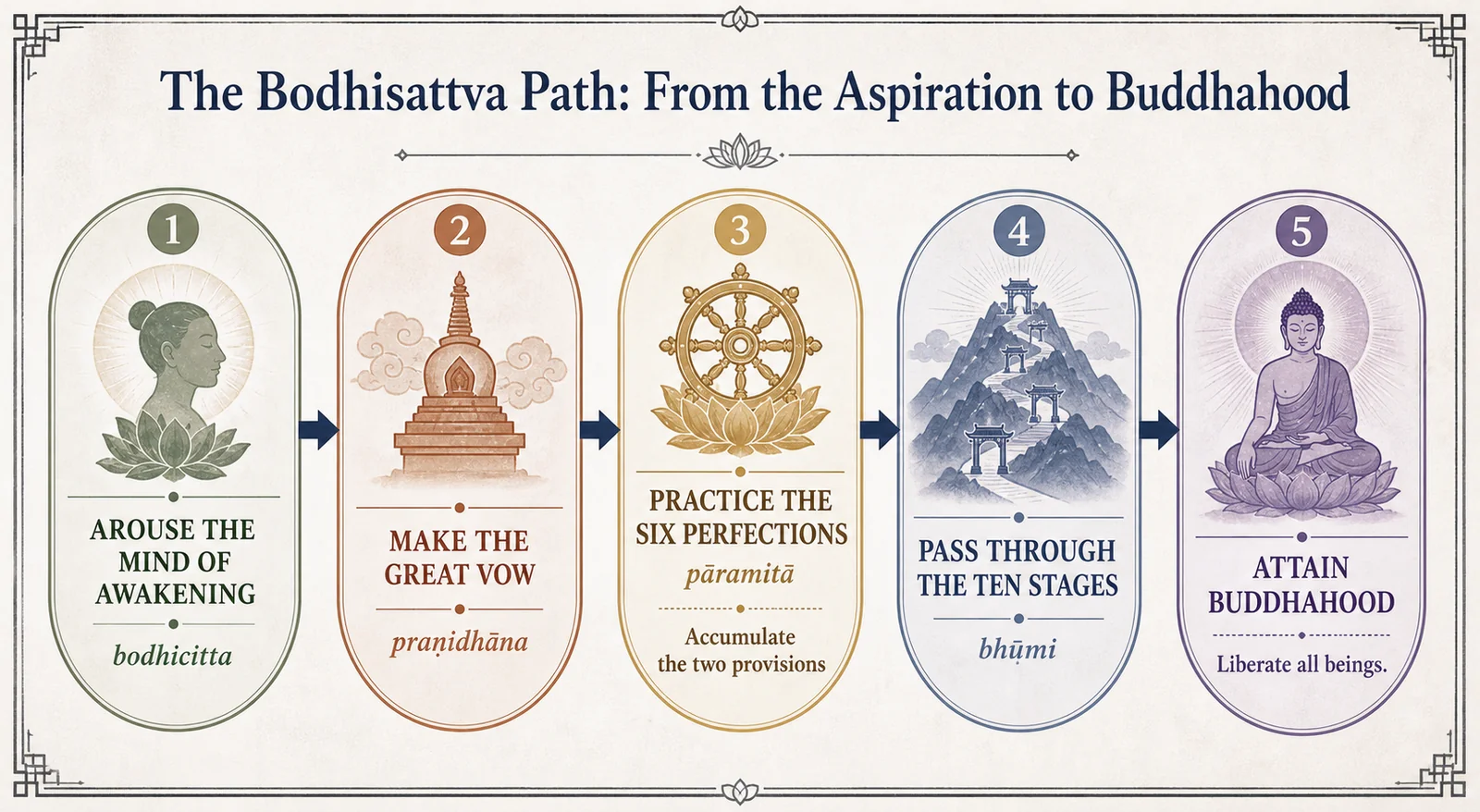
The entrance is generating the mind of awakening, followed by making vows, such as the four universal vows or Amitābha's fundamental vows in the previous chapter. The principal practices are the perfections (pāramitā, literally "gone to the further shore"), traditionally six:
| Perfection | Sanskrit | Principal meaning | Accumulation |
|---|---|---|---|
| Generosity | dāna | Gifts of wealth, Dharma, and fearlessness | Merit |
| Ethical discipline | śīla | Observing precepts with an altruistic orientation | Merit |
| Patience | kṣānti | Enduring suffering and harm without hatred | Merit |
| Diligence | vīrya | Energetic perseverance without regression | Merit/wisdom |
| Meditation | dhyāna | One-pointedness and the foundation of concentration | Merit |
| Wisdom | prajñā | Seeing emptiness and governing the first five | Wisdom |
The six were later expanded into ten by adding skillful means, vows, power, and knowledge.3 Prajñā (seeing emptiness) has a governing role among the six. Without it, the first five are merely worldly good deeds. With it, generosity and discipline become "perfections." This continues the preceding chapter's point: Mahāyāna redefined the bodhisattva's good action through emptiness.
Two accumulations. The claim that the bodhisattva path requires three incalculable eons has an internal structural logic. Over this immense duration practitioners simultaneously accumulate two things. The accumulation of merit (puṇya-saṃbhāra) is built through generosity, discipline, patience, diligence, and meditation and corresponds to the magnificence of a buddha's form or enjoyment body. The accumulation of wisdom (jñāna-saṃbhāra) is built through prajñā and corresponds to the Dharma body—the body of truth, which is formless. Both must be perfected to achieve buddhahood as one "complete in merit and wisdom." This explains why a bodhisattva performs limitless good deeds while cultivating the contemplation of emptiness; the two accumulations cannot substitute for each other.3
The four means of gathering. Alongside the six perfections are four practical forms of altruistic action, the four means of gathering (catuḥ-saṃgraha-vastu): generosity, offering wealth or Dharma; kind speech (priyavāditva), teaching good doctrines according to circumstances; beneficial action (arthakṛtya), helping beings through concrete deeds; and cooperation (samānārthatā), sharing beings' circumstances in order to guide them. The four describe how bodhisattvas enter people's lives. Rather than give from above, they live alongside beings and guide according to circumstances. Chinese Buddhism later summarized them as a practical program for lay bodhisattva conduct.
Dedication: Transferring Merit and the Problem for Karma
The bodhisattva path contains another philosophically intriguing practice: dedication (pariṇāmanā), the transfer of merit. Rather than possess the merit accumulated through practice, the bodhisattva "dedicates" it to every being so that all may share its benefit, ultimately directing it toward unexcelled awakening. This sounds natural, yet it conflicts with the individual principle of karma. If karma is an individual's result of an individual act, how can merit be transferred to someone else? Early Buddhism takes a relatively conservative position: karma is fundamentally personal, and no one can receive another's result in that person's place.
Buddhist traditions offer several responses to the tension, which should be examined separately.
The first appears in Theravāda. That tradition also practices pariṇāmanā, usually translated as dedication or sharing of merit, but explains the mechanism differently. The recipient must respond with appreciative joy (anumodanā) in order to "receive" it. This is interpreted as the recipient generating new karma through that response, not as a direct transfer of merit. The practice is usually directed toward particular beneficiaries, such as deceased relatives, rather than the Mahāyāna dedication to every being; see Part IX. The explanation is coherent within karmic theory, but at the price of leaving "transfer" only in name. The operative event is the recipient's own mental action; the donor's merit does not move.
The second response uses emptiness to reinterpret karmic ownership. In Prajñāpāramitā and Madhyamaka analysis, karma and merit lack intrinsic nature. The "I" in "my merit" is only conventionally established. If no substantive owner exists, the merit's exclusive ownership is likewise only a conventional arrangement; dedication simply redesignates its beneficiary on the conventional level. The difficulty is the symmetry of the price. If emptiness can loosen the exclusivity of merit, it equally loosens the personal ownership of karmic results, even though personal responsibility (one receives the results of one's own actions and not another's) is foundational to Buddhist ethics. Opening the door to dedication with emptiness requires an explanation of why the same door does not let moral responsibility escape. Mahāyāna treatises frequently praise dedication but rarely address the symmetry problem directly.
The third is a practical and institutional explanation. Whatever the mechanism, dedication played a concrete role in Mahāyāna social history. Producing merit for the deceased and dedicating merit to donors became one of the most important religious exchanges between monasteries and lay communities. This explains why dedication was indispensable, but it is a functional explanation, not a defense within karmic theory.
In this book's view, dedication is a bold Mahāyāna redistribution of ethical resources. It gives every bodhisattva's good act beneficiaries without boundaries and supplies a daily, practicable form for "the nonduality of benefiting self and others." Yet at the level of karma, the tension between transferable merit and individually received karmic results has no generally accepted resolution across the systems. It remains an open philosophical problem.
The progress of practice is arranged into the ten grounds, from the Joyous and Stainless through the Cloud of Dharma; see the Avataṃsaka and Daśabhūmika in the preceding chapter. The scale of the entire path is cosmic: three incalculable eons and immeasurable rounds of birth and death are required to perfect buddhahood.
3. Compassion and Wisdom: Liberating Every Being When No Being Can Be Found
The foundation of the four immeasurables. Bodhisattva compassion has a meditative and affective foundation; it is not an abstract vow. Early Buddhism already taught the four immeasurables (brahmavihāra, the four divine abodes): loving-kindness (maitrī), wishing every being happiness; compassion (karuṇā), wishing every being freedom from suffering; sympathetic joy (muditā), rejoicing in others' happiness; and equanimity (upekṣā), impartiality without bias or grasping. These four mental states extend universally to all beings, and the Āgamas provide explicit meditation instructions. Mahāyāna incorporates them into bodhisattva practice and especially elevates compassion into great compassion (mahākaruṇā). Its scale and objects are limitless, and it does not contract according to whether beings reciprocate or can actually be saved.4
The four immeasurables supply the practical basis of Mahāyāna compassion, but Mahāyāna also transforms them. They are cultivated under Prajñāpāramitā's insight of "non-attainment," without attachment to "I am compassionate" or "there are beings receiving my compassion." This is the principle later called "emptiness of the three spheres": giver, receiver, and gift are all empty. It turns the four immeasurables from meditative states into perfections that reach the further shore.
The bodhisattva path contains an apparently fatal contradiction. On one side are not-self and emptiness: beings and self are empty. On the other is the vow to "liberate every being." If there are no beings, who is liberated and who performs the liberation?
Mahāyāna does not evade the contradiction; it makes it the heart of the path. The Diamond Sūtra gives the clearest answer. The bodhisattva brings limitless, innumerable beings to cessation, yet "in reality no being is brought to cessation." If a bodhisattva retains the marks of self, person, being, and lifespan, that person is not a genuine bodhisattva. True great compassion acts precisely without grasping any "being" as really existent: liberating without liberation, compassionate without attachment. In this book's view, this is the substantive meaning of Mahāyāna's "joint operation of compassion and wisdom." Great compassion supplies the direction of action; prajñā, the wisdom of emptiness, prevents action from becoming a new form of grasping. The bodhisattva's skillful means, discussed in the preceding chapter, avoids becoming another disguise for self-attachment only when grounded in this non-grasping wisdom.
The two statements actually speak on different levels. "Liberates innumerable beings" is a statement on the conventional level (saṃvṛti), where sentient beings exist and bodhisattvas teach them. "In reality no being is liberated" is a statement on the ultimate level (paramārtha), where dharmas lack intrinsic nature and no really existing being attains a really existing cessation. The Diamond Sūtra overlays the levels as a paradox without explicitly distinguishing them. This is part of its rhetorical character and one reason different interpretive systems can appropriate it differently. Systematically distinguishing the two as conventional truth (saṃvṛti-satya) and ultimate truth (paramārtha-satya) was the work of later Madhyamaka; Part V will examine it in detail.
The Vajracchedikā Prajñāpāramitā Sūtra was probably composed around the first or second century, roughly contemporary with or slightly earlier than Nāgārjuna, ca. 150–250 CE; their precise textual relationship cannot be established. Many scholars think that the early Prajñāpāramitā tradition represented by the Aṣṭasāhasrikā supplied Nāgārjuna with the intuition of emptiness and that his Mūlamadhyamakakārikā, around the turn of the second to third century, forged it into a systematic logical argument. The Prajñāpāramitā scriptures supply the conclusion; Madhyamaka supplies the argument. The Diamond Sūtra formula "X is not X; therefore it is called X" (for example, "a bodhisattva is not a bodhisattva; therefore he is called a bodhisattva") corresponds internally to the logic of Madhyamaka's two truths, but appears in the text as an assertion without the formal demonstration found in Madhyamaka.5
The later Yogācāra line distilled the position into "non-abiding nirvāṇa" (apratiṣṭhita-nirvāṇa). A bodhisattva neither sinks into saṃsāra like an ordinary person nor rests in the tranquil nirvāṇa attributed to liberation-path practitioners, but through compassion and wisdom abides in neither extreme and remains in the world for beings. The concept is a later refinement and is noted here in advance.
The philosophical problem of compassion without self. Push the contradiction one step further. If no real beings exist (if all dharmas are empty and lack intrinsic nature), what arouses compassion? Does someone who has thoroughly seen that "all beings are empty" theoretically retain any motive for great compassion? This is not a marginal problem. Both Madhyamaka and Yogācāra seriously addressed it internally, though by different routes. The Madhyamaka line, especially Candrakīrti, answers through the two truths: beings still exist conventionally and compassion retains its objects; ultimate emptiness does not cancel conventional practice. Yogācāra moves toward "great compassion grounded in shared identity": awakened beings and ordinary beings share a basis in some sense, such as the perfumed structure of storehouse consciousness, and the loosening of the self–other boundary supplies a deeper ground for compassion. Each answer has costs. Parts V and VI will examine them; here the question is simply marked as a persistent tension in the philosophy of the bodhisattva path.
4. How Difficult It Originally Was: Early Elite Asceticism and Later Popularization
Today "bodhisattva" can evoke a vow available to everyone, almost a benevolent disposition. Historical method requires a correction: the early bodhisattva path was far from easy.
Recall Nattier's argument cited in the preceding chapter on Mahāyāna origins. The early bodhisattva path was exceptionally rigorous. The Ugraparipṛcchā describes a heroic vocation pursued by a small elite, mostly ascetic monastics, who vow to enter birth and death repeatedly over immeasurable eons, giving up their bodies to save beings. It was not a popular, accessible teaching.6 The scripture makes concrete demands: live in the wilderness (araṇya) far from villages, cut off worldly society, keep strict discipline, and do not reside with people outside one's ordination lineage. This bodhisattva is a more ascetic and isolated practitioner, not simply a kind person active in public welfare. In the early layers of the Aṣṭasāhasrikā, bodhisattva practice likewise centers on long contemplations of "non-attainment" in mountains or far from settlements, supported by minimal necessities. The practitioner resembles a solitary awakener polishing himself through endless eons more than a social servant of beings.
From heroic asceticism to a universal promise: mechanisms of transformation. Popularization depended on two shifts in discourse. The first was the legitimation of a lay bodhisattva path. Vimalakīrti, a lay householder surpassing others in wisdom, provides a literary precedent. In the Lotus Sūtra, the nāga girl becomes a buddha in the present, breaking restrictions that denied buddhahood to women or laypeople. Such precedents gradually opened the possibility that "I too can take this path" to a wider population. The second and more fundamental shift was the emergence of tathāgatagarbha and buddha-nature. Once a tradition claimed that "every being possesses the tathāgatagarbha" and "everyone inherently has buddha-nature," the bodhisattva path ceased to be a heroic vow and became a return to something already present. Buddhahood was no longer only a destination three incalculable eons away; it could become something that anyone might "assume directly" at any moment. This transformation forms a complete doctrinal system only in Part VII, but its seeds were already being planted as Mahāyāna scriptural traditions developed. This book's position is that the bodhisattva ideal evolved from "the difficult great vow of a minority" into "a universal promise of buddhahood." It is a genuine historical development; the later popular form should not be read backward into the beginning.
At the same time, a group of "celestial bodhisattvas" became objects of devotion: Avalokiteśvara, Mañjuśrī, Samantabhadra, Kṣitigarbha, and Maitreya, respectively embodying compassion, wisdom, practice, vows, and future hope. They became centers of popular worship and petition. "Bodhisattva" acquired two faces: an extremely difficult path that practitioners were to walk and a compassionate holy being whom ordinary people looked up to and asked for rescue. The two coexist under one word. Their coexistence was the principal form of Mahāyāna's penetration into popular life and the source of the extreme simplification of "bodhisattva" in everyday speech. The devotional face flourished especially in East Asia; see the chapters on Chinese Buddhism.
Another common impression requires correction. The bodhisattva path is not unique to Mahāyāna. The Southern tradition has its own conception of the bodhisatta, but the word itself is layered, and the layers have to be separated first. Its commonest use in the canon stands inside an autobiographical formula: before my awakening, when I was still an unawakened bodhisatta. The bodhisatta there is Gotama in this very life before his awakening, strictly a prior phase rather than a past life. The layer of practice running across lives has a different provenance. Discourses of the type of the Ghaṭīkāra Sutta identify a person of the distant past with the words "he was I"; the stratum of the Buddhavaṃsa and the Apadāna then adds the prediction made by Dīpaṅkara Buddha and the system of the perfections, and only there is the figure of a bodhisatta running a race across many lives complete.7 It is this later layer that Theravāda accepts: someone may make a vow and practice over many lives to become a future buddha, as Maitreya will, and Pāli literature also systematizes ten perfections (dasa pāramī), including in the Cariyāpiṭaka. The difference is that Theravāda reserves the path for a very small number of people seeking to become future buddhas. Most practitioners continue to pursue arhatship, and ordinary followers are not encouraged to take the bodhisattva vow. Part IX will describe the Southern bodhisattva path in detail.
5. The Bodhisattva Ideal: Position and Reservations
The bodhisattva path is Mahāyāna's true religious heart. It redirected Buddhism from individual renunciation toward the great vow to liberate every being and stabilized the vow with the wisdom of emptiness so that it would not revert to a new attachment—the joint operation of compassion and wisdom. Its denigration of the arhat was rhetoric of self-definition, which this book presents but does not endorse. Its development from early elite asceticism into a later universal promise must likewise be historically distinguished.
The next chapter examines Mahāyāna's relationship with the early schools: where it continues their traditions and where it forms new positions. The book then turns to the two great projects that systematized Mahāyāna philosophy: Nāgārjuna's Madhyamaka in Part V, inheriting Prajñāpāramitā emptiness, and Yogācāra consciousness-only in Part VI, inheriting the Avataṃsaka line of "the three realms are mind-only."
References
References
-
Paul Williams. Mahāyāna Buddhism: The Doctrinal Foundations. 2nd ed. London: Routledge, 2009. ↩
-
Among the ten epithets of a tathāgata, Sanskrit arhat is translated semantically in Chinese as "Worthy of Offerings," while the disciple's attainment is transliterated as "arhat": one Sanskrit word, two Chinese translations. See Ding Fubao's Dictionary of Buddhist Studies, entries on the ten epithets, Worthy of Offerings, and arhat. The standard list appears throughout the Chinese Āgamas and Mahāyāna scriptures. ↩
-
Har Dayal. The Bodhisattva Doctrine in Buddhist Sanskrit Literature. London: Kegan Paul, 1932. ↩↩
-
On the four immeasurables in early literature, see Bhikkhu Bodhi (trans.). The Connected Discourses of the Buddha: A Translation of the Saṃyutta Nikāya. Boston: Wisdom Publications, 2000, relevant discourses; and Harvey B. Aronson, Love and Sympathy in Theravāda Buddhism. Delhi: Motilal Banarsidass, 1980, comparing the evolution of the four immeasurables in early and later contexts. ↩
-
Edward Conze (trans.). Buddhist Wisdom Books: The Diamond Sutra and the Heart Sutra. London: Allen & Unwin, 1958. (For "in reality no being is brought to cessation," see the Diamond Sūtra.) ↩
-
Jan Nattier. A Few Good Men: The Bodhisattva Path according to the Inquiry of Ugra (Ugraparipṛcchā). Honolulu: University of Hawai'i Press, 2003. ↩
-
For an analysis of the strata of the word "bodhisattva" in the canon, see Bhikkhu Anālayo. The Genesis of the Bodhisattva Ideal. Hamburg: Hamburg University Press, 2010. The autobiographical formula "before my awakening, when I was still an unawakened bodhisatta" appears in the Bhayabherava Sutta (MN 4), Dvedhāvitakka Sutta (MN 19), Ariyapariyesanā Sutta (MN 26), and Mahāsaccaka Sutta (MN 36). For samples of identification across lives, see the Ghaṭīkāra Sutta (MN 81), Maghadeva Sutta (MN 83), and Mahāgovinda Sutta (DN 19). The prediction made by Dīpaṅkara Buddha does not occur in the four Nikāyas; it belongs to the stratum of the Buddhavaṃsa, the Apadāna, and the Mahāvastu. See Part 13, Chapter 6 of this book. ↩