Chapter Six: The Decline of Buddhism in India—An Inference from Historical Sources
Buddhism arose in India in the fifth century BCE, flourished under Aśoka in the third century BCE, reached an intellectual summit during the Nālandā era from the fifth through twelfth centuries, and then almost entirely disappeared from the South Asian subcontinent in the early thirteenth century. A religious tradition lasting nearly seventeen hundred years became nearly extinct within a relatively short period. This is a rare event in the history of world religions.
“Why?” is the question of this chapter. It has no simple answer. “Islamic invasion” is the most common explanation, but it compresses a complex historical process into a dramatic event. Buddhism’s decline was already well advanced before Islamic armies arrived. This chapter presents the different factors separately and then offers this book’s synthetic judgment.
I. Formulating the Question
Is “decline and disappearance” accurate?
The terminology requires qualification. “Decline” suggests a linear process from flourishing to disappearance, but the actual history was more complex. Buddhism did not vanish on a particular day but contracted slowly over several centuries. It survived longer in some regions and weakened earlier in others. Some of its practices, philosophical concepts, and divine images were absorbed by Hindu traditions and survived in altered form. A distinctive Buddhist tradition continues to the present within the Newar community of Nepal.
It is therefore more accurate to say that Buddhism “ceased to exist on the Indian subcontinent as a recognizably independent religious tradition” than that it disappeared completely.
Limits of the Sources
The question faces an unavoidable evidentiary predicament. Indian Buddhism declined during precisely the period for which documentary records are most scarce. After the thirteenth century, indigenous Buddhist scholars in India virtually disappeared and left no adequate internal account. We depend chiefly on external sources (Chinese records, accounts of Muslim conquerors, and archaeological evidence), and on later retrospective inference. Narratives of Buddhism’s decline are consequently historical constructions inferred from limited evidence to a considerable degree, not direct records of fact. The subtitle “an inference from historical sources” reminds readers of this epistemic premise.
II. A Timeline of Decline: Regional Differences
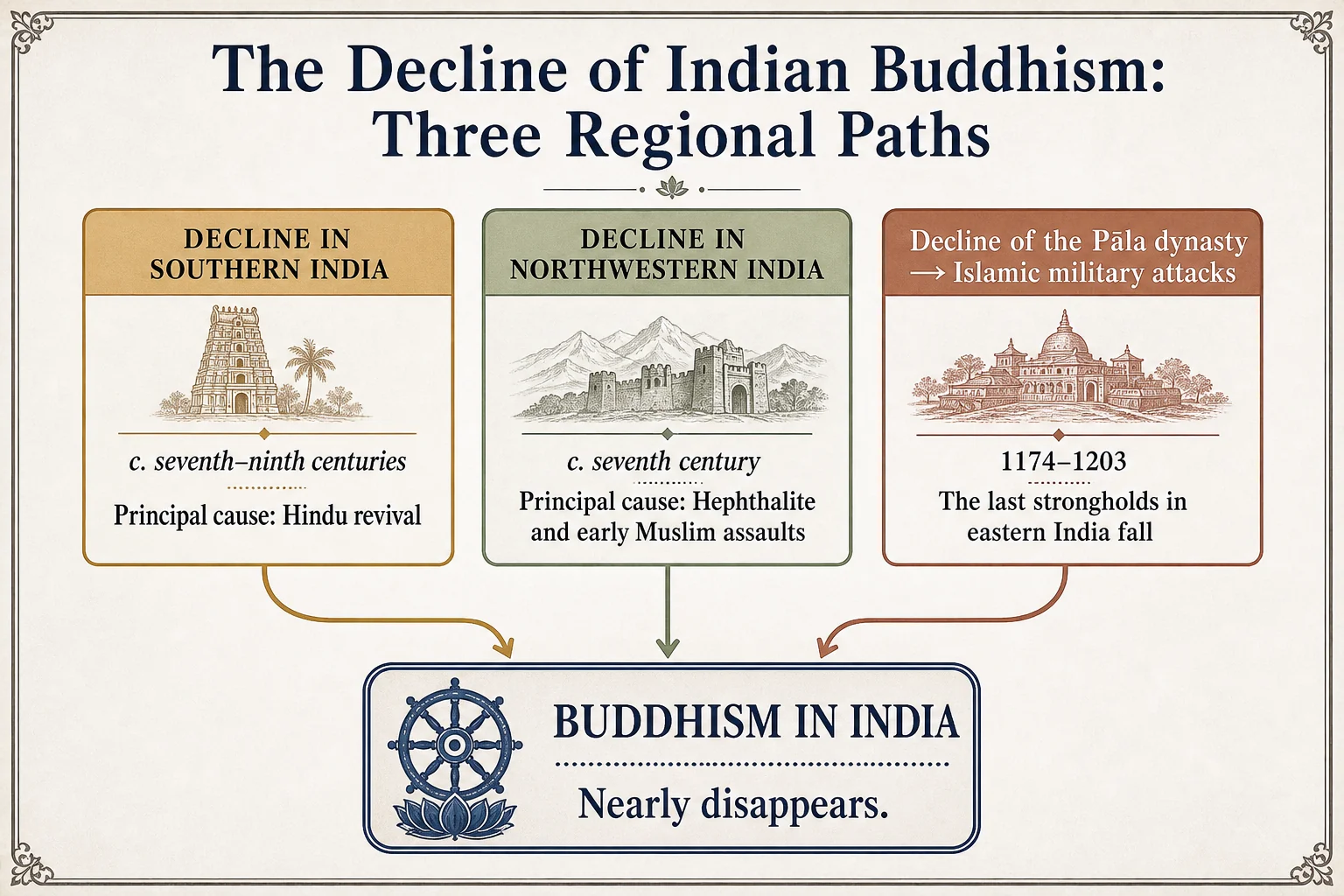
Buddhism did not decline simultaneously across India. Regional differences are essential to understanding the causes.
South India: The Earliest Decline
Buddhism declined in South India around the seventh through ninth centuries, long before Islamic power arrived. During his early seventh-century travels, Xuanzang already recorded diminished Buddhist populations and abandoned monasteries in many southern regions. By the eighth and ninth centuries, Śaivism and Vaiṣṇavism were dominant, leaving Buddhism little foothold.
This decline had nothing to do with Islamic invasion; most of South India did not experience significant Muslim rule until the twelfth century. Its causes were internal and arose from competition with Hindu traditions.
Northwest India: Disruption by the Seventh Century
In northwest India (today’s Pakistan and Afghanistan, including ancient Gandhāra and Kashmir), Buddhism began to contract visibly after attacks by the Hūṇas or “White Huns” and early Muslim incursions. Xuanzang recorded many abandoned monasteries during his passage through the northwest.
Eastern India: The Final Stronghold
Buddhism survived longest in Bihar and Bengal because of continuing Pāla patronage from approximately 750 to 1174. This was also the region most directly struck by Bakhtiyar Khilji’s armies around 1193–1203. The fall of the Pālas in 1174 had already removed Buddhism’s institutional support; the military attacks arrived against a tradition already substantially weakened.
III. Internal Factor One: Monastic Structure and Disembedding from Society
Institutional Vulnerability
Section 8.5 noted that middle and late Indian Buddhism depended heavily upon the monastic system, while monasteries depended upon state patronage. This sharply contrasts with the mendicant economy of early Buddhism, in which monastics relied on daily offerings from lay communities and remained widely present among ordinary people.
Nālandā’s monks lived upon state tax revenues, reducing daily contact with the public. Monastics became a professional scholarly class, and their distance from the broad lay community was much greater than in early Buddhism. A major early mechanism of Buddhist transmission (monks teaching while traveling for alms and ordinary people sustaining them through daily gifts) was greatly weakened during the age of the great monasteries.
The Absence of Institutions Rooted in Popular Life
Compared with Hinduism, Buddhism lacked an equally rooted temple system within popular society. Hindu temples were not only religious places but centers of local community life, organizing festivals, weddings, funerals, and agricultural rites. Brahmin priests supplied the ritual services people needed at every important stage of life: birth, initiation, marriage, and death.
Buddhist monasteries primarily served monastic practice and did not provide equivalent institutionalized ritual services for lay life. When royal patronage disappeared, Buddhism consequently lacked an alternative basis deeply rooted among ordinary people. Hindu temples could continue through villagers’ voluntary maintenance even without royal support.
IV. Internal Factor Two: Blurred Boundaries with Hinduism
The Boundary Blurred by Esotericization
From about the seventh century, as Vajrayāna flourished, Buddhism came increasingly to resemble Hinduism, especially Śaiva tantra. Both possessed divine images, maṇḍalas, mantras, secret rituals, and guru lineages. Lay devotees could scarcely distinguish a Buddhist wrathful protector such as Mahākāla from Śaiva deities.
This blurring had a two-way effect. Buddhist tantra borrowed techniques from Śaiva tantra and became more attractive to some devotees. At the same time, the resemblance meant that moving from Buddhism to Hinduism required little sense of fundamental change. If an ordinary devotee believed that Mahākāla could be worshiped in both traditions, there was little reason to maintain a strong “Buddhist identity.”1
The Buddha Absorbed into Hinduism
Hinduism incorporated the Buddha as the ninth avatāra of Viṣṇu. Superficially, this “recognized” the Buddha; substantively, it subsumed him into a larger Hindu theological framework and removed the necessity of Buddhism as an independent tradition. If the Buddha was an incarnation of Viṣṇu, why was a separate “Buddhist” religion needed?
Śaṅkara and Philosophical Competition with Buddhism
At the philosophical level, the Advaita Vedānta of Ādi Śaṅkara (c. 788–820) became the period’s most important Hindu system and its most systematic philosophical answer to Buddhist thought.
Works
Śaṅkara’s writings include commentaries and independent treatises. The most important commentary is the Brahmasūtra-bhāṣya, which systematically criticizes Buddhist schools. He also commented upon ten principal Upaniṣads, including the Bṛhadāraṇyaka, Chāndogya, and Taittirīya, as well as the Bhagavadgītā. Among independent works, the widely circulated Vivekacūḍāmaṇi and Ātmabodha describe a path from discriminating knowledge to liberation.2 A large corpus is traditionally attributed to Śaṅkara, but scholarship still disputes many attributions; some works were probably composed by later disciples.
The Core Argument of Advaita
Śaṅkara’s basic framework has three points. First, brahman is the only ultimate reality, an indivisible unity of pure consciousness (cit), being (sat), and bliss (ānanda). Second, the individual’s true self, ātman, is nondual with brahman. “You are that” (tat tvam asi) from the Chāndogya Upaniṣad directly expresses this relation. Third, the world’s manifold appearances result from a “superimposition” (adhyāsa) created by ignorance (avidyā): the nonself is mistaken for the self, and differences and objects are superimposed upon brahman, as a snake is superimposed upon a rope. The resemblance to the rope-and-snake analogy of consciousness-only’s three natures is striking and, this book believes, not accidental; Śaṅkara studied and even borrowed deeply from Madhyamaka and consciousness-only. Liberation (mokṣa) removes superimposition through correct knowledge (jñāna) and recognizes that the self has always been brahman. Nothing need be produced; one need only see as it is.
Criticism of the Buddhist Schools
The second chapter, second section of the Brahmasūtra-bhāṣya, 2.2.18–32, specifically refutes Buddhist systems one by one.
Against Sarvāstivāda: Sarvāstivādins hold that external objects are real while the consciousness cognizing them arises and ceases momentarily. Śaṅkara asks how an instantly perishing consciousness can cognize an external object existing in another moment. Without a unitary cognizing subject connecting two moments, Sarvāstivāda realism becomes a shattered puzzle.
Against Sautrāntika: Sautrāntikas say that we cognize only an “image” within consciousness and infer the external object. Śaṅkara pushes the inference one step further. If external objects are known only by inference, and the basis of inference is itself the image (that is, consciousness), then positing external objects is superfluous. This argument drives Sautrāntika toward the consciousness-only position it rejects.
Against consciousness-only or Yogācāra: Śaṅkara concentrates on two points. First, the claim “everything is consciousness-only” itself requires a cognizer. Who knows that everything is consciousness-only? If the cognizer is another manifestation of consciousness, what further consciousness cognizes it? An infinite regress results. Second, Buddhist consciousness arises and ceases momentarily. If each moment of consciousness is independent, experiential unity (memory, identity, and causal continuity) loses its basis unless one admits an enduring cognizer running through them. That enduring cognizer is precisely the Brahmanical brahman or ātman. In Śaṅkara’s view, consciousness-only carries itself to the door of brahman and self but refuses the final step.
Against Madhyamaka: Śaṅkara calls it “nihilism” (śūnya-vāda) and criticizes it most harshly. His central objection is: if everything is empty, what is “emptiness” itself? If emptiness is real, then something (emptiness) is truly existent and Madhyamaka contradicts itself. If emptiness is itself empty, its reasoning lacks any reliable epistemological foundation and becomes sheer nihilism or annihilationism. More fundamentally, if everything is empty, cognition and liberation are empty as well; the pursuit of liberation loses meaning, and Madhyamaka cannot provide a positive soteriology.2
The Historical Victor, Not the Legendary Hero of Debate
Traditional narratives, chiefly medieval Vedānta biographies such as the several Śaṃkara-vijaya works (the best known is Mādhava’s fourteenth-century version), portray Śaṅkara as a legendary wanderer who traversed India, defeated Buddhist thinkers one by one, and drove Buddhism out. This image requires substantial correction.
Historians identify several problems.3 First, nearly every record of Śaṅkara’s victories comes from Vedānta’s own biographies, most written centuries after his death; no contemporary Buddhist document records a debate with him. Second, Śaṅkara’s actual influence was not especially prominent for two or three centuries after his death. His school achieved a genuinely dominant place in Indian philosophy only around the eleventh and twelfth centuries, after Buddhism had already nearly disappeared. Third, South Indian Buddhism had weakened by the seventh and eighth centuries, before Śaṅkara’s activity. The tradition he supposedly “defeated” was already severely diminished.
This book’s position is that Śaṅkara was a philosopher of genuine ability. His criticisms of Buddhist schools were serious philosophical work and not merely debating rhetoric. Under particular historical conditions, Advaita prevailed and became a central axis of later orthodox Indian philosophy. But the story that “he destroyed Buddhism” is a retrospective construction by the victor. After Hindu philosophy won a competition lasting centuries, tradition needed to concentrate victory in one emblematic figure. The forces that actually ended Indian Buddhism included institutional disembedding, the loss of royal patronage, identity blurring through esotericism, and final military attack; victories in formal debate were not decisive. Tradition even gave Śaṅkara the ironic epithet “crypto-Buddhist” (pracchannabuddha), meaning that his Advaita resembled Buddhism so closely that it was Buddhism in Hindu dress. The name shows from another angle that the philosophical boundary was less absolute than the legend of mortal opposition suggests.
Assessing the Force of Śaṅkara’s Critique—and a Modern Fallacy
Serious philosophical work is not the same as philosophical depth. Close inspection reveals problems in these criticisms.
The Madhyamaka objection (“if everything is empty, emptiness itself is real and Madhyamaka contradicts itself”) is a classic misreading of Nāgārjuna. In the Vigrahavyāvartanī, Nāgārjuna explicitly addresses it: emptiness itself is empty. He never asserts “emptiness” as a newly established real foundation. Emptiness describes the dependent arising and absence of intrinsic nature of all dharmas; it is not the annihilationist claim that “nothing exists.” Śaṅkara attacks a straw man when he treats Madhyamaka as nihilism.2
The consciousness-only criticism (“Who cognizes consciousness-only?”) has some force, but ignores the answer already supplied by that school. Dignāga and Dharmakīrti’s theory of self-cognition (svasaṃvedana) holds that consciousness reflexively cognizes itself while cognizing an object and needs no external, permanent observer. Śaṅkara’s structure is in fact circular: he requires a permanent self, brahman or ātman, as the basis of cognition, but whether such a self exists is precisely the issue under dispute and cannot be assumed as a premise.
Advaita’s central posit is that brahman is pure consciousness established in itself, upon which the world is superimposed. This is more assertion than argument. Ask “How is brahman established by intrinsic nature?” and the Madhyamaka question returns. Everything established by intrinsic nature arises through conditions. If brahman does not depend on conditions, how can it act upon the world? If it does, it is not the absolute reality Śaṅkara claims. Later Vedānta thinkers debated this continuously; it is not a solved problem.
This leads to a modern view that must be rejected directly. Some infer from the supposed historical result that “Śaṅkara won the debate and Vedānta replaced Buddhism” that Buddhist not-self (anātman) is philosophically false. The conclusion fails both historically and philosophically.
Historically, the evidence that Śaṅkara actually “won” such debates is extremely weak. Indian Buddhism disappeared through multiple institutional, social, and military causes with scarcely any direct causal relation to the outcome of philosophical contests, as this chapter demonstrates.
Philosophically, a proposition’s truth is not decided by which school survives in history. Śaṅkara’s critique of not-self relies on a misreading of Madhyamaka and ignores the consciousness-only answer. Its actual philosophical force is far too weak to declare not-self refuted. Not-self remains an open debate today. Derek Parfit’s reductionism about personal identity, discussed in 3.5, Thomas Metzinger’s neurophenomenology of no-self, and Evan Thompson’s synthesis of Buddhism and consciousness studies all treat it as a serious contemporary philosophical proposition. Ending the question with “Śaṅkara won” misunderstands both intellectual history and modern philosophy.
V. External Factor One: The Revival of Hinduism
Organization of Brahmanical Traditions
From the fifth century, during the Gupta dynasty, Brahmanical traditions underwent large-scale organization and revival. Gupta rulers strongly supported Brahmin priests, renewed Vedic traditions, and built temples throughout their territories. This did not preclude patronage of Buddhism (ancient Indian kings often supported several traditions), but the center of gravity shifted.
The Rise of Bhakti
From about the seventh century, movements centered upon affective personal devotion (bhakti) began in the Tamil region, swept through South India, and gradually moved north. Tamil Śaiva poets, the Nāyaṉmārs, and Vaiṣṇava poets, the Āḻvārs, composed emotionally powerful hymns in local languages, allowing ordinary people to participate in religion directly and passionately.
This religious form sharply contrasted with monastic Buddhist scholasticism. Bhakti songs could be sung in village life without entering a monastery, learning to read, or understanding complex philosophy; only sincere love of a deity was required. The Buddhism of the great monasteries lacked this accessibility.3
VI. External Factor Two: The Loss of Royal Patronage
The loss of royal support is a continuous thread through the decline. It did not result simply from kings “converting” to Hinduism, but more broadly from changes in political structure.
Localization and fragmentation: from around the eighth century, the subcontinent was politically fragmented among shifting minor kingdoms. Small states lacked the finances to sustain institutions on Nālandā’s scale. To secure support from local Brahmin elites and populations, their kings also tended to patronize nearby temple traditions rather than distant monasteries.
Competition for patronage: Jainism and numerous Hindu traditions competed actively for royal support. In this multireligious environment, Buddhism was not uniquely targeted with hostility; it gradually lost ground in the market for sponsorship.
VII. External Factor Three: Islamic Invasion as the Final Blow
Islamic power entered South Asia over approximately five centuries, from Muḥammad ibn Qāsim’s conquest of Sindh in 711 to the establishment of the Delhi Sultanate in the late twelfth century. The attacks devastating to Indian Buddhism were concentrated in Bakhtiyar Khilji’s Bihar and Bengal campaigns from 1193 to 1203, discussed in 8.5.
Why the Blow Was So Complete
First, the great monasteries were highly concentrated physical targets. Buildings, monks, and manuscripts gathered in one place were easily destroyed. Hindu temples were distributed widely, while nearly all of Buddhism’s institutional presence was concentrated in a few major monasteries.
Second, oral lineages were broken. Many Buddhist practices, especially esoteric transmissions, depended upon living gurus. The killing of large numbers of monks removed traditions that could not be fully recorded in writing and produced irreversible loss.
Third, Hindu and Jain temples had local monastics and priests and could be rebuilt with community support even when their structures were destroyed. Buddhist monks lacked sufficiently deep relations with local communities and could not rebuild in place.4
Historical Controversy
It must be noted that emphasis on “Islamic invasion as the principal cause” sometimes carries an overt historical and political coloring. Modern Indian religious-nationalist narratives often attribute Buddhism’s disappearance directly to Islamic conquest, conveniently ignoring that Buddhism had vanished from South India centuries before Islam arrived.
VIII. Why Buddhism Survived Elsewhere
In contrast with its disappearance from India, Buddhism continued to flourish in East Asia, Southeast Asia, and Tibet. The comparison confirms the causes of Indian decline from another direction.
Sri Lanka: the Vibhajyavāda tradition developed a strong lay foundation, while geographic isolation protected it from direct Islamic military attack.
Southeast Asia: with local royal patrons and deep roots in local society, a strong Southern or Theravāda tradition became fully independent of the Indian great-monastery system. When Buddhism disappeared from India, Southeast Asian Buddhism was already self-sustaining.
Tibet: Tibet systematically transplanted Indian Buddhism during the richest period of its scholastic tradition, from the eighth to twelfth centuries. Geographic isolation kept Islamic armies out. Tibetans translated and preserved Indian Buddhist texts systematically, so the scholarly heritage survived comparatively intact there after disappearing in India. Tibet became, in a sense, the most complete “archive” of Indian Buddhism.
East Asia: by around the sixth century, Buddhism had developed indigenous traditions independent of India. When Indian Buddhism disappeared, East Asian Buddhism was already fully localized.
IX. Historiographical Debate and This Book’s Synthetic Judgment
This book’s position is that Indian Buddhism declined through several interacting factors accumulating over centuries. There was no single principal cause:
| Factor | Period | Effect |
|---|---|---|
| Monastic structure and disembedding from society | Fifth–twelfth century | A long-accumulating internal institutional weakness |
| Blurred boundary with Hinduism through esotericism | Seventh–twelfth century | Erosion of independent Buddhist identity |
| Hindu revival through Brahmanical organization and bhakti | Fifth–twelfth century | Continually increasing external competition |
| Incorporation of the Buddha into the Vaiṣṇava system | c. eighth–twelfth century | Weakening of independent religious identity |
| Fragmentation and loss of royal patronage | c. seventh–twelfth century | Collapse of the institutional economic base |
| Fall of the Pāla dynasty | c. 1174 | Disappearance of the final major patron |
| Islamic military attacks | 1193–1203 | The final blow to an already weakened tradition |
The revival of Hinduism (Brahmanical tradition’s renewed attraction for intellectual elites) may have been the deepest cause. Buddhism’s disembedding from Indian social structure was its most persistent weakness. Islamic invasion was the most direct agent of termination. Equating the final blow with the root cause is a historical error that political agendas have repeatedly exploited.
If twelfth-century Buddhism had retained the broad popular base, strong lay networks, and distributed transmission of its early form, a few military attacks could not have made it extinct. Hinduism and Jainism survived the same Islamic conquests, demonstrating the point.
X. Aftermath: Survival and Revival
Scattered Survival
Buddhism did not vanish completely from India after the thirteenth century, but became extremely marginal. Newars in Nepal’s Kathmandu Valley maintained a distinctive lay Buddhist tradition that continues today. Small Buddhist communities and sites also survived in parts of South India.
Revival in the Late Nineteenth Century
Anagarika Dharmapala (1864–1933) promoted restoration of Buddhist sacred sites including Bodh Gayā and founded the Mahā Bodhi Society in India, renewing Indian intellectual attention to the country’s Buddhist history.
The Ambedkar Movement
The most historically influential event in modern Indian Buddhism was B. R. Ambedkar’s (1891–1956) leadership in the 1956 conversion of approximately half a million Dalits (members of low-caste or casteless communities labeled “untouchable”) to Buddhism. His reason was that Buddhist not-self and rejection of caste supplied the strongest philosophical resources against the caste system. The Neo-Buddhist Movement abruptly increased India’s Buddhist population from almost none to millions, and it continues to grow.
This modern revival is not a direct continuation of the ancient tradition. It is a new social movement using Buddhism as a spiritual resource against inequality, a subject deserving separate treatment in Part XII.
References
References
-
Padmanabh S. Jaini. “The Disappearance of Buddhism and the Survival of Jainism: A Study in Contrast.” In Studies in History of Buddhism, ed. A. K. Narain. Delhi: B. R. Publishing, 1980, 181–191; reprinted in Jaini, Collected Papers on Buddhist Studies. Delhi: Motilal Banarsidass, 2001. (A classic comparative analysis of blurred lay identity boundaries and “imperceptible conversion.”) ↩
-
Wilhelm Halbfass. India and Europe: An Essay in Understanding. Albany: SUNY Press, 1988, chs. 12–13 (Śaṅkara’s criticisms of Buddhist schools, including analysis of Brahmasūtra-bhāṣya 2.2); see also Karl Potter (ed.), Encyclopedia of Indian Philosophies, vol. 3, Advaita Vedānta up to Śaṃkara and His Pupils. Delhi: Motilal Banarsidass, 1981. ↩↩↩
-
David N. Lorenzen. Who Invented Hinduism? Essays on Religion in History. New Delhi: Yoda Press, 2006 (the historical construction of “Hinduism” as an independent religious identity, including Śaṅkara’s relation to Buddhism; see chapter 2 on historical problems in Śaṅkara biography). ↩↩
-
Kanai Lal Hazra. Buddhism in India as Described by the Chinese Pilgrims AD 399–689. New Delhi: Munshiram Manoharlal, 1983 (Indian Buddhism through Chinese pilgrims’ records, including early signs of regional decline). ↩