Chapter Three: Śāntarakṣita and Kamalaśīla—Synthesizing Madhyamaka and Yogācāra
The preceding two chapters examined how Dignāga and Dharmakīrti established the Indian Buddhist pramāṇa system. Philosophically, that tradition belonged to Yogācāra or consciousness-only and concerned the conditions of valid cognition. This chapter turns to another synthesis: how Śāntarakṣita (c. 725–788) and his disciple Kamalaśīla (c. 740–795) integrated Madhyamaka, especially Svātantrika Madhyamaka, with consciousness-only, and how the system they carried to Tibet profoundly shaped the philosophical background of Tibetan Buddhism.
The synthesis mattered beyond philosophy. Śāntarakṣita and Kamalaśīla were among the last major Indian theoreticians to enter Tibet and leave a durable influence. Their scholarly framework established the earliest Tibetan Buddhist intellectual structure and later gave Tsongkhapa’s reform a concrete system to engage and surpass.
I. Historical Setting: Nālandā’s Eighth-Century Intellectual Ecology
Śāntarakṣita and Kamalaśīla were active in the eighth century, when Nālandā and Vikramaśīla were the principal centers of learning. Several parallel philosophical traditions operated together. Prāsaṅgika Madhyamaka in Candrakīrti’s lineage employed reductio and rejected all positive theses. Svātantrika Madhyamaka in Bhāvaviveka’s lineage allowed autonomous arguments and retained some particular characteristics on the conventional level. The Dharmakīrti–consciousness-only tradition supplied a precise epistemology. The tathāgatagarbha tradition centered on the omnipresence of buddha-nature.
Within this confluence, Śāntarakṣita organized the disagreements into a layered synthesis. He did not harmonize the traditions by erasing their differences, but assigned each a distinct philosophical level and function.
II. Śāntarakṣita: Life and Works
Life
Śāntarakṣita, whose Tibetan name is Zhi ba 'tsho, lived approximately 725–788. Born in eastern India, he trained at Nālandā and later became one of the abbots associated with Vikramaśīla. He was among the most important theoreticians of his age.
Around 763, the Tibetan king Trisong Detsen (Khri-srong-lde-btsan, 742–797) invited Śāntarakṣita to Tibet to establish Buddhism there. Śāntarakṣita entered Tibet twice and, together with Padmasambhava in the eighth century, helped found Samye Monastery around 779, Tibet’s first formal Buddhist monastery. He taught Madhyamaka in Tibet and established the earliest philosophical foundations of Tibetan Buddhism.1
Principal Works
| Work | Sanskrit | Content |
|---|---|---|
| Ornament of the Middle Way | Madhyamakālaṃkāra | Root verses, roughly one hundred, with an autocommentary (Svavṛtti); the programmatic work of the synthetic system, widely studied in Tibet |
| Compendium of Reality | Tattvasaṃgraha | A vast critical work of about 3,700 verses refuting the principal Indian philosophical schools one by one |
The Tattvasaṃgraha is among the largest individual treatises in Indian philosophical history. Kamalaśīla wrote an extensive commentary, the Pañjikā. Together they are essential sources for the state of Indian philosophical debate in the eighth century.2
III. The Ornament of the Middle Way: A Program of Synthesis
The Two-Step Approach
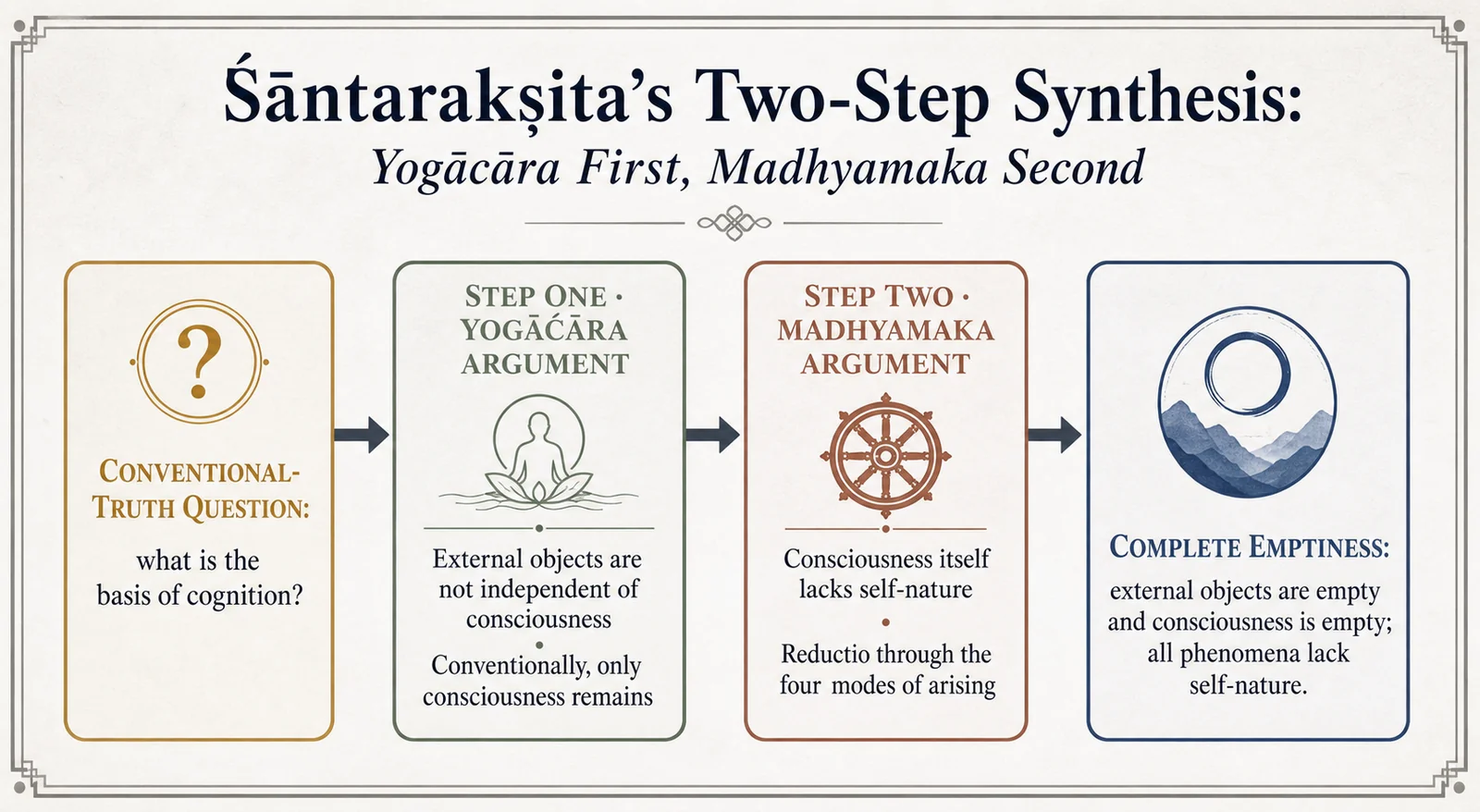
The root verses of the Madhyamakālaṃkāra propose a concise program: first use consciousness-only arguments to deny the real existence of external objects; then use Madhyamaka arguments to deny the real existence of consciousness itself; finally arrive at thoroughgoing emptiness. Section 6.5 introduced these two steps; here we develop their internal logic.
Step One: Consciousness-Only Denies External Objects
Śāntarakṣita accepts the central claim of consciousness-only that external objects are not entities existing independently of consciousness. The argument relies upon the Dignāga–Dharmakīrti framework: cognition can encounter only the “image aspect,” the appearance manifested by consciousness. If an external object is real independently of consciousness, how cognition could cross the gulf between subject and object becomes inexplicable. Conventionally, therefore, only consciousness and its manifestations exist, not independent external objects.
This is the crucial difference between Śāntarakṣita’s Yogācāra-Madhyamaka and Bhāvaviveka’s Sautrāntika-Madhyamaka. Bhāvaviveka accepts real external objects conventionally; Śāntarakṣita adopts the consciousness-only denial and accepts conventionally only manifestations of consciousness.1
Step Two: Madhyamaka Denies Consciousness
But if only consciousness exists conventionally, what status does it possess? The consciousness-only tradition, particularly Dharmapāla’s lineage, accepts that consciousness is “established by its own characteristic”—an other-dependent existent with some degree of reality. Śāntarakṣita introduces Madhyamaka reductio. If consciousness had intrinsic nature, analysis through the four alternatives of arising—arising from itself, another, both, or no cause—would show that it cannot be established. Consciousness likewise lacks intrinsic nature and is empty ultimately. Once consciousness too is empty, all dharmas are empty, which is the Madhyamaka conclusion.
Connection with Dharmakīrti’s Pramāṇa Theory
Śāntarakṣita is a Svātantrika Mādhyamika and accepts a limited conventional reality. Things can be “established through linguistic convention,” including manifestations of consciousness and their causal relations. This conventional establishment preserves particular characteristics in an epistemic sense sufficient to support the operation of Dharmakīrti-style inference on the conventional level.
Here the synthesis connects with Dharmakīrti. His epistemology (unique particulars and universals, causal efficacy, and so on) is positioned as a “valid conventional epistemology,” while Madhyamaka emptiness criticizes the metaphysical basis of that epistemology on the ultimate level. Each has its place, and neither replaces the other.
IV. The Compendium of Reality: A Systematic Refutation of Every Philosophical School
The purpose of the Tattvasaṃgraha is to refute the principal Indian philosophical traditions of the time, Brahmanical and Buddhist alike, and thereby display the superiority of the Madhyamaka–consciousness-only synthesis. Across twenty-six chapters, its principal targets include:2
| Target | Central claim | Śāntarakṣita’s criticism |
|---|---|---|
| The theory of brahman | Brahman is the single ultimate reality | If brahman is one, it cannot produce multiplicity; if it produces multiplicity, it changes and is no longer permanent |
| Sāṃkhya | Prakṛti evolves while puruṣa remains permanent | A permanent puruṣa cannot initiate evolution; if evolution is causeless, it is arbitrary |
| Vaiśeṣika | The six categories are real; inherence (samavāya) connects things | If inherence differs from the things it connects, a further inherence is needed to connect them, producing infinite regress |
| Mīmāṃsā | The sound of the Vedas is eternal; sacrifices bear results | Sound arises and ceases in dependence upon breath and cannot be eternal |
| Nyāya | Universals are real; there are four valid means of cognition | Universals do not exist independently, following Dignāga; the four means can be reduced to two |
| Jainism | Every standpoint is true (anekāntavāda) | If every standpoint is true, the standpoint “not every standpoint is true” must also be true, producing self-contradiction |
| Early Buddhist schools, chiefly Sarvāstivāda | Dharma-substances persist; atoms are real | The aggregation problem: atoms without size cannot combine to produce macroscopic matter |
The work’s historical importance lies in its panoramic documentation of eighth-century Indian philosophical controversy. It presents the positions, arguments, and methods of refutation of each school in detail.
V. Kamalaśīla: Life and Works
Kamalaśīla (c. 740–795), Śāntarakṣita’s most important disciple, largely continued his Yogācāra-Madhyamaka synthesis but made independent contributions to theories of practice and to the debate at Lhasa.
He followed Śāntarakṣita to Tibet and taught philosophy there. According to Tibetan sources, several assassins attacked and killed him around 795, supposedly in retaliation by the Chinese Chan side for losing the debate. This detail cannot be historically verified but reflects the intensity later tradition associated with the event.
Principal Works
| Work | Sanskrit | Content |
|---|---|---|
| Stages of Meditation, three books | Bhāvanākrama | A systematic exposition of the gradual path; the theoretical basis of the Lhasa debate |
| Illumination of the Middle Way | Madhyamakāloka | A systematic account of Svātantrika Madhyamaka with arguments more detailed than Śāntarakṣita’s |
| Extensive commentary on the Tattvasaṃgraha | Tattvasaṃgrahapañjikā | Commentary on the Compendium of Reality |
VI. The Stages of Meditation: The Epistemological Basis of the Gradual Path
The three books of the Bhāvanākrama form a complete philosophy of practice, beginning with compassion and bodhicitta, continuing through calm abiding (śamatha) and insight (vipaśyanā), and ending in direct vision of emptiness.3
The Three Wisdoms: Progression through Hearing, Reflection, and Cultivation
Kamalaśīla emphasizes that awakening to emptiness requires three stages of wisdom:
- Wisdom born of hearing (śrutamayī-prajñā): conceptual understanding of emptiness acquired through scriptures and transmission.
- Wisdom born of reflection (cintāmayī-prajñā): conceptual understanding is digested through thought and analysis, misunderstandings are removed, and certainty concerning emptiness is formed. Logical inference (anumāna) is the central instrument.
- Wisdom born of cultivation (bhāvanāmayī-prajñā): repeated meditative training transforms the certainty established through reflection into direct, nonconceptual present experience. This is the stage of yogic perception and the goal of all three wisdoms.
The sequence has a clear logic. Wisdom born of cultivation, nonconceptual direct experience, must rest upon correct conceptual understanding from hearing and reflection. Without correctly understanding “what emptiness is,” a “nonconceptual state” produced in meditation may be only a psychological blank rather than genuine vision of emptiness.
The Union of Calm Abiding and Insight
Kamalaśīla’s integration of calm abiding (śamatha) and insight (vipaśyanā) is another important theme of the Bhāvanākrama. Calm abiding is meditative stability, the mind’s ability to remain focused without distraction. Insight is wisdom seeing emptiness. Both must be cultivated together. Calm abiding without insight becomes absorbed in meditative tranquility without seeing truth. Insight without calm abiding lacks sufficient stability before its object and cannot deepen. Only their union (yuganaddha) constitutes the complete path.
VII. The Lhasa Debate: The Historical Arena of Sudden and Gradual Awakening
Background
Around 792–794 (the exact dates remain disputed), the Tibetan king Trisong Detsen sponsored a debate near Samye Monastery between Indian Buddhist theoreticians led by Kamalaśīla and Chinese Chan monks led by Moheyan, or Hvashang Mahāyāna. The subject was the relative superiority of two paths of practice.
The Two Positions
The Chinese Chan position—Moheyan: practice requires the complete abandonment of all conceptual activity. Whether wholesome or unwholesome, whether analyzing emptiness or accumulating merit, every conditioned fabrication must be relinquished. The mind should rest in a state without discrimination or thought. That itself is liberation; gradual accumulation is unnecessary.4
The position has an internal philosophical logic. If original awakened nature is already present, every effortful fabrication (including positive effort) reinforces the illusion that “a self must perform some work” and so becomes an obstruction. Only complete release allows original purity to be recognized.
The Indian gradualist position—Kamalaśīla: his central objection directly targets that logic. If “completely abandoning all discrimination” means stopping every mental activity, it produces only a blank meditative state—a neutral condition without thought—not awakening to emptiness. Seeing emptiness requires a correct understanding of what emptiness is, and that understanding must be established progressively through hearing, reflection, and cultivation. To abandon all conceptual activity and “awaken” without first acquiring correct conceptual understanding is to build a house without foundations.3
More concretely, thought-free absorption by itself, a level of śamatha, does not see not-self or emptiness. Only correct insight into not-self and emptiness upon the foundation of calm abiding brings liberation. Equating calm abiding with liberation confuses stable meditative resting with wisdom’s vision.
The Outcome and Its Historical Problems
According to Tibetan sources, Trisong Detsen declared Kamalaśīla’s gradualist position victorious, ordered Moheyan to leave Tibet, established the Indian gradual path as Tibetan orthodoxy, and systematically excluded Chinese Chan influence.4
Historians, however, make several important reservations.
First, Chinese sources, documents discovered at Dunhuang, differ significantly from Tibetan accounts. They do not record Moheyan’s “defeat” and present his position as entirely reasonable. The narrated “outcome” may thus reflect later Tibetan Buddhist views to a considerable degree rather than an objective historical record.
Second, the form of the “debate” is unclear. Some scholars believe it was more like a series of informal discussions than a formal contest. The story that “the Indian side won” may have been constructed afterward to serve the establishment of Tibetan Buddhist orthodoxy.4
Third, Moheyan’s own position was more complex than “abandon all conditioned activity.” He possessed a complete textual corpus that differs from the image presented in later Tibetan narratives.
This book’s position is that the Lhasa debate was a real historical event, but its scale, form, and result were substantially shaped by later construction. The philosophical controversy (gradual cultivation against sudden awakening, conceptual analysis against immediate experience) was real. Tibetan Buddhism’s choice of the Indian gradual path was real. But the story of “a formal debate in which India won and the Chinese side was expelled” has limited historical credibility.
VIII. The Costs and Criticisms of the Synthetic System
Śāntarakṣita and Kamalaśīla’s synthesis was a grand integration in philosophical history, but it introduced several unresolved problems. Section 6.5 noted them from another angle; here we view them internally.
The cost of demoting consciousness-only: Śāntarakṣita positions consciousness-only as an “epistemological tool on the conventional level,” while Madhyamaka becomes the ultimate metaphysical position. From the consciousness-only standpoint, the theory of three natures already includes an account of emptiness through the three absences of nature and does not need Madhyamaka to “negate it again.”
The residue of conventional particular characteristics: as a Svātantrika, Śāntarakṣita accepts particular characteristics within linguistic convention. Candrakīrti’s Prāsaṅgika regards even this concession as realist residue. Once particular characteristics are accepted conventionally, things retain some inherent feature beyond linguistic agreement, as discussed in 5.4 and 5.5. This became a principal reason later Geluk classification ranked Prāsaṅgika above Svātantrika.
Where practice gains purchase after the two steps: once external objects and consciousness have both been emptied, upon what can a practitioner act? Kamalaśīla’s Stages of Meditation supplies an operative answer (the three wisdoms and the union of calm abiding and insight), but the metaphysical question remains open: beneath thoroughgoing emptiness, what is the subject of practice?
IX. Historical Influence
In India
Śāntarakṣita and Kamalaśīla stood among the leading figures of the Nālandā–Vikramaśīla tradition in the eighth century. The Tattvasaṃgraha is an invaluable panorama of philosophical debate in their age. Their synthetic system was more widely transmitted in India than Candrakīrti’s lineage; at least in the eighth century, their approach was mainstream at Nālandā, while Candrakīrti’s Prāsaṅgika was not yet dominant.
In Tibet
Their influence was most profound in Tibet. Śāntarakṣita’s Ornament of the Middle Way became required reading in Madhyamaka study. Kamalaśīla’s three Stages of Meditation established Tibetan philosophy of practice. The Samye Monastery they founded was Tibet’s first formal Buddhist monastery and marked the official beginning of indigenous Tibetan Buddhist transmission.
After the Lhasa debate, the Indian gradual path became the official Tibetan position, while Chinese Chan influence was suppressed. The consequences of this choice continued throughout Tibetan Buddhist history and formed part of the background for Tsongkhapa’s Geluk reform, discussed in Part XI.
Tsongkhapa ultimately surpassed Śāntarakṣita in doctrinal classification: he ranked Candrakīrti’s Prāsaṅgika as the highest view and placed Śāntarakṣita’s Svātantrika Yogācāra-Madhyamaka below it. Yet this very act of surpassing took place through dialogue with the philosophical framework established by Śāntarakṣita. Without his foundation, Geluk classification would have lacked its concrete object of criticism.
References
References
-
James Blumenthal. The Ornament of the Middle Way: A Study of the Madhyamaka Thought of Śāntarakṣita. Ithaca: Snow Lion, 2004 (a detailed study of the Madhyamakālaṃkāra, its philosophical structure, and Tibetan influence). ↩↩
-
Ganganatha Jha (trans.). The Tattvasaṃgraha of Śāntarakṣita, with the Commentary of Kamalaśīla. 2 vols. Baroda: Oriental Institute, 1937–1939 (the standard English translation used in modern scholarship). ↩↩
-
Kamalaśīla. Bhāvanākrama. See Tucci (ed.), Minor Buddhist Texts. Rome: IsMEO, 1958; and Geshe Lhundup Sopa and Jeffrey Hopkins, Practice and Theory of Tibetan Buddhism. New York: Grove Press, 1976 (including analyses and excerpts in English translation). ↩↩
-
Luis O. Gómez. “Indian Materials on the Doctrine of Sudden Enlightenment.” In Early Ch'an in China and Tibet, eds. Lai and Lancaster. Berkeley: Asian Humanities Press, 1983 (a comparative analysis of Chinese and Tibetan sources on the Lhasa debate and an important historical study). ↩↩↩