Chapter Four: The Rise of Esoteric Buddhism and Vajrayāna
Madhyamaka, consciousness-only, tathāgatagarbha, and pramāṇa theory all developed at the philosophical level. Beginning around the fifth century, Indian Buddhism underwent another large-scale evolution: the rise of Esoteric Buddhism, or Vajrayāna. Its center was no longer philosophical debate but a fundamental transformation in forms of practice. It brought mantras, maṇḍalas, rituals, deity visualization, and guru lineages into the heart of Buddhism and claimed to offer a more rapid and effective path to liberation than the exoteric path of the perfections.
This was one of the most controversial developments in Indian Buddhist history. Was Vajrayāna a natural extension of Mahāyāna or a substantive paradigm shift? How deep was its relationship with Hindu traditions, especially Śaivism? Was it an innovation in liberation or a compromise with popular religious needs? This chapter traces its history, central concepts, and philosophical position. This book states its own judgments on those controversies at the ends of the relevant sections.
I. Historical Trajectory: From Dhāraṇī to Vajrayāna
Traces of Incantation in Early Buddhism
Esoteric Buddhism did not appear from nowhere. Early Buddhist literature already contains traces of the dhāraṇī, a protective incantation used to safeguard practitioners, aid retention of the teaching, or ward off malevolent beings. Such dhāraṇīs were not initially central practices but auxiliary ritual instruments, resembling incantatory therapies in early Indian medicine.
From about the third century, their status increased. Mahāyāna scriptures began to connect incantations directly with the vows and supernatural powers of buddhas and bodhisattvas; maṇḍala diagrams appeared; and mudrā gestures were systematized.
The Relationship with Hindu Tantra
At the same time, Hindu traditions, especially Śaivism, developed an extremely similar religious form in Śaiva Tantra. It too employed mantras, maṇḍalas, ritual, guru lineage, and deity visualization. The degree of resemblance has produced a long dispute in Indian religious history. Did Buddhist tantra borrow from Hindu tantra, did both derive from a common predecessor, or did influence flow in both directions?1
Current scholarship tends to find substantial influence from Hindu tantra, particularly transgressive Kāpālika-style Śaivism, upon Buddhist esotericism, with clear signs of borrowing in some texts and practices. Earlier parallels for certain wrathful deities and images of skulls and cremation grounds appear in Śaiva sources. Yet influence was not one-way. Buddhist tantra possessed its own distinct Buddhist philosophical framework (emptiness, bodhicitta, and a theory of liberation), and did not simply transfer Hindu theology wholesale.
This book’s position is that Vajrayāna was genuinely influenced by Indian popular religion and Śaiva esotericism, while also being an internal extension of Mahāyāna practice. It carried the bodhisattva path’s “skillful means” to an extreme, using every available resource (including sensory experience and emotional energy) as material for practice. Both forces were present; neither alone gives a complete explanation.
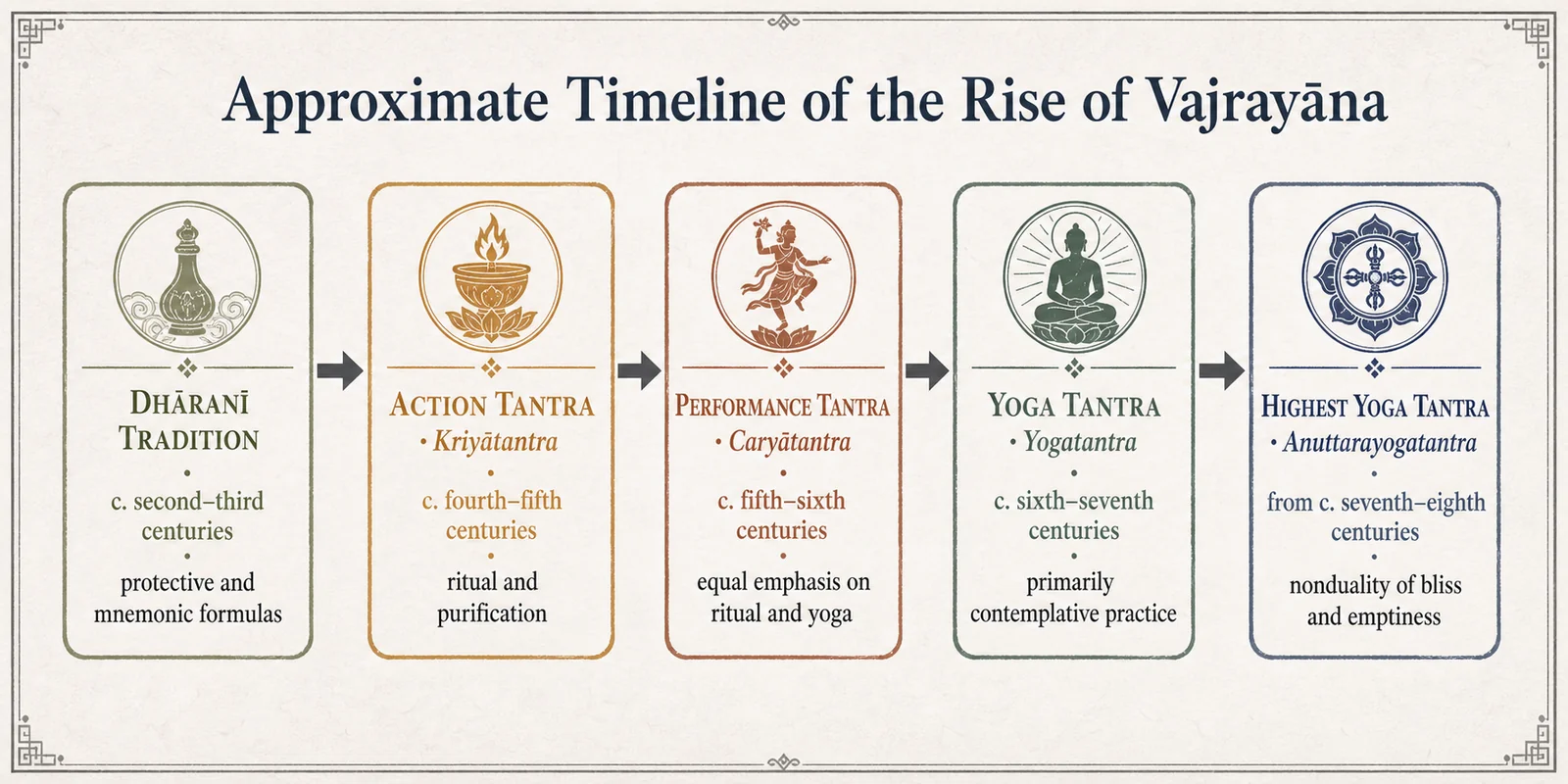
An Approximate Timeline of the Rise
II. Names and Classifications
Esoteric Buddhism has several parallel names, each emphasizing a different aspect:
| Name | Sanskrit | Meaning | Emphasis |
|---|---|---|---|
| Vajra Vehicle | Vajrayāna | The vehicle of the vajra | Vajra symbolizes the indestructibility of emptiness and the sharpness of wisdom |
| Secret Vehicle | Guhyayāna | The vehicle of secrecy | Teachings transmitted secretly and received only after initiation |
| Mantra Vehicle | Mantrayāna | The vehicle of incantation | Mantra as a central instrument of practice |
| Tantra Vehicle | Tantrayāna | The vehicle of tantra | Tantra literally means “weave” or “system,” referring to a complete system of practice |
The meaning of “secret” (guhya) deserves separate explanation. Secrecy concerns not only content but epistemology. Esoteric teachings are genuinely opened only through formal initiation (abhiṣeka) by a lineage-holding guru or vajra master. Without initiation, reading a text does not confer real understanding or authorization to practice its essentials.
Vajrayāna is ordinarily positioned as a branch within Mahāyāna rather than an independent third vehicle. Its foundation remains Mahāyāna bodhicitta and the view of emptiness, while its methods are distinctive. A standard Tibetan formulation is: Prāsaṅgika Madhyamaka as the view, the exoteric path of the perfections as the basis, and esoteric Vajrayāna as the path.
III. Four Classes of Tantra: From Action Tantra to Highest Yoga Tantra
Tibetan Buddhism, especially the Geluk school, classically divides tantra into four classes:2
1. Action Tantra (Kriyātantra)
The earliest class of tantric texts appeared around the fourth century. Practice centers on external ritual purification: bathing, dietary purity, offerings, and visualization of a deity as an external object of devotion whom the practitioner serves like a subordinate. The practitioner’s relation to the deity is “master and servant.”
2. Performance Tantra (Caryātantra)
External ritual and internal yoga receive equal emphasis, and the practitioner’s relation to the deity becomes one of “friendship.” An important text is the Mahāvairocana Sūtra, centered on Mahāvairocana Buddha and foundational to Chinese Esoteric Buddhism.
3. Yoga Tantra (Yogatantra)
The center shifts from external ritual toward internal yoga. Practitioners visualize themselves as the deity rather than merely venerating an external deity; the relation becomes one of identity. The Vajraśekhara is an important text.
4. Highest Yoga Tantra (Anuttarayogatantra)
This class appeared latest, around the seventh and eighth centuries, and is the most controversial. Practitioners directly identify themselves as the deity. Sexual imagery or practice is widely used as a symbol or method for uniting bliss (ānanda) and emptiness (śūnyatā). In certain left-handed tantras (vāmācāra), convention-breaking actions are used pedagogically to dismantle habitual attachment.
Highest Yoga Tantra is divided into father tantras emphasizing method (upāya), such as the Guhyasamāja; mother tantras emphasizing wisdom (prajñā), such as the Hevajra; and nondual tantras such as the Kālacakra.
Its central technique is the “two stages.” In the generation stage (utpattikrama), practitioners visualize the deity’s form and maṇḍala in detail, establishing a pure basis. In the completion stage (sampannakrama), visualization is internalized and practice operates directly upon the subtle body’s channels (nāḍī), winds (prāṇa), and drops (bindu). This subtle yoga culminates in the union of illusory body (māyādeha) and luminosity (prabhāsvara).
| Class | Approximate period | Emphasis in practice | Representative texts |
|---|---|---|---|
| Action Tantra | Fourth–fifth century | External ritual and purification | Susiddhikara Sūtra |
| Performance Tantra | Fifth–sixth century | Equal emphasis on ritual and inner yoga | Mahāvairocana Sūtra |
| Yoga Tantra | Sixth–seventh century | Inner visualization and identity with the deity | Vajraśekhara |
| Highest Yoga Tantra | Seventh–ninth century | Nonduality of bliss and emptiness; channels, winds, and drops | Guhyasamāja, Hevajra, and Kālacakra |
IV. Central Concepts and Practices
Deity Yoga
The central technique of esoteric practice is visualizing oneself as the chosen deity (iṣṭadevatā). Practitioners no longer look upward toward an external buddha; in meditation, they progressively identify their own body, speech, and mind with the deity’s body, speech, and mind, practicing in the mode “I am the deity.”
The philosophical basis is that every living being possesses tathāgatagarbha or buddha-nature and is a potential buddha. Deity yoga treats this potential buddha-nature as an actual buddha, taking the fruition, buddhahood, as the starting point of practice instead of accumulating slowly from an ordinary person’s self-identification. This is the logic behind tantra’s claim to be a “rapid path.”2
Maṇḍala and Initiation (Abhiṣeka)
A maṇḍala is the geometric representation of a deity’s palace or cosmic order and the symbolic establishment of a space of practice. Initiation is Vajrayāna’s most important institutional element. Through a guru’s initiation ceremony, practitioners formally enter the lineage of a particular deity or practice and receive authorization to perform it. Initiation signifies the formal transmission to a disciple of the power of practice accumulated within the guru’s lineage. This material cannot be self-taught but must pass through a living vajra master (vajrācārya).
Highest Yoga Tantra employs four progressively deeper initiations (vase, secret, wisdom, and word), which open successive levels of practice.
The Union of Bliss and Emptiness
Highest Yoga Tantra’s most controversial idea is the use of the union of bliss (ānanda) and emptiness (śūnyatā) as either a symbol or a path to realization.
On the symbolic level, yab-yum images of a male and female figure in union represent the conjunction of method (upāya) and wisdom (prajñā). The male symbolizes method or bodhicitta; the female symbolizes emptiness or wisdom. Their union visually expresses the perfected condition of awakening.
On the level of actual practice, especially in certain left-handed tantras, this includes literal sexual yoga: intense sexual bliss is united with direct vision of emptiness, and the strength of bliss stabilizes and deepens cognition of emptiness. Such practices historically existed, but most lineages restricted them to a small number of specially qualified practitioners or interpreted them as visualization rather than physical conduct.3
The Three Secrets: Body, Speech, and Mind
The simultaneous performance of mudrā (the secret of body), mantra (the secret of speech), and visualization (the secret of mind) is the basic structure of esoteric practice. Mantra is believed directly to embody the sound-energy of the deity’s speech, so recitation itself possesses power. Mudrā connects to a deity’s particular qualities or intention, while visualization identifies the practitioner’s mind with the deity’s mind.
V. Philosophical Integration: Esotericism, Madhyamaka, and Consciousness-Only
Vajrayāna does not claim to be an independent philosophy but adds methods of practice upon the basis of exoteric philosophy. The standard formulation is: Madhyamaka as the view, esoteric methods as conduct.
The Central Place of the View of Emptiness
While visualizing oneself as a deity, practitioners know that the “deity” is empty. Its form is a dependently arisen appearance; no intrinsically real deity exists over there. The “deity arising within emptiness” (a manifestation of emptiness) is the philosophical basis of tantric practice. Upon emptiness, the deity’s form appears like an illusion, while its emptiness is simultaneously known. This is the philosophical meaning of the nonduality of bliss and emptiness: appearance (the deity, maṇḍala, and experience of practice) and emptiness are present together; appearance itself is the manifestation of emptiness as it is.
The Tantric Use of the Three-Body Theory
Tantra applies Mahāyāna’s three-body theory (dharma-body, enjoyment body, and manifestation body) directly to the path. The dharma-body corresponds to recognition of luminosity (prabhāsvara) during the completion stage; the enjoyment body to perfected cultivation of the illusory body (māyādeha); and the manifestation body to compassionate activity benefiting living beings. The three bodies cease to be only descriptions of buddhahood and become waymarks directly operable in practice. Taking the result as the path is another argument for tantra’s “rapid path.”
VI. The Siddha Tradition
Alongside Nālandā’s scholastic tradition, Indian esoteric Buddhism had a lineage of siddhas (literally “accomplished ones”) who operated at the margins of ordinary society. The legendary eighty-four mahāsiddhas (caturaśīti-siddha) include blacksmiths, hunters, sex workers, kings, and beggars. All were said to attain awakening through distinctive tantric methods, sometimes highly dramatic and convention-breaking.4
The tradition embodies tantra’s philosophy that “skillful means is everywhere.” Opportunities for liberation can appear in any form of life and are not restricted to monastic practice or scholastic philosophy. Some siddha songs of realization (dohā) explicitly mock academic philosophical debate and value immediate present experience of awakening over every conceptual discussion.
Important Figures
- Saraha (c. eighth century): a founder of vajra songs (dohā). Tradition describes him as a former Nālandā scholar who later pursued lay tantric practice. His songs are among the most important sources of the Tibetan Mahāmudrā tradition.
- Tilopa (988–1069): an Indian progenitor of the Kagyü lineage, said to have received teachings directly from Vajradhara.
- Nāropa (1016–1100): Tilopa’s disciple, formerly a famous Nālandā scholar who left the academy to practice under Tilopa. His “Six Dharmas of Nāropa” (inner heat, illusory body, dream yoga, luminosity, transference of consciousness, and the intermediate state) form a central Kagyü tantric transmission. Marpa carried teachings from Nāropa to Tibet, directly founding the Tibetan Kagyü lineage.
VII. The Transmission of Vajrayāna
To Tibet: Śāntarakṣita and Padmasambhava jointly established Tibetan Buddhism’s esoteric foundation. Padmasambhava is regarded as the most important figure in transmitting tantra to Tibet and as a progenitor of the Nyingma school. After Langdarma’s ninth-century suppression, esoteric transmission was interrupted and then systematically renewed during the “later dissemination” of the tenth and eleventh centuries through Rinchen Zangpo’s translations and Atiśa’s arrival in Tibet.
To China: esotericism entered Tang China chiefly through three Indian masters: Śubhakarasiṃha (637–735), translator of the Mahāvairocana Sūtra; Vajrabodhi (671–741), transmitter of Yoga Tantra; and Amoghavajra (705–774), a prolific translator with enormous influence at the Tang court. Tang esotericism, associated with the “Three Great Masters of the Kaiyuan Era,” was prominent at court, but largely ceased as an independent tradition after the Huichang persecution of 845. Its influence survived in fragmentary form throughout later Chinese Buddhism.
To Japan: Kūkai (774–835), posthumously Kōbō Daishi, brought esoteric teachings from Tang China and founded Shingon. Saichō’s (767–822) Tendai school also incorporated esoteric elements. Japanese esotericism, Tōmitsu and Taimitsu, retains systematic lineages today.
VIII. This Book’s Position
Vajrayāna represents a genuine expansion of the paradigm, not simply an accumulation of skillful means. It incorporates sensory experience, especially bliss, into the material of practice; makes identification with a deity rather than worship of one a central technique; and engages body, speech, and mind as a whole rather than relying solely upon intellectual understanding. These are not simple continuations of the early Buddhist path but fundamental expansions in the theory of practice.
The boundary between Vajrayāna and Hindu tantra is genuinely indistinct. Some tantric texts, especially transgressive ones, closely resemble Śaiva parallels in deities, imagery, and practice. “Internal Mahāyāna development” alone cannot explain them. This historical fact should be acknowledged directly.
Vajrayāna possesses a philosophical foundation in emptiness and bodhicitta, and this foundation was not intended as ornament. In strict lineages, tantric practice presupposes a firm Madhyamaka view and bodhicitta. Deity yoga operates upon emptiness and need not accept the deity as a real existent or practice as the worship of a god. Historically, however, this prerequisite has often been omitted or minimized, and tantric practice can easily degenerate into substantive deity worship. This is a persistent danger within esoteric traditions, explicitly criticized by many of their own theoreticians.
Claims of a “rapid path” require caution. Vajrayāna produced practitioners judged accomplished by its own standards, but whether “buddhahood in one lifetime” is a universally valid promise is a religious claim requiring empirical verification, on which this book renders no verdict. It notes only that historically the claim produced both genuine achievements in practice and extensive abuse and illusion.
References
References
-
Alexis Sanderson. “Śaivism and the Tantric Traditions.” In The World's Religions, ed. S. Sutherland et al. London: Routledge, 1988 (an authoritative study of the relationship between Śaiva and Buddhist tantra; Sanderson argues that Buddhist tantra borrowed extensively from Śaiva traditions). ↩
-
David Snellgrove. Indo-Tibetan Buddhism: Indian Buddhists and Their Tibetan Successors. Boston: Shambhala, 1987 (a standard English overview of the four tantra classes and the history of esoteric Buddhism). ↩↩
-
Christian K. Wedemeyer. Making Sense of Tantric Buddhism: History, Semiology, and Transgression in the Indian Traditions. New York: Columbia University Press, 2013 (a historical and hermeneutical study of transgression in tantra that challenges misunderstandings based on literal practice). ↩
-
Keith Dowman. Masters of Mahamudra: Songs and Histories of the Eighty-Four Buddhist Siddhas. Albany: SUNY Press, 1985 (English translations of stories and songs of the eighty-four mahāsiddhas). ↩