Chapter Five: The Debate between Consciousness-Only and Madhyamaka
Parts V and VI have presented the philosophical systems of Madhyamaka and consciousness-only from within. This chapter places them together and sets out their dispute directly. It was the longest-running and philosophically deepest internal division in the history of Indian Mahāyāna thought. At its center lies a question still contested today: after a thorough analysis of emptiness, can “the other-dependent flow of consciousness” retain a reality different from “the fabrication of the imagined nature”?
I. The Origins of the Debate
Madhyamaka and consciousness-only share a common source. Both are Mahāyāna traditions, accept Prajñāpāramitā emptiness, and criticize the Abhidharma claim that things are substantially real through intrinsic nature. In this sense they were not entirely alien adversaries: they departed from the same ground and took two different roads.
Section 6.1 identified the point of divergence. Having said that “everything is empty,” Madhyamaka essentially stopped at a negative formulation. Consciousness-only regarded this stopping point as insufficient. Emptiness dismantled the old ontology, but it did not tell practitioners how experience actually occurs, how consciousness operates, or how afflictions accumulate and are purified. The intervention of consciousness-only was meant to supply this positive epistemology and theory of practice while retaining emptiness as its premise.
From Bhāvaviveka onward, the Madhyamaka response remained that consciousness-only had covertly introduced a new realism while supplying that theory. It replaced external objects with consciousness, moving real existence from one side to the other without curing the underlying illness of attachment to intrinsic nature.
The debate between the two schools can be arranged along the following approximate timeline:
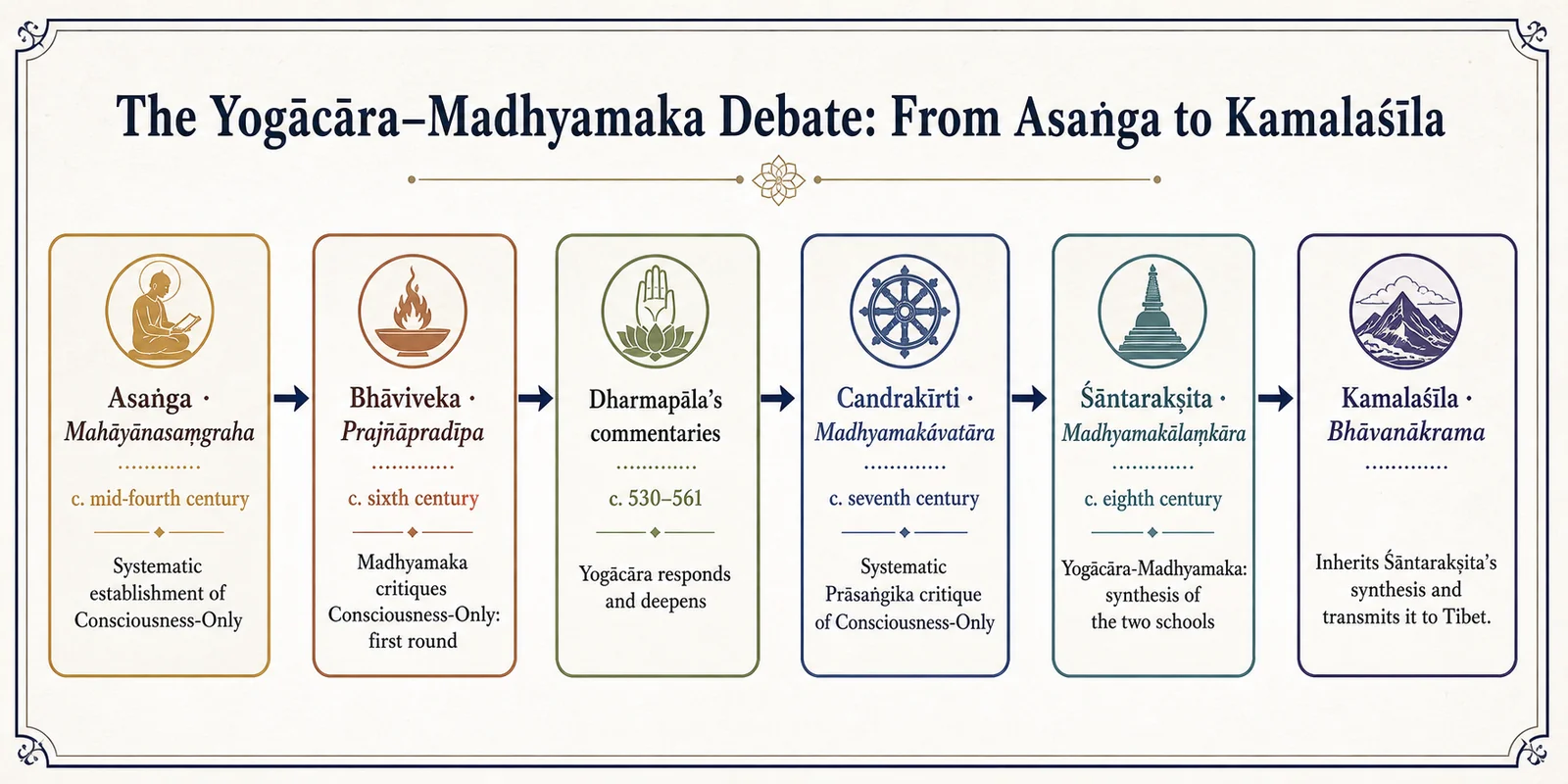
II. Bhāvaviveka’s Critique and the Two Levels of the Dispute
Historically, the first Madhyamaka thinker to mount a systematic critique of consciousness-only was Bhāvaviveka (c. sixth century), not Candrakīrti. In the Prajñāpradīpa and Madhyamakahṛdaya, he directly criticized the consciousness-only position of Asaṅga’s lineage. These works preserve the earliest documented confrontation between the two schools.1 The Karatalaratna, translated by Xuanzang, preserves a fuller side-by-side reading. Each of its two fascicles records a passage introduced as “the masters of the Yogācāra have this to say,” first transcribing at length a statement of the position of that lineage and then answering it sentence by sentence, so that the words of the consciousness-only side survive within a book written from the Madhyamaka side.2
The two fascicles do not dispute the same thing, and that division has to be set up first. Fascicle one disputes the “existence” of the other-dependent; fascicle two disputes the real existence of suchness. What the consciousness-only side defends in the two places is not the same: in the first it is a functional position, in the second a real existent.
Fascicle One: The Dispute over the Other-Dependent. The statement of the consciousness-only side proceeds in five steps. The first is annexation: it says that the Madhyamaka formula “what arises through conditions lacks nature and is therefore empty” accords with its own doctrine, so that “this then completes the meaning of the Yogācāra masters and agrees with correct principle.” The second establishes the formula of the remainder: “that by which it is empty is indeed nonexistent; that on account of which it is empty is indeed existent.” The third matches “that” and “this” to the imagined nature and the other-dependent respectively. The fourth states the fear of annihilation: if the thing that bears the emptiness is itself emptied away, emptiness has nowhere to rest, and “if this were nonexistent, it would be annihilation.” The fifth closes with a warning: to say that the other-dependent too has nothing at all is to fall of oneself into a deep pit of error.
Bhāvaviveka answers along two lines. The first is a dilemma. If the other-dependent is asserted to exist conventionally, then “what you establish is established already,” since the thesis is one his own side has long granted. If it is asserted to exist ultimately, then “there is no example sharing the property,” since at the ultimate level no commonly accepted existent can be found to serve as the example of an inference, and the inference cannot be built. The second line is a positive concession: “If the intrinsic nature of the other-dependent is said to be existent in this sense, then it is well said, for such an intrinsic nature I too admit.” The fear of annihilation accordingly falls away. Conventional intrinsic nature having been granted, provisional dharmas have their support, and nothing whatever has been emptied away.
The reading of this level follows from that. The dispute of fascicle one is for the most part a confusion of levels. What the consciousness-only side is actually holding is the functional position of “a place where emptiness may rest,” and Bhāvaviveka grants that functional position, conventional existence, and the support of provisional dharmas in full; the consciousness-only side still refuses, on the ground that conventional “existence” is not firm enough. Firmness is a question of level, not a question of existence and nonexistence. The word “exists” does not fall on the same level for the two parties, and the point at issue narrows accordingly.
Fascicle Two: The Dispute over Suchness. This level carries a different weight. The consciousness-only side first yields a step and then holds one position: “Upon the ultimate there is no further ultimate; suchness is the ultimate of all dharmas, and therefore to speak of suchness as empty with respect to the ultimate accords with principle. But to say that suchness is not really existent does not accord with principle.” What is yielded is that suchness may be called empty; what is held is that the sentence “suchness is not really existent” cannot stand. Bhāvaviveka answers along four lines: two inferences (“that suchness is not the true ultimate, because it is an object of cognition, like form and the rest”), four scriptural citations of the type “the eye of wisdom sees nothing at all,” one reduction to absurdity (there is no silk within silk, and even a shepherd knows as much, so that shepherds would all be seers of the truth), and last the objection from the non-Buddhist self.
The objection from the non-Buddhist self is the heaviest blow struck in this passage. Bhāvaviveka’s own words are: “If suchness is said to be really existent although apart from speech, then the self of the non-Buddhists, under a difference of name and conception, is what is being called suchness.” The self the non-Buddhists posit is likewise said to be really existent, all-pervading, permanent, and apart from discrimination; it is likewise said to lie beyond the range of language and to go uncognized by discriminating awareness. On this basis Bhāvaviveka judges that no difference between the two can be stated. His own positive claim follows: suchness “is solely the perpetual cessation of all discrimination; it is not a real existent, and it is neither apart nor nonexistent.”2
What the objection from the non-Buddhist self fastens upon is the form “really existent although apart from speech.” Ineffability confers no exemption here: to call a thing really existent while placing it apart from all discrimination merely moves the commitment outside language and does not remove the commitment itself. Here the two parties meet head-on within one and the same set of coordinates, and this is the single place where Bhāvaviveka and consciousness-only strike against each other on the same level.
The quality of the transcript should be marked as well. The passage in fascicle one agrees in its wording with the Cheng weishi lun and can serve as testimony that both parties acknowledge. The passage in fascicle two comes from an adversary’s transcription and is out of tune with the relational terms the treatises themselves assign to the perfected nature, of the type “neither different nor not different” and “neither apart nor nonexistent”; it is registered here only as evidence that such a reading did exist within the consciousness-only lineage, and not as that school’s settled doctrine.
Bhāvaviveka has a further criticism, this one methodological. Asaṅga’s refutations of external-object theorists are not rigorously constructed and do not use the three-member form of argument developed in Dignāga’s logic. What Asaṅga calls a “refutation of external objects” merely offers an alternative explanation without formally proving that external objects do not exist. This agrees with the criticism added by this book at the end of the fourth section of 6.3.
One should note, however, that Bhāvaviveka himself takes the Svātantrika position on “particular characteristics conventionally.” He allows dharmas to have “particular characteristics within ordinary convention.” He therefore does not completely reject all “limited reality”; he insists only that this limited reality should not be located on the side of consciousness in the way Yogācāra does. The debate between Bhāvaviveka and consciousness-only thus has a subtle symmetry. Both accept some limited reality on the conventional level. Consciousness-only places its basis in consciousness, while Bhāvaviveka places it in the conventionally particular characteristics of dharmas. Candrakīrti regards both concessions as excessive: even the opening afforded by conventionally particular characteristics should never have been made.
III. Candrakīrti’s Systematic Attack
Candrakīrti’s (c. seventh century) critique of consciousness-only was presented in detail in the fourth section of 5.5. Here we will gather its principal points and add what was not developed there.
Candrakīrti makes three attacks, as discussed in 5.5. First, self-cognition (svasaṃvedana) is logically impossible: a knife cannot cut itself, and consciousness cannot cognize itself. Second, consciousness “established by its own characteristic” and external objects “established by their own characteristics” have exactly the same status under an analysis of emptiness; consciousness enjoys no exemption unavailable to external objects. Third, consciousness-only explains worldly common sense more circuitously than Madhyamaka and possesses no advantage in explanatory power.
Beyond these three attacks lies a still more fundamental criticism that deserves separate treatment here.
Candrakīrti’s Fundamental Criticism: Other-Dependent Consciousness Remains a Real Existent
Consciousness-only tries to reconnect the three natures with emptiness through the three absences of nature. It says that “the other-dependent is not the imagined; the other-dependent itself also lacks intrinsic nature, in the sense of absence of nature with respect to arising.” Candrakīrti regards this reconciliation as superficial. The crucial point is that consciousness-only continues to insist that “the other-dependent exists”—that “false discrimination exists.” Although it arises in dependence upon others and lacks intrinsic nature, it nevertheless exists in some fashion.
For Candrakīrti, that “exists in some fashion” is already the problem. The Prāsaṅgika Madhyamaka position is that even an “other-dependent existent,” if it has any ground of reality beyond linguistic and conventional practice, however thin or dependent that ground may be, retains some substantive anchor for consciousness. Candrakīrti defines conventional validity through what is commonly accepted in the world and requires no “existence of the other-dependent itself” to ground the conventional. Consciousness-only, by contrast, requires the other-dependent as the basis upon which the perfected (suchness) is disclosed. This function “as a basis” is precisely what Candrakīrti believes consciousness-only has failed to empty.3
Put more plainly, Candrakīrti requires the other-dependent to be established only within linguistic convention. Consciousness-only retains the other-dependent as an effective existent of some sort. Candrakīrti regards that retention as the residue of realism.
IV. The Consciousness-Only Position and Its Countercritique of Madhyamaka
Candrakīrti’s attack touches a genuine tension within the consciousness-only system, already noted at the end of 6.4. But consciousness-only did not accept the criticism in silence. From Asaṅga and Vasubandhu to Dharmapāla, its thinkers offered arguments in response to Madhyamaka.
Countercritique One: Madhyamaka “Emptiness” Cannot by Itself Support a System of Practice
The strongest consciousness-only countercritique is not a direct logical refutation but a broader philosophical judgment: a system that only dismantles and establishes nothing cannot provide operative coordinates for practice.
Madhyamaka says that everything is empty, conventionally established, and commonly accepted by the world. But when practitioners sit down and observe their own minds, they need to know: what is that which arises? What is operating? What is practice transforming? What does awakening see? The Madhyamaka framework cannot answer these questions. Its assurance that “the conventional continues to operate normally” is a general reassurance, not concrete guidance. Storehouse consciousness, manas, the three natures, and transformation of the basis provide practitioners with a map they can actually use. Whatever doubts may be raised about its metaphysical ground, functionally this map fills a gap left by Madhyamaka.
This countercritique does not say that “consciousness-only metaphysics is true.” It says that “Madhyamaka’s negative formulation is incomplete in its soteriological function.” This reveals a fundamental difference in the concerns of the two schools: Madhyamaka focuses on “not grasping,” while consciousness-only focuses on “how transformation occurs.”4
Countercritique Two: Self-Cognition Is Not Analogous to “External Cognition”
Candrakīrti criticizes self-cognition through the analogy that “a knife cannot cut itself.” Cognition is an outward relation directed toward another and cannot turn back upon itself. The consciousness-only reply is that this analogy begins on the wrong basis. A knife cutting itself is a physical relation and cannot serve as a model of conscious activity. The self-illumination of consciousness, its self-cognizing aspect, does not mean that “consciousness as one object cognizes consciousness as a second object.” It means that when consciousness is active, the activity is intrinsically manifest or known. Its existence is its being known, a nonrelational feature of experience itself.
More clearly, self-cognition resembles the immediacy of pain. When you are in pain, you know you are in pain. This “knowing” is not another cognition outside the pain that takes the pain as its object; it is the sentience of the pain itself. By self-cognition, consciousness-only seeks to describe this intrinsic luminosity of experience, not an external structure in which “a second consciousness cognizes the first.” Candrakīrti’s analogy of the “knife” imposes the schema of a physical relation upon the intrinsic luminosity of experience, and so mismatches its target.5
Whether this reply succeeds remains doubtful in this book’s judgment. If self-cognition describes “the sentience of experience itself,” it remains an open theoretical question whether it needs to be established as an independent “aspect.” Sthiramati’s rejection of an independent self-cognizing aspect says precisely that doing so is superfluous.
Countercritique Three: The “Existence” of the Other-Dependent Is Not the Existence of the Imagined
In response to Candrakīrti’s claim that “the other-dependent remains really existent,” consciousness-only distinguishes two kinds of “existence.” The “existence” projected by the imagined nature is the substantive existence of something independent, self-sufficient, and established by intrinsic nature. Consciousness-only fully agrees that nothing exists in that sense. The “existence” of the other-dependent means simply that “an activity arising through conditions is occurring.” Such existence does not refer to a fixed ground but to a flowing process that arises and ceases from moment to moment and has no fixed, unchanging substance.
Consciousness-only holds that Candrakīrti conflates these two senses of “existence,” treating “the other-dependent exists” as if it meant “the other-dependent has intrinsic nature.” This misunderstands the argument. “The other-dependent exists” means only that a process occurring in dependence upon conditions is present; the “exists” in this proposition carries no implication of being established by intrinsic nature.6
Candrakīrti’s reply is that as soon as one says “there is an other-dependent process over there,” no matter how strongly one emphasizes that it is “dependent,” one has already left some ground of reality beyond linguistic convention at that “over there.” Otherwise, what does the sentence “there is a process over there” mean? This, rather than a merely verbal difference, is the true point of disagreement.
V. The Dispute Divided into Levels
Drawing the arguments of both schools together, the point at issue has first to be divided into two levels; reckoning them as one turns disagreements belonging to different levels into a single dispute.
The first level: the “existence” of the other-dependent. What is disputed is whether, once the imagined has been denied, the other-dependent activity of consciousness possesses any ground of reality independent of linguistic convention.
The consciousness-only answer is that it does. Although the other-dependent lacks intrinsic nature, it exists in some fashion; it is the basis upon which the perfected is disclosed and the actual object transformed through practice. This “existence” is not the real existence projected by the imagined, but it remains a kind of dependent reality irreducible to linguistic convention.
On this level the two Madhyamaka thinkers do not answer alike. Bhāvaviveka’s reply is “such an intrinsic nature I too admit”: conventional intrinsic nature is something Madhyamaka grants in any case, the thesis being advanced is one his own side has long conceded, and the disagreement concerns only the level at which that intrinsic nature is placed; on Bhāvaviveka’s side, therefore, this level resolves for the most part into a confusion of levels. Candrakīrti’s is the reply that denies outright: the “existence” of the other-dependent is likewise established through linguistic convention, the sentence “there is an other-dependent process” has meaning only within the framework of what the world commonly accepts, and nothing whatever possesses an existence transcending conventional designation.
The second level: the “real existence” of suchness and the perfected nature. What is disputed is whether suchness is a notation or a real existent. On this level the consciousness-only side will not yield: “to say that suchness is not really existent does not accord with principle.” Bhāvaviveka’s reply is that suchness “is solely the perpetual cessation of all discrimination and is not a real existent,” and, by way of the objection from the non-Buddhist self, that the form “really existent although apart from speech” cannot be told apart from the self the non-Buddhists posit. Here the two parties strike against each other within one set of coordinates; Section II above has gone through the lines of argument one by one.
Once the levels are separated, the assessment adjusts accordingly. On the first level, Bhāvaviveka’s disagreement with consciousness-only is principally one of level, while Candrakīrti’s is substantive; the latter disagreement is finally a question about the “ground of conventional truth.” Either the efficacy of conventional truth rests upon an other-dependent existent, or it is supported solely by linguistic convention itself; consciousness-only takes the former, Candrakīrti the latter. On the second level, however the levels are drawn, the two parties must strike against each other, and this is the genuine head-on point at issue between Bhāvaviveka and consciousness-only.
This book’s judgment is that on the first level both answers are consistent within their respective systems and neither can logically overwhelm the other. Consciousness-only is justified in criticizing Madhyamaka for giving practice “nothing upon which to gain purchase”; Candrakīrti is justified in criticizing consciousness-only for retaining a residue of real existence. Pursued consistently, either path can form an internally coherent system, but neither can render a final verdict from within the other’s framework.
VI. The Limits of the Reconciliation through the Three Absences of Nature
Consciousness-only uses the three absences of nature to reconnect itself with emptiness (the fifth section of 6.4), attempting to show that “consciousness-only” and “everything is empty” are two formulations of one truth. The logic is ingenious, but we can now say more precisely why the reconciliation remains incomplete.
Its crucial step is “the other-dependent’s absence of nature with respect to arising”: the other-dependent possesses no intrinsic nature by which it “arises from itself”; it depends upon conditions. Both consciousness-only and Madhyamaka accept this proposition. Candrakīrti then asks: accepting that “the other-dependent has no independent power of origination” is not the same as accepting that “the other-dependent is itself established through linguistic convention.” There is a leap between the propositions:
Consciousness-only accepts that the other-dependent lacks independent intrinsic nature—absence of nature with respect to arising. It does not accept the further conclusion that the other-dependent itself is established by linguistic convention and possesses no ground of reality beyond convention.
Consciousness-only accepts that “the other-dependent lacks intrinsic nature” while retaining that “the other-dependent exists in some sense.” This “existence in some sense” is precisely the residue that reconciliation through the three absences cannot dissolve. The reconciliation explains “absence of intrinsic nature” without dissolving “existence”; Candrakīrti’s emptiness requires that neither possess independence.3
VII. An Attempted Synthesis: Yogācāra-Madhyamaka
Indian Buddhism did not stop at the opposition between the two schools. In the eighth century, Śāntarakṣita (c. 725–788) and his disciple Kamalaśīla proposed a synthetic philosophy commonly called “Yogācāra-Madhyamaka,” seeking to integrate the strengths of both.7
Śāntarakṣita’s Two-Step Synthesis
In the Madhyamakālaṃkāra, Śāntarakṣita presents a layered philosophical approach.
First, he uses consciousness-only epistemology to deny the independent existence of external objects. Following Dignāga and Dharmapāla, he argues that external objects are merely manifestations of consciousness and that no material entity exists independently of consciousness. This step is handled by consciousness-only.
Second, he uses Madhyamaka analysis of emptiness to deny the independent existence of consciousness itself. Following Nāgārjuna and Candrakīrti, he argues that consciousness likewise lacks intrinsic nature, arises dependently, and is established through linguistic convention; it cannot be the ground of any ultimate reality. This step is handled by Madhyamaka.
External objects are thus negated first (the contribution of consciousness-only), and consciousness is negated afterward—the contribution of Madhyamaka. The final conclusion of thoroughgoing emptiness is not that “consciousness is really existent” but that “all dharmas are empty: external objects are empty, and consciousness is empty as well.”7
This synthetic strategy has a clear advantage. It gives the epistemological argument of consciousness-only a place in practice, as the first step in dismantling the real existence of external objects, while Madhyamaka emptiness ensures that “consciousness too is empty” in the end and prevents consciousness-only from leaving a realist residue on the side of consciousness.
The strategy also has a price. It effectively demotes consciousness-only to an auxiliary stage on the path, the refutation of external objects, rather than treating it as the final philosophical position. Consciousness-only theorists need not accept this demotion. In their view, the three-natures theory already adequately shows that consciousness is other-dependent and lacks intrinsic nature; they have no need to borrow Madhyamaka emptiness to negate it once more. More fundamentally, after both steps have been completed and “other-dependent consciousness has been negated by the analysis of emptiness,” what does practice operate upon? This returns to the challenge faced by Madhyamaka on its own: beneath emptiness, where does practice gain purchase? Śāntarakṣita supplies a hierarchy of levels but does not completely dissolve the problem.
Śāntarakṣita’s Historical Influence
Śāntarakṣita and Kamalaśīla entered Tibet in the late eighth century and brought this Yogācāra-Madhyamaka system with them, profoundly shaping the philosophical foundations of Tibetan Buddhism. From then on, Tibetan Buddhist education in Madhyamaka developed through repeated comparisons between “Yogācāra-Madhyamaka” and the “Prāsaṅgika Madhyamaka” of Candrakīrti, whose relative ranks successive scholars continually debated. The Geluk thinker Tsongkhapa in the fourteenth and fifteenth centuries, in particular, championed Candrakīrti’s Prāsaṅgika as the highest view and discussed Śāntarakṣita’s synthetic approach in detail (see Part XI).
VIII. This Book’s Assessment
Candrakīrti’s criticism is powerful but not final.
Candrakīrti’s criticism of self-cognition reaches a weak point in the epistemological architecture of consciousness-only, but the consciousness-only response concerning the “intrinsic luminosity of experience” is not empty. Active versions of this debate remain in contemporary philosophy of mind, in discussions of the phenomenal and reflexive character of consciousness. Candrakīrti’s criticism that “the other-dependent remains really existent” exposes a substantive limitation in the reconciliation through the three absences of nature. Yet Candrakīrti’s own appeal to “what the world commonly accepts as the ground” also faces the question of why worldly convention itself is valid, as this book noted in the third section of 5.5. At their respective boundaries, both schools leave problems unresolved. The point at issue on Bhāvaviveka’s side is recorded fascicle by fascicle: the dispute of fascicle one resolves for the most part into a confusion of levels, and the dispute of fascicle two over the real existence of suchness is the one place where the two parties strike against each other on the same level.
Madhyamaka cannot replace the positive theory of consciousness-only.
What consciousness-only offered has genuine philosophical value. It provides a fine-grained description of the accumulation and purification of afflictions, a systematic analysis of mental states at each stage of practice, and an explanation through manas of “why the felt sense of self-grasping persists after one intellectually accepts not-self.” These correspond to phenomena genuinely observable in meditative practice. Madhyamaka’s “dismantling of grasping” and consciousness-only’s “transformation” are complementary at the level of practice, not simple substitutes.
Volume II will develop this point: consciousness-only genuinely touches a pressure point in Madhyamaka soteriology (how epistemological and philosophical emptiness actually loosens greed, aversion, and delusion), while the immensity and sophistication of the Yogācāra system produce a kind of doctrinal self-reference within the path of cultivation.
References
References
-
David Seyfort Ruegg. The Literature of the Madhyamaka School of Philosophy in India. Wiesbaden: Harrassowitz, 1981 (a collection and analysis of sources for Bhāvaviveka’s critique of consciousness-only). ↩
-
The Karatalaratna (T30, no. 1578, composed by Bhāvaviveka, translated by Xuanzang) records in each of its two fascicles a passage introduced as “the masters of the Yogācāra have this to say,” transcribing the statement of that lineage and answering it sentence by sentence. In fascicle one the consciousness-only side says: “That by which it is empty is indeed nonexistent; that on account of which it is empty is indeed existent,” and “if this were nonexistent, it would be annihilation.” Bhāvaviveka replies: “What you establish is established already”; “if you assert that this nature exists in the ultimate truth, there is no example sharing the property”; “if the intrinsic nature of the other-dependent is said to be existent in this sense, then it is well said, for such an intrinsic nature I too admit.” In fascicle two the consciousness-only side says: “Upon the ultimate there is no further ultimate … but to say that suchness is not really existent does not accord with principle.” Bhāvaviveka replies: “That suchness is not the true ultimate, because it is an object of cognition, like form and the rest”; “if suchness is said to be really existent although apart from speech, then the self of the non-Buddhists, under a difference of name and conception, is what is being called suchness”; “one should know that suchness is solely the perpetual cessation of all discrimination; it is not a real existent, and it is neither apart nor nonexistent.” For a sentence-by-sentence reading of the two fascicles, see the second division, Part 20, Chapter 7. ↩↩
-
Paul Williams. Mahāyāna Buddhism: The Doctrinal Foundations. 2nd ed. London: Routledge, 2009 (an overview of the Madhyamaka–consciousness-only debate, including problems with the reconciliation through the three absences of nature). ↩↩
-
Thomas A. Kochumuttom. A Buddhist Doctrine of Experience. Delhi: Motilal Banarsidass, 1982 (the trajectory of consciousness-only responses to Madhyamaka criticism). ↩
-
Georges Dreyfus. Recognizing Reality: Dharmakīrti's Philosophy and Its Tibetan Interpretations. Albany: SUNY Press, 1997 (the epistemological background to the debate over self-cognition). ↩
-
Stefan Anacker. Seven Works of Vasubandhu. Delhi: Motilal Banarsidass, 2002 (the consciousness-only position on whether the other-dependent possesses reality). ↩
-
James Blumenthal. The Ornament of the Middle Way: A Study of the Madhyamaka Thought of Śāntarakṣita. Ithaca: Snow Lion, 2004 (a detailed study of Śāntarakṣita’s Yogācāra-Madhyamaka). ↩↩