Chapter Two: Asaṅga—The Mahāyānasaṃgraha and Storehouse Consciousness
The previous chapter explained the origins and philosophical motivations of Yogācāra. This chapter turns to its central concept: storehouse consciousness (ālaya-vijñāna). Our principal source is Asaṅga’s Mahāyānasaṃgraha. It is not the longest Yogācāra treatise, but it is the clearest outline of the consciousness-only system as a whole. Its structure is economical, and it explains with unusual clarity both where each concept is introduced and why.
I. The Prehistory: Who Carries the Sautrāntika Seeds?
The introduction of storehouse consciousness follows a clear philosophical trajectory, extending from the early Buddhist problem of “continuity without a self” discussed in 1.5.
As Section 3.3 explained, the Sautrāntikas used “seeds” (bīja) to solve problems left by the Sarvāstivādins’ cumbersome machinery. When an action is performed, it “perfumes” (vāsanā) the mental continuum with a potential. That potential is transmitted through successive moments and, when the relevant conditions converge, matures into a result. This is a much more economical explanation, but it leaves one question unanswered: what carries the seeds?
The Sautrāntika answer is: the mental continuum (santāna). But this answer is incomplete, because it does not further explain what kind of existent a “mental continuum” is. Is it one of the six consciousnesses? Is it their sum? The first five consciousnesses are too coarse and are interrupted too frequently; the sixth, mental consciousness (mano-vijñāna), also ceases in deep meditative absorption. If seeds merely hang upon consciousnesses that can be interrupted, there seems to be no guarantee that they can be transmitted continuously across deep absorption or from one life to the next.
This is where Yogācāra takes over the problem: if seeds require a stable bearer, and if the practitioner requires a basis that extends through death and rebirth, then a consciousness deeper and more continuous than the first six is needed. That consciousness is ālaya-vijñāna.
II. Arguments for Introducing Storehouse Consciousness
At the outset of the Mahāyānasaṃgraha, Asaṅga recognizes that establishing storehouse consciousness requires an explanation of why it is necessary. He offers a number of arguments; this book selects the most important among them.1
Argument One: The Continuation of Life in the Attainment of Cessation
An arhat can enter the “attainment of cessation” (nirodha-samāpatti), a profound state of absorption in which all coarse and subtle mental activity (including all activity of the first six consciousnesses and of mental consciousness) temporarily ceases. A problem then arises: the person who has entered the attainment of cessation is not dead. The body retains warmth and vitality, and conscious activity can resume upon emergence from the attainment. If every consciousness has completely ceased during it, what sustains the living state of the body? And what “knows,” upon emergence, which conscious activities are to be restored and how the previous continuum is to be rejoined? The first six consciousnesses cannot answer these questions, since all of them have already ceased. There must be a deeper consciousness that does not entirely stop even in the attainment of cessation.2
This book has direct reservations about this argument. First, some traditional accounts claim that even basic vital functions temporarily stop in the attainment of cessation—that body temperature falls and breathing stops. This book does not accept such accounts and does not base its argument upon them. More fundamentally, the complete cessation of mental activity can be explained simply by saying that the many conditions sustaining the arising of consciousness are temporarily absent. Consciousness is likewise interrupted under general anesthesia, yet there is no need to posit a hidden level of consciousness that continues to operate while consciousness has stopped. When the requisite conditions are again present, consciousness naturally arises again and the continuum resumes. This is a complete phenomenological explanation; it does not require an underlying consciousness to span the entire interval and “reconnect” its two sides. To treat the attainment of cessation as proof that storehouse consciousness must exist is to convert a descriptive question (“How do phenomena unfold?”) into an ontological one—“What entity must support them from behind?” In this book’s judgment, that move shifts the argument away from phenomenology and toward ontology.
Argument Two: A Stable Bearer of Seeds
If seeds adhere only to the first six consciousnesses, a contradiction seems to follow: whenever those consciousnesses are interrupted (in deep sleep, coma, the attainment of cessation, or death), the seeds should be interrupted along with them, leaving no way to ensure the continuity of karmic results across those gaps. The transmission of karmic fruition from one life to another requires a storage basis deeper and more continuous than any presently active individual consciousness. This basis cannot be a material entity posited outside consciousness, since that would return to the old Sarvāstivāda path. It can only be a deeper level of consciousness itself.2
This book’s reservation here is similar to its reservation about the first argument. The claim that “seeds require a stable bearer that crosses interruptions” is itself an ontological premise: it presupposes that seeds must be “stored somewhere” during an interruption in order to arise again afterward. But this is not the only possible account. As the discussion following the fourth argument will show, the continuity of phenomena does not logically require an entity that continues to operate throughout the interval. Phenomena can arise when their conditions are again present after an interruption; no continuously existing bearer need carry them from one side of the gap to the other.
Argument Three: The Simultaneous Arising of Multiple Consciousnesses
Visual consciousness can see form at the same time that auditory consciousness hears sound. If mental consciousness, the sixth consciousness, is treated as the background running through all cognitive activity, while it can attend to only one class of object in any given moment, then what integrates the perceptions simultaneously produced by several senses? A foundational consciousness is needed that can coexist with several consciousnesses at once without being tied exclusively to any single object.
Argument Four: A Bearer of Karmic Ripening
“Ripening” (vipāka) refers to the fruition of karma: an action performed in this life and at this moment may mature into a result at a different time, even in a different life. A ripened result (being reborn as a certain kind of living being, for example, or undergoing a certain kind of pleasure or pain) appears as a condition of the psychophysical organism as a whole, rather than falling upon any one particular consciousness. A consciousness is therefore needed that can bear this comprehensive state of fruition and “distribute” it among the particular psychophysical faculties.1
At this point, this book proposes an alternative directly: the continuity of phenomena does not logically require the continuity of an entity. Two examples illustrate the point.
Example One: The Extinguishing and Rekindling of a Flame. Suppose a flame is suddenly extinguished in one place while a flame identical in shape ignites elsewhere at the same moment. Is the latter flame the former? This book’s position is: it both is and is not, just as the later life in Buddhist rebirth both is and is not the same person as the earlier one. Nothing requires us to suppose that some entity moved from the first place to the second. The “identity” between the two flames is a phenomenal continuity in a causal sense, not the physical displacement of an entity.
Example Two: The Teleportation Paradox. Suppose that technology can reproduce a person in one place while the original person remains intact elsewhere. Which one is the “original”? If the answer is that the one who remains in the original location is the original, change the procedure: replace that person’s particles one by one with new particles while transferring the original particles, also one by one, to another place for reassembly. Which is now the original? This is also a variation on the Ship of Theseus. If hundreds or thousands of identical versions are gradually produced and each has causal continuity with the preceding one, which is the original? These paradoxes reveal less an answer to a practical problem than the instability of the presupposition that identity must depend upon some continuously existing entity. Once that presupposition is abandoned, the causal continuity of phenomena (the seeds of the former arising in the latter when appropriate conditions obtain) is already a complete account of continuity. No storage entity need operate without interruption during the intervening blank.
More directly: it is entirely logically possible for seeds to arise when conditions are present, to lie dormant when conditions are absent, and even to arise again after an interruption. There is no need to require a “storehouse” that operates continuously throughout the interruption. Asaṅga answers the question “How can continuity be guaranteed?” by saying that “there must be a continuously operating foundational consciousness.” This gives an ontological answer to a phenomenological question. From the standpoint of early Buddhism, this is precisely the step about which one must be wary.
Nevertheless, Asaṅga’s conclusion from these arguments is that a still more fundamental consciousness must be posited in addition to the seventh: storehouse consciousness, the repository consciousness. It is the repository (ālaya) of seeds, the bearer of karmic ripening, and the basis of every other consciousness. This book presents Asaṅga’s arguments together with its reservations: the reasoning is internally coherent within the consciousness-only system, but from the outset it answers a phenomenological question within an ontological framework.
III. The Structure and Character of Storehouse Consciousness
Name and Meaning
Ālaya-vijñāna is transliterated in Chinese as aluoye shi and translated as “repository consciousness” or “storehouse consciousness.” “Repository” has three senses: that which stores (it can store every seed); that which is stored in (it is perfumed by the actions of the seven active consciousnesses and receives the seeds deposited within it); and that which is appropriated (manas, the seventh consciousness, appropriates it as the “self”). Of the three, the function of being appropriated (that is, taken to be “I”) is particularly important. The next section develops this point.
What Kind of Consciousness Is It?
Storehouse consciousness is neither coarse conscious activity nor an unconscious material process. The line most often used to describe it, “it turns constantly like a torrent,” comes from the fourth verse of Vasubandhu’s Triṃśikā and not from Asaṅga’s Mahāyānasaṃgraha; the table of the three transformations in the next chapter (6.3) already places the line in the column belonging to the Triṃśikā.3 What the verse describes is a stream of this kind: arising and ceasing in continuous succession at every moment, uninterrupted because it is constant and impermanent because it turns, presenting itself overall as a continuous flow with no fixed substance of its own. It is always operating, retaining its subtlest level even in the attainment of cessation—a point disputed by later theoreticians, as discussed below.
The “cognition” of storehouse consciousness, the basic function of any consciousness, is extremely faint and unfocused. Unlike visual consciousness, which clearly takes a particular visible form as its object, it takes as its objects the “receptacle world” (the material world as a comprehensive basis) and the “inner body” (the body as a whole). This is an undifferentiated, indistinct awareness of a totality, not a clear cognition of any particular thing.4
The Perceiving Aspect and the Image Aspect
Consciousness-only theory also distinguishes within storehouse consciousness a “perceiving aspect” (darśana-bhāga, the side that cognizes) and an “image aspect” (nimitta-bhāga, the appearing side that is cognized). The image aspect of storehouse consciousness is the phenomenal basis of the “receptacle world” and the “personal fruition,” meaning one’s own body and mind. This does not mean that storehouse consciousness cognizes an external material world. It means that our perception that “a stable material world exists over there” is itself a transformation or manifestation (pariṇāma) of storehouse consciousness.
IV. The System of Eight Consciousnesses
Upon the six consciousnesses (the first five plus the sixth, mental consciousness), Yogācāra adds the seventh consciousness, manas, and the eighth, storehouse consciousness, forming a system of “eight consciousnesses.” The beginnings of this system are already present in Asaṅga; Vasubandhu’s Thirty Verses on Consciousness-Only systematizes it further (Section 6.3):
| Consciousness | Sanskrit | Chinese translation | Object of cognition | Principal function |
|---|---|---|---|---|
| Visual consciousness | cakṣur-vijñāna | 眼识 (yan shi) | Visible form | Seeing |
| Auditory consciousness | śrotra-vijñāna | 耳识 (er shi) | Sound | Hearing |
| Olfactory consciousness | ghrāṇa-vijñāna | 鼻识 (bi shi) | Odor | Smelling |
| Gustatory consciousness | jihvā-vijñāna | 舌识 (she shi) | Taste | Tasting |
| Tactile consciousness | kāya-vijñāna | 身识 (shen shi) | Tangible objects | Touch sensation |
| Mental consciousness (sixth consciousness) | mano-vijñāna | 意识 (yi shi) | All dharmas: concepts, images, emotions, and so on | Conceptual thought and emotional activity; can cease in deep absorption |
| Manas (seventh consciousness) | manas-vijñāna | 末那识 (mona shi) | Storehouse consciousness, mistakenly appropriated as “I” | Continuously appropriates storehouse consciousness as a permanent self; the root of self-grasping |
| Storehouse consciousness (eighth consciousness) | ālaya-vijñāna | 藏识 (zang shi) | The receptacle world and one’s body as a comprehensive basis | Stores seeds, bears karmic ripening, and manifests the receptacle world; the root consciousness |
The seventh consciousness, manas, is a particularly important new concept in this system and will be discussed separately in the next section.
From an epistemological perspective, these eight consciousnesses can be divided into two levels. The first six are the “active consciousnesses” (pravṛtti-vijñāna), the surface level on which particular cognitive activities occur. The seventh and eighth form a deeper level. Storehouse consciousness is the basis; manas is the mechanism of self-appropriation operating upon that basis.
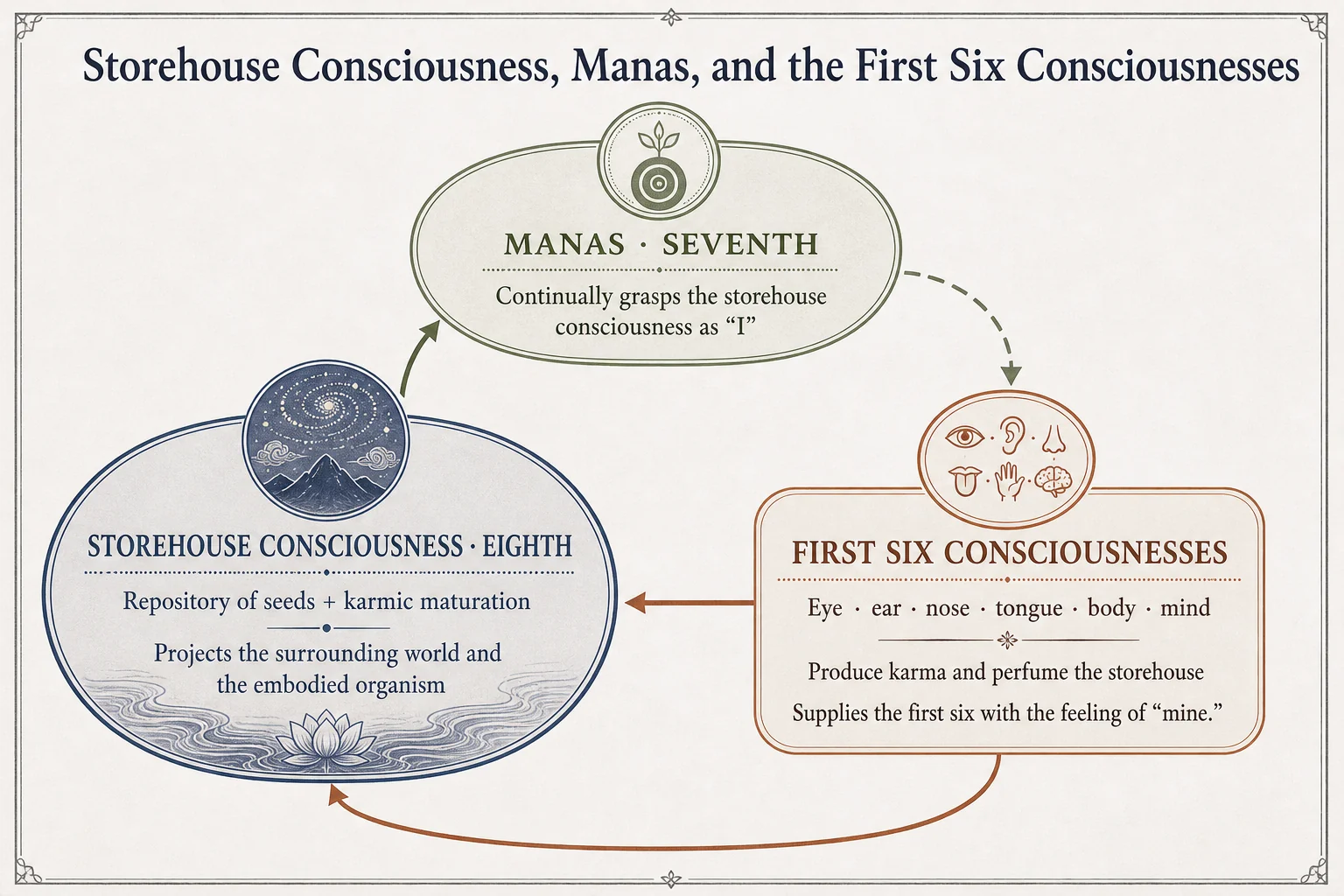
V. Manas: The Root of Self-Appropriation
Manas (manas-vijñāna), the seventh consciousness, is one of the most philosophically interesting concepts in the doctrine of storehouse consciousness. It also shows how far Yogācāra developed its theory of liberation.
It has only one function, but performs it without interruption: it appropriates storehouse consciousness as “I.”
What does this mean? Storehouse consciousness is a continuously flowing stream of consciousness, always operating, carrying seeds, and providing the basis for the continuation of life. Manas constantly takes this flowing stream to be a “permanent self”: there is a stable “I” that exists, thinks, and undergoes every experience. This mistaken appropriation is the most fundamental source of “self-grasping” (ātma-grāha). It operates at every moment, does not depend upon stimulation by an external object, and forms the deep condition for every affliction.4
The afflictions of the first six consciousnesses are “coarse”: when a particular object is encountered, craving or aversion arises in response to a trigger. The self-grasping of manas is “subtle”: so long as life continues, it continuously appropriates storehouse consciousness as “I,” even in the absence of any particular trigger. Meditative absorption can temporarily quiet the first six consciousnesses, but the self-grasping of manas truly stops only when a bodhisattva’s nonconceptual knowledge becomes present.
This claim has an implication for the theory of liberation that deserves close attention. Early Buddhism says “not-self,” emphasizing the fact that no permanent self can be found. In its account of manas, Yogācāra asks: why is not-self so difficult to internalize? Why does the feeling of self-grasping remain inseparable from experience even after one has intellectually accepted not-self? Its answer is that a mechanism is actively constructing the “I” at every moment: manas. Manas is not a piece of false knowledge; it is a continuous operation.5
Manas is also perpetually associated with four fundamental afflictions: self-delusion (ignorance concerning the self), self-view (taking storehouse consciousness to be the self), self-conceit (regarding the self as superior to others), and self-love (craving for the self that has been appropriated). These do not arise only under particular circumstances. So long as manas exists, they accompany it at every moment as structural afflictions.
There is a genuine psychological insight here. Human beings do appear to have a structural tendency to appropriate the experience of each moment continuously as “mine.” This appropriation does not await a particular trigger but occurs at every moment in the flow of experience. Yogācāra made a substantive contribution by stating this explicitly.
Yet naming this tendency an independent “consciousness” (vijñāna) is a dangerous step, even though Yogācāra itself insists that manas is neither an entity nor a permanent self. The danger is that as soon as language establishes it as an independent “consciousness,” it implicitly gives it the outline of an entity. Readers, and even theorists themselves, can scarcely avoid understanding it as a “thing over there doing something.”
From the framework of early Buddhism, the structural tendency toward self-grasping described by manas can be understood entirely as a disposition or influx (āsava) of the sixth consciousness: a deeply conditioned pattern of self-grasping within mental consciousness that arises almost automatically, requiring scarcely any trigger. The analytical framework of not-self in early Buddhism can handle this without positing an additional consciousness. By separating it out as the seventh consciousness, Yogācāra promotes a description of a disposition within consciousness into an ontological claim about the structure of consciousness. Once again, it makes the customary move from phenomenology toward ontology.
VI. Perfuming and Seeds: The Engine of Saṃsāra
Seeds (bīja) and perfuming (vāsanā) constitute the central mechanism through which storehouse consciousness operates. They are also the key to the consciousness-only account of saṃsāra and liberation.
Kinds of Seeds
In the Mahāyānasaṃgraha, Asaṅga distinguishes two major kinds of seeds:
- Seeds of linguistic expression (abhilāpa-vāsanā): every cognitive activity, linguistic habit, and conceptual discrimination leaves seeds in storehouse consciousness. Every act of “calling this X” or “classifying this experience as Y” is an act of perfuming that plants a corresponding potential in storehouse consciousness.
- Seeds of existence (bhava-vāsanā, karmic seeds): the morally charged potentials left in storehouse consciousness by wholesome and unwholesome actions. They ensure the continuity of karmic fruition and determine the destination of future rebirth.
Both kinds of seed are stored together in storehouse consciousness. Under appropriate conditions, they become “active” (samudācāra), giving rise to the corresponding conscious activity or ripened karmic result.
The Direction of Perfuming
Perfuming operates in both directions, forming a circuit:
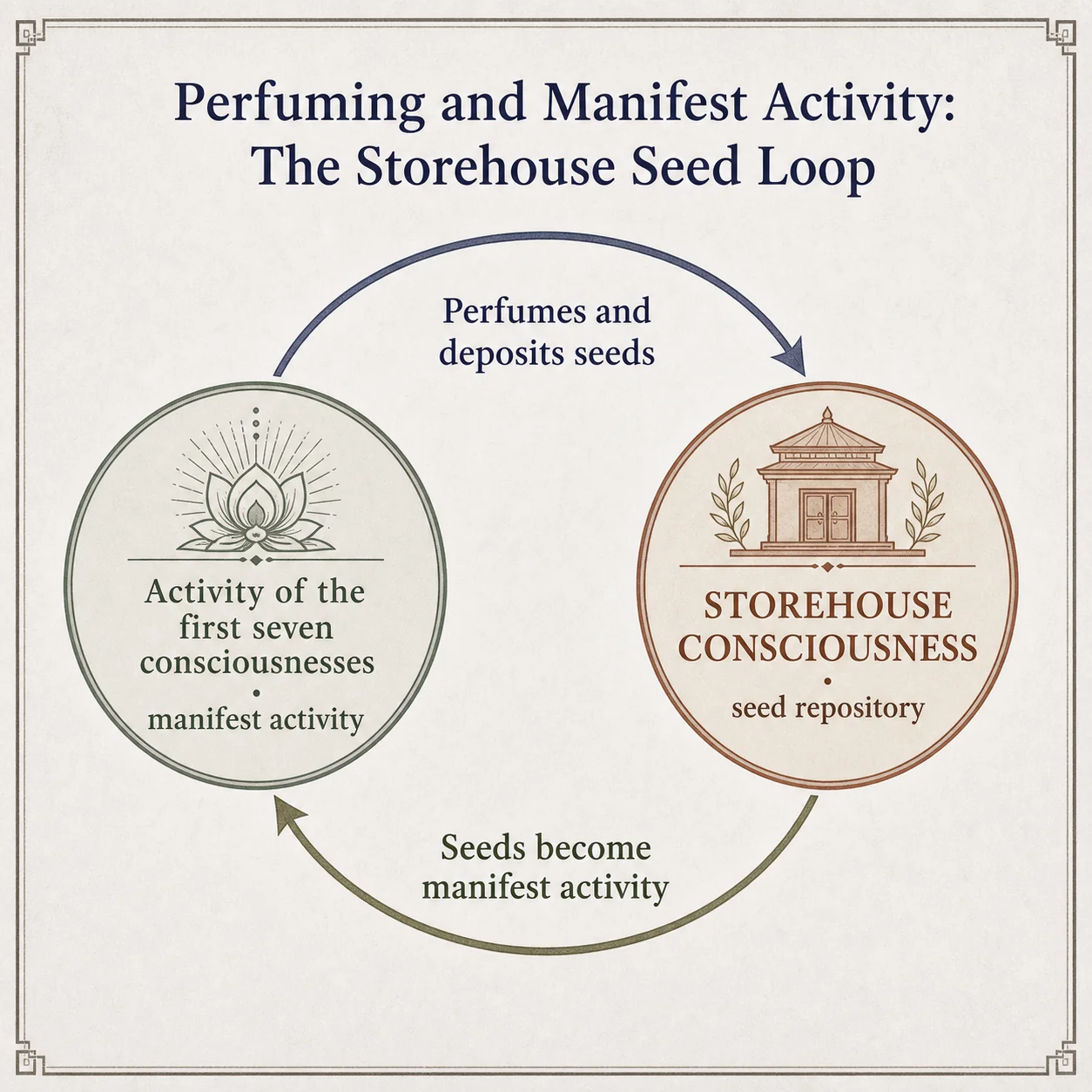
Every activity of the first seven consciousnesses, the first six plus manas, leaves new seeds in storehouse consciousness. Existing seeds in storehouse consciousness become active when conditions mature, triggering new conscious activities. This circuit has no beginning. Beginningless saṃsāra means precisely that it has operated in this way from beginningless time, with no “first cause” to be found.1
Simultaneous or Sequential?
There is a philosophical difficulty within this circuit, and Asaṅga himself noticed it. Seeds reside in storehouse consciousness, while manifest conscious activities occur in the first seven consciousnesses. Do the two influence each other simultaneously, or do they stand in a temporal sequence? If simultaneous, the structure seems to be one in which “storehouse consciousness produces the first seven consciousnesses at this moment, while at the same time the first seven consciousnesses perfume storehouse consciousness,” as though each were the other’s cause and effect. If sequential, one must explain how “before” and “after” can ensure continuity in a system where each moment arises and ceases once and everything is replaced in the next. In Abhidharma a moment is a unit of sequence, and the treatises assign it no physical duration whatever; the conversions into seconds that circulated later belong to the rhetoric of commentaries and lecture notes rather than to measurement.6
Asaṅga answers with an analogy: a wick and its flame. The wick continues to burn (storehouse consciousness continues to produce manifest consciousnesses), while being consumed at the same time—it continuously receives new perfuming. Both occur simultaneously, but this does not mean that “one and the same thing causes itself.” The analogy shows that simultaneity does not entail self-causation. A flame is at once the result of the wick’s ignition and the cause of its consumption; both relations hold at every moment.5
VII. The End of Storehouse Consciousness: Liberation and Transformation of the Basis
Storehouse consciousness is not a permanent structure. This point is crucial to Yogācāra’s theory of liberation.
In ordinary beings and practitioners, storehouse consciousness carries contaminated seeds, continuously manifests the receptacle world, sustains the self-grasping of manas, and acts as the fundamental motive force of saṃsāra. Once practice reaches a certain stage and nonconceptual knowledge (nirvikalpa-jñāna) genuinely becomes present, however, the situation changes.
Nonconceptual knowledge sees emptiness (the absence of intrinsic nature in all dharmas), and the appropriation of storehouse consciousness by manas consequently begins to loosen. As practice deepens, contaminated seeds are progressively replaced by uncontaminated seeds, and storehouse consciousness begins to change from an “afflicted repository” into a “pure cognitive basis.” This process is called transformation of the basis (āśraya-parāvṛtti). The basis that the word names is fixed by the Cheng weishi lun upon the other-dependent nature: “‘Basis’ means that which is depended upon, namely the other-dependent nature, since it serves as the basis of both defiled and pure dharmas” (fascicle nine). What is transformed are two portions upon that one basis: what is relinquished is the imagined nature superimposed upon the other-dependent, and what is obtained is the perfected nature within the other-dependent. The basis itself is not exchanged for another. What storehouse consciousness bears in this process is the side of the seeds, and what is severed there is the coarse heaviness of the two obstructions within the root consciousness.7
Ultimately, a fully transformed storehouse consciousness is no longer called “storehouse consciousness,” since it no longer appropriates and stores seeds of affliction; its function as a “repository” has effectively disappeared. It is transformed into “great mirror knowledge” (ādarśa-jñāna), like a lucid and stainless mirror that illuminates all things without distortion or appropriation, seeing all dharmas as they are.4 The treatise adds a stipulation about the scope of this relinquishing: “By this the name storehouse is forever lost, and that is what is called relinquishing; it is not the relinquishing of the entire substance of the eighth consciousness” (Cheng weishi lun, fascicle three). What is given up is the name “storehouse” and the function of appropriative storage; the substance of the eighth consciousness is not extinguished along with them.7
This architecture of liberation will be developed fully in Section 6.4 in conjunction with the theory of the “three natures.” Here it is enough to emphasize that storehouse consciousness is not a fixed entity: it can be transformed. Otherwise, in outward appearance, it would resemble far too closely some sort of eternal self or soul.
VIII. Tensions and Problems
The introduction of storehouse consciousness resolves a set of problems, but it also brings new difficulties. These tensions cannot be resolved within this chapter, but they deserve to be stated frankly.
1. Is Storehouse Consciousness a Concealed “Self”?
This question has to be put on two levels. The first is the level of claim: how the texts of this tradition name this consciousness, what they undertake about it, and which readings of it they forbid. The second is the level of function: which offices this consciousness actually discharges within the machinery as a whole. The two levels return different answers, and running them together yields conclusions that contradict one another.
On the level of claim the tradition’s record is in good order. Asaṅga says explicitly that storehouse consciousness is not the “self”: it is a stream of consciousness arising and ceasing from moment to moment, not an enduring substance. The verse that the Saṃdhinirmocana-sūtra assigns to this consciousness in its first fascicle writes the likeliest misreading into the very act of promulgation: “The appropriating consciousness is profound and subtle; all its seeds are like a torrent. I have not disclosed it to the foolish, lest they discriminate and grasp it as a self.”8 The six defining characteristics that the later treatises supply for seeds are drafted clause by clause against intrinsic nature. Momentary cessation is said to “exclude permanent dharmas, since what is permanent does not alter and cannot be said to possess any productive power.” Dependence upon a concurrence of conditions is said to exclude the non-Buddhist doctrine of “a spontaneous cause that produces its result all at once without awaiting conditions.” Drawing forth its own result excludes the doctrine that “a single cause produces every result.”9 Unchangingness, independence of others, and self-sufficiency in producing an effect are precisely the conditions under which a concept of intrinsic nature is established, and the framers of this doctrine barred all three by their own hand. The clauses governing storehouse consciousness itself run in the same direction: it is perfumed, it can be transformed, and it is relinquished at the stage of arhatship, all of them things that whatever possesses intrinsic nature could not by definition do.
The level of function has to be reckoned separately. The four arguments of Section II above point, one and all, to a single body of duties: karmic results must cross time, seeds require a stable bearer, several consciousnesses operating at once require a place of integration, and the ripened fruit of action requires a carrier. That body of duties is exactly the one left vacant when the doctrine of not-self dismissed the person (1.5, 3.5). Storehouse consciousness took over the whole of that business, and the six characteristics of seeds and the three senses of “repository” are the defining clauses attached to it. Every clause can be checked; whether the clauses alter the shape of the duties is a different question. Reading momentary cessation together with constantly following in succession shows the point most plainly: on the level of claim it ceases at every moment, while on the level of function it continues as one kind through to the final stage. The name of impermanence and the office of continuation stand on the same page, and adding that name changes nothing whatever in how the machinery runs.
Once the two levels are separated, this book’s judgment can be stated more precisely. This defense holds against the charge that the tradition takes storehouse consciousness to be a permanent self: the level of claim is compliant and the texts are there to be read. It does not hold against a further question, namely whether the mechanism still runs in the shape of the duties belonging to an intrinsic nature, and that question falls on the level of function. Between the “soul” (ātman) that passes through saṃsāra in Brahmanical traditions and a stream of consciousness that “changes from moment to moment yet continues through death and rebirth and carries every seed,” the distance is clear on the level of claim and considerably smaller on the level of function. Critics repeatedly raised this question, and Candrakīrti’s critique in the fourth section of 5.5 touches precisely this second side.10
2. The Infinite Regress of the Perfuming Circuit
If the first seven consciousnesses perfume storehouse consciousness and storehouse consciousness produces the first seven, where does this circuit itself come from? Asaṅga says it is “beginningless”: the circuit has always existed, and no first cause can be found. But “beginningless” is an assertion about time, not an explanation of the circuit itself. It tells us that the circuit has no starting point, but does not explain why this circuit rather than another exists. Liberation only stops, or transforms, the circuit and does not require an account of its origin. But is setting the question aside sufficient? A comparison with Madhyamaka is instructive here: Madhyamaka likewise speaks of “beginningless saṃsāra,” but it does not establish a substantive consciousness that stores seeds in order to explain continuity.
3. The State of Storehouse Consciousness in Deep Absorption
The preceding account held that “storehouse consciousness continues at some subtle level during the attainment of cessation.” But Asaṅga does not, and perhaps cannot, make clear precisely what this “subtle level” is or to what extent it operates. The later commentators Sthiramati and Dharmapāla offered different interpretations, and the point became a subject of prolonged debate within the consciousness-only tradition.
This book regards the introduction of storehouse consciousness as the boldest and most systematic answer in the history of Indian Buddhist philosophy to the problem of “continuity without a self.” It goes beyond the Sautrāntika assertion that “seeds reside upon the mental continuum,” constructing a system of considerable internal consistency. The price is entered on the two levels separately. On the level of claim nothing is owed: the clauses bar unchangingness, independence of others, and self-sufficient efficacy alike. On the level of function, this foundational consciousness occupies exactly the position of a “self in the minimal sense,” running through the three times, holding the seeds, and sharing the fortunes of one lifetime’s psychophysical organism. The sustained challenges that followed from Madhyamaka and from perspectives grounded in early Buddhism all address the latter level.
References
References
-
Étienne Lamotte (trans.). La Somme du Grand Véhicule d'Asaṅga (Mahāyānasaṃgraha). 2 vols. Louvain: Institut Orientaliste, 1938–1939. ↩↩↩
-
Lambert Schmithausen. Ālayavijñāna: On the Origin and the Early Development of a Central Concept of Yogācāra Philosophy. 2 vols. Tokyo: International Institute for Buddhist Studies, 1987. ↩↩
-
Triṃśikā-vijñaptimātratā (T31, no. 1586, composed by Vasubandhu, translated by Xuanzang), verse four: “It turns constantly like a torrent; it is relinquished at the stage of arhatship.” Chinese-language expositions frequently attach this line to Asaṅga and the Mahāyānasaṃgraha; by the wording of the verses themselves it belongs to Vasubandhu. See the second division, Part 20, Chapter 3. ↩
-
John Powers. Wisdom of Buddha: The Saṃdhinirmocana Mahāyāna Sūtra. Berkeley: Dharma, 1995 (including an explanation of foundational consciousness-only concepts); see also John Powers, A Concise Encyclopedia of Buddhism. Oxford: Oneworld, 2000. ↩↩↩
-
Thomas A. Kochumuttom. A Buddhist Doctrine of Experience: A New Translation and Interpretation of the Works of Vasubandhu the Yogācārin. Delhi: Motilal Banarsidass, 1982 (a philosophical analysis of seeds, perfuming, and storehouse consciousness). ↩↩
-
In Abhidharma the mental moment is a unit of sequence, and the treatises assign it no physical duration; the conversions into seconds that circulated in later literature belong to the rhetoric of commentaries and lecture notes rather than to measurement, and no table of conversion links the finest notation of sequence with the coarsest reckoning in aeons. See the second division, Part 14, Chapters 4 and 6. ↩
-
Cheng weishi lun, fascicle nine (T31, no. 1585, composed by Dharmapāla and others, translated by Xuanzang), glosses “basis” as “that which is depended upon, namely the other-dependent nature, since it serves as the basis of both defiled and pure dharmas; the defiled is the falsely imagined nature, the pure is the truly perfected nature,” and “transformation” as “two portions, relinquishing and obtaining.” The full sentence reads: “By repeatedly cultivating nonconceptual knowledge one severs the coarse heaviness of the two obstructions within the root consciousness, and is thereby able to relinquish the imagined nature superimposed upon the other-dependent and to obtain the perfected nature within the other-dependent.” Fascicle three of the same treatise says of the relinquishing of the storehouse: “By this the name storehouse is forever lost, and that is what is called relinquishing; it is not the relinquishing of the entire substance of the eighth consciousness.” See the second division, Part 20, Chapter 6. ↩↩
-
Saṃdhinirmocana-sūtra, fascicle one, chapter on the characteristics of mind, thought, and consciousness (T16, no. 676, translated by Xuanzang), verse: “The appropriating consciousness is profound and subtle; all its seeds are like a torrent. I have not disclosed it to the foolish, lest they discriminate and grasp it as a self.” The same chapter states that a bodhisattva is called skilled in the ultimate only when, inwardly and severally, he “does not see the ālaya and does not see the storehouse consciousness”: this consciousness is itself among the things not seen. See the second division, Part 20, Chapter 3. ↩
-
Cheng weishi lun, fascicle two (T31, no. 1585, composed by Dharmapāla and others, translated by Xuanzang), on the exclusions written into the six characteristics of seeds: “First, momentary cessation. Its substance, as soon as it arises, must cease without interval, and only through this superior efficacy does it become a seed. This excludes permanent dharmas, since what is permanent does not alter and cannot be said to possess any productive power.” “Fifth, dependence upon a concurrence of conditions. This requires that its own conditions converge, whereupon its efficacy is distinguished and it becomes a seed. This excludes the non-Buddhist doctrine of a spontaneous cause that produces its result all at once without awaiting conditions.” “Sixth, drawing forth its own result. Only by drawing forth severally each of the several results of form and mind does it become a seed. This excludes the non-Buddhist doctrine that a single cause produces every result.” The remaining three characteristics are simultaneity with the result, constantly following in succession, and determination of moral quality. The treatise further restricts the term: “Only the differentiated efficacies within the root consciousness possess these six characteristics and constitute seeds; nothing else does. External grain, wheat, and the like, being transformations of consciousness, are provisionally given the name of seeds and are not real seeds.” See the second division, Part 20, Chapter 3. ↩
-
Paul Williams. Mahāyāna Buddhism: The Doctrinal Foundations. 2nd ed. London: Routledge, 2009 (including a survey of comparisons and criticisms between Yogācāra and Madhyamaka). ↩