Chapter Four: The Three Natures, Three Absences of Nature, and Transformation of the Basis
The preceding three chapters explained the architecture of storehouse consciousness and the eight-consciousness system. But “consciousness manifests everything” describes only the structure of saṃsāra; it has not yet explained what goes wrong or how the error can be corrected. This is the task of the theory of the three natures (trisvabhāva). It supplies consciousness-only’s diagnosis and prescription: how we mistakenly apprehend experience, what its true mode of apprehension is, and what the transformation from the former to the latter means. Transformation of the basis (āśraya-parāvṛtti) is the complete expression of this change at the structural level of consciousness.
I. The Basic Framework of the Three Natures
The “three natures” (trisvabhāva) are the central analytical framework of consciousness-only philosophy. They are presented systematically in Asaṅga’s Mahāyānasaṃgraha and Vasubandhu’s commentaries, with their origins in the Madhyāntavibhāga and Dharmadharmatāvibhāga among the Five Treatises of Maitreya.1
The three natures describe the same stream of experience (the dependently arisen activity of consciousness) from three different perspectives. They are not three independent realms of existence. This point is crucial: the three natures are “three modes of apprehension” or “three levels of existence,” not three separate worlds.
| Nature | Sanskrit | Literal meaning | Referent |
|---|---|---|---|
| Imagined nature | parikalpita-svabhāva | The nature appropriated through pervasive conceptual construction | The fixed entities we impose upon experience; the nonexistent layer of “superimposition” |
| Other-dependent nature | paratantra-svabhāva | The nature that arises in dependence upon others | The actual flow of consciousness: cognitive activity arising and ceasing in dependence upon conditions |
| Perfected nature | pariniṣpanna-svabhāva | The nature of perfected reality | The ultimate condition of the other-dependent once the imagined has been removed; suchness |
A common analogy is:
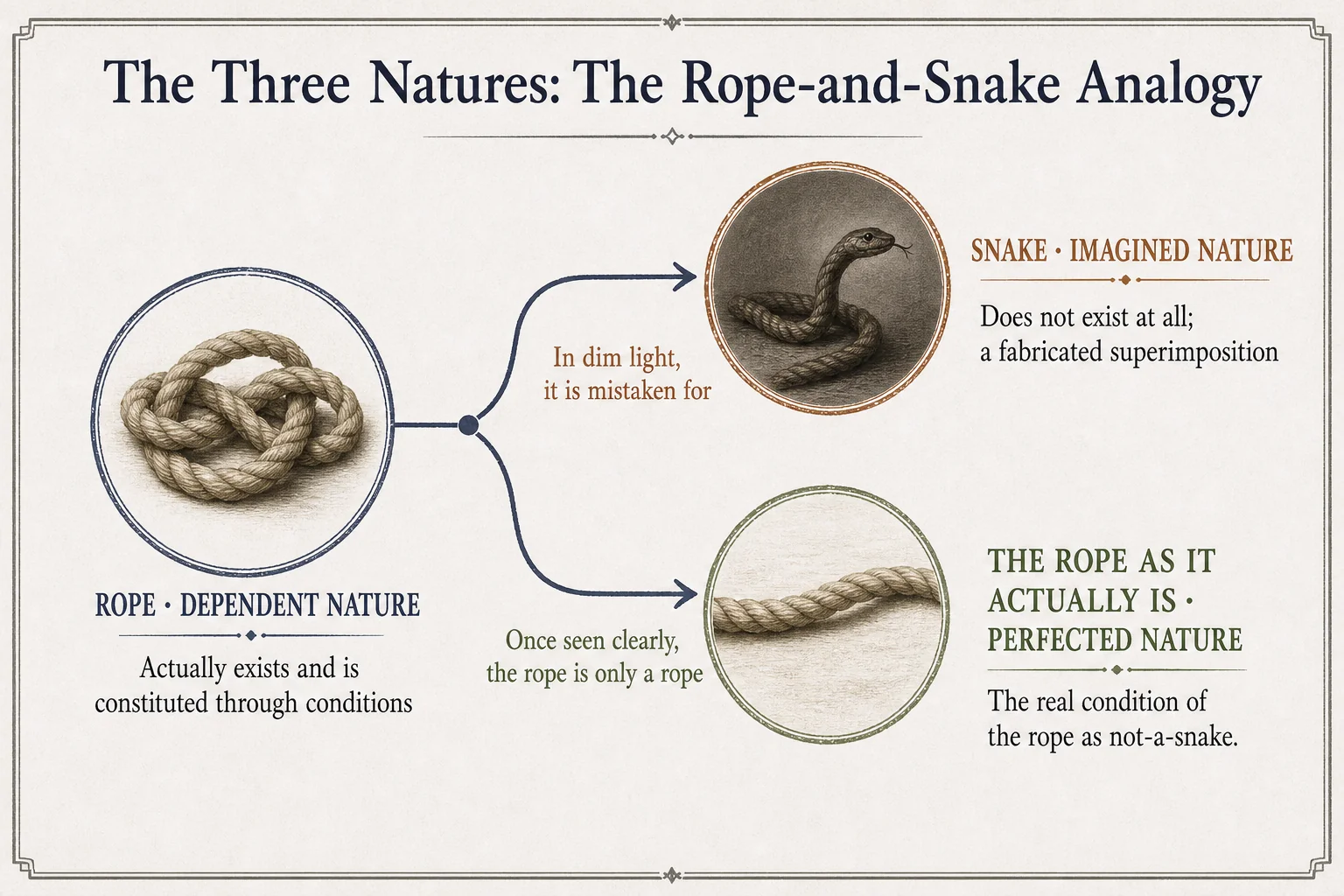
The analogy shows how the three natures relate. The snake does not exist at all—the imagined nature. The rope exists but is misperceived—the other-dependent nature. The rope’s true state once clearly seen is the perfected nature. These are not three independent things; they are three different states of apprehending the same “rope.”
II. The Imagined Nature: Complete Fabrication
The imagined nature (parikalpita-svabhāva) literally means “the nature appropriated through pervasive conceptual construction.” Such “construction” is a pervasive habitual action of mind: it fixes and reifies fluid, dependently arisen experience, labeling it “an independently existing X.”
The crucial point is that the “X” thus imagined, the object we take to be independently real, does not exist at all. This does not mean that we falsely cognize something that actually exists. It means that the mode of existence we believe to be there (fixed, independent, and established by intrinsic nature) was never there in the first place.2
This fabrication has two levels.
The first is grasping at a self: the flowing psychophysical process of the five aggregates is taken to be a stable and agentive “I.” This “I” does not exist; there is only the dependently flowing process of the five aggregates. Habitually, however, we reify that process as “an I undergoing all this.”
The second is grasping at dharmas: the various appearances manifested by consciousness (forms, sounds, odors, tastes, tangibles, and mental objects) are taken to be “external objects” existing independently of consciousness. These “external objects” do not exist either; there is only the manifesting activity of consciousness. Habitually, however, we treat these manifestations as a material world independent of consciousness.
The defining feature of the imagined nature is complete nonexistence (abhāva). It is not some inferior mode of existence. It does not exist at all; it is fabrication through and through. The snake was never there—not a lesser snake that somehow was.
III. The Other-Dependent Nature: A Conditioned Flow That Exists without Intrinsic Nature
The other-dependent nature (paratantra-svabhāva) is the most subtle of the three and the one most easily misunderstood.
Its literal meaning is “the nature that arises (tantra) in dependence upon others (para),” meaning that this activity is neither self-sufficient nor independent. It can arise only in dependence upon numerous conditions—karma, seeds, faculties, objects, and so on. It is the actual flow of consciousness: the continuous manifestations of storehouse consciousness, the continuous activities of the first seven consciousnesses, and the entire cognitive process brought about by the conjunction of conditions.
The other-dependent nature exists, but its existence is not established by intrinsic nature. It arises in dependence upon others, comes into being and passes away from moment to moment according to conditions, and has no fixed, unchanging substance.1
It is the only one of the three natures possessing a certain kind of “reality,” but that reality is limited. It is “the phenomenal flow that exists as it is,” while also serving as the basis upon which the imagined nature can arise—just as the rope is the basis upon which the illusion of the snake arises.
One important clarification: the other-dependent nature is not merely an “innocent object mistakenly perceived.” It contains within itself the structure that generates the imagined nature. The flow of consciousness, the other-dependent, includes a tendency automatically to reify objects and superimpose the fabricated “self” and “dharmas.” Thus the other-dependent nature is both the reality of saṃsāra (the conditioned flow as it is) and its mechanism—the process within which imagination and appropriation arise.
IV. The Perfected Nature: Ultimate Suchness
The perfected nature (pariniṣpanna-svabhāva) literally means “the nature of perfected reality.” It denotes the ultimate true state of the other-dependent nature once the imagined nature has been completely removed.
More precisely, the perfected nature is the emptiness of the imagined nature within the other-dependent nature—the parikalpita-svabhāva-śūnyatā of paratantra-svabhāva. Put more directly: within the conditioned flow of the other-dependent, there is fundamentally no fixed intrinsic nature of the kind projected by the imagined. This “absence” itself is the perfected nature, or suchness (tathatā).2
It is not another world or some absolute reality outside consciousness. It is the condition of “apprehending the other-dependent as it is”: seeing a conditioned flow simply as a conditioned flow, without superimposing any fixed “self” or “dharma.” Once the rope is clearly seen, it is simply a rope, no more and no less. The “rope as it truly is” is the perfected nature.
The perfected nature is doctrinally close to Madhyamaka emptiness (śūnyatā), but the approaches differ. Madhyamaka emptiness is a negative formulation: “all dharmas lack intrinsic nature.” The perfected nature in consciousness-only is “the reality manifested by consciousness in its natural condition once the imagined has been removed.” It carries a certain positive content, expressed as suchness, dharma-nature, and just-so-ness. This is a difference in soteriological temperament between the two schools, not, at least nominally, a fundamental philosophical disagreement.
The Perfected Nature and Nirvāṇa: The Extension and Transformation of a Theory of Liberation
Placed within the framework of early Buddhism, the relation between the perfected nature and nirvāṇa needs to be clarified separately.
Early Buddhist descriptions of nirvāṇa are predominantly negative: the extinguishing of the fires of greed, aversion, and delusion; the cessation of suffering; the exhaustion of craving. Abhidharma classifies it as an unconditioned dharma whose nature is “the cessation of suffering” (3.1). But nirvāṇa itself is not an “object” attained or a positively defined “realm.” It is closer to the “cessation” in which, after greed, aversion, and delusion have been exhausted, no new round of birth and death arises—not the acquisition of a substantive thing.
Formally, the perfected nature resembles nirvāṇa: both are ultimate realities disclosed when the imagined is removed, and both are unconditioned. Yet Yogācāra descriptions give the perfected nature a positive dimension not evident in early Buddhist accounts of nirvāṇa. It is identified with suchness (tathatā), dharma-nature (dharmatā), and the dharma-realm (dharmadhātu)—the “natural condition” displayed by consciousness once imagination is removed—and it possesses the positive features of luminosity and seeing things as they are. Yogācāra’s perfected nature subtly draws nirvāṇa away from the “blank of cessation” and toward “lucid manifestation.” Tathāgatagarbha thought takes this movement still further (Part VII).2
This change has direct consequences for the theory of liberation. The liberation described by Yogācāra, and by Mahāyāna more broadly, is not entry into an extinction in which body and cognition are reduced to ashes. After transformation of the basis, one continues to act in the world without the distortion of the imagined nature. This is the Mahāyāna “non-abiding nirvāṇa” (apratiṣṭhita-nirvāṇa): one abides neither in saṃsāra, because one is not bound by affliction, nor in nirvāṇa, because one does not flee into cessation and abandon the world. Compassion and wisdom operate together, freely benefiting living beings. This differs structurally from the Abhidharma framework in which an arhat passes from “nirvāṇa with a remainder” to “nirvāṇa without a remainder.” At the exhaustion of the body resulting from the arhat’s final life, the arhat enters extinction, whereas a Mahāyāna bodhisattva can manifest without end because of non-abiding nirvāṇa. This book’s judgment is that the distinction has a doctrinal basis but also contains an element of construction. The actual meaning of nirvāṇa in early Buddhism may not have been merely an “escape into cessation,” as Mahāyāna criticism sometimes suggests. The tension was discussed in Part IX on Southern Buddhism and Part IV on the rise of Mahāyāna.
V. The Three Absences of Nature: Reconnecting with Emptiness
The theory of the three natures has a companion doctrine, the “three absences of nature” (trisvabhāva-niḥsvabhāvatā). This is crucial to consciousness-only’s claim that it continues the Prajñāpāramitā–Madhyamaka teaching of emptiness rather than establishing a separate ontology.
The Saṃdhinirmocana Sūtra is the most important scriptural source for this doctrine, and it connects “consciousness-only” with “emptiness” through the three absences of nature.3 Verses twenty-three and twenty-four of the Triṃśikā compress the same procedure into two sentences: “Upon these three natures the three absences of nature are established; therefore the Buddha with hidden intent declared that all dharmas lack nature. The first is absence of nature with respect to characteristics; the next is the absence of a nature arising of itself; the last is the absence, through separation from the former, of the imagined nature of self and dharmas.”4
| Nature | Corresponding absence of nature | Sanskrit | Which intrinsic nature is the one absent |
|---|---|---|---|
| Imagined nature | Absence of nature with respect to characteristics | lakṣaṇa-niḥsvabhāvatā | The characteristic itself is absent: this characteristic is “established as a characteristic by provisional naming, not established as a characteristic by its own mark” |
| Other-dependent nature | Absence of nature with respect to arising | utpatti-niḥsvabhāvatā | No nature that arises of itself: it is produced by the force of conditions and is not spontaneously existent, while arising through conditions proceeds as before |
| Perfected nature | Ultimate absence of nature | paramārtha-niḥsvabhāvatā | No imagined self or dharmas: it is what the ultimate discloses, apart from the imagined self and dharmas, and this does not mean that the nature itself is absent |
Three rows, three kinds of absence, each with its own object. The single sentence “all dharmas lack intrinsic nature” is divided into three portions, and the words “hidden intent” fall precisely upon that act of division.4
The points that matter for interpretation lie in the last two rows. The absence of intrinsic nature in the other-dependent cancels only arising of itself and does not cancel arising through conditions; this half-sentence is the pivot of the entire reconciliation, and the later dispute between consciousness-only and Madhyamaka issues from it (6.5). What is absent in the perfected is the imagined self and dharmas, not the nature itself; reading ultimate absence of nature as “the perfected too is empty” does not match the reason the scripture supplies.
The reconciliation has one further interface, in the distribution of the two truths set out in fascicle eight of the Cheng weishi lun: “How do these three include those two truths? One should know that the conventional possesses all three, while the ultimate is only the perfected nature. The conventional is of three kinds: the provisional conventional, the conventional of activity, and the conventional made manifest. These are to be known, in order, as the three natures.”5
| Truth | Nature | The treatise’s term |
|---|---|---|
| Conventional | Imagined | The provisional conventional |
| Conventional | Other-dependent | The conventional of activity |
| Conventional | Perfected | The conventional made manifest |
| Ultimate | Perfected | The ultimate as object, as attainment, and as practice, all three included in the perfected nature |
Two things follow from this table of distribution. First, the three natures do not stand alongside the two truths; they divide the conventional side alone. The conventional level is cut into three, running from sheer misapprehension, through the mechanism of conditioned arising, to what is made manifest upon that mechanism. Second, the perfected straddles both columns: in the conventional column it is called the conventional made manifest, and in the ultimate column it is the whole of the ultimate. That straddling cell is exactly where the reconciliation through the three absences is most often misread, since one and the same thing occupies a cell in each column, and a slight slip in reading turns it into two things.
The logic of the three absences can now be stated in full. When the Buddha said “all dharmas lack intrinsic nature”—the emptiness of the Prajñāpāramitā—he did not negate every dharma in one and the same way; each of the three rows receives a negation of its own. The imagined does not exist by definition, hence the absence of nature with respect to characteristics. The other-dependent has no power of arising of itself, hence the absence of nature with respect to arising. What the perfected lacks is the self and the dharmas that are grasped, hence ultimate absence of nature. “Everything is consciousness-only” and “everything is empty” are therefore not two opposing claims; they are one and the same matter stated severally at three positions.1
This book regards the logical structure of the reconciliation as ingenious, but doubts whether it truly dissolves the disagreement between Madhyamaka and consciousness-only. Candrakīrti (the fourth section of 5.5) did not consider it successful. The focus of his critique is precisely that consciousness-only leaves some degree of reality to consciousness on the level of the other-dependent: consciousness arises in dependence, but the activity of consciousness itself exists. In Madhyamaka’s thoroughgoing analysis of emptiness, this residual reality has not yet been dissolved. The next section (6.5) will develop the dispute.
VI. False Discrimination: The Perspective of the Madhyāntavibhāga
The Madhyāntavibhāga expresses a similar structure through another, more intuitive concept. It is among the earliest core concepts established by Yogācāra: false discrimination (abhūtaparikalpa, discrimination that does not accord with reality).
A famous verse from the Madhyāntavibhāga is frequently cited to explain the basic standpoint of consciousness-only:
False discrimination exists; within it, the two do not exist at all. Within it there is only emptiness; and within that, this also exists.
Literally: false discrimination, the activity of consciousness, exists. Within it, neither the apprehended (grāhya, the object cognized) nor the apprehender (grāhaka, the cognizing subject) exists. Within this false discrimination there is only emptiness, while emptiness in turn includes this false discrimination.6
These four lines are another expression of the three natures:
- “False discrimination exists”: the other-dependent nature exists; the activity of consciousness really occurs.
- “Within it, the two do not exist”: the imagined nature does not exist; a fixed subject–object duality is fundamentally absent.
- “Within it there is only emptiness”: the perfected nature, or emptiness, appears within the other-dependent.
- “Within that, this also exists”: emptiness is not outside the activity of consciousness. It is present within false discrimination, the other-dependent, itself. Remove the imagined and the perfected is seen.
The philosophical significance of “false discrimination” is that the activity of consciousness, the other-dependent, contains an inherent tendency to discriminate. It automatically divides experience into “apprehender” and “apprehended,” subject and object. This division is “false,” or not in accord with reality, because no fixed opposition between subject and object exists. There is only the flow of consciousness, not a stable subject cognizing a stable object.
The point of practice is consequently clear. It is not to negate the activity of consciousness, which would be annihilationism, but gradually to dissolve within that activity the fixed division between apprehender and apprehended. The flow of consciousness is allowed to remain a flow rather than congealing into the dualistic pattern “I am cognizing the world.”
An Objection That Must Be Faced: Why Should the Disappearance of Subject and Object Constitute Liberation?
The three-natures theory cannot evade one objection: why should dissolving the fixed division between apprehender and apprehended amount to liberation?
The force of the question comes from another current of Indian philosophy. The Brahmanical unity of brahman and self (tat tvam asi, “you are that”) likewise holds that in ultimate realization the boundary between individual self (ātman) and cosmic ground (brahman) dissolves. The individual realizes that it is brahman, and the opposition between knower and known disappears. Is this not also a disappearance of subject and object? If such disappearance is liberation, must not the unity of brahman and self count as liberation as well?
The answer is no, but the reason must be stated clearly. The difference is not whether subject and object dissolve, but what remains after their dissolution and what is diagnosed as the root of saṃsāra.
The dissolution involved in the unity of brahman and self is an “expansion” of the individual self after it discovers itself to be brahman. What disappears is superficial individuality; what remains is an absolute subject—the self-luminous and eternal brahman. This absolute subject is still an ultimately real existent, only larger and more fundamental than the individual self. From a Yogācāra perspective, “brahman” itself is a subtler imagined nature: it reifies the luminous and cognitive aspects of the other-dependent flow of consciousness into an eternal entity, thereby grasping at an “ultimate ground” on a higher level. A smaller imagined construction is dissolved and a larger one erected in its place.
When Yogācāra’s subject–object duality disappears, no brahman remains to take over. The perfected nature is no more a real entity than the “self” and “dharmas” of the imagined nature. It is simply the emptiness of the imagined within the other-dependent—an “absence,” not another kind of “presence.” Once the rope is seen clearly, the rope is still a rope; no absolute flame rises from within it.
There is a still more fundamental point. Buddhism diagnoses craving and appropriation (tṛṣṇā, upādāna), not merely a cognitive subject–object division, as the source of saṃsāra and suffering. The disappearance of subject and object as an insight does not by itself guarantee that craving has been exhausted. A cognitive structure may be penetrated on one level while emotional and volitional appropriation continues to operate. Yogācāra therefore emphasizes that genuine transformation of the basis requires the complete exhaustion of contaminated seeds in storehouse consciousness, not a single “nondual insight.” This is also why Yogācāra values gradual cultivation and meditative practice rather than relying on intellectual understanding alone.
This book regards the objection as one that every theory of liberation centered on “the disappearance of subject and object” must answer directly. Yogācāra’s two replies are acceptable: first, after the duality disappears no brahman remains, since the perfected is an absence rather than a greater presence; second, liberation transforms not only cognitive structure but the seed level of storehouse consciousness in its entirety. These replies remain adequate only if supported by concrete practices; they cannot remain at the level of philosophical concepts.
VII. Transformation of the Basis: The Fundamental Overturning of Consciousness
The theory of the three natures supplies the diagnosis; transformation of the basis (āśraya-parāvṛtti) describes the condition after treatment is complete.
Āśraya means the “supporting basis,” the foundation or ground of consciousness; parāvṛtti means “overturning” or “transformation.” Transformation of the basis is a single qualitative overturning that takes place upon that supporting basis: the imagined nature superimposed upon it is relinquished (the layer of fabrication that appropriates storehouse consciousness as a self and the manifestations of consciousness as external objects), and the perfected nature within it is obtained, so that the natural condition of consciousness is apprehended as it is.2
The Basis upon Which the Transformation Occurs
The Cheng weishi lun defines the word “basis” in fascicle nine: “‘Basis’ means that which is depended upon, namely the other-dependent nature, since it serves as the basis of both defiled and pure dharmas; the defiled is the falsely imagined nature, the pure is the truly perfected nature.” The supporting basis is the other-dependent nature, not storehouse consciousness. What is transformed are two portions upon that one basis: what is relinquished is the imagined nature superimposed upon the other-dependent, and what is obtained is the perfected nature within the other-dependent. Relinquishing and obtaining both fall upon the level of the other-dependent; there is no second site, and the basis itself is not exchanged for another.7
What storehouse consciousness bears in this process is the side of the seeds. The work of practice is to increase uncontaminated seeds (the seeds of Dharma acquired through hearing, reflection, and cultivation) while contaminated seeds gradually diminish, until the coarse heaviness of the two obstructions within the root consciousness is severed and the conditions for the arising of the imagined no longer obtain. The treatise’s own sentence keeps the two positions distinct: “severing the coarse heaviness of the two obstructions within the root consciousness, one is thereby able to relinquish the imagined nature superimposed upon the other-dependent.” What is severed lies among the seeds within the root consciousness; what is transformed lies in the other-dependent. To write transformation of the basis as something that “occurs in storehouse consciousness” is to mistake the site of severance for the basis.7
Is Transformation of the Basis a Sudden Overturning or a Gradual Process?
It is both. From the perspective of practice, transformation of the basis is gradual. Every occasion on which nonconceptual knowledge becomes present loosens the imagined nature and advances the apprehension of the other-dependent as it is. This process proceeds through the successive stages of the bodhisattva path and is completed at buddhahood. From the perspective of its result, transformation of the basis is a complete overturning at buddhahood: every contaminated seed in storehouse consciousness has been exhausted, fundamentally changing the character of the cognitive basis.
Its Relation to the “Disappearance” of Storehouse Consciousness
Section 6.2 already noted that, after complete transformation of the basis, storehouse consciousness no longer operates as an “ālaya,” something appropriated and stored in. Its “storehouse” function (the appropriation and storage of afflicted seeds) disappears, while cognitive activity remains. Because its mode of activity has changed, it receives a new name: great mirror knowledge. Storehouse consciousness has not been discarded or destroyed; its character is overturned from contaminated (appropriating and storing) to uncontaminated—reflecting objects like a mirror. The Cheng weishi lun attaches a further stipulation to this “relinquishing” in fascicle three: “By this the name storehouse is forever lost, and that is what is called relinquishing; it is not the relinquishing of the entire substance of the eighth consciousness.” What is given up is the name “storehouse” and the function of appropriative storage; the substance of the eighth consciousness is not extinguished along with them, the reason being that the function of holding the seeds cannot be left vacant.7
VIII. Transforming Consciousness into Knowledge: The System of Four Knowledges
At the structural level of consciousness, the completion of transformation of the basis appears as the transformation of all eight consciousnesses into four kinds of knowledge (jñāna). This is the most concrete formulation of liberation in consciousness-only thought:8
| Before transformation: consciousness | After transformation: knowledge | Sanskrit | Meaning |
|---|---|---|---|
| Storehouse consciousness, the eighth | Great mirror knowledge | ādarśa-jñāna | Like a great, perfect mirror (lucid and stainless) sees everything as it is without appropriation |
| Manas, the seventh | Knowledge of equality | samatā-jñāna | Sees the equality and nondifference of all dharmas: the equality of self and other, of self and world |
| Mental consciousness, the sixth | Knowledge of wondrous observation | pratyavekṣaṇā-jñāna | Observes dharmas with precision, teaches and liberates living beings according to their capacities |
| The first five consciousnesses—visual, auditory, olfactory, gustatory, tactile | Knowledge that accomplishes what is to be done | kṛtyānuṣṭhāna-jñāna | Accomplishes every necessary task; operates freely on the worldly level |
The central logic of “transforming consciousness into knowledge” is that consciousness (vijñāna) and knowledge (jñāna) are not two different mental faculties. They are two states of the same mental activity. With imagined construction, it is “consciousness”; once imagined construction is removed and it operates in accord with reality, it is “knowledge.” Water is naturally clear: when mixed with mud it becomes turbid, and when clarified it remains the same water although its condition has changed.
The four knowledges are not established in an order of one fundamental knowledge and three derived from it. What fascicle ten of the Cheng weishi lun supplies for each is the stage at which it first arises: the knowledge of wondrous observation first arises already at the stage of seeing in the two vehicles; the knowledge of equality first arises only at the bodhisattva’s stage of the first manifestation of the path of seeing; the knowledge that accomplishes what is to be done likewise first arises on the bodhisattva’s path of cultivation, drawn forth by subsequently attained knowledge; and great mirror knowledge first arises when the bodhisattva’s vajra-like concentration becomes present. By the sequence the treatise gives for itself, the earliest to arise is the knowledge of wondrous observation and the latest is great mirror knowledge. To say that great mirror knowledge is fundamental and that the other three are established upon it does not agree with that sequence.9
Each transformation can still be described in its own terms. The transformation of manas into the knowledge of equality means that fundamental appropriation of the difference between self and other has disappeared. The transformation of mental consciousness into the knowledge of wondrous observation means that cognition is no longer distorted by the imagined and becomes accurate and flexible observation. The transformation of the first five consciousnesses into knowledge that accomplishes what is to be done means that sensory activity continues after liberation without karmic perfuming: one sees form without producing attachment or aversion and hears sound without giving rise to conceptual discrimination. The one-to-one correspondence between the eight consciousnesses and the four knowledges is given in the treatise by way of the stage of first arising and the consciousness transformed; the customary table used above belongs to the ordering work of later commentary.9
IX. The Philosophical Position and Tensions of the Three-Natures Theory
The theory of the three natures performs two tasks within consciousness-only philosophy.
Its ontological task is to explain what “consciousness-only” means. It does not mean that “consciousness is the ultimately real substance.” Rather, other-dependent consciousness is the actual basis of experience, the perfected is its ultimate condition, and the imagined is utterly nonexistent. This distinguishes consciousness-only from naïve idealism (in which consciousness is real), and preserves its compatibility with emptiness.
Its soteriological task is to explain what practice does. Practice does not negate experience, since negating the other-dependent would be annihilationism. Within experience, it dissolves the imagined (the fabricated appropriation of fixed “selves” and “dharmas”), and allows the other-dependent to appear as the perfected. Transformation of the basis is the completion of that process.
One explicit question remains: does this theory of liberation continue early Buddhist soteriology or substantially reconstruct it? This book’s answer is that it does both. The continuity lies in the fact that the exhaustion of craving and appropriation (the affective and volitional dimensions of the imagined) remains central; the perfected nature broadly corresponds to the unconditioned character attributed to nirvāṇa in early Buddhism; and the practical theory of transforming the basis corresponds in certain respects to the threefold training in ethical conduct, concentration, and wisdom. The reconstruction lies in describing the perfected nature positively as suchness and the dharma-realm, giving it a positive content absent from early accounts of nirvāṇa; in using non-abiding nirvāṇa to redefine liberation not as “leaving the world” but as “transformation without departing from the world”; and in shifting the “basis” of liberation from an individual’s abandoning greed, aversion, and delusion to a structural overturning of the other-dependent stream of consciousness as a whole, a formulation with a higher degree of metaphysical elaboration. This book remains doubtful, without rendering a verdict, as to whether the reconstruction loses something important from early Buddhism.
The three-natures theory itself nevertheless retains a philosophical tension that this book will not avoid: how “real” is the other-dependent nature? If it exists (“false discrimination exists”), while the imagined is utterly nonexistent, then a boundary separates “existence” from “nonexistence.” This means that the activity of consciousness possesses some degree of reality at the level of the other-dependent. It is not a reality established by intrinsic nature, but it is still reality of some kind. Madhyamaka’s thoroughgoing position on emptiness does not accept this residue. Candrakīrti holds that consciousness at this level is equally empty and cannot be anchored in any reality by saying “the other-dependent exists.”
This dispute is the subject of Section 6.5.
References
References
-
John P. Keenan. The Scripture on the Explication of the Underlying Meaning (Saṃdhinirmocanasūtra). Berkeley: Numata Center, 2000 (including scriptural sources and interpretations of the three natures and three absences of nature). ↩↩↩
-
Étienne Lamotte (trans.). La Somme du Grand Véhicule d'Asaṅga (Mahāyānasaṃgraha). Louvain: Institut Orientaliste, 1938–1939 (Asaṅga’s systematic account of the three natures and transformation of the basis). ↩↩↩↩
-
John Powers (trans.). Wisdom of Buddha: The Saṃdhinirmocana Sūtra. Berkeley: Dharma, 1995 (a scriptural source connecting the three absences of nature with emptiness). ↩
-
Triṃśikā-vijñaptimātratā (T31, no. 1586, composed by Vasubandhu, translated by Xuanzang), verses twenty-three and twenty-four: “Upon these three natures the three absences of nature are established; therefore the Buddha with hidden intent declared that all dharmas lack nature. The first is absence of nature with respect to characteristics; the next is the absence of a nature arising of itself; the last is the absence, through separation from the former, of the imagined nature of self and dharmas.” The Saṃdhinirmocana-sūtra, fascicle two, chapter on the absence of intrinsic nature in characteristics (T16, no. 676, translated by Xuanzang), names the three as “absence of intrinsic nature in characteristics, absence of intrinsic nature in arising, and absence of intrinsic nature in the ultimate,” and gives as the reason for the first that “this is established as a characteristic by provisional naming, not established as a characteristic by its own mark”; absence of intrinsic nature in arising takes production by the force of conditions rather than spontaneous existence, and absence of intrinsic nature in the ultimate takes what the ultimate discloses in separation from the imagined self and dharmas. See the second division, Part 20, Chapter 2. ↩↩
-
Cheng weishi lun, fascicle eight (T31, no. 1585, composed by Dharmapāla and others, translated by Xuanzang): “How do these three include those two truths? One should know that the conventional possesses all three, while the ultimate is only the perfected nature. The conventional is of three kinds: the provisional conventional, the conventional of activity, and the conventional made manifest. These are to be known, in order, as the three natures. The ultimate is of three kinds: first, the ultimate as object, namely suchness, since it is the object of what is supreme; second, the ultimate as attainment, namely nirvāṇa, since what is supreme is itself the object; third, the ultimate as practice, namely the noble path, since what is supreme is its aim. Being unchanging and unerring, they are all, according to their respective senses, included within the perfected nature.” See the second division, Part 20, Chapter 2. ↩
-
Stefan Anacker. Seven Works of Vasubandhu. Delhi: Motilal Banarsidass, 2002 (including a translation and analysis of the four-line verse on false discrimination from the Madhyāntavibhāga). ↩
-
Cheng weishi lun, fascicle nine (T31, no. 1585, composed by Dharmapāla and others, translated by Xuanzang), glosses “basis” as “that which is depended upon, namely the other-dependent nature, since it serves as the basis of both defiled and pure dharmas; the defiled is the falsely imagined nature, the pure is the truly perfected nature,” and “transformation” as “two portions, relinquishing and obtaining.” The full sentence reads: “By repeatedly cultivating nonconceptual knowledge one severs the coarse heaviness of the two obstructions within the root consciousness, and is thereby able to relinquish the imagined nature superimposed upon the other-dependent and to obtain the perfected nature within the other-dependent.” Fascicle three of the same treatise says of the relinquishing of the storehouse: “By this the name storehouse is forever lost, and that is what is called relinquishing; it is not the relinquishing of the entire substance of the eighth consciousness.” See the second division, Part 20, Chapter 6. ↩↩↩
-
Wei Tat (trans.). Ch'eng Wei-shih Lun: The Doctrine of Mere-Consciousness. Hong Kong, 1973 (a detailed discussion of the system of four knowledges and the transformation of consciousness into knowledge). ↩
-
Cheng weishi lun, fascicle ten (T31, no. 1585), on the stage at which each of the four knowledges first arises. The mental group associated with great mirror knowledge “first arises when the bodhisattva’s vajra-like concentration becomes present.” The mental group associated with the knowledge of equality “first arises only at the stage where the bodhisattva’s path of seeing first becomes manifest, since it runs counter to the two graspings.” The mental group associated with the knowledge of wondrous observation, in its aspect of contemplating the emptiness of persons, “also first arises at the stage of seeing in the two vehicles.” The mental group associated with the knowledge that accomplishes what is to be done “also first arises on the bodhisattva’s path of cultivation, being drawn forth by subsequently attained knowledge.” The correspondence between the eight consciousnesses and the four knowledges is given in the treatise by the stage of first arising and by the consciousness transformed; the one-to-one table belongs to the ordering work of later commentary. See the second division, Part 20, Chapter 6. ↩↩