Chapter Seven Verdicts and the Close of the Sequence
Three overall judgments follow, each with evidence and an account of its risks. Then come a table of clauses, an inventory of hazardous statements and unresolved questions, the conclusion on doctrinal classification, the list of contributions, and finally the close of Essays Thirteen through Twenty-Two.
The six aspects and ten mysteries are judged a grammar of dependent origination: a grammar of perspectives, not an inventory of characteristics. Chapter Four listed six grounds. The house analogy's operational character and its retrospective syntax—no rafter before the house is constituted—share the grammar of mutual individuation in Essay Eighteen, Chapter Four. The sound-house/broken-house distinction fixes the quantifier at the level of qualification. “Boards and tiles are the rafter” and “when constituted, interidentify” provide clauses for the whole network. The three exchanges checking for duplication all distinguish by viewpoint. Constitution through not making closes both additive and transformative readings. The eight-line verse labels itself wisdom's domain and skillful means. The text supplies its own retention clauses of difference and nondestruction: mutual containment of one and many without sameness, bodies still differing, original characteristics undestroyed. “Each remains in its own dharma” is confined within the matrix of mutual dependence that pairs integration and nonintegration, leaving no place to write an ontological pledge. Chapter Two adds its evidence: the original Gates of Contemplation itself says principle is empty and has no substance; full rather than partial pervasion is the formal signature of principle occupying the position of a rule. The risk is located thus: if later readers take “is” as numerical identity, the ten gates destroy their own tenfold character and fall within the stipulated scope. This is the same type of risk as reifying Tiantai's middle truth. Both are rhetorical overreach, not faults of the legislative text.
Nonobstruction among phenomena is judged the utmost E2 construction of maximized relations. It extends Essay Eighteen's classification by relational dependence to the whole domain. One dharma depends on the entire network; remove one and the whole network is removed. On this reading, nonobstruction among phenomena is the most lavish stroke on the preservation side, infringing no condition of identity. There is just one point of vulnerability: if “without sameness” is interfused away, identity collapses and the construction falls where it stands. Huayan itself wrote the clause guarding this point; this book merely highlights it. Chapter Three's counting of ten coins further established that the operating manual makes naturelessness the condition for the entire grammar to work. Once own-nature enters, it stops. The legislators explicitly list this failure state themselves. Chapter Two supplies its statics. Every step deriving nonobstruction among phenomena goes by way of principle: phenomena are not different from principle and so pervade as principle does; all are alike in being like one principle and so contain one another. The construction's entire load therefore rests on principle's status. With principle in the position of a rule, every step complies. With principle as a substrate, the whole level inherits the old D2 case. The original Gates of Contemplation closes the latter reading out with “principle is empty and has no substance.”
Nature-arising and principle's substance are judged legitimate terms within conditional vocabulary, with the weightiest question left open. There are two groups of evidence. Chapter Five lists four: the third meaning in the gate of definition in the Record of Exploring the Mysteries assigns arising to manifestation; each gate of the Awakening of Faith comprehensively contains all dharmas and constitutes the whole; fascicle four of the Five Teachings answers no to all four questions about thusness; and fascicle two gives two meanings without two substances. Three further items appear across this essay: the obscuration model's three wordings, the Classified Explanation's statement that thusness does not hold to own-nature, and the seal “arising is only conditions.” All stand on the conditional side. Principle is a rule; the substrate reading has no warrant. Essay Eighteen, Chapter Seven's criterion applies. The opening lies in the dispute over receiving perfuming. The Awakening of Faith makes thusness both recipient and perfumer, while the eight qualifications for perfuming and receiving it in the Establishment of Consciousness-Only explicitly exclude unconditioned dharmas at both ends. The two parties place the same word, “perfuming,” on different levels. The divergence between conditional and production readings remains undecided. Chapter Five lists both tables in full and arrives at one criterion: a rule should have no inputs or outputs. One reading must be chosen. Fazang did not choose; this book will not choose for him. Chengguan and Zongmi's turn toward a philosophy of mind is separately registered as a shift in reception history. Three generations' wording can be compared item by item: the legislators have not crossed the boundary; Zongmi has reached the threshold.
The clauses against own-nature: a table for the record. Essay Twenty's verdict chapter established a table of twelve clauses, showing that each key Yogācāra component carries its own clause against own-nature. After six chapters of this essay, Huayan's counterparts also fill a table. They are listed by component, original wording, excluded reading, and source:
| Component | Clause wording | Reading excluded | Source |
|---|---|---|---|
| General plan of dependent origination | “Arising is only conditions; hence it is called dependent origination” | An ariser outside conditions | First gate of the Golden Lion (Chapter Six) |
| Thusness in analogy | “Gold illustrates thusness not holding to own-nature” | The full D2 package | Classified Explanation of the Golden Lion (Chapter Six) |
| Thusness in doctrinal exposition | “The ultimate and the conventional have only two meanings, not two substances” | Two substances, one producing and one produced | Five Teachings, fascicle two (Chapter Five) |
| Thusness in questions and answers | “No” to all four questions concerning thusness | Any placement under the four formulations | Five Teachings, fascicle four (Chapter Five) |
| Still permanence | “It does not mean the stillness imagined by mistaken conceptions, in which dharmas are not made” | Stillness as conceived through attachment | Five Teachings, fascicle two (Chapter Five) |
| Principle | “Principle is empty and has no substance … Only when it is wholly phenomena is it true principle” | An E3 foundation | Gates of Contemplation of the Dharmadhātu, seventh gate (Chapter Two) |
| Principle's pervasion | “Principle pervades in full, not in part”; “because that true principle cannot be divided” | The arithmetic of material | Gates of Contemplation of the Dharmadhātu, first gate (Chapter Two) |
| Arising in nature-arising | “Conditions necessarily lack nature; the principle of naturelessness is disclosed at their site” | Production | Record of Exploring the Mysteries, gate of definition (Chapter Five) |
| One | “The one spoken of is not a one by own-nature”; “this is not the one of arithmetic” | One by own-nature | Five Teachings, fascicle four, and Commentary on the Meaning of the Awakening of Faith (Chapters Three and Five) |
| Interidentity and interpenetration | “Otherwise dependent origination would not be established, and there would be the fault of own-nature and the like” | Own-nature, the explicit failure state | Five Teachings, counting ten coins (Chapter Three) |
| Qualifications of limiting statements | “Still the one is not those many”; “their bodies still differ”; “the original characteristics are not destroyed” | Numerical identity | Five Teachings and sūtra verse (Chapter Three) |
| Time | “Time has no separate body and is established in dependence on the flower” | An ontological position for time | Record of Exploring the Mysteries, gate of ten times (Chapter Three) |
| Six aspects | “In nonintegration each remains in its own dharma, always without making; this is wisdom's domain alone, not phenomenal cognition” | An inventory of characteristics | Eight-line verse on the six aspects (Chapter Four) |
| The analogy's underlying term | “Seeing both characteristics, lion and gold, exhausted” | The material cause's last refuge | Final gate of the Golden Lion (Chapter Six) |
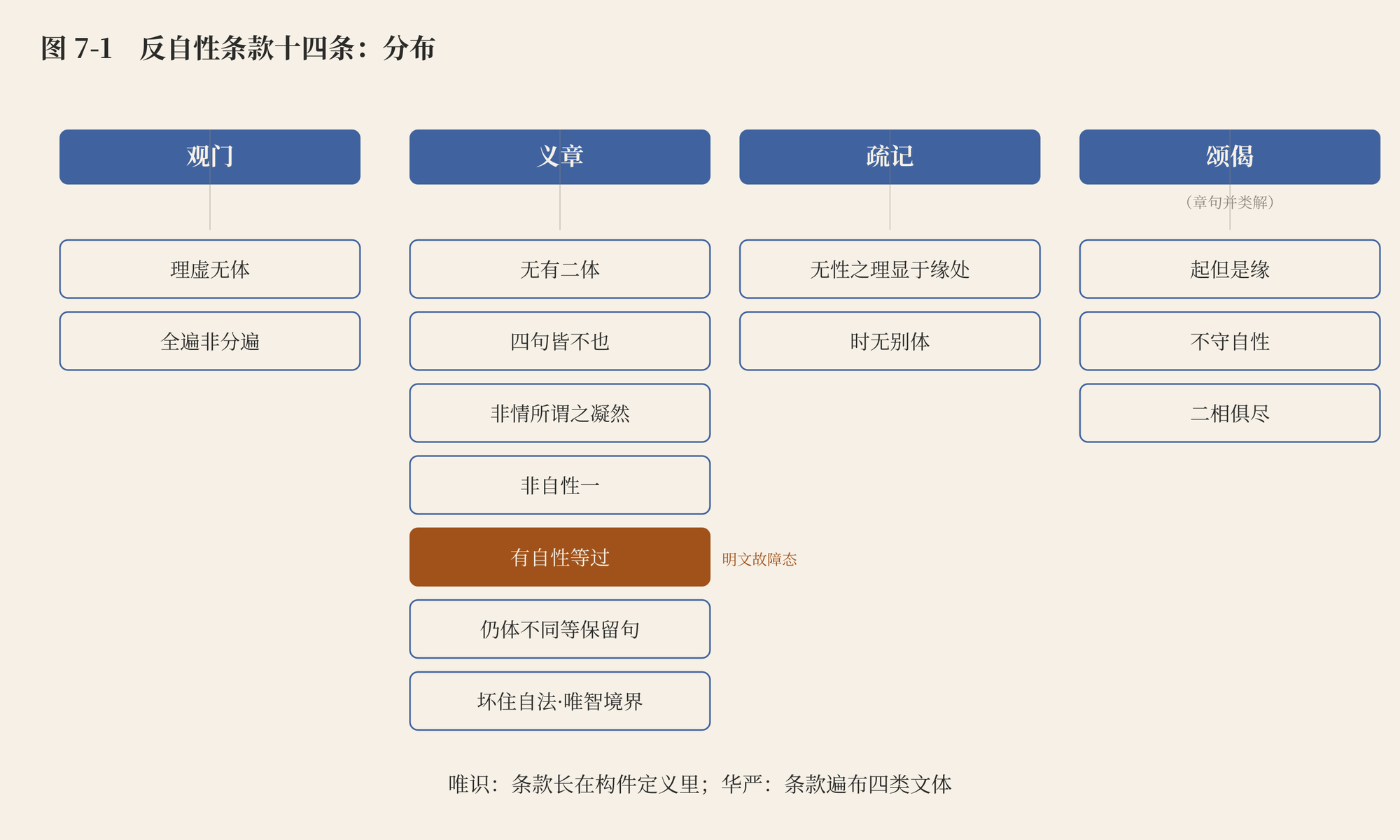
Comparing these fourteen clauses with Essay Twenty's table reveals two structural differences. First, most Yogācāra clauses grow within the definitions of components: six characteristics, eight qualifications, each an admission criterion. Huayan's clauses spread across four genres—contemplative gates, doctrinal sections, commentaries, and verses—with a defense in each. An analogy's antidote is also written on the same page as the analogy. Second, Huayan has a clause Yogācāra lacks. Counting ten coins makes naturelessness the operating condition of the entire grammar. Own-nature is not merely denied item by item; it is explicitly named as the failure state. In accepting the status of designation, Yogācāra complies component by component; Huayan complies through an organized system. The overall table of components and labels in Essay Twenty-One's verdict chapter now has all four entries: the Vibhāṣā establishes components without labels; Yogācāra establishes components with labels attached; Tiantai establishes no components and attaches labels to discourse; Huayan establishes components with an organized system of labels. Huayan's standing is as judged above. Its components are the heaviest—principle in the position of a rule, nature-arising, and the entire dharmadhātu network—and its labeling is the densest, fourteen clauses covering four genres. Label density and component weight increase together: this is the table's most important reading. The density of labeling measures the weight of what is established. Taken together, the four systems give the struggle between restraint and leakage a two-axis scale.
The labels face one final check, concerning their origin: internally derived or externally attached. An internally derived label follows from the argument itself; deleting it impairs the system's reasoning. Counting ten coins makes naturelessness the operating condition of interidentity and interpenetration—otherwise dependent origination is not established. Remove that clause and the mechanism itself stops. In transformation of the basis, the provisional designation of newly acquired purity follows from the definition of the basis as dependently arisen. The checkpoint at the preparation stage is built into the sequence of the path; removing the label changes the route. An externally attached label can be removed without damage. Strip out the exclusions among the six seed characteristics one by one, and seeds still receive perfuming and generate manifestations. Peel off the warning label, and the storehouse misses no turn. Chengguan guarantees true emptiness with sentences from the Ten Grounds Sūtra and familiar Prajñā formulas in Chapter Two: the policy is genuine, but its paper is borrowed. Applying this test throughout Essays Twenty, Twenty-One, and Twenty-Two finds most labels externally attached. After Madhyamaka's legislation, most nonontological testimony from founders of systems consists of paperwork for auditors, not theorems derived from their own arguments. The few internally derived labels are therefore especially important. Counting ten coins is the cleanest instance in the entire sample. This test, together with label density and whether components are established, gives three axes forming the book's full reading of post-Madhyamaka system-building prose. Its governing struggle can now be measured school by school and clause by clause.
Hazardous statements and unresolved questions: the inventory. One hazardous statement: the gold substance originally neither increases nor decreases, the essay's conservation wording closest to substrate language. Three counterweights are on record: the reformulation that arising is solely dharmas arising; the prior statement that gold has no own-nature; and the final exhaustion of gold itself. It belongs in the same hazardous category as “each nature remains” in the Zhao Treatises. Four questions remain open, ranked by weight. Heaviest is the dispute over receiving perfuming, judged above. Next is the shift toward a philosophy of mind. The three-generation table gains a row from the Classified Explanation, making four generations. Nature moves from general characteristic to numinous knowing; permanence moves from permanence not different from impermanence to permanent abiding, unchanging and unaltered. By the fourth generation, the shift has been annotated into the gaps between the root text's words. It is a fact of reception history; recording it does not substitute for judgment. Third is the contraction of scope: Fazang's pervasion of the insentient against Chengguan's denial that the insentient has awakening-nature. The cost of the exchange has been reckoned, facing the case of nature in the insentient in Essay Twenty-One. Fourth is awarding oneself the perfect summit: the ten positions place their own school in the tenth slot. This is recorded alongside Tiantai as a common institutional fault of doctrinal classification, without opening a separate case. There is also the confrontation heard in Chapter Five once both parties' texts were available: Zhanran and Zhili's charge of contemplating principle and cutting off the nine realms. Its three-level verdict: the charge fails against the legislators—the gate of defilement and purity includes all in nature-arising, its scope pervades the insentient, and cutting off targets deluded conditions. It holds against reception history, and Zhili himself specifies the target, numinous knowing as Guifeng's distinctive term: the same case history as this book's table of shifts. Both parties' legislation accepts its status as designation; their disagreement resolves into two disputes over conceptual grammar, the breadth of nature's register and the tightness of the grammar of “is,” insufficient for an ontological charge. The full case of evil in nature belongs to Essay Twenty-One's detailed exposition.
Closing the confrontation over doctrinal classification. Five teachings against eight: both arrangements are constructions on two axes, doctrinal grading and pedagogical parameters. The five teachings add a position for the sudden; the perfect identifies itself as the distinct-teaching One Vehicle and even borrows the Lotus cart analogy to judge the standing of Tiantai's chosen sūtra. The confrontation has more heat than doctrinal substance. Chapter One adds two institutional differences. Huayan sets up a separate axis of positions, with teachings classifying texts and positions classifying propositions; the first six of its ten positions correspond item by item to Part II's records of the Buddhist schools. Simultaneous teaching in the ocean-seal samādhi is paired with the ordinary seal analogy: reading the inscription is sequential, stamping simultaneous. This explicitly separates the two temporal levels of the history of teaching and the dharmadhātu. The three samples of doctrinal classifications judging one another can now be viewed together: three periods against two truths, eight teachings against four levels, five teachings against eight. The conclusion stable across all three tests is Essay Nineteen, Chapter Six's judgment: the logical content carried by doctrinal classification is the grading of doctrinal strength; the rest is the work of adapting to capacities. Awarding oneself the perfect summit is a problem shared by both schools, recorded in the same category.
Huayan's contributions expand from four entries to seven. Dharmadhātu dependent origination maximizes relational ontology while supplying its own clause guarding the point of vulnerability. The six aspects are Chinese philosophy's finest whole–part grammar, with arguments driven throughout by the dilemma of annihilation and permanence: Madhyamaka's negative tools serve positive construction. Counting ten coins gives operational definitions of interidentity and interpenetration, emptiness and existence yielding place, powers and functions permeating one another—a text on mechanisms rare in Chinese Buddhist thought. The ten gates of nonobstruction between principle and phenomena form a complete relational algebra between them, five pairs operating in both directions, with formation, destruction, disclosure, and concealment all functional predicates. Nature-arising makes the tathāgatagarbha line into a system and surrenders own-nature at its entrance. Doctrinal classification separates two axes; the position axis supplies a taxonomy of the Buddhist schools still usable today. The Golden Lion demonstrates the system's compressibility: brief exposition has an ancient precedent. Its commentator marks the compression ratio himself, the single and the double running side by side, and the final gate exhausts gold too.
The overall verdict, in the form of Essay Twenty's but one step further: the text is safe, and safe through an organized system. Fourteen clauses constitute legislation covering every genre, well beyond scattered caution. Readings may not be safe; the shift in reception history is measurable across four generations. This book therefore does not ask whether Huayan is idealism or ontology. The question remains: which statement, used at which level, with what accompanying clauses?
The ten essays of treatise reading close here, with a look back. Essay Thirteen set the question for the whole volume: the early teaching's restraint before metaphysics, and the leakage that inevitably occurs at the point of restraint. Essays Fourteen and Fifteen examined how two inventory systems and one ontology leak into entities while filling gaps. Essay Sixteen examined a commentarial system that stops through adjudication rather than argument. Essay Seventeen followed internal reductions of weight to the threshold. Essay Eighteen cast the pathology of leakage as a theorem: definition requires sameness and difference, while own-nature cancels them; hence contradiction. It also proved preservation: emptiness supports the whole level of everyday life. Essay Nineteen examined two reception histories of this proof, the dispute over authorization and the debate over the two truths. Essay Twenty examined the complete form of conventional mechanics, whose major components carry their own clauses against own-nature. Essay Twenty-One examined Tiantai's reading of that verse as three truths, with defenses retained in its legislation; Essay Twenty-Two examined Huayan's extension of dependent origination to inexhaustibility, with its own clauses guarding its vulnerable points. One line in one sentence: the governing theme of this history of philosophy is the struggle between metaphysical restraint and leakage. After Essay Eighteen, that struggle has explicit rules of adjudication. Every subsequent step of every school can be asked, under the clauses, whether it accepts its status as designation. The two Chinese perfect teachings turn in unexpectedly coherent answers. At their own entrances, the legislators have each written with their own hands the line refusing to hold to own-nature. When Essay Thirteen opened, the Buddha held a handful of leaves. Ten essays later, the leaves are still that handful, the forest is still outside the window, and the rules for counting the leaves are now on paper.1
The treatise readings end with Essay Twenty-Two. Faxiang, Chan, and a general account of tathāgatagarbha each have signposts on record, for future detailed exposition or another volume. Part II does not end here. Essay Twenty-Three, on Mahāyāna sūtras, follows under a different arrangement from the preceding twenty-two essays. It reads sūtras without going through treatise authors. Its list of texts will expand as work continues, with no predetermined total length. What this passage closes is these ten essays. The book's afterword follows Essay Twenty-Three.
References
References
-
This chapter closes the essay and Essays Thirteen through Twenty-Two, introducing no new material. Its grounds are given in this essay's chapter notes, the clauses of Essay Eighteen, and the verdict chapters of Essays Nineteen through Twenty-One; the original sources in the table of clauses against own-nature are the same. Chapter Five has already expanded the detailed-exposition points concerning receiving perfuming and the tendency toward principle as substance. The materials are fascicle sixteen of the Record of Exploring the Mysteries (T1733), the Awakening of Faith and Fazang's Commentary on Its Meaning (T1666/T1846), fascicles two and four of the Five Teachings (T1866), fascicle two of the Establishment of Consciousness-Only (T1585), Chengguan's commentary and subcommentary (T1735/T1736), and the Inquiry into the Origin of Humanity (T1886). The direct Tiantai texts for the charge of contemplating principle and cutting off the nine realms—the Diamond Scalpel (T1932), Subcommentary on the Essentials (T1928), Profound Meaning of Guanyin (T1726), and Record of Teaching and Practice (T1937)—were heard and judged in Chapter Five on 2026-08-05. Quotations appear in that chapter's notes. ↩