Chapter Four The Perfect Interfusion of the Six Aspects: A Direct Confrontation over Sameness and Difference
The six aspects are listed in fascicle four of the Five Teachings, which supplies its own definitions: “The aspect of wholeness: one house has many virtues. The aspect of particularity: the many virtues are not one; the particularities depend on and stand in relation to the whole, filling out that whole.” “The aspect of commonality: the many meanings do not conflict, jointly constituting one whole.” “The aspect of differentiation: the many meanings, viewed in relation to one another, each differ.” “The aspect of integration: these conditions bring about its constitution.” “The aspect of nonintegration: the meanings each remain in their own dharma without moving.”1 Three pairs, six aspects: wholeness and particularity concern whole and parts; commonality and differentiation concern cooperation and differences; integration and nonintegration concern joint constitution and each standing separately.
First, identify the job. The section on the six aspects states why the teaching arises: “This teaching discloses the One Vehicle perfect teaching's dharmadhātu dependent origination: inexhaustible perfect interfusion, free interidentity, unobstructed fusion, extending to Indra's infinite principle and phenomena and so forth. When this meaning becomes present, among all delusions and obstacles, cutting off one cuts off all … At the first arousal of the aspiration, perfect awakening is attained.”1 The preceding section on the ten mysteries ends by saying: “Each of these ten gates contains all the other gates without remainder. They should be comprehended together through the skillful means of the six aspects.”1 Together, the two passages clearly state the six aspects' position. They are a means of comprehending the ten mysteries together, a general format for reading all dependently arisen dharmas. The questions and answers begin with the declaration: “Dependent origination applies everywhere. For now, let us briefly distinguish it in the constitution of a house through conditions.”1 The house is a demonstration sample; the scope is all dependently arisen dharmas. The text registers the six aspects as a method. Record this point now: the verdict will need it.
The question for confrontation is thereby set. Essay Eighteen's definition-boundary clause establishes sameness and difference as logical constants. Their laws are laid down; they are not defined. Sameness and difference are tools of individuation, not entries in an inventory of the world's characteristics. Yet the perfect interfusion of the six aspects makes sameness, difference, wholeness, particularity, integration, and nonintegration into six aspects of the dharmadhātu, and declares all six simultaneously complete. Have tools been raised to an altar? This is the closest encounter between the book's toolkit and a classical system. The outcome must be decided by the original text's usage.
The house analogy opens: the rafter is the house. The usage is displayed in the house analogy, a passage of questions and answers whose literal wording contains all its surprise. “Question: What is the aspect of wholeness? Answer: The house.” The question follows: these are merely the conditions, rafters and so forth; which is the house? The answer goes further: “The rafter is the house.” Then the reason: “Because the rafter, entirely on its own, can make the house. Apart from the rafter, the house is not constituted. When the rafter is obtained, the house is obtained.” The questioner presses: if the rafter can make the house entirely on its own, it should do so before there are tiles. Answer: “Before there are tiles and so forth, it is not a rafter, and so it does not make the house. It is not that it is a rafter but cannot make it … A rafter is a causal condition. Before the house is constituted, there is no causal condition, so it is not a condition. If it is a rafter, the whole is necessarily constituted.”1 A rafter outside the making of a house does not count as a rafter at all; it is merely a piece of wood. This is the key to the entire case. A rafter is individuated as a rafter by its house-making job; a house is individuated as a house by the cooperation of rafters and tiles. The examples in Essay Eighteen, Chapter Four, state that a mover is individuated by moving, and a condition is retrospectively identified through its result. Fazang's rafter is retrospectively identified through the house: the same grammar, carried further. The four characters 椽即是舍, “the rafter is the house,” can now be decoded. They are a limiting statement of definitional interdependence, not a declaration of numerical identity: the same case and verdict as “is” in the ten mysteries.
The small-contribution objection: the assembly model explicitly rejected. The questioner proposes the commonsense solution. Each condition contributes a little power, and the combined powers make the house. Would that not be sound? The answer explicitly closes this route: “If each does not constitute the whole but supplies only a little power, the conditions each supply a little power. This is merely many little powers, not one whole house; hence annihilation. If all conditions supply little power and none constitutes the whole, to insist that a whole house exists is to posit existence without a cause; hence permanence.”1 A model in which each part contributes a share adds up only to a pile of shares, never that complete house. Bypass the shares and directly declare a house, and the house exists without a cause. The two faults, annihilation and permanence, block the two ends. An empirical lever follows: “If it does not constitute the whole, the house should remain when one rafter is removed.”1 On the small-contribution model, removing one rafter should lose only a little power; the house should remain. What actually remains when one rafter is removed, the answer says, “is merely a broken house, with no sound house. Thus we know that the sound house depends wholly on one rafter.”1
The distinction between a sound house and a broken house is the point in this exchange that most needs slow reading. The pile of wood and stone remains after a rafter is removed; the text does not deny that. What has gone is the sound house that qualifies as a house. The quantifier in “constituting the whole” becomes visible. The rafter makes the house entirely on its own, but what it makes is the sound house, the whole in the sense of a qualified whole. What is measured is qualification, not timber. Read “constituting the whole” as supplying all physical support, so that one rafter's collapse brings down the whole house, and experience immediately refutes it. The text's own answer has already moved the domain to the level of qualification. At this point in the confrontation, the opposing party's testimony begins to favor this book. The objects quantified by the six aspects' judgments are qualified wholes and qualified components: registered terms, never a pile of material from the outset.
The boards-and-tiles objection: interidentity spreads horizontally. The questioner presses again. If the house is the rafter, must boards, tiles, and the rest also be the rafter? Answer: “They are all the rafter. Why? Remove the rafter and there is no house. Why is this so? Without the rafter the house is destroyed; when the house is destroyed, they are no longer called boards, tiles, and so forth. Thus boards, tiles, and so forth are the rafter.”1 Remove the rafter and the house is destroyed; destroy the house and the boards cease to qualify as its boards, the tiles as its tiles. Their qualification depends on the house, and the house's qualification depends on the rafter; thus the boards and tiles are the rafter. Interidentity spreads from the vertical relation of part and whole, through the whole as intermediary, into a horizontal network among components. The conclusion raises the demonstration to a general rule: “As with one rafter, so with the others. Thus all dependently arisen dharmas either fail to be constituted or, when constituted, interidentify.”1 The four characters 成則相即, “when constituted, interidentify,” are the six aspects' clause for the entire network. Whatever is validly constituted has qualifications linked to those of the rest; removing one affects the whole. “If there is no ten, whose one is it?” in Chapter Three's coin counting measures one and many. Here the objects are components and whole. The two demonstrations run on the same power.
Pairwise distinctions among particularity, commonality, and differentiation. Particularity: “The conditions, rafters and so forth, differ from the whole. Without this distinction, the meaning of the whole would not be established … The whole is constituted through the particularities; without particularities, the whole is not constituted.”1 The whole is constituted through particularities, and particularities are established through the whole: “If it is not the house, it is not a rafter; if it is not the rafter, it is not the house.” Whole and particularities interidentify. Commonality: “The conditions, rafters and so forth, harmoniously make the house. Since they do not conflict, they are all called conditions of the house. Since they do not make something else, this is called the aspect of commonality.” The questioner immediately checks for duplication: how does this differ from wholeness? Answer: “Wholeness is stated solely with reference to the one house. Commonality here concerns the conditions, rafters and so forth. Although their bodies differ, their constitutive powers are equal in meaning; hence the aspect of commonality.”1 Wholeness views the scene from the house; commonality views it from the cooperation of the conditions. One scene, two perspectives. Differentiation: “The conditions, rafters and so forth, differ when viewed against one another according to their respective shapes and kinds.” Another check: how does differentiation differ from particularity? Answer: “The preceding aspect of particularity concerns only the conditions, rafters and so forth, as distinct from the one house. The aspect of differentiation here concerns those conditions viewed reciprocally against one another, each with its different aspect.”1 Particularity distinguishes conditions from the house; differentiation distinguishes conditions from each other. Again, two perspectives. Another sentence in the exchange on differentiation brings the issue down to earth: “If they did not differ, since the rafter is one zhang and two chi long, the tile should be likewise, destroying the original dharmas of the conditions.”1 Without differentiation, a tile would have to be as long as the rafter, one zhang and two chi. Each thing would lose its own way of being, and the house would fail to form.
These three exchanges checking for duplication provide excellent evidence for judging the character of the six aspects. Whenever two of the six headings approach one another, the boundary supplied by the text is a difference in viewpoint: toward the one house, toward the conditions, or reciprocally toward each other. The six aspects are six directions of registration. The same instance of dependent origination is registered once from each of six directions. This is the original text's own usage, adequately documented in the preceding note, without this book having to speak on its behalf.
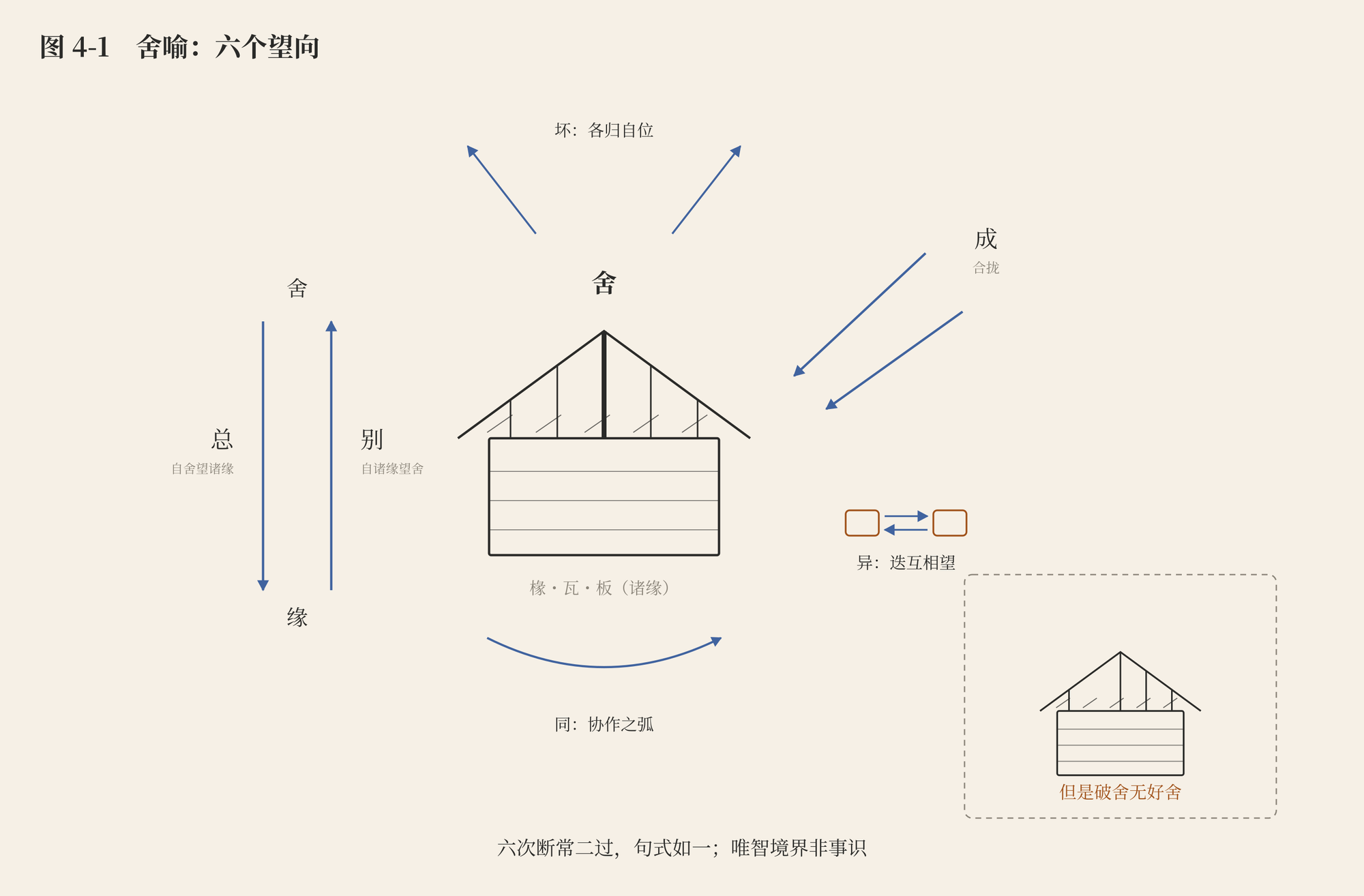
Integration and nonintegration reversed: constitution through not making. Integration: “Through these conditions the meaning of the house is established. Because they constitute the house, rafters and so forth are called conditions. Otherwise neither would be constituted.” The questioner appeals to common sense once more. Rafters and the rest plainly remain in their own dharmas and originally do not make a house. On what basis is the house established? The answer is the deepest doctrinal statement in the section: “Only because the conditions, rafters and so forth, do not make it is the meaning of the house established. Why? If the rafter went over into making the house, it would lose the original dharma of the rafter, and the meaning of the house could not be established.”1 The section on nonintegration repeats the same statement in reverse: “If it went over into making the house, no longer remaining in its own dharma, the meaning of there being a house could not be established … Since the house is now constituted, we clearly know that it does not make it.”1
Hold the two characters 作去, “go over into making,” in view. If the rafter goes over into making the house, it becomes the house and loses the rafter's dharma. Once that is lost, no rafter is available, and the house cannot be constituted. The condition of joint constitution is therefore precisely not changing form. Each component keeps to its own dharma, cooperating without being remade. Integration and nonintegration thereby obtain simultaneously and condition each other. This is the counterpart, in whole–part relations, of Chapter Five's distinction between manifestation and production. There it is manifestation rather than production: a producer need not become its product. Here constitution does not await making: components need not turn into the whole. Joint constitution through dependent origination involves no transfer of material, only cooperation among qualifications. The Five Teachings states the reasoning in both directions and supplies the two faults of annihilation and permanence, drawing a boundary against both the assembly model and the transformation model. The small-contribution objection closes the additive reading; the fault of going over into making closes the transformative reading. The sole remaining route is interidentity at the level of qualification.
A separate note on the form of argument. The section on the six aspects uses only one method of proof throughout: posit the contrary, then derive the two faults of annihilation and permanence. No particularity leads to annihilation and permanence; no commonality, to annihilation and permanence; no differentiation, to annihilation and permanence; no integration, to annihilation and permanence; going over into making, to annihilation and permanence. Six occurrences in the section, all with the same form. The dilemma of annihilation and permanence is Madhyamaka's specialty, powering the central derivation of Essay Eighteen. Fazang uses it here for positive construction. Before establishing each aspect, he dismantles its contrary with the dilemma. A relational grammar supported clause by clause by negative argument: this is the deepest methodological kinship between the section on the six aspects and this book's measuring instrument, more substantial than any verbal resemblance.
The status of sameness and difference within the six aspects is now clear. Commonality in the six aspects—many meanings not conflicting and jointly forming one whole—concerns cooperation. Differentiation—many meanings each differing when viewed against one another—concerns the division of labor among conditions. Both are relational characteristics within the analysis of dependent origination. What continues to operate beneath them is sameness and difference as logical constants. Saying that rafters and tiles each differ is precisely to use the instrument that is not itself defined. The verdict on the confrontation is therefore this: the six aspects have not overstepped. They are a grammar of dependent origination made with the tools of sameness and difference. The tools remain in their original positions; what has been constructed is a fine-grained grammar of parts and whole. Chinese philosophy has no second whole–part grammar on this scale.
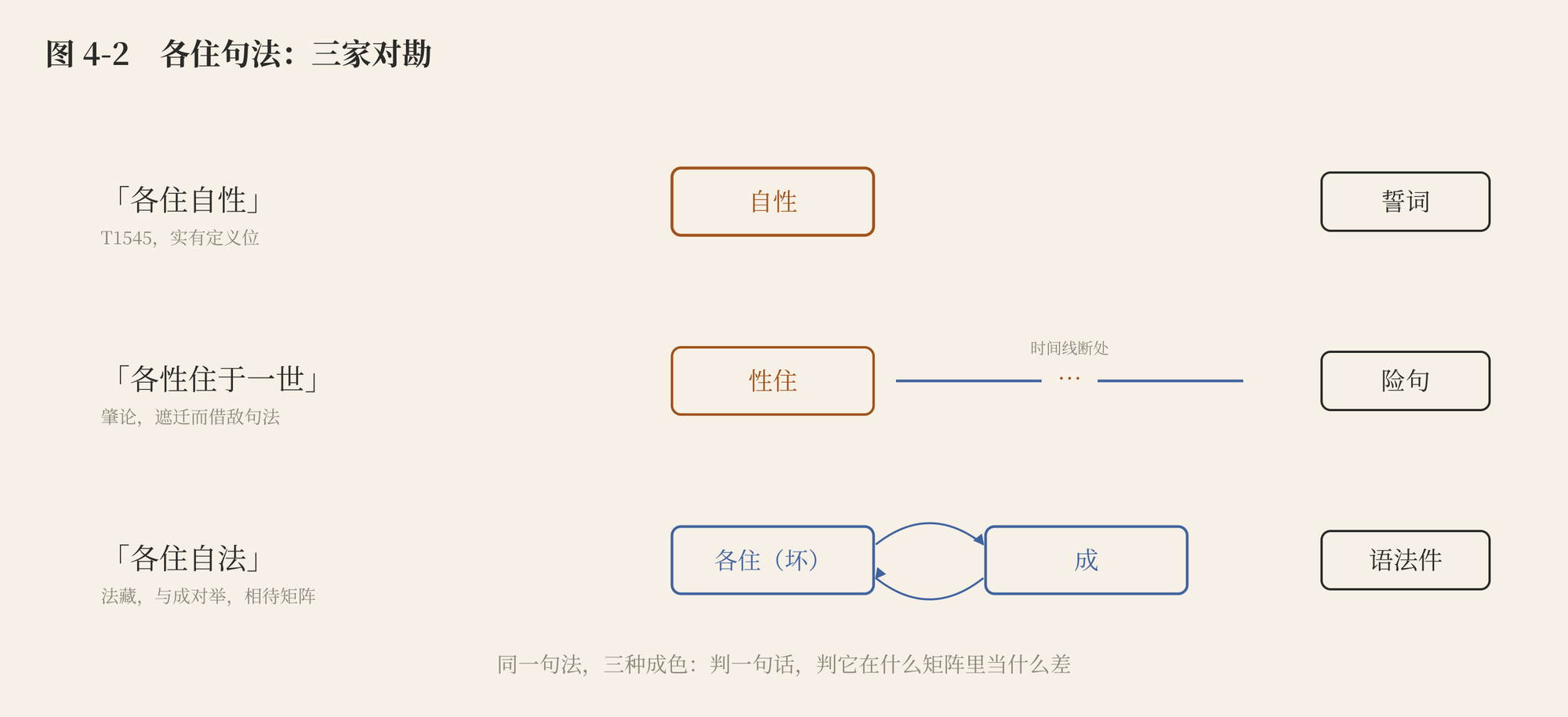
The four characters 各住自法, “each remains in its own dharma,” are separately entered as evidence. The explanation of nonintegration says that the meanings each remain in their own dharma without moving. The syntactic family of “each remains” now has a third member. Essay Fifteen has “each remains in its own-nature,” found only once in the whole of T1545, at the point where real existence is defined: an ontological pledge. The Zhao Treatises has “each nature remains in one time,” intended to block movement but borrowing the opponent's syntax: judged a hazardous statement. Fazang's “each remains in its own dharma” obtains simultaneously with integration. Remaining individually concerns the separate side of components in dependent origination; integration concerns their cooperative side. The two sides of one thing are explicitly juxtaposed, confining “each remains” within a matrix of mutual dependence. Three thinkers, one syntax, three standings: pledge, hazardous statement, grammatical component. This comparison is a small summative example of the book's method. Judge a statement by the job it performs in its matrix, not by its surface wording.
An eight-line verse closes the section. The section on the six aspects ends with a verse, quoted in full: “One contains many: this is wholeness. / Many are not one: this is particularity. / Many kinds share commonality and form the whole. / Each body's distinct difference appears within commonality. / The principle of dependent origination of one and many is wondrously accomplished. / In nonintegration each remains in its own dharma, always without making. / This is wisdom's domain alone, not phenomenal cognition. / Through this skillful means comprehend the One Vehicle.”1 The first six lines each give one aspect. They are precisely the six lines quoted by the Classified Explanation of the Golden Lion in Chapter Six. The last two lines are the text's own registration labels. “Wisdom's domain alone, not phenomenal cognition”: the six aspects are a contemplative format used by wisdom, not entries in the inventory of characteristics before phenomenal cognition. “Through this skillful means comprehend the One Vehicle”: “skillful means” is the job the text declares for itself. The five-character phrase 視角語法學, “a grammar of perspectives,” has already been said by the verse in its own words.
Draft verdict: the six aspects are a grammar of perspectives. The evidence has grown from three items in the earlier case to six: the operational character of the house analogy and the retrospective syntax in which there is no rafter before the house is constituted; the distinction between sound and broken house, fixing the quantifier at the level of qualification; the horizontal spread of “boards and tiles are the rafter” and the network-wide clause “when constituted, interidentify”; the three exchanges checking for duplication, all drawing boundaries by viewpoint; constitution through not making, closing both the additive and transformative readings that overstep; and the eight-line verse's own labels, wisdom's domain and skillful means. The matrix position of “each remains in its own dharma” stays on record. An ontological reading of characteristics is classified as a risk of rhetorical overreach, of the same type as Tiantai's middle truth. These findings pass to Chapter Seven.
References
References
-
Treatise on the Divisions of the Teaching and Meaning of the Huayan One Vehicle, fascicle four (T45, no. 1866, pp. 505c15–509a3), the perfect interfusion of the six aspects. Establishing the names: “The aspect of wholeness: one house has many virtues. The aspect of particularity: the many virtues are not one; the particularities depend on and stand in relation to the whole, filling out that whole. The aspect of commonality: the many meanings do not conflict, jointly constituting one whole. The aspect of differentiation: the many meanings, viewed in relation to one another, each differ. The aspect of integration: these conditions bring about its constitution. The aspect of nonintegration: the meanings each remain in their own dharma without moving.” Why the teaching arises: “This teaching discloses the One Vehicle perfect teaching's dharmadhātu dependent origination: inexhaustible perfect interfusion, free interidentity, unobstructed fusion, extending to Indra's infinite principle and phenomena and so forth. When this meaning becomes present, among all delusions and obstacles, cutting off one cuts off all … At the first arousal of the aspiration, perfect awakening is attained.” Conclusion of the ten-mysteries section: “Each of these ten gates contains all the other gates without remainder. They should be comprehended together through the skillful means of the six aspects.” Questions and answers: “Dependent origination applies everywhere. For now, let us briefly distinguish it in the constitution of a house through conditions.” “Question: What is the aspect of wholeness? Answer: The house.” “The rafter is the house. Why? Because the rafter, entirely on its own, can make the house. Apart from the rafter, the house is not constituted. When the rafter is obtained, the house is obtained.” “Before there are tiles and so forth, it is not a rafter, and so it does not make the house. It is not that it is a rafter but cannot make it … A rafter is a causal condition. Before the house is constituted, there is no causal condition, so it is not a condition. If it is a rafter, the whole is necessarily constituted.” Small-contribution objection: “If each does not constitute the whole but supplies only a little power, the conditions each supply a little power. This is merely many little powers, not one whole house; hence annihilation. If all conditions supply little power and none constitutes the whole, to insist that a whole house exists is to posit existence without a cause; hence permanence. If it does not constitute the whole, the house should remain when one rafter is removed.” Broken house: “Question: With one rafter absent, is it not still a house? Answer: It is merely a broken house, with no sound house. Thus we know that the sound house depends wholly on one rafter.” Boards-and-tiles objection: “Question: If the house is the rafter, should the other boards, tiles, and so forth also be the rafter? Answer: They are all the rafter. Why? Remove the rafter and there is no house. Why is this so? Without the rafter the house is destroyed; when the house is destroyed, they are no longer called boards, tiles, and so forth. Thus boards, tiles, and so forth are the rafter.” “As with one rafter, so with the others. Thus all dependently arisen dharmas either fail to be constituted or, when constituted, interidentify.” Particularity: “The conditions, rafters and so forth, differ from the whole. Without this distinction, the meaning of the whole would not be established … The whole is constituted through the particularities; without particularities, the whole is not constituted.” “For example, the rafter is the house, hence the aspect of wholeness; it is the rafter, hence the aspect of particularity. If it is not the house, it is not a rafter; if it is not the rafter, it is not the house.” Commonality and the duplication check: “The conditions, rafters and so forth, harmoniously make the house. Since they do not conflict, they are all called conditions of the house. Since they do not make something else, this is called the aspect of commonality.” “Wholeness is stated solely with reference to the one house. Commonality here concerns the conditions, rafters and so forth. Although their bodies differ, their constitutive powers are equal in meaning; hence the aspect of commonality.” Differentiation and the duplication check: “The conditions, rafters and so forth, differ when viewed against one another according to their respective shapes and kinds.” “If they did not differ, since the rafter is one zhang and two chi long, the tile should be likewise, destroying the original dharmas of the conditions.” “The preceding aspect of particularity concerns only the conditions, rafters and so forth, as distinct from the one house. The aspect of differentiation here concerns those conditions viewed reciprocally against one another, each with its different aspect.” Integration: “Through these conditions the meaning of the house is established. Because they constitute the house, rafters and so forth are called conditions. Otherwise neither would be constituted.” “Only because the conditions, rafters and so forth, do not make it is the meaning of the house established. Why? If the rafter went over into making the house, it would lose the original dharma of the rafter, and the meaning of the house could not be established.” Nonintegration: “The conditions, rafters and so forth, each remain in their own dharma and originally do not make it.” “If it went over into making the house, no longer remaining in its own dharma, the meaning of there being a house could not be established … Since the house is now constituted, we clearly know that it does not make it.” Eight-line verse: “One contains many: this is wholeness. / Many are not one: this is particularity. / Many kinds share commonality and form the whole. / Each body's distinct difference appears within commonality. / The principle of dependent origination of one and many is wondrously accomplished. / In nonintegration each remains in its own dharma, always without making. / This is wisdom's domain alone, not phenomenal cognition. / Through this skillful means comprehend the One Vehicle.” ↩↩↩↩↩↩↩↩↩↩↩↩↩↩↩↩↩