Chapter One From Scripture to School: Three Translations, Five Teachings, and Ten Positions
First, the sūtra texts. The Huayan Sūtra has three Chinese translations. The sixty-fascicle version, translated by Buddhabhadra under the Eastern Jin, has thirty-four chapters, seven locations, and eight assemblies: the old translation. The eighty-fascicle version, translated by Śikṣānanda under the Tang, has thirty-nine chapters, seven locations, and nine assemblies: the new translation, and the base text for this essay. The forty-fascicle version, translated by Prajñā during the Tang Zhenyuan era, is in fact an expanded, separately circulated version of the chapter on entering the dharmadhātu. It contains the chapter on Samantabhadra's practices and vows, and its final fascicle still circulates independently. The eighty-fascicle version stages assembly after assembly to teach one dharmadhātu. The assemblies move from earth to celestial palaces and back to earth; the arrangement of the places of teaching is itself an arrangement of doctrine. The chapter on entering the dharmadhātu comes last. Sudhana's fifty-three visits turn the teaching of the entire sūtra into a journey in search of the Dharma. The scale and structure of the sūtra themselves embody the school's orientation: it takes inexhaustibility, rather than any single doctrine, as its defining principle.
The destination of that journey deserves a closer look. Entering Maitreya's tower, Sudhana “saw that the tower was vast and immeasurable, like space.” Within it he further saw “immeasurable hundreds of thousands of wondrous towers … all vast, magnificent, and beautiful like space, neither obstructing one another nor becoming confused. In one place the youth Sudhana saw all places, and he saw every place in this same way.” As he bowed, “he saw his own body pervading all the towers.”1 One tower contains innumerable towers, and the observer himself pervades them all. Nonobstruction among phenomena did not have to await the patriarchs' doctrinal formulations: the sūtra had already demonstrated it in a building. Indra's net in Chapter Three, the golden lion in Chapter Six, and the single flower petal in the Record of Exploring the Mysteries are all miniature reenactments of this tower. The school's entire system has a prototype within the sūtra.
The school's lineage of five patriarchs. Dushun established the gates of contemplation; Zhiyan established the ten mysteries and the Kongmu Chapters; Fazang formed the school; Chengguan expanded its teaching through his commentary and subcommentary; and Zongmi introduced the distinction between Chan and doctrinal teaching. The actual architect of the system was Fazang. This essay takes him as its axis, Dushun and Zhiyan as its sources, and selected passages from Chengguan and Zongmi. With the chapters now expanded, each name in this list can be matched to the relevant texts. Under Dushun stand the three contemplations in the Gates of Contemplation of the Dharmadhātu, the main text of Chapter Two. Under Zhiyan stand the old ten mysteries and the source of the ten-coins demonstration, the left column of Chapter Three's comparison table. Under Fazang stand the Five Teachings, the Record of Exploring the Mysteries, the Commentary on the Meaning of the Awakening of Faith, and the Golden Lion, the central materials of Chapters Two through Six. Under Chengguan stand the Mystic Mirror of the Dharmadhātu and the commentary and subcommentary, the explanatory text of Chapter Two and the intermediate stage in Chapter Five's turn toward a philosophy of mind. Under Zongmi stand the Commentary on the Gates of Contemplation of the Dharmadhātu and the Inquiry into the Origin of Humanity, the last row of Chapter Five's table of shifts. The lineage is no longer just a list: each of the five names anchors a stretch of the argument.
Huayan's own doctrinal classification: the five teachings. The Five Teachings establishes five grades: “The sacred teachings vary in countless ways, but in essentials there are only five: first, the small-vehicle teaching; second, the initial Mahāyāna teaching; third, the final teaching; fourth, the sudden teaching; fifth, the perfect teaching.” It immediately explains that “the last is the distinct-teaching One Vehicle.”2 For scriptural evidence of the distinction between initial and final, Fazang takes the feast analogy from the Dharma Drum Sūtra, concluding: “As an incomplete account of the principle of emptiness, it is called the initial teaching. Insofar as it concerns the wondrous scriptures of the permanent tathāgatagarbha, it is called the final teaching.”3 He also maps the sudden and gradual onto the Awakening of Faith: “Through the gate of the sudden teaching it discloses thusness beyond words; through the gate of the gradual teaching it speaks of thusness through words. Within this dependence on words, the initial and final teachings speak respectively of the two kinds of thusness, empty and nonempty.”3 The grading axis is clear. Above the small vehicle, Mahāyāna is divided into initial and final according to emptiness and nonemptiness. What is beyond words receives a separate sudden position, while the distinct-teaching One Vehicle places itself at the perfect summit. The division between initial and final is precisely the doctrinal classification's registration of the divergence over perfuming in Chapter Five: remaining still and not making dharmas is assigned to the initial teaching; following conditions to constitute everything, to the final teaching. Chapter Five quotes the passage in full.
Distinguishing positions by principle: ten positions. Apart from the five teachings, the Five Teachings sets up another axis: “Distinguishing positions by principle, there are ten positions.”4 These separate axes are a distinctive institutional feature of the classification. The teaching axis grades scriptures by the depth of what may be said; the position axis classifies standpoints by the doctrines they establish. A scripture may be assigned to one teaching while its standpoint belongs to a particular position. Teaching locates a text; position locates a proposition. Tiantai's eight teachings operate on a single axis, with the four teachings concerning the content of instruction doing both jobs. Huayan separates the jobs and gives each an axis. The relation between the list of ten positions and the eight positions in the Faxiang line remains on record for future inquiry; the relevant texts have not been checked against the original books. The complete list and its referents follow:
| Position | Referents in the Five Teachings | Standpoint in one sentence | Where this book examines it |
|---|---|---|---|
| One: self and dharmas both exist | The human and celestial vehicles, the Vātsīputrīyas, and others | Five stores of dharmas are established; the fifth, the inexpressible store, “is precisely the self” | The pudgala case in Essay Seventeen, Chapter Six, and Essay Eighteen, Chapter Nine |
| Two: dharmas exist, the self does not | The Sarvāstivādins and others | “The three times and the unconditioned” comprise all dharmas; “all dharmas really exist” | The full cases in Essays Fifteen and Sixteen |
| Three: dharmas have no past or future | The Mahāsāṃghikas and others | “The present and unconditioned dharmas exist, because past and future have neither substance nor function” | The opposing side in Essay Fifteen, Chapter Three |
| Four: the present includes both provisional and real | The Prajñaptivādins, the Satyasiddhi, and particular Sautrāntika teachers | “As aggregates they may be real; as elements and bases they are provisional”; provisionality and reality vary with the case | The Sautrāntika line in Essay Seventeen |
| Five: the conventional is false, the ultimate real | The Lokottaravādins and others | All conventional things are provisional; supramundane dharmas are real | Recorded for later treatment |
| Six: dharmas are only names | The Ekavyavahārikas and others | “All selves and dharmas are merely provisional names, having no substance at all” | Recorded for later treatment; “this extends to the beginning of the initial teaching” |
| Seven: all dharmas are empty | The initial Mahāyāna teaching, Prajñā | All dharmas are truly empty | Essay Eighteen |
| Eight: real virtues are nonempty | The scriptures of the final teaching | All dharmas are solely thusness, “because it has its own substance and possesses the virtues of its nature” | The main subject of Chapter Five |
| Nine: characteristics and thought both cease | The sudden teaching, “as Vimalakīrti discloses through silence” | Principle beyond words | Jizang's line of forgetting words and ending thought in Essay Nineteen |
| Ten: perfect illumination endowed with virtues | The distinct-teaching One Vehicle | Host and companions fully present, inexhaustible and free | This essay |
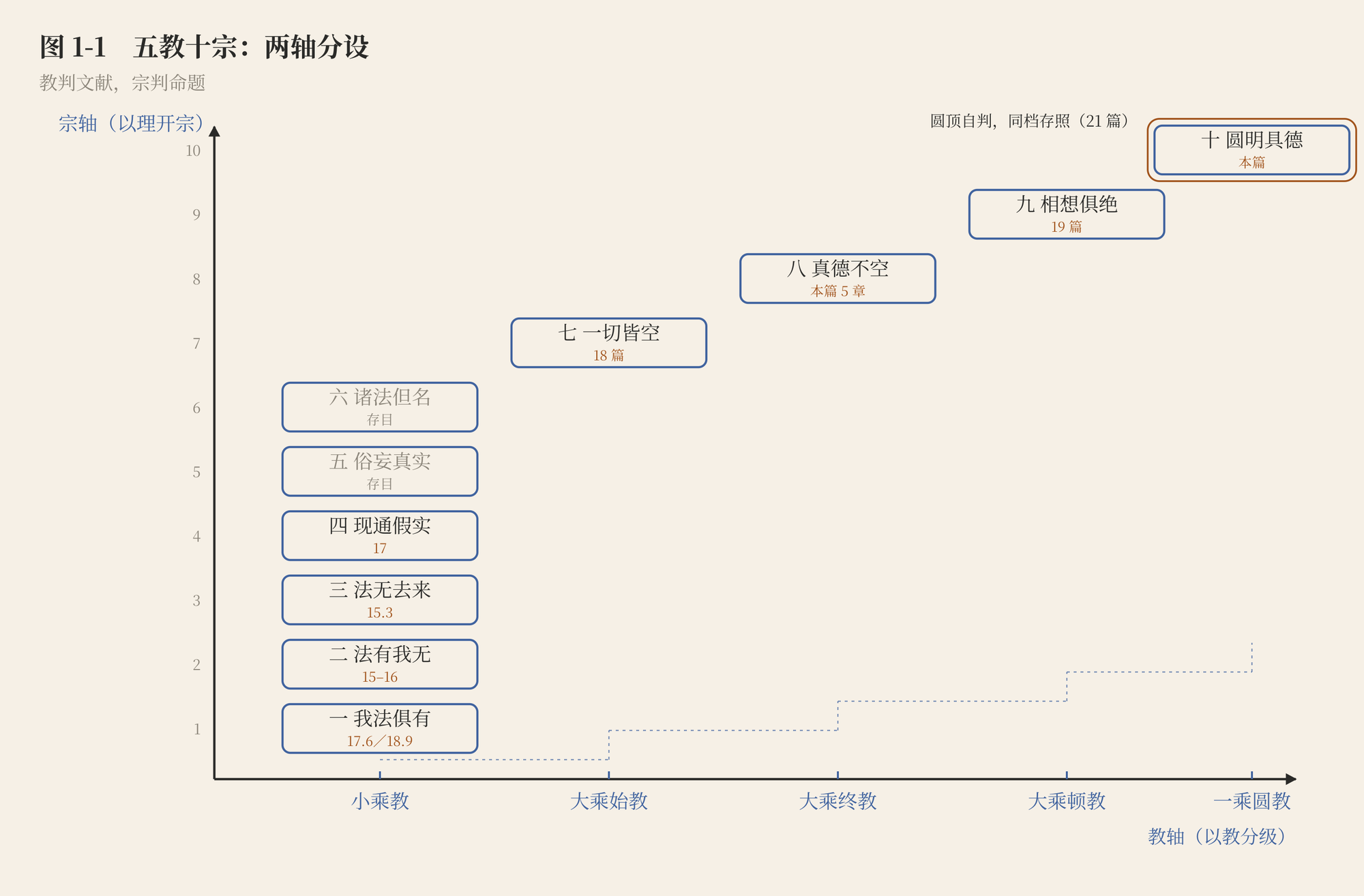
This table calls for two readings. The first assesses its scholarly merit. The first six positions form a taxonomy of the standpoints of the Buddhist schools: the Vātsīputrīyas' inexpressible store, the Sarvāstivādins' real existence in the three times, the Mahāsāṃghikas' denial of substance to past and future, and the Sautrāntikas' provisional elements and bases. Every entry is concrete, matching the materials examined directly in Essays Fourteen through Seventeen of Part II. A framework of doctrinal classification from the late seventh century produced an index of doctrines that remains usable today. The second reading assesses its institutional character. The ten positions are lined up, and the school's own position occupies the tenth slot. Combining a taxonomy and a ranking in one table is standard practice in this genre, as Essay Twenty-One has already judged: grading carries real logical content; awarding oneself the perfect summit is an institutional self-interest shared by both schools, recorded in the same category. One further detail in the Vātsīputrīya entry deserves attention. What the Five Teachings singles out is precisely the inexpressible store. The verdict on the pudgala in Essay Eighteen, Chapter Nine, falls at exactly the point of inexpressibility. Both routes have been adjudicated: refusing to state anything withdraws from the domain of the question; treating the term as a determination leaves predication intact. Fazang chooses this category as the mark of the first position. His eye and the measuring instrument agree.
The confrontation: five teachings against eight. Three structural differences mark the confrontation with Tiantai's eight teachings. The five teachings make a further division between initial and final, separating Mahāyāna according to empty characteristics and nonemptiness. The sudden teaching receives an independent position, reserving a place for what does not depend on verbal instruction. The perfect teaching identifies itself as the distinct-teaching One Vehicle: “This distinct-teaching One Vehicle is distinct from the three vehicles.” It even uses the Lotus Sūtra's own cart analogy to decide the matter. The three carts at the doorway are the three vehicles, while “the ox cart bestowed in the open ground outside the realm is the One Vehicle teaching.”2 Using Tiantai's prized possession to establish a higher grade beyond the sūtra Tiantai venerates: that maneuver contains all the polemical heat of this confrontation.
Alongside the distinct teaching stands the common teaching's inclusive One Vehicle. Fazang himself gives five ways of combining and dividing the five teachings: “First, they may be combined as one … Second, they may be divided into two: one, the root teaching, since the distinct-teaching One Vehicle is the root of all teachings; two, the derivative teachings, namely the small vehicle and the three vehicles, since they flow from it … Fifth, they may be distributed into five.”3 The distinct-teaching One Vehicle stands at the root, with the other teachings as its streams; the common-teaching One Vehicle contains the other teachings within the One Vehicle. Inclusion and distinction retain both directions, equipping doctrinal classification for both establishment and refutation. The Five Teachings closes this institutional scheme without disguise, quoting a sūtra to describe its own work: “Spread the great net of teaching in the sea of birth and death; scoop out the fish of humans and gods and place them on the shore of nirvāṇa.”3 The two characters 教網, “net of teaching,” are the enterprise's name for itself.
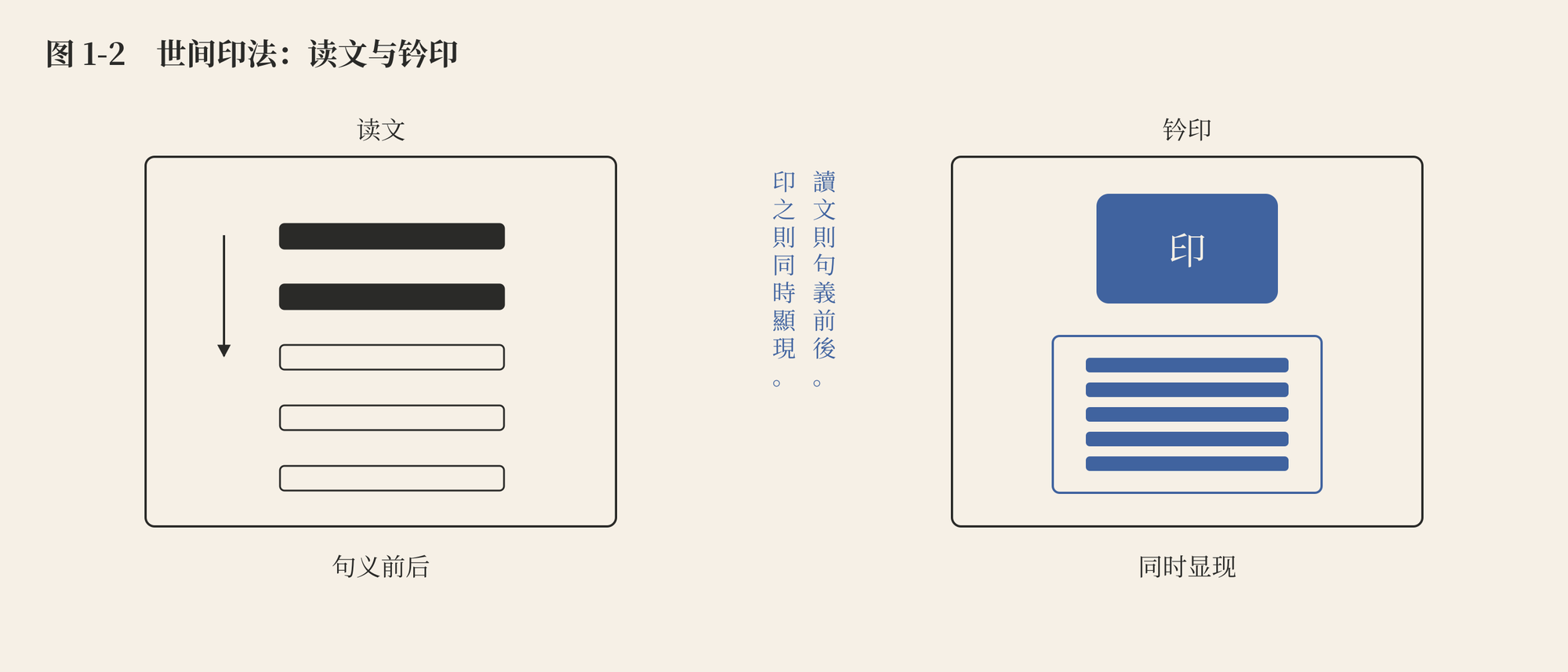
The root teaching that accords with the Dharma, and simultaneous teaching in the ocean-seal samādhi. Beyond classification, the Five Teachings answers a question of time: when was the One Vehicle taught? Its answer is the second seven-day period: “The distinct-teaching One Vehicle was taught beneath the bodhi tree during the second seven days after the Buddha first attained the way, like the rising sun first illuminating the high mountains. In the ocean-seal samādhi he simultaneously expounded the Dharma gates in tens upon tens, with host and companions fully present, perfectly interfused and free.” All Dharma gates, earlier and later, “appeared simultaneously.”3 The rising sun first lighting the high mountains is the standard image for placing the Huayan period first. Tiantai's five periods assign this sūtra to the first three seven-day periods after awakening; Huayan assigns itself to the second seven-day period. The count differs slightly, but both award it first place. Their disagreements concern the ordering of all subsequent periods. Fazang resolves the clash between succession and simultaneity with an analogy: “It is like the ordinary practice of stamping a seal. In reading the inscription, phrases and meanings come before and after; in stamping it, they appear simultaneously. Simultaneity and succession do not conflict in principle.”3 Reading the inscription takes a sequence; stamping takes one impression. Succession in the history of teaching is the reading, and simultaneity in the dharmadhātu is the impression. This seal analogy projects Chapter Three's gate of simultaneous completeness and correspondence onto doctrinal classification; it is also the literal source of the three-character term 海印定, “ocean-seal samādhi.” The three vehicles and the small vehicle are classified as derivative teachings adapted to capacities, with two arrangements allowed: the same time in different places, and different times in different places. Separating the two tracks, accordance with the Dharma and adaptation to capacities, makes the pedagogical parameters of doctrinal classification explicit. Differences among teachings are first of all differences among capacities. This judgment points in the same direction as that in Essay Nineteen, Chapter Six.
We now have a third sample of doctrinal classifications judging one another: the three periods of the Sūtra Unraveling the Deep Intent against the two truths; Tiantai's eight teachings against Jizang's four levels; and now Huayan's five teachings against Tiantai's eight. The overall assessment of the three samples, together with a comparison between the grading axis of the five teachings and this book's tools, awaits Chapter Seven.
References
References
-
Great Expanded Buddha Huayan Sūtra, fascicle seventy-nine, chapter on entering the dharmadhātu (T10, no. 279, pp. 435a3–b3): “He saw that the tower was vast and immeasurable, like space.” “He also saw within it immeasurable hundreds of thousands of wondrous towers, each adorned as described above; all were vast, magnificent, and beautiful like space, neither obstructing one another nor becoming confused. In one place the youth Sudhana saw all places, and he saw every place in this same way.” “Through the majestic spiritual power of the bodhisattva Maitreya, he saw his own body pervading all the towers.” ↩
-
Treatise on the Divisions of the Teaching and Meaning of the Huayan One Vehicle, fascicle one (T45, no. 1866, pp. 477a20–23, 481b7–9; by Fazang): “The sacred teachings vary in countless ways, but in essentials there are only five: first, the small-vehicle teaching; second, the initial Mahāyāna teaching; third, the final teaching; fourth, the sudden teaching; fifth, the perfect teaching.” “The last is the distinct-teaching One Vehicle.” “This distinct-teaching One Vehicle is distinct from the three vehicles.” “The ox cart bestowed in the open ground outside the realm is the One Vehicle teaching.” ↩↩
-
Treatise on the Divisions of the Teaching and Meaning of the Huayan One Vehicle, fascicle one (T45, no. 1866, pp. 481c4–482c5). Conclusion after the Dharma Drum Sūtra analogy: “Explanation: as an incomplete account of the principle of emptiness, it is called the initial teaching. Insofar as it concerns the wondrous scriptures of the permanent tathāgatagarbha, it is called the final teaching.” “Moreover, in the Awakening of Faith, through the gate of the sudden teaching it discloses thusness beyond words; through the gate of the gradual teaching it speaks of thusness through words. Within this dependence on words, the initial and final teachings speak respectively of the two kinds of thusness, empty and nonempty.” Combining and dividing the five teachings: “First, they may be combined as one: root and derivatives interfuse into a single great skillful means. Second, they may be divided into two: one, the root teaching, since the distinct-teaching One Vehicle is the root of all teachings; two, the derivative teachings, namely the small vehicle and the three vehicles, since they flow from it … Fifth, they may be distributed into five.” “Spread the great net of teaching in the sea of birth and death; scoop out the fish of humans and gods and place them on the shore of nirvāṇa.” The root teaching that accords with the Dharma: “The distinct-teaching One Vehicle was taught beneath the bodhi tree during the second seven days after the Buddha first attained the way … In the ocean-seal samādhi he simultaneously expounded the Dharma gates in tens upon tens, with host and companions fully present, perfectly interfused and free … They all appeared simultaneously.” The seal analogy: “It is like the ordinary practice of stamping a seal. In reading the inscription, phrases and meanings come before and after; in stamping it, they appear simultaneously. Simultaneity and succession do not conflict in principle. Know that the principle here is also like this.” ↩↩↩↩↩↩
-
Treatise on the Divisions of the Teaching and Meaning of the Huayan One Vehicle, fascicle one (T45, no. 1866, pp. 481c10–482a11): “Second, distinguishing positions by principle, there are ten positions. One: self and dharmas both exist. This has two divisions: first, the human and celestial vehicles; second, the small vehicle. Within the small vehicle, the Vātsīputrīyas and others … also establish five stores of dharmas: first, past; second, future; third, present; fourth, unconditioned; fifth, inexpressible. This is precisely the self, since it cannot be said to be conditioned or unconditioned. Two: dharmas exist, the self does not. This refers to the Sarvāstivādins and others … Or all are comprised under four: the three times and the unconditioned … Thus all dharmas really exist. Three: dharmas have no past or future. This refers to the Mahāsāṃghikas and others, who say that the present and unconditioned dharmas exist, because past and future have neither substance nor function. Four: the present includes both provisional and real. This refers to the Prajñaptivādins and others. They say that there is no past or future, and that dharmas in the present may be real as aggregates but are provisional as elements and bases. Provisionality and reality vary with the case. The Satyasiddhi and particular Sautrāntika teachers also belong to this category. Five: the conventional is false, the ultimate real. This refers to the Lokottaravādins and others. Conventional things are all provisional because they are false; supramundane dharmas are all real because they are not false. Six: dharmas are only names. This refers to the Ekavyavahārikas and others. All selves and dharmas are merely provisional names, having no substance at all. Understand that this extends to the beginning of the initial teaching. Seven: all dharmas are empty. This refers to the initial Mahāyāna teaching, which says that all dharmas are truly empty. Eight: real virtues are nonempty. As in the scriptures of the final teaching, all dharmas are said to be solely thusness, because of the real virtues of the tathāgatagarbha, because it has its own substance, and because it possesses the virtues of its nature. Nine: characteristics and thought both cease. As in the sudden teaching's disclosure of principle beyond words, and as Vimalakīrti discloses through silence. Ten: perfect illumination endowed with virtues. These are the Dharma gates disclosed by the distinct-teaching One Vehicle, with host and companions fully present, inexhaustible and free.” ↩