Chapter Two Dharmadhātu Dependent Origination: The Four Dharmadhātus
Huayan's central apparatus is called dharmadhātu dependent origination. Set the forms of dependent origination in the earlier essays alongside one another. Dependent origination through karmic response explains transmigration through the chain of karma and its results: the territory of Essays Thirteen and Fifteen. Ālaya dependent origination explains the mechanism through a storehouse and seeds: the territory of Essay Twenty. Dharmadhātu dependent origination starts with no single causal chain. It declares directly that all dharmas dependently originate through one another: one is all, layer upon inexhaustible layer. Later doctrinal classifications arrange these as a three-step ladder. This essay will assess that ladder; first note the structural difference. The first two forms each have a starting point and a bearer. Dharmadhātu dependent origination removes the starting point: the entire network is the bearer.
Listing the four dharmadhātus, and the two glosses of dhātu. The four dharmadhātus map this apparatus. Chengguan's Mystic Mirror of the Dharmadhātu opens with the list: “The aspects of the dharmadhātu are essentially only three, yet comprise four kinds in all: first, the dharmadhātu of phenomena; second, the dharmadhātu of principle; third, the dharmadhātu of nonobstruction between principle and phenomena; fourth, the dharmadhātu of nonobstruction among phenomena.”1 These correspond to Dushun's threefold gates of contemplation, listed at the beginning of the annotated text as “first, the gate of true emptiness,” “second, the gate of nonobstruction between principle and phenomena,” and “third, the gate of pervasive containment.” The Mystic Mirror gives the corresponding contemplations: “First, contemplation of true emptiness; second, contemplation of nonobstruction between principle and phenomena; third, contemplation of pervasive containment.”2 There are only three contemplations but four dharmadhātus. The Mystic Mirror explains why: “The dharmadhātu of phenomena is difficult to set out in all its separate details. Each phenomenal aspect can become a contemplation, so these are omitted. Together they constitute the basis on which the three contemplations depend.”1 There are too many phenomenal aspects to exhaust by setting up a contemplation for each, so the entire dharmadhātu of phenomena takes the supporting position. It is accompanied by a list of ten pairs: teaching and meaning, principle and phenomena, object and wisdom, practice and stage, cause and result, environment and embodied being, substance and function, person and dharma, adversity and accord, stimulus and response. Every phenomenon constitutes a proper basis for the three contemplations.
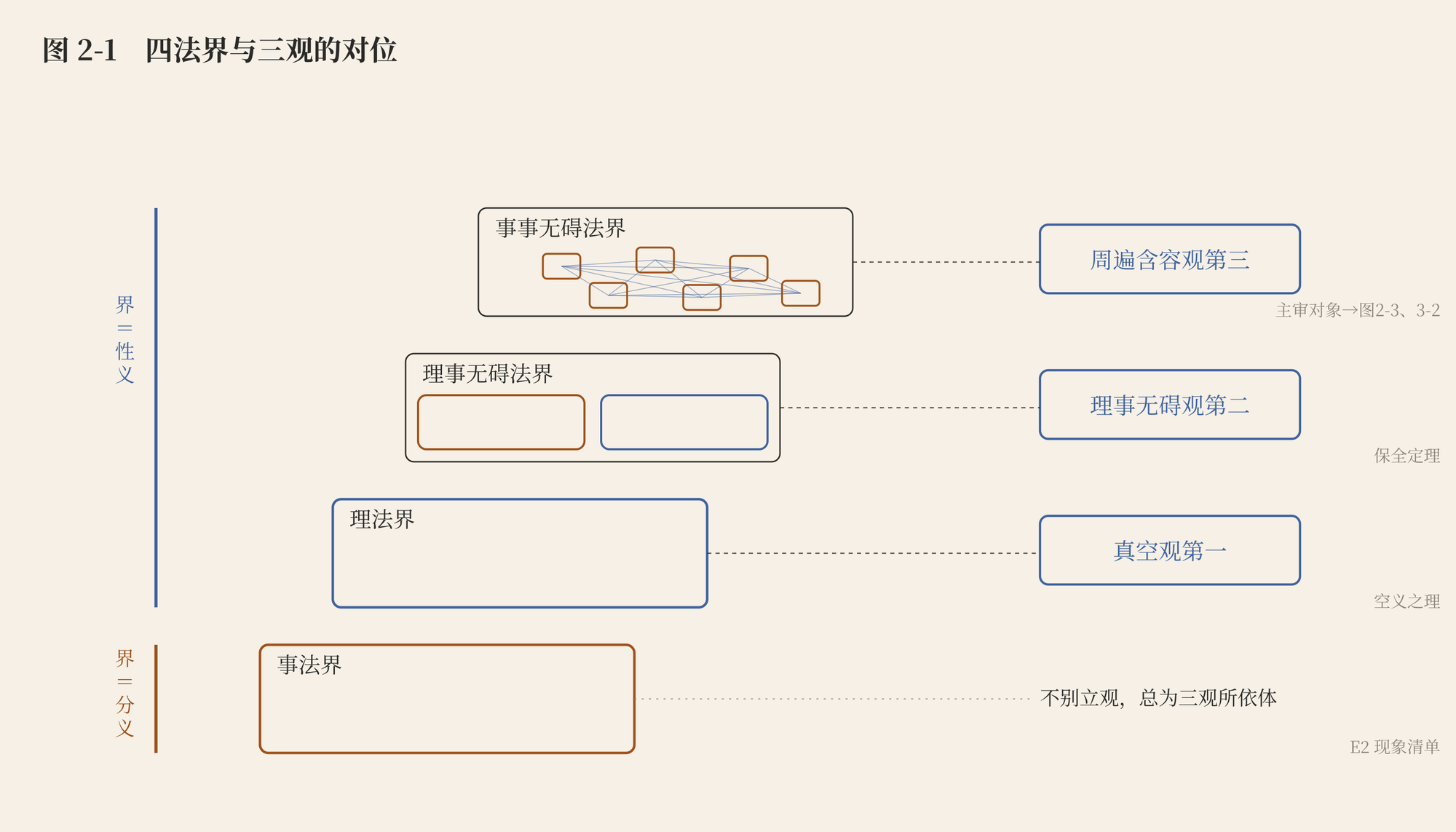
The word dhātu, 界, is itself divided into two glosses: “When phenomenal dharmas are called a dhātu, dhātu means division, since they have the differentiated limits of inexhaustible distinctions. When the dharma of principle is called a dhātu, dhātu means nature, since inexhaustible phenomenal dharmas share one nature. The dharmadhātus of nonobstruction contain both meanings, nature and division.”1 In the dharmadhātu of phenomena, dhātu marks boundaries, overseeing the registration of individuation. In the dharmadhātu of principle, it marks shared nature, overseeing unification at the level of rules. One word does two jobs. Nonobstruction in the third and fourth dharmadhātus means that neither job cancels the other. The ladder of four dharmadhātus rests on a single word's dual gloss: the map comes with its own instructions.
Contemplation of true emptiness: defenses in four formulations and ten gates. The first contemplation is that of the dharmadhātu of principle. Its text distinguishes four gates: “First, contemplating the convergence of form into emptiness; second, contemplating the disclosure that emptiness is form; third, contemplating nonobstruction between emptiness and form; fourth, contemplating complete effacement with nowhere to rest.”3 The convergence of form into emptiness further divides into four formulations. The first three exclude mistaken conceptions; the fourth discloses the Dharma. The first says: “First, form is not emptiness, because it is emptiness. Why? Because form is not annihilative emptiness, it is not emptiness; because form in its entirety is true emptiness.”3 The very first step refutes annihilative emptiness, in the same direction as the chapter examining the four noble truths. Chengguan summarizes what is excluded: “There are three exclusions: first, identity and separation; second, confused conceptions; third, shape and visible color.” He cites as targets the three confused conceptions of emptiness among bodhisattvas before the grounds, from the Treatise on the Jewel-Nature: “first, that things are empty because they are annihilated”; “second, grasping an emptiness outside form”; “third, taking emptiness to be an existent.”3
The third confusion deserves separate attention. Treating emptiness as an existent, setting emptiness itself up as a thing, is precisely the target of clause (c) in Essay Eighteen. Huayan places it on the list of errors in the introductory lesson, setting its defense before the grounds. Chengguan's comment supplies the criterion: “If there were exhaustion and cessation, there would be arising. Now the empty characteristic of dharmas neither arises nor ceases. How could there be an existent?”3 If emptiness were a thing, it would arise and cease. The empty characteristic neither arises nor ceases, so emptiness is no thing. Chengguan identifies the evidence for his comment in two places. First he cites the Ten Grounds Sūtra: “existent, nondual, inexhaustible” (有不二不盡), the three expressions each excluding one confusion; the two characters 不盡, “inexhaustible,” specifically exclude treating emptiness as an existent. He ends with a familiar Prajñā formula: “Thus Prajñā says: these dharmas' empty characteristic neither arises nor ceases, and so on.”3 The proof that true emptiness is no thing uses paper supplied entirely by Prajñā. This floor was built from Madhyamaka materials in the first place, so the borrowed paper is legitimate building material here. What matters is whether the upper floor can claim exemption from inspection on its strength; Chapter Seven will pursue that account. In the fourth formulation, which discloses the Dharma, Chengguan also assigns true emptiness its place among the three natures: “Being conditionally arisen and without nature is the dependent nature's lack of nature; the true principle of naturelessness is the perfected nature.”3 The principle of true emptiness is the principle of naturelessness and is the perfected nature. This belongs to the same comparison table as the three natures in Essay Twenty and their application in the Golden Lion in Chapter Six. From the entrance onward, the principle of the contemplation of true emptiness is registered under naturelessness.
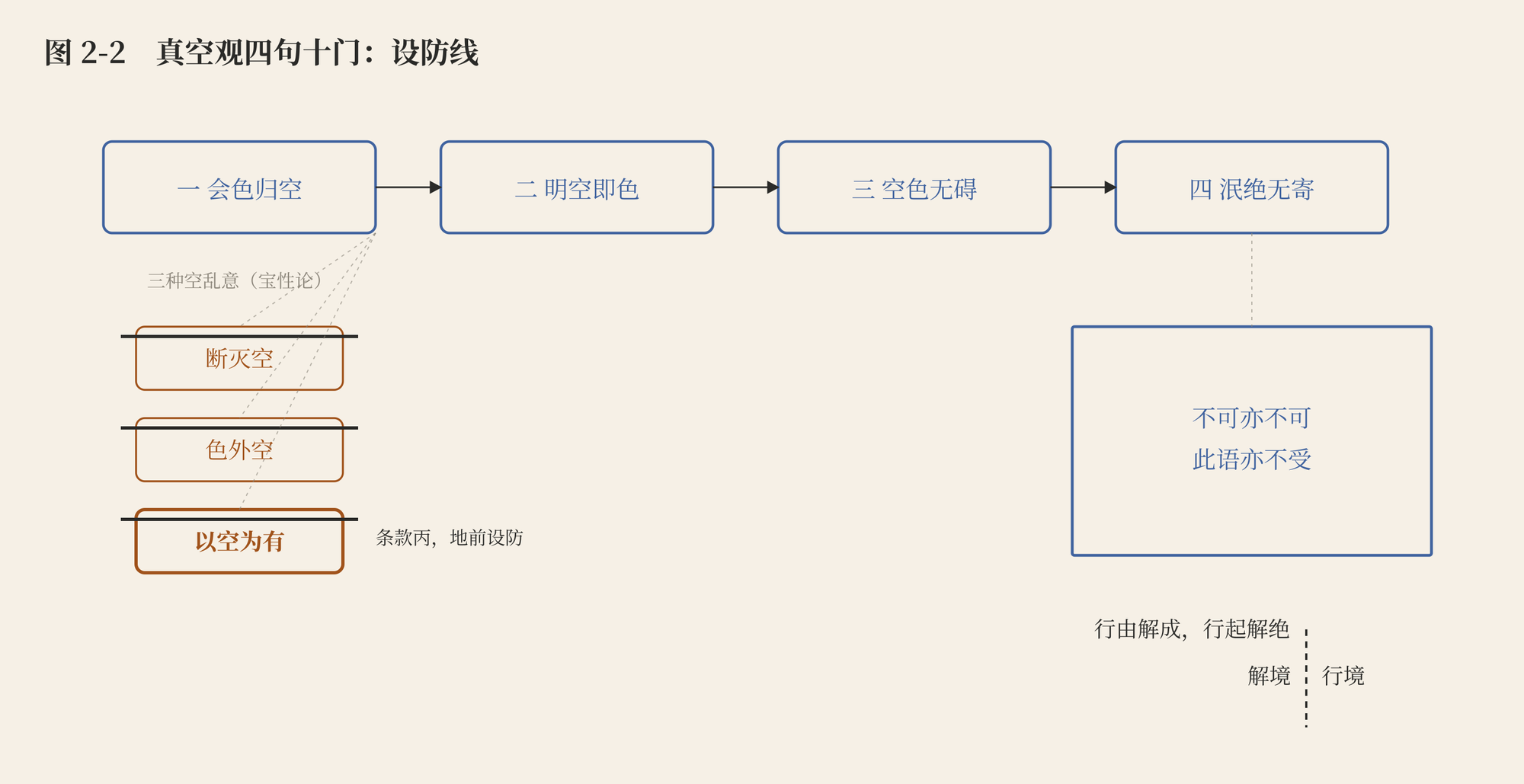
The fourth gate, complete effacement with nowhere to rest, is the weightiest passage in the entire contemplation: “Of the true emptiness contemplated here, one cannot say that it is form or is not form; nor can one say that it is emptiness or is not emptiness. No formulation of any dharma is admissible. Even inadmissibility is inadmissible; even this statement is not accepted. Utterly cut off, with nowhere to rest, it is beyond the reach of words and beyond the attainment of understanding. This is called the domain of practice. Why? Because generating a mental act or stirring a thought departs from the substance of the Dharma and loses right mindfulness.”3 Even inadmissibility is inadmissible; even this statement is not accepted. Negation itself enters the scope of negation: a contemplative rehearsal of the section on emptiness being empty in Essay Eighteen, Chapter Five. The crucial point comes in the second half. The end of speech is registered as the domain of practice. The text immediately sets out the arrangement of understanding and practice: “If one clings to understanding without relinquishing it, one cannot enter this right practice. Thus practice is accomplished through understanding; when practice arises, understanding ends.”3 The first three formulations and eight gates exclude mistaken conceptions and disclose understanding; the fourth formulation properly establishes practice itself. What is placed at the unsayable point is a technical position in practice, not a higher domain of objects. This provides a positive instance of the criterion of resistance to reformulation: the text itself says “beyond the reach of words,” while confining that statement within the division of labor between understanding and practice. It does not use it as a metaphysical exemption from inspection.
Contemplation of nonobstruction between principle and phenomena: a relational algebra of ten gates in five pairs. The second contemplation states its general plan in one sentence: “The interfusion of principle and phenomena, their persistence and disappearance, opposition and accord, comprises ten gates.”4 The Mystic Mirror groups their names and directions into five pairs: “First, the mutual pervasion of principle and phenomena; second, their mutual formation; third, their mutual displacement; fourth, their mutual identity; fifth, their mutual nonidentity.” Odd-numbered gates view phenomena from principle; even-numbered gates view principle from phenomena.4 The table follows:
| Pair | Phenomena viewed from principle | Principle viewed from phenomena | Water-and-waves analogy |
|---|---|---|---|
| Mutual pervasion | One: principle pervades phenomena | Two: phenomena pervade principle | Water is wholly present in one wave; one wave wholly encompasses water |
| Mutual formation | Three: phenomena are constituted in dependence on principle | Four: phenomena can disclose principle | Water is gathered into waves; arising waves manifest water |
| Mutual displacement | Five: principle displaces phenomena | Six: phenomena can conceal principle | Water remains and waves disappear; motion appears and stillness is hidden |
| Mutual identity | Seven: true principle is phenomena | Eight: phenomenal dharmas are principle | Water is waves; waves are water |
| Mutual nonidentity | Nine: true principle is not phenomena | Ten: phenomenal dharmas are not principle | Water is not waves, because motion and wetness differ |
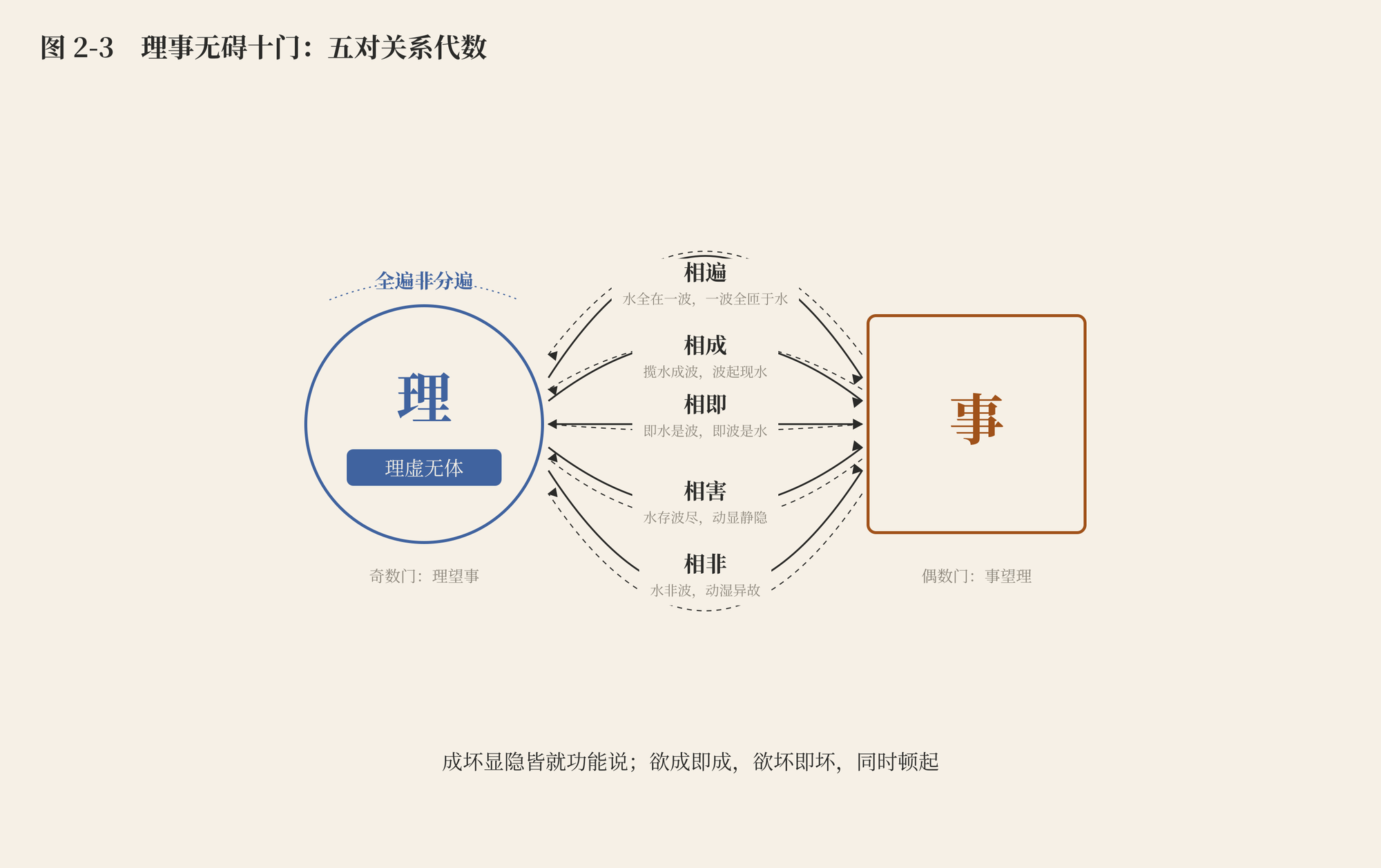
Each of the ten gates offers a passage worth extracting. Principle pervades phenomena: “In every phenomenon, principle pervades in full, not in part … Thus every speck of dust contains boundless true principle, with nothing lacking in its completeness.”4 The two characters 全遍, “pervades in full,” carry exceptional weight. Principle is present in its entirety in every speck. Partial pervasion is excluded, “because that true principle cannot be divided.”4 Pause over the wording. All material can be divided; distributing it among places gives each a portion. To declare something indivisible and wholly present everywhere is to declare that it does not obey the arithmetic of material. A rule is precisely such a thing. When a rule applies in one place, the whole rule applies; there is no question of applying half of it. Full rather than partial pervasion is the formal signature of principle occupying the position of a rule, written into the first gate's main text.
The text handles the resulting difficulty through its own questions and answers. When boundless principle-nature wholly pervades one speck, is there still principle in the phenomena outside that speck? “If there is principle outside the speck, it does not wholly pervade one speck. If there is no principle outside the speck, it does not wholly pervade all phenomena.”4 Neither answer will do. The text responds by opening four formulations on each side. Viewed from principle: “When its whole substance is in one speck, this does not obstruct its whole substance from being in other phenomena. Thus being inside is being outside.” Viewed from phenomena, there are also four formulations, ending: “The first three formulations disclose nondifference from all dharmas. This one formulation discloses nonidentity with all dharmas. Precisely because it is neither identical nor different, inside and outside are unobstructed.”4 Being inside is being outside still relies on the grammar of neither identical nor different. Principle is not different from phenomena, so it is wholly present wherever they are; it is not identical, so being present somewhere does not turn it into a portion there. The difficulty arises from an image of material. The answer exchanges that image for one of a rule and its applications, and the four formulations immediately become unobstructed. For principle displacing phenomena, Chengguan cites the chapter on the Tathāgata's appearance: “Even if all sentient beings attained perfect awakening in a single thought, this would be no different from their not attaining perfect awakening. Why? Because bodhi has neither characteristics nor noncharacteristics.”4 Phenomena can conceal principle: “As water becomes waves, motion appears and stillness is hidden. The sūtra says: the Dharma body transmigrating through the five destinies is called sentient beings.”4 For phenomenal dharmas being principle, the text gives its own argument: “Dependently arisen phenomenal dharmas necessarily lack own-nature. Lacking own-nature, they are wholly the true. Thus it is said that sentient beings are thusness without awaiting cessation.” Chengguan adds a quotation from the Middle Treatise: “If a dharma arises from conditions, it has no own-nature. If it has no own-nature, how can there be such a dharma?”4 The Madhyamaka lever goes to work unchanged in the eighth gate. Sentient beings being thusness without awaiting cessation has the same syntax as the noncessation side of Essay Eighteen's preservation theorem.
Each of the five operations runs in both directions over the same pair of terms. The text also explicitly declares their simultaneity: “When formation is intended, it forms; when destruction is intended, it is destroyed … Formation does not obstruct destruction, and destruction does not obstruct formation … The very time of formation is the time of destruction, and so on; hence ‘simultaneous.’ The five pairs have no before and after; hence ‘arising at once.’”4 Formation and destruction are simultaneous. Their assigned jobs resolve the apparent contradiction. The Mystic Mirror explains: “Formation, destruction, and so forth are spoken of in terms of function. To say that there is formation means that principle can constitute phenomena, not that principle itself is constituted.”4 Formation and destruction, identity and separation, disclosure and concealment, sameness and difference: all are functional predicates. The same continuum is registered differently according to the question asked. The five pairs are five modes of registration, structurally parallel to Essay Eighteen's treatment of the two truths as levels of assertion. The conclusion identifies the character of dependent origination: “Of the five, the first four disclose that phenomena and principle are inseparable; the last discloses that they are not identical. Only nonidentity together with inseparability is the character of dependent origination.”4
One statement among the ten gates deserves to stand alone. In the seventh gate, true principle is phenomena: “Phenomena necessarily depend on principle, because principle is empty and has no substance. Thus only when this principle is wholly phenomena is it true principle.”4 The four characters 理虛無體, “principle is empty and has no substance,” come from the Gates of Contemplation itself: another clause against own-nature written by Huayan's own legislators. The principle of nonobstruction between principle and phenomena is itself empty and substanceless; it is realized entirely by being wholly phenomena. A principle without substance cannot serve as an E3 foundation. The substrate reading has nowhere to gain a foothold in these four characters. Set beside the two meanings without two substances in Chapter Five and thusness not holding to own-nature in Chapter Six, this family now has three members. They guard the three openings most liable to reification: principle, thusness, and the gold analogy. Principle's job is thereby fixed at the position of a rule, on two concurrent grounds. Full rather than partial pervasion is its formal signature; emptiness and lack of substance are its explicit self-description. The criterion from Essay Eighteen, Chapter Seven—that what says nothing of an object yet cannot be discarded is a rule—can be checked gate by gate. Every gate uses principle; none calls it a thing.
Contemplation of pervasive containment: the mechanism generating nonobstruction among phenomena. The third contemplation is that of the dharmadhātu of nonobstruction among phenomena. Its general statement reads: “Phenomena, like principle, interfuse, pervade, and contain without obstruction, freely intermingling. Ten gates are briefly distinguished.”5 Chengguan explains the title through two meanings of space: being everywhere gives the meaning of pervasion; containing so that nothing is outside gives the meaning of containment.5 The ten gates are: principle is like phenomena; phenomena are like principle; nonobstruction as phenomena contain principle and phenomena; nonobstruction between universality and particularity; nonobstruction between breadth and narrowness; nonobstruction between pervasion and containment; nonobstruction between inclusion and entry; nonobstruction in interconnection; nonobstruction in mutual presence; and nonobstruction in universal interfusion.
The generating mechanism lies in the first two gates. Principle is like phenomena: “There are no separate phenomena; principle in its entirety is phenomena. Thus although bodhisattvas look at phenomena, this is contemplation of principle.”5 Phenomena are like principle: “Because phenomenal dharmas are not different from principle, phenomena follow principle in pervading completely, so that a single speck pervades the dharmadhātu.”5 The mechanism can be stated in one sentence: phenomena are not different from principle, so they pervade as principle does; all phenomena are alike in being like one principle, so they are mutually present and mutually contain one another. Phenomena obstruct one another in themselves; what can be transmitted is their pervasion in likeness to principle. Every step deriving nonobstruction among phenomena goes by way of principle. The third gate unfolds containment into four formulations: “One: one within one. Two: one within all. Three: all within one. Four: all within all.”5 The interweaving of one and many is apportioned according to nonidentity and nondifference from principle: because of nonidentity, a phenomenon has a body that can contain; because of nondifference, it follows principle in entering others. In the sixth gate, pervasion and containment, Chengguan explains through an array of mirrors: “When one mirror pervades nine mirrors, it also contains those nine mirrors within itself.”5 Here is the precursor of the ten mysteries' Indra's-net analogy: mirrors reflect one another, and pervasion is containment.
After the tenth gate, universal interfusion, the Mystic Mirror states the genealogy explicitly. The tenth is the gate of simultaneous completeness and correspondence; the ninth is the gate of the realm of Indra's net. After matching them one by one, it concludes: “Thus the ten mysteries also emerge from these.”5 Chengguan derives every item in the ten mysteries from the ten gates of pervasive containment. This statement provides the sign over the next chapter's entrance. The ten mysteries are the operating rules of the fourth dharmadhātu, and the text itself identifies their source.
Structural reading. The first three levels can almost be translated point for point into Essay Eighteen. The dharmadhātu of phenomena is the inventory of phenomena at E2, together with the table of ten pairs of supporting bases. Principle in the dharmadhātu of principle is the principle of emptiness. The Mystic Mirror explains true emptiness: “True emptiness is not annihilative emptiness, nor emptiness apart from form.” It discloses emptiness in what exists.1 These two negations are the Huayan version of the section on reversing reductio in Essay Eighteen. Emptiness is not annihilation, and the defense points in the same direction as the chapter examining the four noble truths. The four formulations and ten gates of true-emptiness contemplation turn the rejection and preservation sides into contemplation. Excluding annihilative emptiness is the introductory lesson on preservation; excluding emptiness as an existent is the introductory lesson on clause (c); complete effacement with nowhere to rest rehearses reflexive immunity. Nonobstruction between principle and phenomena—“principle has no form or characteristic and is wholly within characteristics”1—means that neither obstructs the other: Huayan's statement of the preservation theorem. The ten gates in five pairs turn mutual noninjury into a procedure at each gate, supporting the entire level. Up to this point Huayan has restated in its own language what this book has already proved, and has done something beyond restatement: it has divided the theorem into a sequence of practicable contemplations.
The fourth level is its own. Nonobstruction among phenomena: phenomena directly enter relations of interidentity and interpenetration, each jewel containing every other, layer upon inexhaustible layer. This is Huayan's distinctive offer to Buddhist philosophy and the principal object of this essay's examination. We have seen its generating mechanism: transmission goes by way of principle, so the status of the fourth level depends on the status of principle. If principle is a rule, nonobstruction among phenomena maximizes relational construction at E2, with every step compliant. If principle is read as a substrate, the entire fourth dharmadhātu inherits the full old case against D2, with an additional burden: it magnifies the substrate's efficacy to encompass the whole network. The original Gates of Contemplation bars that reading with “principle is empty and has no substance.” The status of principle in the dharmadhātu of principle is recorded here for consideration alongside nature-arising in Chapters Five and Seven. The operating rules lie in the ten mysterious gates, which the next chapter develops.
Draft verdict: the four dharmadhātus are a map of registration by levels, supplied with instructions in the two glosses of dhātu. True-emptiness contemplation turns the rejection and preservation sides into contemplation, including the introductory defense under clause (c) and the rehearsal of reflexive immunity. “Beyond the reach of words” is placed within the arrangement of understanding and practice, without serving as an exemption from inspection. The ten gates of nonobstruction between principle and phenomena constitute a complete relational algebra between them; formation, destruction, disclosure, and concealment are all functional predicates. Full rather than partial pervasion is the formal signature of principle occupying the position of a rule. “Principle is empty and has no substance” is registered as the third member of the legislators' clauses against own-nature. Pervasive containment is the generating mechanism of nonobstruction among phenomena; Chengguan explicitly states that the ten mysteries emerge from it. Its point of vulnerability follows the status of principle. These findings pass to Chapter Seven.
References
References
-
Mystic Mirror of the Huayan Dharmadhātu, upper fascicle (T45, no. 1883, pp. 672c11–673a2; by Chengguan): “The aspects of the dharmadhātu are essentially only three, yet comprise four kinds in all: first, the dharmadhātu of phenomena; second, the dharmadhātu of principle; third, the dharmadhātu of nonobstruction between principle and phenomena; fourth, the dharmadhātu of nonobstruction among phenomena.” “The dharmadhātu of phenomena is difficult to set out in all its separate details. Each phenomenal aspect can become a contemplation, so these are omitted. Together they constitute the basis on which the three contemplations depend. These phenomena comprise ten pairs in outline: first, teaching and meaning; second, principle and phenomena; third, object and wisdom; fourth, practice and stage; fifth, cause and result; sixth, environment and embodied being; seventh, substance and function; eighth, person and dharma; ninth, adversity and accord; tenth, stimulus and response.” “When phenomenal dharmas are called a dhātu, dhātu means division, since they have the differentiated limits of inexhaustible distinctions. When the dharma of principle is called a dhātu, dhātu means nature, since inexhaustible phenomenal dharmas share one nature. The dharmadhātus of nonobstruction contain both meanings, nature and division.” “True emptiness is not annihilative emptiness, nor emptiness apart from form. It discloses emptiness in what exists, and there is no characteristic of emptiness either; hence it is called true emptiness.” “Principle has no form or characteristic and is wholly within characteristics. Each displaces the other, persisting or disappearing; hence they are called unobstructed.” ↩↩↩↩↩
-
Commentary on the Gates of Contemplation of the Huayan Dharmadhātu (T1884; contemplations established by Dushun, commentary by Zongmi), opening account: “First, the gate of true emptiness”; “second, the gate of nonobstruction between principle and phenomena”; “third, the gate of pervasive containment.” Mystic Mirror of the Huayan Dharmadhātu: “First, contemplation of true emptiness; second, contemplation of nonobstruction between principle and phenomena; third, contemplation of pervasive containment.” ↩
-
Gates of Contemplation of the Huayan Dharmadhātu, contemplation of true emptiness (Dushun; as quoted in the upper fascicle of the Mystic Mirror of the Dharmadhātu, T45, no. 1883, pp. 673a8–675c27): “First, contemplating the convergence of form into emptiness; second, contemplating the disclosure that emptiness is form; third, contemplating nonobstruction between emptiness and form; fourth, contemplating complete effacement with nowhere to rest.” “First, form is not emptiness, because it is emptiness. Why? Because form is not annihilative emptiness, it is not emptiness; because form in its entirety is true emptiness.” Gate of complete effacement with nowhere to rest: “Of the true emptiness contemplated here, one cannot say that it is form or is not form; nor can one say that it is emptiness or is not emptiness. No formulation of any dharma is admissible. Even inadmissibility is inadmissible; even this statement is not accepted. Utterly cut off, with nowhere to rest, it is beyond the reach of words and beyond the attainment of understanding. This is called the domain of practice. Why? Because generating a mental act or stirring a thought departs from the substance of the Dharma and loses right mindfulness.” “If one clings to understanding without relinquishing it, one cannot enter this right practice. Thus practice is accomplished through understanding; when practice arises, understanding ends.” Chengguan's explanations: “There are three exclusions: first, identity and separation; second, confused conceptions; third, shape and visible color.” Three confused conceptions of emptiness, quoted from the Treatise on the Jewel-Nature: “first, that things are empty because they are annihilated”; “second, grasping an emptiness outside form”; “third, taking emptiness to be an existent.” “If there were exhaustion and cessation, there would be arising. Now the empty characteristic of dharmas neither arises nor ceases. How could there be an existent?” “Being conditionally arisen and without nature is the dependent nature's lack of nature; the true principle of naturelessness is the perfected nature.” Chengguan explicitly identifies his evidence in the same passage of the upper fascicle: “Thus the Ten Grounds Sūtra says: existent, nondual, inexhaustible”; “‘existent’ excludes annihilative emptiness; ‘nondual’ excludes explaining emptiness as different from form; ‘inexhaustible’ excludes emptiness as an existent”; “thus Prajñā says: these dharmas' empty characteristic neither arises nor ceases, and so on.” The quoted Prajñā wording occurs in Xuanzang’s Heart Sūtra (T8, no. 251, the paragraph beginning at p. 848c9): “The empty characteristic of these dharmas neither arises nor ceases.” ↩↩↩↩↩↩↩↩
-
Gates of Contemplation of the Huayan Dharmadhātu, contemplation of nonobstruction between principle and phenomena, with the explanations in the upper and lower fascicles of the Mystic Mirror of the Dharmadhātu (T45, no. 1883, pp. 676a10–680a4). Contemplation text: “The interfusion of principle and phenomena, their persistence and disappearance, opposition and accord, comprises ten gates.” Gate one: “In every phenomenon, principle pervades in full, not in part. Why? Because that true principle cannot be divided. Thus every speck of dust contains boundless true principle, with nothing lacking in its completeness.” Questions and answers on dust and principle: “If there is principle outside the speck, it does not wholly pervade one speck. If there is no principle outside the speck, it does not wholly pervade all phenomena.” The four formulations concerning principle: “When its whole substance is in one speck, this does not obstruct its whole substance from being in other phenomena. Thus being inside is being outside.” “The first three formulations disclose nondifference from all dharmas. This one formulation discloses nonidentity with all dharmas. Precisely because it is neither identical nor different, inside and outside are unobstructed.” Gate six: “As water becomes waves, motion appears and stillness is hidden. The sūtra says: the Dharma body transmigrating through the five destinies is called sentient beings.” Gate seven: “True principle can never be outside phenomena, since it is the principle of the selflessness of dharmas. Phenomena necessarily depend on principle, because principle is empty and has no substance. Thus only when this principle is wholly phenomena is it true principle. As water is waves: there is no motion that is not wetness, so water is waves.” Gate eight: “Dependently arisen phenomenal dharmas necessarily lack own-nature. Lacking own-nature, they are wholly the true. Thus it is said that sentient beings are thusness without awaiting cessation.” Chengguan's explanations: “First, the mutual pervasion of principle and phenomena; second, their mutual formation; third, their mutual displacement; fourth, their mutual identity; fifth, their mutual nonidentity.” “Even if all sentient beings attained perfect awakening in a single thought, this would be no different from their not attaining perfect awakening. Why? Because bodhi has neither characteristics nor noncharacteristics” (quoting the chapter on the Tathāgata's appearance). “If a dharma arises from conditions, it has no own-nature. If it has no own-nature, how can there be such a dharma?” (quoting the Middle Treatise). “When formation is intended, it forms; when destruction is intended, it is destroyed … Formation does not obstruct destruction, and destruction does not obstruct formation … The very time of formation is the time of destruction, and so on; hence ‘simultaneous.’ The five pairs have no before and after; hence ‘arising at once.’” “Formation, destruction, and so forth are spoken of in terms of function. To say that there is formation means that principle can constitute phenomena, not that principle itself is constituted.” “Of the five, the first four disclose that phenomena and principle are inseparable; the last discloses that they are not identical. Only nonidentity together with inseparability is the character of dependent origination.” ↩↩↩↩↩↩↩↩↩↩↩↩↩
-
Gates of Contemplation of the Huayan Dharmadhātu, contemplation of pervasive containment, with the explanations in the lower fascicle of the Mystic Mirror of the Dharmadhātu (T45, no. 1883, pp. 680a26–683a12). Contemplation text: “Phenomena, like principle, interfuse, pervade, and contain without obstruction, freely intermingling. Ten gates are briefly distinguished.” Gate one: “There are no separate phenomena; principle in its entirety is phenomena. Thus although bodhisattvas look at phenomena, this is contemplation of principle. Yet these phenomena are said not to be identical with principle.” Gate two: “Because phenomenal dharmas are not different from principle, phenomena follow principle in pervading completely, so that a single speck pervades the dharmadhātu.” The four formulations in gate three: “One: one within one. Two: one within all. Three: all within one. Four: all within all.” Chengguan's explanations: the two meanings of space, pervasion and containment; “when one mirror pervades nine mirrors, it also contains those nine mirrors within itself”; “the tenth gate is the gate of simultaneous completeness and correspondence; the ninth is the gate of the realm of Indra's net … Thus the ten mysteries also emerge from these.” ↩↩↩↩↩↩↩